State of the Cryosphere Report 2024
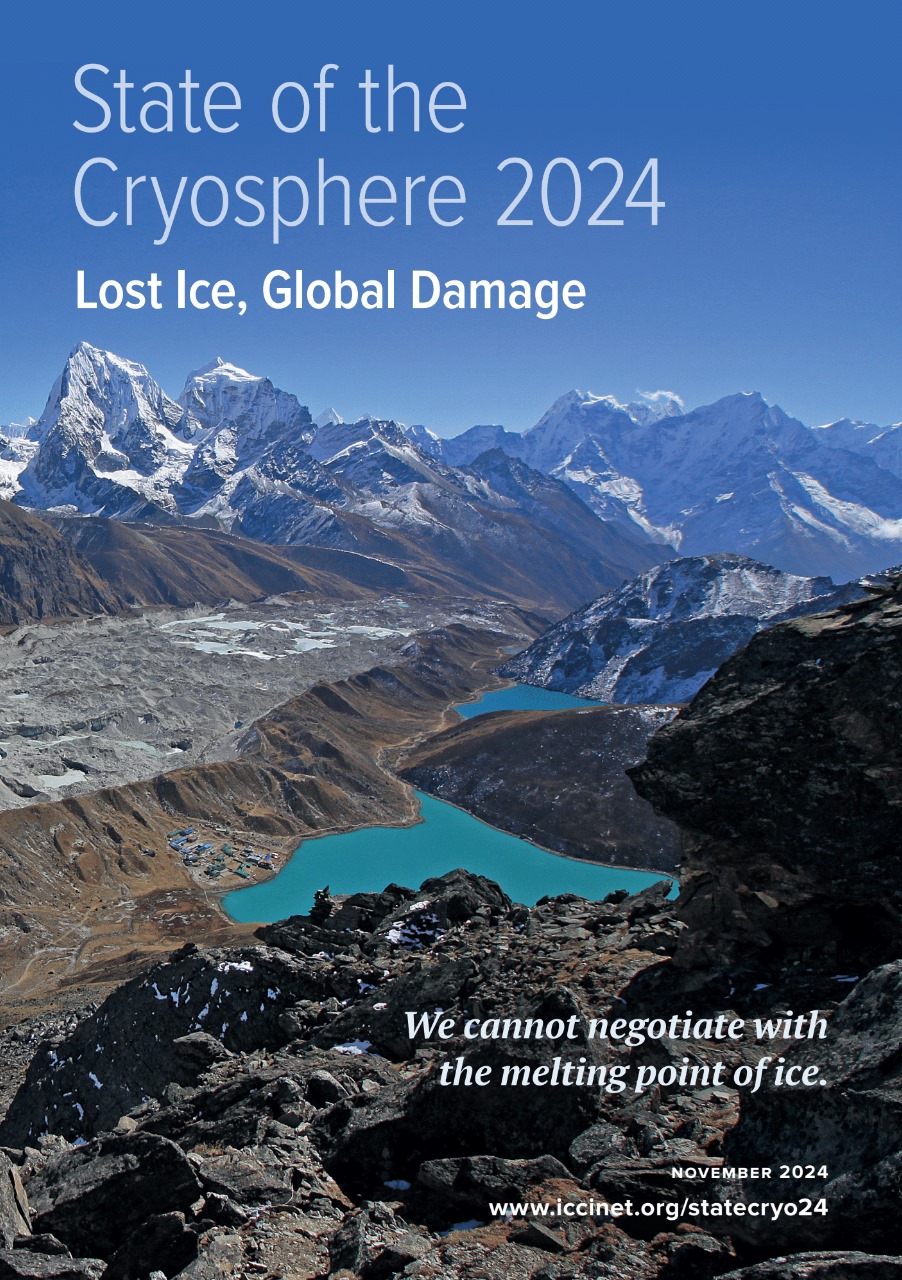
Lost Ice, Global Damage
In the State of the Cryosphere 2024 – Lost Ice, Global Damage report, over 50 leading cryosphere scientists warn of vastly higher impacts and costs to the global economy given accelerating losses in the world’s snow and ice regions. Current climate commitments, leading the world to well over 2°C of warming, would bring disastrous and irreversible consequences for billions of people from global ice loss.
Based on the most recent cryosphere science updates from 2024, the authors underscore that the costs of loss and damage will be even more extreme, with many regions experiencing sea-level rise or water resource loss well beyond adaptation limits in this century if our current level of emissions continues – leading towards a rise of 3°C or more. Mitigation will also become more costly due to feedbacks from thawing permafrost emissions and loss of sea ice.
For the first time, the report notes a growing scientific consensus that melting Greenland and Antarctic ice sheets, among other factors, may be slowing important ocean currents at both poles, with potentially dire consequences for a much colder northern Europe and greater sea-level rise along the U.S. East Coast.
Reviewed and supported by over 50 leading cryosphere scientists, this is the latest report in the State of the Cryosphere series, which takes the pulse of the cryosphere on an annual basis. The cryosphere is the name given to Earth’s snow and ice regions and ranges from ice sheets, glaciers, snow and permafrost to sea ice and the polar oceans – which are acidifying far more rapidly than warmer waters. The report describes how a combination of melting polar ice sheets, vanishing glaciers, and thawing permafrost will have rapid, irreversible, and disastrous impacts worldwide.
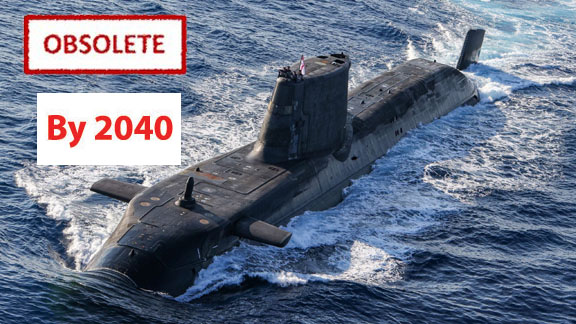
Could AI soon make dozens of billion-dollar nuclear stealth attack submarines more expensive and obsolete?
By Wayne Williams, 5 Jan 25, https://www.techradar.com/pro/could-ai-soon-make-dozens-of-billion-dollar-nuclear-stealth-attack-submarines-more-expensive-and-obsolete
Artificial intelligence can detect undersea movement better than humans.
AI can process far more data from a far more sensors than human operators can ever achieve
But the game of cat-and-mouse means that countermeasures do exist to confuse AI
Increase in compute performance and ubiquity of always-on passive sensors need also be accounted for.
The rise of AI is set to reduce the effectiveness of nuclear stealth attack submarines.
These advanced billion-dollar subs, designed to operate undetected in hostile waters, have long been at the forefront of naval defense. However, AI-driven advancements in sensor technology and data analysis are threatening their covert capabilities, potentially rendering them less effective.
An article by Foreign Policy and IEEE Spectrum now claims AI systems can process vast amounts of data from distributed sensor networks, far surpassing the capabilities of human operators. Quantum sensors, underwater surveillance arrays, and satellite-based imaging now collect detailed environmental data, while AI algorithms can identify even subtle anomalies, such as disturbances caused by submarines. Unlike human analysts, who might overlook minor patterns, AI excels at spotting these tiny shifts, increasing the effectiveness of detection systems.
Game of cat-and-mouse
AI’s increasing role could challenge the stealth of submarines like those in the Virginia-class, which rely on sophisticated engineering to minimize their detectable signatures.
Noise-dampening tiles, vibration-reducing materials, and pump-jet propulsors are designed to evade detection, but AI-enabled networks are increasingly adept at overcoming these methods. The ubiquity of passive sensors and continuous improvements in computational performance are increasing the reach and resolution of these detection systems, creating an environment of heightened transparency in the oceans.
Despite these advances, the game of cat-and-mouse persists, as countermeasures are, inevitably, being developed to outwit AI detection.
These tactics, as explored in the Foreign Policy and IEEE Spectrum piece, include noise-camouflaging techniques that mimic natural marine sounds, deploying uncrewed underwater vehicles (UUVs) to create diversions, and even cyberattacks aimed at corrupting the integrity of AI algorithms. Such methods seek to confuse and overwhelm AI systems, maintaining an edge in undersea warfare.
As AI technology evolves, nations will need to weigh up the escalating costs of nuclear stealth submarines against the potential for their obsolescence. Countermeasures may provide temporary degree of relief, but the increasing prevalence of passive sensors and AI-driven analysis suggests that traditional submarine stealth is likely to face diminishing returns in the long term.
Short nuclear news round-up -week to 5 January 2025

Some bits of good news – 86 Stories of Progress from 2024
A 12-year-old schoolgirl has designed a solar-powered blanket for the homeless. ALSO AT https://nuclear-news.net/2025/01/04/1-a-12-year-old-schoolgirl-has-designed-a-solar-powered-blanket-for-thehomeless/
TOP STORIES
2025, Iran is back in the U.S. crosshairs for regime change.
Japan, US to communicate on possible use of nuclear weapons.
Arms control is essential to prevent the total devastation of nuclear war.
Protect your girls: We show that biological sex IS a factor in radiation outcomes, WIDELY.
JIMMY CARTER: Commemorations by nuke watchdogs
Climate. A snapshot of climate devastation’: Study claims 2024’s biggest climate disasters cost $200bn – ALSO AT https://nuclear-news.net/2025/01/01/2-b1-a-snapshot-of-climate-devastation-study-claims-2024s-biggest-climate-disasters-cost-200bn/ Skiing in France is slowly dying ALSO AT https://nuclear-news.net/2024/12/31/2-b1-skiing-in-france-is-slowly-dying/deal for Ukraine ?
Noel’s notes. Iran and the “right to have nuclear weapons“. Is it realistic for Donald Trump to boast of a quick peace deal for Ukraine?
AUSTRALIA. The $80 billion question buried in Dutton’s nuclear power plan. The Coalition’s coal-keeper plan. Can true nuclear independence be achieved without ending the US Alliance? More Australian nuclear news at https://antinuclear.net/2024/12/31/australian-nuclear-news-30-december-6-june/
NUCLEAR ITEMS
| ECONOMICS. Sizewell C faces calls for more scrutiny of costs ahead of Final Investment Decision. Government urged to review Sizewell C nuclear plant over ballooning cost. Armed with Canadian taxpayer support, AtkinsRéalis and Westinghouse are competing to export nuclear reactors. Which one will prevail? -ALSO AT https://nuclear-news.net/2025/01/04/1-b1-armed-with-canadian-taxpayer-support-atkinsrealis-and-westinghouse-are-competing-to-export-nuclear-reactors-which-one-will-prevail/ |
| ENVIRONMENT. Some Types of Pollution Are More Equal than Others.Radiation is normal at Cesar Chavez Park, but it’s a different story underground, tests show. |
| ETHICS and RELIGION. The Moral Bankruptcy of the West. |
| EVENTS. Petition: Scrutinise Sizewell C |
| HEALTH. Where is the ‘mature debate’ about the health impacts of nuclear power? – ALSO AT https://antinuclear.net/2025/01/03/where-is-the-mature-debate-about-the-health-impacts-of-nuclear-power/ Cellphone radiation warning as researchers reveal new risk factor. |
| MEDIA. Examining Annie Jacobsen’s “Nuclear War: A Scenario”. BBC staffers reveal editor’s ‘entire job’ to whitewash Israeli war crimes. |
| PERSONAL STORIES. Toshiyuki Mimaki: Let’s save humanity from nuclear weapons. One Week in the Carter Presidency: Brokering Peace and a Nuclear Crisis -ALSO AT https://nuclear-news.net/2024/12/31/2-b1-one-week-in-the-carter-presidency-brokering-peace-and-a-nuclear-crisis/ |
| POLITICS.Nuclear power had a strong year in 2024, but uncertainty looms for 2025. No change in Iran’s nuclear doctrine, top security official says. US relaxes green hydrogen rules in race to boost nuclear sector -ALSO AT https://nuclear-news.net/2025/01/04/2-b1-us-relaxes-green-hydrogen-rules-in-race-to-boost-nuclear-sector/ |
| POLITICS INTERNATIONAL and DIPLOMACY. Iran says ready to enter talks soon with the West to agree on a new nuclear deal. Next nuclear talks between Iran and three European countries due on Jan 13.With successful Syrian regime change, will US set sights on Iran regime change 2.0? – https://nuclear-news.net/2024/12/31/2-b1-with-successful-syrian-regime-change-will-us-set-sights-on-iran-regime-change-2-0/ A Trump-Putin Deal Over Ukraine Does Not Look Good for Europe.Can Trump Trump China (or Vice Versa)? |
| RADIATION. Improved way to gauge radiation doses developed for Fukushima, (they studied only 30 people) |
| SAFETY. Incidents. The Time Navy Lt. Jimmy Carter Was Lowered Into A Partially Melted-Down Nuclear Reactor |
| SECRETS and LIES. EU officials will claim ignorance of Israel’s war crimes: a leaked document shows what they knew. |
SPACE. EXPLORATION, WEAPONS. The Quiet Crisis Above: Unveiling the Dark Side of Space Militarization
Departing Air Force Secretary Will Leave Space Weaponry as a Legacy.
TECHNOLOGY. Here comes Yakutia, Russia’s newest nuclear icebreaker.
WASTES. WIPP’s Legacy Transuranic Waste Disposal Plan Demonstrates DOE’s Broken Promises. Decommissioning: Pickering A nuclear power plant bites the dust!
| WAR and CONFLICT. Biden discussed plans to strike Iran nuclear sites if Tehran speeds toward bomb. Syrian minorities under threat as security forces carry out raids against ‘remnants of Assad militias’. |
| WEAPONS and WEAPONS SALES. Trump Wants Greenland to Deploy Medium-Range Missiles Aimed at Russia . US Has Given Israel $22 Billion in Military Aid Since October 2023. Biden spending last month shoveling billions to get more Ukrainians killed for nothing. Biden Administration Announces Nearly $6 Billion in New Ukraine Aid. Canada’s atomic legacy |
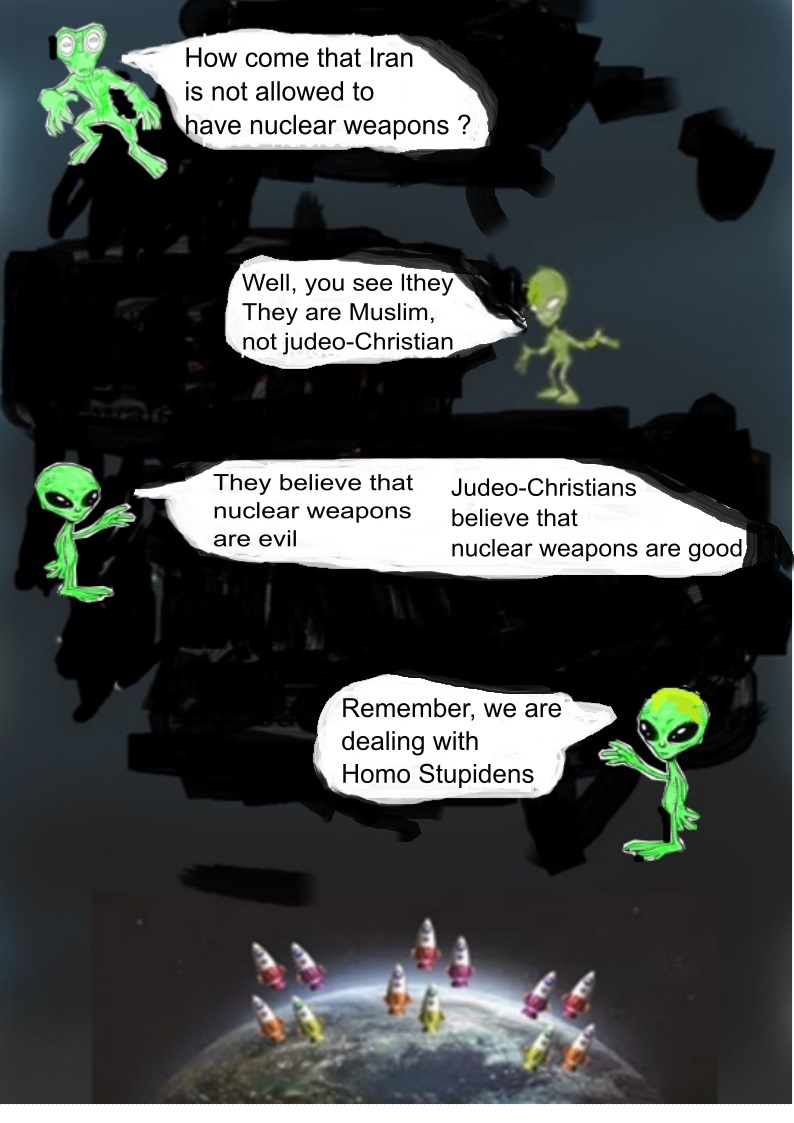
Iran and the “right to have nuclear weapons”
Today we learn that “Biden discussed plans to strike Iran nuclear sites if Tehran speeds toward bomb”. White House national security adviser Jake Sullivan presented President Biden with options for a potential U.S. attack on Iran’s nuclear facilities if the Iranians move towards a nuclear weapon before Jan. 20,
Yeah! Fair enough! I hear many cry.
After all, it’s the wicked dictatorial Muslim state that we’re dealing with, isn’t it?
As against us good Western Christian countries, where the bishops bless both sides in every war, and where it was OK to obliterate with nuclear bombs, 2 Japanese cities .
Yes, we’re so righteous, that our great and exceptional defender of freedom, the United States of America has a quiet unspoken policy that it has the right to a pre-emptive nuclear strike on another country,.
The Islamic Republic of Iran regards use of nuclear and chemical weapons as a cardinal and unforgivable sin- with the fatwa that the production, stockpiling and use of nuclear weapons are forbidden under Islam and that Iran shall never acquire these weapons.
The Judeo-Christian beliefs apparently allow for the wholesale killing of civilians, by nuclear bombing.
Currently the world is witnessing a cruel genocide by Israel, and increasing threats by the Israeli government against Iran. We, the good Christian West, say tut tut about the mass killing of Palestinians, but seem ready to support any militancy against Iran.
What I can’t understand, given the USA’s terrible record of starting wars in faraway places, is why on Earth the USA is accepted as the fount of all goodness – able to decide the rights and wrongs of Iran’s defense and foreign policies?
How is it fair that USA, Russia, UK, France are all OK to have nuclear weapons, but no other countries can? (We frown that North Korea has nuclear weapons, but perhaps USA would have bombed them again, if they didn’t).
The Joint Comprehensive Plan of Action (JCPOA) between Iran and the USA, and endorsed by the UN meant that Iran was banned from transferring, importing, and exporting arms, sensitive nuclear material and equipment. Iran in return got relief from sanctions.
Now that the Israeli government is involved in conflict with other Muslim groups across the Middle East, there is a possibility that Israel will make attacks on Iran’s nuclear sites, even use its nuclear weapons against Iran. With the USA pondering on a pre-emptive strike on Iran’s nuclear sites, before 20 January, is it any wonder that the government in Iran is re-examining its nuclear weapons policy?
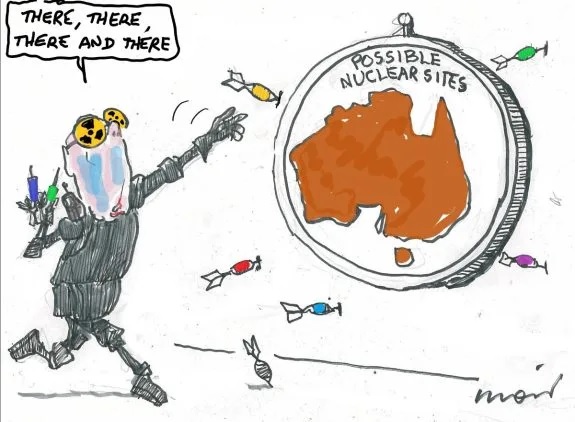
Peter Dutton’s New Clear Vision… Oh, Sorry, Nuclear Fission!
January 5, 2025, first published on March 6, 2024, https://theaimn.net/peter-duttons-new-clear-vision-oh-sorry-nuclear-fission/
Peter Dutton has a vision for our energy future. Personally, I think that’s great. One should have a vision particularly if one is a political leader…
Like Jeff Kennett. Being a Victorian, I clearly remember how Jeff shared his vision of a privatised energy market where choice and the market would bring down prices and lead to the sort of efficiencies that would mean that we could be confident that power prices would be lower but unfortunately it didn’t work out like that. Still, one shouldn’t hold it against him that his vision didn’t work out quite as he described it; one should only get stuck into Labor leaders when they promise that electricity prices will come down by $275 by 2025 even if we’re still in 2024… Or in the case of Tony “Marty McFly” Abbott stuck in the 1950s!
Pete was very clear. The sun doesn’t shine at night, wind turbines at sea are likely to interfere with nature and he’s always been keen on nature, and batteries haven’t been invented yet. Yes, he actually said words to that effect. On the other hand, we can put a small, modular nuclear reactor in lots and lots of places just as soon as someone invents one and we find the several billion dollars to pay for it…
Don’t get me wrong, I think that it’s good that Dutton is thinking long term! Far too often leaders only worry about the short term and I sort of find it inspiring that Peter is so optimistic about the future when any reasonable analysis of the Dunkley by-election would have the party changing leaders before anybody had time to count the numbers.
Let’s elect the new guy from Cook.”
“Simon Kennedy?”
“Yeah. He has to be better and the public don’t know him yet!”
I should point out that the Liberal candidate for Cook hasn’t actually been elected yet, but that didn’t stop News.com.au from declaring him the winner. I mean, I know there’s pressure on to be the first media outlet to declare an election win, but I’m old-fashioned enough to think that we should wait until after the electorate have voted. Still, he did win in spite of the fact that the moderate faction wanted a woman, as did John Howard, but that’s a whole other story. Anyway, he’s a winner because he managed to defeat the moderate faction which shows he should fit in quite nicely in the Canberra party room. And he also defeated John Howard which is pretty easy to do, given he’s the only living PM to lose his seat in a general election.
Of course, Peter Dutton’s new clear fission… sorry nuclear vision… has a few hurdles to get over.
The first is that someone is bound to ask for more detail. Naturally, he can say that we’re just outlining the general idea and we can work out the detail later. This should be enough because, after all, it’s not like the Voice to Parliament because it’s his idea so surely we shouldn’t ask for any more than the broad strokes.
The second is that once he starts to become specific about where to locate the plants, then we’ll undoubtedly see the NIMBYs coming out, and while Dutton supports farmers who don’t want powerlines in their back yard, this is different. It’s sort of like fracking where people should just suck it up… Not the gas. That wouldn’t be good. This problem might be solved by only putting reactor in Labor electorates, but then it makes it hard to win government because they have more electorates than he does.
The third is that, while it’s good to have the vision thing, it doesn’t actually solve the immediate problem. After all, if you’re sleeping in your car, you don’t appreciate being told that the solution to this is a new government initiative where you’ll be trained in building and given a low-cost loan, tools and a free block of land to build your own home, even if it would potentially solve your long term accomodation problem. Similarly, while my solar panels have made me ok with my electricity consumption, I find my gas bill annoyingly high and I’m not going to say, “Nuclear in ten years time. Wow, thanks Pete, I’ll just have cold showers till then, but I hear that’s likely to extend my life… at the very least, it’ll seem longer.”
So let’s have three cheers for Peter:
- One for having a longterm vision
- Two for his optimism in thinking that he’ll be leader by the time the next election comes around. (I’m presuming that News.com.au is right and we already have the winner of Cook. I’m also presuming he lasts that long, so one cheer for me here too!)
- And, finally, for actually being the first Opposition Liberal leader to announce a policy.
All right number 3 may be a little unfair because Tony did have two policies: The first was to undo everything that Labor had done and the second was a rolled, gold paid parental leave scheme.
Whatever. Here we go: Three cheers, hip, hip…
Oh, that’s not very nice. You should be ashamed of yourself.
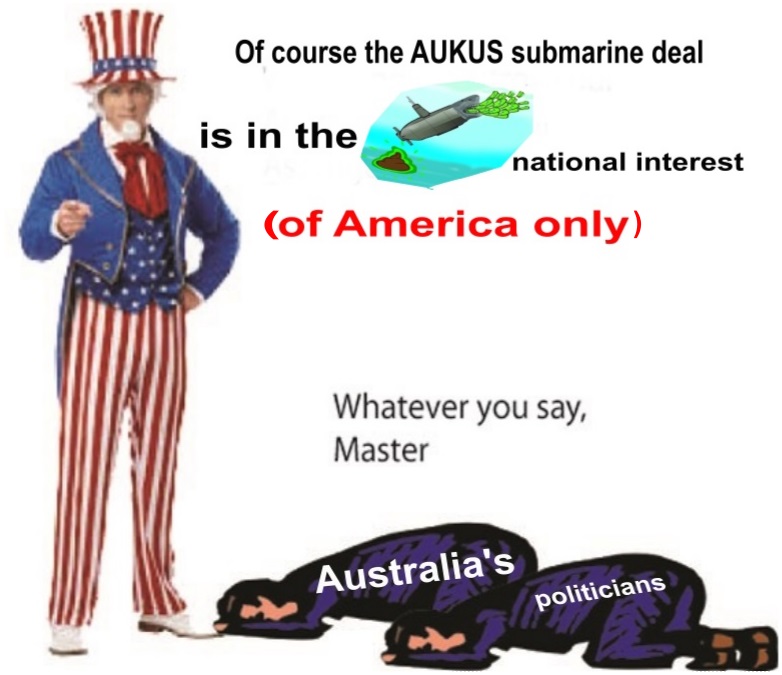
Can true nuclear independence be achieved without ending the US Alliance?
By Donald Wilson, Jan 4, 2025, https://johnmenadue.com/can-true-nuclear-independence-be-achieved-without-ending-the-us-alliance/
Australia’s historical commitment to nuclear disarmament is facing new challenges, as critics say the nation’s alliance with the United States is leading to a conflicted stance on nuclear non-proliferation.
While Australia has actively participated in global nuclear arms control initiatives, such as the Nuclear Non-Proliferation Treaty (NPT) and the Comprehensive Nuclear-Test-Ban Treaty (CTBT), it simultaneously relies on the so-called “US nuclear umbrella” for security. This duality has led to ongoing debate about whether Australia’s security policies align with its disarmament principles.
Australia’s approach to nuclear non-proliferation has shifted over recent years. In 2016, Australia voted against a United Nations General Assembly resolution aimed at creating a legally binding instrument to prohibit nuclear weapons. The following year, it refused to join negotiations that led to the Treaty on the Prohibition of Nuclear Weapons (TPNW). As a result, Australia remains one of the few regional countries not signed onto this treaty, despite a 2018 resolution by the Australian Labor Party to consider joining under a future government.
Critics argue that if Australia were to adopt the TPNW, it would be compelled to prohibit any support for other countries’ nuclear weapons programs—potentially forcing the closure of Pine Gap, a key joint defence facility with the US. Yet government supporters claim that distancing from the US would leave Australia vulnerable, especially amid regional tensions with China.
However, questions have arisen about the reliability of this “nuclear umbrella.” Currently, US military systems, including missile defence, offer limited protection against intercontinental ballistic missiles (ICBMs). After investing over $400 billion in missile defence research and development, no system has yet achieved dependable protection against ICBMs. Critics argue this leaves Australia exposed rather than safeguarded, despite assurances from the US.
In addition, Australia’s recent defence agreements, particularly the AUKUS pact and the US-Australia Force Posture Agreement (FPA), have raised concerns over sovereignty. Signed in 2014, the FPA allows the US to store and control defence equipment on Australian soil. According to Article VII of the agreement, the US retains “exclusive control” over its prepositioned military supplies in Australia, with full ownership rights, effectively restricting Australian authority over the use of these materials.
Article XII of the FPA states that US government vehicles, aircraft, and vessels are exempt from inspection by Australian authorities without US consent. This clause has fuelled arguments that the FPA has compromised Australia’s independence by allowing the US to make defence decisions within Australian borders. For instance, US B2 bombers have launched from Australian bases in operations overseas, reportedly without consulting the Australian public.
As Australia contemplates its nuclear policy, the debate over whether it can maintain both its alliance with the United States and a commitment to nuclear non-proliferation will likely intensify. This complex question has implications not only for Australia’s defence but also for its sovereignty and international standing in the movement toward nuclear disarmament.
UK Labour donor Dale Vince urges ‘rigorous financial scrutiny’ of Sizewell C costs
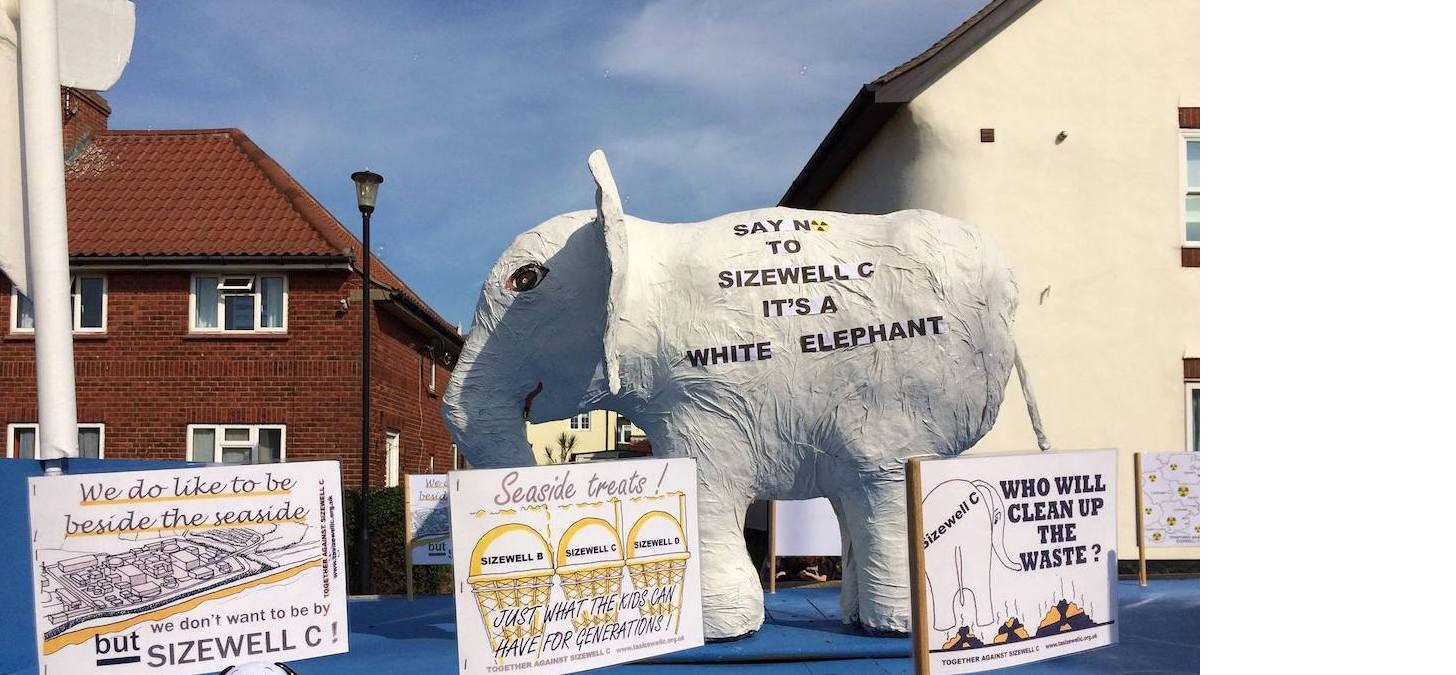
Green energy entrepreneur voices concerns over project’s funding and ‘spiralling costs’ of UK’s other nuclear plants.
Michael Savage , Observer 28th Dec 2024
The government’s new value for money tsar has been challenged to examine the costs of a nuclear power station to be given final approval next year, as ministers attempt to shore up private investment for the project.
New nuclear plants are a key part of the government’s plan to have clean power by 2030. The Sizewell C reactor, billed as generating enough energy to power 6m homes, is expected to be given the final go ahead in June’s review of public spending. Its projected costs are in excess of £20bn.
However, Labour donor and green energy entrepreneur Dale Vince has written to the chair of the governments’ new Office for Value for Money (OVfM), David Goldstone, arguing that a nuclear plant already being built has seen spiralling costs. He also warns the construction of Sizewell C “will saddle consumers with higher bills long before it delivers a single unit of electricity”.
The government and the French state-owned company EDF will fund about 40% of the Sizewell C project, with ministers currently rounding up private investors to meet the rest of the costs. In his letter, Vince claims that billions have already been spent on the project, even “before a final investment decision has been made”. He also raises concerns about the ballooning costs and delays of Sizewell C’s sister project, Hinkley Point C, in Somerset.
“If Hinkley Point C is anything to go by, Sizewell C really should have rigorous financial scrutiny,” he writes. “Originally priced at £18bn, the cost of Hinkley has ballooned to £46bn and then there’s the delays. Back in 2007, the then EDF chief executive Vincent de Rivaz said that by Christmas 2017 we would be using electricity generated from atomic power at Hinkley. We’re now in Christmas 2024 and Hinkley isn’t due to be completed until 2031.
“Due to a novel funding method, a lengthy construction timeline for Sizewell will saddle consumers with higher bills long before it delivers a single unit of electricity at a time when there is clear evidence that we can secure a cleaner, cheaper energy future without nuclear.”
It comes after a similar warning by Citizens Advice earlier this year. The charity warned that the Suffolk project may offer “poor value for money” and called for greater clarity on its funding, in a letter to the Department for Energy Security and Net Zero. It has warned that the project’s funding model could expose households to cost overruns……………………………………… https://www.theguardian.com/business/2024/dec/28/labour-donor-dale-vince-urges-rigorous-financial-scrutiny-of-sizewell-c-costs
The $80 billion question buried in Dutton’s nuclear power plan.

“Companies can go bust, but the nuclear waste is still going to be there. It has to be owned by the government.”
Two elements of the opposition’s nuclear plan are not included in the costings – waste management and public liability for disasters.
Mike Foley, January 3, 2025 , https://www.theage.com.au/politics/federal/the-80-billion-question-buried-in-dutton-s-nuclear-power-plan-20241218-p5kzg9.html
Decommissioning any plants built under the Coalition’s nuclear energy plan could cost more than $80 billion, and taxpayers would have to foot the bill.
Opposition Leader Peter Dutton’s planned seven nuclear plants, with a likely 14 large-scale reactors, would be publicly owned, so taxpayers would be liable for clean-up costs from the radioactive sites and any accidents during operation.
Last month, Britain’s National Audit Office found that the bill to clean up its old nuclear sites, which date back to the 1940s, would be $260 billion.
About $200 billion of this is to decommission Britain’s original Sellafield site for weapons and energy generation, with contaminated buildings and radioactive waste.
Another $48 billion is to decommission eight other nuclear sites, which now range from 36 to 48 years old, at a cost of $6 billion each. They are set to be handed back by a private operator to the government for decommissioning from 2028.
University of NSW energy researcher Mark Diesendorf said international experience showed the cost of decommissioning a nuclear reactor could be roughly in line with its construction cost, which the Coalition has said would be about $9 billion a reactor in Australia.
“For a rough approximation, you’re looking at probably the equivalent of the construction cost,” Diesendorf said.
If the Coalition’s plan to build 14 nuclear reactors by the mid-2040s is realised, the decommissioning bill would be roughly $82 billion to $125 billion in today’s dollars.
Private firm Frontier Economics produced costings of the opposition’s plan that included decommissioning in an overall $331 billion bill to build 14 gigawatts of nuclear generation. However, it is unclear what price was attached to clean-up and whether it is plausible, given Frontier has declined to release the assumptions it used.
Frontier said the government’s policy to boost renewables to nearly 100 per cent of electricity generation by 2050 would cost $595 billion – a figure the federal government has rejected. Labor says nuclear is the most expensive form of new energy generation.
Opposition energy spokesman Ted O’Brien said the Coalition’s plan was cheaper than the government’s renewable energy goals.
“Unlike the Coalition, Labor refuses to calculate the full cost of its plan, such as the decommissioning costs of massive offshore wind projects in the six zones it has identified off the Australian coast,” O’Brien said.
Griffith University Emeritus Professor Ian Lowe said Diesendorf’s assumption that decommissioning a large-scale reactor would cost the same as building it was “sensible”.
“The World Nuclear Association has information about the 25 reactors that have been decommissioned, and the figures vary enormously,” Lowe said.
“The figure of about $6 billion per reactor sounds about the average figure, assuming that there are no complications.”
The opposition has said its nuclear reactors would operate for 80 years, and University of NSW Associate Professor Edward Obbard, a nuclear materials engineer, said it made “perfect sense” for a country to hold the liability for nuclear decommissioning, given the cost and timescale required.
“I don’t think there’s any alternative to the state being responsible for decommissioning a nuclear power program,” Obbard said.
“Companies can go bust, but the nuclear waste is still going to be there. It has to be owned by the government.”
The government could choose to isolate an old nuclear reactor once it reaches its end of life, and leave it alone for several decades until the radioactivity had reduced, he said.
Two elements of the opposition’s nuclear plan are not included in the costings – waste management and public liability for disasters.
Diesendorf and Lowe said public liability in the unlikely event of a nuclear accident could run into the hundreds of billions of dollars, given the $290 billion clean-up bill from Japan’s 2011 Fukushima nuclear disaster.
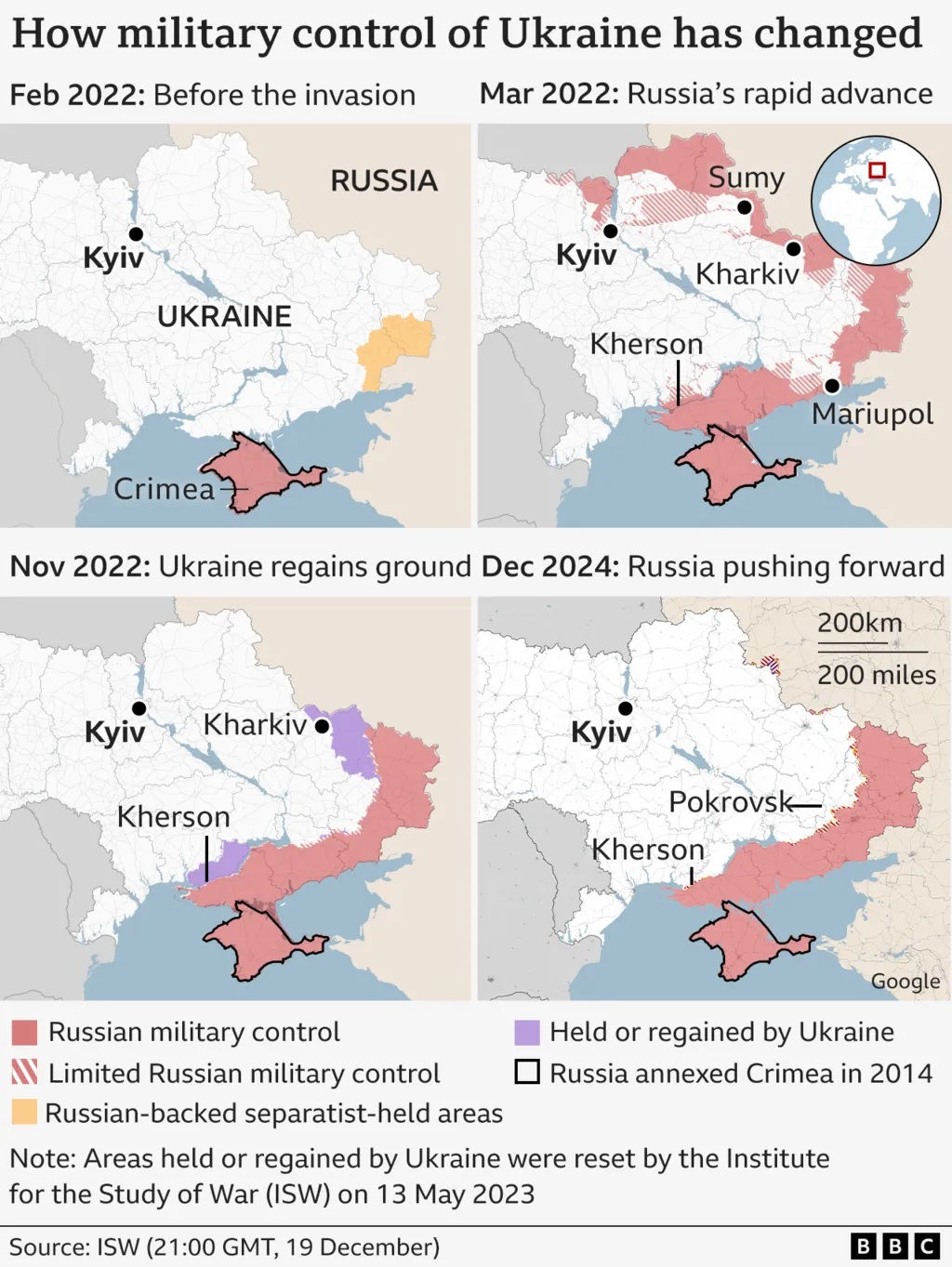
Is it realistic for Donald Trump to boast of a quick peace deal for Ukraine ?
AIMN Editorial, https://theaimn.net/is-it-realistic-for-donald-trump-to-boast-of-a-quick-peace-deal-for-ukraine/ 2 Jan 25
Donald Trump has made so many promises on what he will quickly achieve once he takes office as President. The one about ending the Ukraine war in 24 hours probably gained him support from quite a few normally left-leaning people, who understand that the history of this conflict is far more complicated than is portrayed by the Western media.
However, Trump made that statement in July 2023. By 2025, he has somewhat moderated that particular promise. He has had several conversations with Ukraine’s President Zelensky, . Zelensky praised their Paris meeting on 7 December as “productive and meaningful”, but there were no details discussed. Later, Trump opposed the sending of long-range missiles for Ukraine , but said he would not “abandon” Ukraine. He predicted “less aid” to Ukraine https://www.youtube.com/watch?v=E-R7Gi-uLiY. BY 21st December, it was reported that Trump would continue to supply military aid to Ukraine, provided that NATO members dramatically increase their defence spending.
So, peace in Ukraine is not going to happen in such a hurry, even with President Trump and his supposed great negotiating skills. Britain considers sending troops to Ukraine to train Ukrainian regiments. NATO is not prepared for any compromises, especially about giving up the plan for Ukraine’s NATO membership. With any peace deal, the Western allies agree with Zelensky – “Security guarantees without the US are not sufficient for Ukraine.”
As well as European reluctance to a peace deal, there is the Russian point of view. Despite many set-backs, and a catastrophic loss of soldiers’ lives, Russia is now headed towards winning this war. Why make a deal now, before being in a more powerful position for demanding concessions?
Then we come to the USA. However much Donald Trump might want to end the carnage, and be seen as the peace hero, he is up against significant forces at home – making up what he calls the Deep State. This is a conspiracy theory that helped Trump to gain popularity – and I hate to agree with it, in its rather paranoid theme. BUT, war enthusiasts do exist – among the, military, intelligence, government officials, and wealthy industrialists, and they do exercise influence, and pressure politicians of both parties, to manipulate America’s defense policies. The war in Ukraine continues to be profitable to America’s weapons industries, and at no cost to American lives.

In the whole saga of the war in Ukraine, history has been forgotten. Of course Ukrainian-Russian relations have been tortuous and often terrible. In modern history it goes back to the 1930s, with Stalin’s starvation and genocide of Ukrainians. Then, following oppression from Russia, came in 1941, the short-lived moment of “liberation” by the German Nazis. That brought mass killings of Jews, slave labour, wholesale destruction, and the loss of up to 7 million lives. Russian control over Ukraine returned in 1944, and while the economy was restored, Stalin’s totalitarian rule was back again. In 1991 Ukraine gained independence from Russia.
Is it any wonder that Ukraine, with both Russian and Ukrainian languages still in common use, has been divided in attitudes and loyalties? Going even further back in history, Catherine the Great of Russia, in the 18th Century, made Kiev become Europe’s centre of art and culture, as well as making improvements in health, education, legal rights for Jews, improved conditions for serfs. Sure, she was an absolute monarch, – miles away from being democratic. Now her name and her statues are trashed in Kiev, which is a pity.
From 2014 to 2022, the Ukrainian government waged a war against the separatists in the Eastern, Donbass region. The war was about the 2014-2015 Minsk agreements which meant that the Donbass should have its autonomous government within Ukraine. Volodymyr Zelensky was elected on a platform that he would implement those agreements, but later he reneged on this promise. Russia’s President Putin in 2022 started what he called “a special military exercise” to support the separatists and uphold the Minsk agreement. That turned into the full-scale war against Ukraine.
European and USA support for Ukraine developed into a campaign, at enormous cost, to weaken Russia. The phrase “too big to fail” is used to describe financial crises. But it could apply to the Russia-Ukraine war. From the Western perspective the war is seen as a battle between good and evil – the evil giant Putin against the heroic little Zelensky. With NATO, with most European countries lined up against Russia, it is world democracy to be desperately defended, For Russia, it now is to prevent that last big nation on its border joining that threatening USA-armed line-up.
It was a mistake that Russia started a ‘special military enterprise’ -to evolve into a full-scale war. Some argue that by encouraging Zelensky to reneg on the Minsk agreement, the Western nations provoked the war.
Whatever started the war, the majority of Ukrainians, and especially those in the East, now just want it to end. The prevailing cry of Western leaders – “Putin must fail, Ukraine must prevail” expresses that simplistic view of good versus evil, and just ignores the complicated historic and local concerns of Eastern Ukraine. Diplomacy is jettisoned. As one writer puts it – voices calling for pragmatism and peace remain drowned out by the cacophony of war rhetoric.
Ultimately , every war ends in some sort of a diplomatic outcome. It is doubtful that Trump can make this one end quickly. It might be just one of the promises that he has to give up.
Where is the ‘mature debate’ about the health impacts of nuclear power?

By Margaret Beavis, January 2 2025, Canberra times 2/1/25 https://www.canberratimes.com.au/story/8857513/margaret-beavis-health-risks-near-nuclear-plants-exposed/
When it comes to nuclear radiation, there is a clear disconnect between the medical evidence and the views of the Coalition. Since the 1950s we have known there is a link between X-rays in pregnant women and leukemia and other cancers in their children. It is not for nothing there are signs in every radiology department asking if you are pregnant.
The current shrill denunciations of potential health risks associated with nuclear power plants as a “scare campaign” may yet prove to be an own goal, as it has drawn attention to the issue. Communities considering hosting a nuclear reactor should be aware of the evidence regarding real-world health impacts. Informed consent matters, in politics as well as medicine.
Extra cases of leukaemia occurring in children living near nuclear power plants have caused concern and controversy over decades. In the 1980s excess cases of leukaemia and lymphoma were noticed around the Sellafield nuclear plant in England.
A UK government investigation unexpectedly found that the risks for leukaemia and lymphoma were higher than in the surrounding population. In 2007, the US Department of Energy examined all the reliable data available worldwide, confirming a significant increase in leukaemia for children living near nuclear power plants..
The clearest findings on this subject come from a large national German study from 2008, which examined leukaemia among children living near any of Germany’s 16 operating nuclear plants over a 25-year period.
It showed that the risk of leukaemia more than doubled for children living within 5 km of a nuclear plant. Nuclear proponents quote a UN study with an 80 km radius showing no harm, but the much larger distance dilutes any problems for those living much closer.
Just last June, a very large (over seven million people) meta-analysis of reliable data from a range of studies found residents of any age living 20-30 km from nuclear power stations had an average 5% increased cancer risk, and again children under five were the worst impacted. Thyroid cancer increased by 17 per cent and leukemia by 9 per cent.
For workers in the nuclear industries, there is also clear evidence of increased risk of death from cancer. Indeed, recent findings show even some non-cancer diseases are increased, such as heart attack and stroke.
The best evidence for this comes from INWORKS, a multi-country study of over 300,000 radiation industry workers observed for more than 30 years. Their radiation exposures and health outcomes were carefully monitored and compared with the general population.
The cancers caused by radiation blend in with other cancers – they are not like the characteristic mesothelioma caused by asbestos. The heart attacks and strokes have the same problem. As a result, it takes large population studies and careful long-term monitoring to know what the risks are.
The Coalition has also made claims linking radiology, radiotherapy and nuclear medicine to nuclear power that are patently false and deliberately misleading.
A letter sent by Coalition MPs to their constituents earlier this year claimed that: “Nuclear energy already plays a major role in medicine and healthcare, diagnosing and treating thousands of Australians every day”.
We do not have, and have never had, nuclear power in Australia, and the nuclear power proposal has no connection to our world class nuclear medicine, radiology or radiotherapy services.
Doctors are increasingly concerned about the radiation exposures from medical imaging, particularly in children. CT scans and nuclear medicine scans are done only when essential, and the benefit outweighs the risks. We worry about cumulative lifetime exposures, especially in children.
But perhaps the biggest health issue of all with the Coalition’s proposal is the increased use of coal and gas, for decades to come. Climate change has started, and we have to take action as soon as possible.
From a health perspective, recklessly worsening future heat waves, fires, storms, floods and droughts by delaying the transition from coal for political gain is unconscionable.
Finally, the Coalition’s response to my public submission and testimony to a government inquiry has been to attack me as a past Greens candidate. They neglect to report my qualifications to speak on this.
In playing the man and failing to address the evidence, they fail their own request for an adult conversation on nuclear energy.
Defeated plan to import foreign high-level nuclear waste to South Australia

The main lesson from the dump debate is a positive one: people power can upset the dopey, dangerous ideas driven by political and corporate elites and the Murdoch press. Sometimes. It was particularly heartening that the voices of Aboriginal Traditional Owners were loud and clear and were given great respect by the Citizens’ Jury and by many other South Australians. The Jury’s report said: “There is a lack of Aboriginal consent. We believe that the government should accept that the Elders have said NO and stop ignoring their opinions.”
HOW SOUTH AUSTRALIANS DUMPED A NUCLEAR DUMP

Jim Green, RenewEconomy, 15 June 2017, http://reneweconomy.com.au/south-australians-dumped-nuclear-dump-70197/
Last November, two-thirds of the 350 members of a South Australian-government initiated Citizens’ Jury rejected “under any circumstances” the plan to import vast amounts of high-level nuclear waste from around the world as a money-making venture.
The following week, South Australian (SA) Liberal Party Opposition leader Steven Marshall said that “[Premier] Jay Weatherill’s dream of turning South Australia into a nuclear waste dump is now dead.” Business SA chief Nigel McBride said: “Between the Liberals and the citizens’ jury, the thing is dead.”
And after months of uncertainty, Premier Weatherill has said in the past fortnight that the plan is “dead”, there is “no foreseeable opportunity for this”, and it is “not something that will be progressed by the Labor Party in Government”.
So is the dump dead? The Premier left himself some wriggle room, but the plan is as dead as it possibly can be. If there was some life in the plan, it would be loudly proclaimed by SA’s Murdoch tabloid, The Advertiser. But The Advertiser responded to the Premier’s recent comments ‒ to the death of the dump ‒ with a deafening, deathly silence.
Royal Commission
It has been quite a ride to get to this point. The debate began in February 2015, when the Premier announced that a Royal Commission would be established to investigate commercial options across the nuclear fuel cycle. He appointed a nuclear advocate, former Navy man Kevin Scarce, as Royal Commissioner. Scarce said he would run a “balanced” Royal Commission and appointed four nuclear advocates to his advisory panel, balanced by one critic. Scarce appointed a small army of nuclear advocates to his staff, balanced by no critics.
The final report of the Royal Commission, released in May 2016, was surprisingly downbeat given the multiple levels of pro-nuclear bias. It rejected ‒ on economic grounds ‒ almost all of the proposals it considered: uranium conversion and enrichment, nuclear fuel fabrication, conventional and Generation IV nuclear power reactors, and spent fuel reprocessing.
The only thing left standing (apart from the small and shrinking uranium mining industry) was the plan to import nuclear waste as a commercial venture. Based on commissioned research, the Royal Commission proposed importing 138,000 tonnes of high-level nuclear waste (spent nuclear fuel from power reactors) and 390,000 cubic metres of intermediate-level waste.
The SA Labor government then established a ‘Know Nuclear’ statewide promotional campaign under the guise of ‘consultation’. The government also initiated the Citizens’ Jury.
The first sign that things weren’t going to plan for the government was on 15 October 2016, when 3,000 people participated in a protest against the nuclear dump at Parliament House in Adelaide.
A few weeks later, on November 6, the Citizens’ Jury rejected the nuclear dump plan. Journalist Daniel Wills wrote: “Brutally, jurors cited a lack of trust even in what they had been asked to do and their concerns that consent was being manufactured. Others skewered the Government’s basic competency to get things done, doubting that it could pursue the industry safely and deliver the dump on-budget.”………………………………………
Economic claims exposed
Implausible claims about the potential economic benefits of importing nuclear waste had been discredited by this stage. The claims presented in the Royal Commission’s report were scrutinised by experts from the US-based Nuclear Economics Consulting Group (NECG), commissioned by a Joint Select Committee of the SA Parliament.
The NECG report said the waste import project could be profitable under certain assumptions ‒ but the report then raised serious questions about most of those assumptions. The report noted that the Royal Commission’s economic analysis failed to consider important issues which “have significant serious potential to adversely impact the project and its commercial outcomes”; that assumptions about price were “overly optimistic” in which case “project profitability is seriously at risk”; that the 25% cost contingency for delays and blowouts was likely to be a significant underestimate; and that the assumption the project would capture 50% of the available market had “little support or justification”
The farcical and dishonest engineering of a positive economic case to proceed with the nuclear waste plan was ridiculed by ABC journalist Stephen Long on 8 November 2016: “Would you believe me if I told you the report that the commission has solely relied on was co-authored by the president and vice president of an advocacy group for the development of international nuclear waste facilities?”
The economics report was an inside job, with no second opinion and no peer review ‒ no wonder the Citizens’ Jury was unconvinced and unimpressed.
Prof. Barbara Pocock, an economist at the University of South Australia, said: “All the economists who have replied to the analysis in that report have been critical of the fact that it is a ‘one quote’ situation. We haven’t got a critical analysis, we haven’t got a peer review of the analysis”.
Another South Australian economist, Prof. Richard Blandy from Adelaide University, said: “The forecast profitability of the proposed nuclear dump rests on highly optimistic assumptions. Such a dump could easily lose money instead of being a bonanza.”
The dump is finally dumped
To make its economic case, the Royal Commission assumed that tens of thousands of tonnes of high-level nuclear waste would be imported before work had even begun building a deep underground repository. The state government hosed down concerns about potential economic losses by raising the prospect of customer countries paying for the construction of waste storage and disposal infrastructure in SA.
But late last year, nuclear and energy utilities in Taiwan ‒ seen as one of the most promising potential customer countries ‒ made it clear that they would not pay one cent towards the establishment of storage and disposal infrastructure in SA and they would not consider sending nuclear waste overseas unless and until a repository was built and operational.
By the end of 2016, the nuclear dump plan was very nearly dead, and the Premier’s recent statement that it is “not something that will be progressed by the Labor Party in Government” was the final nail in the coffin. The dump has been dumped.
“Today’s news has come as a relief and is very much welcomed,” said Yankunytjatjara Native Title Aboriginal Corporation Chair and No Dump Alliance spokesperson Karina Lester. “We are glad that Jay has opened his ears and listened to the community of South Australia who have worked hard to be heard on this matter. We know nuclear is not the answer for our lands and people – we have always said NO.”
Narungga man and human rights activist Tauto Sansbury said: “We absolutely welcome Jay Weatherill’s courageous decision for looking after South Australia. It’s a great outcome for all involved.”
Reflections
The idea of Citizens’ Juries would seem, superficially, attractive. But bias is inevitable if the government establishing and funding the Jury process is strongly promoting (or opposing) the issue under question. In the case of the Jury investigating the nuclear waste plan, it backfired quite spectacularly on the government. Citizen Juries will be few and far between for the foreseeable future in Australia. A key lesson for political and corporate elites is that they shouldn’t let any semblance of democracy intrude on their plans.
The role of the Murdoch press needs comment, particularly in regions where the only mass-circulation newspaper is a Murdoch tabloid. No-one would dispute that the NT News has a dumbing-down effect on political and intellectual life in the Northern Territory. Few would doubt that the Courier Mail does the same in Queensland. South Australians need to grapple with the sad truth that its Murdoch tabloids ‒ The Advertiser and the Sunday Mail ‒ are a blight on the state. Their grossly imbalanced and wildly inaccurate coverage of the nuclear dump debate was ‒ with some honourable exceptions ‒ disgraceful. And that disgraceful history goes back decades; for example, a significant plume of radiation dusted Adelaide after one of the British bombs tests in the 1950s but The Advertiser chose not to report it.
The main lesson from the dump debate is a positive one: people power can upset the dopey, dangerous ideas driven by political and corporate elites and the Murdoch press. Sometimes. It was particularly heartening that the voices of Aboriginal Traditional Owners were loud and clear and were given great respect by the Citizens’ Jury and by many other South Australians. The Jury’s report said: “There is a lack of Aboriginal consent. We believe that the government should accept that the Elders have said NO and stop ignoring their opinions.”
Conversely, the most sickening aspect of the debate was the willingness of the Murdoch press and pro-nuclear lobbyists to ignore or trash Aboriginal people opposed to the dump.
Another dump debate
Traditional Owners, environmentalists, church groups, trade unionists and everyone else who contributed to dumping the dump can rest up and celebrate for a moment. But only for a moment. Another dump proposal is very much alive: the federal government’s plan to establish a national nuclear waste dump in SA, either in the Flinders Ranges or on farming land near Kimba, west of Port Augusta.
In May 2016, Adnyamathanha Traditional Owner Regina McKenzie, who lives near the Flinders Ranges site, wrote:
“Last year I was awarded the SA Premier’s Natural Resource Management Award in the category of ‘Aboriginal Leadership − Female’ for working to protect land that is now being threatened with a nuclear waste dump. But Premier Jay Weatherill has been silent since the announcement of six short-listed dump sites last year, three of them in SA.
“Now the Flinders Ranges has been chosen as the preferred site and Mr Weatherill must speak up. The Premier can either support us ‒ just as the SA government supported the Kupa Piti Kungka Tjuta when their land was targeted for a national nuclear waste dump from 1998-2004 ‒ or he can support the federal government’s attack on us by maintaining his silence.”
Perhaps the Premier will find his voice on the federal government’s contentious proposal for a national nuclear waste dump in SA, now that his position on that debate is no longer complicated by the parallel debate about establishing a dump for foreign high-level nuclear waste. He might argue, for example, that affected Traditional Owners should have a right of veto over the establishment of a national nuclear waste dump ‒ precisely the position he adopted in relation to the international high-level waste dump.
Dr Jim Green is the national nuclear campaigner with Friends of the Earth Australia and editor of the Nuclear Monitor newsletter.

Military mansplaining dispels any nonsensical ideas about “the sanctity of space”

Australian Independent Media, 31 Dec 24, https://theaimn.net/military-mansplaining-dispels-any-nonsensical-ideas-about-the-sanctity-of-space/
Doncha love mansplaining? It simplifies everything, takes away your worries, and you can now complacently forget about any silly way-out anxieties that you might have had about technological progress.
As our military defenders develop advanced and artificial intelligence weaponry for war in space , USA Air Force secretary, and former military contractor, Frank Kendall mansplained all this perfectly for us:
Mr. Kendall said when he first came into office, there was an understandable aversion to weaponizing space, but that now the debate about “the sanctity or purity of space” is effectively over.
“Space is a vacuum that surrounds Earth,” Mr. Kendall said. “It’s a place that can be used for military advantage and it is being used for that. We can’t just ignore that on some obscure, esoteric principle that says we shouldn’t put weapons in space and maintain it.
The threat is there. It’s a domain we have to be competitive in.”
One might ponder on where this threat comes from. It seems pretty clear to me that macho military men of one nation, for example the USA, devise killing machines, and then macho men of another nation, for example China, react by devising killer machines. Then the USA men have to go one better and so on. The cleverness of macho men is the original threat.
Of course many men do not have this blinkered macho attitude to exploiting land, sea, and now space, for weaponry that damages no only humans, but other species, and indeed, the whole ecosphere. Unfortunately these many other men are also not so good at confidently mansplaining the ideas that they might have – about caring for the ecosphere, about negotiation as an alternative to war. That takes a lot of hard work, to present those ideas, and they tend to do it in a careful way, rather than talking down to the rest of us..
It is really a lot easier and simpler to decide that becoming the top killer is the way to solve differences: much harder to really think about solving the problems.
The “sanctity and purity of space”. Where did Kendall get that from?
Well, the phrase contains both a religious and environmental significance. Originally from a very spiritual poem – it has caught the imagination of many – as a theme to respect the beauty of the sky, the environment, and our role as custodians of our ecosphere.
This kind of spiritual waffle is anathema to the mansplaining military macho men.
For one thing, it involves some complicated ideas that they probably can’t understand, with their one-track adversarial thinking. To give just one example: light pollution from spacecraft disrupts the lives of not only many tiny species like moths, but also of birds and sea turtles.
Then there are ethical questions – about space vehicles, weapons, debris crashing in various locations, including neutral, uninvolved countries. And, most concerning of all is the newest technology, artificial-intelligence-enhanced fighter jets and space-based warfare. Missile-carrying robot drones with A.I.-enhanced software will be able to independently decide on flying routes, and on identifying and attacking enemy targets. Robots will be able to make decisions on whom to kill.
The phrase that Mr Kendall wanted to discredit comes from a famous poem – High Flight – A Pilot’s Prayer by Pilot Officer John Gillespie Magee, Jr. The author was a religious man, who died at 19, in World War 2. The poem was first read out in a church, right opposite the White House. Written in a romantic style, this poem has inspired many to pond on the writer’s thought:
“with silent, lifting mind I’ve trod The high untrespassed sanctity of space”
I have often thought that art of all kinds does point the way for positive human development, and just phrases like that one from John Gillespie Magee, Jr. can have a powerful influence, No wonder that war-obsessed men are keen to discredit such poems.
If people think of space as a place of beauty, mystery and wonder, they are not likely to be in favour of unrestrained weapons development, and the $215 billion budget overseen by Mr Kendall for ever-advancing weaponry. Whereas if we accept the idea that space is just “a vacuum – a place that can be used for military advantage” , well, the arms race is all OK, and we could be on the way to omnicide.
New Zealand is under siege by the Atlas Network

We have a handful of years to achieve a monumental shift from fossil fuel towards renewable energy: Atlas partners aim to ensure this does not take place.

March 3, 2024, by: Lucy Hamilton, https://theaimn.com/new-zealand-is-under-siege-by-the-atlas-network/—
Just as the Atlas Network-connected Advance body intervened in the Voice referendum in Australia and, in recent weeks, a by-election, similar organisations spawned from the American model are distorting New Zealand’s politics from within as well as from without.
One of the key researchers into the Atlas Network, Lee Fang, observed that it has “reshaped political power in country after country.” In America, every Republican president since Ronald Reagan has begun office with a Roadmap provided by the Heritage Foundation, primary Atlas Network partner. The “Mandate” for 2025 puts America on a hard path to fascism should a Republican win in November. Britain’s economy and standing have been savaged by Atlas partners’ impacts on the Tories. In New Zealand, the recently-elected rightwing coalition government is aping the new “Atlas president” of Argentina, aiming to privatise national assets, but is increasingly also imitating Atlas strategies recently seen in Australia, inflaming racial tensions and harming the wellbeing of Māori people.
Dr Jeremy Walker called Australia’s attention to the local Atlas partner organisations’ impact on the Voice to Parliament referendum and is now helping draw together the focus on the New Zealand partners’ very similar distortion of their national debate. There is a deep racism at the heart of this ultra-free market ideology that has licensed the international right to exploit resources and people around the globe untrammelled, largely in American corporate interest, but more broadly for any corporation or allied sector big enough to be a contender. (They do not, by contrast, fight for the renewable energy sector’s interests, as a competitor to their dominant fossil fuel donors; this shapes their climate crisis denial and delay, and colours their loathing of First People’s capacity to interfere with their profits by environment-driven protest. A sense of Western Civilisation as the apex of human existence and deep disdain for non-Western cultures also pervade the network.)
The Atlas model is to connect and foster talent in the neoliberal sphere. Young men (mostly) are funded or trained to replicate the talking points that Ultra High Net Worth Individuals (UHNWI) and lobbyists have built into a global network of over 500 bodies in 100 nations. The fact that neoliberal orthodoxies are more religious ideology that fact-based theories explains why their impact has been so utterly disastrous everywhere they have reshaped societies. The goal is to spawn replicating bodies with benign-sounding names that promote the UHNWI and corporate talking points – but with a veil hiding the self-interest that is obvious when those groups speak for themselves. Some of the bodies feign being thinktanks, which George Monbiot recently renamed junktanks to clarify their disingenuousness. Others are “astroturf” organisations that pretend to be grass roots bodies representing popular opinion. Another model is the beach-head in universities, an independent organisation within those institutions intended to dignify the neoliberal religion and the chosen strategies, including climate denial. All these produce material to fill civic debate and train more acolytes to enter politics, strategy companies and junktanks. Mainstream media elevates their standing by hosting their operatives as experts without explaining that the benign-sounding organisation to which they belong is a foreign-influence operation’s local outlet.
These groups damage local conditions to favour international corporations. They lobby for the removal of the “regulations” that are actually protections for the public – as workers, as consumers, as residents. They push for the privatisation of national treasures so that (often foreign) corporations can exploit the profits at the expense of the public. The greater the damage to the local democracy, the easier it is for them to act unimpeded. The stronger their infiltration of the media, the harder it is for the local electorate to understand the stakes. The politicians and strategists that emerge from the sphere (or are its allies) know that none of this wins votes, so they fill the space with culture war division to distract the voter from paying attention. Race and sexuality are their most obvious targets, as reactionary nostalgia for a mythical past of white picket fences pervades their ideology: a valorisation of “Christianity” and “family” and the “sacredness of marriage” (preached by adulterous politicians) is equally apparent in their propaganda.
The coalition that took power in NZ late in 2023, after a campaign centred on attacking the country’s founding Waitangi Treaty, has considerable Atlas infiltration. There is concern about Atlas fossil fuel and associated tobacco interests perverting policy in parliament, as well as senior ministerial aides who might be compromised. The government has promised to repeal Jacinda Ardern’s ban on offshore gas and fuel exploration, plans to sell water to private interests, not to mention planning to enable the selling off of “sensitive” NZ land and assets to foreign corporations, just as Argentinian Milei is intending.’
One of the government members, the Act Party, began its existence as an Atlas partner thinktank and continues that close connection. It was founded by former parliamentarian Denis Quigley with two members of the Mont Pelerin Society (MPS), the Atlas Network’s inner sanctum. One, Roger Douglas, was responsible for Rogernomics in NZ which has been described as a “right wing coup” that worked to “dismantle the welfare state.” The other, Alan Gibbs, who has been characterised as the godfather of the party, and a major funder, argued Act ought to campaign for government to privatise “all the schools, all the hospitals and all the roads.” This may not be surprising since he made much of his fortune out of the privatisation of NZ’s telecommunications.
The Act Party is currently led by David Seymour who functions as a co-deputy prime minister in the government. He has worked almost his entire adult life within Atlas partner bodies in Canada and boasts a (micro) MBA dispensed by the Network.
In Seymour’s 2021 Waitangi Day speech, he acknowledged his “old friends at the Atlas Network.” In light of that, his recent disdainful and absolute dismissal of the party’s connection to Atlas in an interview was telling: he clearly felt the association was damaging enough to lie outright.
Seymour is also deeply antagonistic to policies dedicated to repairing the disadvantage suffered by Māori people, disingenuously describing provisions that work cooperatively with Māori people as the “dismantling of democracy.” He appears antagonistic to Māori culture.
Another Atlas partner that has been key to distorting debate in NZ is the Taxpayer Union (TPU) which is emblematic of the production of metastasising bodies central to the Atlas strategy. Its co-founder and executive director is another graduate of the Atlas (micro) MBA program. Jordan Williams (currently “capo di tutti capi” of the Atlas global alliance of anti-tax junktanks) laughably depicts Atlas as a benign “club of like-minded think tanks.” He created, however, a body called the Campaign Company which helped radicalise the established farmer power base in NZ politics, planting sponsored material in the media. Williams claimed to grant the farmers “world-class campaign tools and digital strategies.” He also co-founded the Free Speech Union (FSU), which is unsurprisingly fighting regulation of the damaging impact of internet disinformation as well as fostering culture war battles.
A further spin-off of the bodies illustrates the increasing ugliness of the populist strategies. A former Act Party MP has founded the New Zealand Centre for Political Research which is fomenting civic division against Māori interests, including placing hate-mongering advertisements in the media.
The Act Party (alongside the populist New Zealand First party) is at the heart of the coalition government’s intention to destroy NZ’s admirable efforts to promote Māori interests for the betterment of the commonwealth, including the co-governance innovation. Efforts to undo disadvantage and programs that have promoted the distinctive NZ democratic experiment are set to be dismantled. A “massive unravelling” of Māori rights is at stake.
It is not only Māori people who will suffer. The NZ coalition government is also attempting a kind of “shock therapy” that did so much to tip first Chile and then other “developing” nations into brutal pain in pursuit of market “freedom.” The MPS was at the heart of Pinochet’s neoliberal brutality, resulting from Nixon’s injunction to make the Chilean economy scream.[1] New Zealand now faces cuts to a range of services, welfare and disability payments, even while the new PM, one of NZ’s wealthiest ever holders of the role, charged the taxpayer NZD 52,000 to live in his own property. It’s important to remember that this kind of entitlement is the sort that the neoliberals like, alongside subsidies to industry and corporations.
Lord Hannan (one of Boris Johnson’s elevations to the peerage, and a junktank creature) recently spoke in NZ, welcoming “all the coalition partners around this table” to hear his oration. There he celebrated the small percentage of GDP that NZ’s government spends on its people, cheering on the TPU’s power. He also disdained the “tribalism” that has dictated recognition of First Peoples’ suffering. There is grand (but unsurprising) irony in a graduate of three of Britain’s preeminent educational institutions dictating that humanity’s essential equality is all that can be considered when devising policy, particularly in settler-colonial nations.
Amusingly the weightier debunking of the Atlas connections has come from: Chris Trotter, formerly centre left, now a council member of Williams’ FSU; Eric Crampton, chief economist of the New Zealand Initiative, NZ’s leading Atlas partner and Sean Plunkett whose “anti-woke” vanity media platform, Platform, is plutocrat funded and regularly platforms the NZI talking heads.
While Atlas’s system largely functions to connect and train operatives, as well as acting as an extension of American foreign policy, this modest-seeming program must not be ignored. We have a handful of years to achieve a monumental shift from fossil fuel towards renewable energy: Atlas partners aim to ensure this does not take place.
And Atlas partners will push us at each other’s throats while we procrastinate.
[1] That MPS intervention resulted in massive unemployment, extraordinary inequality, and fire-sale prices of national assets to cronies. Much of Chile’s later success is as likely to be attributable to the trade requirements of (statist) China whose demand for copper has done so much to enrich Chile.
Nuclear power no silver bullet for net zero target
https://www.smh.com.au/national/nsw/nuclear-power-no-silver-bullet-for-net-zero-target-20231229-p5eu7z.html DECEMBER 31, 2023
Thanks to Nick O’Malley and Mike Foley for their comprehensive review of the nuclear power “option” (“Net zero hero or big waste of time that we don’t have on our side?”, December 24). As they explain, nuclear power is too slow and too costly to help Australia meet its 2050 net zero target. As former chief scientist Alan Finkel said in June, “So when put together it’s not realistic, even if we wanted to, to have nuclear in Australia before about 2040, by which time I am quite confident we won’t need it.” The opposition is not strong on science but is better at art – the art of distraction. Ray Peck, Hawthorn
Australian nuclear news 30 December – 6 June.

Headlines as they come in:
- From the archives: -Peter Dutton’s New Clear Vision… Oh, Sorry, Nuclear Fission!
- Can true nuclear independence be achieved without ending the US Alliance?
- The $80 billion question buried in Dutton’s nuclear power plan.
- From the archives: Defeated plan to import foreign high-level nuclear waste to South Australia
- The Coalition’s coal-keeper plan.
- Where is the ‘mature debate’ about the health impacts of nuclear power?
1 This month
To see nuclear-related stories in greater depth and intensity
– go to https://nuclearinformation.wordpress.com/


 Antinuclear