Angus Taylor, Energy Minister – incompetent and ignorant – SO – VOTE HIM OUT

campaign gathers momentum

Kazzi Jai No nuclear waste dump anywhere in South Australia, 4 May 21
maybe we should start a campaign…. for the Federal Election coming ….with t-shirts which say VOTE RAMSEY OUT!Idea taken from this Bulletin article! ·
CAMPAIGN TO OUST ANGUS TAYLOR GATHERS MOMENTUM
The successful campaign to remove former Liberal prime minister Tony Abbott from his Warringah seat during the 2019 Federal Election is being replicated in other electorates.
A 30-year-old pilot from Thirlmere in the Hume electorate’s north-eastern corner – who has avoided politics until now – is behind the grassroots independent movement to oust his Liberal member and the Minister for Energy, Angus Taylor.
Alex Murphy followed the Vote Tony Out campaign and wondered why there wasn’t similar action to remove Mr Taylor.He set about canvassing local voters in 2020 through the Voices of Hume group. He found others were unhappy with the MP’s energy, climate and emissions reduction policies and involvement in the GrassGate, WaterGate and Clover Moore controversies.
Within three months, the campaign has attracted 350 subscribers and gained momentum by selling T-shirts, face masks and tote bags through social media, emails and meetings.
Its first meeting in Wollondilly on 17 April attracted between 50 and 60 people. The next Vote Angus Out meeting is scheduled for 30 May in Goulburn.
Vote Angus Out campaigners are mostly farmers and retirees who disapprove of many of the MP’s decisions, including his support for fracking on farmland and lack of support for the dairy industry, increasing the age pension and encouraging Australian-based industry.
”He’s there to represent the gas and oil industries first and foremost,” Mr Murphy said.
Mr Murphy believes there is more support for Mr Taylor’s removal, assuming retirees only represent the campaign’s demographic because they have more time on their hands.He also bases subscriber numbers on social media follows and email opens. However, if retirees are the true campaign demographic, there would be many who don’t use social media or email.
“People are getting sick of the same old things happening, and a lot of retirees see it as a way to leave something for their children and grandchildren,” Mr Murphy said.
Mr Murphy said he’s confident Mr Taylor will be gone by the next federal election and is seeking advice from Vote Tony Out campaigners.
It makes our job a lot easier to have a politician who is so easily targeted. His inaction on climate change and emissions reduction, and the fact he’s been implicated in a number of scandals, make him an easy target,” he said.
Mr Taylor was also recently voted the most incompetent cabinet member in the Morrison Government in a poll conducted by The Australian Financial Review.
On the other hand, Mr Murphy recognises that the Hume electorate is a safe Liberal seat.It will be a challenge to convince people not to vote for him, but at the same time, it’s certainly going to be a lot easier for us to convince people not to vote for Angus than not to vote for a lot of other politicians,” he said.
That’s why the Vote Angus Out campaign is also focusing its efforts on finding a strong independent candidate.“The problem is, a lot of the big parties are just as bad at taking large donations from fossil fuel companies. We really want to put forward someone who isn’t going to be beholden to those big donors,” Mr Murphy said.
Similar campaigns are also on the hunt for independents to challenge the Liberal member for North Sydney, Trent Zimmerman, and the Liberal member for Bradfield, Paul Fletcher. Both seats neighbour Tony Abbott’s former seat of Warringah. The Riot ACT / Hannah Sparks
Anti-nuclear resistance in Russia: problems protests, reprisals
| Anti-nuclear resistance in Russia: problems protests, reprisals |

Standing up to Rosatom
https://beyondnuclearinternational.org/2020/06/21/standing-up-to-rosatom/ June 21, 2020 by beyondnuclearinternational
Anti-nuclear resistance in Russia: problems protests, reprisals
The following is a report from the Russian Social Ecological Union (RSEU)/ Friends of the Earth Russia, slightly edited for length. You can read the report in full here. It is a vitally important document exposing the discrimination and fear tactics used against anti-nuclear organizers in Russia and details their courageous acts of defiance in order to bring the truth of Russia’s nuclear sector to light.
Rosatom is a Russian state-owned corporation which builds and operates nuclear power plants in Russia and globally. The state-run nuclear industry in Russia has a long history of nuclear crises, including the Kyshtym disaster in 1957 and Chernobyl in 1986. Yet Rosatom plans to build dozens of nuclear reactors in Russia, to export its deadly nuclear technologies to other countries, and then to import their hazardous nuclear waste.
This report is a collection of events and details about the resistance to Russian state nuclear corporation, Rosatom, and other activities that have led to the pollution of the environment and violation of human rights. Social and environmental conflicts created by Rosatom have been left unresolved for years, while at the same time, environmental defenders who have raised these issues, have consistently experienced reprisals.
Nuclear energy: failures and LiesIn the autumn of 2017, the International Atomic Energy Agency (IAEA) discovered a concentration of the technogenic radionuclide ruthenium–106 in the atmosphere of several European countries. A number of experts linked the ruthenium release to the Mayak plant in the Chelyabinsk Region2 3, but Rosatom continues to deny this.
On the 8th of August 2019, an explosion occurred during a test of a liquid rocket launcher at a marine training ground in Nenoksa Village of Arkhangelsk Region. The administration of the city of Severodvinsk, 30 km from the scene, reported an increase in radiation levels, but later denied the claim. The Ministry of Emergency registered an increase of 20 times (to2 μSv/h) around Severodvinsk, while the Ministry of Defense reported the radiation level as normal. Only two days later, Rosatom reported that five employees were killed and three were injured at the test site. According to media reports, two employees of the Ministry of Defense were also killed and three were injured, and medical personnel who helped the victims were not informed about the risk of radiation exposure.
Expired reactorsMore than 70% of Russian nuclear reactors are outdated. They were developed in the 1970s and were designed to operate for only 30 years. The lifetimes of such reactors have been extended by twice the design limit. Rosatom’s strategy also includes a dangerous increase of the reactor’s thermal power. Rostekhnadzor (Federal Environmental, Industrial and Nuclear Supervision Service) grants licenses for lifetime extensions without an environmental impact assessment and without public consultations.
Especially worrying are the lifetime extensions of reactor-types with design flaws. Chernobyl–type (RBMK) reactors in Leningrad, Smolensk and Kursk regions are still in operation after exceeding their lifetimes, as well as VVER–types, such as at the Kola nuclear power plant (NPP) in Murmansk region. Neither type has a sufficient protective shell to contain radioactivity in case of an accident or to protect the reactor from an external impact or influence.
For many years, Murmansk regional environmental groups have opposed the aging Kola NPP reactor’s lifetime extension. They have participated in public hearings, have organised many demonstrations, and appealed to and received support from the prosecutor’s office, but this was all ignored by Rosatom.
Activists also called on the governor to shut down the old NPP, but environmental organisations were shut down instead. One such organisation is Kola Environmental Center (KEC) – listed as a Foreign Agent in 2017 – and subject to two trials and fined 150,000 rubles. KEC was forced to close down as a legal entity in 2018, but has continued its environmental work as a public movement.
Decommissioning problemsMost of the Russian nuclear power plants, despite their lifetime extensions, are approaching inevitable closure. Over the next 15 years, the NPP decommissioning process will take place. Currently, 36 power units are in operation at 11 NPPs in Russia, and 7 units have been shut down. While the fuel was removed from 5 of these units, the NPPs have not yet been decommissioned. This process will lead to enormous amounts of nuclear waste. Moreover, sufficient funds for the decommissioning process have not yet been earmarked.
The public organisation, Green World, has worked for many years in Sosnovy Bor, Leningrad Region, a city dominated by the nuclear industry and closed to outsiders. Since 1988, activists of the organisation have opposed dangerous nuclear projects in the Baltic Sea region and have provided the public with independent information on the environmental situation.
Green World has consistently called for the decommissioning of Leningrad NPP and took an early lead in collecting and preparing information on how decommissioning should take place, studying the experience of other countries. They have paid particular attention to information transparency and to wide participation in decision–making, including, for example, former employees of the nuclear industry.
Rather than be met with cooperation, the organisation and its activists have, since the beginning, experienced pressure from the authorities and the dirty nuclear industry. Activists faced dismissal, lawsuits and even attempts on their lives.In 2015, Green World was listed as a Foreign Agent and forced to close. In its place, another organisation was opened – the Public Council of the South Coast of the Gulf of Finland. Activists have continued their work as before under this new name.
Uranium mining protest
In the Kurgan region, Rosatom’s subsidiary company, Dalur, has been mining uranium and the local communities fear an environmental disaster. In the summer of 2019, the state environmental appraisal revealed a discrepancy between Dalur’s documentation and the Russian legislation requirements, but the company started the deposit’s development anyway at the end of 2019.
- The ‘Dobrovolnoe’ uranium deposit is located in a floodplain of the Tobol river basin. This means that all the water that flows into the river will pass through the aquifer, flushing out radioactive and toxic compounds into the surrounding environment.
- Since 2017, Kurgan activists have been protesting against the development of the deposit. They have appealed to the authorities and begun protests. One of their videos, ‘Uranium is Death for Kurgan’, has already reached 50,000 views. Several times, activists have tried to start a referendum and demand an independent environmental review, but so far, have received only refusals from the local officials.
- In February 2018, Natalia Shulyatieva, the spouse of activist Andrey Shulyatiev and mother of three children, died after falling into a coma. Activists believe this occurred in reaction to learning that Dalur had filed a lawsuit against her husband, accusing him of undermining the company’s reputation. The lawsuit was withdrawn following Shulyatieva’s death.
Rosatom Importing uranium waste
In the fall of 2019, environmentalists revealed that radioactive and toxic waste (uranium hexafluoride, UF6) were being imported from Germany through the port of Amsterdam into Russia. This is the waste from the uranium enrichment process which will be sent to the Urals or Siberia and stored in containers above the ground. Thus, under the auspices of a commercial transaction, the German uranium–enriching enterprise, Urenco, avoids its nuclear waste problem,
while Rosatom profits by taking the hazardous waste into Russia.In response to this transaction, the groups Russian Social–Ecological Union, Ecodefense and Greenpeace Russia called on Russian civil society to protest. More than 30 organisations and movements joined the common statement, and various demonstrations have taken place in Russia, as well as in Germany and the Netherlands.
As a result of protests, the question of importing radioactive waste was taken up by the Legislative Assembly of St. Petersburg and the transportation of the waste was delayed for three months.
However, in March 2020, when people in Russia were further restricted from protests during the COVID–19 virus quarantine, the import of radioactive waste was resumed through the port of the less populated town of Ust–Luga in Leningrad Region. Additional organisations and residents of the Leningrad region then decided to join the earlier anti–nuclear statement and protest.
Following these protests, a number of activists have faced persecution. Novouralsk is a nuclear industry–dominated and closed city of Sverdlovsk region, and is the end destination of the transported uranium hexafluoride. In response to a series of one–person protests, authorities initiated legal cases against three pensioners at the beginning of December 2019. Charges were later dismissed.
Another example is Rashid Alimov, an expert from Greenpeace Russia, who protested in the center of Saint Petersburg. Later the same day, two police officers together with six other people without uniform detained Alimov in front of his house. He then faced charges and a substantial fine. Charges were later dropped.
Environmental organisations that had previously opposed the import of uranium waste were listed as Foreign Agents. Ecodefense was the first of such, listed in 2014. In 2019, the pressure continued and the organisation’s leader, Alexandra Korolyova, was targeted. Five criminal cases were initiated against her, which forced her to leave the country.
The Mayak plant: Rosatom’s dirty face
The Mayak plant in the Chelyabinsk region is a nuclear waste reprocessing facility, arguably one of the places most negatively affected by the Russian nuclear industry. Firstly, radioactive waste was dumped into the Techa river from 1949 to 2004, which has been admitted by the company. According to subsequent reports by the local organisation For Nature however, the dumping has since been ongoing. As a result, 35 villages around the river were evacuated and destroyed. Secondly, the explosion at the plant in 1957, known as the Kyshtym tragedy, is among the 20th century’s worst nuclear accidents.
One of the first organisations that raised the problem of radiation pollution in the Ural region was the Movement for Nuclear Safety, formed in 1989. During its work, the Movement was engaged in raising awareness, social protection of the affected population, and publishing dozens of reports. After unprecedented pressure and persecution, the organisation’s leader, Natalia Mironova, was forced to emigrate to the United States in 2013. Since 2000, another non–governmental organisation, Planet of Hope, has held thousands of consultations with affected citizens. Nadezhda Kutepova, a lawyer and head of the organisation, won more than 70 cases in defence of Mayak victims, including two cases in the European Court of Human Rights. However, some important cases have still not been resolved. These include 2nd generation victims, cases involving pregnant women who were affected during liquidation, as well as the many schoolchildren of Tatarskaya Karabolka village who were sent to harvest the contaminated crop after the accident.
The state and Rosatom have reacted against the actions of Nadezhda Kutepova, persecuting both her and Planet of Hope. The organisation survived arbitrary inspections in 2004 and 2009, but was labelled a Foreign Agent in 2015 and closed in 2018. After being accused of ‘industrial espionage’ under the threat of criminal prosecution, Nadezhda was forced to flee the country with her children. She nevertheless continues her struggle to bring justice for the victims of Mayak.
Since 2002, the public foundation For Nature has been disputing nuclear activity in the region. The organisation appealed to the Supreme Court of the Russian Federation on the import of spent nuclear fuel from the Paks nuclear power plant in Hungary. The court declared the Governmental Decree to be invalid, thus preventing the import of 370 tons of Hungarian radioactive waste.
In March 2015, For Nature was also listed as a Foreign Agent and fined. In 2016, the court shut down the organisation. In its place, a social movement of the same name was formed, and continues to help the South Ural communities.
Struggle against a nuclear repositoryIn the city of Krasnoyarsk, Rosatom plans to build a national repository for high–level radioactive waste. A site has been selected on the banks of Siberia’s largest river, the Yenisei, only 40 km from the city. Environmental activists consider this project, if implemented, to be a crime against future generations and violates numerous Russian laws. Activists are also concerned that waste from Ukraine, Hungary, Bulgaria (and in the future from Belarus, Turkey, Bangladesh, and other countries) could be transported there as well.
The community is understandably outraged, as no one wants to live in the world’s nuclear dump. Since 2013, for more than 7 years, the people of Krasnoyarsk have been protesting. To date, more than 146,000 people have signed the petition to the President of the Russian Federation protesting against the construction of this federal nuclear repository.
Most of the producing nuclear power plants are located in the European part of Russia, but the waste is going to be sent for ‘the rest of its lifetime’ to Siberia. Local activists refer to this, with good reason, as Rosatom’s “nuclear colonisation” of Siberia.
In 2016, Fedor Maryasov, an independent journalist and leader of the protest, was accused of inciting hatred against ‘nuclear industry workers’ as a social group. A criminal case was initiated under the article on extremism. The basis for this accusation was 125 publications on social networks and the press about nuclear topics. The activist’s apartment was searched and his computer seized, along with a printed report on Rosatom’s activities in the Krasnoyarsk region.
The federal security service also issued Maryasov an official warning for treason. Only wide publicity in the media and the active support of human rights lawyers has thus far prevented further criminal prosecution of the activist.
Conclusion:
Nuclear power is a problem, not a solution.
Despite the nightmare described above, Rosatom is trying to convince us of the nuclear industry’s purity and purported carbon neutrality. In addition, Rosatom is building nuclear plants abroad using money from the Russian Federation’s budget. Nuclear not only won’t save our climate, but will continue to create even more insoluble problems of radioactive waste for thousands of years.
We demand that:
Russia must abandon all further development of nuclear energy.
Current nuclear power plants should be closed and decommissioned as soon as possible.Current funds from the development of nuclear energy should be redirected to the development of local renewable energy sources, to the restoration of contaminated territories and as support for those affected by the activities of the nuclear industry.
The problem of nuclear waste should be discussed widely, openly and inclusively, with the participation of all interested parties, and decisions should be made democratically, taking into account the principles of environmental justice.
Pressure on all activists, including environmental defenders and defenders of victims’ rights, should cease immediately.
And finally, Rosatom should be held responsible for environmental pollution and violation of human rights.
The Russian Social Ecological Union (RSEU)/ Friends of the Earth Russia is a non-governmental, non-profit and member based democratic organization, established in 1992. RSEU brings together environmental organizations and activists from across Russia. All RSEU activities are aimed at nature conservation, protection of health and the well-being of people in Russia and around the world. In 2014, RSEU became the Russian member of Friends of the Earth International. Read the full report.
Restless radioactive remains are still stirring in Chernobyl’s nuclear tomb.
‘It’s like the embers in a barbecue pit.’ Nuclear reactions are smoldering again at Chernobyl https://www.sciencemag.org/news/2021/05/nuclear-reactions-reawaken-chernobyl-reactor
By Richard Stone, May. 5, 2021 , Thirty-five years after the Chernobyl Nuclear Power Plant in Ukraine exploded in the world’s worst nuclear accident, fission reactions are smoldering again in uranium fuel masses buried deep inside a mangled reactor hall. “It’s like the embers in a barbecue pit,” says Neil Hyatt, a nuclear materials chemist at the University of Sheffield. Now, Ukrainian scientists are scrambling to determine whether the reactions will wink out on their own—or require extraordinary interventions to avert another accident.
Sensors are tracking a rising number of neutrons, a signal of fission, streaming from one inaccessible room, Anatolii Doroshenko of the Institute for Safety Problems of Nuclear Power Plants (ISPNPP) in Kyiv, Ukraine, reported last week during discussions about dismantling the reactor. “There are many uncertainties,” says ISPNPP’s Maxim Saveliev. “But we can’t rule out the possibility of [an] accident.”
The neutron counts are rising slowly, Saveliev says, suggesting managers still have a few years to figure out how to stifle the threat. Any remedy he and his colleagues come up with will be of keen interest to Japan, which is coping with the aftermath of its own nuclear disaster 10 years ago at Fukushima, Hyatt notes. “It’s a similar magnitude of hazard.”
The specter of self-sustaining fission, or criticality, in the nuclear ruins has long haunted Chernobyl. When part of the Unit Four reactor’s core melted down on 26 April 1986, uranium fuel rods, their zirconium cladding, graphite control rods, and sand dumped on the core to try to extinguish the fire melted together into a lava. It flowed into the reactor hall’s basement rooms and hardened into formations called fuel-containing materials (FCMs), which are laden with about 170 tons of irradiated uranium—95% of the original fuel.
The concrete-and-steel sarcophagus called the Shelter, erected 1 year after the accident to house Unit Four’s remains, allowed rainwater to seep in. Because water slows, or moderates, neutrons and thus enhances their odds of striking and splitting uranium nuclei, heavy rains would sometimes send neutron counts soaring. After a downpour in June 1990, a “stalker”—a scientist at Chernobyl who risks radiation exposure to venture into the damaged reactor hall—dashed in and sprayed gadolinium nitrate solution, which absorbs neutrons, on an FCM that he and his colleagues feared might go critical. Several years later, the plant installed gadolinium nitrate sprinklers in the Shelter’s roof. But the spray can’t effectively penetrate some basement rooms.
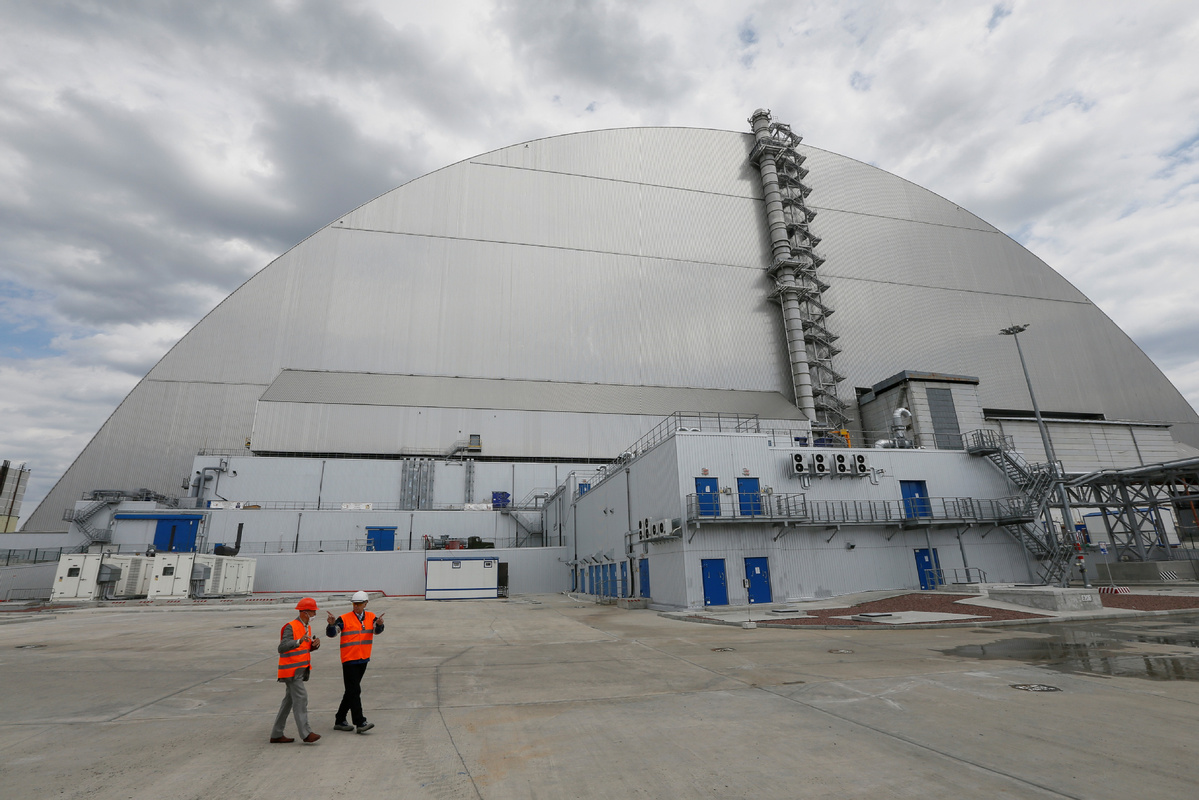
Chernobyl officials presumed any criticality risk would fade when the massive New Safe Confinement (NSC) was slid over the Shelter in November 2016. The €1.5 billion structure was meant to seal off the Shelter so it could be stabilized and eventually dismantled. The NSC also keeps out the rain, and ever since its emplacement, neutron counts in most areas in the Shelter have been stable or are declining.
But they began to edge up in a few spots, nearly doubling over 4 years in room 305/2, which contains tons of FCMs buried under debris. ISPNPP modeling suggests the drying of the fuel is somehow making neutrons ricocheting through it more, rather than less, effective at splitting uranium nuclei. “It’s believable and plausible data,” Hyatt says. “It’s just not clear what the mechanism might be.”
The threat can’t be ignored. As water continues to recede, the fear is that “the fission reaction accelerates exponentially,” Hyatt says, leading to “an uncontrolled release of nuclear energy.” There’s no chance of a repeat of 1986, when the explosion and fire sent a radioactive cloud over Europe. A runaway fission reaction in an FCM could sputter out after heat from fission boils off the remaining water. Still, Saveliev notes, although any explosive reaction would be contained, it could threaten to bring down unstable parts of the rickety Shelter, filling the NSC with radioactive dust.
Addressing the newly unmasked threat is a daunting challenge. Radiation levels in 305/2 preclude getting close enough to install sensors. And spraying gadolinium nitrate on the nuclear debris there is not an option, as it’s entombed under concrete. One idea is to develop a robot that can withstand the intense radiation for long enough to drill holes in the FCMs and insert boron cylinders, which would function like control rods and sop up neutrons. In the meantime, ISPNPP intends to step up monitoring of two other areas where FCMs have the potential to go critical.
The resurgent fission reactions are not the only challenge facing Chernobyl’s keepers. Besieged by intense radiation and high humidity, the FCMs are disintegrating—spawning even more radioactive dust that complicates plans to dismantle the Shelter. Early on, an FCM formation called the Elephant’s Foot was so hard scientists had to use a Kalashnikov rifle to shear off a chunk for analysis. “Now it more or less has the consistency of sand,” Saveliev says.
Ukraine has long intended to remove the FCMs and store them in a geological repository. By September, with help from European Bank for Reconstruction and Development, it aims to have a comprehensive plan for doing so. But with life still flickering within the Shelter, it may be harder than ever to bury the reactor’s restless remains.
Joining the nuclear weapons ban treaty has never been more urgent — IPPNW peace and health blog

The TPNW, the first new multilateral nuclear disarmament treaty to enter into force in 49 years, is essentially the only positive development in the face of growing danger of nuclear war. The first meeting of states parties will be held on 12-14 January 2022 in Vienna.
Joining the nuclear weapons ban treaty has never been more urgent — IPPNW peace and health blog
Keith Pitt vetoes federal funding deal for wind and battery hub in Queensland — RenewEconomy

Resources minister Keith Pitt intervenes to veto $280 million from government fund to Neoen’s Kaban green energy hub in north Queensland. The post Keith Pitt vetoes federal funding deal for wind and battery hub in Queensland appeared first on RenewEconomy.
Keith Pitt vetoes federal funding deal for wind and battery hub in Queensland — RenewEconomy
The Australian backs coal capacity payments, but doesn’t know what they are — RenewEconomy

Fossil fools: Murdoch media has joined Angus Taylor and the coal lobby in pushing capacity markets. But they’re not what it thinks they are. The post The Australian backs coal capacity payments, but doesn’t know what they are appeared first on RenewEconomy.
The Australian backs coal capacity payments, but doesn’t know what they are — RenewEconomy
Australia’s largest energy efficiency market hits new price high, from shaky ground — RenewEconomy

Energy efficiency certificate markets dried up in March and April, and the price again began to climb to a high just above $60. The post Australia’s largest energy efficiency market hits new price high, from shaky ground appeared first on RenewEconomy.
Australia’s largest energy efficiency market hits new price high, from shaky ground — RenewEconomy
Video: Can Australia meet its climate goals? Not at this rate — RenewEconomy

At current rates of emissions cuts, Australia won’t reach net-zero emissions for at least another 200 years. The post Video: Can Australia meet its climate goals? Not at this rate appeared first on RenewEconomy.
Video: Can Australia meet its climate goals? Not at this rate — RenewEconomy
“Urgent action needed now”: More than 100 companies demand more renewables — RenewEconomy

More than 100 Australian companies have issued a joint call to governments to ramp up spending on renewables. The post “Urgent action needed now”: More than 100 companies demand more renewables appeared first on RenewEconomy.
“Urgent action needed now”: More than 100 companies demand more renewables — RenewEconomy
May 5 Energy News — geoharvey

Science and Technology: ¶ “Increasing Extreme Heat And Power Failures Put City Residents At Risk” • The increasingly frequent power failures, combined with heatwaves fueled by climate change, pose severe, compounding threats to major American cities, new research suggests. The study was published in the journal Environmental Science & Technology. [CleanTechnica] Temperature anomaly (Image courtesy […]
May 5 Energy News — geoharvey
Are The Greens taking over from Labor as Australia’s progressive party – Tasmanian election results suggest this.
Have the Greens taken over the progressive mantle from Labor? South Wind, 4 May 2021 by Peter Boyer
Peter Gutwein’s win on Saturday is only part of the story of a fascinating election. ”……….. Predictably, Peter Gutwein won the election on the back of his fine response to COVID-19, recording an exceptional personal vote. People appreciated that this leader, in response to expert scientific advice, could make tough, confronting decisions.
But as the Greens’ Cassy O’Connor pointed out on Saturday night, while the premier chose to follow the science around contagious disease, he has relegated to a secondary position the science that warns of an unfolding climate catastrophe.
In building the Greens as a political force, founding leader Bob Brown fostered the view – perhaps unintentionally – that his party was the only way to environmental salvation. In times past I’ve found myself irritated by what seemed to be the Greens’ uncompromising approach to wicked policy dilemmas. Kevin Rudd’s doomed carbon pricing scheme was one such case.
In 2010, for the first and still the only time in Australia, the Greens became an integral part of government in Tasmania. Leader Nick McKim and then Cassy O’Connor took on the climate challenge on the basis that this responsibility is shared by all jurisdictions, everywhere.
That work culminated in O’Connor’s 2013 strategic plan, which remains the standout among a plethora of such documents that have arrived with fanfare over the years before being quietly shelved. Eight years later, her election night speech showed that this was no accident.
The buzz of leadership doesn’t rest easily with complex, slow-burning issues like climate change. Perhaps taking a cue from Rudd’s unseemly demise in 2010, Australia’s major party leaders and MPs continue to avoid making climate a front-rank policy issue.
Nowhere was that better illustrated than in the last parliament, in a debate over whether Tasmania should declare itself to be in a climate emergency. The only MPs arguing cogently for this fully justified move were O’Connor and her deputy, Rosalie Woodruff, while the rest of the parliament played partisan games.
On Saturday night O’Connor spoke of the Greens’ proposal for a bill to mandate planning for sequestering carbon, adapting to climate change, and annual sectoral emission targets, contrasting that with the major parties’ failure to come up with any coherent climate policy: “a shameful indictment”.
“We hear some Liberals gloating about the state’s climate record while they accelerate native forest logging,” she said. “Tasmania’s status as a net carbon sink is the result of decades of commitment and heart from the broader conservation movement and civil society, and the Greens’ hard work to protect this island’s extraordinary carbon rich forests.”…….
It was a long speech, bringing to mind another politician inclined to go on a bit, Gough Whitlam. The point about both is that they covered a lot of ground and had things to say that mattered, about life, community and government. O’Connor is a leader of real substance……
A century ago another small progressive party was said to be a mere annoyance that would soon disappear. The Labor Party rose to power as a voice for the powerless. On Saturday night, the most effective voice for that noble cause was O’Connor’s….. https://southwind.com.au/2021/05/04/have-the-greens-taken-over-the-progressive-mantle-from-labor/
Greenland’s election won by party opposing Chinese-backed Australian uranium and rare earths company
Greenland’s Rare-Earth Election
A vote last month answered an important question about the world’s largest island. The Atlantic, ROBINSON MEYER 3May 21, ”’……… Since 1979, the ruling Siumut party has dominated Greenland’s elections; in all those years it has lost power only once, in 2009, after the island reformed its government and loosened ties with Denmark, which has ruled it for three centuries. Earlier this month, the democratic-socialist Inuit Ataqatigiit party (IA), Greenlandic for “Community for the People,” won an election with more than a third of the vote, after centering its campaign on a promise to cancel the controversial mining project.
Greenland, the world’s largest island, is populated by about 56,000 people, and its election is, in some ways, an extremely local story. The mining project is called Kvanefjeld, and it would excavate thorium, uranium, and rare-earth elements. Kvanefjeld is less than four miles from Narsaq, one of the larger cities in South Greenland and a local tourism center. (It also has an excellent brewery.)
“There is no way for me to have the mine, because it’s only six kilometers from our town,” Mariane Paviasen, 56, a local activist who ran for Parliament under IA, told me in an interview before the election.
But the election touches on some of the biggest issues in global politics: climate change, mineral economics, and indigenous sovereignty. Rare earths are used to make finely tuned magnets that are essential to modern electronics, including electric vehicles and wind turbines. There is some irony here: Greenland, whose ice sheet is a visual metaphor for the inevitability of climate change, will be mined to power the only technology that can stop it. But the actual interest here is not so overdetermined—like all true climate stories, it draws together questions of money, land, power, and growth. IA’s answer to those questions is not to oppose all extraction, but it has taken a less friendly stance toward some proposed projects. It is particularly opposed to mining that could create radioactive waste……..
The plans for Kvanefjeld had long been paused, according to Zane Cooper, an anthropologist at the University of Pennsylvania who studies how communities respond to mineral extraction. Then, during the pandemic, the plans seemed to accelerate. Greenland Minerals Ltd., an Australian-headquartered but Chinese-backed company, began pressing its plans forward, and the ruling Siumut party complied. The local population had worries, particularly about uranium, which is often found next to thorium, itself a sign of rare earths. A rushed series of public meetings in February gave residents little warning about how rumored uranium dust would affect their farms and settlements. When someone called in a bomb threat to a meeting that Siumut officials were due to attend, they canceled their appearance. Another party, the Democrats, announced it would leave the governing coalition, depriving Siumut of its majority and precipitating snap elections.
The election, on April 6, saw a major victory for IA. It won overwhelmingly in southern Greenland.
IA does not oppose most mining; what it opposes is uranium mining. Another mine, about 30 miles from Narsaq, meets its approval, and the party supports developing mineral extraction as part of a broader strategy. “I think it will work better for us to have our own mining company in Greenland,” Paviasen said. She also supports more economic diversification, embracing a larger role for tourism and local agriculture. Most vegetables in Greenland are imported from Denmark.
Greenland’s blessing and curse is the large block grant, equivalent to more than $500 million, that it receives every year from the Danish government. It makes up about half of Greenland’s annual budget. Greenland has promised to deposit about a third of the revenue from its mineral wealth into a sovereign-wealth fund modeled off the Norwegian oil fund, which could help it replace the Danish block grant
If IA does find a way to instill some measure of economic autarky in Greenland, then it would be the world’s first completely independent indigenous country, Cooper said. Onlookers expect that Greenland would seek independence from Denmark faster under the separatist IA party than the more moderate Siumut. But that remains a ways off: First, IA must figure out how, and whether, it can cancel the mine in a fjord. Greenland Minerals has vowed to fight the decision in court and in international trade tribunals. (Múte Egede, the new IA prime minister, did not respond to a request for comment.) It may seem like a narrow question, but it could have sweeping implications for the island’s 56,000 inhabitants—and for how the world’s largest powers comport themselves with regard to the world’s largest island.
If IA does find a way to instill some measure of economic autarky in Greenland, then it would be the world’s first completely independent indigenous country, Cooper said. Onlookers expect that Greenland would seek independence from Denmark faster under the separatist IA party than the more moderate Siumut. But that remains a ways off: First, IA must figure out how, and whether, it can cancel the mine in a fjord. Greenland Minerals has vowed to fight the decision in court and in international trade tribunals. (Múte Egede, the new IA prime minister, did not respond to a request for comment.) It may seem like a narrow question, but it could have sweeping implications for the island’s 56,000 inhabitants—and for how the world’s largest powers comport themselves with regard to the world’s largest island. https://www.theatlantic.com/science/archive/2021/05/greenlands-rare-earth-election/618785/
Canada’s push for small nuclear reactors effectively stops real action on climate change.
Small Modular Nuclear Reactors Are Mostly Bad Policy, “………So Who Is Advocating For SMRs & Why? Clean Technica, ByMichael Barnard, 3 May 21,
At present we see SMR earmarked funds in both Canadian and US federal budgets, $150 million in Canada and 10 times as much in the US, mostly for research and development with the exception of over a billion to NuScale to, in theory, build something. In Canada, four provinces — Alberta, Ontario, New Brunswick and Saskatchewan — have joined forces in an SMR consortium. Bill Gates’ Terrapower has received another $80 million, as has X-Energy from the US DOE.
The failure conditions of small modular reactors are obvious. The lack of a significant market is obvious. The lack of ability to create a clear winner is obvious. The security costs are obvious. The lack of vertical scaling to thermal efficiency is obvious. The security risks and associated costs are obvious. The liability insurance cap implications are obvious. So why is all of this money and energy being thrown at SMRs? There are two major reasons, and only one of them is at all tenable.
Let’s start with the worst one. The Canadian provinces which are focused on SMRs are claiming that they are doing this as a major part of their climate change solutions. They are all conservative governments. Only one of those provinces has a nuclear fleet, although New Brunswick has one old, expensive, and due-to-retire reactor, as well as a track record of throwing money away on bad energy ideas, like Joi Scientific’s hydrogen perpetual motion machines. One of the provinces, Ontario, has been actively hostile to renewable energy, with the current administration cutting up 758 renewables contracts and legislating a lack of recourse as a very early act after election.
So why are they doing this? Because it allows them to defer governmental climate action while giving the appearance of climate action. They can pander to their least intelligent and wise supporters by asserting that renewables aren’t fit for purpose, while also not doing anything about the real problem because SMRs don’t exist in a modern, deployable, operable form yet.
The other major reason gets back to renewables as well. 15 years ago it was an arguable position to hold that renewables were too expensive, would cause grid reliability issues and that nuclear in large amounts was necessary. That’s been disproven by both 15 years of failures of nuclear deployments, but more importantly plummeting costs and proven grid reliability with renewable generation. Now almost every serious analyst agrees that renewables can economically deliver 80% of required grid energy, but there is still debate from credible analysts about the remaining 20%.
Mark Z. Jacobson and his Stanford team are at the center of this debate. Since the late 2000s, they’ve been publishing regular studies of increasing scope and sophistication on the thesis of 100% renewables by 2050. The 2015 publication saw a lot of pushback. At the time, my assessment of the fundamental disagreement was that the people who published a criticism of it thought the last 20% would be too expensive, and that both nuclear and carbon capture and sequestration would be necessary and scaled components.
Personally, I’ve done various aspects of the math, looked at grid reliability and transformation data from around the world, and looked at ancillary services requirements, and I think Jacobson and team are right. Further, that since we all agree that renewables are fit for purpose for 80% of the problem we should deploy them as rapidly as possible.
However, it’s very reasonable to make a side bet or two to ensure coverage of that last 20%. I don’t mind research dollars spent on SMRs, which is all most of the SMR expenditures amount to, outside of the Nu Scale bailout (which is added to the Ohio $1.3 billion bailout, which is added to the annual $1.7 billion overt federal subsidy, which is added to the annual hidden $4 billion security subsidy which is added to the $70 billion unfunded cleanup subsidy, which is added to the uncosted and unfunded taxpayer liability). Spending a few tens of millions of dollars in rich countries to ensure that we have that last 20% bridged is reasonable.
But the people asserting that SMRs are the primary or only answer to energy generation either don’t know what they are talking about, are actively dissembling or are intentionally delaying climate action. https://cleantechnica.com/2021/05/03/small-modular-nuclear-reactors-are-mostly-bad-policy/
Shoalhaven council to sign up to the Treaty for the Prohibition of Nuclear Weapons
Shoalhaven council wants to abolish nuclear weapons. Liam Cormican
All but one Shoalhaven councillor voted in favour of signing up to the Treaty for the Prohibition of Nuclear Weapons…… (subscribers only) https://www.southcoastregister.com.au/story/7236003/shoalhaven-council-wants-to-abolish-nuclear-weapons/
Nuclear weapons have triggered a new geological era

NUCLEAR WEAPONS IN THE ANTHROPOCENE
Nuclear weapons have triggered a new geological era, but what does that really mean ? Inkstick Media: Peter Waring, 3 May 21, There were a few possible contenders when a working group established by the International Commission on Stratigraphy began searching for a “golden spike” — a geological inflection point marking the end of one era and the beginning of another. ………
from a geological perspective, no marker better captures humanity’s impact on the physical environment than the fallout from decades of atmospheric nuclear testing.

In 2019, the Working Group voted overwhelmingly to recommend establishing a new era — the Anthropocene — to record the beginning of the period where humans have drastically altered the planet. The proposed start day was July 16, 1945, the day of the Trinity Test.
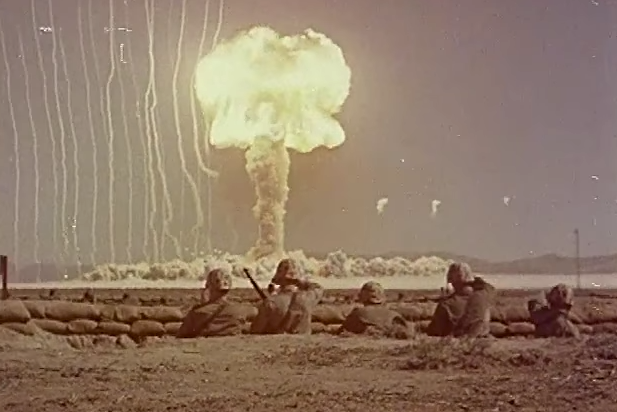
The beginning of the nuclear age marks a new stratigraphic boundary in Earth’s history. The “bomb spike,” as it came to be known, represents the level of carbon 14 and plutonium 239 in the atmosphere, both of which peaked in the mid-1960s at the height of the Cold War. And though levels have subsequently reduced — as states limited and finally halted atmospheric testing — evidence of the spike is now a matter of geological record. In other words, it will exist for as long as the Earth does. But what does this really mean for our security and our environment?
RACING TOWARD CATASTROPHE
Humanity and the environment are now “mutually transformative — and potentially mutually destructive,” a fact which forces us to confront the possibility that the era of climate stability, known as the Holocene, has ended and that our own collective and individual actions are to blame. Apart from its prominent geological signature, the “bomb spike” is also emblematic of the so-called Great Acceleration, the exponential growth in various metrics of human activity since the mid-twentieth century, which include: population, technology, economic development, industrial output, energy consumption, carbon emissions, and international tourism. These measures have been thrust ever upwards by the spread of extractive capitalism, endless technological innovation, and an underlying assumption that somehow the realm of human activity exists outside and separate from nature. Today, we are not witnessing the failure of this world view. Rather, we are witnessing the consequences of its success.
Nuclear arsenals are regularly justified as a bulwark against threats to the postwar, liberal international order. But it is precisely this global system that has served as the launching pad for the Great Acceleration. And as such, it is difficult to separate our conceptions of wealth, progress, and liberty — the very things nuclear weapons are meant to secure — from the causes of human-induced climate change. We have been led to believe that this skyward trajectory is a good thing, that all of our problems will disappear if only there were more progress, more technology, more freedom. But like Icarus, have we flown too close to the sun?
OUR WORST ENEMY
The Manhattan Project, which developed the first atomic weapons, has been described as a “full stop on modernity” — or in other words, the natural terminus of a worldview that separated humankind from our environment. It is the belief that we can do whatever we want to nature and that the Earth exists to support humanity. The Manhattan Project, which developed the first atomic weapons, has been described as a “full stop on modernity” — or in other words, the natural terminus of a worldview that separated humankind from our environment. It is the belief that we can do whatever we want to nature and that the Earth exists to support humanity.
Modernity in this sense is not merely technology or our institutions but rather a mode of thought premised on a belief in human supremacy. Nuclear weapons are the apotheosis of modernity. We can take whatever we want from the Earth and we can destroy it too. Here is the intersection some nuclear threat experts have been looking for, between the environmental movement and the nuclear movement. Between a cause with seemingly endless cultural cachet and one that appears like a mid-century relic.
The nuclear weapons industry is undoubtedly the source of much environmental damage: There are uranium mines, plutonium production facilities, and former test sites. But the true impact exists on a different register altogether. It is more than just the material effects, more even than the devastating ecological impact of a nuclear blast.
Atomic weapons are the most extreme example of our world-possessing pretensions. Their existence and central role in our security apparatus is representative of a mode of thought that portrays humanity as the chief protagonist in the story of Earth. The Anthropocene is the point at which the plot changes.
It is also clear that on a planet increasingly defined by human activity the old dichotomies of friend and foe — of good and evil — are no longer relevant. But constructing enemies is at the core of nuclear thinking as only the most extreme adversaries can justify the most extreme weapons. During the Cold War this was a relatively simple task, albeit one pursued with a kind of cartoonish zeal by politicians on both sides. And while there is a worrisome element of deja vu about the rising discord between Russia and NATO, talk of a new Cold War seems oddly out of place in a world of pandemics and catastrophic climate change. Yet it remains an inescapable feature of the Atomic Age that enemies must be suitably evil and suitably different from us. They must “hate freedom” and they must reject the so-called “rules-based” global order. More significantly, the enemies themselves are largely inconsequential: When they crumble or retreat into the background, we create new ones. As long as the weapons exist there will be myths to justify them. Arundhati Roy perhaps said it best:
“Nuclear weapons pervade our thinking. Control our behavior. Administer our societies. Inform our dreams. They bury themselves like meat hooks deep in the base of our brains. They are purveyors of madness.”
The Anthropocene forces us to grapple with this madness and to reconsider our need for enemies. It demands that we confront unsettling truths and come to terms with the prospect that the greatest threat to our security and way of life is our way of life.
ADJUSTING OUR POLITICS
The long half-life of the Atomic Age is as much the product of outdated thinking as it is bureaucratic inertia or military strategy. The scholarship surrounding nuclear weapons is held back — stuck — by a kind of thinking that belongs to a different epoch. International Relations (IR) and its dominant paradigms of realism and liberalism have lost whatever explanatory power they once had. They are no longer fit for purpose as either an academic discipline or a collection of governing institutions. They have become a trap of our own making. In fact, IR fails even to acknowledge the threat posed by the Anthropocene or the consequences of inaction. The global apparatus constructed to manage twentieth-century challenges, such as genocide, nuclear conflict, and world wars has proved disastrously ill-suited to our new era.
This has been particularly true with regards to the supposed preeminence of the nation-state, which serves as the very basis of world governance. But it is precisely this belief — the privileging of the national above the international, of the human above the planetary — that has drawn attention away from the devastation occurring all around us.
Viewed from the perspective of deep geological time, the pantomime of global politics and state rivalry has been little more than a distraction. What good are states if their future consists of flooded cities, devastated ecosystems, and uninhabitable wastelands? And can states defend the interests of future generations, both human and non-human?
If indeed the domain of the human and the natural are now indistinguishable, then it follows that our notions of international security and geopolitics must change. What is needed is not more realism or liberalism or business-as-usual diplomacy but rather an altogether new way of organizing the world — a theory of IR based on the belief that the Earth itself matters. ……. https://inkstickmedia.com/nuclear-weapons-in-the-anthropocene/
1 This month.


PETITION – To: Prime Minister Anthony Albanese and the Australian Labor Government
Chernobyl: The Lost Tapes – A good documentary on Chernobyl on SBS available On Demand for the next 3 weeks– https://www.sbs.com.au/ondemand/tv-program/chernobyl-the-lost-tapes/235274195556

19 May – Webinar- Webinar: No Nuclear Weapons in Australia
Start: 2026-05-19 18:00:00 UTC Canberra, Melbourne, Sydney (GMT+10:00)
End: 2026-05-19 19:30:00 UTC Canberra, Melbourne, Sydney (GMT+10:00)
20 May – Webinar – The dangerous world of AUKUS, US, military occupation and suppression of dissent

National Webinar, 20th May, 2026, 6.30pm AEST. Confronting laws restricting/suppressing protest speech and action
Speakers: Former Sen. Rex Patrick, Lawyer Nick Hanna ,Arthur Rorris ,Jorgen Doyle, Sen David Shoebbridge,
Facilitator Kelley Tranter.

of the week – Australians for War Powers Reform (AWPR)
To see nuclear-related stories in greater depth and intensity
 Antinuclear