Labor’s got a new mandate to act. Still condones war crimes. Why?
by Michael Pascoe | May 19, 2025 https://michaelwest.com.au/labors-got-a-new-mandate-still-condones-war-crimes-why/
The Palestine elephant remains in the room. It’s putrid, stinking of death while our government holds its nose and looks away, ignoring the war crimes, writes Michael Pascoe.
Yesterday, The Guardian reported another 140 people killed in Gaza, while Israel continues its blockade of all aid from coming in, now entering its 11th week.
Let’s keep this very simple: Is depriving the civilian population of food, water and medicine a war crime? Yes, it is.
So, what is the penalty for this crime? The Australian Government says there is none. You can blockade a couple of million people, use starvation as a weapon of war, and Australia will look the other way.
The old “the standard you walk past is the standard you accept” line means we effectively condone this crime. That we have willingly imposed sanctions for lesser crimes makes us arch hypocrites by ignoring this crime against humanity.
We are made fools when we have given more than $100 million in humanitarian aid to Gaza, but such aid is now blocked without meaningful protest.
We are made jokes of by having imposed sanctions on seven Israeli individuals over settler violence against Palestinians in the West Bank, but dare not mention.
even thinking of action over starving and killing tens of thousands of children.
“We call on Israel to hold perpetrators of settler violence to account and to cease its ongoing settlement activity,” Foreign Minister Wong said last year while announcing sanctions on the token individuals.
All words and no action
“The Albanese Government has been firm and consistent that Israeli settlements in the Occupied Palestinian Territories are illegal under international law and a significant obstacle to peace,” Penny Wong said, but the Albanese Government is game to do nothing more than to mouth those words.
Apply financial and travel sanctions against all Israeli West Bank settlers – a reasonable course of action against those breaching international law – and I might begin to believe the government means it.
But the colonisation of the West Bank pales in comparison with the Gaza blockade.
We know exactly who is responsible, who is committing this catastrophic crime: Benjamin Netanyahu and his Cabinet. And we do nothing.
Australia actively maintains sanctions against a long list of individuals and organisations. You can read all their names, date and place of birth and last known address on what DFAT calls the Consolidated List.
They range from targeted financial sanctions and travel bans on members of the Myanmar military and companies and banks that deal with them to the three individuals held directly responsible for shooting down MH17 over Ukraine, but there’s not even a wrist slap for those ordering malnutrition, disease and death for Palestinians in Gaza.
Double standards
In mitigation for the Russian and Ukrainian MH17 killers, it is possible they did not realise they were destroying a civilian aircraft. On the other hand, there is no lack of knowledge about what Israel is doing to Gaza, no doubt about the murder of aid workers, about the hunger and the denial of medical supplies.
The Jewish Council of Australia has called out genocide, has underlined the International Court of Justice orders, and has repeatedly called on our government to impose sanctions. The government has ignored it.
The grubby politicisation of the Gaza war in the lead up to the federal election, the dog whistling, has run its course. It ended up doing little more than increasing antisemitism and Islamophobia.
Now Albanese has a government so secure it can afford to burn senior Cabinet ministers. Now it has the political capital to stand on principle or continue to effectively condone war crimes.
There are two simple questions to be asked of every government member, and especially the Prime Minister.
The first is the one this started with: Is depriving the civilian population of food, water and medical supplies a war crime?
The second: What are you going to do about it?
Australian Financial Review readers want nuclear plan scrapped, climate ambition raised

Paul Karp AFR, 18 May 25
Most readers of The Australian Financial Review want the Coalition to scrap its nuclear power policy and believe the re-elected Albanese government has a mandate to be more ambitious on its climate policies.
A fortnightly poll of readers found overwhelming support for Opposition Leader Sussan Ley over her vanquished Liberal rival Angus Taylor, but a deep split about whether the Coalition should recommit to net zero emissions by 2050 under her leadership.
As Ley faces calls from the Nationals to include nuclear power in the Coalition agreement, the poll found most readers (57 per cent) want the Coalition to scrap nuclear.
The nuclear policy should be dumped, the business case does not stack up,” said one reader.
“The problem with the Coalition’s nuclear policy is that there are no [small modular reactors] currently working anywhere and the one being built is already over budget,” said another.
A third reader noted that Australia “is not an established player, we have no industry and experience” in nuclear power, meaning that “even if a plant was started today it would be many years off operating. The policy was a furphy.”
Another said: “The nuclear policy [Peter] Dutton took to the election was seen by the electorate as a ploy to kick the emissions abatement can down the road.”……………………………………………………………… https://www.afr.com/politics/federal/afr-readers-want-nuclear-plan-scrapped-climate-ambition-raised-20250516-p5lzv2?utm_content=heres_what_else_happened_today&list_name=4CC7DE0B-EBBE-4073-9A9C-F421CED270D0&promote_channel=edmail&utm_campaign=afr-need-to-know&utm_medium=email&utm_source=newsletter&utm_term=2025-05-18&mbnr=MzA5MjY3OTA&instance=2025-05-18-20-06-AEST&jobid=31478047
The complex truth about gas and renewables
ReNewEConomy, Kane Thornton, May 16, 2025
Energy policy in Australia has long suffered at the hands of a simple lie being easier to accept than a complex truth. The federal election was remarkable in all sorts of ways, but one of those was that the Australian public backed a complex truth and they overwhelmingly rejected a simple lie.
They rejected nuclear power and a massive campaign to hoodwink Australia into backing a solution riddled with risk and uncertainty, likely to have enormous costs and be decades away. Instead, they provided a strong mandate for Australia to proceed with renewables, backed up by batteries, pumped hydro and a small amount of gas.
At the start of this year, amidst waves of misinformation and anticipating another contentious election campaign, the clean energy industry launched a new campaign to ensure the Australian public got the facts. We wanted to make sure the Australian public had access to the facts about clean energy and the alternatives. It’s working.
As the dust settles on the election, we have a lot more to do to ensure the public understand the complexity and nuance of Australia’s energy transition. One of those areas is about the role of gas in the electricity system. So let’s get it straight.
Firstly, the fact is that a small amount of gas-fired electricity generation is playing an important role today, and according to the experts will be necessary for the foreseeable future. That might be an inconvenient truth for some people, but it is the reality for now. It’s a small role, compared to the massive role renewable energy and energy storage is already playing and is expected to in the future.
The Australian Energy Market Operator (AEMO) states that “As coal-fired power stations retire, renewable energy connected with transmission and distribution, firmed with storage, and backed up by gas-powered generation is the lowest-cost way to supply electricity to homes and businesses through Australia’s transition to a net zero economy”
They saw through unprecedented misinformation and a ferocious campaign against renewable energy and for nuclear power. More than anything, Australian’s demonstrated they wanted the truth and could handle that truth. No one said that replacing Australia’s aging coal generation fleet over a decade or so would be easy, or straight forward. But the election showed that it’s time for more honesty with the Australian public.
Importantly, AEMO also projects that gas generation capacity (MW) will produce much less energy (MWh – actual output) than it does today, with a reduced capacity factor for any gas generation of around 7% on average.
AEMO projects gas generation will play a narrower and more focussed role, providing rare but important coverage of seasonal shortfalls, as opposed to its current role in regularly providing peaking support. AEMO is currently forecasting that gas-fired generation capacity will increase from 11.5 GW now to 15 GW in 2050, including replacement of 9.3 GW of the current capacity that is expected to retire over coming decades.
This 15 GW is a relatively small amount of gas capacity when considered alongside the 135 GW of new large-scale renewable generation and the 56 GW of combined utility and distributed energy storage needed by 2050.
The experts tell us that energy storage will play a much bigger role than gas generation in the long term. Energy storage represents a cleaner, lower cost alternative to gas generation and investors are pouring billions into developing more of these assets – last year alone we saw a record 4,000 MW of new energy storage projects, with more than double that due to connect in the next few years. The faster we can deploy clean energy and a range of storage solutions, the faster we can reduce our reliance on gas…………………………………………….. https://reneweconomy.com.au/the-complex-truth-about-gas-and-renewables/
Let’s give Trump credit where credit is due
18 May 25 https://theaimn.net/president-trump-on-ukraine-in-pursuit-of-peace-or-glory/
Yes, he’s a narcissist, yes he’s racist, misogynist, crooked in business, and with no regard for civil institutions and laws. AND he’s just been sucking up to the nastiest most murderous Arabian Gulf regime, in order to make $billions for American business interests, including, notably his own.
BUT even Trump can do some good things. And in the case of the Ukraine war, this is apparent.
In early 2022, Ukraine’s President Zelensky was on the brink of signing a peace agreement with Russia. There’d be no loss of Ukraine territory, and no Ukraine NATO membership. Key Western leaders opposed this negotiation. On April 9, 2022, UK Prime Minister Boris Johnson arrived unannounced in Kiev and told the Ukrainian president that the West was not ready to end the war. Then in April, in Kiev, U.S. Defense Secretary Lloyd Austin said the U.S. wants to use the opportunity to permanently weaken Russia militarily and economically. He went on , at a meeting of Western leaders in Germany, to declare a Ukrainian victory over Russia as a strategic goal for Europe and the USA.
Zelensky promptly switched policy, and this turned into his peripatetic jaunts to the USA and Europe, to drum up weaponry for this determination to defeat Russia. In this, he had the mindless, and never flinching, support from Joe Biden, and NATO. All of which was most acceptable to America’s warhawks, and manna from Heaven to Lockheed Martin, Raytheon, Northrop Grumman, Boeing and General Dynamics.
The West then launched a propaganda campaign about Ukrainian forces defeating Russian forces. English language media continued to show only the Ukrainian perspective. Media scholars have studies this, but I can be sure just from my own experience of the Australian media.
I’ve noticed not only a constant theme that Ukraine can militarily defeat Russia, but that Ukraine IS winning the war. This has been accompanied by copious emotional stories about the Ukrainian civilian victims of Russia’s war. Terrible atrocities done by the Russians. And some atrocity reports are faked. In reality, atrocities have been committed also by Ukrainians, but these are rarely reported on.
With that unflinching support from the West, Russia’s steady progress in the war has been disregarded and downplayed. Now Russia now has the military upper hand on the battlefield and that seems unlikely to change.
From 2022 until 2025, Biden and NATO would not countenance any serious suggestion of a negotiated end, such was their hatred of Russia. Near the end of his office, President Biden signed off on a huge number of weapons to Ukraine.
Donald Trump promised to end the war. In March this year, he stopped all military aid to Ukraine, including weapons already in transit. He’s against NATO membership for Ukraine – as just “not practical”, and does not expect that Ukraine will get back all of its land.
Ukraine has extended martial law until 6 August following Zelensky’s request This will prevent elections from being held before then, and enable Zelensky to stay in power. However, Zelensky could use fraudulent voter lists as a means of gaining re-election.
Critics , (including myself) have stressed Trump’s aim to make money for American companies out of a peace agreement. Well, so what? American weapons companies have been making $billions out of the war.
The thing is, despite all Trump’s negative aspects, he really does not like war. And with the Trump presidency, there is at last the opportunity to end this pointless slaughter, and avoid a wider war – something that was not possible under a Democrat administration.
As to Trump “not liking war” – that is another story to be explored. He likes to bully people with the threat of war. And that may turn out to be a dangerous way to go.
Zelensky’s plan for peace involves Ukraine getting back all the Russian-occupied land, including Crimea, (formally part of Russia since 2014) , and Ukraine headed to become a NATO member.
Europe, and all Westerners who buy into the Joe Biden view of Ukraine seem now still holding onto the idea of a military victory by Ukraine, over Russia. Zelensky’s unrealistic plan for a ceasefire can be disregarded. At least Trump offers a realistic way towards peace. And for that, he deserves acknowledgment.
The fallout of Dutton’s nuclear approach
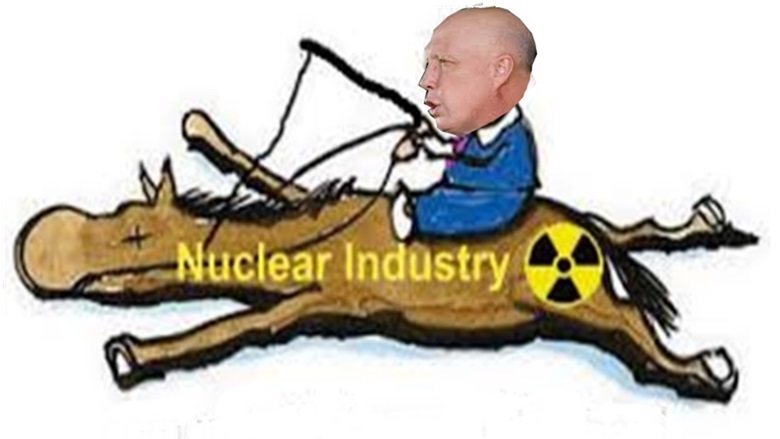
Gladstone Bulletin, Dave Sweeney, Australian Conservation Foundation, 16 May 25,
When he unveiled the Coalition’s nuclear ambitions last June, Peter Dutton said:
“I’m very happy for the election to be a referendum on energy, on nuclear”
It was, and the result was a resounding rejection of high cost, high risk, nuclear power.
The election result is clear, as is the wider lesson: When the Coalition pushes nuclear, Australia pushes back.
In 2007 John Howard too nuclear to an election, where he lost government and his own seat.
In 2025 Dutton said nuclear, and Australia said “No” and “goodbye”.
Thanks to those in the community , who identified and acted on the risk of potential nuclear, – thanks for making a positive difference.
Australians have spoken, and it’s now time to draw a line under this unproductive distraction, and get on with real action to meet our nation’s climate and energy challenges.
Nuclear future off the agenda in Port Augusta, as locals turn to renewables and mining
ABC News, By Kathryn Bermingham, Stateline, 15 May 25
In short:
Port Augusta was thrust into the spotlight when it was announced as one of several sites earmarked, under a Coalition election pledge, to host a nuclear reactor.
While the Coalition has not formally abandoned the plan, its resounding defeat at the recent federal election suggested voters did not embrace the idea.
What’s next?
As Port Augusta looks ahead, locals say its future could lie in several directions, including renewables and mining…………………………………………………………………………………………….
Nuclear off the agenda
Port Augusta was thrust into the national spotlight last year when it was announced as one of the sites earmarked to host a nuclear reactor under a Coalition election pledge.
While the Coalition has not formally abandoned the plan, its resounding defeat at the recent federal election suggested voters did not embrace the idea……………………….
………………………. A future in power generation
Greg Bannon felt the region had scarcely settled one nuclear debate — the now-scrapped proposal to build a low-level nuclear waste dump near Kimba — when the Coalition’s plan was put forward.
“It was really like a punch in the guts,” he said.
Mr Bannon, who lives 40 kilometres from Port Augusta at Quorn and had campaigned against the dump, said Port Augusta has had to reinvent itself in the past and could do so again.
“We also had a very big railway workshop here, it was a huge employer with lots of apprenticeships,” he said.
“Railways built everything. So that was a big loss when that was taken away and of course the most recent large employer has been the coal-fired power station.”
He said the transition to renewables had been more economically beneficial than some gave it credit for — and maintained that Port Augusta’s future was still in energy generation.
“Renewables have provided jobs,” he said.
“We’ve got Sundrop Farm down there, which … grows tomatoes from gulf water that’s been desalinated and solar mirrors.”………………………………………………….. https://www.abc.net.au/news/2025-05-15/nuclear-off-the-table-for-port-augusta/105285976
Can Australia pay off Turkey to host COP31? The Brits did.
A previously unreported package of investment pledges and U.N. support got Turkey to back down last time.
May 8, 2025 By Karl Mathiesen and Zia Weise
LONDON — Australia’s bid to host next year’s climate conference depends on convincing Turkey to step aside.
If they need tips, there’s a British playbook — the details of which are previously unreported — that worked before, involving investment wheel-greasing and support for Turkey’s international priorities.
Riding high on his May 3 election landslide, Australian Prime Minister Anthony Albanese wants to use the 2026 climate talks to drive clean energy investment and win a decades-old political battle with his right-wing rivals over efforts to cut greenhouse gases.
“Renewable energy is an opportunity we must work together to seize for the future of our economy,” Albanese said in his victory speech, capping an election where the prime minister backed Adelaide as the COP31 host city.
But to host the climate summit, Australia needs Turkey to drop its rival bid.
Australian officials flew to Turkey last year, but failed to secure a deal. Instead, Turkish President Recep Tayyip Erdoğan reiterated his intention to bring COP to his country.
Some believe it’s only a matter of time before Turkey crumbles. Australia’s bid has backing from the European Union and other Western countries. More support is expected from the Pacific, given Canberra has offered to cohost the summit with an island nation.
Australia “should hold out until the world forces a deal,” said Richie Merzian, the CEO of the Clean Energy Investor Group and a former Australian diplomat. “The biggest impediment to the COP31 Australia-Pacific bid was the Australian election. With that sorted, it should organize accordingly.”
But Turkey has a track record of extracting more than just diplomatic pain in return for acquiescence. Facing a similar impasse with Erdoğan over the COP26 conference, U.K. officials offered a package of incentives to Turkey in order to host the talks in Glasgow in 2021.
The annual U.N. talks rotate through five groups of countries, loosely based on global regions and countries’ development stages. The “Western European and Other States” group is scheduled to host the 2026 summit. Choosing a host requires consensus.
Turkey is the only developing country in this group, which includes Australia and the U.K. And it has a track record of using the U.N. talks’ location for leverage.
In the lead-up to COP26, British officials courted Ankara intensively. British Prime Minister Boris Johnson and Erdoğan had a “good relationship on this topic in particular,” said Dominick Chilcott, the former British ambassador to Turkey who negotiated the arrangements.
But ultimately, Turkey was transactional in its demands.
Chilcott said Britain’s incentives package included a promise to host a Turkish investment conference in London, as well as U.K. backing of Turkish candidates for several international and U.N. posts. He declined to say which posts.
The U.K. also promised to speak to other countries about classifying Turkey as a “developing country” under the U.N. climate convention — allowing it to receive climate aid. “Although,” Chilcott said, “we didn’t think there was much chance of it going anywhere.”
Why small modular reactors do not exist – history gives the answer.

David Toke, Jan 15, 2025, https://davidtoke.substack.com/p/why-small-modular-reactors-do-not
In recent years we have seen many stories with an upbeat message about small modular reactors (SMRs) and ‘races’ to develop them. But in fact, the concept of SMR is a bogus term that tries to give the impression that something new in nuclear power is afoot. It most certainly is not. In fact what are called SMRs cannot easily be distinguished from nuclear power plants that were built in the 1940s to 1960s, long before the SMR notion was invented. The term SMR does not exist as a useful definable concept.
Even examples of new so-called SMRs are practically non-existent around the world when it comes to operating projects. But there has been a tremendous amount of hype. Indeed the hype seems to grow in inverse proportion to the lack of any projects being completed. First, a definition:
According to the International Atomic Energy Agency:
‘Small modular reactors (SMRs) are advanced nuclear reactors that have a power capacity of up to 300 MW(e) per unit, which is about one-third of the generating capacity of traditional nuclear power reactors. SMRs, which can produce a large amount of low-carbon electricity, are:
- Small – physically a fraction of the size of a conventional nuclear power reactor.
- Modular – making it possible for systems and components to be factory-assembled and transported as a unit to a location for installation.
- Reactors – harnessing nuclear fission to generate heat to produce energy.’ (Ref: see HERE
Yet the problem with this definition is that none of this represents anything new i.e. something that has not been done long ago. The term ‘advanced’ is vague and does not seem to exclude approaches that have been tried before. The notion of modular is even more misleading in practice. That is because having smaller reactors reduces the scope for factory production of components.
There are fewer economies of scale for small reactors compared to making parts for larger-scale reactors (which require more parts of a particular type). The word ‘reactor’ is not new. So what’s new? Certainly nothing, in my view, to warrant the ascription of ‘fourth generation’ nuclear designs that these so-called SMR proposals have often been given.
In practice, even projects that are called SMRs are very, very few in operation around the world. There are very few even under construction, and the ones that are seem to be taking a long time to build. That is, according to the International Atomic Energy Agency. So how can we explain this apparent contrast between, as the media stories put it ‘races’ to develop SMRs, and reality?
The problems with the concept of SMRs can be explained by reference to the historical development of nuclear power. In the 1950s and 1960s, the nuclear industry found that the (then) existing designs of small(er) reactors, what is now called SMRs, were uneconomic compared to larger reactors. As a result, the industry developed larger reactor types. The larger reactors, of course, have had very big construction problems and costs. However, this should not obscure the fact that in comparison the smaller reactors were even worse. Let us look at some of the reactor history in terms of size.
Originally, after WW2, the first electricity-generating nuclear reactors were designed for nuclear submarines. These pressurised water reactors (PWRs) range from a few MWe to over 100MWe for the largest submarines today. I would say that they are the original small nuclear reactors. Indeed here it gets a bit confusing. Why aren’t these submarine reactors called small modular reactors? Essentially, I think, because they do not fit into the current narrative which tries to give the impression that there is a new type of advanced reactor called an SMR.
Small reactors were then designed, starting in the 1950s, for land-based operations to supply mainstream electricity grids. Then design sizes increased and PWRs became the dominant technology throughout the world. Chart 1 shows how nuclear reactor sizes have increased over the decades in the case of the UK. You can see how the average design size for reactors increased from around 100 MW in the 1950s, to 400 MW in the 1960s, over 500 MW in the 1970s, and then to over 1000MW since the 1980s.
There is a very good reason that design sizes increased from the 1950s onwards. Indeed this reason seems to have been mostly overlooked in the blizzard of press releases about small modular reactors. It is all to do with the economies of scale.
There was a (at the time, well-regarded) book published in 1978 by Bupp and Derian (see later reference). This summed up the reason why the rush of ordering nuclear reactors in the USA came to an end in the 1970s. It has great relevance to the issue of small reactors today. It is all to do with the size and cost and also the safety requirements of reactors. They said:
‘In 1955 a 180 MW light water reactor design called for more than 30 tons of structural steel and about one-third of a cubic yard of concrete per MW. By 1965 a much larger plant of about 550MW required less than half as much of these materials per megawatt of capacity. These efficiencies reflect classic ‘economies of scale’. Then, in the late 1960s, the trend reversed. Larger light water plants began to require more, not less, structural materials per unit of capacity; by 1975, the steel and concrete needed per megawatt for 1,200 MW plant approximately equaled the 1960 requirement for a 200-300 MW design. This reversal was a direct consequence of stricter safety and environmental protection requirements laid down during this period. More stringent safety requirements meant thicker concrete walls.’1
So, essentially, nuclear power plants became bigger because of the drive for economies of scale. A big reason why nuclear power did not continue to become cheaper was because, by the 1970s, demands for stricter safety precautions were being translated into regulations. This meant that the progress in reduced costs had been reversed. More recent (so-called Generation 3) nuclear designs have been based on the hope that ever-bigger reactors with better safety designs would once again pave the way to cheaper nuclear reactors. It has not, of course, happened.
In other words, small modular reactors will not produce cheaper outcomes. Arguing for such a proposition flies in the face of history, not to mention basic engineering economic theory. That is, of course, if we assume that small reactors have to deliver the same safety levels as big reactors. Yet it is difficult to see the regulators scrapping the main safety requirements accumulated since the 1960s just for small nuclear reactors. Why would they? Having a much larger number of smaller reactors would increase the risk of there being a serious accident at one of them.
Progress in constructing new small reactors
This is extremely thin. Only two operating so-called SMRs were identified by the International Atomic Energy Agency in 2024, and there are very few others (three in fact) listed as under construction (see HERE page 13). So far as I can see all are very well supported by direct state or research demonstration funds. That is they are nowhere near becoming commercial propositions able to survive on the promise of privately funded bank loans and equity investment.
Of the two so-called SMR plants in operation, one is a 200 MWe reactor built in China (See HERE) – which as you can see in Chart 1 is actually rather bigger than the average reactor size in the UK designed in the 1950s. Not only that, but it took a total of 12 years to construct (see HERE). The other operational project is based on a ship in Russia. This could be described as a variation on a submarine reactor built to support a very niche market, with financing details not available.
One of the three of the three so-called SMRs under construction is being built in Argentina (and whose funding stream is threatened by Government cutbacks). This has a 32MWe reactor and is a variant of a PWR. Construction began in 2014. This is oriented mainly not to electricity production but to an extremely limited market in radioactive products.
The second is a 300 MWe ‘fast’ reactor being built in Russia. Fast reactors are certainly not new. They have been tried in various countries before (including the UK) and have not been commercially successful.
A third, much publicised, development is the 150 MWe Kairos reactor in the USA. This power plant is sited at East Tennessee Technology Park. The US Government’s Department of Energy is supporting the construction of the project. It is a ‘pebble’ bed high temperature, gas cooled reactor. Although called ‘Advanced’ pebble bed reactors were first mooted in the 1940s and have been tried and discontinued before.
Indeed, as Steve Thomas has said about the notion of ‘Advanced’ reactors (see HERE) ‘The advanced designs are not new. For example, sodium cooled fast reactors and high temperature reactors were built as prototypes in the 1950s and 1960s but successive attempts to build demonstration plants have been short-lived failures. It is hard to see why these technologies should now succeed given their poor record. Other designs have been talked about for decades but have not even been built as prototype power reactors – so again it is hard to see why the problems that prevented their deployment to date will be overcome.’
Other variants, including thorium-based plants are proposed (most recently in China). On the one hand, all of these ideas have been tried before, but are being presented as ‘new’ developments. They have failed before. These warmed-up versions of previously tried technical nuclear fission variants do not solve nuclear power’s basic cost problems. These problems involve too much steel, and concrete and the need for unique, very expensive, types of parts and techniques that are too specialist to be sourced from standard industrial supply chains.
This (Kairos) project was made famous by an announcement from Google to buy power from it. However, beyond that, I have no information about how much money Google has actually spent on the project or indeed how much it has agreed to pay for the power the reactor will produce.
Indeed the Autumn of 2024 saw a flurry of announcements of support for so-called SMRs from ‘Tech Giants’. However, the terms of the financial support were generally vague. The announcements were made just prior to the General Election and seemed to respond to the rising hype about powerful AI. In a different blog post I analyse this AI over-hype, (see HERE).
Of course, we can all agree to buy power from people for a specified price by agreeing to PPAs. No commitment to part with money is necessarily required. Whether banks and equity investors are willing to lend money to the energy project in question on the basis of such PPAs is an entirely separate matter.
SMRs in the UK
There are no projects called SMRs operating in the UK. None are under construction and none are in the process of getting anywhere near construction starts. The UK Government for its part, amongst a fanfare of publicity about support for SMRs, promises an aim of ‘deploying a First-of-a-Kind SMR by the early 2030s’ (See HERE). Of course, as Chart 1 above implies, there used to be reactors that are small enough to fit the definition of ‘SMR’. They just weren’t called SMRs at the time.
Indeed, Rolls Royce, has, for several years been promoting their so-called small modular reactor (SMR) design. This is rather larger than a lot of past British nuclear power plants, albeit none still in operation. Their proposed (so-called) SMR design has gone up to 470MWe (See HERE). It uses PWR technology.
This proposed project is rather larger, for example than the 235 MW units which comprised Hinkley A nuclear power station. This power plant began construction in 1957, started generation in 1966, and stopped generating electricity to the grid in 1999. When construction of this project began such a nuclear power plant would have been called large, not small!
I do not understand the claims made by Rolls Royce for their ‘SMR’ to be called modular. The power plant has to be constructed on-site. As I have already stated I do not understand why there is more, or even as much, scope for mass production of parts compared to a conventional reactor such as that being built at Hinkley C.
I could say much the same about Holtec, a US nuclear services company who are promoting a 300 MW reactor – again not really that small. Like Rolls Royce, it has been exciting local people in places in Yorkshire with talk of building factories. This seems unlikely to happen without, essentially the UK Government paying for all or at least much of the project.
My prize for the most ingenious piece of SMR promotion are the claims made by ‘Last Energy’, who are promoting what they describe as a 20 MW PWR reactor. A headline appeared on the Data Centre Dynamics website saying ‘Last Energy claims to have sold 24 nuclear reactors in the UK for £2.4 billion’ (see HERE). Associated with this was another story in Power Magazine saying (see HERE) that the company had secured PPAs for 34 power plants in the UK and Poland, something that was described as ‘extraordinary progress’.
I cannot see any evidence that these power plants are being constructed, ie ‘concrete poured’ at any site. However, it is claimed that the first project will be finished by 2027. There are reports that the company has been conducting site surveys in Wales (see HERE).
What I find especially puzzling about the Last Energy promotion is the lack of a mention on a specific page on the website of the Office of Nuclear Regulation (ONR). In order for a new design of a nuclear power plant to be licensed to generate in the UK, it has to be approved for what is a very lengthy (several years) and very expensive (many £millions) Generic Design Assessment (GDA). However, there is no mention of Last Energy on the ONR information page giving the current and completed GDAs (see HERE).
Why is all this so-called ‘SMR’ activity happening now?
There are two interrelated factors in operation here; material rewards and political-psychological pressures. Material factors include the designation of governmental programmes to fund demonstrations of so-called SMRs. The second is the possibility of raising share capital to fund projects labeled as ‘SMR’.
Of course this in itself does not explain why this has happened in recent years. An excerpt from an opinion piece published in the Guardian in September 2015 can give us an important clue to the political psychology involved. In an article entitled ‘We are pro-nuclear, but Hinkley C must be scrapped’, written by George Monbiot, Mark Lynas and Chris Goodall, there was a subtitle: ‘Overpriced, overcomplicated and overdue, the Hinkley project needs to be killed off and the money invested into other low-carbon technologies’. The authors’ recommendations for alternative funding went on to say: ‘We would like to see the government produce a comparative study of nuclear technologies, including the many proposed designs for small modular reactor, and make decisions according to viability and price’ (See HERE)
What this looks like to me is a face-saving device. It tries to deal with the (recently re-discovered) fact that new nuclear power stations are much too expensive. I interpret this as a piece of cognitive dissonance to deal with the very apparent limitations of environmentalists trying to promote nuclear power as a response to climate change.
This is a form of cognitive denial of the obvious; that nuclear power is extremely expensive and difficult and very longwinded to deliver. SMRs have been at least partly invented to serve the purpose of shifting mental attention from this fact, a form of denial. The denial is sugar-coated with the notion that we can escape reality by embracing so-called SMRs.
This cognitive dissonance allows people to carry on believing in and promoting nuclear power in spite of reality. A new SMR alternative reality is created. This fills the void created by dull reality.
This, in practice, diverts attention from the central cost problems of nuclear power. These are the quantities of steel and concrete needed to build nuclear power stations, the need for unique types of very expensive parts, and the need for exacting, highly specialised processes of building the reactors. Making smaller nuclear plants will not solve these problems. Indeed it makes them worse insofar as this reduces the possibilities for economies of scale.
Now I am not trying to heap the blame for the SMR fantasies on Monbiot, Lynas, and Goodall – at least not entirely! There is a large well of public wishful thinking attached to things with the word ‘nuclear’ in them and this well can be tapped by concerted, if flimsily-based efforts. The promoters of the so-called SMR technologies are the ones who have ignored history to produce what is, in essence, a warmed-up version of a long-discarded set of nuclear technological ideas and practices. Indeed I would class this stream of historical re-interpretation as an example of the use of postmodernism in the nuclear industry.
SMRs as nuclear postmodernism
Postmodernism emerged originally in architecture. It was, put simply, about reviving ancient, or at least old, building designs and using them in contemporary building design (See HERE). The old is presented therefore as the new. For buildings, that’s a pretty harmless, indeed often pleasing, pathway to adopt. However, to present old (smaller) sizes of nuclear power stations (often mixed in with long discarded design ideas) as new and call them ‘Advanced’ nuclear technologies is, in my view, doing a great disservice to us all. It skews public debate relatively against real green energy options by presenting an option (so-called SMRs) that does not exist.
Social scientists are often derided for talking about postmodernism. Yet here we see the apparent apotheosis of natural science, the nuclear sector, engaging in precisely this sort of approach. They are presenting the technologies of the 1940s to 1960s as ‘new’. We should not have to take it seriously. Many people in the nuclear industry are either living in their own alternative postmodern reality or at least are tolerating this non-existent vision.
There may be a small number of demonstration projects constructed that are called SMRs. They are, and will be, expensive and take a long to build. But they are really just warmed-up old-style versions of the 1950s-1960s-sized reactors, mixed in sometimes with tried and failed techniques. They certainly do not represent an ‘advanced’ path for a nuclear-powered future. As a concept, Small Modular Reactors have no existence outside of a postmodernist nuclear industry fantasy.
I invite people to listen to Bonzo Dog’s old hit ‘Urban Spaceman’ (see HERE). The general spirit and especially the last couple of lines of the song seem especially apposite to a discussion of so-called SMRs.
After I wrote this post came the news that the Ontario Government has given the go-ahead to the so-called SMR project at Darlington. Acclaimed as a breakthrough, it may only be a breakthrough as being the most expensive nuclear power scheme in history. Its starting price, as around $21 billion (Canadian dollars, see HERE) for 1.2 GW is almost exactly the same as the final price of the Flamanville EPR reactor in France built by EDF. This came in at €13 billion, roughly 4 times its original price tag (see HERE). Yet Flamanville has a generating capacity of 1.63 GW, that is around a third larger than the sum of the capacities of the four new Ontario reactors! So the Darlington scheme is already a third more expensive than Flamanville!

The crucial difference between the new Ontario scheme and the French power plant at Flamanville is that construction is only about to start at the Canadian scheme. So, let's repeat this. The (spuriously) acclaimed Ontario SMR scheme is already around a third more expensive than the widely panned super-expensive French Flamanville EPR even before the inevitable construction cost increases start piling up!

Given that all nuclear power plant built in the West this century have all come in a great deal more expensive than projected before construction, the cost will spiral even farther upwards. It is likely that the Ontario SMR project will win the prize of the most expensive nuclear project (per GW) this century! Even at its projected price the Ontario SMR scheme is calculated by the Ontario Clean Air Alliance to be up to 8xs more expensive than wind power (See HERE) This puts my arguments in this post in perspective, SMRs are going to be a lot more expensive than conventional nuclear power!
pages 156-157, Bupp, I, and Derian, J-C. 1978. Light Water: How the Nuclear Dream Dissolved. New York: Basic Books
‘Campaign led by anti-nuclear groups had its intended effect’
FOE Adelaide, 14 May 25
Support for Nuclear Power Collapsed from Feb-April 2025
Polling released by the pro-nuclear group WePlanet Australia reveals that support for nuclear power dropped from 55% in February 2025 to just 42% in April. This is the lowest level in years, WePlanet says, and “a clear sign that a … campaign led by anti-nuclear groups had its intended effect in the lead up to this election.”
The polling was conducted by Essential Research with data provided by Qualtrics. The survey was conducted online from 24th to 27th April and is based on 2,241 participants.
Support for nuclear power increased from 2019 to 2021 (AUKUS-related?). Support didn’t take an immediate fall after the Coalition’s mid-2022 announcement that they would promote the introduction of nuclear power to Australia. Support didn’t take an immediate fall after the Coalition’s June 2024 release of 7 proposed nuclear power reactor sites across 5 states, or the December 2024 release of (highly questionable) cost estimates. But in less than 3 months from Feb. 2025 to late April, net support fell from +21% to -2% with a sharp drop in support of -13% and a sharp increase in opposition of 10%. Support fell from 55% to 42% and opposition increased from 34% to 44%.
The polling data shows that most males support “Australia developing nuclear power plants for the generation of electricity” (51% strongly or somewhat support; 41% strongly or somewhat opposed) but among females, support is more than doubled by opposition (23:47). Nuclear power is not supported by those aged 18-34 (38:48), or those aged 35-54 (41:45) but enjoys more support from those aged 55+ (47:41). Nuclear power is opposed by Greens voters (29:60) and Labor voters (27:63) but supported by Coalition voters (65:24).
Techno-optimism alone won’t fix climate change.

Sussex Energy Group 12th May 2025 by Ruby Loughman , https://blogs.sussex.ac.uk/sussexenergygroup/2025/05/12/techno-optimism-alone-wont-fix-climate-change/
This blog post was originally published by the Energy Demand Research Centre (EDRC), 2 May 2025, written by Professor Mari Martiskainen.
Ex-prime minister Tony Blair was making headlines this week by saying that current Net Zero policies are ‘doomed to fail’. In a new report by the Tony Blair Institute (TBI), he argues that voters “feel they’re being asked to make financial sacrifices and changes in lifestyle when they know the impact on global emissions is minimal”. It is an unprecedented call from a former prime minister whose party has been leading climate action in the UK. I will pick up on three key points in relation to the importance of climate action.

The science on climate change is clear
First, the science is clear. Unless we take action, climate change is going to have even more devastating impacts on our societies and the global economy. Countries such as China are seeing this as a big financial opportunity in winning the green race. The evidence on the economic prize is sound and clear: the opportunity for the UK economy is enormous relative to the impact we can have on global emissions, where green growth should be seen as this century’s central opportunity for growing more equitable prosperity.
People want climate action and clear government leadership
Second, people want to take climate action, and for that they want clear leadership from government. While the TBI report questions people’s willingness to undertake lifestyle choices, for example, it is clear from a host of academic and policy studies that people want to act and are ready to change, as long as they get clarity on what is expected. For example, the world’s largest standalone survey on climate change by UNDP found that 80% of people globally want their country to do more on climate change, and 72% want their country to move away from fossil fuels to clean energy quickly.
An academic survey of 125 countries by Andre and colleagues found that “69% of the global population expresses a willingness to contribute 1% of their personal income, 86% endorse pro-climate social norms and 89% demand intensified political action.” Many people have important conditions for this transition, such as it being fair. Crucial issues for policy attention include ensuring that people can have confidence on the value that their own financial commitments will deliver, privately and publicly. This means also the government committing to a genuinely ‘just transition’ in terms of jobs and delivering greener growth.
People must be at the centre of climate solutions
Third, the report calls for ‘actions for positive disruption’, and by this it means accelerating and scaling technologies that capture carbon, harnessing the power of AI, investing in frontier energy solutions, and scaling nature-based solutions. The latter are very welcome, but a major focus on nuclear, carbon capture and AI relates to techno-optimism and the widely debunked approach that technology alone will fix the world’s problems.
This approach leaves out a range of positive socio-technical approaches where people are at the centre of climate solutions. It also misses out on the numerous benefits that could be achieved by engaging citizens in the energy transition. A truly positive disruptive action would be for example to question the high-consuming lifestyles and excess energy consumption that many countries have, including some of those petrostates that TBI has worked for.
It also needs to recognise the opportunity that energy demand action can have in reducing emissions while also enabling a better quality of life for many. The TBI report for example claims that “proposed green policies that suggest limiting meat consumption or reducing air travel have alienated many people rather than bringing them along”. However, our research with people in the UK, for example, has found that there is support for a substantial shift in diets, including reduced meat and dairy consumption.
Addressing climate change needs to be a joined-up, global effort. This needs trusted, robust and impartial evidence applied in a world of vested interests and misinformation. Net zero policies themselves have not become toxic for the majority, yet we should not discount people’s concerns about the changes needed. Technology alone, however, is not the solution.
Solar and wind make up 98 pct of new US generation capacity in Trump’s first three months
Stillwater plant combines 33 MW of the original baseload geothermal, 26 MW of solar PV and 2 MW of solar thermal power generation
Enel Green Power North America
Joshua S Hill, May 13, https://reneweconomy.com.au/solar-and-wind-make-up-98-pct-of-new-us-generation-capacity-in-trumps-first-three-months/
A new analysis of government data has revealed that solar and wind accounted for nearly 98 per cent of new electricity generating capacity in the United States through the first quarter of 2025, despite efforts by the new president to unravel clean energy efforts.
The Sun Day Campaign, a non-profit research and educational organisation founded by Ken Bossong, has been fighting the good fight since 1992, and has been an invaluable tool for journalists covering clean energy in the United States.
A review conducted by the Sun Day Campaign of data recently published by the US government’s Federal Energy Regulatory Commission (FERC) demonstrates the momentum driving the clean energy industry, even in the face of extreme political adversity.
According to the government’s own data, solar and wind accounted for nearly 98 per cent of new US electrical generating capacity added in the first quarter of 2025, and solar and wind were the only sources of new capacity in March – a month that was the nineteenth in a row that saw solar stand out as the largest source of new capacity.
A total of 447MW of solar was installed in March along with the 223.9MW Shamrock Wind & Storage Project in Crockett County, Texas.
Over the first three months of 2025, a total of 7,076MW of solar and wind was installed, accounting for 97.8 per cent of new capacity.
The remainder was made up with 147MW of new natural gas capacity and 11MW from oil.
On its own, solar accounted for two-thirds of all new generating capacity placed into service in March, and 72.3 per cent of new capacity through the first quarter of the year. That makes solar the largest source of new generating capacity per month since September 2023.
This also brings the total installed capacity of solar and wind up to 22.5 per cent of the country’s total available installed utility-scale generating capacity, accounting for 10.7 per cent and 11.8 per cent respectively.
On top of that, approximately 30 per cent of US solar capacity is considered small-scale, or rooftop solar, and is not in fact reflected in FERC’s data. If small-scale solar is added to utility-scale solar and wind, that brings the total share to a quarter of America’s total.
Adding other renewable energy sources – including hydropower (7.7%), biomass (1.1%) and geothermal (0.3%) – renewables accounts for 31.5 per cent of total US utility-scale generating capacity.
FERC itself also expects a “high probability” that new solar capacity additions between April 2025 and March 2028 will total 89,461MW – by far and away the largest source of new capacity. For comparison, over that period, FERC expects 129,609MW of new capacity to be installed, meaning that there is a “high probability” that solar will account for 69 per cent. The next highest source of “high probability” generating capacity is wind energy, with 22,279MW, followed by 16,947MW worth of natural gas.
Conversely, FERC expects there to be no new nuclear capacity installed in its three-year forecast, while coal and oil are projected to contract by 24,372-MW and 2,108-MW respectively. And while new natural gas capacity is expected, that 16,947MW is offset by 15,209MW worth of retirements, resulting in an expansion of only 1,738MW.
“Thus, adjusting for the different capacity factors of gas (59.7%), wind (34.3%), and utility-scale solar (23.4%), electricity generated by the projected new solar capacity to be added in the coming three years should be at least 20 times greater than that produced by the new natural gas capacity while the electrical output by new wind capacity would be over seven times more than gas,” said Sun Day.
Finally, the Sun Day Campaign is currently predicting that all utility-scale renewables will account for 37.5 per cent of total available installed utility-scale generating capacity by April 1, 2028, “rapidly approaching” that of natural gas (40.2 per cent).
“If those trendlines continue, utility-scale renewable energy capacity should surpass that of natural gas in 2029 or sooner,” says Sun Day.
“Notwithstanding the Trump Administration’s anti-renewable energy efforts during its first 100+ days, the strong growth of solar and wind continues,” said Ken Bossong, Sun Day Campaign’s executive director.
“And FERC’s latest data and forecasts suggest this will not change in the near-term.”
Joshua S. Hill is a Melbourne-based journalist who has been writing about climate change, clean technology, and electric vehicles for over 15 years. He has been reporting on electric vehicles and clean technologies for Renew Economy and The Driven since 2012. His preferred mode of transport is his feet.
If the Coalition sticks with nuclear, the fallout will be toxic.

Rebecca Huntley May 10, 2025, https://www.smh.com.au/national/if-the-coalition-sticks-with-nuclear-the-fallout-will-be-toxic-20250505-p5lwmu.html
Much of the post-election commentary has rightly focused on how the Coalition’s nuclear energy proposal was bad – very bad. It was one of the reasons Peter Dutton lost his seat and for net swings against the Coalition in areas such as Gippsland and the Hunter. Unpopular among women voters, who the Coalition continue to struggle to appeal to, and unpopular among undecided voters.
More importantly, nuclear undermined Peter Dutton’s credibility. After the Voice, the only real policy most voters associated with the opposition leader was nuclear. Once his ill-fated campaign began with a backflip on public servants working from home, the swath of undecided voters got spooked.
No one wants someone who seems highly disorganised to build a nuclear reactor.
If you scrutinise the research numbers, the lack of public support for nuclear was clear; more importantly, support for renewables didn’t dip in the face of the pro-nuclear push. Pursuing nuclear made the Coalition look like it was out of sync with what people really wanted. If it continues to pursue this as a policy, it will be seen as defying the will of the people.
Over the years of Labor’s first term, despite a cost-of-living crisis and well-funded campaigns against renewables online and in traditional media, research showed steady support for solar, wind and batteries. Even the election of Donald “drill-baby-drill” Trump didn’t undermine support.
The online misinformation and disinformation campaigns against renewables certainly ramped up after Albanese was first elected, supported by attacks from Sky News and the Murdoch-owned press.
The Coalition playbook was simple: cast enough disinformation and misinformation across channels to create doubt and antagonism against renewables. It fully believed it could win seats off the back of voter dislike of offshore wind in particular, especially in areas such as the Illawarra. It was in for a surprise.
The outcome of this election shows us a truth the Coalition must accept: amid a cost-of-living crisis, Australians back renewables. In fact, the overall swing towards Labor in seats where anti-offshore wind campaigns were rife was greater than the overall statewide swing. Except for Monash in Victoria, anti-offshore campaigns backfired on the Coalition.
Dutton and his Coalition colleagues in the Nationals severely underestimated the Australian people, particularly those in the regions. Support in proposed nuclear reactor communities, including Gladstone, Bunbury, Hunter and Gippsland, was weak, ranging from 22 to 32 per cent.
A poll published in this masthead in April showed 31 per cent of voters said their biggest hesitation in voting for the Coalition and Dutton was the plan to use nuclear power, up 5 percentage points from two months earlier.
This campaign was fought and won on the cost of living. In the end, Australians believed the right policies on renewables – including more access to home batteries – would save them money now and into the future.
Can you imagine what would happen if all the confected outrage over renewables disappeared, and all that was left was public opinion? The support for renewables is there once you strip away the headlines that seem to suggest otherwise.
So, what does this mean for our newly elected Labor-landslide majority government? And for a Coalition still wrestling with where to go on energy policy? When the word “mandate” gets used in relation to election victories, I have to resist a reflexive eye-roll. Election results don’t necessarily equate to public endorsement of every promise made in the campaign by the winning party. But this result is definitive, and more remarkable considering so many federal elections in the past two decades have been close. The last time there was such a strong message from the electorate was in 2007. In many respects, the Rudd government underestimated the permission the public gave it to act on climate. When Labor stepped away from that commitment, its credibility sagged.
A triumphant Albanese government, going into a second term with more power and confidence, should feel like it can act on the energy transition with a belief that the community will follow, especially if its policies deliver cost savings to households and significant and lasting benefits to the regional communities hosting renewable infrastructure. It’s a green light for further progress, but understanding community sentiment – and responding to it – will be essential to maintaining the permission.
Early signs from the Labor government indicate it knows it can proceed swiftly. On election night, Minister for Climate Change and Energy Chris Bowen said, “In 2022, the Australian people voted to finally act on climate change. After three years of progress, in 2025, they said keep going.”
“Keep going” should be the official government slogan. Fingers crossed that sanity prevails, but early signs from the Coalition seem to indicate more of the same: support for nuclear, which really means less renewable energy.
If the members of the Coalition don’t want to believe the polling data, perhaps they should think about these figures. In the years they have been pursuing their nuclear policy, global solar power has doubled. According to the Clean Energy Council, more than 300,000 small-scale rooftop solar systems were installed across Australia in 2024, bringing the total number to more than 4 million. Utility battery storage more than tripled. And last year, Australia added more renewable capacity to the energy system than the entirety of the Coalition’s nuclear plan.
The transition to renewables is happening, and nuclear is a policy that is too toxic for the electorate and too late to be helpful for emissions.
Any politician who resists that logic will be warming the benches of opposition for some time to come.
Dr Rebecca Huntley is one of Australia’s foremost researchers on social trends and a Fellow of the Research Society of Australia. She is director of research at 89 Degrees East.
I just returned from Antarctica: climate change isn’t some far-off problem – it’s here and hitting hard.

The continent stands as a powerful symbol of our interconnected climate systems – a compelling case for conservation…………………… the ocean shapes our world – and Antarctica is central to that story. The surrounding waters link the Pacific, Indian and Atlantic oceans through the Antarctic Circumpolar Current. This connectivity means that what happens in Antarctica affects us all.
Jennifer Verduin, Sun 11 May 2025, https://www.theguardian.com/commentisfree/2025/may/11/antarctica-climate-change-threat
As an oceanographer, I study how the ocean shapes our world. For Australia and other nations, the lesson is urgent.
Antarctica is often viewed as the last truly remote place on Earth – frozen, wild and untouched. But is it really as untouched as it seems?
This vast frozen continent is encircled by the Antarctic Circumpolar Current, the only current in the world that connects all the oceans, showing how closely linked our planet really is.
Earlier this year, I joined more than 100 scientists on a journey to Antarctica. What we encountered was extraordinary: towering icebergs, playful penguins, breaching whales and seals resting on the ice. Yet beneath this natural wonder lies a sobering reality – Antarctica is changing, and fast. The experience left me both inspired and deeply saddened.
This unique environment highlights the fragility of our planet. Its pristine landscapes and thriving wildlife represent what we stand to lose if we don’t take urgent action to reduce human impact.
Historically, Antarctica suffered from exploitation – hunters came for whales and seals, leaving scars on its ecosystems. While wildlife is slowly recovering, these species now face a new threat: climate change. Rising ocean temperatures are melting ice, reshaping habitats and disrupting the delicate balance of life.
The continent stands as a powerful symbol of our interconnected climate systems – a compelling case for conservation. During our visit, we toured research stations and Port Lockroy, where gentoo penguins raise their chicks. Here, human activity is carefully managed. Half the island is set aside for the penguins, while the other half welcomes around 18,000 tourists each year who come to learn about this remarkable place. It’s a model of coexistence – one that shows how we can live alongside nature when we choose to act responsibly.
Along our journey, we witnessed diverse wildlife in their natural habitats – from penguins and seals to whales and seabirds. Albatrosses and cape petrels followed our ship, gliding effortlessly over the waves – symbols of resilience, yet also vulnerability.
But reminders of past damage still linger. On Deception Island, rusted remains of the whaling industry serve as stark evidence of the harm unchecked exploitation can cause. They also underscore why continued protection of these fragile ecosystems is vital.
As an oceanographer, I study how the ocean shapes our world – and Antarctica is central to that story. The surrounding waters link the Pacific, Indian and Atlantic oceans through the Antarctic Circumpolar Current. This connectivity means that what happens in Antarctica affects us all. Pollution, warming seas and oil spills know no borders. These changes disrupt ocean currents, harm marine life and influence climate systems around the globe.
The implications are clear: addressing environmental challenges requires international cooperation and decisive action.
Want to know how the world really ends? Look to TV show Families Like Ours
John Harris, 1 May 25
The Danish drama is piercing in its ordinariness. In the real world, the climate crisis worsens and authoritarians take charge as we calmly look awaySun 11 May 2025 21.35 AESTShare649
The climate crisis has taken a new and frightening turn, and in the expectation of disastrous flooding, the entire landmass of Denmark is about to be evacuated. Effectively, the country will be shutting itself down and sending its 6 million people abroad, where they will have to cope as best they can. Huge numbers of northern Europeans are therefore being turned into refugees: a few might have the wealth and connections to ease their passage from one life to another, but most are about to face the kind of precarious, nightmarish future they always thought of as other people’s burden.
Don’t panic: this is not a news story – or not yet, anyway. It’s the premise of an addictive new drama series titled Families Like Ours, acquired by the BBC and available on iPlayer. I have seen two episodes so far, and been struck by the very incisive way it satirises European attitudes to the politics of asylum. But what has also hit me is its portrayal of something just as modern: how it shows disaster unfolding in the midst of everyday life. At first, watching it brings on a sense of impatience. Why are most of the characters so calm? Where are the apocalyptic floods, wildfires and mass social breakdown? At times, it verges on boring. But then you realise the very clever conceit that defines every moment: it is really a story about how we all live, and what might happen tomorrow, or the day after.
The writer and journalist Dorian Lynskey’s brilliant book Everything Must Go is about the various ways that human beings have imagined the end of the world. “Compared to nuclear war,” he writes, “the climate emergency deprives popular storytellers of their usual toolkit. Global warming may move too fast for the planet but it is too slow for catastrophe fiction.” Even when the worst finally happens, most of us may respond with the kind of quiet mental contortions that are probably better suited to literature than the screen. Making that point, Lynskey quotes a character in Margaret Atwood’s novel The Year of the Flood: “Nobody admitted to knowing. If other people began to discuss it, you tuned them out, because what they were saying was both so obvious and so unthinkable.”
These days, that kind of thinking reflects how people deal with just about every aspect of our ever-more troubled world: if we can avert our eyes from ecological breakdown, then everything else can be either underestimated or ignored. There is a kind of moment, I would wager, that now happens to all of us. We glance at our phones or switch on the radio and are assailed by the awful gravity of everything, and then somehow manage to instantly find our way back to calm and normality. This, of course, is how human beings have always managed to cope, as a matter of basic mental wiring. But in its 21st-century form, it also has very modern elements. Our news feeds reduce everything to white noise and trivia: the result is that developments that ought to be vivid and alarming become so dulled that they look unremarkable.
Where this is leading politically is now as clear as day. In the New Yorker, Andrew Marantz wrote, in the wake of Trump’s re-election, about how democracies slide into authoritarianism. “In a Hollywood disaster movie,” he writes, “when the big one arrives, the characters don’t have to waste time debating whether it’s happening. There is an abrupt, cataclysmic tremor, a deafening roar … In the real world, though, the cataclysm can come in on little cat feet. The tremors can be so muffled and distant that people continually adapt, explaining away the anomalies.” That is true of how we normalise the climate crisis; it also applies to the way that Trump and his fellow authoritarians have successfully normalised their politics.
Marantz goes to Budapest, and meets a Hungarian academic, who marvels at the political feats pulled off by the country’s prime minister, Viktor Orbán. “Before it starts, you say to yourself: ‘I will leave this country immediately if they ever do this or that horrible thing,’” he says. “And then they do that thing, and you stay. Things that would have seemed impossible 10 years ago, five years ago, you may not even notice.” The fact that populists are usually climate deniers is perfect: just as searingly hot summers become mundane, so do the increasingly ambitious plans of would-be dictators – particularly in the absence of jackboots, goose-stepping and so many other old-fashioned accoutrements. Put simply, Orbán/Trump politics is purposely designed to fit with its time – and to most of its supporters (and plenty of onlookers), it looks a lot less terrifying than it actually is.
Much the same story is starting to happen in the UK. On the night of last week’s local elections, I found myself in the thoroughly ordinary environs of Grimsby town hall, watching the victory speech given by Reform UK’s Andrea Jenkyns, who had just been elected as the first mayor of Greater Lincolnshire. For some reason, she wore a spangly outfit that made her look as if she was on her way to a 1970s-themed fancy dress party, which raised a few mirthless laughs. She said it was time for an end to “soft-touch Britain”, and suddenly called for asylum seekers to be forced to live in tents. That is the kind of thing that only fascists used to say, but it now lands in our political discourse with not much more than a faint thump.
Meanwhile, life has to go on. About 20 years ago, I went to an exhibition of works by the French photographer Henri Cartier-Bresson – one of which was of a family of four adults picnicking by the Marne, with their food and wine scattered around them, and a rowing-boat moored to the riverbank. When I first looked at it, I wondered what its significance was. But then I saw the date on the adjacent plaque: “1936-38.” We break bread, get drunk and tune out the noise until carrying on like that ceases to be an option: as Families Like Ours suggests, that point may arrive sooner than we think.
This week – not-the-corporate nuclear news

Some bits of good news: Sustainable Ocean Action: A Global Stocktake of the Our Ocean Conference
How Pakistan pulled off one of the fastest solar revolutions in the world – a “bottom up” revolution.
TOP STORIES Why Is US Congress Silent on the Manmade Nightmare It Is Enabling in Gaza? -Bernie Sanders. Expulsion and Occupation: Israel’s Proposed Gaza Plan.
Resuscitation at Zaporizhzhia?
From the archives. Conflicts of interest in the Trump group’s push to sell nuclear reactors to Saudi Arabia.
Climate. I just returned from Antarctica: climate change isn’t some far-off problem – it’s here and hitting hard.
‘Sitting ducks’: the cities most vulnerable to climate disasters -ALSO AT https://nuclear-news.net/2025/05/07/2-b1-sitting-ducks-the-cities-most-vulnerable-to-climate-disasters/
How ‘out of touch’ Tony Blair became a serious threat to climate action. Two-thirds of global heating caused by richest 10%, study suggests.
5 huge climate opportunities await the next Australian parliament – and it has the numbers to deliver.
Noel’s notes The pro-nuclear drive and Zionism are intertwined.
AUSTRALIA.
- Business as usual: Labor stalls on Defence reform as AUKUS woes grow.
- If the Coalition sticks with nuclear, the fallout will be toxic. Will the Coalition ditch its nuclear power policy? Coalition bombs itself with nuclear energy policy. Australians choose batteries over nuclear after election fought on energy. Scrap nuclear: Key Liberal senator wants radioactive energy plan buried.
- Poison in the Heart-The Nuclear Wasting of South Australia.
- Who’s afraid of big, bad China?
- Front groups working with Zionist actors are promoting Islamophobia.
- The dark cloud of Murdoch has no silver lining.
NUCLEAR ITEMS.
| ECONOMICS. Ontario’s Darlington SMR project to cost nearly $21-billion, significantly higher than expected. Google agrees to fund the development of three new nuclear sites. How Miliband can make renewables cheaper – but there is really no alternative to renewables. |
| ENERGY. Rooftop solar can be torn out of capital’s hands. |
| ENVIRONMENT. Sellafield’s massive water abstraction plan for its new construction work has no environmental impact assessment and inadequate monitoring. Ohio EPA launches limited Luckey water testing after independent report shows high radiation in wells. |
| HISTORY. 80 years on US still embattled in senseless Cold War with Russia.The Anglo-Nazi Global Empire That Almost Was. |
| LEGAL. Lawsuit Compels Nationwide Public Review of Plutonium Bomb Core Production. |
| MEDIA. Israel Will Even Persecute Palestinians For Simply Talking To Journalists. |
| POLITICS. Durbin successor must not be co opted by the Israel Lobby. [SMRs] Trump wants to speed up construction of more NPP, bypass safety regulations- ALSO AT https://nuclear-news.net/2025/05/12/2-b1-draft-executive-orders-aim-to-speed-construction-of-nuclear-plants/. Trump administration considers orders expediting nuclear plant construction, NYT reports. US Administration’s initial proposal sees cuts to nuclear energy budget. |
| POLITICS INTERNATIONAL and DIPLOMACY. Iran calls latest nuclear talks with US ‘difficult’ but both sides agree negotiations will continue. The Stakes of Donald Trump’s Negotiations with the Islamic Republic of Iran. Trump’s trip to Saudi Arabia raises the prospect of US nuclear cooperation with the kingdom. Non Proliferation Preparatory Committee concludes; Treaty on the Prohibition of Nuclear Weapons states point way forward. |
SAFETY.
- The Challenge to Japan’s Nuclear Restart.
- Starmer ignored nuclear watchdog when he blamed regulations for delays. Improvement notice issued at Dounreay nuclear power plant.
- Chernobyl shelter’s drone damage includes 330 openings in outer cladding. Russian drone strike caused tens of millions worth of damage to Chornobyl.
- Zaporizhzhia: Hurdle or catalyst for a peace deal in Ukraine
- Trump tightens control of independent agency overseeing nuclear safety. Trump considers weakening nuclear safety agency in bid for more power plants- ALSO AT https://nuclear-news.net/2025/05/12/1-b1-trump-considers-weakening-nuclear-agency-in-bid-for-more-power-plants/
| SECRETS and LIES. The Deep State & the Death of Democracy. ‘It’s deceitful’: Critics slam owners of TMI Unit 2 for not reporting fire at plant. |
| SPINBUSTER. Who are Britain Remade? Atomic lobby seizes on Spanish blackout .Google tries to greenwash massive AI energy consumption with another vague nuclear deal. |
| TECHNOLOGY. Westinghouse drops out of UK SMR competition. |
| URANIUM. Depleted Uranium by Lynda Williams 2025- https://www.youtube.com/watch?v=4_BXI5wVhKU |
| WAR and CONFLICT. Too Cruel to Even Imagine—Nuclear War in Densely Populated Areas Close the US military bases in Asia! Nuclear war has never been more likely – Here’s what it would look like now. |
| WEAPONS and WEAPONS SALES. Nuclear threat is more real than at any time since second World War. Starmer prepares for attack by Russia. |
1 This month
17 October, Free Public Talk on Nuclear Issues in South Australia
David Noonan will speak on public interest concerns over the new Roxby Downs Indenture Act 2026 on BHP copper-uranium mining and ore processing in SA, and on how AUKUS may face SA with a High-Level nuclear waste agenda.
Dr Jim Green will discuss international developments in the field of nuclear power including ‘small modular reactors’ and Generation 4 ‘advanced’ nuclear reactor concepts.


Help Aunty Sue Protect Her Land and Sacred Sites From Destructive Rocket Testing.
.

Australians deserve the truth
about
AUKUS – https://aukuspublicinquiry.com/

PETITION – To: Prime Minister Anthony Albanese and the Australian Labor Government

of the week – Australians for War Powers Reform (AWPR)
To see nuclear-related stories in greater depth and intensity

