The climate crisis is heating up nights faster than days in many parts of the world
 Global heating warming up ‘nights faster than days’
Effect seen across much of world will have profound consequences, warn scientists . https://www.theguardian.com/environment/2020/oct/01/global-heating-warming-up-nights-faster-than-days Damian Carrington Environment editor @dpcarrington, Thu 1 Oct 2020 09. The climate crisis is heating up nights faster than days in many parts of the world, according to the first worldwide assessment of how global heating is differently affecting days and nights.
The findings have “profound consequences” for wildlife and their ability to adapt to the climate emergency, the researchers said, and for the ability of people to cool off at night during dangerous heatwaves.
The scientists compared the rises in daytime and night-time temperatures over the 35 years up to 2017. Global heating is increasing both, but they found that over more than half of the world’s land there was a difference of at least 0.25C between the day and night rises.
In two-thirds of those places, nights were warming faster than the days, Continue reading
Ionising radiation – the tragedy of the ”radium girls”

They weren’t just making paints, they were doing the painting, too. According to NPR, US Radium hired scores of girls and young women — as young as just 11-years-old — to paint watch dials with the glow-in-the-dark, radium-based paint. As if just working with the paint wasn’t bad enough, they were also encouraged to put the brush between their lips and twirl it into a point. It was the best way to get truly precise numbers and brush strokes, but with each lick of the brush, they were swallowing radium.
the human body isn’t great at telling the difference between radium and calcium. Radium gets absorbed into the bones just like calcium does, and when that happens, the rot starts.
Writer and historian Kate Moore documented the cases of the Radium Girls (via The Spectator) and found that there were a whole host of symptoms. Some started suffering from chronic exhaustion. For many, it started with their teeth — one by one, those teeth would start to decay and rot. When they were removed, their gums wouldn’t heal. In some cases, the jaw would just simply disintegrate at the dentist’s touch. Bad breath was common. Skin became so delicate that the slightest touch would tear open wounds. Ulcers formed for some, and those that were pregnant bore stillborn babies.
THE RADIUM GIRLS HAD TO BE BURIED IN LEAD-LINED COFFINS
The Radium Girls weren’t just sick, they were very literally radioactive. Mollie Maggia was exhumed in 1927, in the hopes that her bones would give still-living Radium Girls the evidence they needed to win in court. According to Popular Science, her coffin was lifted out of the ground, and her body? It glowed. That wasn’t entirely surprising, considering her bones were found to be highly radioactive — and considering radium’s half-life is 1,600 years, they’re not going to stop glowing any time soon.
Eventually, 16 separate sites around Ottawa would be classified as Superfund sites.
NPR Illinois says that many have been cleaned up, but as of 2018, there was at least one site — a 17-acre plot of land on the Fox River — that still remained a highly radioactive and terrifying legacy of the Radium Girls.
THE MESSED UP TRUTH ABOUT THE RADIUM GIRLS https://www.grunge.com/181092/the-messed-up-truth-about-the-radium-girls/ BY DEBRA KELLY/DEC. JULY 14, 2020
History is filled with episodes that prove mankind is just sort of making everything up as it goes. There’s no shortage of things that can kill us or do horrible, terrible things to our soft and squishy bodies, and every time we think we know about them all, it turns out there’s something else lurking around the corner.
And sometimes, it’s disguised as something awesome. Need proof? Look no further than the Radium Girls.
Yes, that radium. Today, the Royal Society of Chemistry says there’s really only one use for radium — targeted cancer treatments, because it’s so good at killing cells. It was first discovered in 1898 by Marie and Pierre Curie, after they extracted a single milligram from ten tons of a uranium ore called pitchblende. And it was pretty darn cool. It glowed, and seriously, how exciting is that? Unfortunately, it was also deadly — as the so-called Radium Girls would find out.
Japanese Government Is Ordered to Pay Damages Over Fukushima Disaster — Fukushima 311 Watchdogs

The Sendai High Court said the state and the plant’s operator must pay $9.5 million to survivors of the 2011 nuclear accident. They have until mid-October to appeal to the country’s Supreme Court. A damaged reactor building at the Fukushima Daiichi nuclear power plant in Japan in 2011. September 30, 2020 TOKYO — A high […]
Japanese Government Is Ordered to Pay Damages Over Fukushima Disaster — Fukushima 311 Watchdogs
Environmental News Stories We Should Be Paying Attention To — Skyler Breanne

With everything going on this past year, environmental news and its importance has been placed on a back burner, overtaken by pandemic related issues as well as social and political chaos. While it may be understandable that we are focused on other important news stories right now, 2020 is set to be the hottest year […]
Environmental News Stories We Should Be Paying Attention To — Skyler Breanne
Flexible exports: It looks like the future of rooftop solar for households — RenewEconomy

Trials in South Australia and Victoria to test “dynamic exports”, giving power to networks to manage rooftop solar exports and removing static export limits.
Flexible exports: It looks like the future of rooftop solar for households — RenewEconomy
Why combining hydro power and floating solar PV may be a good idea — RenewEconomy

New research published this week highlights the “untapped potential” of combining floating solar PV projects and hydropower plants.
Why combining hydro power and floating solar PV may be a good idea — RenewEconomy
TEPCO’s fitness to operate nuke reactors still open to question — Fukushima 311 Watchdogs

From left, the No. 5 to No. 7 reactors of the Kashiwazaki-Kariwa nuclear power plant in Niigata Prefecture September 24, 2020 The Nuclear Regulation Authority has effectively endorsed Tokyo Electric Power Co.’s fitness to operate nuclear reactors in its safety screening of the utility’s plans to restart the No. 6 and No. 7 reactors at […]
TEPCO’s fitness to operate nuke reactors still open to question — Fukushima 311 Watchdogs
Japan Struggles to Secure Radioactive Nuclear Waste Dump Sites — Fukushima 311 Watchdogs

A small, aging town grapples with the financial lure of storing radioactive waste underground. Japan’s worsening depopulation crisis is crippling the public finances of regional towns. Now one small town has made national headlines after expressing interest in storing radioactive nuclear waste underground in a last ditch effort to save itself from impending bankruptcy. The […]
Japan Struggles to Secure Radioactive Nuclear Waste Dump Sites — Fukushima 311 Watchdogs
Technology roadmap not a credible policy to tackle climate, investors say — RenewEconomy

Investors say the Morrison government’s Technology Roadmap is not a replacement ‘for a coherent national climate policy’, or a lack of 2050 target. The post Technology roadmap not a credible policy to tackle climate, investors say appeared first on RenewEconomy.
Technology roadmap not a credible policy to tackle climate, investors say — RenewEconomy
Grossly inadequate Senate report on National Radioactive Waste Management Amendment Bill

The report released on 14 September 2020 by the majority of the Senate committee inquiring into the National Radioactive Waste Management Amendment Site Specification,Community Fund and Other Measures) Bill is both grossly deficient and biased and does no credit to the members of the committee.
While I do not intend to comment on all of the report in detail I will refer to some aspects of the introduction being chapter 1 including the conduct of the inquiry but more extensively to the second part of the report dealing with support for the legislative changes and the evidence of the witnesses who appeared before the committee.
**************************************
Pine Gap could play role in accidental US-China nuclear fight
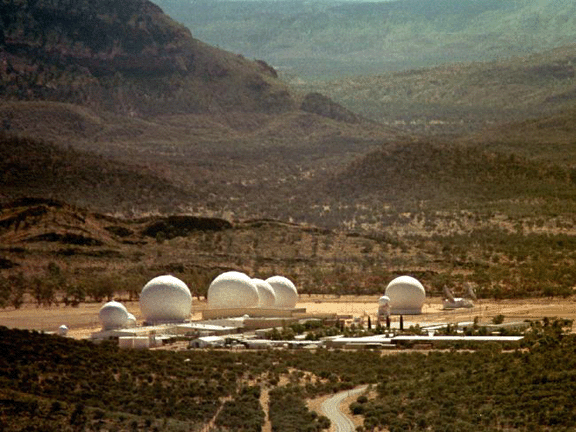
Pine Gap could play role in accidental US-China nuclear fight NT News, 30 Sept 20
Heightened US-China tensions have increased the risk of an accidental nuclear exchange between the two superpowers — and whether or not the Northern Territory’s Pine Gap surveillance base is playing a role in hyping this up needs to be looked at ……. (subscribers only)
Julian Assange could face life in America’s most dreaded ‘Supermax’ prison
  Julian Assange ‘faces fate worse than death’ in US: WikiLeaks founder could serve life in isolation at dreaded ‘Supermax’ prison that’s home to America’s most violent terrorists and drug lords if extradited, court hears Daily Mail, 30 Sept 20, Julian Assange ‘faces fate worse than death’ in US: WikiLeaks founder could serve life in isolation at dreaded ‘Supermax’ prison that’s home to America’s most violent terrorists and drug lords if extradited, court hears Daily Mail, 30 Sept 20,
Julian Assange ‘faces a fate worse than death’ in a lifetime of isolation at the ‘Supermax’ prison currently home to America’s most violent terrorists and drug lords if he is extradited, a court has heard. The Wikileaks founder, 49, could live out his years alone at maximum security ADX Colorado jail where he would spend 23 hours in a cell if he is convicted of espionage offences in the US. Assange is wanted in the US for allegedly conspiring with army intelligence analyst Chelsea Manning to expose military secrets between January and May 2010 Prison expert Joel Sickler said the US government had ‘raised the possibility of sending Mr Assange to ADX’. ……… I believe, based on my understanding of the case, that this is a not unlikely proposition.’ He said Supermax was the only prison criticised as inhumane by its own staff, adding: ‘Robert Hood, the Warden says, “this is not built for humanity. I think that being there day by day, it’s worse than death”.’…….. The WikiLeaks founder could be placed on a prison regime called Special Administrative Measures (SAMS). This means he could be deprived of meals, phone calls, visits or interaction with other inmates. Mr Sickler, who advises federal prison defence attorneys, said: ‘Based on decades of experience, over a dozen of my clients committed suicide, it can be done. ‘I think he is only going to go there if he is a SAMS inmate. There is an outside chance he will go there on other grounds. ‘SAMS will seal his fate. If he is given a life sentence he must start at a United State Penitentiary. ‘He is someone our government alleges has knowledge of certain highly qualified information.’……… ‘Officially known as Administrative Maximum-Security United States Penitentiary (“ADX”); it is most known by its shorthand name, “Supermax”,’ Mr Sickler added. ‘This is a facility is the most feared by inmates and is where the most violent offenders in the nation are sent. ‘And this is where the Government, according to its own affidavit, sees as a potential prison placement for Mr Assange. He said it was the solitary nature of the ADX that made it so difficult for its inmates to bear. ‘Should Mr Assange be sent to ADX he will almost certainly spend all his time in ADX in solitary,’ he added……….. https://www.dailymail.co.uk/news/article-8781275/Julian-Assange-faces-fate-worse-death-WikiLeaks-founder-serve-life-isolation.html?fbclid=IwAR21x4PeHIIn2pjMDgqjBSqfqA2pK5YPTZ9Q4q4SOG066tGN_aKkZj91ROE |
|
Legacy of Maralinga bomb tests -a reminder of need for safety in matters nuclear
 Sixty years on, the Maralinga bomb tests remind us not to put security over safety, The Conversation Liz Tynan, Senior Lecturer and Co-ordinator Research Student Academic Support, James Cook University September 26, 2016 It is September 27, 1956. At a dusty site called One Tree, in the northern reaches of the 3,200-square-kilometre Maralinga atomic weapons test range in outback South Australia, the winds have finally died down and the countdown begins……….
The count reaches its finale – three… two… one… FLASH! – and all present turn their backs. When given the order to turn back again, they see an awesome, rising fireball. Then Maralinga’s first mushroom cloud begins to bloom over the plain – by October the following year, there will have been six more.
RAF and RAAF aircraft prepare to fly through the billowing cloud to gather samples. The cloud rises much higher than predicted and, despite the delay, the winds are still unsuitable for atmospheric nuclear testing. The radioactive cloud heads due east, towards populated areas on Australia’s east coast.
Power struggle
While Australia was preparing to sign the Maralinga agreement, the supply minister, Howard Beale, wrote in a top-secret 1954 cabinet document:
The British carried out two clean-up operations – Operation Hercules in 1964 and Operation Brumby in 1967 – both of which made the contamination problems worse.
Legacy of damage
The damage done to Indigenous people in the vicinity of all three test sites is immeasurable and included displacement, injury and death. Service personnel from several countries, but particularly Britain and Australia, also suffered – not least because of their continuing fight for the slightest recognition of the dangers they faced. Many of the injuries and deaths allegedly caused by the British tests have not been formally linked to the operation, a source of ongoing distress for those involved.
Decades later, we still don’t know the full extent of the effects suffered by service personnel and local communities. Despite years of legal wrangling, those communities’ suffering has never been properly recognised or compensated.
Why did Australia allow it to happen? The answer is that Britain asserted its nuclear colonialism just as an anglophile prime minister took power in Australia, and after the United States made nuclear weapons research collaboration with other nations illegal, barring further joint weapons development with the UK. …..Six decades later, those atomic weapons tests still cast their shadow across Australia’s landscape. They stand as testament to the dangers of government decisions made without close scrutiny, and as a reminder – at a time when leaders are once again preoccupied with international security – not to let it happen again. https://theconversation.com/sixty-years-on-the-maralinga-bomb-tests-remind-us-not-to-put-security-over-safety-62441?fbclid=IwAR3-AXJA_-RZTlr1AW6qxgcFRPuOX5IIi163L75vLWXFyIOcZGKxbet5DDE
The American election- what will the nuclear order look like after this?
 THE U.S. ELECTION AND NUCLEAR ORDER IN THE POST-PANDEMIC
  WORLD Limitless Life, LEON V. SIGAL, SEPTEMBER 29 2020Abstract
U.S. power and prestige may have diminished in recent years, but the United States still plays a pivotal role in international institutions, alliances, and mass media, so who becomes its president and which party controls Congress matter a lot for the global nuclear order. However unlikely it is that Donald Trump’s expressed desire to contest the election’s outcome could succeed, whether the nation can avert a violent backlash among disappointed partisans is less clear.
Nuclear weapons are often thought to be the esoteric domain of experts. Yet one need only recall that although mass activism does not guarantee policy change, three of the most significant developments in recent decades – the ban on above-ground nuclear tests, the INF
Treaty, and the collapse of the Berlin Wall – would not have happened without mass protests in many countries. And citizen involvement, organized by NGOs, can even facilitate monitoring of arms agreements and nuclear developments in some countries.
positive change to the global nuclear order will continue to be marginal and fitful. This makes the international milieu critical for the nuclear future – a milieu that a president can influence but not determine.
President Trump’s reelection is likely to have a pernicious effect on that milieu, hindering international cooperation to limit nuclear weapons and accelerating a qualitative arms race that could endanger crisis stability. Yet two of Trump’s more positive impulses are likely to continue. He is unlikely to increase the risk of an intense crisis leading to nuclear war because he wants to avoid U.S. involvement in any wars, not start new ones. He will also try to sustain negotiations
with North Korea to curb nuclear developments there, though whether he is prepared to satisfy Pyongyang’s stiffer demands remains in doubt.
His opponent, Joseph Biden, will face those same demands. Personnel is policy, and the Biden administration will likely be staffed with officials who served under President Obama. That means a return to shoring up alliances and international cooperation. It also means continuity with Obama’s nuclear policies. Whether he will curtail Obama’s modernization plans is not clear, but in contrast to Trump, he will try his best to restore the JCPOA, which could head off nuclear
weapons development not only in Iran but also in Saudi Arabia. He will also strive to save START, seek technical talks with China, and not abandon the Open Skies accord……….. https://wordpress.com/read/feeds/2663585/posts/2938659215
China’s zero emissions target is contrasted with Australia’s inaction on global heating
China’s escalation is also set to have implications for Australia’s diplomatic position in the Pacific, where it has been attempting to manage China’s rising influence among some of its closest neighbours.
“From both sides of Parliament Australian politicians aren’t understanding it, they approach climate change like it’s just another issue for our Pacific counterparts. What Australian politicians 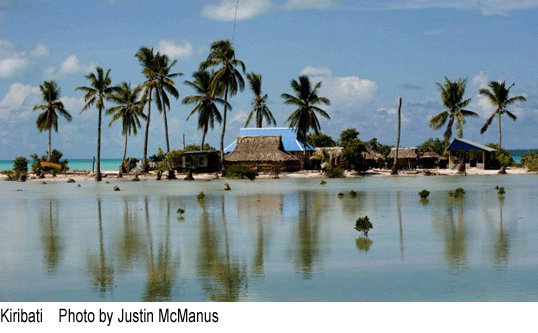 do often miss is this issue is personal,” said Professor Bamsey.
“It concerns Pacific politicians when they get out of bed, they can see the changes to the future of their country when they look out the window.”
China’s zero emissions target puts Australia on notice, The Age, By Eryk Bagshaw and Mike Foley, September 30, 2020 — Australia’s former top climate diplomat has warned China’s net-zero emissions target will leave Australia behind, threatening future trade deals and its influence in the Pacific as the Morrison government becomes wedged between the US and China on climate action.
Howard Bamsey, who was Australia’s special envoy on climate change during the Rudd government, said the announcement from President Xi Jinping last week had turned the politics of emissions reduction into a sharp economic and diplomatic issue.
Professor Bamsey, who was also Australia’s ambassador for the environment under the Howard government, said the new policy “pulls the rug out from under the argument” that Australia’s domestic climate goals do not need to accelerate because China was yet to increase its ambitions.
“It’s clear now China is accepting a leadership role,” he said. “Xi made the announcement. That carries all the weight of the state and party.”
The coronavirus has forced this year’s United Nations Glasgow Climate Change Conference to be rescheduled to November 2021, turning Australia’s international emissions obligations into a major election flashpoint. The earliest month a federal election can be held is August 2021 and voters are expected to go to the polls by the end of next year.
China, which is simultaneously the world’s largest polluter and biggest producer of renewable energy, pledged to go carbon neutral by 2060 at the UN General Assembly last week………… Continue reading
1 This month.


PETITION – To: Prime Minister Anthony Albanese and the Australian Labor Government
Chernobyl: The Lost Tapes – A good documentary on Chernobyl on SBS available On Demand for the next 3 weeks– https://www.sbs.com.au/ondemand/tv-program/chernobyl-the-lost-tapes/235274195556

19 May – Webinar- Webinar: No Nuclear Weapons in Australia
Start: 2026-05-19 18:00:00 UTC Canberra, Melbourne, Sydney (GMT+10:00)
End: 2026-05-19 19:30:00 UTC Canberra, Melbourne, Sydney (GMT+10:00)
20 May – Webinar – The dangerous world of AUKUS, US, military occupation and suppression of dissent

National Webinar, 20th May, 2026, 6.30pm AEST. Confronting laws restricting/suppressing protest speech and action
Speakers: Former Sen. Rex Patrick, Lawyer Nick Hanna ,Arthur Rorris ,Jorgen Doyle, Sen David Shoebbridge,
Facilitator Kelley Tranter.

of the week – Australians for War Powers Reform (AWPR)
To see nuclear-related stories in greater depth and intensity
 Antinuclear