Australia is to build new nuclear reactors, in partnership with China (does Parliament know?)


Republishing again, in view of Dr Adi Paterson’s departure from Ansto.
Republishing this one, in view of news from the UK, that a British-China nuclear research programme may be siphoning UK tax-payers’ funds off into China’s military projects.
Australia is back in the nuclear game, Independent Australia, By Noel Wauchope | 24 March 2019, One of Australia’s chief advocates for nuclear power Dr Adi Paterson, CEO of Australian Nuclear Science and Technology Organisation, (ANSTO), has done it again.
This time, he quietly signed Australia up to spend taxpayers’ money on developing a new nuclear gimmick — the Thorium Molten Salt Reactor (TMSR).
This new nuclear reactor does not physically exist and there is no market for it. So its development depends on government funding.
Proponents claim that this nuclear reactor would be better and cheaper than the existing (very expensive) pressurised water reactors, but this claim has been refuted. The TMSR has been described by analyst Oliver Tickell as not “green”, not “viable” and not likely. More recently, the plan has been criticised as, among other things, just too expensive — not feasible as a profitable commercial energy source.
Paterson’s signing up to this agreement received no Parliamentary discussion and no public information. The news just appeared in a relatively obscure engineering journal.
The public remains unaware of this.
In 2017, we learned through the Senate Committee process that Dr Paterson had, in June 2016, signed Australia up to the Framework Agreement for International Collaboration on Research and Development of Generation IV Nuclear Energy Systems (also accessible by Parliament Hansard Economics Legislation Committee 30/05/2017).
This was in advance of any Parliamentary discussion and despite Australia’s law prohibiting nuclear power development. Paterson’s decision was later rubber-stamped by a Senate Committee……..
Dr Paterson was then obviously supremely confident in his ability to make pro-nuclear decisions for Australia.
Nothing seems to have changed in Paterson’s confidence levels about making decisions on behalf of Australia.
Interestingly, Bill Gates has abandoned his nuclear co-operation with China. His company TerraPower was to develop Generation IV nuclear reactors. Gates decided to pull out of this because the Trump Administration, led by the Energy Department, announced in October that it was implementing measures to prevent China’s illegal diversion of U.S. civil nuclear technology for military or other unauthorised purposes.
Apparently, these considerations have not weighed heavily on the Australian Parliament.
Is this because the Parliament doesn’t know anything about Dr Paterson’s agreement for Australia to partner with the Shanghai Institute of Applied Physics (SINAP) in developing Thorium Molten Salt Reactors? https://independentaustralia.net/environment/environment-display/australia-is-back-in-the-nuclear-game,12488#.XJWdhxDqitc.twitter
The process for selecting Napandee nuclear waste site – flawed and divisive
Womankind arise! — Beyond Nuclear International

Still no equal protection under radiation law
Womankind arise! — Beyond Nuclear International
Nuclear exposure standards discriminate on the basis of sex
By Linda Pentz Gunter, 20 Sept 20,
As we mourn the passing of Supreme Court justice, Ruth Bader Ginsburg, we look back at her landmark victories against discrimination “on the basis of sex” and wonder how nuclear regulations might have stood up to her legal scrutiny. As things currently stand, the nuclear power industry gets away with “allowable” radiation exposure levels that discriminate against women……….
And despite RBG’s immense contribution to our greater wellbeing, as women, we still face discrimination in so many walks of life. That could be about to get worse.
That discrimination remains most infuriatingly true when it comes to the nuclear power industry which is not, it turns out, an equal opportunity poisoner, as we have shown in our earlier articles about Native American and African American communities.
Women and children, and especially pregnant women, are more vulnerable — meaning they suffer more harm from a given dose of radiation than the harm a man suffers from that same dose.
One should quickly add here that scientists still agree that there is no completely safe dose of radiation. In fact, when a dose is described as safe, it doesn’t mean harmless. It means something called “As low as reasonably achievable”, which means as safe as we are prepared to protect for — or, really, as safe as the nuclear industry is willing to pay for.
So not really safe then, and when they say “safe”, the question women must ask is: safe for whom?
In the US, that means safe for someone called Standard Man or sometimes Reference Man. That is on whom the “allowable” radiation exposure standards are based.
Who is Standard Man? ….
Discrimination strikes again here, on the basis of race and age, because the amount of radiation exposure that is considered “safe” for an individual in the US is based on what would be safe for a healthy, robust, 20-30-something white male…….. more https://wordpress.com/read/feeds/72759838/posts/2922365220
Julian Assange case: Witnesses recall Collateral Murder attack: “Look at those dead bastards,” shooters said
|
Witnesses recall Collateral Murder attack: “Look at those dead bastards,” shooters said, WSWS, By Thomas Scripps and Laura Tiernan, 19 September 2020New Zealand investigative journalist Nicky Hager testified in Julian Assange’s extradition hearing yesterday morning. Hager has extensive experience in reporting imperialist violence and intrigue. In 2017, he released the book Hit and Run with co-author Jon Stephenson exposing the killing of civilians by New Zealand and United States forces in Afghanistan. He worked with WikiLeaks in the release of US diplomatic cables from November 2010 and made use of other releases in his writing.
Hager explained that serious journalists routinely make use of classified materials when reporting on conflicts and potential state crimes. This, he said, was “generally impossible … without access to sources that the authorities concerned regard as sensitive and out of bounds. Consequently, information marked as classified is essential to allow journalism to perform its role in informing people about war, enabling democratic decision making and deterring wrongdoing.” The Iraq and Afghanistan war logs and US embassy cables obtained by WikiLeaks, Hager said, were documents “of the highest public interest—some of the most important material I have ever used in my life.” Referring to the “Collateral Murder” video, which District Judge Vanessa Baraitser intervened to stop him describing in full, he said, “After the shooting, the pilot and the co-pilot were heard saying ‘Look at those dead bastards,’ with the other replying ‘Nice’ … My belief is … the publication of that video and those words was the equivalent of the death of George Floyd and his words ‘I can’t breathe.’ They had a profound effect on public opinion in the world.” The Iraq and Afghanistan war logs and US embassy cables obtained by WikiLeaks, Hager said, were documents “of the highest public interest—some of the most important material I have ever used in my life.” Referring to the “Collateral Murder” video, which District Judge Vanessa Baraitser intervened to stop him describing in full, he said, “After the shooting, the pilot and the co-pilot were heard saying ‘Look at those dead bastards,’ with the other replying ‘Nice’ … My belief is … the publication of that video and those words was the equivalent of the death of George Floyd and his words ‘I can’t breathe.’ They had a profound effect on public opinion in the world.”……………. Yesterday’s cross-examination centred on the scope of the Espionage Act, with US prosecutors making clear that journalists and media outlets are now a legitimate target—especially those which are deemed “non-conventional.” …….. Throughout the hearing, US prosecutors have claimed the “Collateral Murder” video is not part of their case against Assange. But as Fitzgerald argued, after taking instruction from his client, the “Collateral Murder” video is connected “indivisibly” from the Iraq Rules of Engagement published by WikiLeaks and named in the US indictment. It was on the basis of these Rules of Engagement that Apache’s crew member “Crazy Horse 1-8” fired on civilians, leaving 18 dead and horrifically injuring two children. The hearing continues on Monday. https://www.wsws.org/en/articles/2020/09/19/assa-s19.html |
|
Scott Morrison transfers his love affair with coal, to gas
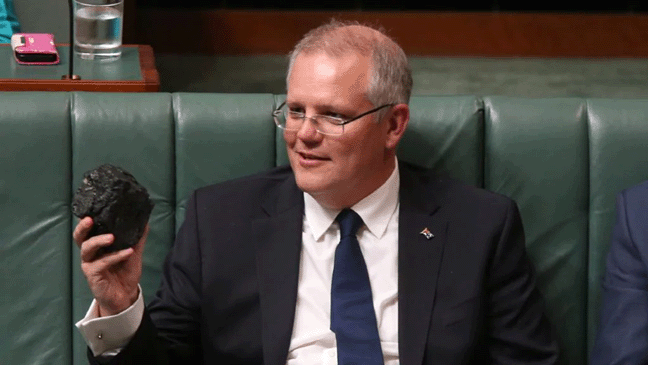
Our coal-fondling PM switches his prop to gas, but is anything really different? Jacqueline Maley, Columnist and senior journalist, The Age, 20 Sept 290 In February 2017, Scott Morrison walked into Parliament to perform a piece of coal-centred theatre that became one of the defining moments of his political career. “Mr Speaker, this is coal,” he pronounced, brandishing a black lump. “Don’t be afraid, don’t be scared. It won’t hurt you!”
As was pointed out at the time, the coal must have been lacquered – touching raw coal covers you in black dust. Morrison didn’t want to get his hands dirty. He just wanted to score a political point.
His speech was not about the benefits of coal so much as it was a gleeful attempt to wedge Labor over the electability problem it had, and still has – the insoluble tension between its heavy industry-reliant, blue-collar voter base, and its urban voters, who want meaningful climate action.
No one feels this tension more than Opposition Leader Anthony Albanese, who is old-Labor in his sensibilities, but whose inner-Sydney electorate is under siege from the Greens…………
It was always the Coalition, of course, that had the ideological attachment to coal as an energy source. The Nationals, in particular, appear to be moving away from representing farmers to supporting what is buried in the earth beneath their crops.
It is Labor that has always had the political problem with coal. It needed to convince its blue-collar base it cared about jobs and electricity prices, while also being serious about emissions reduction. But Labor is also the only side of politics that has ever been effective on emissions reduction, instituting in 2012 the only sensible mechanism to bring emissions down – a carbon price and emissions trading scheme.
It worked, in the short time it was operational, before being abolished by Tony Abbott, elected in a 2013 landslide to do exactly that.
The energy prop has changed now, with Morrison this week announcing he wants a “gas-led recovery” for the post-COVID-19 future. He is backing slowly away from coal.
In a speech in the Hunter Valley – a carefully chosen location given its significance in Labor’s own climate wars – he said there was “no credible energy transition plan for an economy like Australia that does not involve the greater use of gas”.
Details of his plan were scant. It is a plan for a plan. Morrison issued an ultimatum to electricity companies, saying if the industry did not back “dispatchable” electricity generation by next year, taxpayer money would be used to build a gas-fired power plant in the Hunter Valley, replacing the near-defunct Liddell coal plant at Muswellbrook………
Most Australians are too stressed by contemporary events, and fatigued by the climate wars, to follow the detail, which is complex. But Morrison will be able to use his “gas-led recovery” rhetoric to hedge.
His government no longer has to fight a rearguard action in defence of coal, an energy source that markets have firmly turned away from, and which public opinion is swaying against. But his party can still keep its distance from the renewable energy sources to which it seems to nurse an ideological objection. It remains to be seen if the plan will work to reduce emissions, or ensure low electricity prices.
Meanwhile, business continues to move ahead faster than the government. On Friday, BlackRock, the world’s largest investor, with $US7.32 trillion in assets under management, released a report showing that more than 1000 global companies and other organisations had signed up to the Task Force on Climate-related Financial Disclosure standards.
………Morrison’s plan for a plan will stand in for an energy policy, for now, from a government that has thoroughly betrayed the electorate on this issue for the seven years it has been in power. In that time, the earth has warmed further, and Australia has had a good taste of what is yet to come in terms of climate devastation. https://www.theage.com.au/politics/federal/our-coal-fondling-pm-switches-his-prop-to-gas-but-is-anything-really-different-20200918-p55ww9.html
Global heating is disrupting the ground in Siberia
 Bizarre Bumps come up in Siberia, The tundra climate of Siberia and Russia have been the victim of climate change and the bumps on the grounds bear its scars https://www.outlookindia.com/outlooktraveller/travelnews/story/70633/siberias-ground-bumps, Trinetra Paul, September 20 , 2020 Over the past few decades, climate change and global warming has had a string of adverse effects on the planet. And the signs of damage are increasing day by day. Bizarre Bumps come up in Siberia, The tundra climate of Siberia and Russia have been the victim of climate change and the bumps on the grounds bear its scars https://www.outlookindia.com/outlooktraveller/travelnews/story/70633/siberias-ground-bumps, Trinetra Paul, September 20 , 2020 Over the past few decades, climate change and global warming has had a string of adverse effects on the planet. And the signs of damage are increasing day by day.
Siberia has been facing the wrath of this global phenomenon over the years. Now, the ground bears the scars of climate change. The Siberian permafrost (or frozen organic ground) is slowly thawing and this is resulting in huge, bizarre bumps on the ground. Many of the craters formed in between these bumps have been filled with melting water and have transformed into small lakes. The alarming rate at which the ground is thawing is a cause for major concern. The permafrost has frozen grass and shrubs and is a reservoir of greenhouse gases. When the layer thaws, these gases are directly emitted into the atmosphere. The Siberian city of Yakutsk has been standing on a permafrost, the depletion of which will not only be a hazard for the city but also for Siberian climate and weather. Siberia, and most parts of Russia, has witnessed a huge rise in temperatures, heat waves and an early summer with temperatures reaching almost 35 degrees. A large part of it is due to global warming, oil spills, factory leakages as well as increase in eco-tourism. Yes, even friendlier modes of tourism and travel too play a pivotal role in increasing the temperature. The COVID-19 pandemic too has had its share in this. With lack of proper maintenance, devastating Siberian wildfires in May proved to be deadly due to reduced workforce, and gave out large volumes of greenhouse gases. Though eco-tourism is beneficial in creating awareness about indiginous culture, and in creating employment among locals, it also leads to modernisation and artificial (often damaging) development of a place. Nature-based adventures, trails and extreme offbeat destinations are often held accountable for destruction of untramelled areas. Experts says that there must be conscious efforts in de-escalating these ventures. Such tourism must be curtailed, and introduced with buffers like controlling daily visitor numbers, maintaining a tab over timings, and consulting environmental organisations about the best measures to protect the vulnerable areas. Sometimes that may mean not allowing any tourists at all. |
|
David Attenborough now wants us to face up to the state of the planet
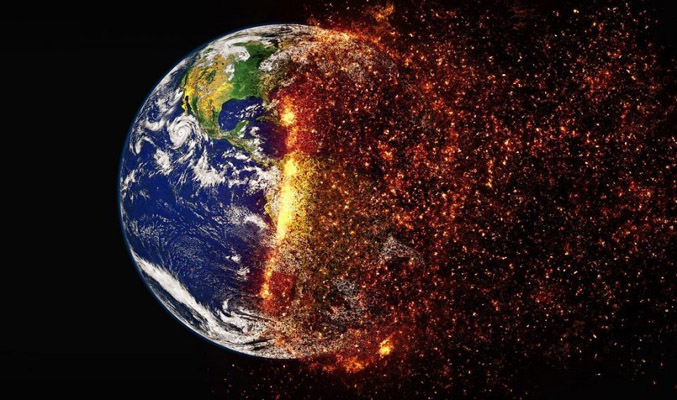
Don’t look away now: are viewers finally ready for the truth about nature?
For decades David Attenborough delighted millions with tales of life on Earth. But now the broadcaster wants us to face up to the state of the planet, PatrickGreenfield @pgreenfielduk
Fri 18 Sep 2020 Sir David Attenborough’s soothing, matter-of-fact narrations have brought the natural world to our living rooms for nearly seven decades and counting. From Australia’s Great Barrier Reef to the jungles of central Africa, the 94-year-old broadcaster has dazzled and delighted millions with tales of life on Earth – mostly pristine and untouched, according to the images on our screens. But this autumn Attenborough has returned with a different message: nature is collapsing around us.
“We are facing a crisis. One that has consequences for us all. It threatens our ability to feed ourselves, to control our climate. It even puts us at greater risk of pandemic diseases such as Covid-19,” he warned in Extinction: The Facts on BBC One primetime, receiving five-star reviews.
News Corp, Facebook and disinformation about climate and pandemic


With its stranglehold on daily newspapers and online news, News Corp in Australia has created the most rightwing media culture in the English speaking world, and they aren’t really accountable to anyone.
Facebook is also the place where we see the two disinformation crises overlap.
Just like Australia, disinformation is thriving during the US fire crisis https://www.theguardian.com/commentisfree/2020/sep/19/just-like-australia-disinformation-is-thriving-during-the-us-fire-crisis
Jason Wilson 20 Sept 20 In both countries, fake news about arson proliferated while the role of climate change was obscured.
isinformation successfully obscured the real causes of Australia’s catastrophic bushfire season. Now the same thing is happening around me, as I report on a disastrous wildfire season in the American west.
In both countries, the response to a pandemic is also being complicated by disinformation, as conspiracy theorists refuse isolation, refuse masks, and ready themselves to refuse vaccines.
A lot of the fundamental problems are the same, but there are differences in detail.
In the western United States in recent days, backroads vigilantism has seen civilians set up armed road blocks, and journalists held at the point of loaded assault rifles.
Australia does not have the complication of American gun culture, which is itself one marker of the clash of ideologies and identities in a deeply divided nation, and also raises the stakes on every other social conflict.
That may be, but it’s easy to forget that one of the major stumbling blocks to stricter gun laws in the United States is a bill of rights.
We can argue whether the right to bear arms is a sensible thing to constitutionally enshrine, but Australia has no such constitutionally defined individual rights, beyond those that the high court has seen fit to torture from the document.
The absence of such rights also contains the real world effects of conspiracy theories – the people recently arrested for incitement in Victoria over the promotion of Covid conspiracy theories and anti-lockdown protests would likely enjoy first amendment protections in the US. Whether or not people ought to have the liberty to promote ideas which are, frankly, insane, and a threat to public order, is beyond the scope of this article.
In other ways, Australia is worse off. It is easy to make the mistake of thinking that Fox News, or other skewed or tabloid media, is representative of US media as a whole. Continue reading
53 million tons of plastic could end up in rivers, lakes and oceans every year by 2030
 Annual plastic waste could reach 53m tons by 2030 https://www.dhakatribune.com/world/2020/09/20/annual-plastic-waste-could-reach-53m-tons-by-2030 Annual plastic waste could reach 53m tons by 2030 https://www.dhakatribune.com/world/2020/09/20/annual-plastic-waste-could-reach-53m-tons-by-2030
In a new modelling study published in the journal Science, ecologists monitoring pollution in aquatic ecosystems have voiced their concern, saying more needs to be done to reduce emissions
As much as 53 million tons of plastic could end up in rivers, lakes and oceans every year by 2030, even if global commitments to reduce plastic pollution are met, experts have warned. In a new modelling study published in the journal Science, ecologists monitoring pollution in aquatic ecosystems have voiced their concern, saying more needs to be done to reduce emissions, reports Evening Express. Chelsea Rochman, an assistant professor in the department of ecology and evolutionary biology at the University of Toronto, and senior author on the study, said: “Unless growth in plastic production and use is halted, a fundamental transformation of the plastic economy to a framework based on recycling is essential, where end-of-life plastic products are valued rather than becoming waste.” According to the researchers, about 19 to 23 million tons, or 11%, of plastic waste generated globally in 2016 entered aquatic ecosystems. They say computer modelling shows between 24 and 34 million tons of emissions are currently entering waterbodies around the world every year. The researchers modelled future scenarios to include the strategies that are currently in place to reduce plastic pollution in waters, such as bans on certain plastic products, continuous clean-up of litter, and plastic waste management. They found these mitigation strategies are not enough to keep plastic pollution in check, adding that an “enormous” amount of effort would be required to keep emissions below eight million tonnes a year. This would include a 25%-40% reduction in plastic production across all economies, increasing the level of waste collection and management to at least 60% across all economies, and recovery of 40% of annual plastic emissions through clean-up efforts. Plastics are slow to degrade, and even when they do, bits of them, known as microplastics, make their way into the aquatic food chain, and eventually into humans. The “Great Pacific Garbage Patch” – an enormous raft of plastic waste floating in the sea is located between California and Hawaii and embodies the worsening crisis of global plastic pollution. The patch is said to cover 1.6 million square kilometres, an area about 8 times the size of Wales. |
|
Killing the virus comes at enormous cost — doing nothing will cost more.
Killing the virus comes at enormous cost — doing nothing will cost more.

|
Why harsh COVID-19 lockdowns are good for the economy https://www.abc.net.au/news/2020-09-21/why-harsh-covid-19-lockdowns-are-good-for-the-economy/12683486, By Ian Verrender
It has been a pile-on for the past few months as Team Australia has splintered right down the political divide.
Border closures in Western Australia and Queensland have been called out as unnecessary while the Victorian lockdown has been labelled an overreaction that has angered business leaders and drawn the ire of Prime Minister Scott Morrison. The restrictions, we are constantly told, are costing the nation dearly, delaying a return to normal activity and pushing out the timetable for an economic recovery. While some argue state governments are milking the pandemic for political gain, pointing the blame at regional and state governments for our current predicament ignores two important points. The first is that the restrictions have been imposed to limit the spread of a pandemic. It is the virus that is the fundamental cause, not the restrictions. And the second is that, while it’s almost impossible to measure the true cost of the lockdowns and the shutdowns, most critics look only at the costs and completely overlook the economic benefits the shutdowns have delivered. How could lockdowns have helped the economy?Here’s one good example. Continue reading |
Scott Morrison’s three hundred year climate plan is a dark moment for Australia — RenewEconomy

“Gas chose Itself”. Those who profess – like Scott Morrison – to be ‘technology neutral’ are scrambling for a way to dismiss the urgency of climate action. The post Scott Morrison’s three hundred year climate plan is a dark moment for Australia appeared first on RenewEconomy.
Scott Morrison’s three hundred year climate plan is a dark moment for Australia — RenewEconomy
W.A. puts out call to develop 1.5 gigawatt wind and solar hydrogen hub — RenewEconomy

WA government wants to create a 1.5GW wind and solar hydrogen hub north of Perth, and has called for expressions of interest. The post W.A. puts out call to develop 1.5 gigawatt wind and solar hydrogen hub appeared first on RenewEconomy.
W.A. puts out call to develop 1.5 gigawatt wind and solar hydrogen hub — RenewEconomy
September 20 Energy News — geoharvey

Opinion: ¶ “Clearly, Biden Has Grasp On Threat Climate Change Poses” • There is near universal consensus among scientists that human activity is warming the planet. While Trump has dismissed man-made climate change as a “hoax,” Biden has put forward a $2 trillion plan to have the electricity sector free of carbon pollution by 2035. […]
September 20 Energy News — geoharvey
BHP betrays international safety efforts
|
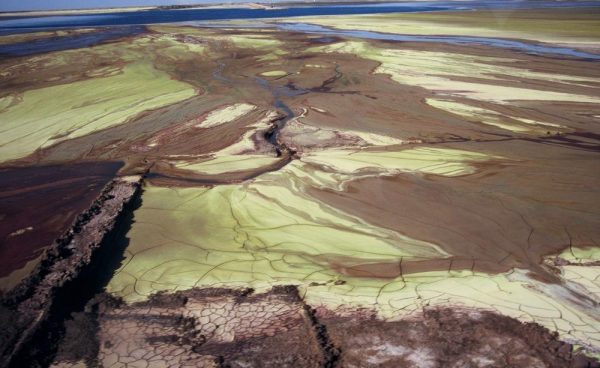
BHP betrays international safety efforts https://theecologist.org/2020/sep/15/bhp-betrays-international-safety-efforts, Dr Jim Green, David Noonan 15th September 2020, Mining giant BHP was complicit in the Samarco mining disaster in Brazil but the company has not learned from the experience. The world’s largest mining company BHP has betrayed international efforts to reform the mining sectors’ ongoing potential to cause catastrophic impacts though the failure of tailings dams. Operations at the Olympic Dam copper-uranium mine in South Australia show BHP has failed to learn key lesson’s regarding transparency, accountability and corporate responsibility following its complicity in the November 2015 disaster at the BHP and Vale joint venture Samarco iron ore mine in Brazil. Samarco was a corporate mining disaster which caused the loss of 19 lives and catastrophic environmental impacts with permanent pollution of native people’s land and rivers. Brazilian prosecutors say the company failed to take actions that could have prevented the disaster. Mine BHP now faces a $6.3 billion (US dollars) law-suit in the UK on behalf of 200,000 Brazilian people. The case alleges the Anglo-Australian mining giant BHP was “woefully negligent” in the run-up to the 2015 dam failure that led to Brazil’s worst environmental disaster. Mayors of two towns wiped out by the Samarco disaster assert that BHP has been using delaying tactics to avoid paying compensation to thousands of people affected by the flood of tailings waste. There have long been calls from environmentalists and others for Australian mining companies to be required to apply Australian standards to their overseas mining operations. The logic is sound given the often inadequate practices of Australian mining companies overseas. But the logic is also a little shaky given that mining standards in Australia leave much room for improvement. Olympic Dam is a case in point. BHP orchestrated approval in 2019 for a massive new tailings dam at Olympic Dam ‒ Tailings Storage Facility 6 (TSF6). This tailings dam is to be built in the same risky ‘upstream’ design that featured in both the Samarco disaster and the January 2019 Vale Brumadinho tailings dam disaster that killed over 250 people – mainly mine workers ‒ in Brazil. Community An internal 2016 report reveals that TSF6 has the potential to cause the death of 100 or more BHP employees and to cause “irrecoverable” environmental impacts from release of tailings waste. Yet, contrary to the recommendations of NGOs in Australia, Federal Environment Minister Sussan Ley granted approval for TSF6 without a comprehensive safety impact assessment and without setting any conditions on BHP to protect workers and the environment. TSF6 is to cover an area of nearly three sq km in tailings waste up to a height of 30 metres at the centre of the tailings pile, equivalent to the height of a nine-story building. BHP will leave this toxic mine waste there forever. Australian Prime Minister Scott Morrison has announced a “fast track” taskforce to further prioritise and accelerate approvals to BHP mining interests in a major Olympic Dam mine expansion process. BHP has clearly failed to learn the lessons of the disasters in Brazil. TSF6 represents an untenable risk to the lives of BHP employees and is unfit for community safety expectations in the 2020’s. Such approaches are clearly inconsistent with modern environmental practice and community expectations. Secret Radioactive tailings waste at Olympic Dam poses a significant long-term risk to the environment and must be isolated for over 10,000 years ‒ effectively forever. Continue reading |
Why NuScam and other ”small” nuclear proposals just don’t make any sense
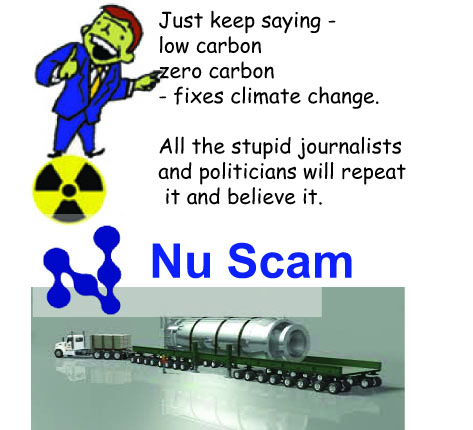 New nuclear projects, like this NuScale proposal, make no sense, Deseret, By Robert Davies, Contributor Sep 18, 2020, The debate over nuclear power has ramped up recently in Utah, with a number of the state’s municipal power agencies wrestling with continued participation in an experimental nuclear project in Idaho, the Utah Associated Municipal Power Systems/NuScale project.
Much has already been written about the project itself. Though proponents tout benefits of cost and reliability, two municipalities so far, Logan and Lehi, have recently opted out of further participation, citing mainly financial concerns over an experimental design with delays and cost overruns mounting rapidly. Still, this extremely expensive energy might be worth it ― if the environmental benefits, particularly for climate change, were significant.
Climate change is regarded within the full scientific community as a bona fide civilizational emergency ― that is, a situation requiring immediate, meaningful response to avoid catastrophic outcomes. For the climate emergency, meaningful response means cutting global carbon emissions at least in half in the next decade, and eliminating them entirely in the next two to three decades.
Electricity generation, as roughly a third of the current carbon emissions, is a large piece of the equation ― and it is on this point that nuclear power has been worth considering. Indeed, the project’s developers, having christened the endeavor the “Carbon Free Power Project,” are emphasizing the climate angle. And if the question were about building new nuclear generation versus new fossil (coal or natural gas) generation, they would have a point; the clear winner with respect to climate would be nuclear.
But this isn’t the question. In rapidly decarbonizing the electrical grid, the name of the game is replacing existing high-carbon (coal and gas) with new low-carbon, as quickly as possible.
……..proposed new nuclear makes no sense ― because it isn’t competing with fossils. Instead, new nuclear is competing with low-carbon renewables, chiefly solar and wind. And it simply can’t compete.
Investing in new nuclear projects to combat climate change is akin to the crew of the Titanic devoting time to building a whole new ocean liner instead of putting all their effort into loading the lifeboats; it steals time and resources from a much better alternative. Any money spent on new nuclear could buy us four to six times more wind and solar energy, available in months instead of a decade. And, remember, the next 10 years are critical.
Faced with this reality, UAMPS/NuScale proponents have said they want a mostly renewable grid, but supplemented by just a bit of nuclear for “baseload” ― and that this is necessary.
The refrain of 20th century-era power managers is that renewables like wind and solar aren’t reliable (“The wind doesn’t always blow, the sun doesn’t always shine … ”) and so constantly humming “baseload” is necessary for reliability. It sounds reasonable, but like most bumper-sticker wisdom, doesn’t hold up. In fact, it is objectively, demonstrably wrong.
The technologies of energy storage (utility-scale battery systems, for example) and demand management (when the energy is used) have transformed the landscape. Traditional “baseload” is no longer a necessary grid attribute. Anyone who says it is simply isn’t keeping up.
In Australia, for example, a 100-megawatt utility-scale battery system (about 1.5 times bigger than one of NuScale’s nuclear modules) is already proving more reliable and 90% cheaper than the “baseload” natural gas system it’s replacing. ………
new nuclear makes no sense whatsoever ― financially, or far more importantly, for addressing climate change.
The UAMPS/NuScale project is a poor choice for the planet, for our nation and for Utah’s independent municipal power companies. A bright future is possible if we’re smart and focused; the nuclear power trap is a distraction we can’t afford.
Robert Davies is an associate professor of professional practice in Utah State University’s department of physics. His work focuses on global change, human sustainability and critical science communication.https://www.deseret.com/opinion/2020/9/18/21400144/guest-opinion-nuscale-uamps-nuclear-project-power-utah-idaho-makes-no-sense
1 This month.


PETITION – To: Prime Minister Anthony Albanese and the Australian Labor Government
Chernobyl: The Lost Tapes – A good documentary on Chernobyl on SBS available On Demand for the next 3 weeks– https://www.sbs.com.au/ondemand/tv-program/chernobyl-the-lost-tapes/235274195556
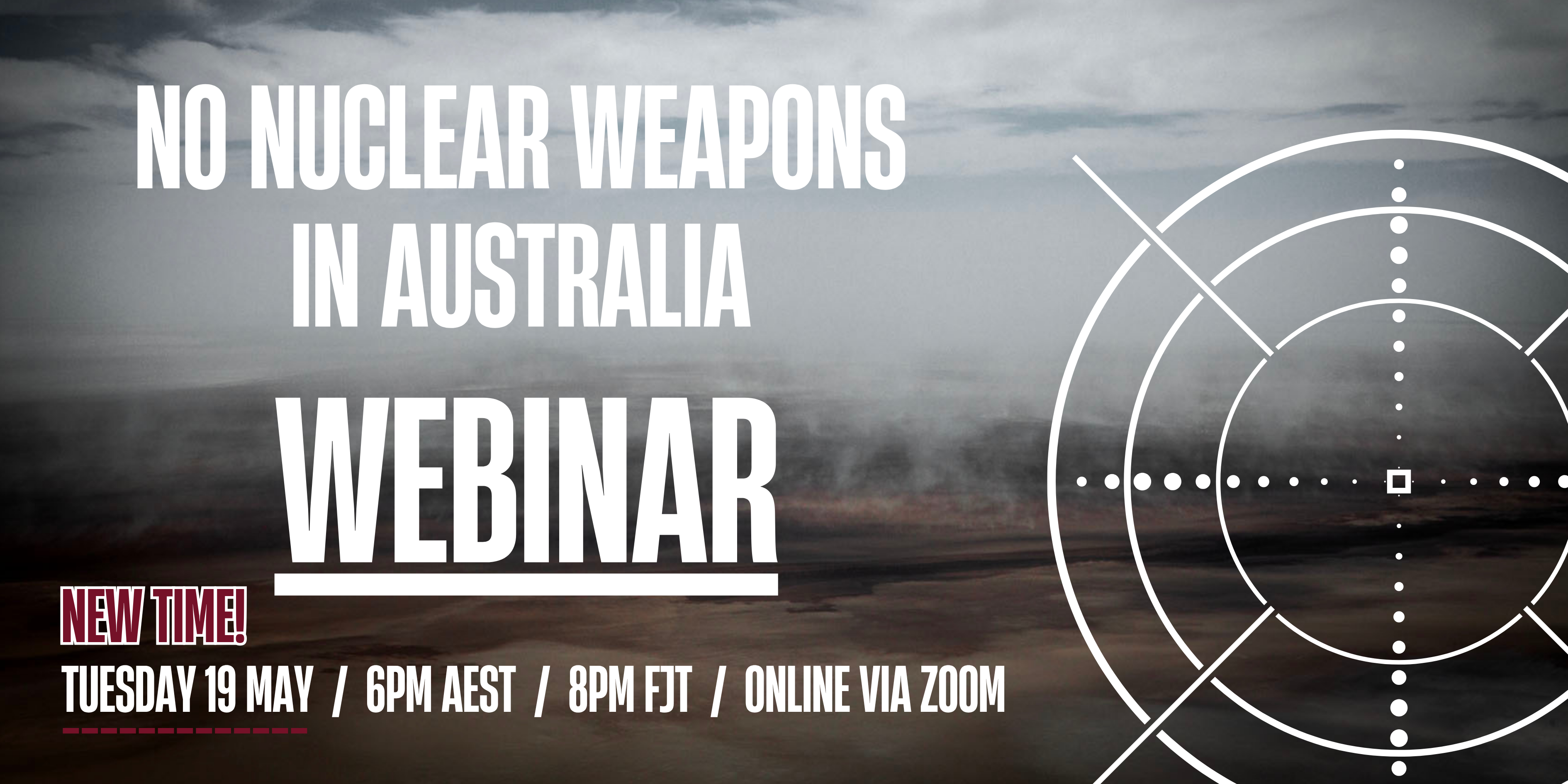
19 May – Webinar- Webinar: No Nuclear Weapons in Australia
Start: 2026-05-19 18:00:00 UTC Canberra, Melbourne, Sydney (GMT+10:00)
End: 2026-05-19 19:30:00 UTC Canberra, Melbourne, Sydney (GMT+10:00)
20 May – Webinar – The dangerous world of AUKUS, US, military occupation and suppression of dissent

National Webinar, 20th May, 2026, 6.30pm AEST. Confronting laws restricting/suppressing protest speech and action
Speakers: Former Sen. Rex Patrick, Lawyer Nick Hanna ,Arthur Rorris ,Jorgen Doyle, Sen David Shoebbridge,
Facilitator Kelley Tranter.

of the week – Australians for War Powers Reform (AWPR)
To see nuclear-related stories in greater depth and intensity
 Antinuclear