Aussies call for tougher environment laws
ACF’s chief Kelly O’Shanassy has sent it to Prime Minister Scott Morrison and his Environment Minister Sussan Ley, who are in the midst of tweaking the national protection laws.
The changes are in response to an interim review of the laws, but rather than strengthening environmental standards the first move is to cut red tape.
ACF’s petition calls on the government to create a “new generation of national laws to protect nature and funding to restore ecosystems to bring our wildlife back from the brink”.
In his interim review, former competition watchdog Graeme Samuel found the current laws were ineffective and Australia’s environmental trajectory is unsustainable.
He recommended an independent environmental watchdog, which has been rejected by the government.
Instead the first changes set the stage for states to take over environmental approvals.
They will have to abide by a set of national environmental standards, which have not yet been developed…….
Labor and the Greens oppose the government’s changes, and want Ms Ley to wait until Professor Samuel’s final report is handed down next month before changing the laws. https://www.denipt.com.au/national/2020/09/03/1566977/aussies-call-for-tougher-environment-laws
Climate change is spreading radiation from Chernobyl over 2,000 miles away
 Climate change is spreading radiation from Chernobyl over 2,000 miles away, Boing Boing, 3 Sep 20, One of the more difficult parts of trying to convince people about the seriousness of climate change is explaining how so many disparate elements and factors can collude and compound* and make everything worse. And it’s even harder to predict how long those complications will take to manifest, whenever they do what they do…….
. As The Atlantic reports:
Monitors in Norway, 2,000 miles away, detected increased levels of cesium in the atmosphere. Kyiv was smothered in smoke [from forest fires]. Press reports estimated that the level of radiation near the fires was 16 times higher than normal, but we may never know how much was actually released: Yoschenko, Zibtsev, and others impatient to take on-the-ground measurements were confined to their homes by the coronavirus pandemic. August is typically the worst month of the Chernobyl fire season, and this year, public anxiety is mounting. The devastation left by the world’s worst nuclear disaster is colliding with the disaster of climate change, and the consequences reach far and deep.
The unexpected result is an immense, long-term ecological laboratory. Within the exclusion zone, scientists are analyzing everything, including the health of the wolves and moose that have wandered back and the effects of radiation on barn swallows, voles, and the microorganisms that decompose forest litter. Now, as wildfires worsen, scientists are trying to determine how these hard-hit ecosystems will respond to yet another unparalleled disruption. ……
when something nuclear does go wrong — which is still likely, because nothing’s perfect — more nuclear power production will result in more radiation damage. And, if this situation with Chernobyl’s forest fires is any indication, then the ultimate fallout of that combined with our existing climate change problems could be even more insurmountably devastating……. https://boingboing.net/2020/09/04/climate-change-is-spreading-ra.html
Uranium mining’s health toll, on Indian regions
 Child with cerebral palsy, in uraniummining region Dungridih village. Jaduguda, photo by Subhrajit Sen.
[Photos] Suffering in the town powering India’s nuclear dreams. Mongabay, BY SUBHRAJIT SEN ON 4 SEPTEMBER 2020
- Uranium is a vital mineral for India’s ambitious nuclear power programme. Out of the seven states with uranium reserves, Jharkhand and Andhra Pradesh have currently operating mines.
- In Jharkhand’s Jaduguda region, which has India’s oldest uranium mines, local communities narrate stories of suffering due to degrading health and the environment. The government, however, denies any ill-impact of uranium mining on people.
- The Indian government is aiming to increase uranium exploration and mining.
- This photo essay features images taken between 2016-2019 of residents of villages around uranium mines in Jharkhand. Some of these photos contain sensitive content.
Anamika Oraom, 16, of village Dungridih, around a kilometre away from Narwa Pahar uranium mine in Jharkhand, wants to study. But she cannot, owing to severe headaches that come up periodically, triggered by a malignant tumour on her face. Sanjay Gope, 18, cannot walk and is confined to his wheelchair. Haradhan Gope, 20, can study, walk, talk, but owing to a physical deformity, his head is much smaller in proportion to his body.
There are many more, young and old, in the village Bango, adjacent to Jaduguda uranium mine in Jharkhand, whose lives and death highlight the ill-effects of uranium mining, say the villagers.
Uranium is a naturally occurring radioactive mineral and is vital to India’s nuclear power programme. At present (till August 31, 2020), India’s installed nuclear power capacity is 6780 megawatts (MW). The country aims to produce 40,000 MW of nuclear power by 2030.
The Uranium Corporation of India Limited (UCIL) is involved in the mining and processing uranium ore in the country. According to the UCIL, mining operations at Jaduguda began in 1967, and it is India’s first uranium mine.
In the 25-kilometre radius of Jaduguda, there are other uranium deposits at Bhatin, Narwa Pahar, Turamdih, Banduhurang, Mohuldih, and Bagjata. While UCIL claims that Jaduguda mine has created a large skill base for uranium mining and the mining industry, local communities point out that their lives and land have changed irreversibly.
The villagers complain that the hills surrounding Jaduguda, dug up to create ‘tailing ponds,’ have proven to be a severe health hazard. A tailing pond is an area where leftover material is stored after the excavated ore is treated to extract uranium. Communities argue that these ponds have led to groundwater and river contamination.
Namita Soren of village Dungridih said, “This radioactive element has become a part of our daily life.”
“Children are born with physical disabilities or people with cancer. But our sorrow doesn’t end there,” said Soren who had three miscarriages before giving birth to a child born with physical deformities.
Ghanshyam Birulee, the co-founder of the Jharkhandi Organisation Against Radiation (JOAR), said that villagers earlier marked certain forest areas as ‘cursed’ – a woman passing through the area was believed be affected by an evil gaze and suffer a miscarriage or people would feel dizzy. These areas coincided with the forest spaces around tailing ponds. In cultural translation, the regions surrounding tailing ponds became infested with ‘evil spirits.’ But as the people became more aware, they connected their misery to the mining operations.
A 2003 study by Tata Institute of Social Sciences emphasised that 18 percent of women in the region suffered miscarriages/stillbirth between 1998 and 2003, 30 percent reported some sort of problem in conception, and most women complained of fatigue and weakness.
When asked the reason for opposing the UCIL’s mining project, Birulee said, “Before mining started, people never used to have diseases like these – children were not handicapped, women were not suffering from miscarriages, people didn’t have tuberculosis or cancer. People had ordinary illnesses, cold and cough, that got cured by traditional medicines. But today, even the doctors are not able to diagnose diseases. It all emerged after uranium mining started.”
India has uranium reserves in Rajasthan, Jharkhand, Chhattisgarh, Meghalaya, Telangana, Andhra Pradesh, and Karnataka. It is currently operating mines in Jharkhand and Andhra Pradesh. The country has a detailed plan to become self-sufficient in uranium production by achieving a nearly ten-fold rise by 2031-32, including expansion from existing mines and opening new mines. However, to augment supply until then, it has signed a long-term contract with Uzbekistan (in 2019) to supply 1,100 metric tons of natural uranium ore concentrates during 2022 -2026. Similar agreements have been signed with overseas suppliers from various other countries like Canada, Kazakhstan, and France to supply uranium ore.
No help from the government or politicians
Birulee feels that the political class is aware of the problem but that has not translated into safeguarding villagers’ lives. “Whoever is elected from here – legislator or parliamentarian – has never raised our issue about radiation either in the state legislature or parliament. If they raise our issue, I am sure the government will take some action to resolve people’s issues,” said Birulee.
In March 2020, Bharatiya Janata Party leader Rajiv Pratap Rudy asked Prime Minister Narendra Modi in Lok Sabha about public health hazards due to India’s uranium mines.
Rudy asked whether the central government has reports of hazardous activities like radioactive slurry being stored in the open, causing health hazards to people residing in adjacent areas of uranium mines in the country, and, if so, the action taken on it.
While replying to the question, Minister of State for Personnel, Public Grievances and Pensions and Prime Minister’s Office, Jitendra Singh, refuted any such impact. ………..
Birulee reflects on the opposing conditions that he has witnessed. For him, it is impossible to leave behind his land, livelihood, and traditions. But for people close to the mines and tailing ponds, “the only solution is that from this region – from this radiation zone – people should be rehabilitated to a safer place. Else they’ll be surrounded by the same problems.”
Local livelihood options impacted
The people note that displacement and then deforestation for uranium mining robbed them of their land and livelihood, and later cursed them with health impacts.
Though the company and those in power deny any ill-impact on local ecology and livelihood, locals alleged that small-scale production of bidis is also hampered due to the low quality of tendu leaves. They suspect that the trees have been exposed to contaminated groundwater.
Villagers said that with expansion of mining large tracts of sal, sarjom, and teak trees are being wiped out. The trees are essential for the communities’ sacred rituals and traditional activities.
Ashish Birulee, photojournalist and member of JOAR, said that the route for transporting uranium ore is the same used by the public. He says the resulting pollution from the dust has a long-term impact on health and ecology.
Ashish adds that the mining company cannot ignore the most significant factor – the experience of people living in this area. “The experience of people is nothing less than any study or research. It can’t be denied. UCIL is not ready to admit that there are problems. It is because if it admits it would have to compensate people. Peoples’ experience shows that before 1967 there were no such issues, but it started after mining took off. If you look at the population of Jaduguda, there are a lot of people with disabilities. But if you go about 15 kilometres away, there are no such problems.”
“As far as a solution is concerned, once you start mining at any place, there is no solution. The company will mine here till the uranium ore exists. It has a lease for 45-50 years and after mining is over here, it will move to a new mine and extract resources. But the mining waste will be left here,” said Ashish. …… https://india.mongabay.com/2020/09/photos-suffering-in-the-town-powering-indias-nuclear-dreams/
Goulburn community solar farm cuts ties with Siemens over Adani coal connection — RenewEconomy

NSW 1.8MW community solar and battery project will not use Siemens inverters due to the German multi-national’s connection with Queensland’s Adani coal mine. The post Goulburn community solar farm cuts ties with Siemens over Adani coal connection appeared first on RenewEconomy.
Goulburn community solar farm cuts ties with Siemens over Adani coal connection — RenewEconomy
Tokyo Olympics will be most costly Summer Games, Oxford study shows — limitless life

In this June 3, the Olympic rings float in the water at sunset in the Odaiba section in Tokyo. Photo: AP file Sports Tokyo Olympics will be most costly Summer Games, Oxford study shows Today 04:10 pm JST 25 Comments https://japantoday.com/category/sports/oxford-study-tokyo-olympics-are-most-costly-summer-games? By STEPHEN WADE TOKYO The Tokyo Olympics are already the most expensive Summer Games on record with costs set […]
Tokyo Olympics will be most costly Summer Games, Oxford study shows — limitless life
Rooftop solar charts second-best month of 2020, despite Victoria Covid plunge — RenewEconomy

Australian homes and businesses installed another 251MW of rooftop solar in August, even as installs in Victoria fell by nearly one-quarter. The post Rooftop solar charts second-best month of 2020, despite Victoria Covid plunge appeared first on RenewEconomy.
Rooftop solar charts second-best month of 2020, despite Victoria Covid plunge — RenewEconomy
Huge 1,100MW offshore wind farm proposed in W.A. by oil explorer — RenewEconomy

Oil and gas explorer Pilot Energy launches a study into a massive 1,100MW offshore wind farm which could form part of major wind and solar hub in West Australia. The post Huge 1,100MW offshore wind farm proposed in W.A. by oil explorer appeared first on RenewEconomy.
Huge 1,100MW offshore wind farm proposed in W.A. by oil explorer — RenewEconomy
September 4 Energy News — geoharvey

Opinion: ¶ “How Does The Tesla Solar Roof Stack Up To A Traditional Solar System After 6 Months?” • Earlier this year, Tesla activated our Tesla Solar Roof system with two Powerwalls in the garage for storage. After 6 months of playing with the system, I’m excited to look at the pros and cons of […]
September 4 Energy News — geoharvey
Victoria says new transmission vital as second wind and solar tender attracts “strong” interest — RenewEconomy

D’Ambrosio says VRET2 will be formally launched in “coming weeks”, although investors concerned about network capacity and connection risk. The post Victoria says new transmission vital as second wind and solar tender attracts “strong” interest appeared first on RenewEconomy.
Victoria says new transmission vital as second wind and solar tender attracts “strong” interest — RenewEconomy
Tesla VPP expands to add virtual Big Battery to South Australia grid — RenewEconomy

Another 3,000 Powerwall batteries take Tesla SA VPP to 54MWh of combined storage to act as a single “power plant” offering services including synthetic inertia. The post Tesla VPP expands to add virtual Big Battery to South Australia grid appeared first on RenewEconomy.
Tesla VPP expands to add virtual Big Battery to South Australia grid — RenewEconomy
Foresight says Queensland solar problems to be resolved soon, falling prices take toll — RenewEconomy

Foresight hopes to have problems at two of its Queensland solar farms resolved by the end of the year, but its revenues have been squeezed by falling prices. The post Foresight says Queensland solar problems to be resolved soon, falling prices take toll appeared first on RenewEconomy.
Foresight says Queensland solar problems to be resolved soon, falling prices take toll — RenewEconomy
Mirrar people at last have control of Jabiru, as Ranger uranium mining set to end operations

Traditional owners regain control of Jabiru as historic land rights law passes Senate Natasha Emeck, NT News, 3 Sept 20 HISTORIC land rights legislation that will allow the traditional owners of Jabiru to regain control of their township has passed through the Senate.
Amendments to Aboriginal land rights laws passed through the upper house of federal parliament pm Thursday, returning the ownership of Jabiru to the Mirarr people and allowing for a long-term township lease.
The mining town was built in 1982 to service the Ranger uranium mine, which will cease operation in January 2021, heralding a new era for the town and surrounding Kakadu National Park.
Senator Malarndirri McCarthy said today’s historic moment had been a “long time coming” for the Mirarr people, who had been campaigning for this for 20 years.
Senior Mirarr traditional owner and Kakadu resident Yvonne Margarula, pictured in Kakadu National Park.
Mirarr senior traditional owner Yvonne Margarula said her people were glad to see the legal changes finally happen.
“They are essential to ensuring the vibrant post-mining future of Jabiru and the Kakadu region that Mirarr have been planning for,” she said.
“We look forward to welcoming visitors from all around the world to our beautiful country.”
Gundjeihmi Aboriginal Corporation, who represents the Mirarr traditional owners, have crafted a masterplan to turn Jabiru into an Indigenous-led tourism and services town.
“This bipartisan change to the legislation is an essential step to correct the historical exclusion of the town of Jabiru from Aboriginal ownership and allow Mirarr to take the legal control they need to enact their vision,” chief executive Justin O’Brien said.
Renewable energy can save the natural world – but if we’re not careful, it will also hurt it
Renewable energy can save the natural world – but if we’re not careful, it will also hurt it https://theconversation.com/renewable-energy-can-save-the-natural-world-but-if-were-not-careful-it-will-also-hurt-it-145166
September 2, 2020 Laura Sonter, Lecturer in Environmental Management, The University of Queensland, James Watson, Professor, The University of Queensland, Richard K Valenta, Director – WH Bryan Mining and Geology Research Centre – The Sustainable Minerals Institute, The University of Queensland
A vast transition from fossil fuels to renewable energy is crucial to slowing climate change. But building solar panels, wind turbines and other renewable energy infrastructure requires mining for materials. If not done responsibly, this may damage species and ecosystems.
In our research, published today, we mapped the world’s potential mining areas and assessed how they overlap with biodiversity conservation sites.
We found renewable energy production will exacerbate the threat mining poses to biodiversity – the world’s variety of animals and plants. It’s fair to assume that in some places, the extraction of renewables minerals may cause more damage to nature than the climate change it averts.
Australia is well placed to become a leader in mining of renewable energy materials and drive the push to a low-carbon world. But we must act now to protect our biodiversity from being harmed in the process.
Mining to prevent climate change
Currently, about 17% of current global energy consumption is achieved through renewable energy. To further reduce greenhouse gas emissions, this proportion must rapidly increase.
Building new renewable energy infrastructure will involve mining minerals and metals. Some of these include:
- lithium, graphite and cobalt (mostly used in battery storage)
- zinc and titanium (used mostly for wind and geothermal energy)
- copper, nickle and aluminium (used in a range of renewable energy technologies).
The World Bank estimates the production of such materials could increase by 500% by 2050. It says more than 3 billion tonnes of minerals and metals will be needed to build the wind, solar and geothermal power, and energy storage, needed to keep global warming below 2℃ this century.
However, mining can seriously damage species and places. It destroys natural habitat, and surrounding environments can be harmed by the construction of transport infrastructure such as roads and railways.
What we found
We mapped areas around the world potentially affected by mining. Our analysis involved 62,381 pre-operational, operational, and closed mines targeting 40 different materials.
We found mining may influence about 50 million km² of Earth’s land surface (or 37%, excluding Antarctica). Some 82% of these areas contain materials needed for renewable energy production. Of this, 12% overlaps with protected areas, 7% with “key biodiversity areas”, and 14% with remaining wilderness.
Our results suggest mining of renewable energy materials may increase in currently untouched and “biodiverse” places. These areas are considered critical to helping species overcome the challenges of climate change.
Threats here and abroad
Australia is well positioned to become a leading supplier of materials for renewable energy. We are also one of only 17 nations considered ecologically “megadiverse”.
Yet, many of the minerals needed for renewable energy exist in important conservation areas.
For example, Australia is rich in lithium and already accounts for half of world production. Hard-rock lithium mines operate in the Pilbara region of Western Australia.
This area has also been identified as a national biodiversity hotspot and is home to many native species. These include small marsupials such as the little red antechinus and the pebble-mound mouse, and reptiles including gecko and goanna species.
Australia is also ranked sixth in the world for deposits of rare earth elements, many of which are needed to produce magnets for wind turbines. We also have large resources of other renewables materials such as cobalt, manganese, tantalum, tungsten and zirconium.
It’s critical that mining doesn’t damage Australia’s already vulnerable biodiversity, and harm the natural places valued by Indigenous people and other communities.
In many cases, renewables minerals are found in countries where the resource sector is not strongly regulated, posing an even greater environmental threat. For example, the world’s second-largest untouched lithium reserve exists in Bolivia’s Salar de Uyuni salt pan. This naturally diverse area is mostly untouched by mining.
The renewables expansion will also require iron and steel. To date, mining for iron in Brazil has almost wiped out an entire plant community, and recent dam failures devastated the environment and communities.
We need proactive planning
Strong planning and conservation action is needed to avoid, manage and prevent the harm mining causes to the environment. However global conservation efforts are often naive to the threats posed by significant growth in renewable energies.
Some protected areas around the world prevent mining, but more than 14% contain metal mines in or near their boundaries. Consequences for biodiversity may extend many kilometres from mining sites.
Meanwhile, other areas increasingly important for conservation are focused on the needs of biodiversity, and don’t consider the distribution of mineral resources and pressures to extract them. Conservation plans for these sites must involve strategies to manage the mining threat.
There is some good news. Our analyses suggest many required materials occur outside protected areas and other conservation priorities. The challenge now is to identify which species are most at risk from current and future mining development, and develop strong policies to avoid their loss.
Murray-Darling River system; mysterious loss of more than 2 trillion litres of water
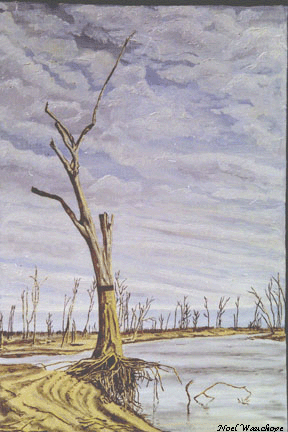
The mystery of the Murray-Darling’s vanishing flows, ABC By national science, technology and environment reporter Michael Slezak, Mark Doman, Katia Shatoba, Penny Timms and Alex Palmer 3 Sep 2020
It might be the biggest whodunnit — or what-dunnit — in Australia.
More than 2 trillion litres of water — enough to fill Sydney Harbour four and a half times — has gone missing from our largest and most precious river system — the Murray-Darling Basin.
And it’s happened in what was already one of the driest periods the basin has seen.
According to an investigation by some of Australia’s top water scientists, shared exclusively with the ABC, 20 per cent of the water expected to flow down the rivers from 2012-2019 was simply not there. That’s despite almost $7 billion being spent to protect the health of the system’s rivers and ecosystems that rely on them.
Was it stolen? Was it lost? Has climate change made it go up in steam? Or was it simply never there in the first place?
There are clues scattered up and down the rivers but one simple message is clear in the scientists’ findings. For the first time, they provide evidence that the Murray-Darling Basin Plan — the most expensive environmental program in Australia’s history — is delivering much less water than was expected.
And the implications could be huge……. EXCELLENT INTERACTIVE GRAPHICS HERE
…..“It’s a huge discrepancy to be missing a fifth of the water that’s meant to be in the rivers,” said Jamie Pittock from the ANU. He’s an expert in water management and a co-author of the Wentworth Group’s report.
“It means that there are all sorts of things that Australians value that won’t be sustained … like more water for towns … the floodplains, growing grass for sheep and cattle, in terms of biodiversity being conserved, waterbirds, red gum forests and conserving our fish.”…………
there are clues. Lots of them. We’ve seen water go missing up and down the river with clear explanations before. And looking closely at the new report, many of those explanations are consistent with the new data.
Clue one: tampered meters and criminal prosecutions
One possible explanation for the shortfall is that some of the missing water has been stolen.
An investigation by Four Corners in 2017 put water theft in the spotlight — much of it around the Barwon-Darling catchment in the Northern Basin.
Irrigators there, according to official figures, use 3 per cent of all the water taken from the entire Murray-Darling Basin.
But on top of those official figures, there has been significantly more water taken in that area. The Murray-Darling Basin Authority itself estimated that in the Northern Basin, as little as 25 per cent of surface water take has been metered.
Some of the water that went unmetered was stolen.
Peter Harris, who was named in the 2017 Four Corners, was this year found guilty of water theft just upstream from those gauges at Brewarrina.
Anthony Barlow, another person named in the program, was found guilty and fined $190,000, for water theft just upstream again.
Since the Natural Resources Access Regulator (NRAR) was formed in NSW in 2018, 15 additional charges have been laid in these locations across the state for water theft and related actions, according to an NRAR spokeswoman.
Emma Carmody, a lawyer at the Environmental Defenders’ Office, said the criminal prosecutions do not represent how widespread water theft has been.
“I’d actually go so far as to say that this situation pre-2018 was catastrophically bad in those northern catchments in relation to compliance and enforcement,” Dr Carmody said………..
Clue two: shadow take
Travel further upstream along the Macquarie River towards Dubbo, and you land in the internationally protected wetlands of the Macquarie Marshes………
In a landscape so flat, structures like roads, engineered channels and small levee banks can divert staggering volumes of floodwater — potentially shepherding it across a farmer’s fields where it is left to soak into the ground, or even pumped into dams.
This water taken by irrigators and graziers from the floodplains — rather than from the rivers — has hardly ever been measured.
Using satellite imagery, flood paths appear guided by seemingly innocuous structures, or completely cut off by others.
Richard Kingsford is a river ecologist at the University of New South Wales who has studied the Macquarie Marshes and the impacts of floodplain harvesting.
He says water that spills over floodplains often drains back into rivers, and interrupting its flow can have big impacts, including contributing to the missing flows.
“There are very few places where we have an accurate estimate of how much water is being taken from the floodplain. And to me, this has been a yawning gap in the policy,” he said…………
Clue Three: The cash splash
If we head all the way to southern NSW, we see a completely different clue.
Billions have been spent subsidising “efficiency measures” to help farmers save water there.
That can be done by upgrading old irrigation systems to deliver water directly to roots, or lining water channels, for example. Then about half of the water saved by the farmers gets handed to the government for the environment.
But according to some experts, the “inefficiencies” prior to the upgrades just meant some of the water used by irrigators flowed back into the rivers. The upgrades mean that “return flow” stops happening………..
In a report published in 2019, Professor Williams estimated that at least 280 billion litres of water per year might have been lost from the rivers — and are unaccounted for — due to this problem.
“That must be a major reason that we’re not getting the flow regimes that we need,” Professor Williams said.
The MDBA commissioned its own analysis of the issue and concluded the loss of return flows was reducing water in the rivers by 121 billion litres a year.……..
Clue Four: Climate change
There is one issue, however, that most experts do agree is a major reason for the missing water in the basin.
“The MDBA considers a changing climate to be the primary contributory factor,” said the MDBA’s Vicki Woodburn.
Since the basin plan was introduced, heat records across the area have been broken in four of the eight years. The last three years have been the hottest ever recorded in the basin.
According to the South Australian royal commission into the Murray-Darling basin plan, the MDBA “completely ignored climate change” when determining how much water needed to be saved.
If true, that means the overall target may have been set too low — that more water needs to be recovered from irrigation to save the river system.
But the same models used to set those targets have also been used to manage the rivers, and now to calculate how much water should be in the rivers. And by inadequately accounting for climate change, those models are likely over-predicting how much water is being recovered.
Climate change means more water is likely being lost between gauges, as it flows along — lost into the dry river beds and the hot air…………..
Clue five: The water was never there
In a twist worthy of any whodunnit, could it be that some of the missing water was simply never there in the first place?
According to the Wentworth Group, the government modelling used to predict how much water we should see in the river has some fundamental flaws which likely exaggerate the volumes.
For example, in 2018, the Murray-Darling Basin Authority found its modelling “has trouble predicting low flows”.
That meant that when water stopped flowing in the river, the model would still show water flowing — something that could have been particularly problematic over the past seven years when low flows were very common………….
What it all means
If there’s less water in the rivers than we ever planned for, what’s to be done about it?……………..
Professor Vertessy, who advises the MDBA, thinks this sort of shortfall could contribute to a rethink of the long-term water recovery targets. https://www.abc.net.au/news/2020-09-03/the-mystery-of-the-murray-darlings-vanishing-flows/12612166?nw=0
“We may have to — I think everyone would accept that these sustainable diversion limits aren’t quantities which you ossify for posterity,” he says.
“They’ve got to be adjusted to fit in with the new climate realities and the social preferences of the day.”
And the scientists say whatever the response to the findings, something has to give.
“The current basin plan tries to pretend that we can do everything with a smaller and smaller cake,” says Professor Pittock.
“What this really means is that society is going to have to make some hard choices. How much irrigated agriculture do we want as a society versus how much do we want to retain by way of wetlands and ecosystems [or] of sites of cultural value to Indigenous people?” https://www.abc.net.au/news/2020-09-03/the-mystery-of-the-murray-darlings-vanishing-flows/12612166?nw=0
Repower WA with Renewables: 90% by 2030
|
Repower WA with Renewables: 90% by 2030, https://www.cleanstate.org.au/repower_wa Western Australia’s energy sector is one of the best places to start to create thousands of jobs and drive down emissions. With the best sun and wind resources in the world, it’s time to harness the economic benefits and renewable potential of our state. All Australia’s other states & territories are embracing the clean energy transition with renewable energy targets, and WA’s lack of such a plan is a failure to grasp an excellent opportunity.
Repowering WA with renewable energy provides a once in a generation opportunity for infrastructure investment, jobs and value creation that will be a powerful driver for economic activity for decades to come. The proposalPowering WA’s Southwest electricity grid with renewable energy by 2030 is both affordable and achievable. The costs of building and delivering renewable energy solutions are reducing every year, and large scale wind and solar are already able to deliver cheaper electricity than coal and gas. Repowering WA can reduce energy bills for homes and businesses, and support significant growth in manufacturing, minerals processing and other energy-intensive industries that can employ more people here in WA. A report commissioned by Clean State has found the move to 90% renewable electricity on WA’s South West Interconnected System (SWIS) is technologically possible by 2030 and would create over 8600 jobs. The 90% Renewable Energy Roadmap created by expert group Sustainable Energy Now provides a transition blueprint for the SWIS – WA’s main electricity grid covering most of the population and spanning from Geraldton to Kalgoorlie. For this plan, new renewable energy generation capacity totalling 11.7 GW of will be required by 2030. Optimising the mix of technology to take into consideration electricity demand, weather, cost, technology and the design of the SWIS grid, the SEN model suggests that this should be made up of:
This investment would provide a significant number of jobs to build the infrastructure required. Each year, 800MW of new renewable energy capacity would need to be added, which is, roughly equivalent to the sum of the following:
There would also be additional investment and employment opportunities in providing energy storage and grid services to compliment this generation mix. Much of the rooftop solar can be delivered by private investment if WA’s electricity market is reformed to enable rooftop solar and battery systems to link into the grid productively. Increased battery storage would stabilise the network, and with 78,000 houses in WA coming off a 40c feed in-tariff this year, there is a prime opportunity to encourage these households to upgrade and battery. Besides the climate benefits and direct employment gains accompanying these investments and reforms, a timetable for the staged and managed closure of WA’s coal-fired power stations will avoid energy and business uncertainty, both for the state and for those currently working in the industry. Many credible studies have found that the SWIS, WA’s main grid, can transition to 100% Renewable sources by 2030. These include:
|
|
1 This month.

PETITION – To: Prime Minister Anthony Albanese and the Australian Labor Government
Chernobyl: The Lost Tapes – A good documentary on Chernobyl on SBS available On Demand for the next 3 weeks– https://www.sbs.com.au/ondemand/tv-program/chernobyl-the-lost-tapes/235274195556

19 May – Webinar- Webinar: No Nuclear Weapons in Australia
Start: 2026-05-19 18:00:00 UTC Canberra, Melbourne, Sydney (GMT+10:00)
End: 2026-05-19 19:30:00 UTC Canberra, Melbourne, Sydney (GMT+10:00)
20 May – Webinar – The dangerous world of AUKUS, US, military occupation and suppression of dissent

National Webinar, 20th May, 2026, 6.30pm AEST. Confronting laws restricting/suppressing protest speech and action
Speakers: Former Sen. Rex Patrick, Lawyer Nick Hanna ,Arthur Rorris ,Jorgen Doyle, Sen David Shoebbridge,
Facilitator Kelley Tranter.

of the week – Australians for War Powers Reform (AWPR)
To see nuclear-related stories in greater depth and intensity
 Antinuclear