Nuclear news and more – week to 2 December.

Some bits of good news. Scientists develop a plastic that dissolves at sea. Cop29 offered some silver linings. More Than 30 Stranded Whales Rescued in New Zealand by People Lifting Them on Sheets.
TOP STORIES
Project 2025 calls for massive changes to Hanford nuclear cleanup. France is weighing zero-interest loan for 6 nuclear reactors, sources say.
Civil and military nuclear programmes: will they be derailed by skills shortages?
Decommissioning old nuclear sites to cost £130bn in blow to Miliband.
Climate. Huge COP29 climate deal too little too late, poorer nations say. ‘Unprecedented’ climate extremes are everywhere – Our baselines for what’s normal will need to change.
Environment. What Project 2025 Would Do to the Environment – and How We Will Respond.
Noel’s notes. SMRs underground – long drop nuclear toilets? – a chance to use that beaut new word – enshittification. Ecology be damned -we won’t know what’s hit us after January 20th
AUSTRALIA. ABC chair Kim Williams says investment in national broadcaster the best counter to ‘flood’ of misinformation. Australia’s top environment groups – Submission to Government Inquiry into Nuclear Power Generation in Australia.
NUCLEAR ITEMS.
ATROCITIES. Israel Attacks Kill 155 Palestinians in Gaza Over 72 Hours. Israel Has Killed Over 1,000 Doctors and Nurses in Gaza. Israeli snipers ‘shoot Palestinians for sport’.
CIVIL LIBERTIES. The Antisemitism Awareness Act Is the Death Knell for Free Speech.
ECONOMICS. Is Europe Ready for a Nuclear Renaissance? France postpones financing decision of 6 new reactors – report.
| EDUCATION. Christian Nationalism Marches on With ‘Bible-Infused’ Texas Curriculum. |
| EMPLOYMENT. Hinkley Point C: Hundreds down tools over concerns. Only 20% of Great British Nuclear staff employed permanently-ALSO AT https://nuclear-news.net/2024/12/02/1-b-only-20-of-great-british-nuclear-staff-employed-permanently/ |
| ENERGY. Hunterston ‘industrial revolution’ on our doorstep – liquid air energy storage. |
| ENVIRONMENT. Just Don’t Mention (or Measure) the Pu (Plutonium). Plans to turn land in Somerset into a saltmarsh should be scrapped.. |
| EVENTS. 5 December -Adelaide, Australia – STOP PETER DUTTON’S NUCLEAR REACTOR THREATS -Peaceful protest outside Federal Government’s Inquiry into nuclear power generation in Australia |
| HEALTH. ‘No plans’ for specific nuclear test veteran compensation. Plutonium. Suspected case of plutonium contamination in Rome plant. |
| INDIGENOUS ISSUES.Listening to Indigenous views. Indigenous views on nuclear energy and radioactive waste .https://www.youtube.com/watch?v=9i7XtIGFqyY |
| LEGAL. Today in Imperial Recklessness & Insanity. The United States Raises a Middle Finger to the International Criminal Court. |
| MEDIA. War Crimes in Lebanon: Human Rights Watch Says Israel Used U.S. Arms to Kill 3 Journalists. |
POLITICS. As America barrels toward war with Russia….Where’s Biden? From Genocide Joe to Omnicide Joe. Donald Trump’s quick trip to absolute dictatorship.
Inside Project Esther, the right wing action plan to take down the Palestine movement. https://www.youtube.com/watch?v=PPar-qf5FwY
EDF’s controversial River Severn saltmarshes plan should cease, says County Council leader.
POLITICS INTERNATIONAL and DIPLOMACY. “Israel Wants Wars”: Gideon Levy on Lebanon Ceasefire, Gaza & Gov’t Sanctions Against Haaretz– https://www.youtube.com/watch?v=i12aMIxc8As
Iran and Europe seek to break nuclear impasse before return of Trump. Iran to hold nuclear talks with France, Germany, UK. Iran says it could end ban on possessing nuclear weapons if sanctions reimposed.
PUBLIC OPINION Game changer: world turns against Israel – https://www.youtube.com/watch?v=gJSWAun9Xnc
SAFETY.
- IAEA warns of impact on nuclear safety of attacks on Ukraine’s energy infrastructure.
- Unidentified drones continue to fly over US military bases in UK. Mystery drone spotted over British aircraft carrier.
- Security planning for small modular reactors ‘not where it should be’, academic says= ALSO AT https://nuclear-news.net/2024/12/02/1-b1-security-planning-for-small-modular-reactors-not-where-it-should-be-academic-says/
- Indonesia’s nuclear energy push pits growth against safety concerns.
- Very ambitious’: regulator’s view of 2027 Bridgend nuke power plant plan. Channel Islands sign nuclear incident agreement. Small nuclear reactors are at risk from military attacks, so should be built underground.
- Why Bunkers Won’t Save The Super Rich.
| SECRETS and LIES. UK Government urged to end secrecy over ‘worrying’ drone sightings near nuclear-linked air bases. The secret audit that crucifies most French nuclear start-ups ALSO AT https://nuclear-news.net/2024/11/26/3-b1-the-secret-audit-that-crucifies-most-french-nuclear-start-ups/ |
| TECHNOLOGY. The entanglement of fusion energy research and bombs.Iran deploys advanced centrifuges in defiance of IAEA resolution. |
| URANIUM. Ironic Dependency: Russian Uranium and the US Energy Market |
| WASTES. The Nuclear Waste Management Organization (NWMO) Siting Process Fails to Achieve its Goal. South Bruce spared, but Ignace selected for Canadian nuclear waste dump. |
WAR and CONFLICT. Israeli army pushes deeper into south Lebanon as ceasefire violations intensify. Ceasefire Falters as Israel Launches Airstrikes, Artillery Shelling on Southern Lebanon.
Mass Desertions Over Radiation Could End the War in Ukraine. Ukraine has lost almost 500,000 troops – Economist. Mass desertions crippling Ukrainian army – AP. White House Pressing Ukraine To Draft 18-Year-Olds for War . Ukrainians And Americans Are Done With This War, But It Keeps Escalating Anyway.
WEAPONS and WEAPONS SALES. Biden seeking extra $24bn for Kiev – Politico. G7 finalizing $50 billion loan to Ukraine – Washington. White House finally confirms greenlight for deep Russia strikes. Russia Prepares to Respond to the Armageddon Wanted by the Biden Administration. Transfer of nukes to Kiev would be viewed as attack on Russia – Medvedev.
Biden administration advancing $680m arms sale to Israel, source says.
The Technology for Autonomous Weapons Exists. What Now?.
A sneak preview of Peter Dutton’s nuclear costings
Tristan Edis, Dec 2, 2024, , https://reneweconomy.com.au/a-sneak-preview-of-peter-duttons-nuclear-costings/
Any day now, we should be provided with an estimate from the Liberal-National Coalition and/or Frontier Economics on what Peter Dutton’s plan for nuclear power will cost us.
Keep in mind we already have plenty of sources of information for what nuclear power costs based on real-world experience.
The chart below,[ on original] based on analysis by myself and Johanna Bowyer, shows the power price required for nuclear power plants to be commercially viable compared to current wholesale energy costs passed on to residential power consumers.
These power prices are based on the cost of actual power plants which have either been committed to construction or which provided tender construction contract offers over the past 20 years across Europe and North America.
Our research indicates that conventional nuclear power stations cost anywhere between $14.9 to $27.5 million per megawatt to construct. They also accumulate significant finance interest costs over a lengthy construction period ranging between 9 to 18 years.
While yet to be commercialised small modular reactors are promised to achieve shorter build times, they don’t exist, except on the drawing board.
The only one that has progressed to a construction contract in the developed world would have cost $28.9 million per megawatt. These are the range of costs and build times that the Coalition and/or Frontier Economics should be using if they want to be realistic.
This would lead to the uncomfortable conclusion that household power bills would need to rise by around $665 per year for nuclear power plants to recover their costs from the electricity market.
Oddly, Ted O’Brien and Angus Taylor didn’t think real world experience with nuclear projects was a valid basis for assessing the cost of their plan. That, of course, makes one wonder what they might have in mind.
Here are four ways they might instead approach their costing:
1) Apply the shoulda, coulda, woulda approach to costing nuclear power plants also known as a “nth of a kind” costing;
2) Assume all transmission upgrade costs can be avoided with nuclear even though the prior Liberal-National Government approved and supported these transmission projects when in government;
3) Assume coal power plants never grow old;
4) Assume the damage from emissions released prior to 2050 don’t matter
We look at those claims in detail.
1) Look out for ‘NOAK’ or the shoulda, coulda, woulda approach to costing
Advocates for nuclear power aren’t terribly fond of using costs based on real-world experience. Instead they like to apply the shoulda, coulda, woulda approach to power plant costing.
This is where they assume away all the things that almost always go wrong with nuclear power plant construction, and imagine what should, could, or would happen if the real world would just stop being so damn unco-operative.
This typically requires that:
1. Construction companies and component suppliers stop making mistakes and stop seeking to claim contract variations;
2. Members of the community and politicians welcome nuclear projects with open arms and stop seeking to obstruct and delay them;
3. Nuclear plant designers get their designs perfect right from the start, avoiding the need to make adjustments on the fly as construction unfolds;
4. Financiers stop worrying about risk;
5. The community and politicians loosen-up about the small risk of radioactive meltdowns and apply less onerous safety requirements;
6. Construction staff aren’t tempted away to non-nuclear projects with offers of better pay or a more reliable stream of work;
7. Safety regulators work co-operatively and flexibly (compliantly?) with industry; and
8. Power companies en masse commit to ordering lots of reactors from a single supplier well in advance of when needed to enable the supply chain of nuclear equipment suppliers to achieve mass economies of scale and learning.
You generally know that these types of assumptions have been made in a nuclear costing because that costing will be described as a “nth of a kind” or NOAK cost.
The idea here is that incredibly high costs that were incurred in building all the prior nuclear power plants were an anomaly because they involved a whole bunch of mistakes and inefficiencies that the industry will learn from.
So, after they build several more and get progressively better, they’ll eventually reach the “Nth” number of plants, and all the problems that made prior plants so expensive will be ironed out.
At exactly what number plant do we reach N?
Well that’s usually a bit rubbery.
Under pressure from the nuclear lobby, you’ll find this NOAK costing approach is commonly adopted by the International Energy Agency, the US Department of Energy and even Australia’s CSIRO adopted a nuclear NOAK costing for its GenCost publication.
Unfortunately, while these agencies are generally good sources of information, the Nth power plant seems to always be a few more nuclear power plants away from being realised.
In reality the cost of building nuclear reactors has historically got worse rather than better over time in the western world.
The chart below [on original] illustrates the construction cost experience for pressurised water reactors in the US (in blue) and France (in red). Note this was based on a 2011 paper and omits the more recent and even worse cost experience detailed in the report by Bowyer and myself.
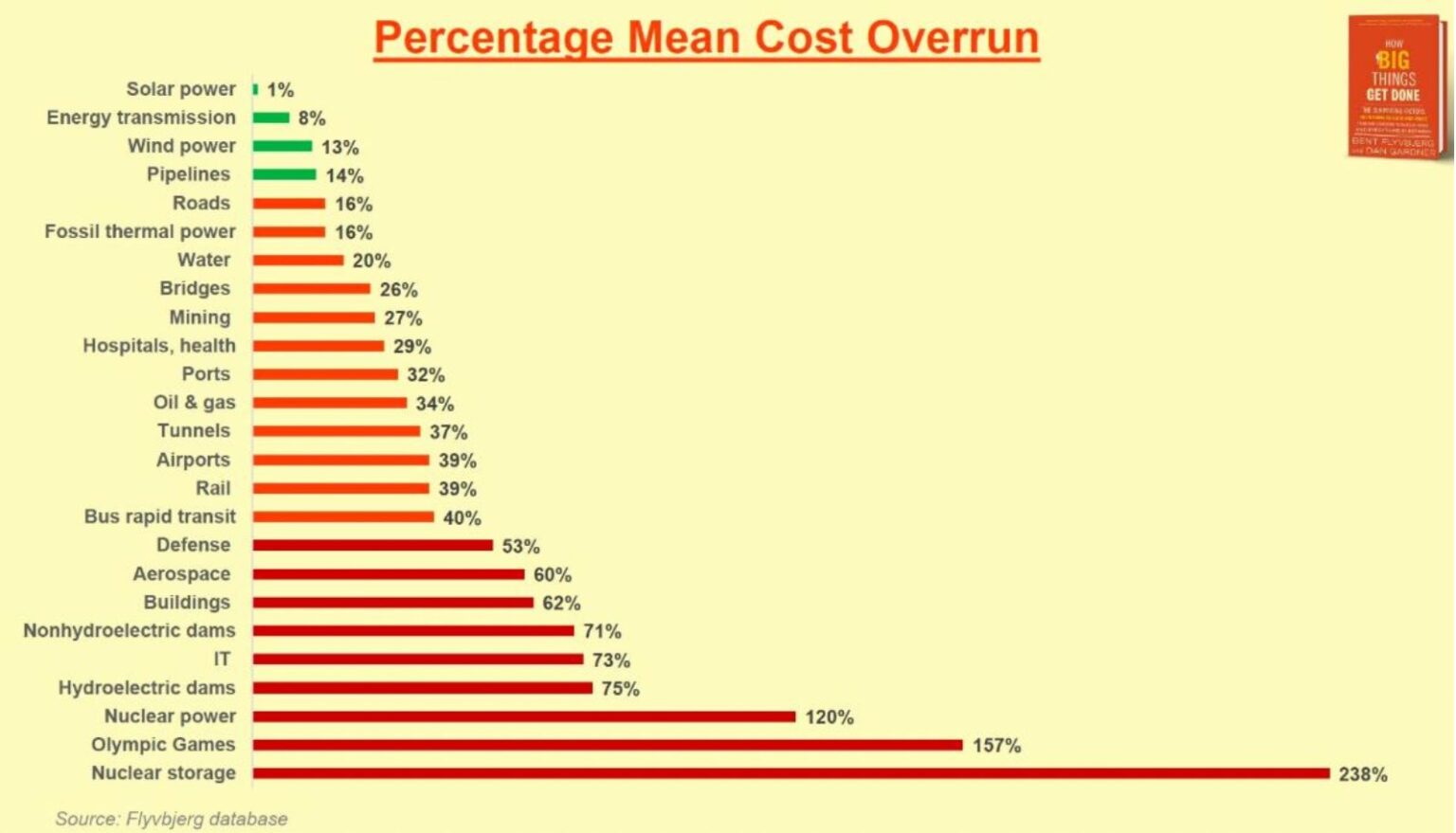
Bent Flyvberg – a professor in construction management at Oxford University and author of the bestselling book, How Big Things Get Done, has helpfully compiled a huge database of how major construction projects across the globe have performed against their original budgets.
This database reveals just how unreliable are the costings provided by the nuclear industry and its proponents. As the chart below published by Flyvberg reveals, the mean cost overrun of nuclear power projects stands at 120%, with only Olympic Games and Nuclear Waste Storage Facilities managing worse cost over-runs.
Meanwhile look at what types of projects perform well [graph at top of page]– notice anything?
For the journalists reading this article your task is simple – when the Coalition or Frontier Economics release their nuclear plan costing you need to ask them the following:
(1) Can you please provide us with a written assurance from the CEO of an experienced nuclear technology provider, like Westinghouse, EDF or Korea Hydro and Nuclear Power, confirming they are willing to enter into a fixed price contract to build a nuclear power plant in Australia for the cost and timeframe used in your costing?
If instead they cite to you the experience of the Barakah Plant in the United Arab Emirates let’s say, then you can always ask them:
So, like the United Arab Emirates, will you be:
– allowing the mass importation of construction labour from developing countries;
– removing the right of workers to collectively organise and bargain;
– exempting nuclear construction projects from paying Australian award wages; and
– banning the right to peacefully protest?
2) All transmission expansion costs are the fault of Labor and can be avoided with nuclear power
It should be acknowledged that transmission network expansion projects in this country are also being hit by large budget blow outs which involve multi-billion dollar costs. We need to do a far better and more judicious job in the roll out of transmission projects in this country.
It’s also true that several of these projects are critical to supporting ongoing expansion of wind and solar power. Ted O’Brien and David Littleproud have been highly critical of these new transmission projects and claimed extra transmission costs can be avoided by rolling out nuclear.
Given this, their forthcoming costing will probably suggest all of these new transmission costs can be sheeted home to Labor’s Renewable Energy Policies.
But this would also indicate that O’Brien and Littleproud suffer from amnesia. That’s because the major transmission expansions which are incurring the largest costs were actively pushed by the former Coalition Government which both of them served in.
Read more: A sneak preview of Peter Dutton’s nuclear costingsThe prior government “welcomed” and helped underwrite the new 900 kilometre transmission interconnector between SA and NSW.
In the lead up to the 2019 election, they vowed to build a second electricity interconnector between Tasmanian and the mainland.
In January 2020 the Federal Coalition entered into a funding deal with the NSW Government to upgrade transmission lines across north, central and southern NSW.
As part of the 2020 budget, Angus Taylor and a range of National Party MPs announced funding support for an 840km transmission line across inland Queensland which they declared was a “commitment to regional jobs, industry development and affordable reliable power.”
Then, leading into the 2022 election, they announced they would underwrite construction works on a major new transmission line between NSW and Victoria.
Then Energy Minister Angus Taylor’s press release at the time spoke glowingly about the benefits of new transmission, stating:
“Our investment in this project will support reliable electricity supply, deliver substantial cost savings and help keep the lights on for Australian families, businesses and industries.
This builds on the Morrison government’s record of judicious investment of over $800 million in priority transmission projects recommended by AEMO’s Integrated System Plan – projects that stack up for consumers.”
3) Relying on coal power plants that never grow old
It is almost guaranteed that the Coalition’s costing model will assume we can rely on the existing coal power stations to keep powering on for another decade or two with no deterioration in their reliability, before they then switch to nuclear power.
This is a very handy assumption to make because it allows you to avoid or delay significant costs involved in building the new, replacement power stations before the nuclear plants miraculously come to the rescue.
Yet while it might be a handy modelling assumption, it probably isn’t a realistic one.
To keep coal power plants reliable, especially when they are several decades old, requires ongoing significant expenditure on maintenance and replacement parts. Plus, even with this expenditure there can reach a point where a plant is so old it will continue to suffer serious reliability problems.
A good example of the risks and limitations of refurbishment is the case of the attempt to refurbish Western Australia’s Muja A and B coal generating units of 240 megawatts.
In 2007 these units, which were approaching 50 years of age, were mothballed. But by 2009 the WA Government announced they would be recommissioned due to a gas shortage that had afflicted the state. At the time the cost was estimated to be $100m.
The cost of refurbishment subsequently blew out to $290 million and in 2012 one of the units suffered an explosion due to corroded piping, injuring a worker.
A subsequent investigation highlighted a range of technical problems with the plant that made refurbishment challenging, but in 2013 the government chose to press on and sink a further $45 million into the project, claiming it would have a lifetime of 15 years and ultimately recover its costs.
However, even after refurbishment was completed it was reported by the West Australian newspaper the generating units were “plagued by operational and reliability problems, generating electricity just 20 per cent of the time. By 2018 the WA Government decided to cut their losses and shut Muja A and B permanently.
AGL’s Liddell Power Station is another case in point. AGL argued that a ten year life extension would cost $900m, and decided it wasn’t worth it. A government taskforce which sought to second guess AGL on the closure noted,
“a Liddell extension meets the maximum power output requirement.
This means it could provide sufficient capacity to maintain current levels of reliability in NSW as long as it is actually available during peak demand conditions. However, the increasing risk of outages as the plant ages gives rise to an increasing possibility those outages would lead to supply shortfalls.
Liddell already has a high outage rate compared with other NSW coal generators…. There is a risk that upgrades to make the plant compliant with safety and other regulation would not alter its upward trajectory of faults and unplanned outages.”
The other issue is that owners of power plants are likely to face considerable difficulty raising finance to undertake such refurbishment.
Delta Electricity, the owner of the Vales Point B coal power station, revealed in a rule change request to the AEMC that it was facing significant difficulty accessing bank finance stating, “A significant number of financial institutions…are no longer providing financing facilities to fossil fuel generators”.
The rule change request asked that Delta be able to provide cash, rather than a bank guarantee to AEMO to meet prudential requirements for trading purposes.
It explained that the bank providing its current guarantee was unwilling to continue with this arrangement because lending to a coal generator was in breach of environmental policies governing its financing practices.
In a search to find another lender Delta found, “during the refinancing process that 13 of the 15 lenders declined due to ESG [Environment, Social and Governance] constraints, which included the Big-4 Australian banks.
“Both of the remaining financial institutions were prepared to offer a bank guarantee facility to provide credit support related only to requirements for mining rehabilitation obligations and renewable Power Purchase Agreements.”
Some conservative politicians might like to pass this off as some short-term, woke fashion that will pass once they reach power. But it won’t pass, because bankers don’t like to lend money to risky commercial ventures.
Some conservative politicians might think global warming is an idea promoted by a mass conspiracy of meteorological science agencies across the globe to impose a socialist, world-wide government. However, most people think that’s a bit far-fetched.
Conservative politicians that think climate change is a hoax aren’t always in power, so bankers recognise there is a significant risk coal generators will be subject to emission control policies that will undermine their commercial viability.
This isn’t a distant risk, because such policies (which often are targeted towards supporting growth of renewable energy) have already been implemented.
4) The damage caused by power plant emissions in the years prior to 2050 don’t matter
Carbon dioxide and a range of other greenhouse gas emissions released by fossil fuel extraction and combustion last many decades once released into the atmosphere. Consequently, the extent of global warming is a function of the accumulated stock of greenhouse gas emissions in the atmosphere built up over time.
It isn’t a function solely of emissions in the single year of 2050. If we manage to achieve net zero emissions in 2050, but have polluted the hell out of the atmosphere in the preceding years then global warming will be very bad indeed.
A tonne of CO2 emitted this year and each of the years preceding 2050 will cause damage to society that is worth something to avoid. Any economist worthy of calling themselves an economist knows that the value of this avoided damage needs to be taken into account in any attempt to properly cost alternative options for our electricity system.
The Australian Energy Regulator provides one such option for valuing this in its paper – Valuing emissions reductions.
It should be noted the AER’s attaches significantly lower value to avoiding emissions than the United States Environmental Protection Agency recommends in the years prior to 2050, and very far below values used by the UK Government.
If the Liberal-National Party’s policy leads to slower emission reductions (even if they ultimately deliver net zero by 2050) this carries a serious penalty for our children and future children.
If it is ignored from their economic analysis, can we come to any other conclusion than the Liberal-National Party think climate change is so unimportant its impacts can be ignored?
Tristan Edis is director of analysis and advisory at Green Energy Markets. Green Energy Markets provides data and analysis on energy and carbon abatement certificate markets to assist clients make informed investment, trading and policy decisions.
Australia’s top environment groups – Submission to Government Inquiry into Nuclear Power Generation in Australia.
Friends of the Earth Australia
Australian Conservation Foundation
Greenpeace Australia Pacific
The Wilderness Society
Climate Action Network Australia
Nature Conservation Council (NSW)
Environment Victoria
Conservation SA
Queensland Conservation Council
Conservation Council of WA
Environment Centre NT
Solutions for Climate Australia
Arid Lands Environment Centre
Environment Tasmania
Environs Kimberley
Cairns and Far North Environment Centre
Submission to the House Select Committee on Nuclear Energy Inquiry into Nuclear Power Generation in Australia. November 2024 – (23 pages)
EXECUTIVE SUMMARY
Our groups maintain that federal and state legal prohibitions against the construction of
nuclear power reactors have served Australia well. We strongly support the retention of
these prudent, long-standing protections.
Claims that nuclear reactors could be generating electricity in Australia by 2035‒37 do not
withstand scrutiny. Introducing nuclear power to Australia would necessitate at least 10
years for licensing approvals and project planning, and around 10 years for reactor
construction. Nuclear power reactors could only begin operating around the mid-2040s at
the earliest. Most or all of Australia’s remaining coal power plants will be closed long before
nuclear reactors could begin supplying electricity.
Small modular reactors (SMRs) do not exist. The so-called operating SMRs in Russia and
China were not built using serial factory production methods. They could not even be called
prototype SMRs since there are no plans to mass-produce these reactor types using serial
factory production methods. SMRs are best thought of as Smoke & Mirror Reactors: they do
not exist. A few small reactors are under construction (in China, Russia and Argentina) but
once again serial factory production methods are not being deployed.
Construction timelines for the so-called SMRs in Russia and China were protracted: 9 years
in China and 12 years in Russia. In both countries, planning plus construction took 20 years
or more.
After costs rose to a staggering A$31 billion per gigawatt, US company NuScale abandoned
its flagship SMR project in Idaho last year. This led the Australian Coalition parties to
abandon their SMR-only nuclear policy. Worse was to follow. In mid-2024, French utility EDF
announced that it had suspended development of its Nuward SMR and reoriented the
project “to a design based on proven technological building blocks.” In May 2023, Ultra Safe
Nuclear claimed at an Australian Senate hearing that the company is building SMRs in North
America. In fact, the company has not begun building SMRs anywhere and in October 2024
the company announced that is pursuing a sale process under Chapter 11 of the US
Bankruptcy Code.
Many other SMR projects have failed. The French government abandoned the planned
ASTRID demonstration fast reactor in 2019; Babcock & Wilcox abandoned its Generation
mPower SMR project in the US in 2017; Transatomic Power gave up on its molten salt
reactor R&D in 2018; MidAmerican Energy gave up on its plans for SMRs in Iowa in 2013;
TerraPower abandoned its plan for a prototype fast neutron reactor in China in 2018; and
the US and UK governments abandoned consideration of ‘integral fast reactors’ for
plutonium disposition in 2015 and 2019, respectively.
The SMR sector is littered with failed and abandoned projects, false claims and false dawns
Large reactor construction projects have also suffered catastrophic cost overruns and
delays. In both of Australia’s AUKUS partner countries, early cost estimates were proven to
be wrong by an order of magnitude:
- One project in the US was abandoned in 2017 after A$13.9 billion was wasted on the
failed project, in South Carolina. Another project ‒ the twin-reactor Vogtle project in the
state of Georgia ‒ reached completion at a cost 12 times higher than early estimates, and 6‒
7 years behind schedule. Not a single reactor is currently under construction in the US. Not
one. - In the UK, the Hinkley Point twin-reactor project was meant to be complete in 2017 but
construction didn’t even begin until 2018 and the latest cost estimate is 11.5 times higher
than early estimates. No other reactors are under construction in the UK. The UK National
Audit Office estimates that taxpayer subsidies for the Hinkley Point project could amount to
£30 billion (A$58.4 billion). The Hinkley Point reactors are being built by French utility EDF.
France’s only recent domestic reactor construction project has also been a disaster: the
reactor is still not operating 17 years after construction began and costs increased six-fold to - A$31 billion.
If we were to make the heroic assumption ‒ the absurd assumption ‒ that reactor
construction projects in Australia would fare as well (or as badly) as those in the US and the
UK despite Australia’s lack of experience and expertise, they would be 20+ year projects and
costs would range from A$23.8 ‒ 27.9 billion per gigawatt. Or A$31 billion per gigawatt for
unproven NuScale SMR technology.
The two most significant economic modelling studies of Australia’s energy options are the
Net Zero Australia 2023 analysis and CSIRO’s annual GenCost analyses. Both make extremely
generous assumptions about nuclear costs ‒ indeed both assume costs several times lower
than real-world experience in the UK and the US ‒ yet nuclear power is still found to be
uneconomic in both studies.
Pursuing the nuclear path would be a recipe for increased power bills, increased taxes and
increased greenhouse emissions. And it would pose unnecessary risks of catastrophic
accidents and produce high-level nuclear waste for future generations of Australians to
manage for millennia.
There are currently no operating deep underground repositories for high-level nuclear waste anywhere in the world. The one operating deep underground repository for long- lived intermediate-level nuclear waste − the Waste Isolation Pilot Plant in the US state of New Mexico ‒ suffered a chemical explosion in a waste barrel in 2014 due to inept management and inadequate regulation.
Efforts to establish national radioactive waste facilities (repositories and stores) in Australia
for low- and intermediate-level waste have repeatedly failed since the 1990s. Decades of
failure do not inspire confidence that far more complex high-level nuclear waste challenges
from a nuclear power program would be responsibly managed in Australia.
Claims that converting coal power plants to nuclear plants will be straightforward and advantageous rest on untested assumptions rather than real-world success stories. Coal-to-nuclear transitions could potentially reduce nuclear costs by using some existing
infrastructure but nuclear power would still be far more expensive than firmed renewables
(i.e. renewable systems with storage capacity). No coal power plants have been repurposed
as nuclear plants in the US or the UK, so purported synergies and cost savings are
speculative.
There is no social license to introduce nuclear power to Australia. The Coalition’s nuclear
power policy is not supported by state governments in the five states being considered.
There is little or no support from Coalition parties in those states. The nuclear policy is not
supported by the energy industry, including the owners of the sites being targeted for
nuclear reactors. The policy is not supported by scientists. It is not supported by the public ‒
nuclear power recently regained its status as Australian’s least popular energy source ‒ or
by First Nations communities. The Coalition’s nuclear policy does not even enjoy widespread
support within the Coalition: deep rifts are evident.
While nuclear power has been stagnant for more than 20 years, renewable energy is
growing strongly around the world. Last year, nuclear power capacity fell by 1.7 gigawatts
while renewable additions amounted to 507 gigawatts ‒ record growth for the 22nd
consecutive year. This year, the same pattern is repeating: nuclear stagnation and record
renewables growth. Nuclear power accounts for a declining share of global electricity
generation ‒ currently 9.1%, barely half its historic peak ‒ whereas the renewables share
has grown to 30.2%. The International Energy Agency expects turbocharged growth in the
coming years with renewables reaching 46% by 2030. Renewable energy sources currently
generate over three times more electricity than nuclear reactors, and will likely generate
five times more by the end of the decade.
The energy transition is well underway in Australia, with renewables supplying nearly 40%
of the National Electricity Market. Nuclear power has no place in this transition. As
Australia’s leading scientific organisation CSIRO says, nuclear power “does not provide an
economically competitive solution in Australia” and “won’t be able to make a meaningful
contribution to achieving net zero emissions by 2050.”……………………………………………………………………………………………………………………………………………………………………………………………………………………………more https://www.aph.gov.au/Parliamentary_Business/Committees/House/Select_Committee_on_Nuclear_Energy/Nuclearpower/Submissions
The Green List: Peter Garrett on the ‘high-risk’, ‘cruel joke’ of nuclear energy
The Midnight Oil frontman, former politician and environmentalist says the idea that Australia needs a more expensive and riskier technology when it has an abundance of sun, wind and flowing water is ‘a cruel joke’.
Andrew McMillen, The AUSTRALIAN, November 22, 2024.
Andrew McMillen talks with the Midnight Oil frontman, former politician and committed environmentalist Peter Garrett about his passion for Australia to turn away from fossil fuels and towards a cleaner, greener, more sustainable future.
Have you always been “green”, or sustainability-inclined?
If growing up in nature and caring about the natural world means being green, then yes. As a young boy, I spent a lot of time playing in the bush. My parents gave me the great gift of freedom to roam, to explore and to imagine. Those experiences still sustain me. As a scout, I ventured further afield, learning self-sufficiency and independence. As a surfer, I learned to respect the power of the ocean, and marvel at its productivity.
This is an article from The List: 100 Top Energy Players 2024, which is published in full online on November 21.……………………………………………..
What is your view on nuclear energy?
The idea that Australia needs a far more expensive, high-risk, difficult to manage and uninsurable technology when it has an abundance of sun, wind and flowing water is a cruel joke. Despite assertions by vested interests, nuclear can’t happen quickly, efficiently or safely enough to deal with the need to get out of oil, coal and gas and put ourselves on a safe, reliable and affordable energy footing. Given the millions of solar panels on roofs and the now substantial contribution of renewables to providing power, I’d say we’re ready. Still, it’s a desperate race to avoid more climate tipping points. Expanding fossil-fuel production flies in the face of rational thinking. It’s time we called it criminal behaviour, since we can foresee the terrible harm being caused.
……………………………………. If you had a magic wand, what’s one thing you would change about how we, as a nation, approach our allocation of natural resources?
That we adopt the “do no harm” principle in regulation, so any resources allocation – particularly coal, oil and gas exploitation that increases the amount of CO2, or damages the environment – be ruled out. The employment gains of moving away from fossil fuels are tangible. In many cases, markets have already made the call, yet perversely, fossil fuel companies who pay little tax in Australia and are hellbent on continuing with their destructive business model are still allowed to operate. In summary: start by getting rid of fossil fuel subsidies so energy businesses can operate on a level playing field.
What is your greatest hope with regard to Australia’s natural environment?
That we stop treating the environment as an afterthought. I sense and hope for an attitudinal sea change – informed by Indigenous experience, inspired by our holidays, our artists, our farmers, our gardeners – that lifts our gaze to the extraordinary coastline, reefs, rivers and wetlands, verdant rainforests; the whole panoply of environments to which we owe our existence, and decide irrespective of age, political persuasion or station, that protection of nature – whose health is vital to our survival – is no longer a mercenary trade-off, but as inviolable as family, barbecues and footy.
https://www.theaustralian.com.au/business/renewable-energy-economy/the-green-list-peter-garrett-on-the-highrisk-cruel-joke-of-nuclear-energy/news-story/2b4df8d5055ff0ccd5db76b45f3d02fa
‘Unprecedented’ climate extremes are everywhere. Our baselines for what’s normal will need to change

November 28, 2024 , https://theconversation.com/unprecedented-climate-extremes-are-everywhere-our-baselines-for-whats-normal-will-need-to-change-244298
Extreme temperature and rainfall events are increasing around the world, including Australia. What makes them extreme is their rarity and severity compared to the typical climate.
A region’s “climate” is defined by a 30-year average of mainly rainfall and temperature. Increasingly, these climate definitions have become less appropriate – we need to look at events over shorter time periods to gain a more accurate picture.
We can see this in the recent worldwide proliferation of extreme flooding and prolonged heatwaves.
Using southern Australia as a prime example, our newly published research in Academia Environmental Sciences and Sustainability shows that machine learning techniques can help identify key climate drivers, supporting a redefinition of climate in a warming world.
Increasing ‘flash’ events
In Australia, eastern coastal regions of Queensland and New South Wales continue to receive record downpours and flash floods, interspersed by dry periods of a few months to a few years.
In stark contrast, southern coastal regions are drying and facing more extreme heatwaves. With already parched vegetation and catastrophic fire dangers, this region is experiencing drought conditions due to decreased cool season rainfall and increased temperatures.
Notably, flash droughts and flash floods have adversely affected both agricultural crop yields and grazing pasture quality. Flash droughts greatly reduce moisture for germination. Flash floods ruin crops close to harvest time.
The problem with these “flash” events is just how difficult they are to forecast. To make more accurate seasonal and annual predictions for rainfall and temperatures, we need to update our climate models. But how do we know which climate drivers need to be included?
Seeking a new normal
To keep track of typical climate conditions and provide context for weather and climate forecasts, the World Meteorological Organization uses a set of data products known as climatological standard normals.
They define climate as averages of monthly, seasonal and annual weather-related variables such as temperature and rainfall, over consecutive 30-year periods.
Climate normals can be used to assess how typical of the current climate a particular event was in a given location. It’s how we arrive at temperature anomalies.
For example, to tell whether a year was relatively “hot” or “cool”, we look at the anomaly – the difference between the average temperature for the calendar year in question, compared to the climate normal.
But extreme variations are now occurring in periods of ten years or even shorter. Consequently, multiple increases and decreases can cancel each other out over a 30-year period. This would hide the large changes in statistics of weather variables within that period.
For example, large rainfall changes in average monthly, seasonal and annual amounts can be hidden within 30-year averages. Global warming often amplifies or diminishes the impacts of multiple climate driver phases within approximately ten-year periods. When averaged over 30 consecutive years, some information is lost.
What did we find?
Over the past decade or so, machine learning (where computers learn from past data to make inferences about the future) has become a powerful tool for detecting potential links between global warming and extreme weather events. This is referred to as attribution.
Machine learning techniques are simple to code and are well-suited to the highly repetitive task of searching through numerous combinations of observational data for possible triggers of severe weather events.
In our new study, machine learning helped us untangle the dominant climate drivers responsible for recent flash flood rainfall on the east coast of Australia, and a lack of rainfall on the southern coast.
Along the southern coast, the cool season from May to October is typically produced by mid-latitude westerly winds. In recent years these winds were farther away from the Australian continents, resulting in the recent drought of 2017–19 and flash drought of 2023–24.
In contrast, after the 2020–22 La Niña, the east coast continues to experience wetter conditions. These come from generally higher than average sea-surface temperatures off the east coast and Pacific Ocean, due to the presence of onshore winds.
Machine learning identified the dominant drivers of the scenario above: the El Niño-Southern Oscillation, the Southern Annular Mode, the Indian Ocean Dipole, and both local and global sea surface temperatures.
A key finding was the prominence of global warming as an attribute, both individually and in combination with other climate drivers. Climate drivers and their combinations can change with increasing global warming over shorter periods that contain extremes of climate. Hence, the use of 30-year periods as climate normals becomes less useful.
Finding regional attributes for better forecasting
Climate models often disagree on the climate drivers likely to be relevant to extreme events.
A key feature of machine learning is the ability to deal with multi-source data by identifying regional attributes. We can combine possible climate-driver predictors with high-resolution climate model predictions, especially after the climate model data are downsized to cover specific regions of concern. This can help with extreme event forecasting at a local scale.
Scientists are continuously developing new methods for applying machine learning to weather and climate prediction.
The scientific consensus is that global warming has dramatically increased the frequency of extreme rainfall and temperature events. However, the impacts are not uniform across the world, or even across Australia. Some regions have been more affected than others.
Currently there is no single alternative definition to the traditional 30-year climate normal, given the variable impacts across the planet. Each region will need to determine its own relevant climate time period definition – and machine learning tools can help.
5 December – STOP PETER DUTTON’S NUCLEAR REACTOR THREATS -PROTEST – ADELAIDE outside Federal Government’s Inquiry into nuclear power generation in Australia.
DATE: Thursday, 5 December 2024
TIME: 8am to 9am ‒ peaceful protest outside. Then the hearing will begin at 9am.
VENUE: Hotel Grand Chancellor Adelaide, 65 Hindley St, Adelaide
The federal parliament’s nuclear power inquiry is holding a hearing in Adelaide next week, on Thursday, Dec 5.
Port Augusta is one of the sites being targeted for nuclear reactors by the Dutton Coalition. And wherever the reactors are built, there will be more pressure for nuclear waste dumping in SA.
Please join us outside the inquiry from 8am to 9am to voice our opposition to Dutton’s plan to build nuclear reactors, to prolong and expand the use of fossil fuels, and to derail the renewable energy transition. Please bring placards and banners.
Also, it would be great to have a decent turnout inside the hearing, beginning at 9am. The hearing schedule will be posted online and will include speakers for and against Dutton’s nuclear plans.
Frisson vs fission in nuke fantasy vs facts
What’s hot and what’s not in the contest of ideas? The Grattan Institute reckons SMRs are too hot to handle and renewables play it cool.
by MURRAY HOGARTH, 26 November 2024, https://thepolitics.com.au/frisson-vs-fission-in-nuke-fantasy-vs-facts/?fbclid=IwY2xjawGzOJ9leHRuA2FlbQIxMQABHdspzuMHENz02Lj8EZ5cQ2dLAjLtF07_Y9DOMfUzUO4galMDnSzr7KEP3w_aem_VAbXVviTwHaKR6W26dn-Rg
This week the quickfire Senate inquiry into a social media age ban has been hit with 15,000 submissions in a bit over 24 hours. Meanwhile, the months-long House select committee inquiry into nuclear energy is yet to hit 300.
Sure most of the social media age ban submissions will follow a template propagated by vested-interest outrage from Elon Musk, the world’s richest man, X/Twitter owner and now self-styled “First Bro” in the Trump US presidency team. But the raw numbers are a sobering reminder of what’s hot and what’s not when it comes to voter attention and the political sausage-making machine and, to borrow the new word of the year, the “enshittification” of our public policy decision-making.
Of course it’s not apples and apples to compare the social media age ban and the fate of the energy transition. The former is an impossibly subjective behavioural challenge for society, here and internationally, which could be rushed into law this week for pre-election political expediency. The latter is a far-reaching, fundamental matter of economic and environmental strategy for the nation, which will be decided one way or the other at a federal election by May at the latest.
Will it continue to be renewables-led with a gas top-up under the current Labor government? Or a switch to nuclear-led under a resurrected Coalition government, keeping dirty coal for longer and burning a lot more carbon-polluting gas for 15 to 20 years while reactors get legalised, planned and built?
Reality bites
The last time Australia had a national nuclear energy inquiry, in 2019, about 300 submissions were received, and a number of the same interested parties are back in similar numbers for the 2024 version of the debate which has been running for more than 60 years. The too-niche nuclear contest is like that. Ideologically enduring. Factually selective. Passionately partisan. Conducted largely removed from mainstream political sentiment or awareness of detail, and also remote from economic reality.
Yet it’s of monumental national importance, given that the energy transition will decide both the shape and success of the economy in the 21st century, and how we respond to the great global imperative of climate action and net zero decarbonisation by 2050. Which is where a relatively brief submission to the nuclear energy inquiry from the Grattan Institute, the widely respected independent public policy think-tank, becomes worthy of particular attention.
Titled “Nuclear energy for Australia? Not Plan A and probably not Plan B”, the Grattan submission has been written by energy experts Tony Wood and Alison Reeve, and it reflects a facts-over-fantasy approach to the question it poses. For starters, it considered the same question more than a decade ago, in 2012, and finds not much has changed. Except, that is, that the Liberal-National Coalition has put nuclear energy at the heart of its climate and energy election pitch, and is leading in the national polls.
Fraught with danger
Grattan says:
“Nuclear power generation is banned in Australia. The Australian Radiation Protection and Nuclear Safety Act 1998 and the Environment Protection and Biodiversity Conservation Act 1999 both prohibit nuclear power. Similar prohibitions exist under the laws of every state and territory. Recent interest in nuclear power and the initiation of this inquiry have been largely triggered by a proposal from the federal Coalition for nuclear power to be part of its policy platform for the next federal election.”
Cost and technology uncertainty was (and remains) the key barrier:
“Grattan’s headline conclusion in 2012 was that uncertainty about the probable cost of nuclear power in Australia would continue until there was a weight of practical experience in deploying current reactor designs in countries with similar economic and regulatory conditions. But unlike some other countries such as the UK, Australia could afford to wait for this to happen, because Australia has multiple options to ensure its overall energy security. Given this, Australia should wait to see the economics of new nuclear deployment in other countries before considering any commitment to build nuclear power plants here.”
Fast-forward to 2024 and the picture for nuclear, the Coalition’s Plan A, remains the same:
“Since the publication of that report in 2012, little has happened to change our views. The cost of nuclear has not improved over that time, and large-scale nuclear construction timelines continue to blow out.”
But what has changed dramatically is the cost and technology picture for renewables, although that’s not without its challenges:
“Since 2012, the cost of solar and wind generation has fallen dramatically and renewables’ share of power generation has increased from about 10% to about 40%. The pace of deployment has recently slowed, mostly due to challenges in building the transmission network capacity in areas where there is insufficient capacity to connect more distributed generation. These challenges have been caused by escalating costs, slow regulatory approvals, and failure to secure local social licence for this new infrastructure.”
B stands for bad news
Nor does Grattan see the case for nuclear being enhanced or saved by the new, as yet commercially unproven technology, focus on small modular reactors (SMRs), which it dubs Plan B:
“Although more than 80 designs are in development, their economic competitiveness is still to be proven in practice. Recent work by the Academy of Technological Sciences and Engineering suggests a mature market for SMRs is unlikely before the mid to late 2040s. This means they are no quicker an option for Australia than is large-scale nuclear.”
What is needed, according to Grattan, is a major, very objective overhaul of the national electricity market (NEM) to make it fit for purpose in a new energy era:
“The review must be approached as a co-design exercise between consumers, industry and politicians, drawing on the deep expertise of the market bodies. It has to acknowledge and accommodate political and physical realities as well as technocratic theory. It cannot be held hostage by ministers insisting that various technologies must be in or out.”
Apparently reading Grattan’s collective mind — although really just responding to a blindingly obvious and long overdue need — Climate Change and Energy Minister Chris Bowen announced today exactly such a review of Australia’s main electricity grid and market, led by an expert independent panel, to run for 12 months.
Grattan also takes an even-handed view of long-term political failure by Australian governments to come to grips with the real issue for climate and energy: decarbonisation:
“The single biggest challenge facing energy markets is decarbonisation. And yet, with a couple of honourable exceptions, governments are consistently shy about stating explicitly what this means and by when it should happen.”
The 2019 nuclear energy inquiry, dominated by the then-Coalition government, found in favour of a shift towards nuclear. The 2024 version, dominated by the Labor government, and just months out from an election, will inevitably find itself opposing such a shift. All of which will make Australians not much the wiser. In this debate, even more than most, the role of independent experts and fact-based analysis is more important than ever.
A footnote
Former NSW Liberal treasurer and energy minister Matt Kean participated in a debate last night organised by Macquarie University in Sydney around the topic “Australia’s Future Energy Mix — Is Nuclear Part of the Solution?” As though in some parallel political universe, where Liberals can be renewables champions and climate action true-believers, Kean is now the Labor-appointed chair of the Climate Change Authority, which advises the government on emissions targets. He warned that waiting 20 years for nuclear power would destine Australia to a less reliable, more expensive, dirtier energy future, saying:
“And let me tell you what that looks like. It looks like a breakdown of our precious ecosystems and biodiversity. Just look at the Great Barrier Reef and the coral bleaching that is going on there that is going to be baked into the system. Look at the Arctic ice sheets. Look at sea level rise, and look at the fact that large tracts of Australia will be uninhabitable because they are unlivable. That’s what the science tells us. And the science is not something that’s happening in the future. It’s happening now.
“I was the treasurer of NSW. It’s those that say the cost of taking action on climate change is too high. Let me tell you, I had to foot the bill because we hadn’t taken action on climate change to fund the worst natural disaster event that we’ve ever seen in the Lismore floods that followed the worst bushfires the country had ever seen, the Black Summer bushfires that followed the worst drought our nation had ever seen. So anyone sitting there saying, oh, you know, the cost of taking action on climate change is too much. Let me tell you, the cost of not acting on climate change will be far, far greater. How we get to net zero matters just as much as the goal itself.”
He may be an ex-politician now, if not forever, but Kean remains the nation’s best political communicator on the climate crisis and energy challenge by far.
Greens welcome Victorian government ending agreement with Elbit
Guardian, 28 Nov 24
The Greens MP Gabrielle de Vietri has welcomed the news the Victorian government has ended its agreement with weapons manufacturer Elbit Systems:
Relentless community pressure has forced Victorian Labor to end its partnership with Elbit – a company whose drones killed Australian aid worker Zomi Frankcom and countless Palestinian and Lebanese civilians. It shouldn’t have taken this long for Labor to cut its ties with genocide.
She questioned why the government hadn’t announced the Elbit decision since writing to the Labor MP Bronwyn Halfpenny last week:
This is an important step in the right direction, but why are Labor still leaving Victorians in the dark, they clearly have something to hide. https://www.theguardian.com/australia-news/live/2024/nov/28/australia-politics-live-climate-super-social-media-ban-senate-anthony-albanese-peter-dutton-question-time
ABC chair Kim Williams says investment in national broadcaster the best counter to ‘flood’ of misinformation
ABC, By political reporter Jake Evans, 27 Nov 24
In short:
Kim WIlliams has called for more investment in the ABC to combat a splintering of information online.
The ABC chair also endorsed the government’s attempts to ban children and teenagers from social media, saying they are particularly vulnerable to misinformation.
What’s next?
A federal government bill to ban young people from social media is before parliament.
The ABC’s chair, Kim Williams, has warned Australia is being “flooded” with misinformation and disinformation, just days after the federal government abandoned a bill to force social media giants to tackle harmful content on their platforms.
In an address to the National Press Club, Mr Williams said misinformation must be countered, and doing so would require extra investment in journalism — as well as a commitment by news organisations to objectivity.
“That’s why since taking the job of chair of the ABC, I have been insisting that all our journalists adhere, always, to the highest standards of objectivity and professional ethics,” Mr Williams said.
“We do not serve causes at the ABC, we serve the truth. This is non-negotiable.”
Williams says operating revenue at ABC has fallen $150 million in real terms
The ABC chair said operating revenue for the national broadcaster had fallen by 13.7 per cent in real terms over the past decade, the equivalent of an annual reduction of $150 million.
After winning government in 2022, the Albanese government extended the ABC’s funding terms from three years to five years, a long-running request of the broadcaster.
The renewed funding deal also included an additional $103.8 million over five years to maintain programs that were expiring, including the ABC’s enhanced news gathering scheme, which supports regional journalist positions, and ABC Audio Description, which provides accessible screen content for blind and vision-impaired audiences.
Earlier this year, a $70 million hole was opened in the ABC’s annual budget after social media giant Meta decided it would no longer honour the Morrison-era News Media Bargaining Code, and refused to pay for the news media content on its site.
“As our nation has become richer, our nation’s broadcaster has become much poorer,” Mr Williams said.
He also made note that commercial newsrooms were suffering in the internet age, and “the knife is now scraping the bone”.
He said a generation of journalists had been swept away, and now industry revival must begin at the ABC.
Mr Williams said additional funding could be used to expand fact-checking capability, more and better children’s programs, and to open new newsrooms in suburban and peri-urban locations, among other things.
“As the waters of misinformation and disinformation rise, the continuing existence of the ABC as a trusted source of the truth will help save our democracy from the populist damage going on elsewhere,” the chair said.
The federal government had attempted to legislate requirements for social media companies to combat misinformation and disinformation on their platforms and give powers to the Australian Communications and Media Authority to enforce the laws.
But the bill was dumped after widespread opposition and criticism from legal experts it could lead to unintentional suppression of true content and free speech……………………………………… https://www.abc.net.au/news/2024-11-27/abc-chair-calls-for-funding-to-combat-misinformation/104651438
Ecology be damned -we won’t know what’s hit us after January 20th

Sorry I’m such a pessimist. Don’t pay too much attention to my stuff – I am hoping that I’m wrong, anyway !
BUT – I have previously written about the speed with which Donald Trump could turn the USA into an absolute dictatorship. I compared this process to the process by which Adolf Hitler took just seven and a half weeks, using legal means, to change his parliamentary position from a relatively powerless role to one of complete control. Opponents didn’t know what hit them: it was so fast.
The other insidious thing about Hitler’s early regime was that, in the first years, the workers had never had it so good. Hitler was never voted in as leader, but became popular once in. Trump has some popularity already – and perhaps will get more of it?
Meanwhile – Dharna Noor scrutinised the agenda for Project 25 – and it is scary stuff.
Project 2025, was convened by the notorious rightwing, climate-denying thinktank the Heritage Foundation, which has ties to fossil fuel billionaire Charles Koch. Called the Mandate for Leadership: The Conservative Promise, it is meant to guide the first 180 days of presidency for an incoming Republican president.
Earth Justice sets it out in detail:
Project 2025 is 900 pages, and 150 of them are about how to destroy the environment. This deregulatory agenda, written by former Trump government officials and Heritage Foundation staff, would strip away our rights to clean air, clean water, and a healthy planet.
Earth Justice takes a legal approach: – We are here because the earth needs a good lawyer. When we go to court, we get results. We go to court to defend the planet and its people.
What a terrific organisation! And they have had many victories in the past.
Never needed more than today – Earth Justice has over 200 attorneys lined up with strategies to counter Donald Trump’s administration with it plans to shred environmental protections.
BUT – is Donald Trump a jump ahead of them?
What Donald Trump is – is a wrecker! He apparently has a sort of artistic instinct directed towards wrecking humanity’s collective institutions – and first among the institutions to be wrecked – is the Law. He’s already managed to manipulate himself into the kingly position of being above the law – “immunity from prosecution”
Unfortunately, Trump has many greedy and ambitious sycophants, all too willing to carry out the manipulations needed to destroy human rights and environmental protections. Today I note one important example – Project 2025 calls for massive changes to Hanford nuclear cleanup – to weaken the rules on nuclear radiation.
Earth Justice, and we who care about the planet, are out there in our millions. I do hope that somehow we can organise, and prevent the planetary destruction that the new American government intends to carry out.
Australian nuclear news headlines 25 November to 2 December.
Headlines as they come in:
- Australia’s top environment groups – Submission to Government Inquiry into Nuclear Power .Generation in Australia
- The Green List: Peter Garrett on the ‘high-risk’, ‘cruel joke’ of nuclear energy
- Frisson vs fission in nuke fantasy vs facts
- Greens welcome Victorian government ending agreement with weapons company Elbit.
- Emergency leaders say nuclear reactors pose unnecessary risk.
- Canada’s nuclear waste organisation joins forces with the Australian Radioactive Waste Agency
Emergency leaders say nuclear reactors pose unnecessary risk

November 27, 2024, by: The AIM Network, Emergency Leaders for Climate Action. https://theaimn.com/emergency-leaders-say-nuclear-reactors-pose-unnecessary-risk/
NUCLEAR REACTORS WOULD introduce significant and unnecessary risk to Australian communities and emergency responders, including firefighters already stretched by escalating climate fuelled disasters, warns Emergency Leaders for Climate Action (ELCA) in a submission to the parliamentary inquiry into nuclear power generation in Australia.
Greg Mullins, speaking on behalf of 38 former fire and emergency service chiefs from across Australia said: “Our firefighters are on the frontlines of escalating climate fuelled disasters, like bushfires and floods, fuelled by climate pollution. They’re not trained or equipped to deal with nuclear emergencies that could arise from nuclear reactors or the transportation and storage of radioactive waste.”
The ELCA submission highlights that nuclear reactor emergency planning and management has not been addressed by proponents of nuclear energy and emphasises that Australian emergency services lack the experience and resources to handle potential nuclear emergencies.
“Australian emergency services would have to be built up from scratch to respond to nuclear disasters, with no costings or plans in place to achieve this. There are no fully staffed urban fire service stations near the proposed sites for nuclear reactors, and it’s neither feasible nor reasonable to expect volunteer bushfire fighters to handle such high-risk emergencies,” said Mr Mullins
“I oversaw the deployment of Australian firefighters to assist in the wake of the earthquake and tsunami that led to the Fukushima disaster, where the chaos and devastation caused by nuclear failures was stark. First responders, many of them civilian firefighters, were thrown into situations they weren’t trained for. That’s not a risk we should take in Australia, no matter how remote.
“There are no safety or environmental frameworks in place to manage the risks of nuclear reactors or to safely transport and store radioactive waste in Australia.
“Placing nuclear reactors in disaster-prone areas like Latrobe, Lithgow, Singleton, and South Burnett would add to the burden emergency services already face responding to worsening bushfires, floods, and storms.
Beyond the safety risks, former Commissioner Mullins called the proposal a “dangerous distraction” from the energy solutions Australia urgently needs right now. “Every coal-fired power station will shut down before a single watt of nuclear power can enter our system. Nuclear reactors simply cannot be built quickly to address the urgent task of slashing pollution and reducing climate disaster risks right now.
“Our communities and emergency services are bearing the brunt of worsening disasters driven by burning coal, oil and gas. We don’t have the luxury of waiting decades for new power stations, we must slash climate pollution now to protect Australians. Australia can’t afford to risk our energy security, economy and safety on a nuclear fantasy when renewables can cut pollution today and help ensure a safer future for our kids.”
About Emergency Leaders for Climate Action: We are 38 former senior Australian fire and emergency service leaders who have observed how climate change is driving increasingly catastrophic extreme weather events that are putting lives, properties and livelihoods at greater risk and overwhelming our emergency services.
Canada’s nuclear waste organisation joins forces with the Australian Radioactive Waste Agency
World Nuclear News, November 25, 2024
Canada’s Nuclear Waste Management Organization said it recently signed a
new co-operation agreement with the Australian Radioactive Waste Agency
at a ceremony in the Australian Parliament in Canberra. The NWMO and
ARWA will collaborate on a range of issues related to the safe
management of radioactive waste, including the important topic of
reconciliation with Indigenous peoples.
The NWMO said it was honored to
learn from the experiences of Aboriginal Australians and Torres Strait
Islanders during the visit and it “looks forward to a relationship of
partnership and knowledge-sharing”.
Coalition-linked nuclear expert questioned by parliament over coal industry ties

by political reporter Tom Lowrey, 22 Nov 24, https://www.abc.net.au/news/2024-11-22/coalition-nuclear-expert-questioned-coal-funding/104629770
In short:
A Labor-led committee has questioned a nuclear expert with close links to the Coalition over whether he made a potentially misleading statement to parliament over his funding for research.
Adjunct professor Stephen Wilson told a committee hearing he had not received funding from the “fossil fuel” sector, but government MPs are pointing to comments that contradict that.
What’s next?
Professor Wilson has denied that he “personally received payment from ‘fossil fuel’ companies” to fund his work looking into nuclear power.
A nuclear expert from the University of Queensland and a conservative think-tank have been questioned over possibly misleading parliament over funding for his work.
Parliamentary officials, writing on behalf of the Labor-led committee looking into nuclear power, have written to adjunct professor Stephen Wilson to clarify his ties to the coal industry.
In response to questions from the ABC, Professor Wilson said he had not “personally” received funding from the “fossil fuel” sector for his work on nuclear power.
Professor Wilson gave evidence to the inquiry last month in his capacity as a nuclear expert with the Institute of Public Affairs, a conservative think-tank.
He has been regularly cited by the Coalition as an advocate for the technology, which forms the centrepiece of the Coalition’s energy policy heading into the next election.
Professor Wilson travelled to North America with shadow energy minister Ted O’Brien on a nuclear study tour in 2023, including meetings with executives from nuclear giant Westinghouse.
He has also spoken at events with Mr O’Brien, criticising the current government’s renewables-led energy approach and talking up the potential of nuclear power.
During the evidence Professor Wilson gave to the nuclear inquiry in October, he was asked if he had “accepted donations from the fossil fuel industry to fund your research on energy”.
“No, I have not,” he replied.
n a letter sent this week, officials have pointed to comments made by Professor Wilson in a speech delivered to an IPA event in mid-2023.
In a transcript of the speech, Professor Wilson describes his work with the IPA’s energy security research program, and thanks donors for their support.
“I have taken on the challenge of working with Scott [Hargreaves] and the IPA staff, supported and encouraged by the far-sighted group of donors that Nick Jorss is bringing together,” he said.
Mr Jorss is the executive chairman of coal miner Bowen Coking Coal, and chair of lobby group Coal Australia.
The letter seeks “clarification on what appears to be contradictory information on the issue of donorship”.
The committee now questioning Professor Wilson was set up by the government in the House of Representatives to scrutinise nuclear power, which the Coalition has committed to ahead of the next election.
Professor Wilson has been cited by Opposition Leader Peter Dutton in speeches making the case for the Coalition’s proposed pivot to nuclear power.
In a speech in July last year, Mr Dutton quoted Professor Wilson calling on Australia to “prepare real options to deploy nuclear energy … in case we need them.”
The ABC contacted Professor Wilson with questions over the sources of his funding, and whether he had misled the committee.
In response, he denied having directly receiving funding from ‘fossil fuel’ sources for his work.
“I have not personally received payment from ‘fossil fuel’ companies for my research into the need for Australia to embrace carbon-free, nuclear energy,” he said.
“I have advocated strongly for years, in my own capacity, for energy policy to be developed and implemented on a rational basis.
“As an energy engineer and economist with 30 years’ experience in the economics and dynamics of energy systems around the world, and electricity and resources markets, I understand how vital it is for Australia to have energy security. Encouragingly, more and more Australians are starting to share this view.”
1 This month

of the week – Australians for War Powers Reform (AWPR)
To see nuclear-related stories in greater depth and intensity
 Antinuclear