The non-corporate nuclear-related news this week

Some bits of good news
France launches its largest ever rewilding project in the Dauphiné Alps.
Chile’s dark skies look set to stay that way.
Colombia Cedes Vast Amazon Land to Indigenous Peoples as Deforestation Surges
TOP STORIES.
As Landmark Treaty Expires, No Binding Limits on US-Russia Nuclear Arsenals.
The right to have nukes.
The Future of Los Alamos Lab: More Nuclear Weapons or Cleanup?
If You Think Our Rulers Do Bad Things In Secret, Wait Til You See What They Do Out In The Open.
Left to Bleed: How Israeli Forces Treat the Killing of Palestinian Children as Routine.
WANTED: Volunteers to host nuclear waste, forever.
Climate. These US states want polluters to pay for the rising insurance costs of climate disasters.
Noel’s notes. The complex, long-form writers – but is anybody listening?
AUSTRALIA. Aussie Flotilla Team to Gaza Announced. . In Australia The Police Beat You Up For Opposing Genocide. Selective context: Why Isaac Herzog’s visit deepens Australia’s moral failure. Albanese v Albanese.
For more see Australian nuclear-related news this week
NUCLEAR-RELATED ITEMS
| ATROCITIES. Israel Destroyed Gaza’s Hospitals – Now It’s Banning Doctors Without Borders. |
| ECONOMICS. Electricity: A confidential EDF report anticipates an explosion in costs and risks. |
| EMPLOYMENT. Nuclear weapons workers vote for strike action. Dounreay workers among 200 allowed to leave Nuclear Restoration Services’ UK in early exit scheme |
| ENERGY. Nuclear Power –A White Elephant in the Energy Debate. |
| ENVIRONMENT ‘Green laws hold up nuclear plans —but we can’t say where’– ALSO AT https://nuclear-news.net/2026/02/14/4-b1-green-laws-hold-up-nuclear-plans-but-we-cant-say-where/ A Business Necessity: Align With Nature or Risk Collapse, IPBES Report Warns. Trump nixes nukes from environmental reviews. £700m plan with ‘fish disco’ could save 90% of marine life, says Hinkley Point C study. New Mexico Environment Department Takes Necessary Action on Los Alamos National Laboratory’s Hexavalent Chromium Plume. |
| ETHICS and RELIGION. Rot at the Top: The Elite’s Darkest Secrets Spill Out. |
| EVENTS. 19 February – VIRTUAL EVENT-Decision Time: AI and Our Nuclear Arsenal |
| HEALTH. Residential proximity to nuclear power plants and cancer incidence in Massachusetts, USA (2000–2018). |
| INDIGENOUS ISSUES. Submissions to the Federal Court of Appeal about UN Declaration on the Rights of Indigenous Peoples (UNDRIP) .Sizewell C opponents to appeal High Court decision. Palestine Action protesters found not guilty of Elbit burglary. |
| MEDIA. Leading PapersCall for Destroying Iran to Save It. Whitehaven’s Polluted Harbour is “Riviera of the North” NuSpeak Lives. |
| OPPOSITION to NUCLEAR . An environmental coalition defends Environmental Justice (EJ) against the Canadian Nuclear Waste Management Organization’s (NWMO) latest Deep Geological Repository (DGR) scheme. |
- Is the UK keeping up with the nuclear revival? – ALSO AT https://nuclear-news.net/2026/02/14/4-b1-is-the-uk-keeping-up-with-the-nuclear-revival/ REVEALED: Labour said Scottish nuclear study could be seen as ‘waste of money’.
- France slashes renewable energy targets, expands nuclear power with new law.
- Japan Restarts Nuclear Power at Kashiwazaki Kariwa After 14 Years. Japan to restart world’s biggest nuclear plant on Monday.
- The West Bank- Israel’s atrocities in clear sight, but out of mind.
- Sixth Trump meeting with his de facto boss…good day to fire him.
- Our Leaders Couldn’t Fix Our Problems If They Wanted To (And They Don’t Want To). US Military Helping Trump to Build Massive Network of ‘Concentration Camps,’ Navy Contract Reveals.
POLITICS INTERNATIONAL and DIPLOMACY.
- Russia says it will stick to limits of expired nuclear treaty if US does the same.
- Without an economic reset with Russia, a peace deal for Ukraine may render Britain and Europe weakened relics of a unipolar past.
- Collapsing Empire:US Bows To African Revolutionaries.
- Bad Beginnings:The End of New START. Last arms control treaty expires.
- Iran’s Comprehensive Peace Proposal to the United States. Trump warns Iran of ‘very traumatic’ outcome if no nuclear deal. Trump is not threatening war on Iran over its nuclear program, but because it challenges U.S. dominance. Has Trump been trumped by large, powerful, resolute Iran? Why Iran–US negotiations must move beyond a single-issue approach to the nuclear problem. Iran offers to dilute enriched uranium in exchange for full sanctions relief. Iran suggests it could dilute highly enriched uranium for sanctions relief.
| RADIATION. Shrimp with a side of cancer? – Radioactive contamination is real. |
| SAFETY. Russian nuclear agency insists it can run seized Ukrainian atomic power plant. France must start to plan nuclear closures – safety chief. |
| SECRETS and LIES. UK ignores corruption scandals when awarding major military contracts. |
| SPACE. EXPLORATION, WEAPONS. Hegseth calls for U.S. space dominance. |
| SPINBUSTER. Ontario – Lecce’s nuclear spin –and the $3.3 billion he forgot to mention EDF makes distorted claims about Hinkley C fish deterrent. |
| TECHNOLOGY. US campaign puts case for disposal, not reprocessing, of used nuclear fuel. |
| WASTES. Hanford begins removing waste from 24th single-shell tank. |
WAR and CONFLICT.
- 66 years after France’s firstnuclear test in Algeria, justice is still denied.
- Eight Decades Later, It Remains One World or None. On the road to nuclear war. The risk of nuclear war is rising again- We need a new movement for global peace.
- Over 2,000 Britons served for Israel amid Gaza genocide.
- The Calculus of Conflict: How Russia’s Military Doctrine is Reshaping Modern Warfare .
- Department of War Partners With Department of Energy in Historic Nuclear Energy Initiative.
- Uncharted Nuclear Territory. People Are Not Upset Enough About the End of New START
- The 24-site US military network in Britain worth £11 billion.
Australian nuclear-related news this week
AUSTRALIA.
- Aussie Flotilla Team to Gaza Announced.
- Herzog’s Visit to Australia: Just Who Is Being Comforted, and at What Cost?
- NSW Police’s attacks on protesters in Sydney likely to lead to lawsuits – https://www.youtube.com/watch?v=5OyqPfZvsC8&t=361s Herzog protests- Medics attacked too, lawyers question police violence. This was planned- And Chris Minns owns it. In Australia The Police Beat You UpFor Opposing Genocide.
- Selective context: Why Isaac Herzog’s visit deepens Australia’s moral failure. Albanese v Albanese.
- “Beyond the Pale” – Protesters Slam Albanese for Hosting “War Criminal” | DRM News | AC1F – https://www.youtube.com/watch?v=URQnfpUbtds The Siege Within: How Clarity Died in the Aftermath of Bondi. Bondi’s Blood, Herzog’s Shield: How Australia’s Grief was Hijacked for Geopolitics. Sheikh who led prayer at Sydney protest against Herzog says police were ‘unhinged and aggressive’- https://www.youtube.com/watch?v=7VhPsj4NZcc
- Why The Economics of War in Australia Matter.
A “Call for Peace”

Australian Anti=AUKUS Coalition
We call on the Government of Australia in the interests of peace and security for the Australian people and the region:
- To advise its AUKUS partners that Australia will not be involved in a war against China over Taiwan or disputed territorial waters in the South China Sea, or any other country, and will not allow use of Australian territory for that purpose
- To sign and ratify the United Nations Treaty on the Prohibition of Nuclear Weapons.
- To cancel military spending for AUKUS war preparations, including cancellation of the acquisition of nuclear-propelled submarines, so that urgent domestic social needs (climate change mitigation, education, health including public hospitals and housing) can be better addressed.
18 February – Rally against militarism and the Australian military establishment
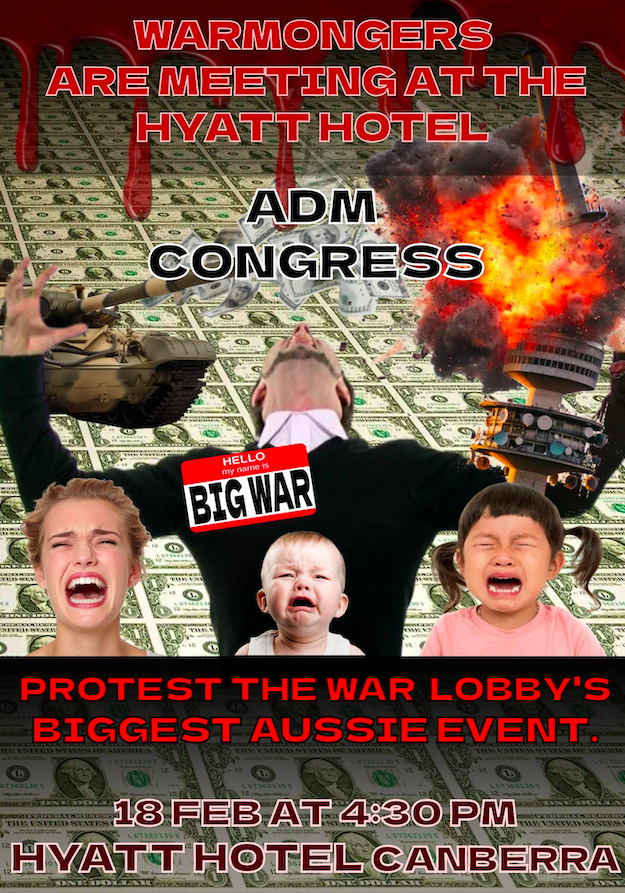
Wednesday 18th of February at 4:30 Outside the Hyatt hotel
Exposing the DISTURBING ISRAELI Lobby inside Australia | Ex-Foreign Minister Bob Carr
In this exclusive interview, former Australian Foreign Minister, the Hon. Bob Carr reveals the deep underlying influence of the Israeli lobby in Australian politics – and how it has long shaped Canberra’s stance on Israel–Palestine.
Once a co-founder of the Labor Friends of Israel with Bob Hawke in 1977, Carr has undergone a dramatic transformation – from being hailed in Tel Aviv as an “honourable gentile” to now becoming one of the loudest critics of Israel’s brutality in Gaza.
Herzog’s Visit to Australia: Just Who Is Being Comforted, and at What Cost?
12 February 2026 AIMN Editorial, By Ricky Pann, https://theaimn.net/herzogs-visit-to-australia-just-who-is-being-comforted-and-at-what-cost/
Chris Minns, symbolism, policing, and the narrowing of dissent
The five-day visit of Israeli President Isaac Herzog to Australia in February 2026 was framed by the federal government as a gesture of compassion. A “moment of profound significance,” we were told, intended to comfort a Jewish community still reeling from the Bondi Beach massacre. Yet as Sydney’s CBD was placed under extraordinary police powers under the authority of NSW Premier Chris Minns, and peaceful dissent was progressively marginalised, a harder question emerged. Who exactly was being comforted, and who was being disciplined?
This essay is not about Jewish Australians, nor is it an attack on Jewish identity, culture, or faith. It is about power. Specifically, it examines the political influence of pro-Zionist lobbying networks, their intersection with far-right activism, and the way criticism of Israel’s war in Gaza has been recoded as antisemitism in order to narrow the space for lawful protest and political dissent in Australia.
The radicalization confronting this country is not racial or religious. It is ideological.
Symbolism, Selectively Applied
Symbolism, Selectively Applied
Political authority in modern Australia is increasingly exercised through symbolism. In October 2023, the Premier Chris Minns NSW Labor Government authorized the projection of the Israeli flag onto the Sydney Opera House, a unilateral display of solidarity following the outbreak of war in Gaza. No equivalent space was afforded to Palestinian grief, despite mounting civilian casualties and credible allegations of war crimes.
Less than two years later, when hundreds of thousands of Australians sought to march peacefully across the Harbour Bridge in the “March for Humanity” to protest the starvation and bombardment of Gaza, NSW Premier Chris Minns attempted to block the demonstration entirely. The stated reasons were “logistics” and “public safety,” yet the inconsistency was glaring. The same government that had no difficulty illuminating national icons for one side of a foreign conflict suddenly discovered insurmountable risk when confronted with mass civic dissent.
This contradiction matters because Minns’ own federal party had already moved to recognize the State of Palestine in early 2025, a move grounded in international law and bipartisan precedent. His resistance to the march therefore cannot be explained by party policy. It must be understood as political pressure from lobbying networks that historically provide the largest sponsorship of non-government funded international trips for federal parliamentarians.
Electoral Mandates and Managed Fear
Minns’ 2023 election was powered by Muslim and multicultural Western Sydney electorates. These communities did not merely vote Labor. They organized, volunteered, and mobilized. By 2026, those same voters found their protests discouraged, surveilled, and in some cases forcibly dispersed under expanded “Major Event” police powers.
The Premier moved from campaigning on inclusion to presiding over the criminalization of dissent. Symbolically, he shifted from promising a “fresh start for all of NSW” to publicly accepting praise from Isaac Herzog as a “friend of Israel,” even as Palestinian Australians were told their grief must remain silent.
Why?
Dissent Recast as Disloyalty
That question sharpened further when the police response and official rhetoric began to frame protesters as “anti-Australian.” The remark was not incidental; it signaled a reframing of peaceful assembly as national disloyalty.
Anti-Australian is not marching with placards. Anti-Australian is pepper-spraying, manhandling, and arresting ordinary citizens exercising democratic rights. Among those dispersed and detained at Town Hall and Bondi were young people affiliated with the Labor movement itself. The irony is difficult to ignore: a government elected by grassroots mobilization now presiding over the physical suppression of its own political base.
When dissent is redefined as threat, the social contract fractures. Protest becomes suspicion. Citizenship becomes conditional.
The Infrastructure of Influence
The answer lies not in religion, but in networks. Central to this landscape is Jillian Segal, Australia’s Special Envoy to Combat Antisemitism appointed by Prime Minister Antony Albanese. Appointing any lobbyist as a special envoy is a dangerous move for social cohesion, especially one with strong links to a right wing government that operates with its military, intelligence agencies, the military industrial complex and propaganda machine hand in glove.
While the role is framed as protective, its credibility has been undermined by Australian Electoral Commission data showing her household, via the Henroth Discretionary Trust, as a significant donor to Advance Australia. Advance Australia led the campaign against the Indigenous Voice to Parliament, arguing that constitutional recognition would grant disproportionate influence to a single minority. Yet the same ideological ecosystem now demands exceptional legal protections that redefine criticism of a foreign state as racial hatred. In doing so, it collapses the distinction between antisemitism and opposition to Zionism or Israeli military policy.
This is not a contradiction. It is a strategy.
By expanding definitions of antisemitism to include phrases, political speech critical of Israel, these actors create a legal and cultural environment in which Palestinian Australian identity itself becomes suspect.5 Protest becomes threat. Dissent becomes hate. Assembly becomes extremism.
Fear as a Political Tool
Former Foreign Minister and Labor Premier of NSW Bob Carr has described the pro-Israel lobby in Australia as a “well-funded foreign influence operation.” Its power does not rest solely on donations, though the Henroth Trust alone provided $280,000 to the Liberal Party in 2024-25, but on fear. Fear of reputational destruction. Fear of being branded weak on security. Fear of becoming the next viral political target of confected rage.
Public rebukes from Israeli Prime Minister Benjamin Netanyahu, including claims that Australian policy “fueled” the Bondi attack, functioned as signals. The message was clear: deviation will be punished. For a state premier, the threat of an organized backlash from internationally connected lobbying networks appears to have outweighed the expressed will of his voters, the principles of his party caucus, and the basic democratic right to protest.
The Theatre of Tragedy
The Bondi Beach attack must be named for what it was: outright terrorism driven by radicalized ideology. It is a national trauma. Australians are grieving. Jewish Australians are grieving. Muslim Australians are grieving. This pain is real and shared.
To use that tragedy as diplomatic cover for Herzog’s visit is not an act of healing. It is socially inflammatory populist theatre. It is exploitation pornography, weaponizing grief to silence dissent and to morally coerce the public into picking a side while laws are quietly rewritten in the background. Politicians call for social cohesion while banning words, narrowing protest rights, and empowering police to detain, search, and suppress political opponents. They invoke unity while demanding ideological compliance.
Is this cohesion, or is it theatre?
Surveillance and the Authoritarian Horizon
That question becomes more urgent in light of the federal government’s expanding relationship with Palantir, the data analysis firm whose platforms underpin United States immigration enforcement (ICE) and provide battlefield intelligence to the Israeli military.
Australia has now granted this company “protected-level” access to sensitive national data following its Nov 2025 assessment. The question is no longer theoretical. How long before these tools are turned inward? How long before citizens who challenge laws championed by foreign-aligned lobbyists find themselves catalogued, profiled, and neutralized in the name of security?
True social cohesion is not achieved through surveillance, intimidation, or moral blackmail. It is built through consistency, restraint, and the protection of civil liberties. When governments abandon those principles, they do not preserve democracy. They hollow it out. And no amount of symbolic lighting can conceal that erosion.
Author’s Note
I am pro-Jewish. I am pro-Arab. I am unequivocally opposed to antisemitism, Islamophobia, and political violence in all forms. I draw a clear distinction between race, religion, and ideology. In an age of populism and misinformation, where mainstream and social media demand that we pick a side, I refuse to do so. As a centrist, I reject the false binary that equates moral clarity with tribal allegiance. Democracies fail not when citizens disagree, but when dissent itself is recast as disloyalty. I have resigned from the Labor party as it no longer hears my voice or represents my values
This was planned. And Chris Minns owns it.
by Andrew Brown | Feb 10, 2026 , https://michaelwest.com.au/this-was-planned-and-chris-minns-owns-it/
NSW Police have assaulted dozens of peace protestors who gathered to protest the visit by Israeli president Isaac Herzog to Australia. Andrew Brown was there.
I was there. Not watching from a distance. Not reconstructing events from police statements. I was on the steps of Sydney Town Hall, with organisers and MPs, looking out over a vast peaceful crowd and then watching the state choose violence.
Israeli President Isaac Herzog arrived in Sydney for a tightly secured visit. That context matters, because what unfolded was not crowd management. It was a demonstration of power. A message. A deliberate assertion of authority.
An estimated 15,000 to 20,000 people gathered peacefully at Town Hall to protest Herzog’s presence. Thousands more were turned away by police cordons. Had the crowd been allowed to assemble freely, numbers would almost certainly have reached 30,000 or more. Families. Elderly people. Students. Health workers. Jews and Muslims standing together. Calm. Disciplined. Focused.
“There was no riot energy. No vandalism. No threat.“
I stood on the steps with protest organisers and elected representatives, looking out over a crowd that never surged, never damaged property, never turned violent. Beside me were Stephen Lawrence MLC, Sue Higginson MLC, Senator Mehreen Faruqi, Cameron Murphy MLC, and other Greens MPs and MLCs.
At least five sitting members of the Minns government were present. They were not hovering at the edges. They were chanting with the crowd. Standing shoulder to shoulder with constituents. Watching events unfold in real time.
This was not fringe politics. This was Parliament in the street.
Dr Muhammad Mustafa, known widely as Dr Mo, did not address the crowd. He spoke quietly to me. Online, he goes by the handle Dr Mo the Beast from the Middle East, a name that reads like bravado until you understand what forged it.
He told me about operating on children without anaesthetic. About hospitals without power. About performing surgery by torchlight while bombs fell nearby. About the dozens of his own relatives who have been murdered in Gaza.
He did not raise his voice. He did not need to. People who have lived through that kind of loss do not perform outrage. They carry it.
“That was the moral gravity of the gathering.“
And while tens of thousands of Australians stood in the open air exercising democratic rights, Premier Chris Minns was not there.
He was dining.
Dining with a war criminal
Inside the International Convention Centre, Minns broke bread with Herzog as the Israeli president spoke about social cohesion.
This is the same Isaac Herzog who once declared there were no innocent civilians in Palestine. The same Herzog who autographed artillery shells later dropped on Gaza. His government now stands before international courts, its conduct under legal scrutiny.Minns knew exactly what this moment represented.
Last year, more than 300,000 people marched across the Harbour Bridge in support of Palestine.
“Minns tried to stop it. He failed.“
He lost in court. He lost the argument. He lost control. That march exposed the limits of his authority and the strength of public opposition.
This was his chance to correct that.
Herzog was in town. The optics were international. Minns was not going to lose again.
Peace, then the violence
The rally ended peacefully. Speakers finished. People began to leave.
That should have been the end of the day.
Instead, it was the beginning of a deliberate escalation.
New South Wales Police blocked exits and sealed movement south toward Circular Quay. People trying to go home were trapped without explanation. There were no clear lawful directions. No safety rationale. Just containment.
Bottlenecks were deliberately created. Confusion was manufactured. Then force was applied to the disorder police themselves had caused.
This was not crowd control. It was crowd engineering.
Police brutality
I watched police push into a dispersing crowd.
I watched elderly people panic.
I watched bodies hit the ground.
I helped a young girl who had been pepper sprayed in the face and collapsed into a seizure on the pavement. She was convulsing, incapacitated. As she lay there on the ground, police sprayed her again in the face. Again.
Attacks on the elderly
Nearby, I helped a 71-year-old woman whose eyes and face were burned red from pepper spray. She was blinded, sobbing, asking what she had done wrong. She had done nothing.
“My own family was not spared.“
My mother is 84 years old. She was attempting to leave peacefully. She was pushed by police, knocked to the ground, and suffered a fractured arm.
My sister lives with Parkinson’s disease. She was shoved and thrust by police during the same operation.
As the evening wore on, the brutality escalated. Dozens upon dozens were arrested. Protesters were dragged across pavement, punched, kicked, restrained. This was not reactive policing. It was proactive force.
“Attacks on people praying“
Later, I witnessed a line crossed that should alarm anyone who believes Australia still respects basic freedoms. Sheikh Wesam Charkawi was praying peacefully with followers, prostrate on the ground. Silent. Non-confrontational. Police moved in anyway.
People were brutalised while in the act of prayer. Shoved. Dragged. Hauled up by force.
This was no longer just an attack on protest. It was an attack on worship.
There were roughly 500 police deployed at Town Hall and an estimated 3,000 across the CBD. This scale was not accidental. It was a show of force. Police created the disorder they later claimed to suppress. This tactic is known. It is taught. It is deliberate.
And it is political.
“Minns owns this”
Chris Minns owns this operation from top to bottom. He cannot hide behind operational reviews or police statements. His own MPs were there. Chanting. Watching. Warning. They knew instantly this was wrong.
Minns wanted to prove he was in charge. He wanted to assert authority while hosting a foreign leader accused of mass atrocities. He chose force as his language.
A Premier who dines with a leader accused of genocide, who has signed the very bombs dropped on civilians, while his police break the arm of an 84-year-old woman, assault a woman with Parkinson’s disease, spray a seizing child in the face, and brutalise people at prayer has forfeited all moral authority to govern.
This was not a mistake.
“It was a tactic.“
Chris Minns may still occupy the office. “Thank you friends,” he told the pro-Israel crowd at the Convention Centre to a warm round of applause.
But tonight, in the streets of Sydney, while he clinked glasses with Isaac Herzog, he lost the right to lead this state.
And I watched it happen.
Herzog protests. Medics attacked too, lawyers question police violence
by Stephanie Tran and V Y Franco-Klothos | Feb 11, 2026 https://michaelwest.com.au/herzog-protests-medics-attacked-too-lawyers-question-police-violence/
Monday’s police actions against anti-genocide protestors in Sydney represent a significant escalation of unwarranted violence. Stephanie Tran and V Y Franco-Klothos report.
Editor’s note: An earlier version included unconfirmed claims that the police used tear gas (in addition to pepper spray, which was used).
NSW Police are on the defensive. Following the spate of attacks on pro-Palestine protestors on Monday night, and amid rising criticism of their brutality, the Police are refusing to answer questions as to the number of people arrested, the number charged, and the nature of the charges.
According to the ABC yesterday, 27 people were arrested and 9 have since been charged. That was yesterday. Today, they were not responding, apart from a motherhood statement unrelating to those arrested.
From the outset of the protest against the visit of Israeli President Isaac Herzog, police had set up clear lines around every exit from the Town Hall area to contain the protest within Town Hall Square.
“Police were seen giving contradictory instructions to protestors – both instructing them to disperse from the square and demanding that they stop attempting to leave the square.“
“Aerial video clearly shows NSW police kettling protesters and causing a crowd crush.
“Incontrovertible evidence of the police hemming in protesters, preventing them from leaving(kettling) and attacking them.”
“They started this from before the speeches had even ended. The police commissioner is proud of this. He needs to resign with Minns. pic.twitter.com/ERU7K3Tn9f“
— The Longford Slasher (@Longfordslasher) February 10, 2026
Aggressive police behaviour
Activist Larissa Payne was near a group of Muslim demonstrators who had begun evening prayers in a corner of Town Hall Square. Payne, her family members and other members of the public linked arms to form a barrier between the praying group and riot police.
“It was a deliberate expression of non-violence, it was an expression of love and solidarity,” Payne said.
Footage of the scene shows officers moving in and violently grabbing members of the prayer group.
Payne was restrained using a wrist hold and dragged down steps, leaving her with sprained wrists.
Payne’s 78-year-old father, Ian Payne was with her. When he put his arm out to protect her, police forced his arm behind his back, causing a deep wound to his elbow.
“When he instinctively put his arm out to protect me, they grabbed his arm and put it right up behind his back. They tore open his elbow so he had skin and blood hanging everywhere. It was just awful.”
Payne’s partner, former Senator Scott Ludlam, was knocked to the ground, leaving him with a possible fractured rib. He was handcuffed and arrested before being released.
Payne said a lack of accountability for the police brutality on Monday would lead to police impunity becoming “normalised”, telling MWM:
“If we don’t do something collectively to hold them to account, if the police get impunity, this violence is going to become normalised.“
“The police violence is a symptom of something larger. If you look at the global context, we’re moving towards more extreme right wing politics. The fact that this was done under the leadership of a Labor Premier speaks to how Labor is being dragged to the right,” Payne said.
Another protester, Ali Al-lami says he was pushed to the ground and called a “brown c*nt”. Police proceeded to punch Al-lami and handcuff him while pressing his head to the ground.
“It was like how an IDF soldier would put a Palestinian to the ground and brutalise them. That’s exactly what they did to me,” Al-lami said. He was arrested but subsequently released without charge.
“They released me without any charges because they know what they did was wrong. They didn’t have any legal basis to arrest me. I did nothing wrong, I wasn’t resisting, I didn’t attack anyone,” he said.
Jordan, who asked that his surname be withheld, was also injured during the police operation.
“I saw police knock someone next to me to the ground and punch them,” he said. “When I tried to help the victim on the ground, I was knocked down.”
He said officers removed his safety goggles, threw them aside and restrained him. “I was cuffed tightly and left with injuries on my face, hand and wrist,” he said.
He was charged with inciting violence, breaching the peace and resisting arrest.
“There’s photographic evidence that shows I didn’t resist arrest in any way,” Jordan said.
“I knew it was state-sanctioned violence but I was surprised at how openly and proudly they were all doing it. Many of the officers were literally grinning as they were hitting us – they were loving life.”
Medics under attack
Volunteer street medics, who operate independently of PAG, were in attendance on Monday evening and treated dozens of protestors who had been indiscriminately attacked with pepper spray.
Omaim Al-Baghdadi was one of the medics at the scene. She told MWM that police officers attacked and pepper-sprayed medics who were assisting injured protesters.
“We were in the middle of treating people. We told them we were medics, but it didn’t matter to them. They grabbed us and shoved us and told us to move on.”
1×1515
5:10 / 11:23
Listen to this story
11 min
Monday’s police actions against anti-genocide protestors in Sydney represent a significant escalation of unwarranted violence. Stephanie Tran and V Y Franco-Klothos report.
Editor’s note: An earlier version included unconfirmed claims that the police used tear gas (in addition to pepper spray, which was used).
NSW Police are on the defensive. Following the spate of attacks on pro-Palestine protestors on Monday night, and amid rising criticism of their brutality, the Police are refusing to answer questions as to the number of people arrested, the number charged, and the nature of the charges.
According to the ABC yesterday, 27 people were arrested and 9 have since been charged. That was yesterday. Today, they were not responding, apart from a motherhood statement unrelating to those arrested.
From the outset of the protest against the visit of Israeli President Isaac Herzog, police had set up clear lines around every exit from the Town Hall area to contain the protest within Town Hall Square.
Police were seen giving contradictory instructions to protestors – both instructing them to disperse from the square and demanding that they stop attempting to leave the square.
Aerial video clearly shows NSW police kettling protesters and causing a crowd crush.
Incontrovertible evidence of the police hemming in protesters, preventing them from leaving(kettling) and attacking them.
They started this from before the speeches had even ended. The police commissioner is proud of this. He needs to resign with Minns. pic.twitter.com/ERU7K3Tn9f
— The Longford Slasher (@Longfordslasher) February 10, 2026
Aggressive police behaviour
Activist Larissa Payne was near a group of Muslim demonstrators who had begun evening prayers in a corner of Town Hall Square. Payne, her family members and other members of the public linked arms to form a barrier between the praying group and riot police.
“It was a deliberate expression of non-violence, it was an expression of love and solidarity,” Payne said.
Footage of the scene shows officers moving in and violently grabbing members of the prayer group.
Payne was restrained using a wrist hold and dragged down steps, leaving her with sprained wrists.
Ian Payne
Payne’s 78-year-old father, Ian Payne was with her. When he put his arm out to protect her, police forced his arm behind his back, causing a deep wound to his elbow.
“When he instinctively put his arm out to protect me, they grabbed his arm and put it right up behind his back. They tore open his elbow so he had skin and blood hanging everywhere. It was just awful.”
Larissa Payne
Payne’s partner, former Senator Scott Ludlam, was knocked to the ground, leaving him with a possible fractured rib. He was handcuffed and arrested before being released.
Payne said a lack of accountability for the police brutality on Monday would lead to police impunity becoming “normalised”, telling MWM:
If we don’t do something collectively to hold them to account, if the police get impunity, this violence is going to become normalised.
“The police violence is a symptom of something larger. If you look at the global context, we’re moving towards more extreme right wing politics. The fact that this was done under the leadership of a Labor Premier speaks to how Labor is being dragged to the right,” Payne said.
Another protester, Ali Al-lami says he was pushed to the ground and called a “brown c*nt”. Police proceeded to punch Al-lami and handcuff him while pressing his head to the ground.
“It was like how an IDF soldier would put a Palestinian to the ground and brutalise them. That’s exactly what they did to me,” Al-lami said. He was arrested but subsequently released without charge.
“They released me without any charges because they know what they did was wrong. They didn’t have any legal basis to arrest me. I did nothing wrong, I wasn’t resisting, I didn’t attack anyone,” he said.
Jordan, who asked that his surname be withheld, was also injured during the police operation.
“I saw police knock someone next to me to the ground and punch them,” he said. “When I tried to help the victim on the ground, I was knocked down.”
He said officers removed his safety goggles, threw them aside and restrained him. “I was cuffed tightly and left with injuries on my face, hand and wrist,” he said.
He was charged with inciting violence, breaching the peace and resisting arrest.
“There’s photographic evidence that shows I didn’t resist arrest in any way,” Jordan said.
“I knew it was state-sanctioned violence but I was surprised at how openly and proudly they were all doing it. Many of the officers were literally grinning as they were hitting us – they were loving life.”
Medics under attack
Volunteer street medics, who operate independently of PAG, were in attendance on Monday evening and treated dozens of protestors who had been indiscriminately attacked with pepper spray.
Omaim Al-Baghdadi was one of the medics at the scene. She told MWM that police officers attacked and pepper-sprayed medics who were assisting injured protesters.
“We were in the middle of treating people. We told them we were medics, but it didn’t matter to them. They grabbed us and shoved us and told us to move on.”
“Many families and elderly people were caught in the crowd as tear gas* was deployed by police.“
Another volunteer medic, who asked not to be named, was caught in the middle of the crowd as police simultaneously crushed, pepper-sprayed and tear-gassed* families.
“I saw a lot of horrible things at the protest, but what really stuck with me was the fear and panic I saw in the eyes of children and their parents as this was all unfolding. It was really distressing to me, even as someone who has personally witnessed and experienced a lot of police violence,” they said.
“We were being crushed in as the police kettled us, and then everyone around me began to cough violently. I think it took longer to hit me than others because I had an N95 mask and goggles on, but when it did eventually hit, it was awful. I felt like I was being choked and began to wretch and shake. It has been nearly 24 hours since the protest, and I still have ongoing nausea and wretching.”
Excessive police powers
In the wake of the Bondi attack in December 2025, NSW parliament rushed through the Terrorism and Other Legislation Amendment Bill 2025, which gave police powers to effectively ban protests and other public assemblies for up to three months following a ‘declared terrorist incident’.
In addition to the rushed “anti-terror” legislation, the Minns Labor government made a “Major Event Declaration” to facilitate the Herzog visit. This legislation gives police additional powers, including the ability to significantly increase officer numbers, enact warrantless searches and block the public from a “declared area”.
On Monday afternoon, the NSW Supreme Court dismissed PAG’s challenge to the major event declaration, leaving the public vulnerable to these broad powers.
The major event declaration not only extended police powers further, but also gave them relative immunity for their brutality. Perhaps most concerningly, the Major event declaration diminishes the right for protestors to receive compensation for violence inflicted by the State.
Specifically, section 62 of the Major Events Act 2009 details the exemption from paying compensation. According to the legislation, the State, local Councils and officers, employees or agents of the State or local council cannot be compelled to provide compensation regarding “an act or omission that is a major event-related matter, or that arises (directly or indirectly) from a major event related-matter.”
Criminal lawyer and investigative journalist Nick Hanna noted that this could
“significantly limit the claims for protestors injured by police.“
“This is one of the egregious examples of wanton police violence we’ve seen in a long time. There are countless people who would ordinarily have a strong basis to sue the police for assault, unlawful arrest and/or false imprisonment, but may now effectively be precluded from doing so as a result of the major event declaration,” Hanna said.
Hanna represented Palestine Action Group in their Supreme Court challenge against the major event declaration.
“Had the Supreme Court granted our application on behalf of PAG to declare the major event declaration invalid, these restrictions on the ability to recover damages from the police for their tortious conduct wouldn’t apply,” he said.
If PAG successfully appeals the Supreme Court’s decision, protesters may have more legal avenues.
“If PAG appeals the decision and is successful, this may have the effect of lifting the restrictions on people suing the state for the violence inflicted by the police,” Hanna said.
NSW Police response
MWM put the following questions to NSW Police:
- How many people were arrested at the protest? Of those, how many have been released and how many have been charged, and with what offences?
- There are numerous reports that NSW Police used excessive violence in response to the protest, including video footage of police officers assaulting individuals who were on the ground in prayer. How does NSW Police respond to these allegations?
- Aerial footage appears to show police forming multiple lines and barriers along George Street and surrounding exits, which protesters say prevented them from leaving the area (a tactic often described as “kettling”). What was the operational rationale underpinning this policing decision?
A NSW Police spokesperson provided the response below:
“NSW Police will review all officially reported complaints from the Town Hall event. If a complaint is made through official channels police will investigate appropriately. During the event at Town Hall on Monday (9 February 2026), police gave multiple opportunities for attendees to leave the area safely. Police deployed multiple crowd management techniques during the event to maintain public security. Attendees were at no point forced to remain in the area and were always afforded the opportunity to leave the event.”
Our Leaders Couldn’t Fix Our Problems If They Wanted To (And They Don’t Want To)
Caitlin Johnstone, Feb 11, 2026, https://www.caitlinjohnst.one/p/our-leaders-couldnt-fix-our-problems?utm_source=post-email-title&publication_id=82124&post_id=187582757&utm_campaign=email-post-title&isFreemail=true&r=1ise1&triedRedirect=true&utm_medium=email
Our leaders are not going to fix the worst problems in our world. They couldn’t if they wanted to. And they don’t want to.
Our leaders are not wise or insightful. They’re not even particularly intelligent. Our society is led by plutocrats who only know how to make more money, by unelected empire managers who only know how to dominate and control, and by elected politicians who only know how to say the right words and make the right bargains in order to get themselves elected.
These people are not capable of curing our civilization of its dysfunction. They don’t have the necessary skills or attributes. Even if they weren’t a bunch of evil sociopaths who are only in the positions they’re in because of their willingness to collaborate with the agendas of oligarchy, war, militarism, imperialism, ecocide, exploitation, oppression and planetary domination, they don’t even have the personal characteristics necessary to do things like end poverty, rescue our biosphere, bring about world peace or give rise to human thriving. They’d have no idea where to star
I say this because as I watch Americans and Australians falling all over themselves to justify the recent police brutality in our respective nations, I am struck by how many people still believe our society is run by leaders who more or less know what they are doing and will guide us to more or less where we need to be. They view their government as a wise and beneficent father who knows what’s best for all of us, and they believe anyone who disagrees with Daddy is being naughty.
That’s really all it is. They’ll make up all sorts of justifications and excuses, but ultimately their police apologia arises from an infantile worldview which believes the authorities are right for no other reason than because they are in authority. They begin with their tongue on the boot of power, and then they make up reasons for why their tongue needs to be there.
That’s the worldview that gets a lot of people through their day. Believing our society is basically just and decent, and that we don’t need to concern ourselves with the world’s problems because we’ve got highly qualified leaders working hard at fixing them.
Believing our society is just and decent allows one to relax under the assumption that they deserve all the comforts they have in life and that the system will never turn against them. If someone is killed by police, or is impoverished or imprisoned or homeless, then it’s because they did something wrong and immoral, and all you need to do to avoid the same fate is follow the rules and make ethical choices. Under a just and decent system, good things happen to good people and bad things happen to bad people, so all you need to do is be good and you’ll be fine, and if things are going badly for you it’s because you deserve it.
Believing we’ve got highly qualified leaders working on our world’s problems allows one to relax under the assumption that everything’s taken care of. There’s no need to concern ourselves with all the information which tells us we’re plunging deeper and deeper into tyrannical dystopia on a collision course with environmental catastrophe under a globe-spanning empire that is fueled by human blood, because Daddy’s got it all taken care of.
Really these are just juvenile fairy tales designed to help us psychologically compartmentalize away from uncomfortable realities; no grown adult has any business believing them. But a lot of people would do anything to avoid internal discomfort. Entire psychological universes are constructed around the unconscious agenda of not feeling unpleasant feelings.
Daddy’s not gonna save us, kiddos. Daddy’s a serial killer with dead bodies in the attic, and many important parts of his brain are missing. Our problems aren’t going to get fixed until we get rid of Daddy. Getting rid of Daddy means forcibly getting rid of the entire system under which we live and replacing it with something that serves the interests of ordinary human beings.
Bootlickers hate revolutionary politics, because it is diametrically opposed to their infantile worldview of paternalistic government deities. But things aren’t going to get better until we find a way to get the steering wheel of our world out of the hands of the people who are currently in charge. Until then, everything’s just going to keep getting worse.
The complex, long-form writers – but is anybody listening?

11 February 2026 Noel Wauchope, https://theaimn.net/the-complex-long-form-writers-but-is-anybody-listening/
I sympathise with readers who have a short attention span. I myself am one of those. And nowadays, well – that’s pretty much everybody.
And yet, people keep writing long, and very long, articles. Are they wasting their time? Who actually reads these articles?
I used to think that long articles were indeed a waste of time. And in a certain sense, I was right. I came from the angle of an antinuclear activist, and for a long time, the “nuclear debate” was run by highly – informed people, who made sure to use the absolutely correct technical language – no weak slips into ordinary talk. The anti-nuclear experts generally showed their opponents that they were right up there with the jargon that only experts understood. So the ordinary peasant, the general public, including many well-educated people, “dazzled by science” couldn’t really understand the long arguments. The result was that most people were intimidated, felt they could not understand it all. which was exactly the situation that the nuclear lobby wanted.
Then along came Dr Helen Caldicott, and mucked it all up. She understood all the technical stuff, and could write about that. But she also used ordinary, understandable language. And worse – heaven forfend – she sometimes was emotional. God, she even described some nuclear propagandists as “wicked”. Personally, I thought that the term was accurate. Anyway, Dr Caldicott copped a lot of flak, including even from the anti-nuclear lobby, with their obsession about being “respectable”. How dare she be so “hysterical”. But then she couldn’t help it, having the disability of being female.
But, Dr Caldicott, with her many books, public speaking, meeting world leaders, even influencing Ronald Reagan, got her message through to people, and the “debate, has never been the same since.
So, I rejoiced at this development, which did help journalists to loosen up, and cover nuclear issues in a more readable and human way. And in shorter articles.
But now the pendulum has swung too far in the direction of being short and easily digestible, especially with the communications monster of social media. It is a sad thing that probably only old people have the time and the inclination to read long articles.
And people are missing out, because often the full story on a subject is really covered only in long articles. I have a collection of these, on a variety of topics, and I had planned to reference a number of them here. Some are very densely written, full of facts, dates, events – and therefore really informative – but still a bit of hard work to read. And some show how very complex a situation can be – how there are two sides, and maybe more than two, to a story.
So, here are examples of very informative ones:
Planet Plastic: How Big Oil and Big Soda kept a global environmental calamity a secret for decades, by Tim Dickinson.
US military action in Iran risks igniting a regional and global nuclear cascade, by Farah N. Jan.
Cumulative effects of radioactivity from Fukushima on the abundance and biodiversity of birds, by Timothy A Mousseau
Securing the nuclear nation, by Kate Brown
Very interesting are the articles which cover something in depth, showing contradictory sides, and how very complex a subject can be:
Some examples-
Betrayed: How Liberals Supported Islamic Revolution in Iran in 1979 and Turned Against the Progressive Shah, by SL Kanthan,
The Long History Of Zionist Proposals To Ethnically Cleanse The Gaza Strip, by Mouin Rabbani.
And these can often be personal articles, about human conditions, character and integrity, leaving politics aside:
The heroes who saved the world from Chernobyl Two, by By Serhii Plokhy – also at The heroes who saved the world from Chernobyl Two.
Elon Musk’s Shadow Rule, by Ronan Farrow. Also at Elon Musk’s Shadow Rule, nuclear-news.
I hope that some people are reading long articles. Well, they must be, because some excellent movie documentaries and TV series often come up, and are derived from the written word. And perhaps many people are thus getting their longform stories in a different form. And perhaps some longform articles have a profound effect, even if it’s only on a relatively few readers.
The Siege Within: How Clarity Died in the Aftermath of Bondi
13 Feb 26, https://urbanwronski.com/2026/02/11/the-siege-within-how-clarity-died-in-the-aftermath-of-bondi/
The summer evening of December 14, 2025, began in the soft, amber glow of Hanukkah candles at Archer Park. It ended in the staccato rattle of rifle fire and the scent of sea spray mixed with shotgun powder. Fifteen lives were extinguished by Sajid and Naveed Akram; a night that exposed not only the fragility of security, but the deeper frailty of Australia’s political imagination.
In the wake of that horror, the Albanese and Minns governments promised resolve. What they delivered instead was the familiar choreography of risk-aversion: the committees, the taskforces, the talking-points, and finally, a version of the old dingo fence. What began as an act of collective grief has metastasised into a tinpot tyranny, a prison guard or police patrol’s vision of order.
From Public Grief to Private Fear
By February, that perimeter has hardened into a siege. Sydney’s once open streets have become the staging ground of a security politics that no one voted for. The images from Town Hall; men dragged from prayer mats, Greens MP Abigail Boyd coughing through pepper spray—belong to a country that has quietly rewritten its own story of tolerance. A pluralist democracy does not kneel beneath its police lines for long without losing something essential.
The truth is simpler and harder: we have allowed fear, dressed in the high-vis vest of “public order,” to set the terms of our morality, proscribe our speech, define the living sinews of our commonwealth.
The Invisible, Myopic Pragmatists
Who, then, is running this show? Increasingly it seems to be the invisible, myopic pragmatists; those faceless avatars of modern Labor who mistake managerial caution for moral intelligence. This is the small-target governance of realpolitik, the gutless risk-avoidance that flatters itself as prudence. Yet it turns out to be a type of costly false economy; in the refusal to confront or even name the deeper moral crises beneath Australian politics; it proves a costly wrong, right turn.
Labor still governs as if haunted by ghosts: of Murdoch’s tabloids, of Trump’s shadow, of talkback nationalism. So fearful of offending the pro-Israel lobby or a resurgent Washington, they have allowed Australia’s political stage to be colonised by a foreign narrative. It is one thing to host Isaac Herzog on a “healing tour.” It is another to pretend that such theatre constitutes diplomacy while Gaza still smoulders and UN inquiries speak of mass dispossession.
Under the banner of “social cohesion,” the government has transformed mourning into a managed event and dissent into security risk.
The Ritual of Control
January’s Combatting Antisemitism, Hate and Extremism Act is the latest iteration of this logic; a law that inflates “incitement” until speech itself becomes suspect. Under the euphemism of protection, dissent becomes pathology. This is governance as theatre: motion without moral movement, legislative vigour masking ethical paralysis.
Paul Keating warned of the “instant band-aid”—politics mistaking activity for achievement. The current government has perfected the art. It calls Parliament to ban protest chants overnight, but remains paralysed before the “recreational hunting” loopholes that armed the Akrams. You can now go to prison for carrying a certain flag, but not for stockpiling a .308 rifle under the name of sport.
The Day of Kettling
And so came February 9, the day that Albanese and Minns kettled not only citizens, but independence of mind itself. In those 24 hours, freedom of expression was pinned beneath riot shields, freedom of association shoved into police vans, and the rights of conscience, democracy, and common decency were trampled into the wet asphalt of George Street.
Australia has always prided itself on a kind of decent moderation; the belief that even in our disputes, there existed a shared moral floor. What unfolded yesterday suggests that floor has given way. The government’s instinctive use of force against non-violence didn’t merely reveal insecurity—it revealed contempt. For protest, for plurality, and for the ordinary intelligence of the public.
History will not remember this as a day of security. It will remember it as a day of surrender; the moment when a Labor government, raised on the language of solidarity, chose the comfort of coercion over the courage of care.
The Moral Reckoning
We are witnessing the normalisation of the riot shield as a symbol of civic order, a transformation as swift as it is insidious. When a government greets a vigil with chemicals and batons, it is not protecting its people. It is protecting itself.
True cohesion is never policed; it is nurtured. It grows when governments address inequality rather than manage optics, when they embrace dissent as a sign of health, not heresy. It exists in the old Australian compact between decency and fairness; an agreement far older than Parliament and infinitely more fragile.
Labor, if it still remembers, must left heel; breaking from the intellectual, moral and spiritual shipwreck of the Shoppies bloc and return to its real heritage: the workers and communities who built a nation out of solidarity, common care, and the stubborn conviction that a free people stand tallest when they stand together.
Until then, we remain a country barricaded from itself.
In Australia The Police Beat You Up For Opposing Genocide.
Caitlin Johnstone, Feb 10, 2026, https://www.caitlinjohnst.one/p/in-australia-the-police-beat-you?utm_source=post-email-title&publication_id=82124&post_id=187467234&utm_campaign=email-post-title&isFreemail=true&r=1ise1&triedRedirect=true&utm_medium=email
Australian authorities were fully aware that inviting Israel’s president for a visit was going to ignite unrest and furious opposition. They invited him anyway, and sent in the police to assault the protesters.
I saw a video of two cops pinning a kid in a keffiyeh face down on the ground and proceeding to punch him over and over again long after he’d been subdued.
I saw another video of police repeatedly punching a middle-aged man who was holding his hands in the air until he fell to the ground.
I saw another video of police repeatedly pepper spraying a demonstrator directly in the face as he was visibly complying with their demands to move and providing no resistance whatsoever.
I saw another video of police manhandling Muslim men who were literally on their knees praying, presenting no possible threat of any kind.
That’s right kids, welcome to Australia, where the government invites the head of a genocidal apartheid state for a happy cuddle party and then beats the shit out of anyone who opposes this.
It’s a testament to the courage and vitality of the pro-Palestine movement in Australia that people keep showing up to anti-genocide protests even as authorities do everything they can to create a chilling effect on them.
After all, this happens as the state of Queensland moves to make it illegal to utter the pro-Palestine phrases “from the river to the sea” or “globalise the intifada”, with violations punishable by two years in prison. This is easily the single most bat shit insane speech suppression legislation in Australian history, and that’s an extremely high bar.
To be clear, not one person sincerely believes that “from the river to the sea, Palestine will be free” is a genocidal or antisemitic statement. This is one of those many, many instances in which Israel supporters are pretending to believe something they do not actually believe in order to further outlaw criticism of Israel.
They’re trying to make it so that nobody feels comfortable opposing Israel’s abuses without first consulting with a lawyer about what exactly they are legally permitted to say in that moment, thereby throwing a chilling effect on pro-Palestine activism throughout the nation.
This comes weeks after the Australian government passed frightening new “hate speech” laws in the name of “combatting antisemitism” which will make it much easier to designate activist groups as “hate groups”. Australian officials have conspicuously refused to say that the new laws will not be used to ban groups for speech that is critical of Israel, which tells you all you need to know about the real intentions at work here.
This also comes as the state of New South Wales cracks down on protests with extreme aggression, banning protests in certain areas and seeking to outlaw the use of the phrase “globalise the intifada” to appease Australia’s obscenely powerful Israel lobby. Premier Chris Minns is presently defending the actions of the police he sent in to crack skulls at the Herzog protests on Monday.
Just two months ago a prominent member of the Australian Israel lobby publicly announced that he wants a total ban on pro-Palestine protests throughout the nation, and said it is criticism of Israel that is the problem, not just hatred toward Jews. Joel Burnie, Executive Manager of the Australia/Israel & Jewish Affairs Council (AIJAC), explicitly said that what he wants is “No more protests! No more protests!” in Australia.
“I for one as a Jewish leader will no long talk about antisemitism in isolation from Israel, because it’s the rhetoric and language on Israel that motivates the people to come and kill us,” Burnie said during a video conference, later adding that “ language on Israel invading all of our social spaces in Australia have made this country a very unsafe space and place for Jews.”
Increment by increment, Joel Burnie and his ilk have been getting their wish ever since. Australian civil rights are indeed being disintegrated to protect the information interests of a genocidal apartheid state.
Sheikh who led prayer at Sydney protest against Herzog says police were ‘unhinged and aggressive’
Ben Doherty and Jordyn Beazley, 10 Feb 26, https://www.theguardian.com/australia-news/2026/feb/10/sheikh-who-led-prayer-at-sydney-protest-against-herzog-says-police-were-unhinged-and-aggressive-ntwnfb
Any officers who acted unlawfully should face prosecution for actions, Muslim groups say
New South Wales police who grabbed men kneeling in prayer during a protest in Sydney against Israeli president Isaac Herzog’s visit should face prosecution, a coalition of Muslim organisations has said.
The joint statement demanded an apology from the state premier and called for the resignation of the NSW police commissioner after the incident on Monday night, with the man leading the prayer calling the police response “unhinged” and “aggressive”.
Video shot at a protest in Sydney on Monday night showed about a dozen men, led by Sheikh Wesam Charkawi, kneeling in prayer in two straight lines in the forecourt of Sydney Town Hall. The men did not appear to be blocking a road or marching, which is effectively banned in designated areas under a NSW law passed after the Bondi antisemitic terror attack.
New South Wales police who grabbed men kneeling in prayer during a protest in Sydney against Israeli president Isaac Herzog’s visit should face prosecution, a coalition of Muslim organisations has said.
The joint statement demanded an apology from the state premier and called for the resignation of the NSW police commissioner after the incident on Monday night, with the man leading the prayer calling the police response “unhinged” and “aggressive”.
Video shot at a protest in Sydney on Monday night showed about a dozen men, led by Sheikh Wesam Charkawi, kneeling in prayer in two straight lines in the forecourt of Sydney Town Hall. The men did not appear to be blocking a road or marching, which is effectively banned in designated areas under a NSW law passed after the Bondi antisemitic terror attack.
Video showed that, as the men prayed, police officers descended on the group, grabbing those at the edge of the prayer group and dragging them along the ground.
The men in prayer did not respond and continued to pray. Other protesters yelled at police “Leave them” and “They’re fucking praying”.
Charkawi said police had used violence at an otherwise peaceful protest.
“[Police were] so unhinged, so aggressive and so violent and had zero regard for anyone and anything in their way, even peaceful worshippers who were not in anyone’s way.”
Charkawi said he and his fellow worshippers were about 15 minutes behind schedule to hold sunset prayer towards the end of the demonstration.
He said as he prayed, “we could obviously hear a big ruckus behind us. And I saw people … being flung off on my right, flung off on my left.”
In the footage, Charkawi can be seen continuing to kneel in prayer.
“When you’re in prayer, you’re not allowed to break it for any reason. There’s got to be a catastrophe, or some type of emergency that is happening, for us to do that,” he said.
As he was pulled by police, he said he felt like his shoulder was nearly ripped out of its socket.
“We weren’t disobeying any police commands. We were simply making our prayers and we had our back turned,” he said. “What an unacceptable thing that they have done.”
Charkawi, a support officer at Granville Boys high school, was last year ordered to work from home after posting a video in response to the Bankstown hospital nurses footage, in which he criticised “selective outrage”.
In his video, Charkawi said the nurses’ comments were “never meant to be literal or intended to be a threat to patient care” and criticised people who had spoken out about them but remained silent on Israel’s actions.
The NSW Greens MLC Abigail Boyd said she was punched in the head and shoulder by police officers, and then saw Muslim men who were on their knees praying being dragged away by police.
“[Police] then went in and grabbed those who were praying – you can’t get anything more peaceful than prayer – picking them up and just throwing them on the ground again.
“People were just treated so incredibly poorly. That is not social cohesion. This was a peaceful protest, standing for people who were protesting a genocide on the other side of the world, but had made it explicit that we were inclusive of Jewish people. We are against antisemitism.”
Muslim groups urge police to apologise
At least 38 Muslim and legal organisations across Australia have demanded the resignation of the NSW police commissioner, Mal Lanyon, with the group saying his “leadership bears responsibility for a policing culture in which such conduct was permitted to occur”. Lanyon has spent nearly 40 years in the NSW police force and has been commissioner for five months.
The group said the NSW premier, Chris Minns, should apologise for the police “abuse of power”.
The coalition of Muslim organisations said the use of force against worshippers during a lawful and peaceful protest was unacceptable.
“Police officers knowingly intervened in a moment of religious observance, forcibly interrupted prayer and used physical force against individuals who posed no threat to public safety. Some worshippers were dragged away and thrown to the ground,” the group said in a statement.
“This was an abuse of power and a serious failure of judgment.”
The group argued no other faith community would be expected to accept sacred practices being forcibly disrupted by police.
“Muslims should not be held to a different standard, nor should our religious expression be treated as a problem to be managed or suppressed,” the statement said.
The group called for an independent inquiry into the incident, and accountability – including potentially criminal charges – for individual officers found to have acted unlawfully.
The Australian National Imams Council said it was outraged by the police’s “heavy-handed” and unprovoked physicality.
“Police are entrusted to protect the community, uphold public safety and de-escalate tensions, not to interfere with religious worship or inflame an already sensitive situation.”
Lanyon defended his officers’ actions, saying they showed “remarkable restraint”.
“Speakers were inciting the crowd to march. We had made it clear throughout the week [that a] march through the CBD was not acceptable.
“We wanted a respectful and responsible protest. That’s not what we got last night. Our police took action to disperse that protest.”
Minns said while he understood there had been criticisms of the police, officers needed to keep protesters separated from more than 7,000 people who were at an event with Herzog at Darling Harbour, mourning the Bondi beach attacks.
Police “were caught in an impossible situation,” the premier said.
“They did their job by keeping those groups separate, and we want to thank them for their service to the people of NSW.”
Minns insisted police had a “strong and cooperative relationship” with Sydney’s Muslim community.
“I want to make it clear there is no suggestion, under any circumstances, that police would have wanted to prevent people praying or get in the way of people lawfully exercising their religion.
“But context is important here, and the circumstances facing NSW police was incredibly difficult. It was, in effect, in the middle of a riot. Police have to make critical early decisions in those circumstances. It wasn’t designed to pick on or target a particular community.”
The prime minister, Anthony Albanese, raised the issue of police action against praying protesters in parliament, saying he would “allow police to do their job” in investigating. He said many in Australia “will want to know all of the circumstances around that”.
Bondi’s Blood, Herzog’s Shield: How Australia’s Grief was Hijacked for Geopolitics
The invitation of Isaac Herzog to Australia was not an act of solidarity. It was an act of political calculation; a cynical attempt to fold the grief of Bondi’s victims into a diplomatic script that served the government’s interests, not theirs.
The emergence of the Jewish Council of Australia (JCA), a progressive body representing a significant segment of the Jewish community, disrupted the government’s assumptions. The JCA warned that using Jewish grief as a diplomatic backdrop risked entrenching the dangerous conflation between Jewish identity and the Israeli state, a conflation that has already fuelled antisemitism around the world. Their warning went unheeded.
10 February 2026 David Tyler, https://theaimn.net/bondis-blood-herzogs-shield-how-australias-grief-was-hijacked-for-geopolitics/
The Massacre as a Mirror
The Bondi massacre was not an aberration. It was a reflection, a brutal, unfiltered image of the fractures in Australia’s legal frameworks, the cynicism of its political class, and the ease with which communal grief can be repurposed for geopolitical theatre. On 14 December 2025, Sajid Akram and his son Naveed opened fire on a Hanukkah celebration at Bondi Beach, killing fifteen people and wounding over forty. It was the deadliest mass shooting since Port Arthur, the worst antisemitic attack in Australian history, and a tragedy that exposed not one or two failures, but a cascade of systemic neglect.
This violence did not emerge from a vacuum. It was the latest eruption in a long, unbroken line of homegrown brutality. The 1928 Coniston massacre, where state-sanctioned militias slaughtered Indigenous Australians under the guise of frontier justice. The 1978 Hilton bombing, which shattered the illusion of domestic immunity. The 2019 Christchurch killings, where an Australian radical exported terror across the Tasman. Each of these events was nurtured in the cracks of our own institutions, yet each was swiftly repackaged as something else: a foreign threat, a diplomatic opportunity, or a moment to reassert the myth of Australian exceptionalism.
The Albanese government’s response to Bondi followed this script to the letter. Within weeks, Israeli President Isaac Herzog was invited to stand at the centre of Australia’s mourning, a man whose own words and actions have been cited in allegations of incitement to genocide by the International Court of Justice. The message was clear: in the face of domestic horror, Australia would default to the familiar playbook of alliance politics, even if it meant suspending its own commitments to international law and the right to dissent.
Policy Failure #1: The Firearms Regime’s Fatal Loopholes
The weapons used at Bondi were all legally acquired. Straight-pull rifles, designed to mimic the rapidity of banned pump-action firearms while slipping through the 1996 National Firearms Agreement’s (NFA) mechanism-based categories, sat comfortably in the least restrictive licensing tiers. This was not an accident. It was the inevitable result of a firearms regime that has been systematically weakened by lobbying, political inertia, and a cultural reluctance to confront the reality of gun violence in Australia.
The NFA was never the ironclad solution it was sold as. From the outset, it was a compromise; a patchwork of state-level regulations stitched together under the pressure of public outrage after Port Arthur. Over the years, the seams have frayed. Successive governments, both Labor and Coalition, have bowed to the gun lobby’s demands, carving out exemptions for farmers, sport shooters, and collectors. The result? A licensing system so riddled with loopholes that a man investigated by ASIO for ISIS-linked associations could arm himself with lethal rapid-fire weapons without raising a single red flag.
The National Cabinet’s post-massacre reforms, announced with the usual fanfare of “never again,” arrived only after the familiar ritual of hindsight. But the real question is not whether these reforms will work; it’s why they weren’t implemented decades ago. The answer lies in the quiet, persistent influence of groups like the Sporting Shooters’ Association of Australia (SSAA), which has spent years lobbying against even the most modest restrictions. The SSAA’s success is a testament to the power of organised interests over public safety; a dynamic that has played out in everything from climate policy to industrial relations.
If Australia is serious about preventing another Bondi, it must confront this reality head-on. That means closing the loopholes in the NFA, ending the revolving door between gun lobbyists and political advisors, and treating firearms regulation as a matter of national security; not a bargaining chip for rural votes.
Policy Failure #2: Intelligence – Blind Spots and Misplaced Priorities
ASIO had investigated Naveed Akram for ISIS-linked associations. Yet, somehow, the licensing system never flagged the Akram household. This was not a failure of intelligence gathering. It was a failure of intelligence prioritisation; one that reflects a broader pattern in Australia’s approach to counterterrorism.
Since 9/11, Australia’s security apparatus has been obsessed with the spectre of foreign terrorism. Billions of dollars have been poured into surveillance, border security, and counter-radicalisation programs, all aimed at keeping the “external threat” at bay. Yet, time and again, the real danger comes from within. The Christchurch killer was an Australian. The Bondi killers were Australian. The Hilton bombers were Australian. In each case, the warning signs were ignored or dismissed until it was too late.
The problem is not a lack of resources. It’s a lack of focus. ASIO’s mandate is vast, encompassing everything from cybersecurity to foreign interference. But when it comes to monitoring domestic extremism, particularly the kind that doesn’t fit the “Islamist terrorist” stereotype, the agency has repeatedly dropped the ball. The Lindt Café siege, the Melbourne Bourke Street attack, and now Bondi: all cases where individuals known to authorities slipped through the cracks.
This is not just a bureaucratic failing. It’s a cultural one. Australia’s security establishment remains fixated on the idea of terrorism as an imported phenomenon, something that can be kept out with enough border controls and surveillance. The result is a blind spot the size of a continent; one that allows homegrown radicals to arm themselves, plan their attacks, and strike with devastating effect.
If we are to learn anything from Bondi, it must be this: the greatest threat to Australia’s security is not some shadowy foreign network. It’s the failures of our own systems; the gaps in our laws, the biases in our intelligence agencies, and the political cowardice that prevents us from addressing them.
Policy Failure #3: The Geopolitical Exploitation of Grief
The invitation of Isaac Herzog to Australia was not an act of solidarity. It was an act of political calculation; a cynical attempt to fold the grief of Bondi’s victims into a diplomatic script that served the government’s interests, not theirs.
Above all, Herzog’s presence in Australia is fraught with legal and moral contradictions. The International Court of Justice has found the allegation of genocide against Israel “plausible” and ordered the state to prevent genocidal acts. A United Nations Commission of Inquiry concluded in 2024 that Herzog himself engaged in “direct and public incitement to commit genocide,” citing his statement that “it is an entire nation out there that is responsible.” These are not fringe allegations. They are serious, internationally recognised findings, and they attach to the man Australia chose to place at the centre of its national mourning.
The political logic behind the invitation is clear. After the deadliest antisemitic attack in the country’s history, the Albanese government sought to reassure a frightened Jewish community while maintaining alignment with the United States. In moments of crisis, governments default to familiar interlocutors. The problem is that, in this case, the familiar interlocutor was a figure facing credible allegations of war crimes.
The emergence of the Jewish Council of Australia (JCA), a progressive body representing a significant segment of the Jewish community, disrupted the government’s assumptions. The JCA warned that using Jewish grief as a diplomatic backdrop risked entrenching the dangerous conflation between Jewish identity and the Israeli state, a conflation that has already fuelled antisemitism around the world. Their warning went unheeded.
Instead, the government doubled down. Herzog’s visit was declared a “major event” under the NSW Major Events Act 2009, granting police extraordinary powers; warrantless searches, exclusion zones, and the ability to restrict public assemblies for months. Three thousand officers were deployed, with snipers stationed on rooftops. Sydney was transformed into a security theatre, where the right to protest was suspended to shield a foreign head of state from public criticism.
The scale of dissent was far larger than mainstream broadcasters acknowledge. While the ABC described “hundreds” of protesters in Melbourne, independent footage and on-the-ground reporting suggested the turnout was in the thousands. In Sydney, thousands gathered at Town Hall, only to be met with capsicum spray and arrests when they attempted to march. The message was unmistakable: in the name of “solidarity,” the Australian state was willing to suspend the democratic rights of its own citizens.
The Deeper Contradiction: Gaza and the Rule of Law
The irony of this crackdown was not lost on those who noted the stark contrast with Australia’s response to the ongoing violence in Gaza. Despite a US-brokered ceasefire agreed to in October 2025, the killing has not stopped. Since that agreement, over 500 Palestinians have been killed, and hundreds more have been retrieved from the rubble. The death toll now exceeds 72,000. Herzog, as the titular head of the Israeli state, presides over a government that continues to restrict life-saving aid even as it claims to participate in a truce.
Australia’s signature on the Genocide Convention carries a positive duty to prevent genocide and to refrain from complicity. This obligation is non-derogable. It cannot be set aside, even in times of crisis. Yet, by centring Herzog in its response to Bondi, the Australian government did precisely that. It offered a form of diplomatic indemnification to a leader facing credible allegations of incitement, while simultaneously suppressing domestic dissent in his name.
This is not solidarity. It is complicity. And it raises a fundamental question: if Australia is willing to suspend its commitment to international law in the name of “comforting” one community, what does that say about its commitment to justice for all?
A Path Forward: Truth, Accountability, and Policy
The lessons of Bondi are not just about what went wrong. They are about what must change.
Firearms Reform: Close the loopholes in the NFA. Ban straight-pull rifles and any other weapons designed to circumvent the spirit of the law. End the influence of the gun lobby in political decision-making.
Intelligence Overhaul: Reorient ASIO’s priorities to focus on domestic extremism, regardless of ideology. Invest in community-based counter-radicalisation programs that address the root causes of violence, rather than just the symptoms.
Diplomatic Integrity: Australia’s foreign policy must be consistent with its legal obligations. Inviting leaders accused of war crimes to stand as symbols of national mourning is not just hypocritical; it is a violation of our duties under international law.
Protest Rights: The Major Events Act and other laws used to suppress dissent during Herzog’s visit must be repealed or radically reformed. The right to protest is not a privilege to be revoked at the government’s convenience. It is the bedrock of democracy.
Bondi’s grief does not need a geopolitical interpreter. It needs truth, accountability, and a government capable of upholding the law, even when-and especially when- it is uncomfortable. The real tribute to the victims of Bondi is not a photo op with a foreign leader. It is a commitment to ensuring that the failures that enabled their deaths are never repeated.
This article was originally published on URBAN WRONSKI WRITES
1 This month
15 April – Zoom –Nuclear Power is Not the Solution
Apr 15, 2026 01:00 AM in Canberra, Melbourne, Sydney

Join the International Physicians for the Prevention of Nuclear War (IPPNW) on Tuesday, April 14th for a timely webinar exploring the risks associated with nuclear power and challenging the myth that it offers a simple, safe, carbon-free solution to the climate crisis

21 April Webinar: No Nuclear Weapons in Australia
Start: 2026-04-21 18:00:00 UTC Canberra, Melbourne, Sydney (GMT+10:00)
End: 2026-04-21 19:30:00 UTC Canberra, Melbourne, Sydney (GMT+10:00)
Event Type: Virtual
A virtual link will be communicated before the event.
Host Contact Info: australia@icanw.org

of the week – Australians for War Powers Reform (AWPR)
To see nuclear-related stories in greater depth and intensity
 Antinuclear