Katrina Bohr – an undemocratic farce – the National Radioactive Waste Management “community consultations”
 Katrina Bohr – Submission to National Radioactive Waste Management Amendment (Site Specification, Community Fund and Other Measures) Bill 2020 [Provisions] Submission 84
The site selection process in South Australia has not been democratic. From the Traditional land owners to the pastoralists and agricultural land owners, many voices that have not been heard.
There has been a flood of information cascading the communities of Kimba, Quorn and Hawker for numerous years.
In 2018, in Minister Matt Canavan’s words when questioned in Parliament on his definition of Broad Community Support, said-
1. The formal vote in the Kimba Council area and the Flinders Ranges Council area is only
one input, and a very important factor.
2. Submissions and views of people that live outside the formal regions-who also have an
interest in stake.
4. The number is not just a simple majority.
In a meeting with Alexander Scott, the then Assistant Adviser to Matt Canavan, we were informed that the Minister would be looking at submissions after the postal vote.
However, the Minister’s decision was immediate upon ballot results.
Kimba only.
Nuclear Waste is not what South Australia needs or wants. A National Nuclear Waste Facility should not be carried by a small remote community. The Department’s process involved imposing themselves onto small communities, and into
people’s homes. That’s personal, and it affects the health and well being of individuals in the communities,
and the community as a whole.
I’m presuming that the Hawker and surrounds are just collateral damage.
The Government’s process from the site selection right through to the final decision has not
been a consultative one . The concerns of those who live in Kimba are very real. Were the views of indigenous people taken into account, as was stated by the Minister in Parliament?
There are many unanswered questions.
Webinar Registration Free Assange – Stop the Extradition
Webinar Registration Free Assange – Stop the Extradition Time May 6, 2020 07:00 PM in London
https://us02web.zoom.us/webinar/register/WN_Ei2DGsIzTsex6XdoK50szg? link_id=5&can_id=3294684aa2f19f5e6bb632e712ba9105&source=email-3-vital-meetings&email_referrer=email_787333___subject_1060111&email_subject=3-vital-meetings
Organised by Greater Manchester Manchester Stop the War Coalition
Speakers:
Renata Avila – Wikileaks legal team
Tim Dawson – National Union of Journalists
John Rees – Stop the War Coalition
John Shipton – anti-war activist and Julian Assange’s father
Chair: Penny Hicks, Greater Manchester Stop the War Coalition
Renata Avila is an international human rights lawyer and Co-convener of the Progressive International. She has been a part of the legal and advocacy team of Julian Assange and WikiLeaks for more than a decade.
Tim Dawson is an NUJ past President and represents the NUJ and the International Federation of Journalists on the campaign against Julian Assange’s extradition.
John Rees is a writer, broadcaster and activist, one of the organisers of the People’s Assembly and co-founder of Stop the War Coalition.
John Shipton is Julian Assange’s father, an anti-war activist dedicated to the campaign to drop the extradition charge and see his son freed.
BOGUS CLAIMS AND DODGY FED GOVT NUCLEAR WASTE DUMPS PROCESS
 Kim Mavromatis Nuclear Fuel Cycle Watch Australia, 5 May 20
What we now know is 2,789 submissions in total were received by Scomo’s Fed Govt [reported at the Kimba Consultative Committee meeting 23rd February 2020] and 94.5% of those submissions opposed dumping nuclear waste on farmland near Kimba. But that didn’t stop Scomo’s Fed govt and Senator Canavan from naming the site on farmland near Kimba. Not only did they ignore the Barngarla Native Title Holders of country, they also ignored the majority of the submissions that were opposed to the dumps near Kimba. And Scomo’s Fed govt BOGUS broad community support claim is nothing but a FRAUD. All the figures need to be independently scrutinised. https://www.facebook.com/groups/1021186047913052/
It would be worthwhile to act on climate change, to prevent rapid global heat rise

|
‘Blown away’: Safe climate niche closing fast, with billions at risk, https://www.theage.com.au/environment/climate-change/blown-away-safe-climate-niche-closing-fast-with-billions-at-risk-20200504-p54pod.html By Peter Hannam, May 5, 2020 As much as one-third of the world’s population will be exposed to Sahara Desert-like heat within half a century if greenhouse gas emissions continue to rise at the pace of recent years.Scientists from China, the US and Europe found that the narrow climate niche that has supported human society would shift more over the next 50 years than it had in the preceding 6000 years.
As many as 3.5 billion people will be exposed to “near-unliveable” temperatures averaging 29 degrees through the year by 2070. Less than 1 per cent of the Earth’s surface now endures such heat. That heat compares with the narrow 11- to 15-degree range that has supported civilisation over the past six millennia, according to research published Tuesday in the journal Proceedings of the National Academy of Sciences. “Absent climate mitigation or migration, a substantial part of humanity will be exposed to mean annual temperatures warmer than nearly anywhere today,” the paper said. Xu Chi, a researcher at China’s Nanjing University and one of the paper’s authors, said: “We were frankly blown away by our own initial results. As our findings were so striking, we took an extra year to carefully check all assumptions and computations.” “Clearly we will need a global approach to safeguard our children against the potentially enormous social tensions the projected change could invoke.” Among the most exposed nations will be India – where many people live in “already-hot places” – with as many as 1.2 billion people likely to be forced to move if population and warming trends continue. For Nigeria, the number exposed could be 485 million, according to a media release distributed along with the paper. The scenario used projected the total populations in India and Nigeria to reach 2.2 billion and 600 million, respectively, by 2070, Dr Xu told the Herald and The Age. In Australia, areas of Western Australia and the Northern Territory home to about 200,000 people will be at risk. The research extended current population and greenhouse gas emissions trends into the future, and excluded impacts from the coronavirus pandemic on both. The researchers also considered possible rainfall changed. “The global pattern of population distribution seems less constrained by precipitation – while there is also an optimum around 1000 mm [of rainfall a year ] – so we focused on temperature,” Dr Xu said. “Changes of precipitation regime would definitely have impacts, but such impacts together those of temperature change would be more complex to foresee.”
Compared with pre-industrial-era conditions, temperatures globally will be about 3 degrees hotter by 2070. But as land warms faster than the oceans, the rise for people on average will be about 7.5 degrees, the paper found. Should the world adopt strong emissions reductions – the so-called Representative Concentration Pathway 2.6 – it would “substantially reduce the geographical shift in the niche of humans and would reduce the theoretically needed movement to about 1.5 billion people”, the paper said. Still, that number would account for about one in seven of the world’s population. “Each degree of temperature rise above the current baseline roughly corresponds to 1 billion humans left outside the temperature niche, absent migration,” it said.
The researchers added that upheavals among populations – and the ecosystems that support them – could happen well before 2070. “Migration inevitably causes tension, even now, when a relatively modest number of about 250 million people live outside their countries of birth.” Tim Lenton, director of the Global Systems Institute at the University of Exeter and one of the paper’s authors, said: “The good news is that these impacts can be greatly reduced if humanity succeeds in curbing global warming.” Marten Scheffer, a professor at Wageningen University and an author of the report, said the response to the coronavirus should give cause for some optimism that climate change’s looming threats could also be tackled. “The COVID-19 response revealed that if a problem appears to be urgent and serious, humanity globally is able to act massively if needed, even if there are economic costs,” he told the Herald and The Age. “Perhaps this may serve to make it feel more doable to address global warming too. Our findings indicate that that would be worthwhile.” |
|
Investors urge governments to go green for coronavirus recovery
 Investors urge governments to go green for coronavirus recovery, The Age ,By Mike Foley, May 4, 2020 Major investors, Australian superannuation funds and the International Energy Agency are urging governments to seize the green opportunity to drive economic growth after the coronavirus pandemic and avoid the risks they see in high carbon emitting projects.“Recovery plans that exacerbate climate change would expose investors and national economies to escalating financial, health and social risks in the coming years,” said a statement from the Investor Agenda group – an international coalition of institutional investors and asset managers whose members hold more than US$80 trillion under management. Investors urge governments to go green for coronavirus recovery, The Age ,By Mike Foley, May 4, 2020 Major investors, Australian superannuation funds and the International Energy Agency are urging governments to seize the green opportunity to drive economic growth after the coronavirus pandemic and avoid the risks they see in high carbon emitting projects.“Recovery plans that exacerbate climate change would expose investors and national economies to escalating financial, health and social risks in the coming years,” said a statement from the Investor Agenda group – an international coalition of institutional investors and asset managers whose members hold more than US$80 trillion under management.
Large-scale energy generators such as coal and gas fired power plants and their heavy duty transmission networks, as well as gas powered manufacturing facilities, are built to deliver a return on investment over decades. Investors argue international commitments to tackle climate change and reduce emissions such as the Paris Agreement create an unacceptable risk for long-term investment in emissions intensive projects…… The Clean Energy Council, which represents renewable energy companies that employ more than 28,000 workers said governments had “an opportunity to transform Australia forever”. In its Clean Recovery report released on Tuesday the Council said wind and solar projects totalling 30 gigawatts energy capacity, which already have development approval, would generate $50 billion in investment across the supply chain 50,000 construction jobs and 4000 permanent positions. The Council also said support for large and small-scale renewables, such as rooftop panels, and an accelerated roll-out of batteries would create a “smart energy system” that could deliver flexibility and lower costs for consumers with low-emissions. This week, the International Energy Agency, an intergovernmental energy forecast adviser, highlighted opportunities in the energy sector in the wake of COVID-19. Global energy demand is forecast to fall a whopping 6 per cent this year, seven times more than during the global financial crisis….. The Council also said support for large and small-scale renewables, such as rooftop panels, and an accelerated roll-out of batteries would create a “smart energy system” that could deliver flexibility and lower costs for consumers with low-emissions. This week, the International Energy Agency, an intergovernmental energy forecast adviser, highlighted opportunities in the energy sector in the wake of COVID-19. Global energy demand is forecast to fall a whopping 6 per cent this year, seven times more than during the global financial crisis…. Emma Herd, chief executive of the Australian Investor Group on Climate Change, said “government policy that spurs fresh private investment in clean energy … will lead to much needed jobs and economic growth”. “The Australian government should be looking to integrate recovery plans with its technology investment roadmap, long-term emissions reduction strategy, grid modernisation planning and bushfire recovery to build greater resilience and reduce climate risk,” Ms Herd said. https://www.theage.com.au/politics/federal/investors-urge-governments-to-go-green-for-coronavirus-recovery-20200504-p54pmu.html |
|
|
Canberra records 18 per cent fall in emissions as renewables kick in — RenewEconomy
ACT records 18 per cent fall in greenhouse gas emissions as the territory’s wind and solar supplies come online, but a tougher challenge looms in transport emissions. The post Canberra records 18 per cent fall in emissions as renewables kick in appeared first on RenewEconomy.
via Canberra records 18 per cent fall in emissions as renewables kick in — RenewEconomy
Massive Pilbara wind and solar export hub gets environmental green light — RenewEconomy

Western Australia watchdog recommends environmental approval for massive Asian Renewable Energy Hub, including up to 1,743 wind turbines and 2GW of solar. The post Massive Pilbara wind and solar export hub gets environmental green light appeared first on RenewEconomy.
via Massive Pilbara wind and solar export hub gets environmental green light — RenewEconomy
CEC says wind and solar could add $50 billion of investment in Covid recovery — RenewEconomy

CEC says Australia’s current pipeline of big solar and wind, alone, could generate more than $50bn of investment, and 50,000 jobs for Australia’s regional areas. The post CEC says wind and solar could add $50 billion of investment in Covid recovery appeared first on RenewEconomy.
via CEC says wind and solar could add $50 billion of investment in Covid recovery — RenewEconomy
Cheap electricity is back in Australia — RenewEconomy
Australia is now enjoying low spot and futures prices for electricity. Cheap power is back. The post Cheap electricity is back in Australia appeared first on RenewEconomy.
May 4 Energy News — geoharvey

Opinion: ¶ “In A Post-Pandemic World, Renewable Energy Is The Only Way Forward” • Pollution affects us all. Not only does it kill seven million of us each year, it makes us more vulnerable to all kinds of respiratory diseases, including, of course, those caused by such viruses as the one that brought us Covid-19. […]
It’s time Coalition listened to experts on climate and energy, and plotted a Green New Deal — RenewEconomy

True story: Morrison sets up new platform for investment in renewable energy power plants, with particularly focus on large scale wind, solar PV and storage. The post It’s time Coalition listened to experts on climate and energy, and plotted a Green New Deal appeared first on RenewEconomy.
Week to 4 May in climate and nuclear news
 Well, ya can’t get away from it. It’s always the pandemic! This week, the news moves on to considering the future. Biodiversity scientists warn that future pandemics are on the horizon, if we don’t stop our rapid destruction of nature. With increasing human population, encroaching on wild habitats, there’s increased risk of pathogens transferring between animals and humans.
But also, the pandemic is showing us how our trashed world can heal.
Amidst the continuing propaganda for the (still non existent) new “cheap ” small nuclear reactors, comes the sobering fact that the nuclear industry is in trouble, in this time of pandemic. It’s not just nuclear’s unique safety problem, but now the business problem. As wind and solar power thrive , nuclear power is going down the drain, with low prices and slumping demand.
A bit of good news – Hole in the ozone layer is now closed.
AUSTRALIA
Institute of Public Affairs (IPA) continues attacks on ABC .
Rampant, unmonitored use of water by Australia’s coal industry in time of drought!.
NUCLEAR. Australia: Epidemiology on nuclear radiation?
Flinders Local Action Group want a new process for disposal of Australia’s nuclear waste. South Australian group calls – ” No to radioactive waste on agricultural land in Kimba or South Australia.” Dr Helen Caldicott explains the (virtually eternal) problem of toxic nuclear waste. Beyond Uranium Canberra. Group calls for an end to Kimba waste plan, wants Inquiry into nuclear waste management.
CLIMATE Emissions Reduction Minister Angus Taylor, refuses to release findings of ‘expert panel’ into emissions reductions Australia’s govt betting on a fossil-fuel led recovery – despite expert advice on renewable energy. Why does the Morrison govt hear the experts on coronavirus, but ignore the experts on climate change?
RENEWABLE ENERGY
- AEMO lays out “action plan” to manage 75 pct wind and solar by 2025 . Another record month for rooftop solar, but Covid-19 likely to hit in May.
- Want an economic tonic, Mr Morrison? Use that stimulus money to turbocharge renewables. Paralysis by analysis: Absurd regulatory regime is burying energy transition. Major contractor quits Australia solar market after huge losses on projects. ARENA told to strengthen processes, as decisions on future loom. Deep dive: Why “step change” to high renewables grid will deliver low cost, reliable grid.
- South Australia winemaker completes shift to 100% renewables with solar car park.
- Zero contact and zero emissions: “Covid safe” electric taxis to launch in Sydney. Cherry Tree wind farm delivers first generation to Victorian grid.
INTERNATIONAL
The nuclear pandemic. Nuclear Issues and Epidemiology. Low Oil Prices May Kill Off The Next Nuclear Boom Before It Begins.
New START is the only U.S.-Russian nuclear treaty still in effect. Time to renew it.
Petersberg Climate Dialogue to be held virtually this year. Climate change: lakes and rivers will become drier, increasingly infectious and toxic.
Solar and Wind Cheapest Sources of Power in Most of the World Solar heating.
NO RADIOACTIVE WASTE ON AGRICULTURAL LAND IN KIMBA OR SOUTH AUSTRALIA

RECOMMENDATIONS ……That the National Radioactive Waste Management Amendment (Site Specification, Community Fund and Other Measures) Bill 202 be withdrawn, and an independent inquiry into the management of Australia’s radioactive waste be commissioned.
There are many examples of how this is process has been unfair and wrong…… COMMUNITY CONSULTATION……DEFINITION OF ‘NEIGHBOURS’…… ‘INFORMED CONSENT’…… Community Benefit Packages…… Siting on Agricultural Land….. Double handling of Intermediate Level Waste…. Declaration and Legislation of Selected Site
No Radioactive Waste on Agricultural Land in Kimba or SA Committee ,Submission No 80
“To campaign against any nuclear radioactive waste management facility in South Australia’s agricultural land
and in particular the District Council of Kimba
SUBMISSION TO THE SENATE INQUIRY INTO THE NATIONAL RADIOACTIVE WASTE MANAGEMENT
AMENDMENT
The No Radioactive Waste on Agricultural Land in Kimba or SA Committee was established in 2016 to represent the members of the Kimba, Eyre Peninsula and SA community who are opposed to the siting of the National Radioactive Waste Management Facility on Farming land in South Australia.
As both a committee and individuals we have been heavily involved in the 5 year process the Federal
Government has undertaken to site the National Radioactive Waste Facility in Kimba and we would like to thank the Committee for their time and efforts in undertaking this inquiry.
As the Senate Committee would be well aware, the process which led to this point has been long and arduous,
particularly for those who do not support the siting of the facility in the Kimba district. We have had no goal or
prize in sight, only the onerous task of proving our opposition.
The proposal has caused, and continues to cause, significant division within our community, which has been
fuelled by the actions of the Department in their quest to establish support for the facility. There are many
examples of how this is process has been unfair and wrong, and we appreciate the opportunity to put forward
some important facts from our perspective.
COMMUNITY CONSULTATION
The finding by former Minister Matthew Canavan that broad community consent for this facility exists in Kimba,
a basis on which this Bill rests, is tenuous at best. The path that the Federal Government took to making this
finding has been a long road of propaganda, manipulation and promises, and is now completely lacking
justification at its conclusion for the decision made.
The Hawker site was removed from the process due to lack of support as shown in the result of the ballot.
However, there is every probability this same finding would have been made in Kimba had the voting rules been equitable. Continue reading
Scientists Warn Worse Pandemics Are on the Way if We Don’t Protect Nature
 Scientists Warn Worse Pandemics Are on the Way if We Don’t Protect Nature https://www.ecowatch.com/pandemics-environmental-destruction-2645854694.html?rebelltitem=4#rebelltitem4 Jordan Davidson
Apr. 27, 2020 A group of biodiversity experts warned that future pandemics are on the horizon if mankind does not stop its rapid destruction of nature.
Writing an article published Monday by The Intergovernmental Science-Policy Platform on Biodiversity and Ecosystem Services (IPBES), the authors put the responsibility for COVID-19 squarely on our shoulders.
“There is a single species that is responsible for the COVID-19 pandemic – us. As with the climate and biodiversity crises, recent pandemics are a direct consequence of human activity – particularly our global financial and economic systems, based on a limited paradigm that prizes economic growth at any cost. We have a small window of opportunity, in overcoming the challenges of the current crisis, to avoid sowing the seeds of future ones,” the authors wrote on IPBES.
The authors of the report include the three co-chairs of the comprehensive 2019 IPBES Global Assessment Report on Biodiversity and Ecosystem Services, which found that one million species of plants and animals are at risk of extinction within decades. The fourth author, Peter Daszak, is the president of EcoHealth Alliance and is tasked with spearheading the IPBES’ next global assessment, as The Guardian reported.
The authors argue that government stimulus plans need to include sustainable and nature-positive initiatives. “It may be politically expedient at this time to relax environmental standards and to prop up industries such as intensive agriculture, long-distance transportation such as the airlines, and fossil-fuel-dependent energy sectors, but doing so without requiring urgent and fundamental change, essentially subsidizes the emergence of future pandemics,” the authors wrote.
They also fault wanton greed for allowing microbes that lead to novel diseases to jump from animals to humans.
“Rampant deforestation, uncontrolled expansion of agriculture, intensive farming, mining and infrastructure development, as well as the exploitation of wild species have created a ‘perfect storm’ for the spillover of diseases from wildlife to people,” they wrote in their article.
They warn that 1.7 million unidentified viruses known to infect people are estimated to exist in mammals and water birds. Any one of these may be more disruptive and lethal than COVID-19.
With that in mind, the authors suggest three facets that should be considered for COVID-19-related stimulus plans. Countries should strengthen environmental regulations; adopt a ‘One Health’ approach to decision-making that recognizes complex interconnections among the health of people, animals, plants, and our shared environment; and prop up healthcare systems in the most vulnerable countries where resources are strained and underfunded. “This is not simple altruism – it is vital investment in the interests of all to prevent future global outbreaks,” the scientists argue in their IPBES article.
“The programs we’re talking about will cost tens of billions of dollars a year,” Daszak told The Guardian. “But if you get one pandemic, even just one a century, that costs trillions, so you still come out with an incredibly good return on investment.
“Business as usual will not work. Business as usual right now for pandemics is waiting for them to emerge and hoping for a vaccine. That’s not a good strategy. We need to deal with the underlying drivers.”
Their assessment has been supported recently by others in the scientific community. A study published earlier this month blamed human impact on wildlife for the current outbreak, as The Guardian reported.
The authors of the new article end their piece on an optimistic note about nature’s resiliency. “We can build back better and emerge from the current crisis stronger and more resilient than ever – but to do so means choosing policies and actions that protect nature – so that nature can help to protect us,” they wrote.
Rampant, unmonitored use of water by Australia’s coal industry in time of drought!
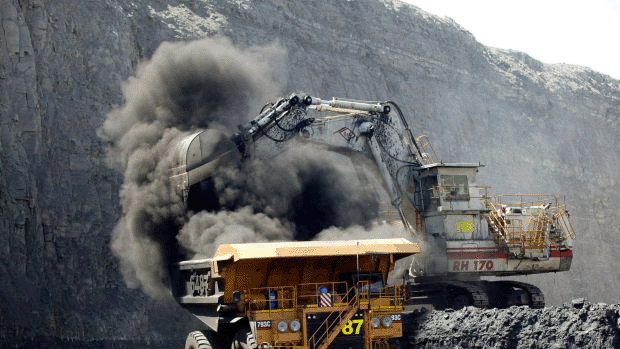 Aren’t we in a drought? The Australian black coal industry uses enough water for over 5 million people, The Conversation, Ian Overton, Adjunct Associate Professor, Centre for Global Food and Resources, University of Adelaide, 4 May 20, Aren’t we in a drought? The Australian black coal industry uses enough water for over 5 million people, The Conversation, Ian Overton, Adjunct Associate Professor, Centre for Global Food and Resources, University of Adelaide, 4 May 20, Water is a highly contested resource in this long, oppressive drought, and the coal industry is one of Australia’s biggest water users. Research released today, funded by the Australian Conservation Foundation, has identified how much water coal mining and coal-fired power stations actually use in New South Wales and Queensland. The answer? About 383 billion litres of fresh water every year. That’s the same amount 5.2 million people, or more than the entire population of Greater Sydney, uses in the same period. And it’s about 120 times the water used by wind and solar to generate the same amount of electricity. Monitoring how much water is used by industry is vital for sustainable water management. But a lack of transparency about how much water Australia’s coal industry uses makes this very difficult. Adani’s controversial Carmichael mine in central Queensland was granted a water licence that allows the company to take as much groundwater as it wants, despite fears it will damage aquifers and groundwater-dependent rivers. Now more than ever, we must make sure water use by coal mines and power stations are better monitored and managed………. No transparencyData on total water use by coal mines is not publicly available. Despite the development of Australian and international water accounting frameworks, there is no reporting to these standards in coal mine reports. This lack of consistent and available data means water use by the coal industry, and its negative effects, is not widely reported or understood. The problem is compounded by complex regulatory frameworks that allow gaps in water-use reporting. A patchwork of government agencies in each state regulate water licences, quality and discharge, coal mine planning, annual reviews of mine operations and water and environmental impacts. This means that problems can fall through the gaps…….. https://theconversation.com/arent-we-in-a-drought-the-australian-black-coal-industry-uses-enough-water-for-over-5-million-people-137591 |
|
|
|||||||
1 This month.
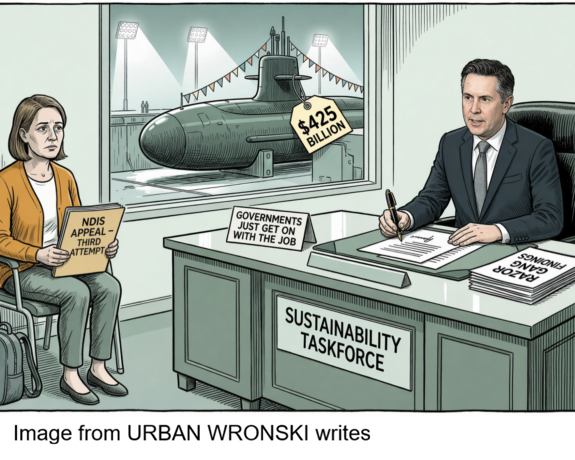

PETITION – To: Prime Minister Anthony Albanese and the Australian Labor Government
Chernobyl: The Lost Tapes – A good documentary on Chernobyl on SBS available On Demand for the next 3 weeks– https://www.sbs.com.au/ondemand/tv-program/chernobyl-the-lost-tapes/235274195556

19 May – Webinar- Webinar: No Nuclear Weapons in Australia
Start: 2026-05-19 18:00:00 UTC Canberra, Melbourne, Sydney (GMT+10:00)
End: 2026-05-19 19:30:00 UTC Canberra, Melbourne, Sydney (GMT+10:00)
20 May – Webinar – The dangerous world of AUKUS, US, military occupation and suppression of dissent

National Webinar, 20th May, 2026, 6.30pm AEST. Confronting laws restricting/suppressing protest speech and action
Speakers: Former Sen. Rex Patrick, Lawyer Nick Hanna ,Arthur Rorris ,Jorgen Doyle, Sen David Shoebbridge,
Facilitator Kelley Tranter.

of the week – Australians for War Powers Reform (AWPR)
To see nuclear-related stories in greater depth and intensity
 Antinuclear