South Korea’s government dismissed rumours about North Korean leader Kim Jong Un being gravely ill
|
North Korean leader Kim Jong-un health rumours dismissed by South Korean intelligence, ABC News, 27 Apr 20, South Korea’s Government has dismissed rumours that North Korean leader Kim Jong-un is in a fragile condition, as speculation about his health intensifies amid the North’s silence on his whereabouts. Unification Minister Kim Yeon-chul told a closed-door forum in Seoul that South Korea had “enough intelligence to confidently say that there are no unusual developments” in rival North Korea that would back up speculation about Mr Kim’s health, his ministry said. The minister did not reveal what specific intelligence led to that conclusion, but stressed that it was reached after a thorough analysis. His comments are a reiteration of earlier South Korean statements that Mr Kim appeared to be handling state affairs normally and that no unusual activities had been detected in North Korea. Those comments, however, failed to dispel the rumours about Mr Kim, partly because past outside intelligence reports on developments in North Korea have sometimes turned out to be wrong. ….. As the absolute leader of a country with a nuclear weapons program, Mr Kim’s health is a matter of intense interest both regionally and globally. If something were to happen to him, it could lead to instability in North Korea. Mr Kim hasn’t publicly anointed a successor, and that has prompted questions about who would take control of North Korea if he is gravely ill or dies….. serious unrest could occur if a power struggle erupts between those supporting the Kim dynasty and those who want non-Kim rule…….. https://www.abc.net.au/news/2020-04-28/kim-jong-un-health-rumours-south-korea-intelligence/12191504 |
|
USA government puts nuclear industry ahead of public health risk
 As Pandemic Rages, Federal Nuclear Regulators Put Keeping Reactors Running Ahead
 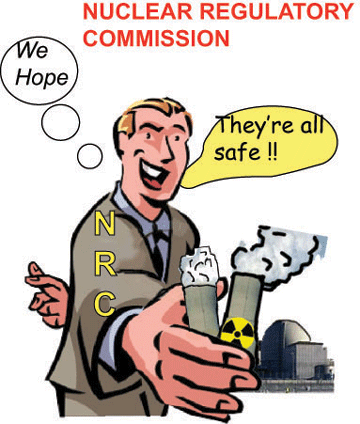 of Public Health and Safety https://www.ewg.org/energy/23141/pandemic-rages-federal-nuclear-regulators-put-keeping-reactors-running-ahead-public-27 Apr 20,
The federal government’s toothless nuclear “watchdog” has historically shown more concern for keeping dangerous aging reactors running than for Americans’ safety from a nuclear accident. So how is the Nuclear Regulatory Commission, or NRC, responding to the coronavirus pandemic?
-
-
- Letting nuclear power plants cut back their workforces to facilitate social distancing – but letting them make up for the reduced numbers by requiring the remaining control room operators and other key employees to work back-to-back 84-hour weeks, heightening the danger of worker exhaustion that could contribute to a reactor accident.
-
- Telling the agency’s on-site safety inspectors – two or more resident inspectors at each plant – to work from home, and allowing plants to defer required inspections of piping systems critical to cooling the reactors.
- Keeping reactor refueling crews of up to 1,500 technicians traveling from plant to plant, working in crowded conditions and staying in nearby communities, increasing the likelihood of crew members spreading the virus
The U.S. has 58 nuclear power plants housing 96 nuclear reactors in 29 states. Each plant employs 500 to 1,000 workers. Every 18 to 24 months, plants are powered down for four to six weeks for refueling, done in the spring or fall, when electric demand is low. According to the Nuclear Energy Institute, or NEI, the lobbying arm of the nuclear industry, refueling is scheduled at 56 plants this year.
On March 20, the NEI wrote the NRC to request that refueling crews have “unfettered access to travel across state lines” and unrestricted access to local hotels and food services, and to be prioritized for personal protective equipment. The NRC responded by allowing a reduction in the required number of plant personnel, and allowing an increased work week for remaining employees of 12-hour days for up to 14 days straight.
That worries Beyond Nuclear, a nonprofit that advocates “for an energy future that is sustainable, benign and democratic.”“Nuclear plant operators on extended 12-hour shifts, who can now be assigned to work two consecutive 84-hour weeks, will suffer excessive fatigue,” Beyond Nuclear’s director of plant oversight, Paul Gunter, said in a news release. “This not only compromises their immune systems, but makes catastrophic mistakes more likely.” The release cited the infamous Three Mile Island nuclear accident, in 1979, which it said was attributed to “mechanical failure worsened by operator fatigue and error.”
One week after the Nuclear Institute’s letter, the NRC directed resident inspectors to work from home, “only coming on site for risk-significant in-plant operations.” The agency has also allowed utilities operating the plants to request postponement of inspections and maintenance. “There are some ancillary activities during an outage that can be deferred,” an NRC spokesperson told Bloomberg.Among the “ancillary” activities that can be deferred is inspection of piping critical to cooling the reactors. Beyond Nuclear says three plants, in Illinois, Florida and Texas, have requested 18-month deferments of inspections of steam generator tubes that are subject to extreme heat, radiation and vibration. Failure of the piping, says the International Atomic Energy Agency, could lead to “core damage or large release events” of radiation.At least four nuclear plants – Fermi 2, near Detroit, Susquehanna, near Berwick, Pa., Limerick, near Pottstown, Pa., and Vogtle, near Waynesboro, Ga. – have seen cases of COVID-19
The Pottstown Mercury reports that local officials asked Exelon, the owner of Limerick, to postpone refueling because they found the company’s plans to address the pandemic inadequate. Regardless, the company went ahead with refueling and didn’t begin social distancing until workers told the press they were “terrified” that they’re working in a “breeding ground” for COVID-19.Nearly 30 Limerick workers have tested positive for the virus, according to The Philadelphia Inquirer. But Vogtle has by far the biggest outbreak, with 143 workers testing positive. It’s unknown how many nuclear plant workers nationwide have tested positive, because the NRC has not reported cases.“The key question,” Edwin Lyman, director of nuclear power safety for the Union of Concerned Scientists, told Utility Dive, “is how much additional risk will the NRC allow nuclear plants to accept in order to keep them running during the crisis?”Good question.
-
International climate ministers meet to discuss green recovery post COVID-19
 International climate ministers meet to discuss green recovery post COVID-19 https://www.miragenews.com/international-climate-ministers-meet-to-discuss-green-recovery-post-covid-19/ This week environment ministers from 30 countries will meet in a two-day (27 – 28 April) online conference to discuss how to organise a green economic recovery after the worst of the COVID-19 pandemic is over. They will also aim to agree on how to proceed with ambitious carbon reductions despite the postponement of this year’s UN Climate Change Conference (COP26).
The ‘Petersberg Climate Dialogue’ will be hosted by Svenja Schulze, Germany’s Federal Environment Minister and Alok Sharma, the UK Secretary for Business and Energy and designated President of COP26.
Helen Clarkson, CEO of The Climate Group, an international non-profit with a mission of accelerating climate action said:
“The impact of COVID-19 has been devastating. As the world seeks to address the longer-term impact of this crisis, there is an opportunity for governments to help rebuild society differently. A side effect of the reduced economic activity we are seeing is cleaner air and clearer skies – through positive international cooperation we can begin to understand how we keep those things without compromising on economic growth.
“We have received signals from our partners, including 300 of the world’s largest businesses, that their commitment to climate action overwhelmingly remains in spite of the challenging circumstances. Just last week, nine members of our global electric vehicles initiative EV100, including the likes of Ingka Group, Unilever and LeasePlan, called on the EU to retain 2020 CO2 targets for cars, vans and trucks.
“Electric vehicles and renewable, efficient energy are profitable, long term investments. We need these smart green stimulus policies to not just maintain momentum but rapidly ramp-up investment to another level, and help deliver the halving of emissions we need in this decade.”
Animals in radiation zones are not doing well

above – Chernobyl bird at right has facial tumour
Not thriving, but failing https://beyondnuclearinternational.org/2018/03/11/not-thriving-but-failing/ https://beyondnuclearinternational.org/2018/03/11/not-thriving-but-failing/ Animals in radiation zones are not doing well, By Linda Pentz Gunter
It started with wolves. The packs around the Chernobyl nuclear plant, which exploded on April 26, 1986, were thriving, said reports. Benefitting from the absence of human predators, and seemingly unaffected by the high radiation levels that still persist in the area, the wolves, they claimed, were doing better than ever.
Appearances, however, can be deceptive. Abundant does not necessarily mean healthy. And that is exactly what evolutionary biologist, Dr. Timothy Mousseau and his team began to find out as, over the years, they traveled to and researched in and around the Chernobyl disaster site in the Ukraine. Then, when a similar nuclear disaster hit in Japan — with the triple explosions and meltdowns at Fukushima Daiichi on March 11, 2011 — Mousseau’s team added that region to its research itinerary.
Mousseau has now spent more than 17 years looking at the effects on wildlife and the ecosystem of the 1986 Chernobyl nuclear disaster. He and his colleagues have also spent the last half dozen years studying how non-human biota is faring in the wake of Fukushima. Ninety articles later, they are able to conclude definitively that animals and plants around Chernobyl and Fukushima are very far indeed from flourishing.
Mousseau’s findings strongly contradicted earlier work including the 2006 Chernobyl Forum report which claimed the Chernobyl zone “has become a wildlife sanctuary,” and a subsequent article published in Current Biology in 2015 that said wildlife was “thriving”around Chernobyl.
“I suppose everyone loves a Cinderella story,” speculated Mousseau, who is based at the University of South Carolina. “They want that happy ending.” But Mousseau felt sure the moment he read the Forum report, which, he noted, “contained few scientific citations,” that the findings “could not possibly be true.
What Mousseau found was not unexpected given the levels of radiation in these areas and what is already known about the medical effects of such long-term exposures. Birds and rodents had a high frequency of tumors.
“Cancers are the first thing we think about,” Mousseau said. “We looked at birds and mice. In areas of higher radiation, the frequency of tumors is higher.” The research team found mainly liver and bladder tumors in voles and tumors on the head, body and wings of the birds studied.
But Mousseau wanted to look beyond cancers, which is what everyone expects to find and what researchers had looked for, but only in humans. There were few wildlife studies, a fact Mousseau found surprising, given nature’s ability to act as a sentinel for likely impending human health impacts.
Mousseau and his fellow researchers found cataracts in birds and rodents. Male birds had a high rate of sterility. And the brains of birds were smaller. All of these are known outcomes from radiation exposure.
“Cataracts in birds is a problem,” Mousseau said. “A death sentence.”
Mental retardation has been found among children exposed to radiation in utero. Mousseau and colleagues discovered the same pattern in the birds they studied. “Birds already have small brains, so a smaller brain size is a definite disadvantage,” he said.
There were also just fewer animals in general. “There were many fewer mammals, birds and insects in areas of higher radiation,” Mousseau said. And they had their hunch as to why.
He and his colleagues extracted sperm from the male birds they caught and were shocked to find that “up to 40% of male birds in the radiologically hottest areas were sterile.”
The birds’ sperm were either deformed or dead. None would be able to reproduce. The discovery, he said, was “not at all surprising. These are the levels of radiation known to influence reproduction. At the same time, there is no safe level of radiation below which there aren’t detectable effects.”
Fewer birds have already been observed in the contaminated areas around Fukushima, said Mousseau. “Although it’s too early to assess the long term impact on abundance and diversity around Fukushima, there are very few butterflies and many birds have declined in the more contaminated areas. If abundance is compressed, biodiversity will follow.”
The consequences of radiation exposure, says Mousseau, “will have a tremendous impact on the quality of life of these animals, and the length of quality of life. It need not necessarily be cancers,” that cause these damages he said. “There is no doubt that the levels of radiation in Chernobyl and Fukushima generate genetic damage.”
Read more about Dr. Timothy Mousseau’s work.
Wind and solar could play key role in future of Australia’s aluminium industry — RenewEconomy

Wind and solar could play key role in the future of Australia’s aluminium industry, particularly as dependence on coal becomes a reliability rather than an asset. The post Wind and solar could play key role in future of Australia’s aluminium industry appeared first on RenewEconomy.
via Wind and solar could play key role in future of Australia’s aluminium industry — RenewEconomy
Australia’s main grid sets new milestone for negative prices over weekend — RenewEconomy

Electricity prices go negative prices in all five state markets in Australia’s main grid for four consecutive settlement intervals over the weekend. The post Australia’s main grid sets new milestone for negative prices over weekend appeared first on RenewEconomy.
via Australia’s main grid sets new milestone for negative prices over weekend — RenewEconomy
AEMO to resume new connections after solar constraints lifted in West Murray — RenewEconomy

AEMO tells project owners that connections will resume now that solar oscillation issues in West Murray are resolved, and tells them where they stand in the growing queue. The post AEMO to resume new connections after solar constraints lifted in West Murray appeared first on RenewEconomy.
via AEMO to resume new connections after solar constraints lifted in West Murray — RenewEconomy
On-site solar is key to cost competitive renewable hydrogen — RenewEconomy

On-site solar seen as key to making renewable hydrogen cost-competitive by 2025, according to new study by Dyno Nobel. The post On-site solar is key to cost competitive renewable hydrogen appeared first on RenewEconomy.
via On-site solar is key to cost competitive renewable hydrogen — RenewEconomy
Huge Dundonnell wind farm powers past 100MW-mark in Victoria — RenewEconomy

Tilt Renewables’ massive Dundonnell wind farm on track after powering up its output to more than 110MW last week. The post Huge Dundonnell wind farm powers past 100MW-mark in Victoria appeared first on RenewEconomy.
via Huge Dundonnell wind farm powers past 100MW-mark in Victoria — RenewEconomy
April 27 Energy News — geoharvey

World: ¶ “SoftBank-Backed SB Energy And EDEN Bag 900 MW Of Solar In India” • A 2-GW solar power tender received very a encouraging response amidst uncertainty of the Covid-19 outbreak. The government-owned power company NHPC set a maximum tariff bid of ₹2.78/kWh (3.64¢/kWh). It received bids for over 3.1 GW. [CleanTechnica] ¶ “Sweden Shutters […]
No COVID-19 Didn’t Stop the Climate Crisis, But It’s Interacting with it in a Bad Way — robertscribbler

As we stand in the grips of one major global crisis, one whose first wave of mass casualties may finally be starting a merciful down-slope (on April 27, 2020), it’s important not to lose sight of the other, larger, one. Yes, I’m talking about the Climate Crisis. And as I mention it, I would be […]
Nuclear weapons, the climate crisis, social justice, and the COVID-19 pandemic — IPPNW peace and health blog

An online international conference sponsored by the Rosa Luxembourg Stiftung NYC on April 25 provided a unique opportunity for the world’s nuclear disarmament campaigns, allied movements and organizations, and diplomats committed to banning and eliminating nuclear weapons to amplify nuclear abolition demands and to show how the nuclear dangers interconnect with the threats posed by […]
Katrina Lester: major South Australian Aboriginal groups not consulted in Kimba nuclear waste dump decision.
 Katrina Lester, Submission No 49 to Senate Committee Inquiry on National Radioactive Waste Management Amendment (Site Specification, Community Fund and Other Measures) Bill 2020 I, Karina Lester make this submission on behalf of concerned members of the the
Yankunytjatjara Native Title Aboriginal Corporation RNTBC (YNTAC) (SCD2006/001), the
De Rose Hill – Ilpalka Aboriginal Corporation RNTBC (DRHIAC) (SCD2005/001), the
Tjayiwara Unmuru Aboriginal Corporation RNTBC (TUAC) (SCD2013/001), and the First
Nations of South Australia Aboriginal Corporation (FNSAAC).
At this stage, the aforesaid concerned members are opposed to the National Radioactive Waste Management National Radioactive Waste Management Amendment (Site Specification, Community Fund and Other Measures) Bill 2020. This is on the basis that there has been no engagement or consultation with the aforementioned concerned members, or the organisations of which they are a part.
While we acknowledge that the specified site for the radioactive waste management facility lies in the Barngarla Native Title Determination Area, this land has significance for a wider group of Aboriginal people, including members of YNTAC, DRHIAC, TUAC and FNSAAC.
The Bill overrides the proposed use of the specified site is thus a matter of significance for Aboriginal people
from across South Australia, whose non-native title rights and interests would be affected by
the construction and operation of a radioactive waste management facility at this site.
We particularly wish to raise concern about the way section 34GB overrides the application of the Aboriginal and Torres Strait Islander Heritage Protection Act 1984 (ATSIHPA) and the Environmental Protection and Biodiversity Conservation Act 1999 (EPBCA), in relation to the activities authorised under section 34G of the Bill.
Many of the activities contemplated by section 34G have the potential to be highly destructive to Aboriginal sites and objects which would otherwise be protected by ATSIHPA. These activities also have the potential to cause serious environmental damage of the kind that would otherwise be prevented by the EPBCA. Parliament should not allow the introduction into legislation of provisions that undermine the fundamental objects and functionality of essential legislation like the ATSIHPA and the EPBCA.to be negotiated for damage to the heritage and environment of our ancestors. Should our ancient rights and interests be overridden, we will take appropriate action in in court to ensure
justice for our people and their environment.
We would welcome the opportunity to discuss further this submission if requested. Please feel
free to contact me by email at: in this regard.
Yours sincerely,
Karina Lester
Director: Yankunytjatjara Native Title Aboriginal Corporation
Tjayiwara Unmuru Aboriginal Corporation
Member: De Rose Hill – Ilpalka Aboriginal Corporation
First Nations of South Australia Aboriginal Corporation
Lodged on behalf of Karina Lester by:
Osker Linde
Deputy Principal Legal Officer
South Australian Native Title Services
Susan Craig: South Australia’s $27.9 billion food, wine and tourism markets endangered by Kimba nuclear waste dump plan

South Australia’s strength in this marketplace is the trust other countries have, in not only our clean reputation, but SAFE food. The establishment of a nuclear waste facility, in particular one that is built in the heart of agriculture is a profound contradiction of South Australia’s position and will put that reputation and business at risk.
Combined; the food, wine and tourism markets are valued at $27.9 billion, to South Australia, yet operators in this industry have been totally disregarded by the DIIS and denied the rightful and proper mechanisms to become involved and informed and therefore have never been given the opportunity prepare a case to defend their industries.
Susan Craig, Submission 62 (part 1) to Senate Committee re National Radioactive Waste Management Amendment (Site Specification, Community Fund and Other Measures) Bill 2020
CRITICAL THREAD
We must protect the environment serving potential growth areas and industries to maintain our clean, green, reputation and maintain our global competitive advantage in agriculture and food, tourism and other industries – CSIRO- Securing South Australia’s Future, CSIRO Publishing 2017.
Critical stakeholders in the food, wine, agriculture and tourism industries that operate throughout South Australia were never given the rightful and proper opportunity to engage with the Department of Industry Innovation and Science (DIIS) on the details relating to the National Radioactive Waste Management Facility (NRWMF).
The boundaries for consultation did not take into account economic geography and focused only on a local district, overlooking the many South Australian stakeholders who will be adversely affected by the establishment of nuclear waste facility; as it is a profound contradiction of their clean, green, pristine and SAFE reputation, which is the cornerstone of their sustainable competitive advantage in world markets.
SOUTH AUSTRALIA’S FOOD AND WINE REVENUE IS VALUED AT $20.3 BILLION
“Particularly in regional South Australia”. “South Australia’s primary industries are a vital part of the state’s
economy. Grains, livestock, horticulture, wine, seafood, forests and dairy sectors are significant contributors to the state’s exports. In 2017–18, South Australia’s gross food and wine revenue totalled $20.3 billion.”
https://www.pir.sa.gov.au/ data/assets/pdf file/0011/339842/PIR
The most important commodity in South Australia based on the gross value of agricultural production is wheat (valued at $1.7 billion)
o Well-established natural resource management.
o Environmental protection frameworks.
o Impeccable food safety and quality assurance standards.
Protecting South Australia’s clean air, soil and water is vital for the prosperity of our food and wine sectors.
Demand for South Australian products is increasing due to our high quality safety and production standards.
SA Tourism soars to break new record $7.6 billion
South Australia’s visitor economy worth $7.6 billion – NVS and IVS results.
SUMMARY
The cornerstone of South Australia’s food, wine and tourism industries is without question; its premium, clean, green, SAFE reputation which is clearly understood by the South Australian Government, South Australia’s primary producers, tourism industries and the international markets who enjoy these products and services.
South Australia’s strength in this marketplace is the trust other countries have, in not only our clean reputation, but SAFE food. The establishment of a nuclear waste facility, in particular one that is built in the heart of agriculture is a profound contradiction of South Australia’s position and will put that reputation and business at risk.
Combined; the food, wine and tourism markets are valued at $27.9 billion, to South Australia, yet operators in this industry have been totally disregarded by the DIIS and denied the rightful and proper mechanisms to become involved and informed and therefore have never been given the opportunity prepare a case to defend their industries.
Until engagement between the National Radioactive Waste Management committee, the Department of Industry, Innovation and Science and those critical South Australian stakeholders in the South Australian primary industries and tourism sector takes place, the current plans for the NRWMF should be halted
Please accept my submission in asking the committee to reject any amendments to the National Radioactive Waste Management Susan Craig, Independent Campaigner
Susan Craig: in Kimba “Informed Consent” not possible, as the community was not properly informed
 Susan Craig Submission No 62. to the Senate Committee Inquiry on National Radioactive Waste Management Amendment Bill (part 2)
CRITICAL THREAD – “Informed Consent” – voting is not possible if there is insufficient knowledge of the process.
Informed consent is based on a clear appreciation and understanding of the facts, identifying the implications, adverse risks and consequences of an action.
Because the KIMBA community were not given an unbiased and objective view
of the long term implications of the National Radioactive Waste Management
Facility (NRWMF), it is not possible for them to be in a duly qualified position
to determine the best long term solution for KIMBA and therefore they were
never afforded the opportunity to execute their decision to vote based on
“informed consent”.
INFORMATION PROVIDED TO THE KIMBA COMMUNITY BY THE DEPT. OF
INDUSTRY, INNOVATION AND SCIENCE (DIIS).information in
support of the NRWMF; outlining ONLY the proposed potential benefits
to the community of KIMBA.
The proponents of the NRWMF, DIIS, only disseminated information in support of the NRWMF ,outlining only the propsed potential benefits to the community of Kimba. At no stage during the consultation process
Because the KIMBA community were not given an unbiased and objective viewof the long term implications of the National Radioactive Waste Management Facility (NRWMF), it is not possible for them to be in a duly qualified position to determine the best long term solution for KIMBA and therefore they were never afforded the opportunity to execute their decision to vote based on “informed consent”.
At no stage during the consultation process did DIIS present the risks associated with a NRWMF to the community. Nor did they actively engage with an independent authority asking them to provide
information on the risks that the facility would pose.
A risk assessment was never carried out by DIIS to explain the
consequences of a radiological release and the effect it would have on
human life, the environment, agriculture and subsequent risk of a shift
in product / region value and land values
Refer to:
“National Radioactive Waste Management Facility Taskforce:
Information pack.” The hyperlink below [on original] is to the list of 25 documents covering various aspects of
the NRWMF and is representative of the print material distributed throughout
the Kimba community, leading up to the ballot. Note the absence of
information/documentation relating to potential risks.
Furthermore, the document titled “Safety and Security,” (extract below) shows
the extreme and unfair bias for the NRWMF. The Task Force in their dealings
and consultation were unethical and opportunist by using deception and
concealment to persuade the ill-informed taskforce-information-pack.
This information serves to demonstrate the inequitable information
that was disseminated to the Kimba community.
THE FOLLOWING INFORMATION REPRESENTS POTENTIAL RISKS
THAT WERE NEVER PART OF THE INFORMATION PROVIDED BY DIIS
TO THE KIMBA COMMUNITY.
Interim might be forever. With regards to the intermediate/high level
nuclear waste, the Kimba community needed to understand that
“interim” could mean storage for an indefinite period—perhaps
forever—if a permanent disposal facility is not constructed. Even if a
date for opening a permanent repository was stated, it is meaningless,
as the community would be relying on future Governments to uphold
the promise over the next 10, 20 – 100 years and make the tenuous
assumption that future Governments would have the expertise, impetus
or financial resources to implement them. DIIS advised the Kimba
community that the intermediate level waste would be ‘temporary,”
never referencing “indefinite” and only once the NRWMF was
established, would they commence identifying a possible permanent
facility for the intermediate/high level
Therefore the Kimba community were never informed.
A risk assessment was never carried out by DIIS to explain the
consequences of a radiological release and the consequence this would
have on human life, the environment, agriculture and subsequent risk of
a shift in product / region value and land values. This information was
never part of the consultation process.
Therefore the KIMBA community were never informed.
A Radiation Emergency Preparedness and Response Action plan was
never presented by DIIS to the Kimba community, in accordance with
ARPANSA regulations that refer to the IAEA Response Assistance
Network (RANET).
As stated by ARPANSA and the IAEA. “It is the responsibility of the State
Emergency response agencies with radiation protection guidance from
State Radiation Safety Officers to respond to a radiation emergency
within their jurisdiction.” (RANET).
“As part of these activities, it develops safety standards, guidelines and
technical tools; assists Member States in building the capacity for
emergency response; and maintains the IAEA Incident and Emergency
System to efficiently implement its role in response to nuclear or
radiological incidents and emergencies, regardless of whether they arise
from accident, negligence or deliberate act.”
A Radiation Emergency Preparedness and Response Action plan
specifically addressing and tailored to the NRWMF at Kimba does not
exist and was never presented as part of the proposal.
Therefore the Kimba community were never informed.
Without the above information being provided to the KIMBA community by
DIIS, the community has absolutely no understanding as to the consequences
of their vote in the community ballot and therefore should be disregarded and
declared to be of no consequence in assessing “broad community support”.
To do otherwise would be morally and legally negligent.
Because the KIMBA community were not given an unbiased and objective view
of the long term implications of the NRWMF, it is not possible for them to be in
a duly qualified position to determine the best long term solution for KIMBA
and therefore they were never afforded the opportunity to execute their
decision to vote based on “informed consent.”
1 This month.


PETITION – To: Prime Minister Anthony Albanese and the Australian Labor Government
Chernobyl: The Lost Tapes – A good documentary on Chernobyl on SBS available On Demand for the next 3 weeks– https://www.sbs.com.au/ondemand/tv-program/chernobyl-the-lost-tapes/235274195556
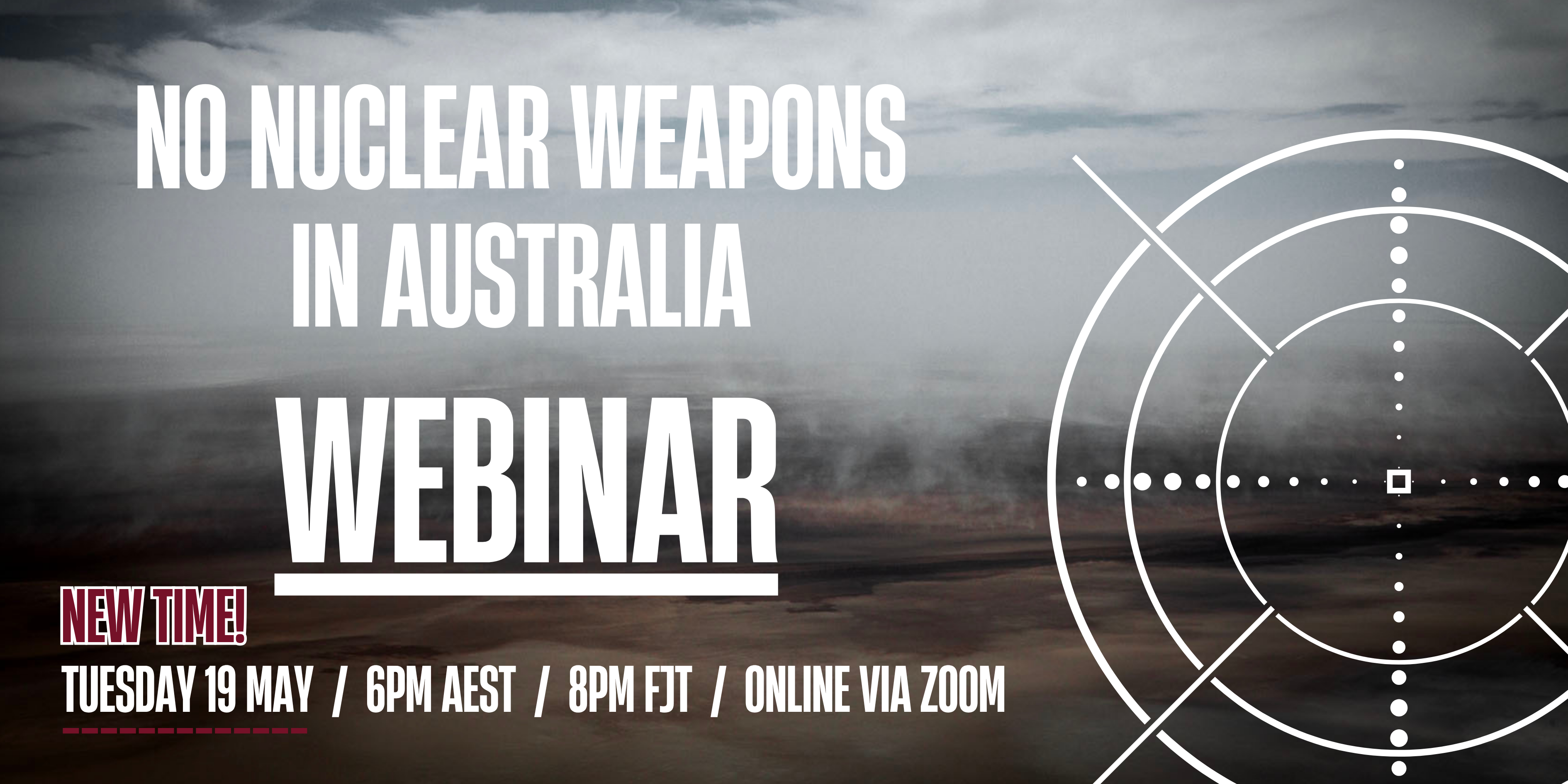
19 May – Webinar- Webinar: No Nuclear Weapons in Australia
Start: 2026-05-19 18:00:00 UTC Canberra, Melbourne, Sydney (GMT+10:00)
End: 2026-05-19 19:30:00 UTC Canberra, Melbourne, Sydney (GMT+10:00)
20 May – Webinar – The dangerous world of AUKUS, US, military occupation and suppression of dissent

National Webinar, 20th May, 2026, 6.30pm AEST. Confronting laws restricting/suppressing protest speech and action
Speakers: Former Sen. Rex Patrick, Lawyer Nick Hanna ,Arthur Rorris ,Jorgen Doyle, Sen David Shoebbridge,
Facilitator Kelley Tranter.

of the week – Australians for War Powers Reform (AWPR)
To see nuclear-related stories in greater depth and intensity
 Antinuclear