TODAY. A genocidal USA President to be followed by another genocidal USA President?
“If those hostages aren’t back, I don’t want to hurt your negotiations, if they’re not back by the time I get into office, all hell will break out in the Middle East and it will not be good for Hamas and it will not be good, frankly, for anyone. All hell will break out. I don’t have to say anymore, but that’s what it is.”
“Democracy” is becoming a joke. With a sort of gerry-mandered system, the USA Electoral College, not the majority of voters, determines the result of the presidential election. Indeed, the majority of U.S. citizens don’t vote, anyway.
So the USA ends up with a lying, foul-mouthed, misogynist, convicted felon as President. But that really doesn’t matter all that much, as whoever gets in can only do so with the backing of the mega-wealthy owners of corporations and media, and indeed, of the “military industrial complex”. So however the President might want to, personally, avoid militarism, he can’t.
Joe Biden has been allout for promoting and supporting and paying, for the proxy war against Russia, and for Israel’s genocidal war in Gaza. All the while, he’s had his slimy, silver-tongued Antony Blinken publicly pretending that the USA wants peace.
Donald Trump is an interesting contrast. From all that I could find out, he actually hates war, but has this unusual modus operandi of getting what he wants by bullying – so his weapon, preferably, is the threat of war, rather than war itself. He admires dictators, and likes to pal up with them. In the case of Ukraine, he’d probably go for a peace deal, as long as it somehow helps U.S. trade interests, and of course, his own business interests.
In the case of Gaza, perhaps the same thinking applies? If Trump could get the Gazans to hand over all their Israeli hostages back to Israel, perhaps that war would end, so perhaps Trump is using dire threats, to bully Hamas into that action.
Either way, by Biden’s consistent support and promotion of war, or by Trump’s inflammatory bullying tactics threatening war, – militarism is the way to go. And that’s how American business interests like it.
Both administrations are walking on a tightrope, that at any moment could erupt into World War 3. But that’s OK, – in the meantime, lots of weapons sales, lots of corporate profits, lots of shareholder gains, lots of jobs.
The Atlas Network has eugenicist roots

January 8, 2025 Lucy Hamilton, https://theaimn.net/the-atlas-network-has-eugenicist-roots/
We don’t expect the free market’s ad men to understand their movement’s deep integration with eugenicist ideas. It is worth knowing that fact, however much they will deny the relevance of their origin stories.
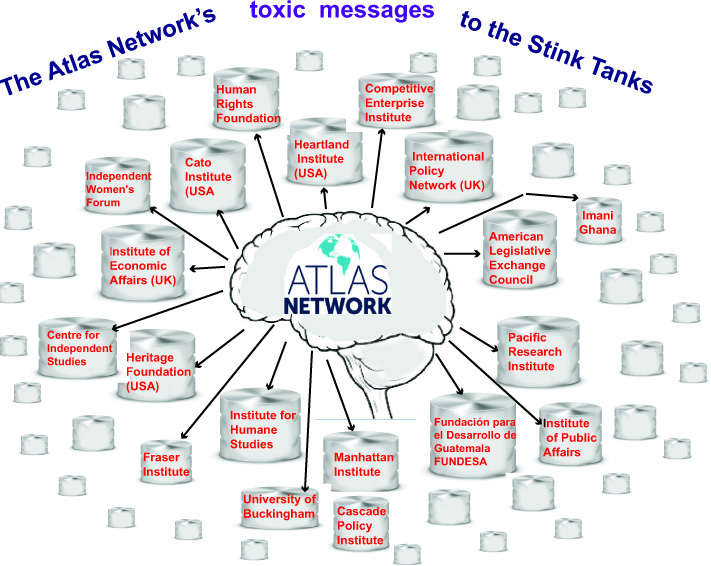
Peter Kurti, of the Atlas Network’s Centre for Independent Studies, wrote an opinion piece for The Australian recently called “Citizenship based on rights can’t replace the glue of civil society.” There he posits “social cohesion” as more important than rights. He blames “multiculturalism” for the reluctance of Australians to volunteer. These are baseless tropes common to the Atlas Network, and also to Viktor Orbán’s junktank space where Kurti is a feature.
British investigative journalist Nafeez Ahmed has just published a book tracking the tight integration of the same American eugenics movement that fed the Nazi death camps into the “science” of free market economics. The integration of “former” Nazis and fellow travellers into the movement around libertarianism is made quite clear in his account. The same donors that fund the Atlas Network also funded the “science” of class and racial difference.
It is not surprising that a movement designed to serve the rich should emerge out of racist beliefs. The upper classes of the early 20th century tended to be eugenicist and many supported the Nazis. The 19th century Social Darwinist idea that success, in society or business, reflected genetic fitness never went away.
The Mont Pelerin Society (that later birthed the Atlas Network to act as the self-replicating advertising agency for its oligarch donors’ policy goals) was established in 1947 to fight the threat of communism. Property had to be protected from the masses. Keynesian government involvement in the market and society was just another form of theft for these economist-servants of the upper echelons.
At the same time, Ahmed explains, the proto-CIA was integrating former Nazi spies into the Western intelligence gathering circuit where they fostered anti-Soviet hysteria for their own purposes. William Casey was one of the key OSS figures in that era and later director of the CIA under Reagan.
Casey also worked with the creator of the Atlas Network Sir Antony Fisher, co-founding together Fisher’s first American junktank, the Manhattan Institute.(1)
Race, empire and capitalism have deeply intertwined roots. Part of the monumental global violence of the Cold War involved empires and capitalist forces rejecting the colonised people’s demand for freedom. One of the Atlas Network’s roles has been to deploy disgruntled local elites to foster a more convenient definition of “freedom” that protects the local (lighter skinned) aristocracy’s property, alongside the (foreign) corporations’ investments and profits.
The Cold War struggle against redistribution came to demarcate the “communist” enemy in any group that wanted equal rights. Old racisms were recast as factual detection of communist subversion. The Civil Rights movement was depicted by the propagandists entrenching privilege as a communist threat.
Many amongst the moneyed class in America belonged to the notorious John Birch Society through the 1950s into the 70s. Charles Koch, one of the key Atlas Network donors and strategists later in the century bought a lifetime membership. His father had been a founding member. Birch was an hysterical conspiracist organisation that fought communism but was also explicitly racist.
So the fact that key Atlas donors like the Mellon-Scaifes, Bradleys and Olins were also funding research to establish that “science” could shore up the Evolutionary Ladder is not surprising. They wanted the proof that Black people were genetically inferior.
It had the adjunct benefit of establishing that the White working class was inferior also.
Atlas junktanks and Rupert Murdoch, who was a junktank director at Atlas’s Cato Institute in the 90s, fostered the career and disseminated the writing of figures like Charles Murray who gave them the (discredited) science to fight “welfare.” There was no value in helping the poor, of any skin colour, if they were genetically trapped in their suffering.
Many of the same donors funded the transition of the race biology industry into the Islamophobia industry after 9/11. They needed a new enemy, now that Russia was White and Christian again. Creating a sense that there was an integral “clash of civilisations” with the Islamic “world” was as useful as the certainty that the Soviets were an existential threat and that Black people were genetically inferior.
Many of same figures and families continue to work now in this movement that gradually flipped Western society from a Keynesian understanding of political economy to a neoliberal one.
In the wake of the shooting of a CEO in New York, there have been many musings on the “ruthless arithmetic” of neoliberal capitalism, the implicit knowledge that some lives have no value for the shareholder.
The same old idea of the fungibility of the lower orders underpins the Atlas Network’s Institute of Public Affairs (IPA) hosting Jay Bhattacharya in Australia during the pandemic to promote his easily debunked research fighting public health measures. The massive death toll amongst (darker skinned) “essential workers” in the USA was a small price to pay for quarterly profit protection.
One of the reasons such tools argued that schools must remain open (despite the unwillingness to allow investment in the improvements that would make schools safer during a pandemic) is because the CEOs needed them as childminding.
Atlas Network junktanks fight any regulation that translates into making workplaces and products safer. Their workers, neighbours and customers can die if the shareholder is happy.
The demonisation of “welfare” by Atlas Network junktanks over the decades created the space for Alan Tudge’s threats towards the battlers in the rhetoric around Robodebt. It provides the context for the individual cases that Tudge had extracted and provided to “friendly” media to ruin the reputation of people complaining about the illegal program.
The rich are on tax strike, one of the Atlas Network’s key goals. Much of the common wealth that is collected is funnelled up to the investors in industries such as the weapons sector, or just gifted as Jobkeeper overpayments were. This limits the money available for social goods.
That means that Kurti’s emphasis on volunteering becomes even more important. If the oligarchs have ensured that there is very little money available for the community, we need volunteers to compensate. The neoliberal project also partly works to fan up “family values” because they need women to provide the care for the family unit that they have prevented society making available.
And the enemy must be depicted as the Other. Whether it is the Black rights activist who must be portrayed as “communist” or the multicultural society that Kurti singles out as undermining “social cohesion,” the enemy cannot be the oligarch whose propaganda has enabled making our lives more precarious. Viktor Orbán is the guiding light of those who want ethnostates, the only way they can imagine cohesion.
The alleged socialism of anyone who wants their rights protected continues in random allegations of “socialism” by Atlas Network operatives. They rant against the trope of “woke” which they claim is the product of “cultural marxism,” a fevered furphy that is both an allegation of socialism and an antisemitic slur.(2)
The roots of the racism and desired inequality that underpinned the creation of the Atlas Network continue in its talking points now. We need to help those around us see those ghostly echoes for the dangerous entrenchment of privilege that they are.
- Atlas’s Manhattan Institute now has Christopher Rufo as a Senior Fellow. This is the man who took the academic legal study of residual racist laws from past eras – Critical Race Theory – and turned it into a frenzied effort by the MAGA base to prevent the teaching of accurate history in schools. His work to return American education to a White mythologised version of the nation’s history has been very effective at mobilising – and distracting – the radicalised base. Rufo followed up that work with a second toxic campaign to erase the existence of LGBTQIA+ people from education. Rufo is one of the connections between the acknowledged Atlas junktanks and Viktor Orbán’s junktank sphere.
Jack Posobiec was a 2019 Fellow at Atlas’s Claremont Institute. Claremont was a more reputable right-wing junktank but has become radicalised. It has many personnel connections with an “extremist fraternal order” with Christofascist goals. It hosted senior personnel connected to the plot behind Donald Trump’s insurrection attempt in 2021. It appeared to be promoting a new civil war. Jack Posobiec has written a book that labels anyone not belonging to the radicalised Right a “socialist” threat and an Unhuman. The violence likely to follow that label has clear historical precedents.
PM sharpens attack on nuclear in election-style tour

Maitland Mercury, By Kat Wong and Tess Ikonomou, January 7 2025 –
Anthony Albanese is testing new lines of attack as he hurtles through key battlegrounds ahead of an official election campaign.
The prime minister has embarked a whirlwind tour of Queensland, the Northern Territory and Western Australia just months before voters are expected to go to the polls.
A federal election must be held by late May and, while Mr Albanese is yet to pull the trigger, the trip might be seen as a soft campaign launch………………………………………………….
Labor has renewed its offensive against the opposition’s $330 billion bid to set up seven nuclear reactors.
It initially aimed its criticism at safety and environment concerns, leaning on the nuclear fears of older generations.
But its latest attack highlights cost, viability and time, with a particular focus on economic consequences for the Sunshine State.
Fresh analysis released by Labor shows the coalition’s plan assumes it will cost Queensland more than $872 billion in lost output by 2050 and treasurer Jim Chalmers said Mr Dutton’s “economic madness” would leave Queensland households worse off.
“As a Queenslander, I won’t sit back and watch Peter Dutton push energy prices up and growth down right across the state,” he said…………………………………………………………… more https://www.maitlandmercury.com.au/story/8860529/pm-sharpens-attack-on-nuclear-in-election-style-tour/
The continual cover up – Jenny Hocking on the strange disappearance of Gough Whitlam’s ASIO file
January 5, 2025 , Australian Independent Media, By Jenny Hocking
And it is not just Gough Whitlam’s ASIO file that has been “culled” by the National Archives of Australia. The relevant Government House Guest Books at the time of the Dismissal have disappeared and the entire archive of Kerr’s prominent supporters, including Lord Mountbatten, was accidentally burnt in the Yarralumla incinerator.
I was made sharply aware of the conceptual and physical fragility of archives as historical representation 20 years ago through a chance encounter, or more precisely a lost encounter, with Gough Whitlam’s Australian Security Intelligence Organisation (ASIO) file. I had stumbled onto Whitlam’s security file quite unexpectedly through a reference to it in another, unrelated, file. Clearly, any file maintained by the domestic security service on Gough Whitlam would be a critically important historical record in itself, and even more so given the Whitlam government’s fractious relationship with the security services and the well-known surveillance excesses of ASIO and the state Special Branches at that time.
To find evidence of the existence of an ASIO file on Whitlam that I had never expected was a rare moment of archival anticipation. That anticipation was dashed four months later when the Archives informed me that, having maintained this security file for nearly 40 years, it had been destroyed in a routine culling, just weeks before I requested it. Although Archives assured me that, according to ASIO’s records, the now destroyed file “contained material of a vetting nature only”, this is now impossible to verify. A request for access to the ASIO documents referred to in this response and on which this claim about the nature of the file was based, went unanswered.
As a former Prime Minister, Whitlam was a recognised “Commonwealth Person”, for the purposes of the Archives management systems. These are “individuals who have had a close association with the Commonwealth” and whose records are therefore expressly collected and preserved for history. Notwithstanding that acknowledged significance, the Archives had issued an authorisation for ASIO to destroy Whitlam’s security file within weeks of my request to view it. It brings to mind Blouin’s arch observation that “a historian working in state archives, particularly on topics related to the recent past, is constantly engaged in some way in a struggle with the politics of state-protected knowledge”.
The misplaced destruction of Whitlam’s security file compounds the unsettled history of the dismissal by allowing the circulation of competing speculations over its coincident erasure: was this a vetting file as ASIO stated, did the file identify agents or surveillance methods, would its release have led to files on other members of the Whitlam government? This latter is no idle speculation. ASIO was already monitoring deputy Prime Minister Dr Jim Cairns, whose ASIO “dossier” was sensationally leaked to The Bulletin in 1974, causing immense damage to the Whitlam government and to Cairns personally. The possibility of security files on other ministers and even on Whitlam himself is only stirred by the deliberate destruction of ASIO’s vetting file. In the absence of the file itself an already clouded history becomes further compromised.
It was this episode that introduced me to the force of what Elkins terms “archival scepticism” in archive-based research. Whatever the reason for its apparent destruction, the Archives had successfully removed Whitlam’s ASIO file from public view and therefore from the consideration of history. In doing so it had played an important role in the construction of the dismissal in history, in which a security file on Gough Whitlam does not and cannot now feature. This underscores precisely, if there were any doubt about this, that archives are not neutral replicators of documented history, but politicised re-creators of it.
The Lost Archive: Government House Guest Books
In 2010, I first requested access to the Government House guest books held by the Archives, which provide the details of visits and visitors to “their Excellencies” at Yarralumla………………………….. The guest books appear regularly from July 1961 until July 1974, before stopping altogether until December 1982.
…………………………………………. The guest books for 1975 are now officially lost.
These missing guest books add fuel to the longstanding speculation that security and defence officials, notably the Chief Defence Scientist Dr John Farrands as the recognised authority on Pine Gap and the Joint Facilities, had briefed Kerr in the week before the dismissal about mounting security and defence concerns over Whitlam’s exposure of CIA agents working at Pine Gap, and his planned Prime Ministerial statement on this in the House of Representatives on the afternoon of 11 November 1975. ……………………………………….
The Burnt Archive: Sir John Kerr’s Prominent Supporters
In 1978, soon after Kerr left office, a cache of letters “of outstanding value” to Kerr was accidentally reduced to ashes in the Yarralumla incinerator………………………………
Kerr had sought these congratulatory letters for use in his forthcoming autobiography Matters for Judgement. Among his correspondents was the Queen’s second cousin, Lord Louis Mountbatten, Prince Philip’s uncle and King Charles III’s great mentor; the former Governor-General and distant royal relation, Viscount De L’Isle; and other prominent individuals supporting Kerr’s dismissal of Whitlam. These names alone indicate that these burnt letters were as important to history as they were to Kerr. Were it not for this secondary file of correspondence between Smith and Kerr detailing the saga of the “burnt letters”, the existence and apparent inflammatory end of Kerr’s correspondence with his minor aristocratic supporters would never have come to light. The letters themselves now never will.
Philip Ziegler’s authorised biography of Mountbatten, however, gives just a glimpse of this story. Ziegler recounts that Mountbatten wrote to Kerr days after the dismissal, congratulating him on his “courageous and correct action” in dismissing Whitlam. It was a remarkably partisan royal intercession, and Mountbatten was not alone among Kerr’s royal supporters. We now know, thanks to letters released in 2020 following the High Court’s decision in my legal action, that King Charles also fully supported Kerr’s actions. Charles’s letter to Kerr, written in starkly similar terms to Mountbatten’s weeks after the dismissal, leaves no doubt of Charles’s support for Kerr; “What you did […] was right and the courageous thing to do.”
As Kerr later wrote to the South Australian lieutenant-governor, Sir Walter Crocker, “I never had any doubt as to what the Palace’s attitude was on this important point.”
*************************
These are extracts from Professor Jenny Hocking’s essay ‘Critical Archival Encounters and the Evolving Historiography of the Dismissal of the Whitlam Government’, Australian Journal of Politics and History, 11 April 2024.
Open access publishing facilitated by Monash University, as part of the Wiley – Monash University agreement via the Council of Australian University Librarians. This article was originally published on Pearls and Irritations and has been republished with permission. https://theaimn.net/the-continual-cover-up-jenny-hocking-on-the-strange-disappearance-of-gough-whitlams-asio-file/
The polar playground for a suicidal species?
https://theaimn.net/the-polar-playground-for-a-suicidal-species/ 7 January 25
Where to begin on this mind-boggling story about epic changes on a very small planet?
Well, let’s begin on the fun part. The Australian Antarctic Program encourages some pretty innocuous recreational activities, plus of course, encouragement for tourists to come, and to learn about the polar world. So that’s OK, I suppose. But lately, in the news, there is growing concern that tourists, Australians in particular, are taking such a playful attitude to Antarctica, that they are risking their personal safety.
Interesting that the video above puts the blame on TikTok for encouraging the fun and danger. But tourism itself is good for increasing education about Antarctica. As long as individuals personally behave safely, that’s fine, isn’t it?
But what about planetary safety?
What Australians, and most of the world, learn about Antarctica, is that it’s pretty, and has penguins, Oh, and the ice is melting a bit, too. And that’s about it. The media does not trouble our complacent little minds with information about the thermohaline ocean circulation, the atmospheric circulation patterns, the carbon-sequestration of krill, the polar vortex…. Much too hard for us, in this cricket-tennis season.
Right now, Northern Europe and parts of the USA are experiencing extreme cold weather. No doubt some people would say that this disproves global heating, climate change. Alas, these extremes, emanating from the Arctic, by the polar vortex, are exacerbated by global heating. The polar vortex is a complex system, difficult to grasp, for the average news reader, so it is part of the whole poorly known, global climate system.
Antarctica is at the other end of the world – not connected to all this? Well, not if you ignore the global thermohaline circulation, among other things like sea level rise.
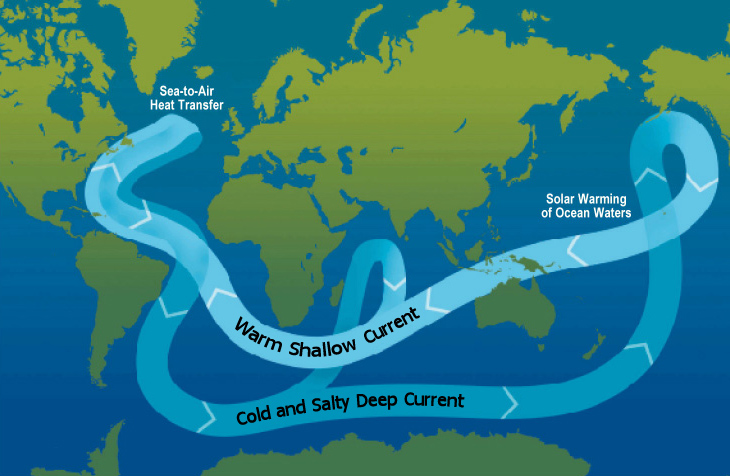
Global thermohaline circulation
Professor Elisabeth Leane, Professor of Antarctic Studies at the University of Tasmania says – What happens in Antarctica doesn’t stay in Antarctica. Its future will shape the future of the planet
Which brings me to the question of safety in relation to Antarctica – planetary, not just personal.
And here’s what the University of Tasmania says about it – Antarctica’s tipping points threaten global climate stability.
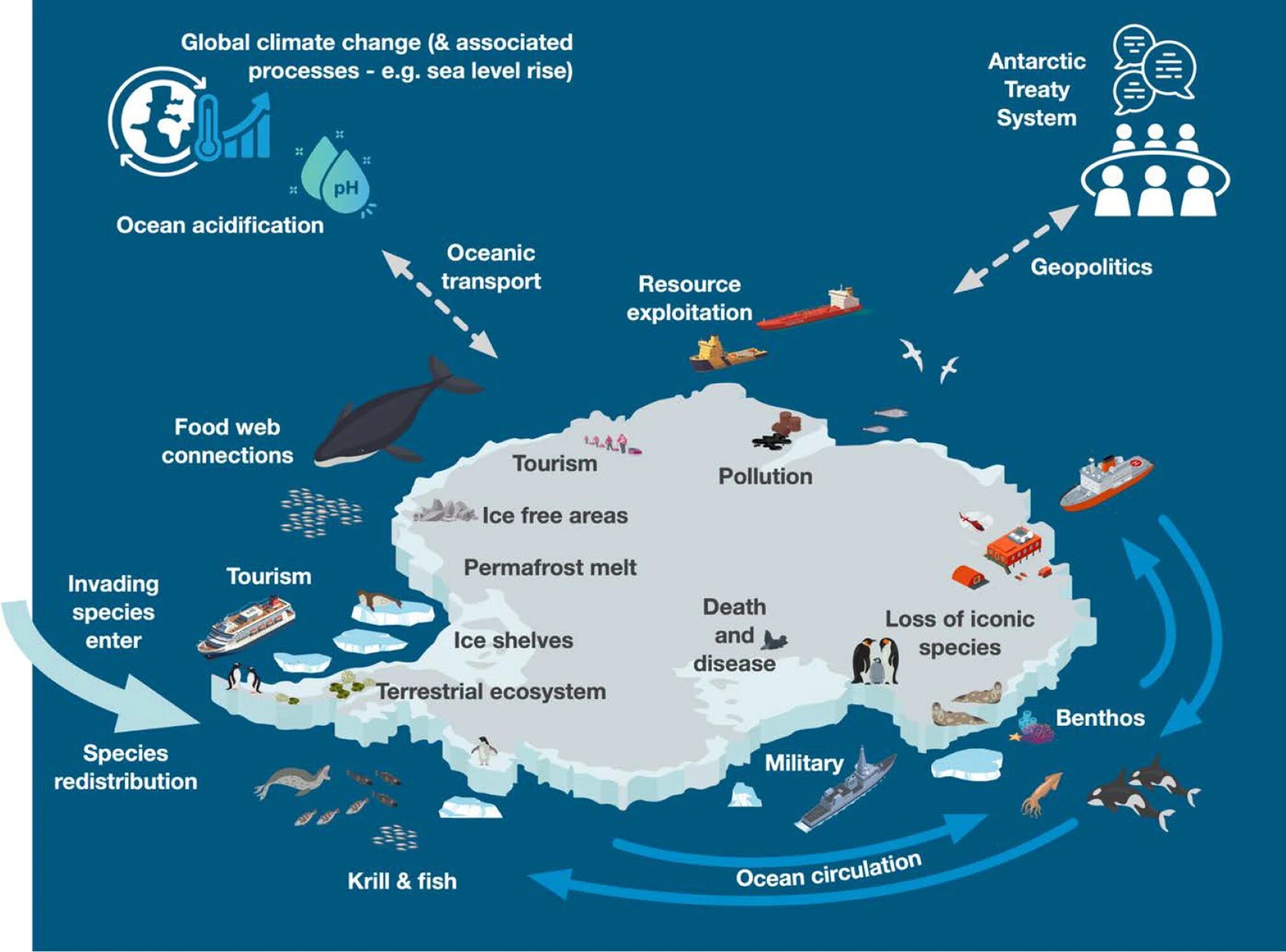
The map above is from the University of Tasmania’s report by international climate scientists . It identifies the various cascading tipping points and their interactions and pressures on the ecosystem.
For those who care about the climate change issue, and about Australia and the Antarctic, I would urge them to watch, and persist with, this brilliant report by climate researcher Paul Beckwith – https://www.youtube.com/watch?v=6WccDhnM8R8
Beckwith explains the potential tipping points identified by the study and their interrelationships , and adds the issue of sea ice loss. Critical issues are ice sheets, ocean acidification, ocean circulation, species redistribution, invasive species, permafrost melting, local pollution, chemical impacts, social impacts, local pollution and the Antarctic Treaty System. He goes on to explain with excellent graphics, the global thermohaline circulation, and then, in-depth, the records on sea ice, and then on to his detailed study on the tiny krill or light shrimp, and their global importance. Finally, Beckwith outlines the politics, the various national claims in the Antarctic Treaty System. The scientists’ conclusion – the urgent need for action on climate. Heavy stuff. Fascinating stuff. He finishes with a reminder of the unique role of that amazing critter the krill.
If you want a more concise discussion of the University of Tasmania’s December remarkable workshop of international marine scientists – go to Radio Ecoshock – World-changing Tipping Points – In Antarctica !
The “mainstream media” rarely covers climate change in any depth. For decades, the public has been informed very superficially on this life and death matter for our survival. The dedicated scientists produce their research results, but the media seem to find these too difficult, or too “political” to bother to report on them properly. The December 2024 “emergency summit” of international polar scientists in Tasmania barely got a mention in the Australian or international press.
You have to go to alternative media, to get any real insight into what is happening to the climate of our planet home. For decades now, Paul Beckwith has being producing his highly informative and wonderfully illustrated videos, on Youtube. Meanwhile Alex Smith has been doing the same sort of thing on radio and podcast, and print, – on Radio Ecoshock, which is heard in Australia on Community Radio 3CR.
In 2025, it is ever more urgent for people to wade through the morass of “social” media, and corporate media, and “alternative” media, to find the facts on climate change. Paul Beckwith and Radio Ecoshock are two examples of a rare and endangered human species – journalists who do their homework on climate change.
State of the Cryosphere Report 2024
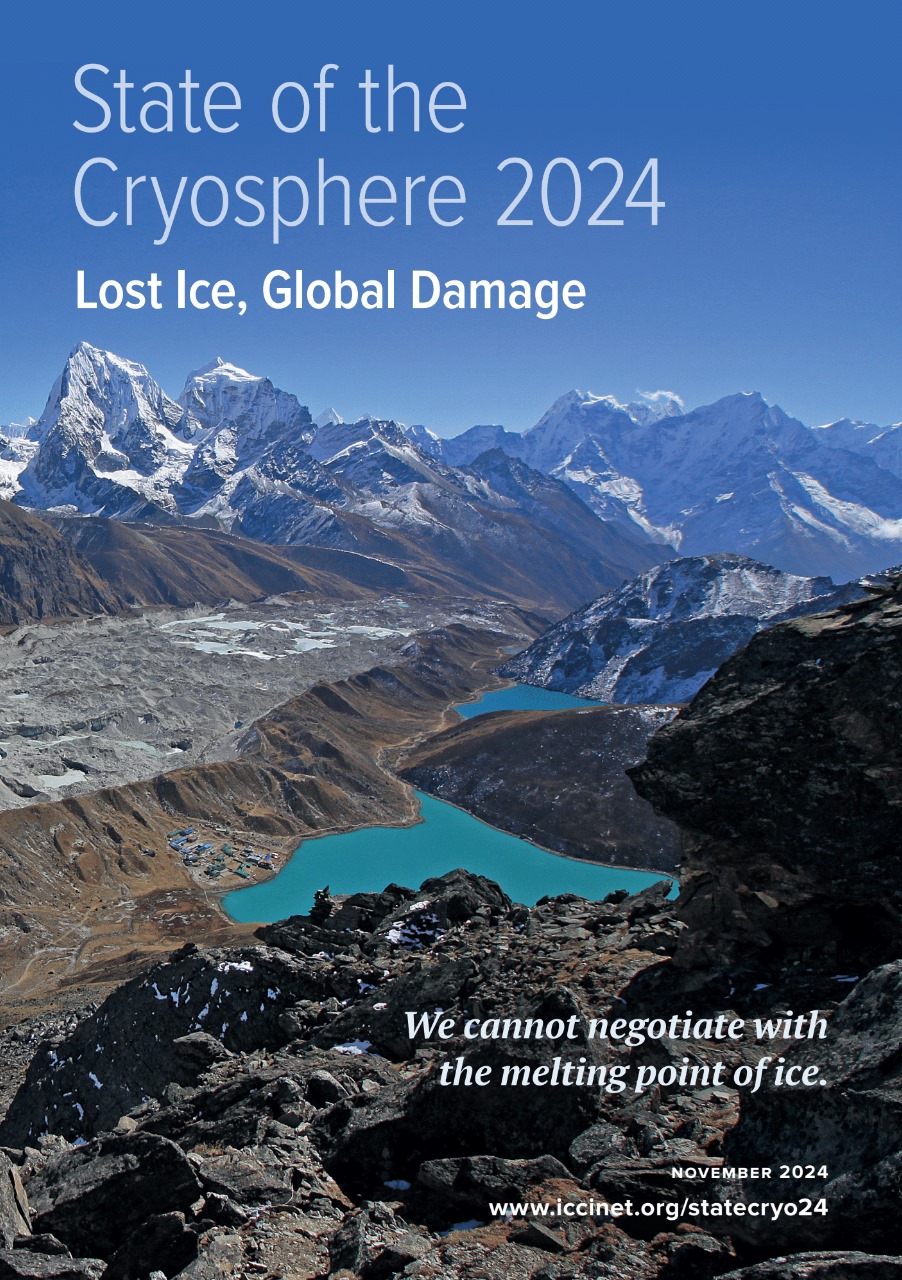
Lost Ice, Global Damage
In the State of the Cryosphere 2024 – Lost Ice, Global Damage report, over 50 leading cryosphere scientists warn of vastly higher impacts and costs to the global economy given accelerating losses in the world’s snow and ice regions. Current climate commitments, leading the world to well over 2°C of warming, would bring disastrous and irreversible consequences for billions of people from global ice loss.
Based on the most recent cryosphere science updates from 2024, the authors underscore that the costs of loss and damage will be even more extreme, with many regions experiencing sea-level rise or water resource loss well beyond adaptation limits in this century if our current level of emissions continues – leading towards a rise of 3°C or more. Mitigation will also become more costly due to feedbacks from thawing permafrost emissions and loss of sea ice.
For the first time, the report notes a growing scientific consensus that melting Greenland and Antarctic ice sheets, among other factors, may be slowing important ocean currents at both poles, with potentially dire consequences for a much colder northern Europe and greater sea-level rise along the U.S. East Coast.
Reviewed and supported by over 50 leading cryosphere scientists, this is the latest report in the State of the Cryosphere series, which takes the pulse of the cryosphere on an annual basis. The cryosphere is the name given to Earth’s snow and ice regions and ranges from ice sheets, glaciers, snow and permafrost to sea ice and the polar oceans – which are acidifying far more rapidly than warmer waters. The report describes how a combination of melting polar ice sheets, vanishing glaciers, and thawing permafrost will have rapid, irreversible, and disastrous impacts worldwide.
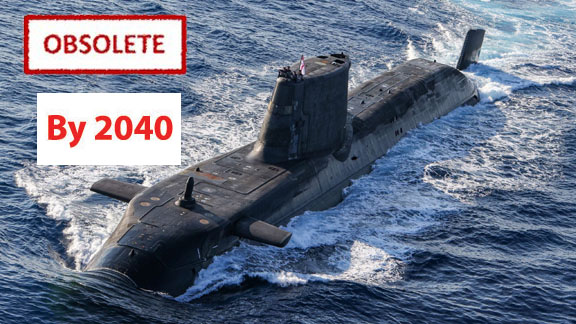
Could AI soon make dozens of billion-dollar nuclear stealth attack submarines more expensive and obsolete?
By Wayne Williams, 5 Jan 25, https://www.techradar.com/pro/could-ai-soon-make-dozens-of-billion-dollar-nuclear-stealth-attack-submarines-more-expensive-and-obsolete
Artificial intelligence can detect undersea movement better than humans.
AI can process far more data from a far more sensors than human operators can ever achieve
But the game of cat-and-mouse means that countermeasures do exist to confuse AI
Increase in compute performance and ubiquity of always-on passive sensors need also be accounted for.
The rise of AI is set to reduce the effectiveness of nuclear stealth attack submarines.
These advanced billion-dollar subs, designed to operate undetected in hostile waters, have long been at the forefront of naval defense. However, AI-driven advancements in sensor technology and data analysis are threatening their covert capabilities, potentially rendering them less effective.
An article by Foreign Policy and IEEE Spectrum now claims AI systems can process vast amounts of data from distributed sensor networks, far surpassing the capabilities of human operators. Quantum sensors, underwater surveillance arrays, and satellite-based imaging now collect detailed environmental data, while AI algorithms can identify even subtle anomalies, such as disturbances caused by submarines. Unlike human analysts, who might overlook minor patterns, AI excels at spotting these tiny shifts, increasing the effectiveness of detection systems.
Game of cat-and-mouse
AI’s increasing role could challenge the stealth of submarines like those in the Virginia-class, which rely on sophisticated engineering to minimize their detectable signatures.
Noise-dampening tiles, vibration-reducing materials, and pump-jet propulsors are designed to evade detection, but AI-enabled networks are increasingly adept at overcoming these methods. The ubiquity of passive sensors and continuous improvements in computational performance are increasing the reach and resolution of these detection systems, creating an environment of heightened transparency in the oceans.
Despite these advances, the game of cat-and-mouse persists, as countermeasures are, inevitably, being developed to outwit AI detection.
These tactics, as explored in the Foreign Policy and IEEE Spectrum piece, include noise-camouflaging techniques that mimic natural marine sounds, deploying uncrewed underwater vehicles (UUVs) to create diversions, and even cyberattacks aimed at corrupting the integrity of AI algorithms. Such methods seek to confuse and overwhelm AI systems, maintaining an edge in undersea warfare.
As AI technology evolves, nations will need to weigh up the escalating costs of nuclear stealth submarines against the potential for their obsolescence. Countermeasures may provide temporary degree of relief, but the increasing prevalence of passive sensors and AI-driven analysis suggests that traditional submarine stealth is likely to face diminishing returns in the long term.
Short nuclear news round-up -week to 5 January 2025
Some bits of good news – 86 Stories of Progress from 2024
A 12-year-old schoolgirl has designed a solar-powered blanket for the homeless. ALSO AT https://nuclear-news.net/2025/01/04/1-a-12-year-old-schoolgirl-has-designed-a-solar-powered-blanket-for-thehomeless/
TOP STORIES
2025, Iran is back in the U.S. crosshairs for regime change.
Japan, US to communicate on possible use of nuclear weapons.
Arms control is essential to prevent the total devastation of nuclear war.
Protect your girls: We show that biological sex IS a factor in radiation outcomes, WIDELY.
JIMMY CARTER: Commemorations by nuke watchdogs
Climate. A snapshot of climate devastation’: Study claims 2024’s biggest climate disasters cost $200bn – ALSO AT https://nuclear-news.net/2025/01/01/2-b1-a-snapshot-of-climate-devastation-study-claims-2024s-biggest-climate-disasters-cost-200bn/ Skiing in France is slowly dying ALSO AT https://nuclear-news.net/2024/12/31/2-b1-skiing-in-france-is-slowly-dying/deal for Ukraine ?
Noel’s notes. Iran and the “right to have nuclear weapons“. Is it realistic for Donald Trump to boast of a quick peace deal for Ukraine?
AUSTRALIA. The $80 billion question buried in Dutton’s nuclear power plan. The Coalition’s coal-keeper plan. Can true nuclear independence be achieved without ending the US Alliance? More Australian nuclear news at https://antinuclear.net/2024/12/31/australian-nuclear-news-30-december-6-june/
NUCLEAR ITEMS
| ECONOMICS. Sizewell C faces calls for more scrutiny of costs ahead of Final Investment Decision. Government urged to review Sizewell C nuclear plant over ballooning cost. Armed with Canadian taxpayer support, AtkinsRéalis and Westinghouse are competing to export nuclear reactors. Which one will prevail? -ALSO AT https://nuclear-news.net/2025/01/04/1-b1-armed-with-canadian-taxpayer-support-atkinsrealis-and-westinghouse-are-competing-to-export-nuclear-reactors-which-one-will-prevail/ |
| ENVIRONMENT. Some Types of Pollution Are More Equal than Others.Radiation is normal at Cesar Chavez Park, but it’s a different story underground, tests show. |
| ETHICS and RELIGION. The Moral Bankruptcy of the West. |
| EVENTS. Petition: Scrutinise Sizewell C |
| HEALTH. Where is the ‘mature debate’ about the health impacts of nuclear power? – ALSO AT https://antinuclear.net/2025/01/03/where-is-the-mature-debate-about-the-health-impacts-of-nuclear-power/ Cellphone radiation warning as researchers reveal new risk factor. |
| MEDIA. Examining Annie Jacobsen’s “Nuclear War: A Scenario”. BBC staffers reveal editor’s ‘entire job’ to whitewash Israeli war crimes. |
| PERSONAL STORIES. Toshiyuki Mimaki: Let’s save humanity from nuclear weapons. One Week in the Carter Presidency: Brokering Peace and a Nuclear Crisis -ALSO AT https://nuclear-news.net/2024/12/31/2-b1-one-week-in-the-carter-presidency-brokering-peace-and-a-nuclear-crisis/ |
| POLITICS.Nuclear power had a strong year in 2024, but uncertainty looms for 2025. No change in Iran’s nuclear doctrine, top security official says. US relaxes green hydrogen rules in race to boost nuclear sector -ALSO AT https://nuclear-news.net/2025/01/04/2-b1-us-relaxes-green-hydrogen-rules-in-race-to-boost-nuclear-sector/ |
| POLITICS INTERNATIONAL and DIPLOMACY. Iran says ready to enter talks soon with the West to agree on a new nuclear deal. Next nuclear talks between Iran and three European countries due on Jan 13.With successful Syrian regime change, will US set sights on Iran regime change 2.0? – https://nuclear-news.net/2024/12/31/2-b1-with-successful-syrian-regime-change-will-us-set-sights-on-iran-regime-change-2-0/ A Trump-Putin Deal Over Ukraine Does Not Look Good for Europe.Can Trump Trump China (or Vice Versa)? |
| RADIATION. Improved way to gauge radiation doses developed for Fukushima, (they studied only 30 people) |
| SAFETY. Incidents. The Time Navy Lt. Jimmy Carter Was Lowered Into A Partially Melted-Down Nuclear Reactor |
| SECRETS and LIES. EU officials will claim ignorance of Israel’s war crimes: a leaked document shows what they knew. |
SPACE. EXPLORATION, WEAPONS. The Quiet Crisis Above: Unveiling the Dark Side of Space Militarization
Departing Air Force Secretary Will Leave Space Weaponry as a Legacy.
TECHNOLOGY. Here comes Yakutia, Russia’s newest nuclear icebreaker.
WASTES. WIPP’s Legacy Transuranic Waste Disposal Plan Demonstrates DOE’s Broken Promises. Decommissioning: Pickering A nuclear power plant bites the dust!
| WAR and CONFLICT. Biden discussed plans to strike Iran nuclear sites if Tehran speeds toward bomb. Syrian minorities under threat as security forces carry out raids against ‘remnants of Assad militias’. |
| WEAPONS and WEAPONS SALES. Trump Wants Greenland to Deploy Medium-Range Missiles Aimed at Russia . US Has Given Israel $22 Billion in Military Aid Since October 2023. Biden spending last month shoveling billions to get more Ukrainians killed for nothing. Biden Administration Announces Nearly $6 Billion in New Ukraine Aid. Canada’s atomic legacy |
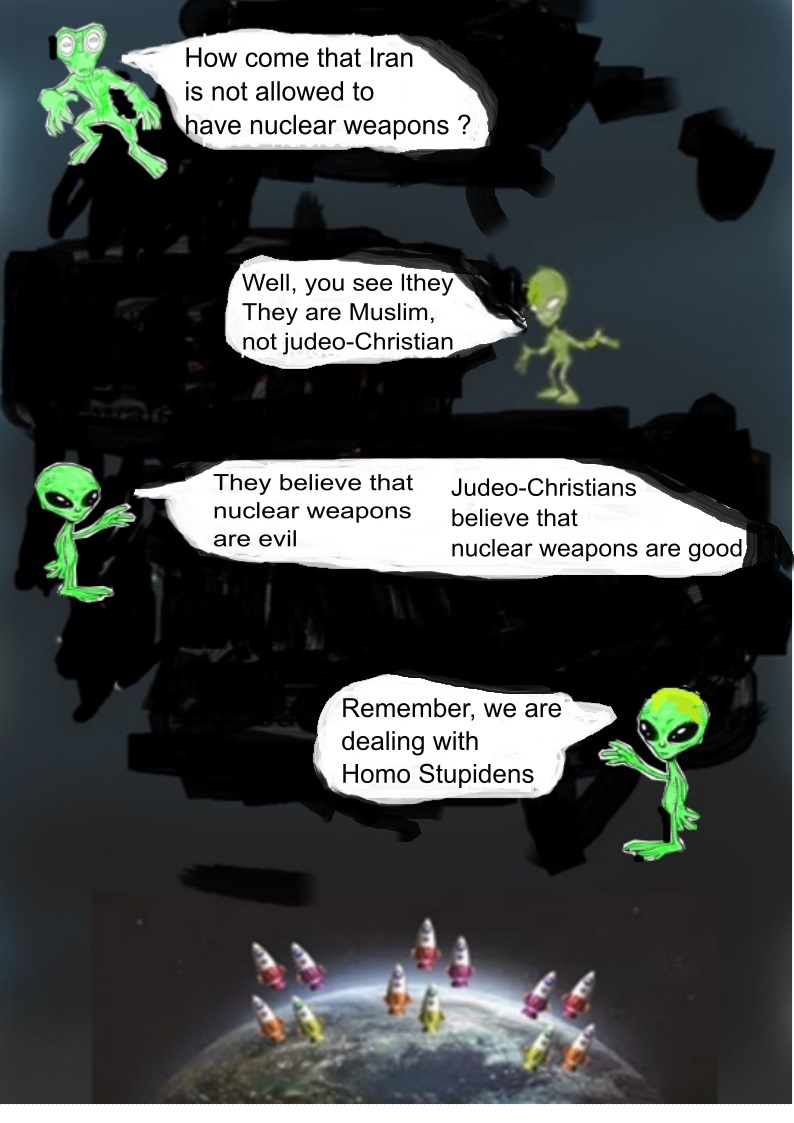
Iran and the “right to have nuclear weapons”
Today we learn that “Biden discussed plans to strike Iran nuclear sites if Tehran speeds toward bomb”. White House national security adviser Jake Sullivan presented President Biden with options for a potential U.S. attack on Iran’s nuclear facilities if the Iranians move towards a nuclear weapon before Jan. 20,
Yeah! Fair enough! I hear many cry.
After all, it’s the wicked dictatorial Muslim state that we’re dealing with, isn’t it?
As against us good Western Christian countries, where the bishops bless both sides in every war, and where it was OK to obliterate with nuclear bombs, 2 Japanese cities .
Yes, we’re so righteous, that our great and exceptional defender of freedom, the United States of America has a quiet unspoken policy that it has the right to a pre-emptive nuclear strike on another country,.
The Islamic Republic of Iran regards use of nuclear and chemical weapons as a cardinal and unforgivable sin- with the fatwa that the production, stockpiling and use of nuclear weapons are forbidden under Islam and that Iran shall never acquire these weapons.
The Judeo-Christian beliefs apparently allow for the wholesale killing of civilians, by nuclear bombing.
Currently the world is witnessing a cruel genocide by Israel, and increasing threats by the Israeli government against Iran. We, the good Christian West, say tut tut about the mass killing of Palestinians, but seem ready to support any militancy against Iran.
What I can’t understand, given the USA’s terrible record of starting wars in faraway places, is why on Earth the USA is accepted as the fount of all goodness – able to decide the rights and wrongs of Iran’s defense and foreign policies?
How is it fair that USA, Russia, UK, France are all OK to have nuclear weapons, but no other countries can? (We frown that North Korea has nuclear weapons, but perhaps USA would have bombed them again, if they didn’t).
The Joint Comprehensive Plan of Action (JCPOA) between Iran and the USA, and endorsed by the UN meant that Iran was banned from transferring, importing, and exporting arms, sensitive nuclear material and equipment. Iran in return got relief from sanctions.
Now that the Israeli government is involved in conflict with other Muslim groups across the Middle East, there is a possibility that Israel will make attacks on Iran’s nuclear sites, even use its nuclear weapons against Iran. With the USA pondering on a pre-emptive strike on Iran’s nuclear sites, before 20 January, is it any wonder that the government in Iran is re-examining its nuclear weapons policy?
Peter Dutton’s New Clear Vision… Oh, Sorry, Nuclear Fission!
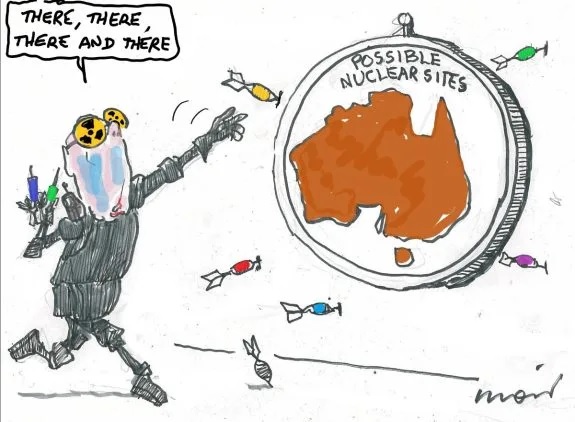
January 5, 2025, first published on March 6, 2024, https://theaimn.net/peter-duttons-new-clear-vision-oh-sorry-nuclear-fission/
Peter Dutton has a vision for our energy future. Personally, I think that’s great. One should have a vision particularly if one is a political leader…
Like Jeff Kennett. Being a Victorian, I clearly remember how Jeff shared his vision of a privatised energy market where choice and the market would bring down prices and lead to the sort of efficiencies that would mean that we could be confident that power prices would be lower but unfortunately it didn’t work out like that. Still, one shouldn’t hold it against him that his vision didn’t work out quite as he described it; one should only get stuck into Labor leaders when they promise that electricity prices will come down by $275 by 2025 even if we’re still in 2024… Or in the case of Tony “Marty McFly” Abbott stuck in the 1950s!
Pete was very clear. The sun doesn’t shine at night, wind turbines at sea are likely to interfere with nature and he’s always been keen on nature, and batteries haven’t been invented yet. Yes, he actually said words to that effect. On the other hand, we can put a small, modular nuclear reactor in lots and lots of places just as soon as someone invents one and we find the several billion dollars to pay for it…
Don’t get me wrong, I think that it’s good that Dutton is thinking long term! Far too often leaders only worry about the short term and I sort of find it inspiring that Peter is so optimistic about the future when any reasonable analysis of the Dunkley by-election would have the party changing leaders before anybody had time to count the numbers.
Let’s elect the new guy from Cook.”
“Simon Kennedy?”
“Yeah. He has to be better and the public don’t know him yet!”
I should point out that the Liberal candidate for Cook hasn’t actually been elected yet, but that didn’t stop News.com.au from declaring him the winner. I mean, I know there’s pressure on to be the first media outlet to declare an election win, but I’m old-fashioned enough to think that we should wait until after the electorate have voted. Still, he did win in spite of the fact that the moderate faction wanted a woman, as did John Howard, but that’s a whole other story. Anyway, he’s a winner because he managed to defeat the moderate faction which shows he should fit in quite nicely in the Canberra party room. And he also defeated John Howard which is pretty easy to do, given he’s the only living PM to lose his seat in a general election.
Of course, Peter Dutton’s new clear fission… sorry nuclear vision… has a few hurdles to get over.
The first is that someone is bound to ask for more detail. Naturally, he can say that we’re just outlining the general idea and we can work out the detail later. This should be enough because, after all, it’s not like the Voice to Parliament because it’s his idea so surely we shouldn’t ask for any more than the broad strokes.
The second is that once he starts to become specific about where to locate the plants, then we’ll undoubtedly see the NIMBYs coming out, and while Dutton supports farmers who don’t want powerlines in their back yard, this is different. It’s sort of like fracking where people should just suck it up… Not the gas. That wouldn’t be good. This problem might be solved by only putting reactor in Labor electorates, but then it makes it hard to win government because they have more electorates than he does.
The third is that, while it’s good to have the vision thing, it doesn’t actually solve the immediate problem. After all, if you’re sleeping in your car, you don’t appreciate being told that the solution to this is a new government initiative where you’ll be trained in building and given a low-cost loan, tools and a free block of land to build your own home, even if it would potentially solve your long term accomodation problem. Similarly, while my solar panels have made me ok with my electricity consumption, I find my gas bill annoyingly high and I’m not going to say, “Nuclear in ten years time. Wow, thanks Pete, I’ll just have cold showers till then, but I hear that’s likely to extend my life… at the very least, it’ll seem longer.”
So let’s have three cheers for Peter:
- One for having a longterm vision
- Two for his optimism in thinking that he’ll be leader by the time the next election comes around. (I’m presuming that News.com.au is right and we already have the winner of Cook. I’m also presuming he lasts that long, so one cheer for me here too!)
- And, finally, for actually being the first Opposition Liberal leader to announce a policy.
All right number 3 may be a little unfair because Tony did have two policies: The first was to undo everything that Labor had done and the second was a rolled, gold paid parental leave scheme.
Whatever. Here we go: Three cheers, hip, hip…
Oh, that’s not very nice. You should be ashamed of yourself.
Can true nuclear independence be achieved without ending the US Alliance?
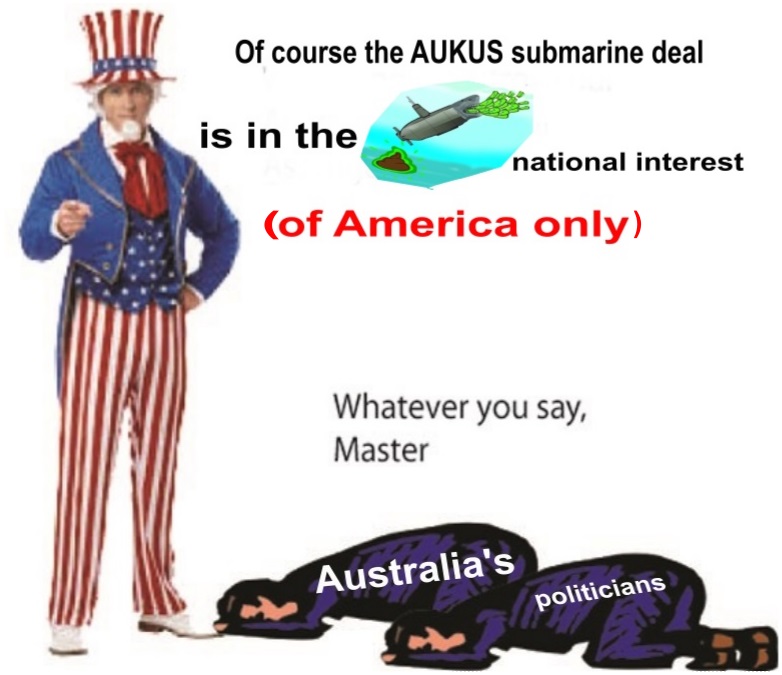
By Donald Wilson, Jan 4, 2025, https://johnmenadue.com/can-true-nuclear-independence-be-achieved-without-ending-the-us-alliance/
Australia’s historical commitment to nuclear disarmament is facing new challenges, as critics say the nation’s alliance with the United States is leading to a conflicted stance on nuclear non-proliferation.
While Australia has actively participated in global nuclear arms control initiatives, such as the Nuclear Non-Proliferation Treaty (NPT) and the Comprehensive Nuclear-Test-Ban Treaty (CTBT), it simultaneously relies on the so-called “US nuclear umbrella” for security. This duality has led to ongoing debate about whether Australia’s security policies align with its disarmament principles.
Australia’s approach to nuclear non-proliferation has shifted over recent years. In 2016, Australia voted against a United Nations General Assembly resolution aimed at creating a legally binding instrument to prohibit nuclear weapons. The following year, it refused to join negotiations that led to the Treaty on the Prohibition of Nuclear Weapons (TPNW). As a result, Australia remains one of the few regional countries not signed onto this treaty, despite a 2018 resolution by the Australian Labor Party to consider joining under a future government.
Critics argue that if Australia were to adopt the TPNW, it would be compelled to prohibit any support for other countries’ nuclear weapons programs—potentially forcing the closure of Pine Gap, a key joint defence facility with the US. Yet government supporters claim that distancing from the US would leave Australia vulnerable, especially amid regional tensions with China.
However, questions have arisen about the reliability of this “nuclear umbrella.” Currently, US military systems, including missile defence, offer limited protection against intercontinental ballistic missiles (ICBMs). After investing over $400 billion in missile defence research and development, no system has yet achieved dependable protection against ICBMs. Critics argue this leaves Australia exposed rather than safeguarded, despite assurances from the US.
In addition, Australia’s recent defence agreements, particularly the AUKUS pact and the US-Australia Force Posture Agreement (FPA), have raised concerns over sovereignty. Signed in 2014, the FPA allows the US to store and control defence equipment on Australian soil. According to Article VII of the agreement, the US retains “exclusive control” over its prepositioned military supplies in Australia, with full ownership rights, effectively restricting Australian authority over the use of these materials.
Article XII of the FPA states that US government vehicles, aircraft, and vessels are exempt from inspection by Australian authorities without US consent. This clause has fuelled arguments that the FPA has compromised Australia’s independence by allowing the US to make defence decisions within Australian borders. For instance, US B2 bombers have launched from Australian bases in operations overseas, reportedly without consulting the Australian public.
As Australia contemplates its nuclear policy, the debate over whether it can maintain both its alliance with the United States and a commitment to nuclear non-proliferation will likely intensify. This complex question has implications not only for Australia’s defence but also for its sovereignty and international standing in the movement toward nuclear disarmament.
UK Labour donor Dale Vince urges ‘rigorous financial scrutiny’ of Sizewell C costs
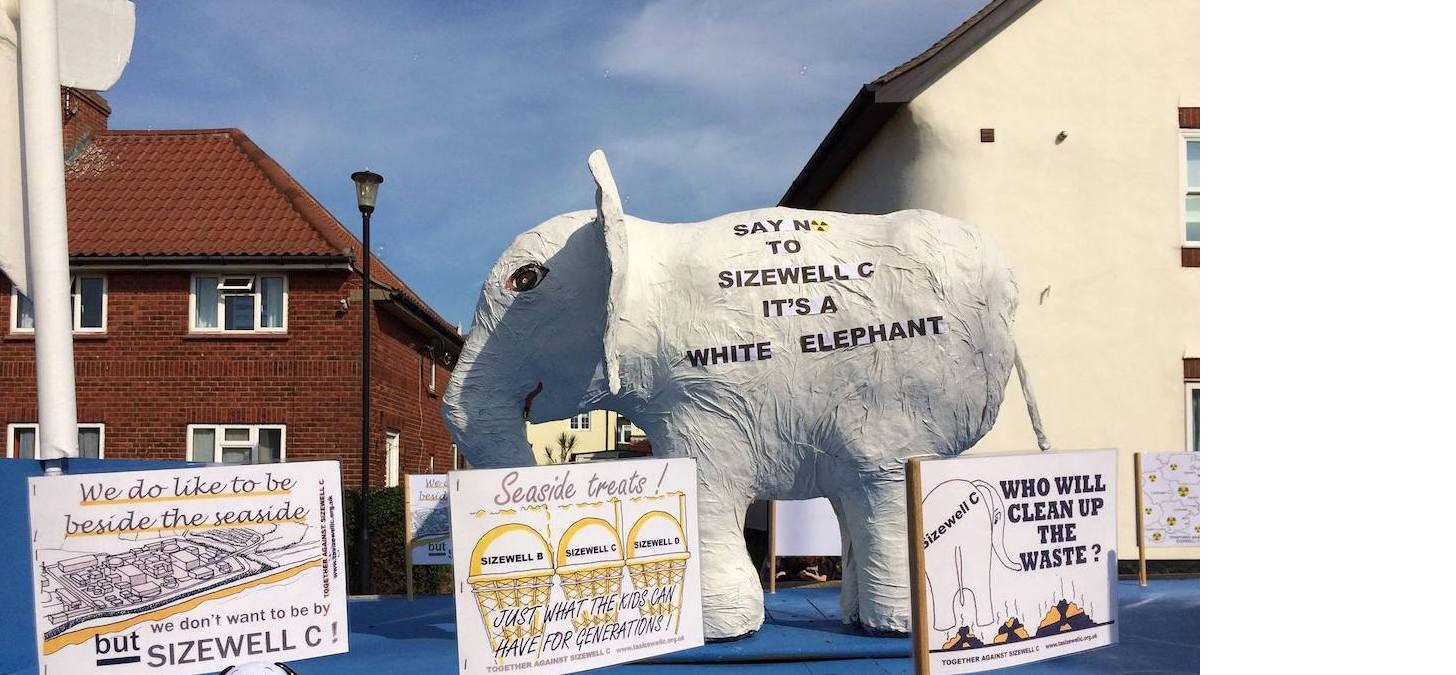
Green energy entrepreneur voices concerns over project’s funding and ‘spiralling costs’ of UK’s other nuclear plants.
Michael Savage , Observer 28th Dec 2024
The government’s new value for money tsar has been challenged to examine the costs of a nuclear power station to be given final approval next year, as ministers attempt to shore up private investment for the project.
New nuclear plants are a key part of the government’s plan to have clean power by 2030. The Sizewell C reactor, billed as generating enough energy to power 6m homes, is expected to be given the final go ahead in June’s review of public spending. Its projected costs are in excess of £20bn.
However, Labour donor and green energy entrepreneur Dale Vince has written to the chair of the governments’ new Office for Value for Money (OVfM), David Goldstone, arguing that a nuclear plant already being built has seen spiralling costs. He also warns the construction of Sizewell C “will saddle consumers with higher bills long before it delivers a single unit of electricity”.
The government and the French state-owned company EDF will fund about 40% of the Sizewell C project, with ministers currently rounding up private investors to meet the rest of the costs. In his letter, Vince claims that billions have already been spent on the project, even “before a final investment decision has been made”. He also raises concerns about the ballooning costs and delays of Sizewell C’s sister project, Hinkley Point C, in Somerset.
“If Hinkley Point C is anything to go by, Sizewell C really should have rigorous financial scrutiny,” he writes. “Originally priced at £18bn, the cost of Hinkley has ballooned to £46bn and then there’s the delays. Back in 2007, the then EDF chief executive Vincent de Rivaz said that by Christmas 2017 we would be using electricity generated from atomic power at Hinkley. We’re now in Christmas 2024 and Hinkley isn’t due to be completed until 2031.
“Due to a novel funding method, a lengthy construction timeline for Sizewell will saddle consumers with higher bills long before it delivers a single unit of electricity at a time when there is clear evidence that we can secure a cleaner, cheaper energy future without nuclear.”
It comes after a similar warning by Citizens Advice earlier this year. The charity warned that the Suffolk project may offer “poor value for money” and called for greater clarity on its funding, in a letter to the Department for Energy Security and Net Zero. It has warned that the project’s funding model could expose households to cost overruns……………………………………… https://www.theguardian.com/business/2024/dec/28/labour-donor-dale-vince-urges-rigorous-financial-scrutiny-of-sizewell-c-costs
The $80 billion question buried in Dutton’s nuclear power plan.

“Companies can go bust, but the nuclear waste is still going to be there. It has to be owned by the government.”
Two elements of the opposition’s nuclear plan are not included in the costings – waste management and public liability for disasters.
Mike Foley, January 3, 2025 , https://www.theage.com.au/politics/federal/the-80-billion-question-buried-in-dutton-s-nuclear-power-plan-20241218-p5kzg9.html
Decommissioning any plants built under the Coalition’s nuclear energy plan could cost more than $80 billion, and taxpayers would have to foot the bill.
Opposition Leader Peter Dutton’s planned seven nuclear plants, with a likely 14 large-scale reactors, would be publicly owned, so taxpayers would be liable for clean-up costs from the radioactive sites and any accidents during operation.
Last month, Britain’s National Audit Office found that the bill to clean up its old nuclear sites, which date back to the 1940s, would be $260 billion.
About $200 billion of this is to decommission Britain’s original Sellafield site for weapons and energy generation, with contaminated buildings and radioactive waste.
Another $48 billion is to decommission eight other nuclear sites, which now range from 36 to 48 years old, at a cost of $6 billion each. They are set to be handed back by a private operator to the government for decommissioning from 2028.
University of NSW energy researcher Mark Diesendorf said international experience showed the cost of decommissioning a nuclear reactor could be roughly in line with its construction cost, which the Coalition has said would be about $9 billion a reactor in Australia.
“For a rough approximation, you’re looking at probably the equivalent of the construction cost,” Diesendorf said.
If the Coalition’s plan to build 14 nuclear reactors by the mid-2040s is realised, the decommissioning bill would be roughly $82 billion to $125 billion in today’s dollars.
Private firm Frontier Economics produced costings of the opposition’s plan that included decommissioning in an overall $331 billion bill to build 14 gigawatts of nuclear generation. However, it is unclear what price was attached to clean-up and whether it is plausible, given Frontier has declined to release the assumptions it used.
Frontier said the government’s policy to boost renewables to nearly 100 per cent of electricity generation by 2050 would cost $595 billion – a figure the federal government has rejected. Labor says nuclear is the most expensive form of new energy generation.
Opposition energy spokesman Ted O’Brien said the Coalition’s plan was cheaper than the government’s renewable energy goals.
“Unlike the Coalition, Labor refuses to calculate the full cost of its plan, such as the decommissioning costs of massive offshore wind projects in the six zones it has identified off the Australian coast,” O’Brien said.
Griffith University Emeritus Professor Ian Lowe said Diesendorf’s assumption that decommissioning a large-scale reactor would cost the same as building it was “sensible”.
“The World Nuclear Association has information about the 25 reactors that have been decommissioned, and the figures vary enormously,” Lowe said.
“The figure of about $6 billion per reactor sounds about the average figure, assuming that there are no complications.”
The opposition has said its nuclear reactors would operate for 80 years, and University of NSW Associate Professor Edward Obbard, a nuclear materials engineer, said it made “perfect sense” for a country to hold the liability for nuclear decommissioning, given the cost and timescale required.
“I don’t think there’s any alternative to the state being responsible for decommissioning a nuclear power program,” Obbard said.
“Companies can go bust, but the nuclear waste is still going to be there. It has to be owned by the government.”
The government could choose to isolate an old nuclear reactor once it reaches its end of life, and leave it alone for several decades until the radioactivity had reduced, he said.
Two elements of the opposition’s nuclear plan are not included in the costings – waste management and public liability for disasters.
Diesendorf and Lowe said public liability in the unlikely event of a nuclear accident could run into the hundreds of billions of dollars, given the $290 billion clean-up bill from Japan’s 2011 Fukushima nuclear disaster.
Is it realistic for Donald Trump to boast of a quick peace deal for Ukraine ?
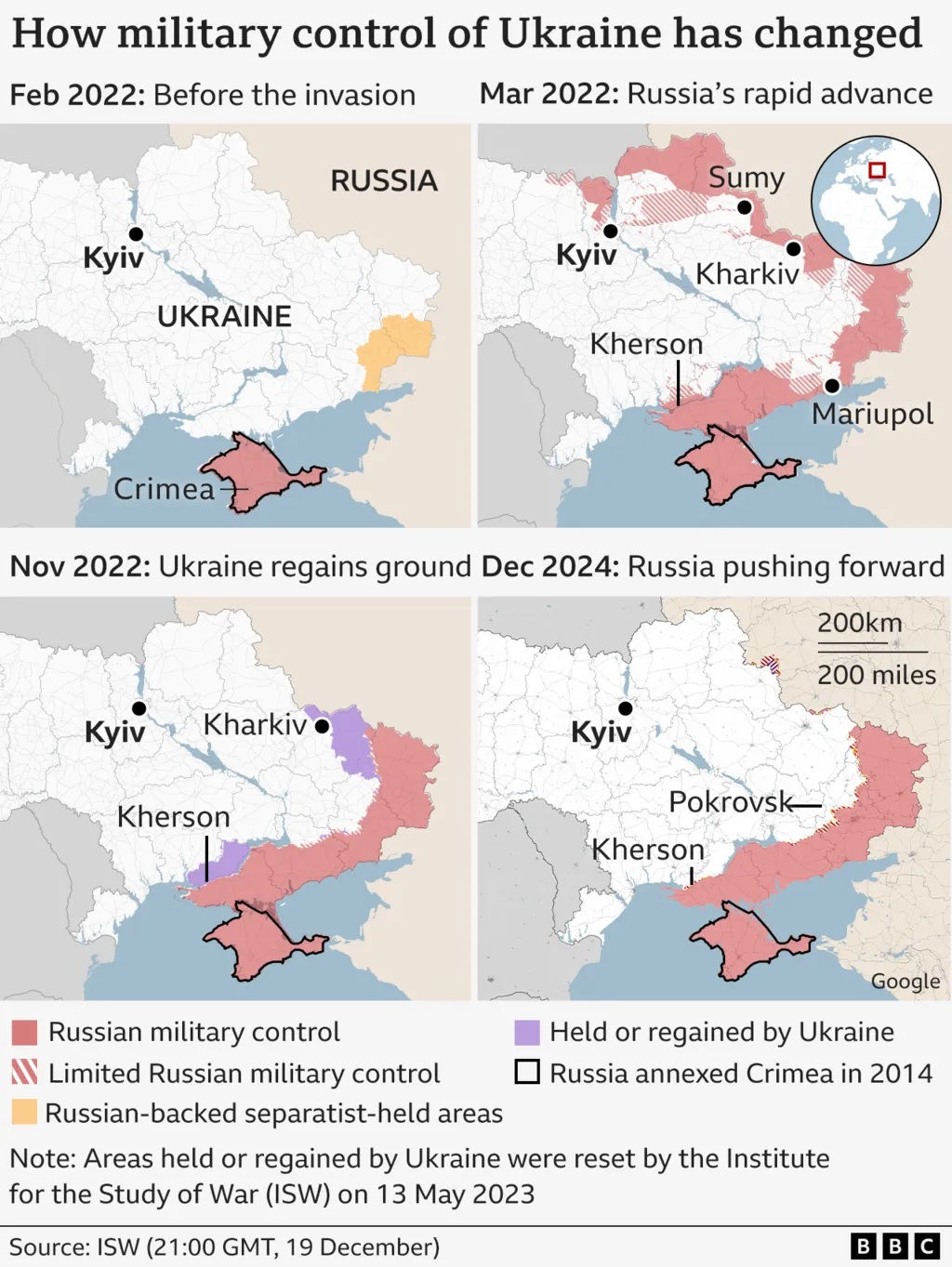
AIMN Editorial, https://theaimn.net/is-it-realistic-for-donald-trump-to-boast-of-a-quick-peace-deal-for-ukraine/ 2 Jan 25
Donald Trump has made so many promises on what he will quickly achieve once he takes office as President. The one about ending the Ukraine war in 24 hours probably gained him support from quite a few normally left-leaning people, who understand that the history of this conflict is far more complicated than is portrayed by the Western media.
However, Trump made that statement in July 2023. By 2025, he has somewhat moderated that particular promise. He has had several conversations with Ukraine’s President Zelensky, . Zelensky praised their Paris meeting on 7 December as “productive and meaningful”, but there were no details discussed. Later, Trump opposed the sending of long-range missiles for Ukraine , but said he would not “abandon” Ukraine. He predicted “less aid” to Ukraine https://www.youtube.com/watch?v=E-R7Gi-uLiY. BY 21st December, it was reported that Trump would continue to supply military aid to Ukraine, provided that NATO members dramatically increase their defence spending.
So, peace in Ukraine is not going to happen in such a hurry, even with President Trump and his supposed great negotiating skills. Britain considers sending troops to Ukraine to train Ukrainian regiments. NATO is not prepared for any compromises, especially about giving up the plan for Ukraine’s NATO membership. With any peace deal, the Western allies agree with Zelensky – “Security guarantees without the US are not sufficient for Ukraine.”
As well as European reluctance to a peace deal, there is the Russian point of view. Despite many set-backs, and a catastrophic loss of soldiers’ lives, Russia is now headed towards winning this war. Why make a deal now, before being in a more powerful position for demanding concessions?
Then we come to the USA. However much Donald Trump might want to end the carnage, and be seen as the peace hero, he is up against significant forces at home – making up what he calls the Deep State. This is a conspiracy theory that helped Trump to gain popularity – and I hate to agree with it, in its rather paranoid theme. BUT, war enthusiasts do exist – among the, military, intelligence, government officials, and wealthy industrialists, and they do exercise influence, and pressure politicians of both parties, to manipulate America’s defense policies. The war in Ukraine continues to be profitable to America’s weapons industries, and at no cost to American lives.
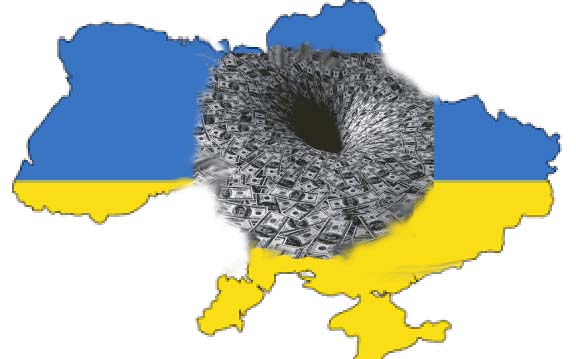
In the whole saga of the war in Ukraine, history has been forgotten. Of course Ukrainian-Russian relations have been tortuous and often terrible. In modern history it goes back to the 1930s, with Stalin’s starvation and genocide of Ukrainians. Then, following oppression from Russia, came in 1941, the short-lived moment of “liberation” by the German Nazis. That brought mass killings of Jews, slave labour, wholesale destruction, and the loss of up to 7 million lives. Russian control over Ukraine returned in 1944, and while the economy was restored, Stalin’s totalitarian rule was back again. In 1991 Ukraine gained independence from Russia.
Is it any wonder that Ukraine, with both Russian and Ukrainian languages still in common use, has been divided in attitudes and loyalties? Going even further back in history, Catherine the Great of Russia, in the 18th Century, made Kiev become Europe’s centre of art and culture, as well as making improvements in health, education, legal rights for Jews, improved conditions for serfs. Sure, she was an absolute monarch, – miles away from being democratic. Now her name and her statues are trashed in Kiev, which is a pity.
From 2014 to 2022, the Ukrainian government waged a war against the separatists in the Eastern, Donbass region. The war was about the 2014-2015 Minsk agreements which meant that the Donbass should have its autonomous government within Ukraine. Volodymyr Zelensky was elected on a platform that he would implement those agreements, but later he reneged on this promise. Russia’s President Putin in 2022 started what he called “a special military exercise” to support the separatists and uphold the Minsk agreement. That turned into the full-scale war against Ukraine.
European and USA support for Ukraine developed into a campaign, at enormous cost, to weaken Russia. The phrase “too big to fail” is used to describe financial crises. But it could apply to the Russia-Ukraine war. From the Western perspective the war is seen as a battle between good and evil – the evil giant Putin against the heroic little Zelensky. With NATO, with most European countries lined up against Russia, it is world democracy to be desperately defended, For Russia, it now is to prevent that last big nation on its border joining that threatening USA-armed line-up.
It was a mistake that Russia started a ‘special military enterprise’ -to evolve into a full-scale war. Some argue that by encouraging Zelensky to reneg on the Minsk agreement, the Western nations provoked the war.
Whatever started the war, the majority of Ukrainians, and especially those in the East, now just want it to end. The prevailing cry of Western leaders – “Putin must fail, Ukraine must prevail” expresses that simplistic view of good versus evil, and just ignores the complicated historic and local concerns of Eastern Ukraine. Diplomacy is jettisoned. As one writer puts it – voices calling for pragmatism and peace remain drowned out by the cacophony of war rhetoric.
Ultimately , every war ends in some sort of a diplomatic outcome. It is doubtful that Trump can make this one end quickly. It might be just one of the promises that he has to give up.
Where is the ‘mature debate’ about the health impacts of nuclear power?

By Margaret Beavis, January 2 2025, Canberra times 2/1/25 https://www.canberratimes.com.au/story/8857513/margaret-beavis-health-risks-near-nuclear-plants-exposed/
When it comes to nuclear radiation, there is a clear disconnect between the medical evidence and the views of the Coalition. Since the 1950s we have known there is a link between X-rays in pregnant women and leukemia and other cancers in their children. It is not for nothing there are signs in every radiology department asking if you are pregnant.
The current shrill denunciations of potential health risks associated with nuclear power plants as a “scare campaign” may yet prove to be an own goal, as it has drawn attention to the issue. Communities considering hosting a nuclear reactor should be aware of the evidence regarding real-world health impacts. Informed consent matters, in politics as well as medicine.
Extra cases of leukaemia occurring in children living near nuclear power plants have caused concern and controversy over decades. In the 1980s excess cases of leukaemia and lymphoma were noticed around the Sellafield nuclear plant in England.
A UK government investigation unexpectedly found that the risks for leukaemia and lymphoma were higher than in the surrounding population. In 2007, the US Department of Energy examined all the reliable data available worldwide, confirming a significant increase in leukaemia for children living near nuclear power plants..
The clearest findings on this subject come from a large national German study from 2008, which examined leukaemia among children living near any of Germany’s 16 operating nuclear plants over a 25-year period.
It showed that the risk of leukaemia more than doubled for children living within 5 km of a nuclear plant. Nuclear proponents quote a UN study with an 80 km radius showing no harm, but the much larger distance dilutes any problems for those living much closer.
Just last June, a very large (over seven million people) meta-analysis of reliable data from a range of studies found residents of any age living 20-30 km from nuclear power stations had an average 5% increased cancer risk, and again children under five were the worst impacted. Thyroid cancer increased by 17 per cent and leukemia by 9 per cent.
For workers in the nuclear industries, there is also clear evidence of increased risk of death from cancer. Indeed, recent findings show even some non-cancer diseases are increased, such as heart attack and stroke.
The best evidence for this comes from INWORKS, a multi-country study of over 300,000 radiation industry workers observed for more than 30 years. Their radiation exposures and health outcomes were carefully monitored and compared with the general population.
The cancers caused by radiation blend in with other cancers – they are not like the characteristic mesothelioma caused by asbestos. The heart attacks and strokes have the same problem. As a result, it takes large population studies and careful long-term monitoring to know what the risks are.
The Coalition has also made claims linking radiology, radiotherapy and nuclear medicine to nuclear power that are patently false and deliberately misleading.
A letter sent by Coalition MPs to their constituents earlier this year claimed that: “Nuclear energy already plays a major role in medicine and healthcare, diagnosing and treating thousands of Australians every day”.
We do not have, and have never had, nuclear power in Australia, and the nuclear power proposal has no connection to our world class nuclear medicine, radiology or radiotherapy services.
Doctors are increasingly concerned about the radiation exposures from medical imaging, particularly in children. CT scans and nuclear medicine scans are done only when essential, and the benefit outweighs the risks. We worry about cumulative lifetime exposures, especially in children.
But perhaps the biggest health issue of all with the Coalition’s proposal is the increased use of coal and gas, for decades to come. Climate change has started, and we have to take action as soon as possible.
From a health perspective, recklessly worsening future heat waves, fires, storms, floods and droughts by delaying the transition from coal for political gain is unconscionable.
Finally, the Coalition’s response to my public submission and testimony to a government inquiry has been to attack me as a past Greens candidate. They neglect to report my qualifications to speak on this.
In playing the man and failing to address the evidence, they fail their own request for an adult conversation on nuclear energy.
1 This month.

Australians deserve the truth
about
AUKUS – https://aukuspublicinquiry.com/
30 July – WEBINAR (Free) – Is Nuclear Power the Solution to Climate Change? https://my.acaw.org.au/event/acaw-is-nuclear-power-the-solution-to-climate-change
18:30 – 19:45 ACST
19:00 – 20:15 AEST
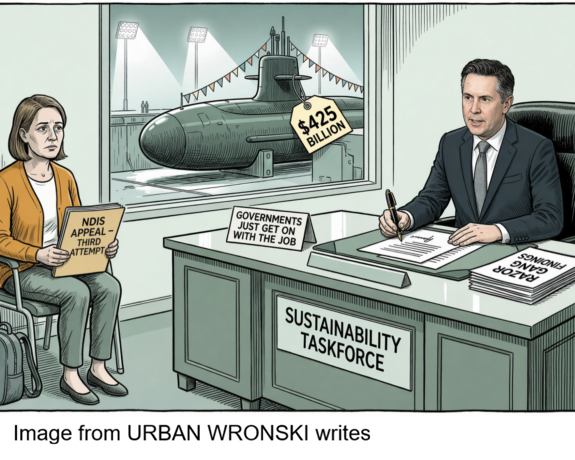

PETITION – To: Prime Minister Anthony Albanese and the Australian Labor Government

of the week – Australians for War Powers Reform (AWPR)
To see nuclear-related stories in greater depth and intensity
 Antinuclear