Weathercasters Are Talking About Climate Change—and How We Can Solve It
 Weathercasters Are Talking About Climate Change—and How We Can Solve It https://www.motherjones.com/environment/2020/02/weathercasters-are-talking-about-climate-change-and-how-we-can-solve-it/
In recent years there’s been a seismic shift on climate change within the weather reporting community. MADDIE STONE THIS piece was originally published in Grist and appears here as part of our Climate Desk PARTNERSHIP.
For many years, as the science of human-caused climate change grew ever clearer, TV meteorologists avoided discussing the topic on air. Today, many weathercasters bring up climate change regularly. By embracing the science and presenting it in a simple, locally-relevant manner, TV meteorologists have managed to become some of the most effective and trustworthy climate change educators in the country.
Now some meteorologists are taking the conversation a step further and talking not just about the science of climate change, but how we can solve it.
At the 100th annual meeting of the American Meteorological Society (AMS) in Boston earlier this month, a panel of broadcast meteorologists, climate communicators, and policy experts assembled to discuss how solutions to the climate crisis can be woven into TV weather reporting. While wading into politics on the air can carry career risks for many meteorologists, weathercasters are also uniquely positioned to educate the public about climate solutions in a nonpartisan way, whether that’s by delivering locally tailored forecasts of renewable power production or discussing climate resilience strategies in the wake of a major storm.
“Broadcasters have an unusually good platform from which to engage,” said Ed Maibach, the director of the Center for Climate Change Communication at George Mason University, during the panel. “You not only have the access but consistency of relationships with an audience.”
In recent years there’s been a seismic shift on climate change within the weather reporting community. In a 2011 survey of AMS members and the National Weather Association, less than 20 percent felt sure humans are the primary driver of global warming, a statistic that Maibach attributes, in part, to an “aggressive misinformation campaign by the Heartland Institute,” a climate change–denying think tank. But by 2017 that figure had jumped to 80 percent. That’s thanks largely to the efforts of the educators who organized Climate Matters, a climate reporting resource developed by the nonprofit Climate Central, the AMS, and various governmental and academic partners.
#ScottyFromMarketing has no climate target, because he is controlled by climate denialists

|
Scott Morrison’s missing target: climate https://www.afr.com/policy/energy-and-climate/scott-morrison-s-missing-climate-target-20200203-p53x5g
If he is going to appease noisy climate change denialists, it would be better if the Prime Minister left emissions reduction policy to the states. Richard Denniss Columnist Scott Morrison loves long-run targets for everything except climate policy.The federal government has long-run targets for inflation (2 to 3 per cent), the budget surplus (1 per cent of gross domestic product) and net debt (zero). It’s got a long-run target for defence spending (2 per cent of GDP) and countless long-run targets when it comes to Indigenous disadvantage, education performance, aged care quality and foreign aid. But when it comes to reducing the amount of coal, oil and gas Australia burns, apparently long-run targets are an unnecessary distraction for an “action man” like Scotty from Marketing. Targets give business, consumers and other levels of government something clear to work towards. Energy sources, especially the coal and nuclear power stations that the Prime Minister likes the sound of, take years to plan, years to build and decades to pay for themselves. Targets give business more certainty but they also make governments accountable for performance, which is presumably why the Prime Minister is so determined to avoid them when it comes to carbon emissions. In his sermon to the National Press Club last week, he avoided committing to net zero emissions by 2050 on the basis that his “climate action agenda is a practical one, it goes beyond targets and summits”. But you can’t go “beyond” long-run targets without having first set them.
Morrison knows targets matter. That’s why his government targeted so many sports grants to marginal electorates, and it’s why he spends so much time talking about meeting and beating Tony Abbott’s 26 to 28 per cent Paris target. Scott knows that if you set the bar low enough you can easily clear it, and if you don’t set the bar at all you can do nothing at all. After six years in office, continuing to avoid long-run emissions targets makes the government’s job easier and the energy industry’s harder. The Prime Minister’s real problem with long-run climate targets is the long-run climate change deniers in the party he’s trying to lead. For 10 years the only way for a Liberal leader to survive has been to publicly promise to do something about climate change while privately promising not to. Morrison waved a lump of coal in Parliament when he wanted to destabilise Malcolm Turnbull, but today he waves his “climate action now” slogan to stabilise his slide in the polls. Ultimately, like the last five Liberal leaders, he will be impaled on the fence his party insists he sit on. Morrison’s new-found interest in hazard reduction is no substitute for spending his prime ministerial capital in international forums, trying to steer the world away from the 3 degrees of warning we are currently on track to experience. The state premiers are perfectly capable of raking the leaves, but only the federal government can negotiate on the nation’s behalf for more ambitious action. Which brings me back to targets. Back in 2016, the ACT set a target to source 100 per cent of its electricity from renewable sources by 2020, and it’s already “meeting and beating” that goal and providing some of the cheapest electricity in Australia. The City of Sydney will be 100 per cent renewable by the end of this year and the state Coalition government of Gladys Berejiklian has committed NSW to net-zero emissions by 2050. In fact, every state in Australia is committed to carbon neutrality by 2050 – which, whether Scott Morrison likes it or not, means that Australia has committed to being carbon neutral by 2050. But rather than using those targets as leverage on the international stage, Morrison is undermining them on the domestic stage. If the Prime Minister was as interested in appeasing the quiet Australians as he was in appeasing the noisy climate denialists, he would welcome the bear hug the state premiers have wrapped him in and take credit for their ambition on the world stage while holding the premiers to account for their commitments back home. While a national approach to emissions reduction would be nice, the federal Coalition has shredded every initiative that has been put forward. Rather than take over more responsibilities from the states, Morrison would do better to leave climate and energy policy to them. The only thing stopping him from showing up at the next global climate talks and putting the states’ target of net zero by 2050 on the table is his backbench. |
|
|
Pro nuclear stooge Minister Matt Canavan faces conflict-of-interest inquiry
 Matt Canavan faces conflict-of-interest inquiry over $20m club loan, SMH By David Crowe, February 3, 2020 The Morrison government is caught up in another inquiry into one of its own senior figures after Resources Minister Matt Canavan revealed a potential conflict of interest over a $20 million loan.Senator Canavan announced on Monday night he had not declared his link to the North Queensland Cowboys football club at the time it gained the loan from the Northern Australia Infrastructure Facility…….. Matt Canavan faces conflict-of-interest inquiry over $20m club loan, SMH By David Crowe, February 3, 2020 The Morrison government is caught up in another inquiry into one of its own senior figures after Resources Minister Matt Canavan revealed a potential conflict of interest over a $20 million loan.Senator Canavan announced on Monday night he had not declared his link to the North Queensland Cowboys football club at the time it gained the loan from the Northern Australia Infrastructure Facility……..
Senator Canavan disclosed the inquiry at the same time he announced he had offered his resignation from the ministry because he would back former Nationals leader Barnaby Joyce in a challenge against party leader and Deputy Prime Minister Michael McCormack. The Northern Australia Infrastructure Facility, or NAIF, is a key agency within Senator Canavan’s portfolio and was used last year to fund a multi-use training centre at the club……. The inquiry into the loan raises the prospect that Senator Canavan may remain outside the ministry whatever the outcome of the Nationals leadership ballot. The potential conflict has similarities with the resignation of former Nationals deputy leader Bridget McKenzie, who stood down because she had not disclosed her membership of a gun club when the club received money from the sports funding program she oversaw as minister……… https://www.smh.com.au/politics/federal/matt-canavan-faces-conflict-of-interest-inquiry-over-20m-club-loan-20200203-p53xez.html?fbclid=IwAR2SINUWJoXs791GHHySuwgvYFHG9YJRtCT-qtRYJGdmcVvUeXIBb2_P0yQ |
|
How the ocean is gnawing away at glaciers,

|
How the ocean is gnawing away at glaciers, https://www.sciencedaily.com/releases/2020/02/200203114350.htm
|
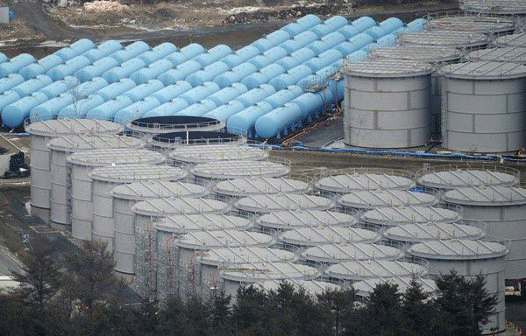
‘An Appalling Act of Industrial Vandalism’: Japanese Officials Do PR for Plan to Dump Fukushima Water Into Ocean
|
|
‘An Appalling Act of Industrial Vandalism’: Japanese Officials Do PR for Plan to Dump Fukushima Water Into Ocean https://www.commondreams.org/news/2020/02/03/appalling-act-industrial-vandalism-japanese-officials-do-pr-plan-dump-fukushima The Japanese government told embassy officials from nearly two dozen countries that releasing the water into the ocean was a “feasible” approach that could be done “with certainty.”
According to Kyodo News, officials from the Ministry of Economy, Trade, and Industry claimed releasing the water and evaporating it are both “feasible methods” but said the former could be done “with certainty” because radiation levels could be monitored. There’s more than one million tons of contaminated water already stored at the plant, with 170 tons more added each day. Utility TEPCO says there will be no more capacity for tanks holding contaminated water by 2022. As Agence France-Presse reported, “The radioactive water comes from several different sources—including water used for cooling at the plant, and groundwater and rain that seeps into the plant daily—and is put through an extensive filtration process.” That process still leaves tritium in the water and “has been found to leave small amounts of other radioactive materials,” Kyodo added. The session for embassy officials followed Friday’s recommendation by a Japanese government panel that releasing the water into the ocean was the most feasible plan. As Reuters reported Friday:
Local fishermen oppose the plan and Reuters noted it is “likely to alarm neighboring countries.” They’re not alone. Nuclear policy expert Paul Dorfman said Saturday, “Releasing Fukushima radioactive water into ocean is an appalling act of industrial vandalism.” Greenpeace opposes the plan as well. Shaun Burnie, a senior nuclear specialist the group’s German office, has previously called on Japanese authorities to “commit to the only environmentally acceptable option for managing this water crisis, which is long-term storage and processing to remove radioactivity, including tritium. |
|
Liberal Senator Jim Molan disgrees with the scientific evidence on climate change
Senator Jim Molan grilled over climate change, bushfire response on Q&A with Hamish Macdonald, ABC PAUL JOHNSON 4 Feb 2020 The new era of Q&A kicked off with a bang under new host Hamish Macdonald, with Liberal senator Jim Molan taking centre stage as the nation’s bushfire crisis was discussed.
Key points:
- Senator Jim Molan defended the Federal Government’s response to the bushfire crisis
- The senator said while some might say the science on climate change was settled, he was “not relying on evidence”
- He was heckled and laughed at by the live audience in Queanbeyan ………. https://mobile.abc.net.au/news/2020-02-04/jim-molan-under-fire-for-climate-change-admission-on-q&a/11925750
Dirty Politics: Palmer spent $89m on election, fossil fuel lobbies back LNP and Labor — RenewEconomy

Clive Palmer spent almost $90 million to re-elect the Morrison government as the fossil fuel industry split its donations between the major parties. The post Dirty Politics: Palmer spent $89m on election, fossil fuel lobbies back LNP and Labor appeared first on RenewEconomy.
via Dirty Politics: Palmer spent $89m on election, fossil fuel lobbies back LNP and Labor — RenewEconomy
Morrison’s refusal to move on climate, and the “prosperity doctrine” — RenewEconomy

Morrison’s refusal to act on climate may not just be due to the denialists and the fossil fuel lobby that surround him, it’s also guided by the “prosperity doctrine” of his pentecostal church. The post Morrison’s refusal to move on climate, and the “prosperity doctrine” appeared first on RenewEconomy.
via Morrison’s refusal to move on climate, and the “prosperity doctrine” — RenewEconomy
Coalition energy policy void could reverse wind and solar price gains — RenewEconomy

Slump in renewables investment could cut short electricity price declines – and potentially send them back in the opposite direction – under current federal policy settings. The post Coalition energy policy void could reverse wind and solar price gains appeared first on RenewEconomy.
via Coalition energy policy void could reverse wind and solar price gains — RenewEconomy
February 3 Energy News — geoharvey

Opinion: ¶ “If There’s A Silver Lining In The Clouds Of Choking Smoke It’s That This May Be A Tipping Point” • As a climate scientist on sabbatical in Australia, I’ve had plenty of conversations about the climate crisis lately. Although the Murdoch media make it seem as if there’s plenty of debate, the reality […]
Behind the mask of “medical necessity” the nuclear lobby prepares the way for its birth-to-grave nuclear cycle dream
 Dennis Matthews, 3 Feb 2020 It is obvious to me that the nuclear industry’s nuclear dump campaign is based on connecting the dump with nuclear medicine, just look at the last 2 issues of The Advertiser (1st and 3rd Feb).
Once the public accepts that we need to have a centralized dump for the dangerous but necessary nuclear waste from hospitals then the rest is easy – throw money, promise of jobs, etc, etc and it’s all over bar the shouting.
By volume, most of the waste will be from hospitals, universities, mining companies. However, from the point of view of radioactivity and hence hazard, by far the most dangerous and difficult to manage material is from the nuclear reactor at Lucas Heights in NSW. This material will remain highly dangerous for our children, grandchildren, great grandchildren, and so on for many more generations.
Moving long-lived radioactive nuclear waste from a place (Lucas Heights in NSW), where it is already stored and which has more nuclear scientists than the rest of Australia put together, to a remote place like Kimba is not scientifically, environmentally or morally defensible.
The initial dump is highly likely to be the thin edge of the wedge. When people get tired of complaining the nuclear industry can slowly and quietly up the ante.
Strong rally in Kimba, South Australia, against nuclear dump plan
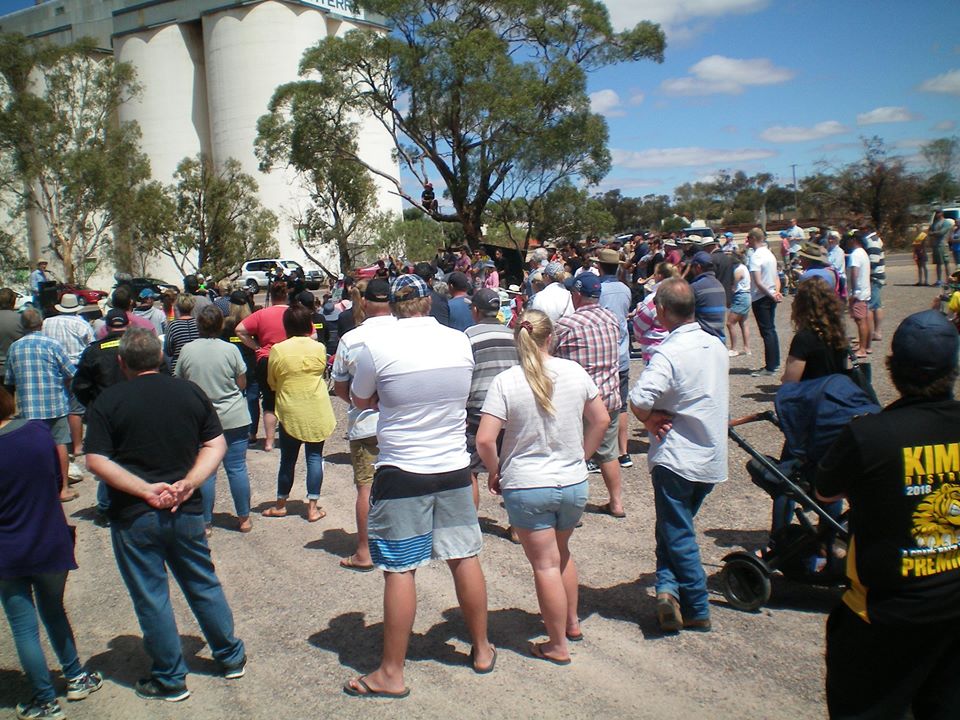
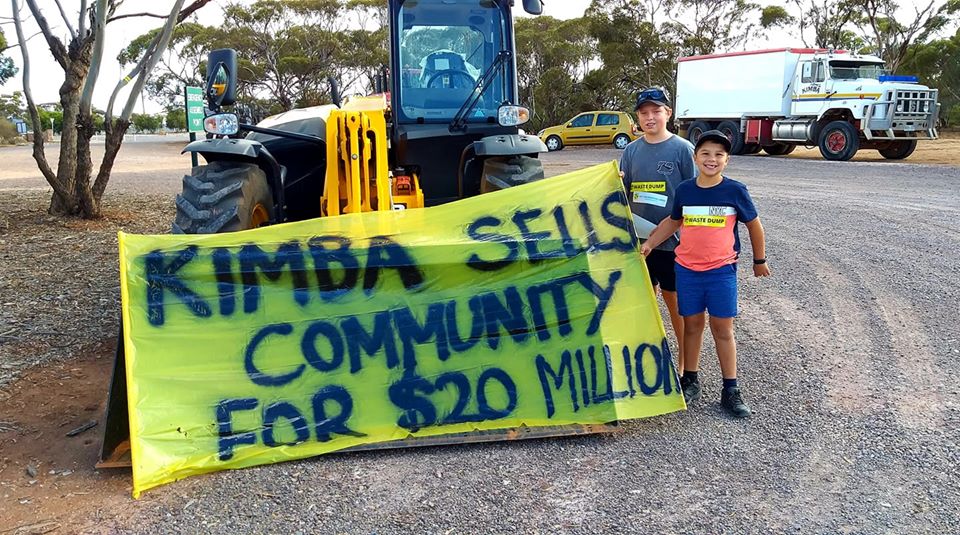
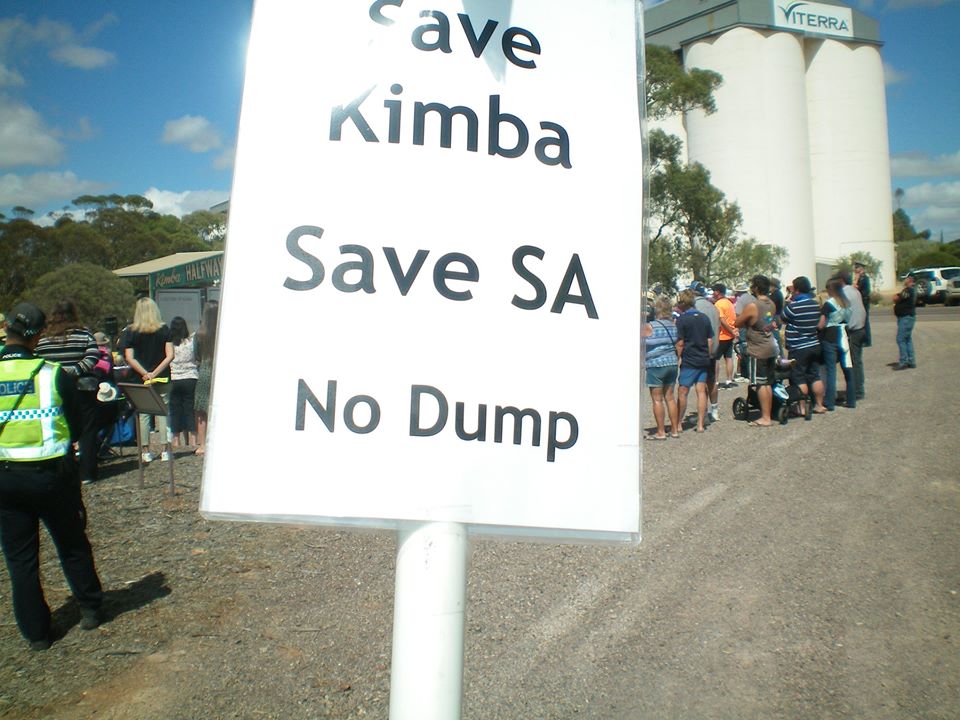
SA community calls on government to scrap planned nuclear waste dump, SBS, 2 Feb 2020 Protesters are venting their anger at a nuclear waste dump proposed on South Australia’s Eyre Peninsula. Protesters are calling on the federal government to scrap a proposed nuclear waste dump on South Australia’s Eyre Peninsula at a rally on Sunday.
The farming property Napandee near the town of Kimba was announced as the site of the radioactive facility on Saturday.
But the No Radioactive Waste on Agricultural Land in Kimba or SA committee says the community consultation process was flawed.
“Those opposed to the facility have had no choice but to fight, at every opportunity, for our legitimate concerns to be heard,” president Peter Woolford said…..
Federal Resources Minister Matthew Canavan said a decision on the site would be announced soon. https://www.sbs.com.au/news/sa-community-calls-on-government-to-scrap-planned-nuclear-waste-dump
A clear path to climate action for Australia
The Princes Highway to climate action, SMH, Jono La Nauze 2 Feb 2020 In the past few weeks a clear path to real action on climate change has emerged. State and territory governments are aligning on the need for stronger climate policy.If the states act decisively and act together on setting emissions targets they can reduce pollution through an alternative route. Let’s call it the Princes Highway to climate action, because, like the famous road, it passes through the eastern capitals and deliberately avoids Canberra. Nauze 2 Feb 2020 In the past few weeks a clear path to real action on climate change has emerged. State and territory governments are aligning on the need for stronger climate policy.If the states act decisively and act together on setting emissions targets they can reduce pollution through an alternative route. Let’s call it the Princes Highway to climate action, because, like the famous road, it passes through the eastern capitals and deliberately avoids Canberra.
The biggest barrier to action has been a lack of political will and outright climate denialism in Federal Parliament, mainly from the Liberal and National parties. Even after the bushfires, the Prime Minister has tried to deflect attention from his party’s failure by focusing the debate on how we can “adapt” to a hotter, more chaotic climate, rather than cutting the pollution that causes it. But at the state level, things have been different. In recent weeks, senior Liberals have been speaking out about the need to cut pollution and have called for stronger climate policy – including the South Australian Premier, the outgoing and incoming Tasmanian premiers, the Victorian Opposition Leader and the NSW Climate and Energy Minister. In South Australia, the Liberal Party shifted a long time ago. When a freak storm toppled transmission lines and blacked out the state, the federal Coalition rolled out an aggressive misinformation campaign blaming the then Labor government’s renewable energy leadership. But when the Liberals came to power they didn’t follow their federal counterparts in trashing wind and solar – instead, they embraced it. “A lot of people thought when I got elected that we would be scaling back the state’s focus on renewable energy, when in fact we are putting the foot to the floor,” said Liberal Premier Steven Marshall on Friday. South Australia is now on track for 75 per cent renewable energy by 2025, and the Premier has linked the recent bushfires to climate change. Every single state and territory in the country has now set a goal of net zero emissions by 2050 – a long-term target the Prime Minister has so far rejected. Of course, the reality is that emissions cuts in the next five and 10 years will count the most. That’s why it’s critical that premiers such as Gladys Berejiklian and Daniel Andrews seize this moment to work with their fellow premiers on a national climate change strategy…….. This is a critical moment that could shift the national debate. If Victoria adopts emissions targets in line with the Paris Agreement, it is possible for other states to follow suit, passing similar legislation and creating a de-facto national climate change strategy – whether Scott Morrison decided to help out or not. In a few years, rather than being stuck in a stalemate at the federal level while temperatures rise and the country burns, we could have agreement between states and territories to get on with the job of lowering emissions and creating a safer future. https://www.smh.com.au/national/the-princes-highway-to-climate-action-20200131-p53wg6.html |
|
|
Australian govt’s dodgy process, with “jobs promises” for getting support for Kimba nuclear waste dump.
 Megan Jo I Fight To Stop A Nuclear Waste Dump In South Australia 3 Feb 2020 I feel empathy for the people that voted yes. I think they truly believe that the promises of jobs, safety and prosperity are going to materialise. Sure, the government has promised 45 jobs….. but the current definition of ‘employed’ is 1 hour per week.
 Indigenous community votes down proposed nuclear waste bunker near Lake Huron,
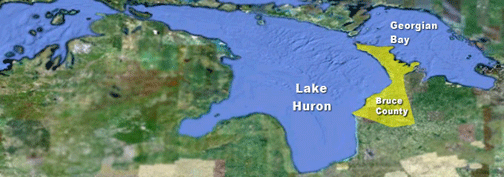 ‘We were not consulted when the nuclear industry was established in our territory’,https://nationalpost.com/news/canada/indigenous-community-votes-down-proposed-nuclear-waste-bunker-near-lake-huron The Canadian Press , Colin Perkel, February 1, 2020
TORONTO — An Indigenous community has overwhelmingly rejected a proposed underground storage facility for nuclear waste near Lake Huron, likely spelling the end for a multibillion-dollar, politically fraught project years in the making.
After a year of consultations and days of voting, the 4,500-member Saugeen Ojibway Nation announced late Friday that 85 per cent of those casting ballots had said no to accepting a deep geologic repository at the Bruce nuclear power plant near Kincardine, Ont.
“We were not consulted when the nuclear industry was established in our territory,” SON said in a statement. “Over the past 40 years, nuclear power generation in Anishnaabekiing has had many impacts on our communities, and our land and waters.” Continue reading
1 This month.

PETITION – To: Prime Minister Anthony Albanese and the Australian Labor Government
Chernobyl: The Lost Tapes – A good documentary on Chernobyl on SBS available On Demand for the next 3 weeks– https://www.sbs.com.au/ondemand/tv-program/chernobyl-the-lost-tapes/235274195556

19 May – Webinar- Webinar: No Nuclear Weapons in Australia
Start: 2026-05-19 18:00:00 UTC Canberra, Melbourne, Sydney (GMT+10:00)
End: 2026-05-19 19:30:00 UTC Canberra, Melbourne, Sydney (GMT+10:00)
20 May – Webinar – The dangerous world of AUKUS, US, military occupation and suppression of dissent

National Webinar, 20th May, 2026, 6.30pm AEST. Confronting laws restricting/suppressing protest speech and action
Speakers: Former Sen. Rex Patrick, Lawyer Nick Hanna ,Arthur Rorris ,Jorgen Doyle, Sen David Shoebbridge,
Facilitator Kelley Tranter.

of the week – Australians for War Powers Reform (AWPR)
To see nuclear-related stories in greater depth and intensity
 Antinuclear