Russia covered up a major nuclear accident. Scientists now locate the source
|
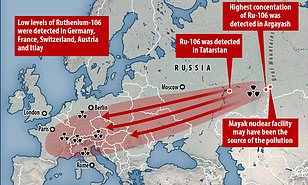
Russia appears to have kept a major nuclear accident secret. But scientists called the ‘Ring of 5’ tracked the plume of radiation to its source. https://www.businessinsider.com.au/russia-nuclear-accident-radiation-timeline-2017-2019-12?r=US&IR=T, ARIA BENDIX
DEC 21, 2019
A group of scientists called the “Ring of Five” noticed something unusual in the atmosphere in late 2017: Air across Europe showed “unprecedented” levels of the radioactive isotope ruthenium-106.
The isotope is often made when reprocessing nuclear fuel. “We were stunned,” Georg Steinhauser, a professor at the University of Hanover in Germany who is part of the group, told Business Insider in August. “We did not have any anticipation that there might be some radioactivity in the air. We were just measuring air filters as we do on a weekly basis, 52 times a year, and suddenly there was an unexpected result.” The Ring of Five, which had been monitoring Europe’s atmosphere for elevated levels of radiation since the mid ’80s, spent the next two years looking for the cause of the spike.
The culprit, according to a study released in July, was an undisclosed nuclear accident at the Mayak nuclear facility in Russia, which was once the centre of the Soviet nuclear-weapons program. Mayak was also the site of the 1957 Kyshtym explosion, the world’s third-worst nuclear accident. More than 10,000 nearby residents were forced to evacuate at the time. Russia has never acknowledged that any nuclear accident happened at the Mayak facility in 2017, and has not responded to any findings from the Ring of Five. But now, the scientists have unravelled the mystery even further.A second study published last month offers even more evidence that an accident occurred at Mayak in 2017. It even pinpoints a timeline: Most of the ruthenium was emitted on September 26, 2017.
Tracing a radioactive plume across EuropeThe Ring of Five is so named because the group was originally made up of scientists from five nations – Sweden, Germany, Finland, Norway, and Denmark – but it now includes researchers from 22 countries. Their monitoring work takes takes place 24 hours a day, 365 days a year. The new study suggests that the Mayak facility likely released 250 terabecquerels (a measurement of radioactivity) of ruthenium into the atmosphere. The Kyshtym explosion, by comparison, released around 2,700 terabecquerels of ruthenium. The world’s worst nuclear accident, Chernobyl, released around 5.3 million terabecquerels of radioactive material, according to a 2013 analysis.
To find out where the 2017 radioactive plume came from, scientists traced the path of the wind at the time using more than 1,100 measurements from the fall of that year. That required studying the wind’s altitude and direction, as well as weather conditions that may have changed its course.
The scientists determined that the plume started out in the Southern Urals, where the Mayak facility is located, then was driven towards southwest Russia. It arrived in Romania on September 29, then split in two. The main part of the plume spread toward Central Europe, where it encountered rain in Bulgaria. Plant and soil samples taken in the country showed elevated levels of ruthenium at the time. After that, the plume moved north to Scandinavia before arriving in Italy on October 2, 2017. That day, Italian scientists sent an alert to the Ring of Five about elevated levels of ruthenium in Milan. Steinhauser called this the “single greatest release from nuclear-fuel reprocessing that has ever happened.” Russia has not responded to the Ring of Five’s findingsAt the time of the alleged accident in 2017, Russian officials said the Mayak facility wasn’t the source of the release, even though the nation showed elevated levels of ruthenium. Instead, officials in Russia attributed the radiation to a satellite that burned up in the atmosphere. Russia still hasn’t issued a response to either of the studies the Ring of Five published this year. “We should not forget that Mayak is a military facility – and, of course, the Russian Federation is very reluctant when it comes to talking about military facilities,” Steinhauser said. “I presume this would not be much different for other superpower nations.” The scientists don’t consider the levels of radiation they detected to be an immediate threat to people’s health. Last year, France’s Institute for Radiological Protection and Nuclear Safety determined that the levels of ruthenium-106 in the atmosphere do not pose danger to human health or the environment. But the long-term consequences are unknown. Another unanswered question, Steinhauser said, is whether the population near the Mayak facility breathed any radiation into their lungs. He added that there could be reason to monitor food safety if radiation leaked into the soil and water. “We would like to get some more in-depth information on what actually happened,” he said. “There’s a good chance that we’ll catch every single accident – but, in the present case, surprise was on our side.” |
|
Eight new electric vehicle models set to join Australia market in 2020 — RenewEconomy

At least 8 new electric vehicle models will hit Australian shores in 2020, opening up choice for drivers wanting to reduce transport emissions or simply have the latest in auto tech. The post Eight new electric vehicle models set to join Australia market in 2020 appeared first on RenewEconomy.
via Eight new electric vehicle models set to join Australia market in 2020 — RenewEconomy
Telsa Models X and 3 ranked among Australia’s Top 3 safest cars for 2019 — RenewEconomy

Two of out three of Australia’s independently ranked safest cars are electric vehicles, and both of those are Teslas. The post Telsa Models X and 3 ranked among Australia’s Top 3 safest cars for 2019 appeared first on RenewEconomy.
via Telsa Models X and 3 ranked among Australia’s Top 3 safest cars for 2019 — RenewEconomy
December 20 Energy News — geoharvey

Opinion: ¶ “This Century Is An Era Of Climate Retreat, Both Managed And Unmanaged” • Fifteen years after Hurricane Katrina, the population of New Orleans is down 100,000, an unmanaged retreat. An alternative is managed retreat. Communities are looking at ways to deal with the consequences of climate change. Moving the whole town is just […]
Grid “balanced on a knife edge”: AEMO flags more solar delays in Victoria — RenewEconomy

AEMO warns solar project owners that constraints and delays may be long lasting as it seeks a solution to issues “unprecedented in any power system.” The post Grid “balanced on a knife edge”: AEMO flags more solar delays in Victoria appeared first on RenewEconomy.
via Grid “balanced on a knife edge”: AEMO flags more solar delays in Victoria — RenewEconomy
South Australia prices hit market cap as temperature records tumble — RenewEconomy

Period of low prices in South Australia comes to an abrupt end amid third day of unprecedented heatwave. The post South Australia prices hit market cap as temperature records tumble appeared first on RenewEconomy.
via South Australia prices hit market cap as temperature records tumble — RenewEconomy
Flaws in the Senate Committee’s nuclear report
Parliamentary Committee Supports Nuclear – But Only If Everyone Is Into It , Solar Quotes, December 19, 2019 by Ronald Brakels “……..The Parliamentary Nuclear Committee used 214 pages to come to the wrong conclusion. But arriving at the right conclusion can’t be easy if you have no ability to smell bullshit in your own research.
One Solar Panel Does Not Cause 0.8 Tonnes Of CO2 Emissions
Take a look at this table included in the report, taken from a publication that advocates nuclear power:
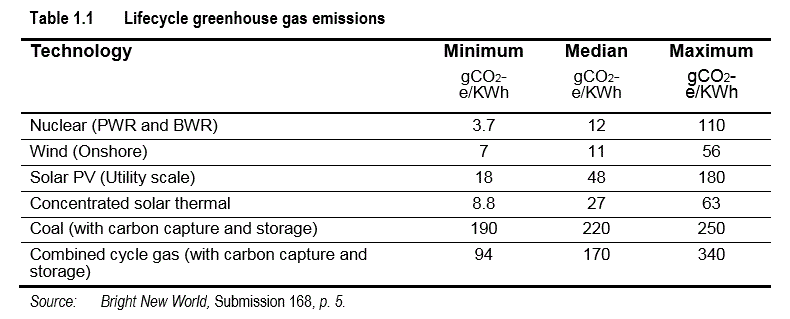
Casually looking at that you might think CO2 emissions for both nuclear energy and solar PV are pretty low. But if we stop for one minute and use basic mathematical ability that’s available to anyone who doesn’t have to take their socks off to count to 20, then we can see that a Parliamentary committee saw fit to include a table in an official report that gives ridiculous results.
Looking at their minimum figure for Solar PV (Utility scale), I see they are claiming a large solar farm will result in at least 18 grams of CO2 emissions per kilowatt-hour generated. While generating electricity from PV doesn’t result in any emissions, they are involved in the manufacture of solar panels, so they aren’t completely emissions-free. However, they are a lot bloody closer to emission free than this table suggests.
These days a typical standard sized solar panel is around 300 watts. In a solar farm in Australia on a fixed mount it will generate around 12,300 kilowatt-hours over 25 years. This means they are saying the solar panel will result in a minimum of 222 kilograms of CO2 emissions. If we use their maximum figure it will result in 2.22 tonnes of CO2, all for a panel that weighs about 18 kilograms. So they are saying manufacturing and installing one solar panel results in emissions equal to burning 80-800 or more kilograms of coal.
Jinko Solar, the world’s largest solar panel manufacturer, has a figure from 2017 of just 2.19 grams of CO2 per kilowatt-hour generated by a solar farm. As this has been decreasing year by year it will be even lower now. However, this is just for the solar panel and doesn’t include emissions from the construction of its ground mount or inverter, so I’ll double it to 4.4 grams. This means the actual emissions per kilowatt-hour are probably less than the best figure on the table and more than 40 times less than the worst figure. Even if we triple the Jinko figure it still comes to less than their median emissions for nuclear energy and less than 4% of their maximum figure for PV.
It’s clear the committee had no ability to detect figures that were bullshit — or they simply didn’t care.
Renewable Energy Increases The Cost Of Nuclear
Here is section 1.50 of the report:
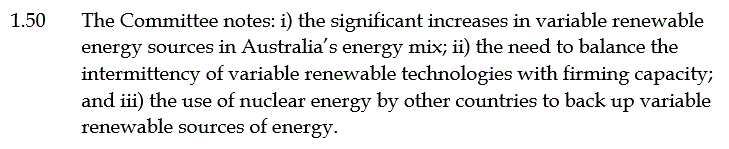
I note the committee has failed to understand the economics of nuclear power if they think it works well with solar and wind energy. This is because if a nuclear power station produces half the energy its capable of, it almost doubles the cost of that energy. This is due to nuclear fuel being very cheap1 per kilowatt-hour, so very little money is saved by ramping down, while nearly all other costs remain the same.
This means nuclear power, which is already too expensive when operated in the most economical way — almost continuously at full normal power — becomes even more expensive when used in a grid with a significant amount of solar energy and/or wind power capacity. Australia already has more than enough to adversely affect the economics of nuclear energy and, even if we approve and build a nuclear power station in one quarter the average time it has taken overseas this century, things will be much worse for its economics by the time it’s complete….. https://www.solarquotes.com.au/blog/nuclear-energy-australia/
Questions on the research and legal help given to men who offered their land for nuclear waste dump
Are the land owners who nominated their properties at Kimba for the radioactive waste management facility fully aware of and sought independent technical advice on all aspects of the selection and development of the facility I understand that their surnames are Rayner and Baldock and are they prepared to disclose the nature and result of any independent advice that they may have obtained Can they explain why they are getting legal advice and whether any outside source is meeting Or contributing towards the cost of that advice Will they agree to the Kimba community having access to their respective nominations Were they given any assistance by any government persons in completing their nominations Finally has the Kimba District Council itself sought any proper technical advice independent of the federal government in its various capacities as to the government’s proposals for safeguarding the rights of the Kimba community If not why was this not done because of the importance of this issue and the legal obligations of the Council and its councillors to ensure that the population of Kimba is fully and properly protected This surely should have been done as part of the Council as respondent to the Barngarla application to the federal court I am rather intrigued by this personally and should add that I have been asked for the same information by the various politicians with whom I have been discussing then South Australian situation in the context of the Azark Project at Leonora https://www.facebook.com/groups/941313402573199/ |
|
||||||||||


Scrutiny on Parliamentary Committee Nuclear Report
Parliamentary Committee Supports Nuclear – But Only If Everyone Is Into It , Solar Quotes, December 19, 2019 by Ronald Brakels
Last Friday the House Of Representatives released a report on nuclear energy in Australia. They said it’s a good idea — provided everyone is cool with it.
The report is called:
“Not without your approval: a way forward for nuclear technology in Australia”
It gives the country three recommendations :
- Consider using nuclear power.
- Gather information to support the future use of nuclear power.
- End or partially lift the moratorium that prohibits building nuclear reactors.
- \While nuclear is a low-emissions source of energy, .I don’t agree with these recommendations because:
- There is no point considering nuclear power here until one of the countries that have been using it for decades gets it right and starts building reactors that supply energy at a lower cost than renewables.
- There is no point paying people to study nuclear energy until other countries with existing nuclear industries show it can make economic sense. If it never manages to pay for itself, the research will be a waste. If it does pay for itself then the cost effective reactors may be very different from existing ones and the effort will, again, have been wasted.
- We live in a country where the government is always going to require you to get permission before you can build a nuclear reactor, so saying the magic words, “The moratorium is lifted!” makes no practical difference. But I figure we may as well say the magic words just to make it clear the reason we don’t have nuclear power isn’t because they haven’t been uttered.
The problem with this report is not that the Committee and I have a difference of opinion. The problem is, only someone who has been whacked on the head with a graphite rod could look at the problems new nuclear power is experiencing around the world today and recommend Australia go ahead with it.
The problems have nothing to do with safety, nuclear waste, or security. These issues are irrelevant because nuclear power can not pay for itself. If it can’t do that, there is no point in worrying about the other issues and it is painfully clear new nuclear power makes no economic sense when renewables are now cheaper than coal power and continuing to fall in cost.
In the United Kingdom — the nuclear power possessing nation that is, embarrassingly, most similar to our own — they will pay 22 cents per kilowatt-hour for electrical energy from the under-construction Hinkley C reactors. That’s three times its average cost in the Australian National Electricity Market this year and fives times its average price in 2015.
While Australia’s wholesale electricity prices are unusually high at the moment, they are not going to get three miles high on this island. Thanks to the decreasing cost of renewable energy they are expected to trend downwards from their current high of one-third the cost of new nuclear energy in the UK.
Britain’s not the only place where new nuclear power is extremely expensive. A similar price is required for it to be constructed in the US. There have also been huge cost overruns building reactors in other countries, which include France and Finn’s land. Because Australia doesn’t have an existing nuclear power industry it could be even more expensive here and, last time I checked, we didn’t have any magic pixie dust we could sprinkle on nuclear energy projects to make them cheaper or on our politicians to make them smarter.
To me, it seems this report is an expensive face-saving measure by Parliamentary supporters of nuclear power. It makes no sense for this country given the current and decreasing cost of renewable energy, but they’re not willing to admit that. They instead want to pretend nuclear power is a great idea for us but the reason it’s not going ahead is because it’s unpopular. Hence the title, “Not without your approval”. In other words, they are saying the Australian people aren’t smart enough to know a good thing when they see it and that’s the only reason why we’re not building nuclear reactors.
Well, I say screw you House of Representatives Standing Committee on Energy and the Environment and the plutonium powered pony you rode in on. I felt that looking into nuclear power once again was a waste of time, but if you had investigated it and said
“Nuclear power is far too expensive to make sense for Australia. If this changes and new reactors overseas produce electricity at a lower cost than renewables we can look into it again, but until that happens, forget about it.”
Then at least we’d know the system works. We would be able to see that Parliamentary committees are able to look at the bleeding obvious and interpret it correctly. But instead, they only looked at information they liked while avoiding asking the obvious question of — are modern reactors making enough money to cover the cost of their construction and operation? Rather than do this, they took bits and pieces they picked from around the obvious question, turned them this way and that, and squinted until they were able to announce that it looked good — but the punters wouldn’t appreciate it and they’re the reason why we can’t have nice things.
They did this rather than admit what has been obvious for years now, that new nuclear will not pay for itself in Australia and, given the decreasing cost of renewable energy, it looks impossible for current nuclear designs to ever pay for themselves here.
By choosing to protect their egos rather than admit they were wrong, the nuclear energy supporters have sullied Parliament’s good… well, they’ve sullied Parliament’s name. I don’t expect anything run by humans to be perfect, but I really think we need a turn around in the ratio of sullying to pride inducing Parliamentary moments.
It’s A Long Report
The report is 214 pages. It could have been a lot shorter. I could have gotten it down to something like:
“Given that:
- The UK will be pay around 22 cents per kilowatt-hour in today’s money for electricity from the Hinkley C nuclear power plant, and…
- In the United States new nuclear capacity requires a similar price to proceed and nuclear plants have been abandoned while under construction because it became clear they would never pay for themselves.
- Australia has no advantages in building nuclear power stations while having the disadvantage of no existing nuclear power industry.
It is therefore not reasonable to believe we can build nuclear generating capacity for less than what it costs in the UK or USA. Until reactors are built overseas that produce electricity at a cost that is competitive in Australia, the subject does not merit further consideration.
Additionally, given that:
- New reactors under construction in France and Finland have had long delays and are far over budget, indicating the high cost of new nuclear capacity is not confined to English speaking countries, and…
- No organization is offering to or wants to build a nuclear power station in Australia at a price we would find anywhere close to acceptable.The idea of nuclear power in Australia should be abandoned and only reviewed if there are major improvements in its economic viability.”That’s under 214 words while having the advantage of being correct. The House of Representatives committee used 214 pages to come to the wrong conclusion. But arriving at the right conclusion can’t be easy if you have no ability to smell bullshit in your own research…..Parliamentary Committee Supports Nuclear – But Only If Everyone Is Into It , Solar Quotes, December 19, 2019 by Ronald Brakels
Australia’s big problem – P.M. Scott Morrison’s lack of leadership
 “…….Scott Morrison’s holiday is not the problem, his lack of leadership on the bushfires is
The prime minister’s badly timed holiday has become a source of anger but while the reaction is valid it’s the wrong thing to focus on, Guardian, Katharine Murphy Political editor, @murpharoo, Wed 18 Dec 2019 Let’s talk about Scott Morrison’s holiday. The prime minister is on holidays, presently, while the country is still burning.
Morrison’s ill-judged holiday has become a thing, a totem, a social media event. It somehow epitomises everything that’s wrong with this bloke. As well as failing to show up at a critical time, leaving the running of the country to Michael McCormack, who struggles to run his own mulish political party, let alone anything else, Morrison is a hypocrite because he once blasted Christine Nixon for eating dinner during a bushfire…..
I think it might actually be a productive thing if Morrison stops moving for five minutes, stops trying to be the self-appointed hero of the hour. If he stops moving, then he might think more often. I think the country would benefit if Morrison thought more often, more deeply, about more things. We really do need him to think, rather than just maintain the constant barrage of humblebrag and marketing. If there’s been any lessons from the back half of this year, I think that’s the lesson. …..
What I give a shit about is we have a government, led by him, which is, in many different ways, failing to rise to the challenges of our time.
They. Are. Failing.
I get very impatient about that.
I get very worried about that.
People are angry about Morrison’s mini-break because it symbolises the lack of leadership he has shown on the bushfires; the lack of principled leadership Australia showed last week in Madrid on climate change and the Coalition’s indefensible record on climate at home; the lack of velocity in the government’s response to Australia’s stuttering economy, which was underscored by the latest midyear economic forecast, which had downgrades as far as the eye could see.
The Morrison holiday has accumulated public outrage because it symbolises absence: a prime minister missing in action on important things. A prime minister too regularly substituting rhetoric for action. A prime minister apparently too pleased with himself to understand that people need more from government than they are getting.
I totally get it.
But I’m not fussed about the holiday. What I care about, what I am minutely focused on, and will go on being minutely focused on, is what this bloke does when he gets home. https://www.theguardian.com/australia-news/2019/dec/18/scott-morrisons-holiday-is-not-the-problem-his-lack-of-leadership-on-the-bushfires-is
Smaller Nuclear Power Is Not Cheaper Nuclear Power
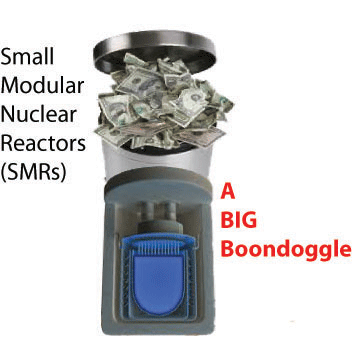 Parliamentary Committee Supports Nuclear – But Only If Everyone Is Into It , Solar Quotes, December 19, 2019 by Ronald Brakels “……..Smaller Is Not Cheaper
Small Modular Reactors (SMRs) are suggested in the report as a way of making nuclear power economically viable. The problem with this is they cost more per kilowatt than large ones. This fact should not be a surprise to anyone. The engineers who designed the large nuclear reactors in the world today are not idiots who are currently slapping their foreheads, saying, “I’m so stupid! If only I had thought of making them smaller instead of bigger!” Modern reactors are very large to keep their cost per kilowatt down. Going small has the opposite effect.
That small reactors are not cheap is made obvious by the fact Britain, which has the longest history of nuclear power generation of any country, decided to power their new aircraft carriers with kerosene and diesel rather than small nuclear reactors because of they are so expensive. This is despite the alternative being expensive oil products rather than much cheaper solar and wind energy.
An advantage given for SMRs is they will supposedly suffer from fewer cost overruns. But that sales pitch is not enough to make nuclear energy economically attractive — pay for a more expensive product so you’ll have less of a chance of unpleasant surprise expenses down the line.2…… https://www.solarquotes.com.au/blog/nuclear-energy-australia/
India is getting out of coal
 Good news for climate change: India gets out of coal, Canada’s National Observer, By Tim Buckley in News | December 17th 2019 This story was originally published by Bulletin of the Atomic Scientists and appears here as part of the Climate Desk collaborationIn the often grim world of climate reporting, there is at least one upbeat story: India has been aggressively pivoting away from coal-fired power plants and towards electricity generated by solar, wind, and hydroelectric power. This means that the amount of carbon dioxide the country emits into the atmosphere should come down dramatically. Good news for climate change: India gets out of coal, Canada’s National Observer, By Tim Buckley in News | December 17th 2019 This story was originally published by Bulletin of the Atomic Scientists and appears here as part of the Climate Desk collaborationIn the often grim world of climate reporting, there is at least one upbeat story: India has been aggressively pivoting away from coal-fired power plants and towards electricity generated by solar, wind, and hydroelectric power. This means that the amount of carbon dioxide the country emits into the atmosphere should come down dramatically.
The reasons for this change are complex and interlocking, but one aspect in particular seems to stand out: The price for solar electricity has been in freefall, to levels so low they were once thought impossible. For example, since 2017, one solar energy company has been generating electricity in the Indian state of Rajasthan at the unheard-of, guaranteed wholesale price of 2.44 rupees per kilowatt-hour, or 3 US cents. (In comparison, the average price for electricity in the United States is presently about 13.19 cents per kilowatt-hour, and some locations in the country pay far more . As recently as 2008, the average homeowner on Block Island, Rhode Island, paid a staggering 61 cents per kilowatt-hour for electricity, before any other fees or charges—which can nearly double the price. And businesses had it even worse, with some business owners reporting electric bills of as much as $30,000 per month.) Consequently, with this massive reduction in the cost of renewables, India is able to shift away from the world’s dirtiest fossil fuel, and to much cleaner sources. It’s a stunning change, and one that could have profound implications on the world energy market. While western countries continue to baulk at reducing their reliance on fossil fuels, India is accelerating its plans to lock in a sustained, aggressive reduction in the carbon emissions intensity of its economy. In fact, India’s prime minister, Narendra Modi, is targeting a fivefold expansion of the electricity generated from renewable energy sources by 2030—and this from a country that has already doubled its renewable energy in the past three years. ……https://www.nationalobserver.com/2019/12/17/news/good-news-climate-change-india-gets-out-coal |
|
Australia just had its hottest day on record
 It’s official: Tuesday was ‘Australia’s hottest day on record’, SBS, 18 Dec 19, Preliminary results show Tuesday was Australia’s hottest day on record. Tuesday was the hottest day on record with an average across the country of 40.9 degrees Celsius, preliminary results show.
The Bureau of Meteorology said the average temperature beat the previous record of 40.3 degrees Celsius recorded on 7 January 2013.
Southern and central Australia sweltered as temperatures reached eight to 16 degrees above average.
Tuesday’s record could soon be eclipsed though – with temperatures expected to exceed 40 in parts of Australia until the end of the week.
Adelaide is facing a four-day heatwave, with an expected peak of 44 degrees Celsius on Friday.
Victoria is also predicted to record its hottest December day on Friday if northwest towns such as Mildura and Swan Hill reach a forecast 47 degrees Celsius. ….. https://www.sbs.com.au/news/it-s-official-tuesday-was-australia-s-hottest-day-on-record
Safety costs rise for Japanese nuclear power plant
Australian Parliamentary Committee Want Money Wasted On More Nuclear Reports
Parliamentary Committee Supports Nuclear – But Only If Everyone Is Into It , Solar Quotes, December 19, 2019 by Ronald Brakels “….They Want Money Wasted On More Reports
The report suggests we get people to write another report on how much nuclear power will cost here:
But I have a different suggestion. A much cheaper one. We just wait for another country to build and operate a nuclear power plant at a low enough cost that would be competitive in Australia. Then we can look into it.
Better yet, to make sure they aren’t exaggerating how cheap their nuclear power is, we say:
“Hey, budget nuclear energy guys, how would you like to build a nuclear power station in Australia? We give you nothing, but you get the market price for whatever electricity you sell.”
If they say, “nyet” or “bu shi” or “piss off” then we can suspect it’s not as cheap as they’re making it out to be.
If they say, “yes” then we can talk about how they’ll be required to insure it for a reasonable amount based on the costs of nuclear accidents that have occurred in the past. While nuclear power is very safe, there must have been at least one or two minor little upsets.
Everyone Has To Love Nuclear Energy
The report says that social acceptance of nuclear power is necessary for it to go ahead. So it’s not going to go ahead because that’s not going to happen. Nuclear energy has turned out to be an economic disaster overseas, we have much cheaper alternatives, and now that I think about it there have been one or two major nuclear accidents overseas that have left a bad impression.
There was a problem with a nuclear power station in Fukushima, Japan. The Japanese Government estimated the cost at around $270 billion dollars. As our government is currently willing to spend around $4.5 million to save an Australian life through public health and safety measures, if we lost that amount of money it would represent around 60,000 Australian lives that potentially could have been saved with it.
Since nuclear power — at the costs we see overseas — is only going to increase electricity bills, and we have far cheaper ways to reduce emissions that are quicker to deploy, and because Australians aren’t in love with a very very small chance of a nuclear accident that has a very high cost, there will never be acceptance for nuclear power in this country. Not in its current form. But be sure to let me know when a DeLorean compatible Mr Fusion becomes available.
I’m guessing the entire section on social acceptance is only in the report so when nuclear power doesn’t get built, its supporters can say, “It’s the fault of normal Australians for not believing in the nuclear economic viability fairy hard enough”, rather than admit they themselves were wrong.
The Moratorium Means Nothing
Currently there is a moratorium on nuclear power in Australia. This means you’re not allowed to build it without special permission from the government. Well, guess what? In this country you are never going to be allowed to build a nuclear reactor without permission from the government. That’s just the way it is. I know it’s a terrible infringement of our right to build nuclear reactors in our backyards and squash courts. But on the other hand, it does support our right not to live next door to someone who’s building a nuclear reactor in their backyard, so I could go either way on this one.
The report suggests scrapping the moratorium or partially lifting it. I’m not sure what partially lifting it means. Maybe you have to ask for permission but you don’t have to say pretty please or maybe it just means they won’t be too worried if you have an eye patch, a cool scar, and introduce yourself as “The Jackal”.
Because the moratorium doesn’t really mean anything, there may not be any harm in lifting it and shutting up a few idiots who think the only reason nuclear power isn’t currently under construction in this country is because the government hasn’t muttered the magic words, “The moratorium is lifted!” So they may as well say moratorium leviosa and be done with it.
It’s not as if nuclear power is going to be built in this country one way or the other. Supporters will soon discover no one’s lining up to build reactors even with our current high wholesale electricity prices. The only way they will get built is with very substantial subsidies and the government is too busy trying to keep coal power afloat while Australia burns to waste its energy subsidising nuclear. https://www.solarquotes.com.au/blog/nuclear-energy-australia/


1 This month.


PETITION – To: Prime Minister Anthony Albanese and the Australian Labor Government
Chernobyl: The Lost Tapes – A good documentary on Chernobyl on SBS available On Demand for the next 3 weeks– https://www.sbs.com.au/ondemand/tv-program/chernobyl-the-lost-tapes/235274195556
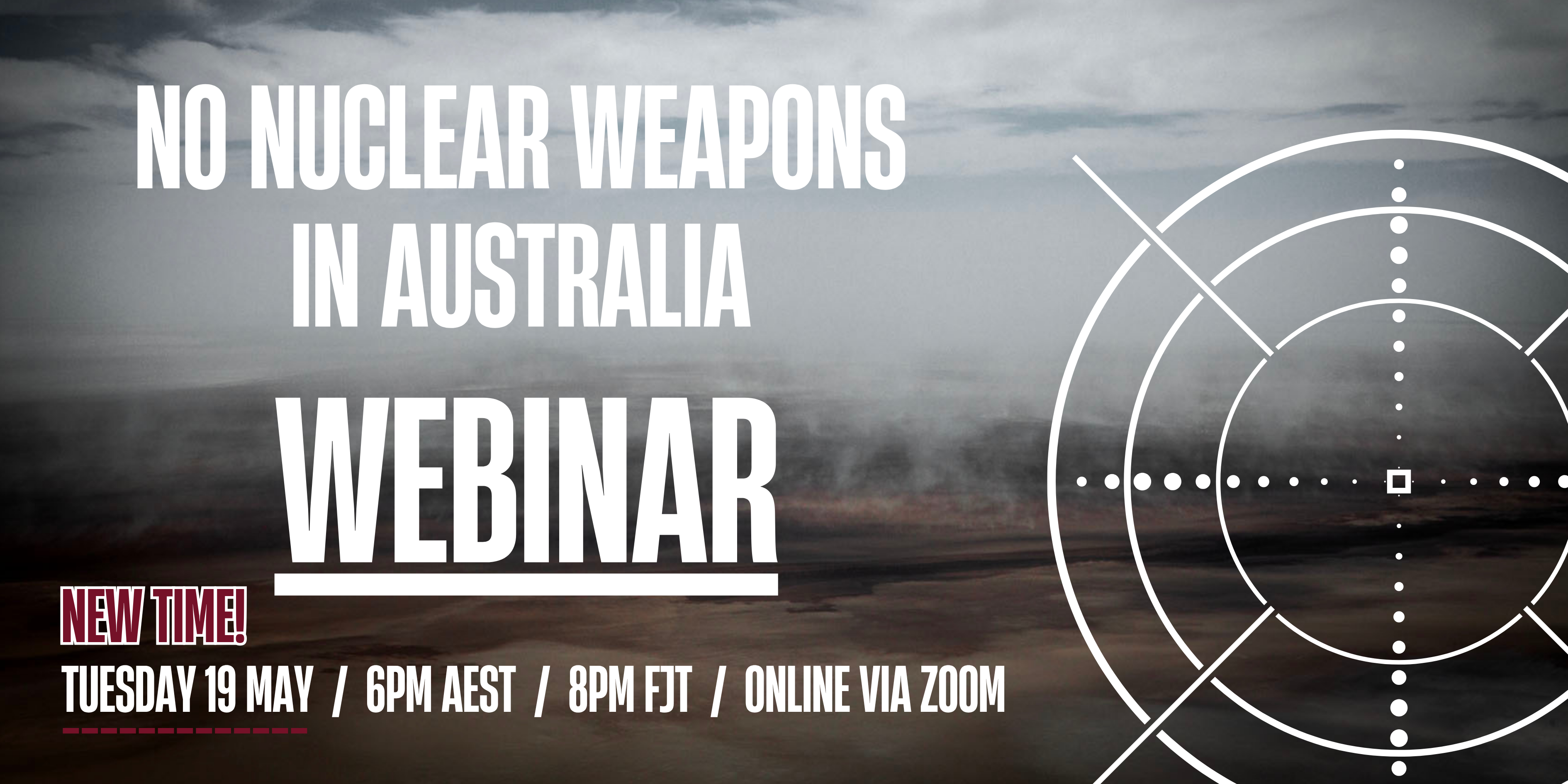
19 May – Webinar- Webinar: No Nuclear Weapons in Australia
Start: 2026-05-19 18:00:00 UTC Canberra, Melbourne, Sydney (GMT+10:00)
End: 2026-05-19 19:30:00 UTC Canberra, Melbourne, Sydney (GMT+10:00)
20 May – Webinar – The dangerous world of AUKUS, US, military occupation and suppression of dissent

National Webinar, 20th May, 2026, 6.30pm AEST. Confronting laws restricting/suppressing protest speech and action
Speakers: Former Sen. Rex Patrick, Lawyer Nick Hanna ,Arthur Rorris ,Jorgen Doyle, Sen David Shoebbridge,
Facilitator Kelley Tranter.

of the week – Australians for War Powers Reform (AWPR)
To see nuclear-related stories in greater depth and intensity
 Antinuclear