December 13 Energy News — geoharvey

COP25: ¶ “Crunch Time At Climate Talks Amid Discord On Carbon Markets” • Officials from almost 200 countries are poring over revised drafts, preparing for a last push at an annual UN summit to finalize rules for the Paris climate accord amid signs that resolving the issue of international carbon markets may be postponed for […]
A tale of two markets: Rooftop PV smashes records as large-scale wind, solar slow down — RenewEconomy

Regulator’s report shows early signs of a dramatic fall in new large-scale renewables investment, to lowest level since mid-2016. The post A tale of two markets: Rooftop PV smashes records as large-scale wind, solar slow down appeared first on RenewEconomy.
Snowy 2.0 will reduce greenhouse gas emissions in Australia: truth or lie? — RenewEconomy

Snowy Hydro has claimed that its massive “Snowy 2.0” pumped hydro scheme will reduce emissions by storing renewable electricity. Is this correct? The post Snowy 2.0 will reduce greenhouse gas emissions in Australia: truth or lie? appeared first on RenewEconomy.
via Snowy 2.0 will reduce greenhouse gas emissions in Australia: truth or lie? — RenewEconomy
Combining home solar, batteries and EVs will be better deal than solar alone by 2024 — RenewEconomy

IEEFA report finds with “modest” suite of EV incentives, payback for rooftop PV, a home battery and electric vehicle falls to just five years today, and zero by 2030. The post Combining home solar, batteries and EVs will be better deal than solar alone by 2024 appeared first on RenewEconomy.
via Combining home solar, batteries and EVs will be better deal than solar alone by 2024 — RenewEconomy
Australia’s biggest steel city targets net zero emissions by 2050 — RenewEconomy

Wollongong, the NSW home to Australia’s biggest steelworks, has committed to becoming carbon neutral by 2050, with a view to reducing that timeline to 2030. The post Australia’s biggest steel city targets net zero emissions by 2050 appeared first on RenewEconomy.
via Australia’s biggest steel city targets net zero emissions by 2050 — RenewEconomy
Energy Insiders Podcast: Why networks really like wind and solar — RenewEconomy

Network owners were once seen as villains for over-charging on local networks, but they’re pretty happy about building new links to capture wind and solar resources. The post Energy Insiders Podcast: Why networks really like wind and solar appeared first on RenewEconomy.
via Energy Insiders Podcast: Why networks really like wind and solar — RenewEconomy
NSW to cut emissions by 35 pct by 2030, attacks “vested interests and ideologues” — RenewEconomy

NSW government breaks ranks with federal Coalition, signing off on 2030 target to reduce emissions by 35 per cent amid bushfire crisis. The post NSW to cut emissions by 35 pct by 2030, attacks “vested interests and ideologues” appeared first on RenewEconomy.
via NSW to cut emissions by 35 pct by 2030, attacks “vested interests and ideologues” — RenewEconomy
Which parts of Australia deliver the cheapest wind and solar? — RenewEconomy

AEMO says south west Queensland and South Australia deliver lowest cost solar, while Tasmania has the lowest cost wind resource. The post Which parts of Australia deliver the cheapest wind and solar? appeared first on RenewEconomy.
via Which parts of Australia deliver the cheapest wind and solar? — RenewEconomy
AEMO maps out path to 90 per cent renewables for Australia by 2040 — RenewEconomy

Australia will need at least 30GW of new wind and solar capacity to replace expected coal generator retirements, over the next two decades, and up to 47GW in the case of a “step change” scenario. The post AEMO maps out path to 90 per cent renewables for Australia by 2040 appeared first on RenewEconomy.
via AEMO maps out path to 90 per cent renewables for Australia by 2040 — RenewEconomy
UNSW scientists say they have key to unlock low-cost green hydrogen — RenewEconomy

Australian scientists say a new green hydrogen production technique could slash costs by avoiding the need for expensive metals. The post UNSW scientists say they have key to unlock low-cost green hydrogen appeared first on RenewEconomy.
via UNSW scientists say they have key to unlock low-cost green hydrogen — RenewEconomy
The missing pieces from AEMO’s big energy transition plan — RenewEconomy

If the grid valued environmental outcomes there wouldn’t need to be so many different scenarios in AEMO’s Integrated System Plan. The post The missing pieces from AEMO’s big energy transition plan appeared first on RenewEconomy.
via The missing pieces from AEMO’s big energy transition plan — RenewEconomy
Coalition pushes for nuclear ban to be lifted, Labor says its madness,

Coalition pushes for nuclear ban to be lifted, Labor says its madness, https://reneweconomy.com.au/coalition-pushes-for-nuclear-ban-to-be-lifted-labor-says-its-madness-43980/, Sophie Vorrath, Federal Coalition MPs have called on the Morrison government to lift the ban on nuclear energy and pave the way for “emerging nuclear technologies to be introduced into Australia’s energy mix, despite their enormous expense, huge environmental risks, and as-yet unproven technical status.
The controversial push comes with the tabling of a 230-page report on Friday, the result of the inquiry into nuclear power called by energy and emissions reduction minister, and ex anti-wind campaigner Angus Taylor.
It was conducted by the Liberal dominated House Standing Committee on the Environment and Energy and chaired by pro-nuclear MP Ted O’Brien. See also: Federal nuclear inquiry report: Loopy lunatics in charge of the asylum
The finding from the Coalition MPs is unsurprising, but it should be noted that it goes against the advice from some of Australia’s foremost energy market authorities, including the Australian Energy Market Operator, who – as part of an expert panel including representatives from the market regulator (AER) and rule maker (AEMC) – told the inquiry that nuclear power just didn’t stack up against firmed renewables.
The nuclear report – entitled Not without your approval – was unveiled by O’Brien on Friday, who said it was “informed” by months of evidence-taking and the assessment of over 300 submissions on the prerequisites for nuclear energy in Australia.
In a statement released with the report, O’Brien urged Australians to “say a definite ‘No’ to old nuclear technologies but a conditional ‘Yes’ to what he called new and emerging technologies such as “small modular reactors,” which the inquiry was told by nearly all experts would not be commercially available for at least a decade.
But the Coalition report largely skated over the costs, and the delays in new technologies, and the projections from AEMO that Australia’s grid could reach 90 per cent renewables by the time that nuclear could be built in Australia, and instead relied on the highly contestable submissions from a group of nuclear proponents and ginger groups.
The focus on small modular reactors, or SMRs, is in line with the advice to the Committee from Ziggy Switkowski, who headed up the Coalition’s last nuclear thought bubble.
In fact, Switkowski told the Committee that the only hope for nuclear in Australia hinged on the future of Small Modular Reactors – which, as Jim Green explains here, are currently “non-existent, overhyped, and obscenely expensive.” The CSIRO and the AEMO agree – at least on the expensive bit.
O’Brien appears to have taken Switkowski’s advice and spun it into something resembling action on climate change, which is a new angle for the federal Coalition.
“If we’re serious about reducing greenhouse gas emissions, we can’t simply ignore this zero-emissions baseload technology,” he said, ignoring AEMO’s and other advice about the potential of emission cuts from renewables, something backed up by the latest government report.
“But we also need to be humble enough to learn lessons from other countries who have gone down this path. It’s as much about getting the technology right as it is about maintaining a social license based on trust and transparency.” No mention of the massive cost blowouts and delays in every other western country that has tried to build new nuclear.
O’Brien said “the Australian people should be at the centre of any approval process, and refer to a separate and possibly self-defeating recommendation of the report, that the partial-lift of the moratorium be subject to a technology assessment and a commitment to community consent as a condition of approval for any nuclear power or nuclear waste disposal facility.
The federal opposition has slammed O’Brien’s recommendation, which it says has been made “despite clear evidence nuclear power is enormously expensive, slow, inflexible, and dangerous to the environment and human health.”
The Committee’s deputy chair, ALP MP Josh Wilson, said O’Brien’s view was not supported by Labor – which has argued in a dissenting report that the pursuit of nuclear power is “madness.”
Senate Inquiry recommends consideration of nuclear energy, but public must approve
 Dave Sweeney, 13 Dec 19, A parliamentary committee has released a report into nuclear energy that puts the Australian people at the centre of any approval process for a future nuclear plant. “Nuclear energy should be on the table for consideration as part of our future energy mix”, said Member for Fairfax Ted O’Brien who chairs the House Standing Committee on the Environment and Energy. “Australia should say a definite ‘No’ to old nuclear technologies but a conditional ‘Yes’ to new and emerging technologies such as small modular reactors. “And most importantly,” said Mr O’Brien “the Australian people should be at the centre of any approval process”.
Hawker ballot says no to nuke waste dump
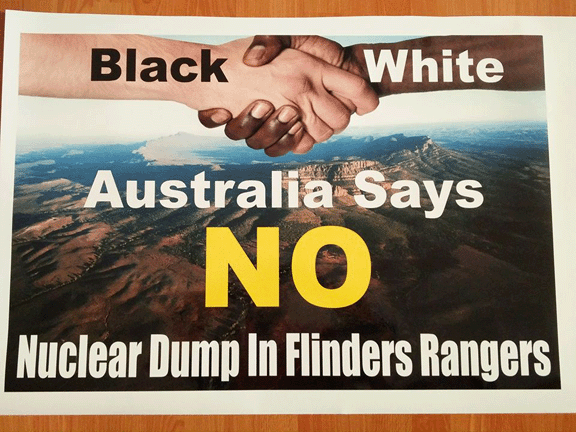
https://www.9news.com.au/national/hawker-ballot-to-close-on-nuke-waste-dump/18ef3ba3-8409-4783-a114-2652368da458#close By AAPstra6:12pm Dec 12, 2019 A community poll among residents in South Australia’s Flinders Ranges has narrowly voted against the construction of nuclear waste dump in the area.
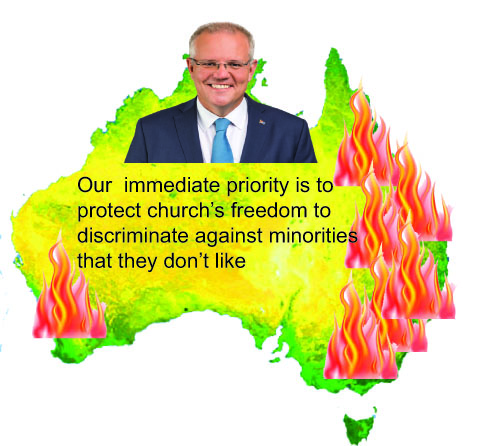
Scott Morrison and the Coalition are fiddling as Australia burns
|
Scott Morrison and the Coalition are fiddling as Australia burns On climate action, the Coalition is the party of wreck, defer and obfuscate, the party with a shameful and indefensible record, Guardian Katharine Murphy Political editor, @murpharoo, Tue 10 Dec 2019 “………… Swathes of the country are burning, and we’ve only just entered summer. While Christian Porter was working through his various concessions on religious discrimination on Tuesday, trying to contain blowback from the churches and from colleagues, dot point by dot point, thick smoke was choking Sydney. In Canberra, the heat is also blistering, and the smoke from Braidwood rolls in and out, triggering memories of that traumatic January in 2003 that many of us lived through, our treasured possessions tucked in boxes, babies on hips, sheltering friends displaced from the western suburbs of the city; a city ready to flee, watching a red sky, raining ash and burning cinders, houses on fire, trees on fire. I flew to Brisbane on Sunday. The ground below me was dust for a thousand kilometres and the sky was a milky fog of smoke and heat haze. Dear prime minister. The country is not parched but desiccated, and it is burning like a tinderbox, and people are frightened. They are frightened about today and the terrible business of defending property and saving lives, and they are frightened about whether this is what spring and summer in Australia now looks like as droughts lengthen and deepen, and the fire season extends and intensifies because of climate change – which is what scientists have been trying to tell us all these years, so many times, in so many different ways, experts maligned and mangled in a culture war, pleading to be understood. Fear has accompanied the dry, and the heat and the flames, and that is a difficult and frankly politically unwelcome development for a prime minister who won an election just a few months ago at least in part by telling people to calm down about climate change, because the Coalition had things under control. It wasn’t true of course. That pitch has no basis in fact because the Coalition has done more than any other political party in Australia to frustrate climate action. If anyone is inclined to think wrecking is behaviour of the past, a vestige of Abbottism rather than behaviour of the present, because Morrison is so much more sensible, just remember this very week, in Madrid, Australian officials are making the case we need to use an accounting loophole to meet our Paris target. Far from meeting our 2030 target in a canter, Australia will not meet the target at all unless we invoke carryover credits to carry about half the abatement load. By taking this stance, we not only defer corrective action in our own country that should be happening now, in orderly fashion over this decade, we also validate the inclination of other countries, with higher emissions than us, to hunt for workarounds too. To cut a long story short, we make it less likely that the world will deliver the ambition we need to avert the worst of warming. So let’s be very clear. On climate action, the Coalition is the party of wreck, defer and obfuscate, the party with a shameful and indefensible record, the party that only last year bundled Malcolm Turnbull out of office in part because of a policy idea that might have settled a decade of partisan warfare that the Coalition believes is helpful to its re-election prospects. Morrison pursued an electoral strategy in May of telling voters in the cities the Coalition had climate under control, there was no need for hysterics, while in the regions, out of sight of the metro campaigns, the government weaponised climate change against Labor. So the Coalition in 2019 is the party of placate where necessary and punch on where politically profitable – which feels like the grimmest story of all. It might be grim, but it will remain the model as long at there’s enough voters in enough regional seats either not buying the science, or more worried about their immediate material circumstances than the science, to swing an election in the Coalition’s favour. As long as the status quo delivers a pathway to victory, the climate war in Australia will go on being an artefact of partisan politics rather than a practical problem to be solved. It’s hard, that truth, so hard I flinch. But truth is hard, and it’s past time truth won this argument rather than being obscured in the emoting, and the bobble head ranting, and the posturing, and the dissembling, and the clever strategising. Now by carrying on resolutely while the country burns, and being seen to carry on while things are being managed, Morrison is not avoiding the issue so much as trying to set the tone. The prime minister doesn’t want to validate the rising fear in the community by looking perturbed about the disaster currently in progress, because that obviously makes a lie of the Coalition’s “everything is fine” messaging. He wants to be getting on with ordinary business in full public view, not flapping about with special summits with the premiers just because Turnbull said he should do it on Q&A. …… The obfuscation, the false comfort, the changing of the subject, the head-patting, will keep happening as long as we let it. It will keep happening as long as soft and hard denialism is enabled in mainstream media outlets, as long as journalists prioritise other lines of inquiry over rigorously pursuing accountability on this issue, and as long as Australian voters abdicate responsibility by telling themselves all political parties are as bad as each other so it doesn’t matter who you vote for. The only way things will change is if we choose, as a country, to do something else. To take responsibility. To demand something better. Because, ultimately, this, the future, is on us. https://www.theguardian.com/australia-news/2019/dec/10/australia-is-burning-like-a-tinderbox-and-the-coalition-wont-acknowledge-voters-rising-fears |
|
1 This month.

PETITION – To: Prime Minister Anthony Albanese and the Australian Labor Government
Chernobyl: The Lost Tapes – A good documentary on Chernobyl on SBS available On Demand for the next 3 weeks– https://www.sbs.com.au/ondemand/tv-program/chernobyl-the-lost-tapes/235274195556

19 May – Webinar- Webinar: No Nuclear Weapons in Australia
Start: 2026-05-19 18:00:00 UTC Canberra, Melbourne, Sydney (GMT+10:00)
End: 2026-05-19 19:30:00 UTC Canberra, Melbourne, Sydney (GMT+10:00)
20 May – Webinar – The dangerous world of AUKUS, US, military occupation and suppression of dissent

National Webinar, 20th May, 2026, 6.30pm AEST. Confronting laws restricting/suppressing protest speech and action
Speakers: Former Sen. Rex Patrick, Lawyer Nick Hanna ,Arthur Rorris ,Jorgen Doyle, Sen David Shoebbridge,
Facilitator Kelley Tranter.

of the week – Australians for War Powers Reform (AWPR)
To see nuclear-related stories in greater depth and intensity
 Antinuclear