Australia’s submarine project is dubious, as supplier France’s nuclear industry withers
 The French nuclear revolution is rusting away, December 6, 2019, THE AUSTRALIAN, Henry Ergas “……..France’s nuclear power industry faces a future that is more uncertain than ever. The problems gripping the industry were highlighted late last month in an official report prepared by the former president and chief executive of PSA Peugeot Citroen, Jean Martin Folz.
While the report’s focus is on the difficulties that have plagued the construction of a new reactor at Flamanville in northwestern France, its implications reach much further.
With nuclear power plants accounting for more than 70 per cent of its overall electricity generation, no country is as dependent on nuclear energy as is France.
The decision to rely so massively on nuclear energy was taken in 1974, after the oil shock of the previous year had underlined France’s vulnerability to Middle Eastern oil. Prime minister Pierre Messmer launched a crash program that led to the construction of 56 reactors in just 15 years.
…….. however, most of France’s generators are approaching the final decade of their useful life. Planning for their replacement has been a stop-start affair, with the Greens’ increasingly strident opposition to nuclear power deterring successive governments from taking action.
As a result, only the Flamanville plant received the go-ahead, with construction beginning in 2007 for an expected entry into service in 2012. Virtually from the outset, the project was beset by woes. At this stage, the total costs of construction are four times greater than initially estimated, while the plant will not enter service before the end of 2022.
The problems stem partly from the sheer complexity of the new reactor, which is the first of its kind to be built in France.
Additionally, the catastrophe at Fukushima in 2011 led to regulatory changes that necessitated costly redesigns. And the project has suffered more than its fair share of mismanagement, aggravated by a byzantine allocation of responsibilities between EDF, the main French electricity utility, which oversaw the project, and many layers of subcontractors.
However, as the Folz report shows, the primary cause of the difficulties lies in the erosion of the industry’s skill base during the long hiatus from the end of the crash program in 1990 to the initiation of Flamanville………
There is, at this point, no prospect of France scaling up its nuclear program ………The cost blowout at Olkiluoto drove Areva, the “national champion” of France’s nuclear industry, into bankruptcy.
Even with an injection of $7.3bn in public funds EDF, which acquired Areva, lacks the balance sheet strength to underwrite new projects, while the French government’s borrowing ability is hampered by its already too high levels of debt.
To make matters worse, the regulated prices at which EDF has to sell the power it generates mean that it cannot charge its European clients the full value of the baseload it supplies.
As for global investors, who might provide the debt financing EDF would require, they are wary of projects that are risky in themselves ….
Given those constraints, the government has announced a modest plan to eventually build six additional reactors. So far, however, there are no actionable decisions beyond the completion of Flamanville. And work on the next generation of reactors….. has been quietly downgraded, making it likely that there will no fourth generation reactor of French design.
The consequences for France itself are far-reaching. Beginning in the late 1950s, French firms succeeded in one high-technology market after the other by developing or acquiring a rather basic design (including the Westinghouse Pressurised Water Reactor, the Mirage jet fighter and the TGV high-speed train) that they upgraded while producing it on a large scale.
That era is over, and there is every sign France is struggling with almost all the major projects it has in train.
The Folz report should therefore come as an ominous warning for our submarine project, as it identifies French industry’s serious managerial and technological weaknesses in a range of areas, such as precision welding, that are crucial to that project’s success……. https://www.theaustralian.com.au/commentary/the-french-nuclear-revolution-is-rusting-away/news-story/afe4546ed799939cf117d71f05035c5e
Bushfires crisis in New South Wales, smoke pollution in Sydney, and even New Zealand
The NSW bushfire crisis has people “living in fear” with more than 100 blazes burning across the state and Sydney choking on harmful smoke pollution.
Firefighters will have a brief window over the weekend to get on top of the crisis before the weather deteriorates early next week.
The Bureau of Meteorology has painted a grim picture for the coming week, with winds forecast to whip dangerous fire grounds and no rain relief in sight. At one point on Friday there were nine fires burning at an emergency level, including the massive Gospers Mountain blaze, which has merged with neighbouring fire grounds to create a “megafire”.
Smoke from the fires was drifting to New Zealand and affecting communities there, NSW Rural Fire Service commissioner Shane Fitzsimmons said on Friday.
There were 108 fires burning in NSW on Friday afternoon, with 74 of those burning out of control.
Hazardous air pollution readings were recorded in many parts of the state, with emergency departments seeing an increase in presentations for respiratory issues…….
NSW Premier Gladys Berejiklian said residents from the South Coast up the Queensland border are “living in fear”.
“The difference now as we lead into the summer months is previously [bushfires] were pretty much confined to the northern part of NSW but what we are seeing this week is our resources stretched across the entire coastline,” she told reporters……
Fire crews have arrived from interstate as well as New Zealand and Canada, while a team from the US will arrive on Saturday.
Total fire bans will be in place on Saturday for the far north coast, New England, the northern slopes, the greater Hunter, greater Sydney, the central ranges and the nortwestern regions…… https://www.sbs.com.au/news/nsw-living-in-fear-as-bushfires-continue-to-rage
Huge bushfire North of Sydney, with conditions forecast to worsen
 Australia fires: five blazes merge north of Sydney as conditions forecast to worsen, More than 100 bushfires were burning in New South Wales on Friday, more than half of them out of control, Guardian, Ben Doherty and Helen Davidson, Fri 6 Dec 2019 Five fires burning to the north of Sydney joined up into one huge conflagration on Friday, with out-of-control blazes threatening homes and lives.On a day that brought choking smog to Sydney, the premier of New South Wales said the entire coastline of the state was on fire.
Six people have died, and more than 680 homes have already been lost to bushfires in NSW this fire season, and on Friday more than 100 fires were burning, more than half of them out of control. Eight fires have emergency warnings, which means they pose an immediate risk to lives and property.
The largest fire – a conglomeration of five blazes which have joined up north of Sydney – has burned over 335,000 hectares.
The forecast for coming days is for more hot, dry conditions. Strong winds are likely to continue to fan blazes towards towns and properties.
The NSW premier, Gladys Berejiklian, said while fires had been burning across the state for weeks, the sheer scale of the current fire threat was stretching crews’ ability to fight the blazes……..
Sydney has been choked by thick smoke for almost a week.
Hospital emergency departments have seen a 25% increase in people presenting with asthma and breathing problems, and ambulance crews are responding to between 70 and 100 call-outs a day for respiratory conditions, including to school children as young as six.
Some schools across the state have been closed because of the fire risk, while others have kept children inside because of the worsening air quality…… https://www.theguardian.com/australia-news/2019/dec/06/australia-fires-five-bushfires-merge-north-of-sydney-as-conditions-forecast-to-worsen
In reality, nuclear power is useless as a solution to global heating
The Tantalizing Nuclear Mirage, Many see nuclear power as a necessary part of any carbon-neutral mix. The reality isn’t so simple. The American Prospect, BY ALEXANDER SAMMON DECEMBER 5, 2019 “………..
If it’s going to take 10 to 15 years to see a plant through to completion, even with massive financial backing, that’s seemingly impossible to square with the 11 years to decarbonize. At the very least, we’d need hundreds, if not thousands of plants already under construction just to make a dent. Booker, Yang, and other advocates are betting that R&D might accelerate that process, but in a real sense it’s already too late.
So if new construction can’t be counted on, and the window for adding new nuclear to the fleet has already shut, what about the reactors we currently have? Has their environmental potential gotten short shrift?
 While nuclear fission emits far less carbon dioxide than energy production by oil and gas, the process of getting to that energy generation complicates nuclear’s claim to zero-carbon status. Uranium mining, processing, and transport are all carbon-intensive procedures done by diesel-powered heavy machinery. Instead of carbon, the plants themselves emit heat, often in great quantities, which can warm nearby air and water dramatically, killing fish and wildlife and afflicting neighboring habitats.
And while nuclear may maintain a cleaner sheet than fossil fuels when it comes to CO2, its record on H2O is less rosy. An American nuclear plant can require between 19 million and 1.4 billion gallons of water a day, just for purposes of cooling. Because of that implacable thirst, it’s imperative that nuclear plants are constructed near major water sources. Continue reading
Environment is downgraded, as Morrison merges government departments
Concerns for environment as Morrison merges government departments Newsline, 5 Dec 19, “……. Farmers for Climate Action spokesperson Verity Morgan-Schmidt said strong environmental policy was essential to make the agriculture sector sustainable.
“We’re failing to address climate change, which is the biggest threat to agriculture, and the concern in this merger is that ecological outcomes will be overlooked,” Ms Morgan-Schmidt said.
……. Farmers for Climate Action spokesperson Verity Morgan-Schmidt said strong environmental policy was essential to make the agriculture sector sustainable.
“We’re failing to address climate change, which is the biggest threat to agriculture, and the concern in this merger is that ecological outcomes will be overlooked,” Ms Morgan-Schmidt said.
……. Infrastructure, transport, regional development, communications and the arts will also come together in another massive new department.
Education, skills and employment will be merged in a move welcomed by vocational education advocates…….. https://www.newsline.com.au/2019/12/05/concerns-for-environment-as-morrison-merges-government-departments/
Grim summer is forecast for Murray Darling river system
“Campaigns led by irrigators and the NSW National party to derail the basin plan do not represent the interests of all communities across the basin. Governments must listen to all voices in this debate, not just the loudest and most belligerent,”
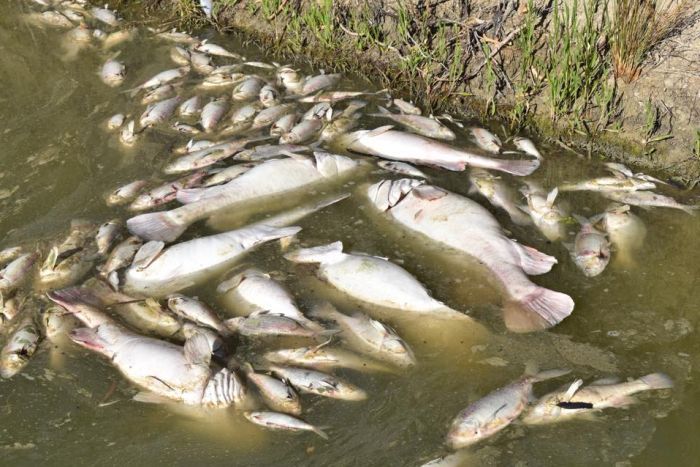
Murray-Darling authority warns of ‘dire’ summer of mass fish deaths and blue-green algae https://www.theguardian.com/australia-news/2019/dec/06/murray-darling-authority-warns-of-dire-summer-of-mass-fish-deaths-and-blue-green-algae
Alert comes as Indigenous group issues plea for states to stick with basin plan or risk marginalising vulnerable communities and endangering river health, Anne Davies, 6 Dec 19,
The Murray-Darling Basin Authority has warned of more mass fish deaths and blue-green algae events throughout the Murray-Darling River system as the peak group representing First Nations issued a plea for the states to stick with the plan.
The MDBA issued a communique on Friday saying the summer outlook from the Bureau of Meteorology was “dire”, and there was a greater than average chance of drier, warmer conditions and an elevated fire danger across the basin.
“We are already seeing the drying of critical aquatic refuges in the north, and water quality issues such as blue-green algae and stratification are becoming more widespread,” the MDBA said.
These were the conditions that led to mass fish deaths at Menindee in January this year.
The MDBA reiterated how important it is to use what little environmental water that remained available to protect critical habitats and maintain water quality.
It has produced a detailed water quality map that will be updated as the drought worsens. Continue reading
December 6 Energy News — geoharvey

Opinion: ¶ “We Need To Protect The Environment Like We Protect Our Economies” • In nature, everything is connected. This is equally true of a healthy environment and a healthy economy. We cannot hope to sustain life without taking care of nature. And we need healthy economies to lift people out of poverty and achieve […]
Angus Taylor escapes the House and heads for Madrid, where more fact checkers await — RenewEconomy

Taylor survives a shocking last week of parliament, but the emissions reduction minister is set to face more heat in Madrid over Australia’s lack of climate ambition. The post Angus Taylor escapes the House and heads for Madrid, where more fact checkers await appeared first on RenewEconomy.
via Angus Taylor escapes the House and heads for Madrid, where more fact checkers await — RenewEconomy
Craig Kelly wants you to burn as much fossil fuel as you can this summer — RenewEconomy

Coalition MP Craig Kelly urges attendees at oil and gas lobby group’s event to burn as much fossil fuels as they can this summer. The post Craig Kelly wants you to burn as much fossil fuel as you can this summer appeared first on RenewEconomy.
via Craig Kelly wants you to burn as much fossil fuel as you can this summer — RenewEconomy
Morrison sponsored report says reef tourism may be virtually wiped out by climate change — RenewEconomy

A Morrison-government sponsored report finds Australia’s reef tourism industry could shrink by 94% due to climate change by 2100. The post Morrison sponsored report says reef tourism may be virtually wiped out by climate change appeared first on RenewEconomy.
BHP’s plan to take yet more water for huge copper-uranium mine

https://www.melbournefoe.org.au/olympic_dam_uranium_mine_expansion1219
The federal government is inviting public comment on BHP’s proposed expansion of the Olympic Dam copper-uranium mine (ODM) until Tues. 10 Dec 2019.
BHP plans to increase extraction of precious Great Artesian Basin water to an average 50 million litres per day for the next 25 years, with likely serious adverse impacts on the unique and fragile Mound Springs ‒ which are listed as an Endangered Ecological Community and are of significant cultural importance to Aboriginal people.
Please make a brief submission to the Federal Minister for Environment. You can use our pro-forma submission and just add your name (and you can add any additional comments you like).
More information:
- Short briefing papers on the proposed Olympic Dam expansion are posted at https://nuclear.foe.org.au/olympic-dam/.
- See esp. the “Preconditions to Protect Mound Springs in Olympic Dam Expansion EIS Guidelines“.
- Detailed BHP information: See the BHP Referral at http://epbcnotices.environment.gov.au/publicnoticesreferrals/ and scroll down to Referral Number 2019/8570, dated 27 Nov. in chronological listing, or Search (use the tab “Filter by Referral Number’) for 2019/8570.
Traditional Aboriginal owners will not give up fight against planned WA uranium mine, despite legal loss
 Traditional Owners lose another fight against planned WA uranium mine, https://www.sbs.com.au/nitv/nitv-news/article/2019/08/01/traditional-owners-lose-another-fight-against-planned-wa-uranium-mine?fbclid=IwAR3fZ4v8xEAU1sPLXNPznPMbbgTM0YSa97czCEvMfQacuYNB2XTsWaOhUgo 1 Aug 19, Environmental approval for Cameco’s Yeelirrie uranium mine proposal in WA still stands after another appeal by Traditional Owners failed. Traditional Owners and the Conservation Council of WA have lost their fight against a proposed uranium mine that the Environmental Protection Authority refused to back, saying risks to subterranean fauna in the project area were too great.Former state environment minister Albert Jacob approved Cameco’s Yeelirrie mine plan in January 2017, just 16 days before the pre-election caretaker mode began. Traditional Owners lose another fight against planned WA uranium mine, https://www.sbs.com.au/nitv/nitv-news/article/2019/08/01/traditional-owners-lose-another-fight-against-planned-wa-uranium-mine?fbclid=IwAR3fZ4v8xEAU1sPLXNPznPMbbgTM0YSa97czCEvMfQacuYNB2XTsWaOhUgo 1 Aug 19, Environmental approval for Cameco’s Yeelirrie uranium mine proposal in WA still stands after another appeal by Traditional Owners failed. Traditional Owners and the Conservation Council of WA have lost their fight against a proposed uranium mine that the Environmental Protection Authority refused to back, saying risks to subterranean fauna in the project area were too great.Former state environment minister Albert Jacob approved Cameco’s Yeelirrie mine plan in January 2017, just 16 days before the pre-election caretaker mode began.
Together with members of the Tjiwarl native title group, CCWA challenged the approval in the Supreme Court but lost, and on Wednesday had their the Court of Appeal challenge dismissed. Traditional Owner Vicki Abdullah said the native title group was disappointed, but taking the case to court had exposed problems with WA’s environmental laws. “We won’t give up – our country is too important. We will continue to fight for Yeelirrie and to change the laws, ” Ms Abdullah said. CCWA director Piers Verstegen said the judgment was appalling and demonstrated WA’s environmental laws urgently needed to be strengthened. “This case has confirmed our worst fears – that it is legally admissible for a minister to sign off on a project against the advice of the EPA and in the knowledge that it would cause the extinction of multiple species, ” he said. “We will consider options for further appeal of this decision. “The mining company can expect a long, expensive process if they want to continue pursuing plans to mine uranium at Yeelirrie.” |
|
Fatal drive for economic growth, as planet is trashed by pollution and climate change
 Don’t pursue economic growth at expense of environment – report
Europe’s environmental watchdog gives warning as climate crisis continues, Guardian, Fiona Harvey 4 Dec 19, in Madrid Pursuing economic growth at the expense of the environment is no longer an option as Europe faces “unprecedented” challenges from climate chaos, pollution, biodiversity loss and the overconsumption of natural resources, according to a report from Europe’s environmental watchdog.
Europe was reaching the limits of what could be achieved by gradual means, by making efficiencies and small cuts to greenhouse gas emissions, with “transformational” change now necessary to stave off the impacts of global heating and environmental collapse, warned Hans Bruyninckx, executive director of the European Environment Agency…..
The EEA scored 35 key measures of environmental health, from greenhouse gases and air pollution, waste management and climate change to soil condition and birds and butterfly species, and found only six in which Europe was performing adequately.
“Incremental changes have resulted in progress in some areas but not nearly enough to meet our long-term goals,” said Bruyninckx. Further marginal changes would grow only more expensive, he predicted, making large-scale change necessary. “We already have the knowledge, technologies and tools we need to make key production and consumption systems such as food, mobility and energy sustainable.”
Wholesale changes could include banning internal combustion engines and scaling up public transport, abandoning fossil fuels in favour of 100% renewable energy, stipulating that products must be designed and manufactured to create no waste, and changes to our diets and agricultural production. Environmental goals could not be seen as separate to or lesser than economic goals, and accepting environmental damage as an inevitable cost would lead to ecological collapse, Bruyninckx warned.
The old system – of “continuing to promote economic growth and seeking to manage the environmental and social impacts” – would not deliver the EU’s long-term vision of “living well, within the limits of the planet”, the report warned.
The report, known as European Environment – State and Outlook (SOER), is a comprehensive study produced every five years and details the health or otherwise of all natural systems across EU member states and others including Norway, Switzerland and Turkey. The 2020 edition was brought forward to inform the incoming European commission as they discuss a promised “green new deal”, and for delegates at COP25, the UN conference on climate change currently taking place in Madrid.
There has been little improvement since the last report in 2015, despite promises, policies and targets, according to SOER 2020. Fewer than a quarter of protected species and only 16% of habitats are in a good state of conservation. Reduced pollution has improved water quality, but Europe will miss by a long way its goal of having a “good” rating for all water bodies by 2020. Though air quality has improved, about a fifth of the urban population live in areas where concentrations of pollutants exceed at least one EU air quality standard, and 62% of ecosystems are exposed to excessive nitrogen levels.
Global heating has added to the risks to health……https://www.theguardian.com/environment/2019/dec/04/dont-pursue-economic-growth-at-expense-of-environment-report
Paducah, Kentucky – severe nuclear waste problem exacerbated by climate change
 “I never said a bad thing about the plant the whole time
  I was growing up,” Lamb said. “It made the economy good. But then we got sick.”
“People who were not highly educated could make really good money working in these industries
“Not only that but the government was saying, this is your patriotic duty. We need this. So everybody just went along because the compensation was pretty good.”
a GAO report released in November showed that 60 percent of U.S. Superfund sites are at risk from the impacts of climate change.
Instead of focusing on cleanup plans, some state lawmakers and federal agencies are loosening regulations on hazardous sites…… Last year, the DOE also moved to relax restrictions on the disposal and abandonment of radioactive waste
|
Nuclear waste in Paducah, Kentucky poses extra threat to region facing historic flooding, Scalawag, Austyn Gaffney, 4 Nov 19, “…….. the 750-acre Paducah Gaseous Diffusion Plant. Built in a horseshoe bend of the Ohio River, the plant was the last uranium enrichment facility for nuclear fuel and weaponry in the U.S. before it shuttered its 50-year operation in 2013. It turned a solid — uranium — into a gas called uranium hexafluoride, or UF-6, which was then shipped off to facilities like Oak Ridge in Tennessee (infamous for its role in the Manhattan Project). Due to the presence of hazardous and radioactive wastes contaminating soil, groundwater and surface water, the Environmental Protection Agency added the plant to its Superfund National Priorities List in 1994. …….. For over half a century, the plant was Paducah’s main employer, providing up to 7,000 jobs in a place where nearly a quarter of people now live in poverty. But poor working conditions and unregulated waste disposal also harmed Paducah residents. The legacy of these problems have cost the town and taxpayers. Despite multiple recommendations from a watchdog government agency, the Department of Energy is decades behind schedule on cleanup efforts.
Some experts say the federal government doesn’t know the full cost or scope of what cleaning them up will entail, and that becomes more complicated with more frequent extreme weather. It’s a problem Superfund sites — and especially nuclear waste sites — around the country face. Continue reading
|
Research finds that climate modals have accurately predicted global heating
 Climate models have accurately predicted global heating, study finds
Findings confirm reliability of projections of temperature changes over last 50 years, Guardian, Dana Nuccitelli, Thu 5 Dec 2019 Climate models have accurately predicted global heating for the past 50 years, a study has found.The findings confirm that since as early as 1970, climate scientists have had a solid fundamental understanding of the Earth’s climate system and the ability to project how it will respond to continued increases in the greenhouse effect. Since climate models have accurately anticipated global temperature changes so far, we can expect projections of future warming to be reliable as well.
The research examines the accuracy of 17 models published over the past five decades, beginning with a 1970 study and including 1981 and 1988 models led by James Hansen, the former Nasa climatologist who testified to the US Senate in 1988 about the impacts of anthropogenic global heating. The study also includes the first four reports by the UN’s intergovernmental panel on climate change (IPCC).
“We found that climate models – even those published back in the 1970s – did remarkably well, with 14 out of the 17 model projections indistinguishable from what actually occurred,” said Zeke Hausfather, of the University of California, Berkeley, and lead author of the paper.
Based on modern climate model projections, if countries follow through with current and pledged climate policies, the world is on track for about 3C of warming above pre-industrial temperatures by 2100 – a situation the IPCC and others predict would be catastrophic…….
Based on modern climate model projections, if countries follow through with current and pledged climate policies, the world is on track for about 3C of warming above pre-industrial temperatures by 2100 – a situation the IPCC and others predict would be catastrophic. https://www.theguardian.com/environment/2019/dec/04/climate-models-have-accurately-predicted-global-heating-study-finds
1 This month.


PETITION – To: Prime Minister Anthony Albanese and the Australian Labor Government
Chernobyl: The Lost Tapes – A good documentary on Chernobyl on SBS available On Demand for the next 3 weeks– https://www.sbs.com.au/ondemand/tv-program/chernobyl-the-lost-tapes/235274195556

19 May – Webinar- Webinar: No Nuclear Weapons in Australia
Start: 2026-05-19 18:00:00 UTC Canberra, Melbourne, Sydney (GMT+10:00)
End: 2026-05-19 19:30:00 UTC Canberra, Melbourne, Sydney (GMT+10:00)
20 May – Webinar – The dangerous world of AUKUS, US, military occupation and suppression of dissent

National Webinar, 20th May, 2026, 6.30pm AEST. Confronting laws restricting/suppressing protest speech and action
Speakers: Former Sen. Rex Patrick, Lawyer Nick Hanna ,Arthur Rorris ,Jorgen Doyle, Sen David Shoebbridge,
Facilitator Kelley Tranter.

of the week – Australians for War Powers Reform (AWPR)
To see nuclear-related stories in greater depth and intensity
 Antinuclear