Week to 30 September- countering the nuclear-military-industrial-political spin

Some bits of good news.
– Women Wage Peace . Countries’ climate obligations could be legally defined at top UN court in December.Vertical Greening Brings Nature to Urban ‘Heat Islands’ Quickly and Easily.
TOP STORIES. How civilisation could end – an all-too-possible nuclear scenario.
The Israeli nuclear risk no one is talking about.
Cold War II: US Congress passes 25 anti-China laws in 1 week, funds propaganda campaign. https://www.youtube.com/watch?v=Tix5L5qDaNw
Ukraine’s Zelensky arriving in US….to pitch WWIII.
The Madness of Antony Blinken. Antony Blinken LIED?! State Dept Caught WITHHOLDING Humanitarian Aid From Gaza https://www.youtube.com/watch?v=hb30Sn6WR-s
Nuclear finance will rely on consumers’ stomach for risk. ALSO AT …… https://nuclear-news.net/2024/09/27/2-a-nuclear-finance-will-rely-on-consumers-stomach-for-risk/
From the archives. Questions still remain on the suspicious death of nuclear worker Karen SilkwoodWeek to 30 September.
Climate. Green campaigners lambast UN climate summit hosts for clinging to fossil fuels .
Noel’s notes. Hurricane Helene : when global heating collides with our dependence on digital systems. I would rather have tough-guy macho men, than slimy sweet-talk hypocrites.
***************************************
AUSTRALIA.
Defence Minister Marles, with all pretension, flogging a dead seahorse.
Nuclear Concerns – Hiroshima, Maralinga and Dutton’s Australia.
Climate Change Authority head Matt Kean contradicts Peter Dutton’s claim on nuclear and renewables working together.
Australians are installing batteries at a record rate, as rooftop solar heads for major new milestone. Renewable and Energy storage jobs will soon overtake those in coal and gas.
More Australian news headlines at https://antinuclear.net/2024/09/24/australian-nuclear-news-headlines-23-30-september/
***************************************
NUCLEAR ITEMS
ATROCITIES. Israel’s Tally of War Crimes in Lebanon Increases in Wake of Exploding Pagers.
CLIMATE.
Hurricane Helene Floods Closed Duke Nuclear Plant in Florida.
ECONOMICS. Nuclear fuel costs soar as conversion and enrichment bottleneck strains supply.
US company eliminated from race to build Britain’s first mini-nuclear. ALSO AT https://nuclear-news.net/2024/09/29/2-b1-us-company-eliminated-from-race-to-build-britains-first-mini-nuclear-plant/ Why NuScale Power Stock Dropped Today.
EDUCATION. “Peaceful” and war-making nuclear industries get together in tertiary education.
| ENERGY. Microsoft’s Three Mile Island deal: How big tech is snatching up nuclear power. US nuclear plants won’t power up Big Tech’s AI ambitions right away. |
| ENVIRONMENT. Charities call for greater transparency over Sizewell C. |
ETHICS and RELIGION
Cardinal Parolin: ‘World threatened by irreversible nuclear destruction’.
EVENTS. Sleepwalking into War? IPAN Conference 2024 –– October 4-6 in Perth,Australia or attend online The Independent and Peaceful Australia Network.
| HUMAN RIGHTS. Assange to Testify at Council of Europe. |
MEDIA. Losing The Narrative War: Israel Illegally Raids and Shuts Down Al Jazeera’s West Bank Bureau. Going From “The Civilian Buildings Are Hamas” To “The Civilian Buildings Are Hezbollah“. The Looming Catastrophe in the Middle East (w/ Gideon Levy) | The Chris Hedges Report.
PLUTONIUM. Japan and 11 other countries call for early start of fissile material ban talks.
POLITICS. A push for compensation for U.S. nuclear testing fallout resumes on Capitol Hill. . Mistaking Militarism for Statecraft, Empire for Democracy and Debt for Prosperity.
Nuclear Weapons and the U.S. Presidential Elections.
Weatherwatch: UK Labour’s stance on nuclear power is worryingly familiar. Scottish National Party blasts Labour for ‘frittering away’ money on nuclear plant instead of winter fuel payment.
POLITICS INTERNATIONAL and DIPLOMACY.
- Iran ready for nuclear talks at UN ‘if other parties willing‘, foreign minister says.
- Walking a fraying nuclear tightrope. The UN won’t protect Gaza, but can adopt a ‘Pact for the Future?’. Biden would rather defend Israeli impunity than stop a regional war.
- Julian Assange’s Interview with the Late Hezbollah Leader Hassan Nasrallah – https://www.youtube.com/watch?v=3M1fHfKenTM
- Public scrutiny of UK-US nuclear pact is essential.
- Indonesia, Solomon Islands join countries banning nuclear weapons, putting Australia at odds with neighbours
SAFETY.
- IAEA chief says situation tense around Russia’s Kursk plant, but no permanent mission planned.
- Swarm of over 100 earthquakes hits Hanford nuclear site near Tri-Cities in Washington.
- U.S. Outgoing French nuclear safety chief warns of 25% budget cut.
- Incident. China’s Newest Nuclear Submarine Sank, Setting Back Its Military Modernization.
SECRETS and LIES
Blinken Lied To Congress About Israeli War Crimes Because He Knows He’ll Get Away With It. https://www.youtube.com/watch?v=AYEBm0eKuo0
Karen Silkwood and Kerr-McGee: A Reinvestigation.
SPACE. EXPLORATION, WEAPONS. NASA’s uncrewed Artemis mission highlights radiation risk to astronauts.
Woomera Manual: International Law Meets Military Space Activities.
WASTES. Despite vastly different social and political contexts, Finland, Germany and France are all grappling with the question of safe nuclear waste disposal.
Spent nuclear fuel shipped to Japan’s 1st interim storage facility in Aomori.
New developments at Sellafield for endless storage of ever-increasing amounts of highly radioactive spent nuclear fuel.
WAR and CONFLICT. After destroying Ukraine and Gaza, Biden seeks a destroyed nation trifecta in Lebanon.
The Illusion of a Solution: Killing Hassan Nasrallah. Netanyahu: Israel Is Fighting a War on Seven Fronts . Israel: ‘Escalate to De-escalate’.
Putin outlines new rules for Russian use of vast nuclear arsenal. Ukraine army attacks nuclear plant substation: Russia.
Ambassadors called upon to refrain from military action involving nuclear plants. Wars, Propaganda Wars and Funding Them.
WEAPONS and WEAPONS SALES. US Gives Israel $8.7 Billion in Military Aid for Operations in Gaza and Lebanon. War Forever, Everywhere, War Doesn’t End When It “Ends“.
Japan’s new Prime Minister calls for deployment of US nuclear weapons.
‘Cheaper with nuclear’: What will Dutton’s nuclear plan really cost?

The Age, Mike Foley, September 27, 2024
Opposition Leader Peter Dutton is refusing to release the costings of his nuclear energy policy, despite claiming a national fleet of reactors would slash power bills.
But enough work has been done by independent agencies to give us some idea of the potential price tag.
What Dutton said
“We can have cheaper, cleaner and consistent energy if we adopt nuclear power,” Dutton said last week, adding that nuclear plants did not require the thousands of kilometres of transmission lines that link renewables to the grid, and took up less space than wind and solar farms.
A Coalition government would build seven nuclear plants on the sites of existing coal plants, including two small modular reactors and five large-scale plants, and plans to have the first operating by 2037.
Dutton says residents of Ontario, Canada enjoy cheaper power prices – 18¢ a kilowatt-hour (kWh) – courtesy of the province’s eight nuclear reactors generating about 60 per cent of the electricity supply.
He told Nine’s Today program on September 20 that Ontarians were “paying one-third the cost of electricity that we are here”. In July, he said they were “paying about a quarter of the price for electricity that we are here in Australia”.
These claims are overstated.
Power prices
Victoria pays about 28¢ a kWh, NSW 33¢ and Queensland 30¢. So rather than prices being three to four times higher, they are a bit less than twice the 18¢ figure. South Australians pay more than the other states at 45¢, but still less than Dutton’s claim.
However, this comparison is questionable because Australian prices include a range of costs that Ontarians must pay on top of their kWh charge. Network charges – the cost of building, running and maintaining power poles and wires across the grid – are listed separately on Ontario’s bills and can run into hundreds of dollars a year.
Construction costs
The CSIRO’s latest energy cost report card estimated a large-scale nuclear reactor in Australia would cost $16 billion, based on the low-cost construction of plants in South Korea, and take nearly two decades to build. It calculated that cost could fall to about $8 billion per reactor as efficiencies of scale were achieved after at least five and possibly 10 reactors were built.
Britain’s Hinkley Point C plant, which was announced in 2007 with an estimated $18 billion price tag, is set to be completed 13 years late at a cost of $90 billion.
If a Dutton government built reactors in Australia, that cost would have to be repaid, which could come via consumers’ electricity bills……………………………………………………………. more https://www.theage.com.au/politics/federal/cheaper-with-nuclear-what-will-dutton-s-nuclear-plan-really-cost-20240920-p5kc8z.html
AustralianSuper ESG option invested in nuclear weapons: report.

Hannah Wootton, 1 Oct 24 https://www.afr.com/wealth/superannuation/australiansuper-esg-option-invested-in-nuclear-weapons-report-20240926-p5kdpp .
Australia’s 14 biggest superannuation funds are investing about $3.4 billion of workers’ retirement savings in nuclear weapons despite many promising to avoid controversial arms, new research shows.
Industry fund gorilla AustralianSuper alone had $1.5 billion in nuclear weapons companies, while UniSuper, Aware Super and HESTA invested more than $200 million each.
Hostplus was the only major fund on the Australian market to exclude nuclear weapons, according to the study by Quit Nukes and the Australia Institute.
It comes as members ramp up engagement with super funds over concerns about unethical or environmental investments and regulators crack down on companies making false promises to consumers about their social good.
It also follows Treasurer Jim Chalmers saying there was an opportunity for super funds to “think more strategically” about how institutional capital flows into the defence industry as part of his push last year to tap $3.9 trillion for nation building investments, which funds and experts pushed back on.
Looking at funds’ default MySuper options, which account for the bulk of their members and funds under management, the report found Aware Super was the most exposed to nuclear weapons.
About 0.91 per cent of its total funds in the option were in nuclear weapons, outstripping AustralianSuper with 0.7 per cent and UniSuper and HESTA with just under 0.5 per cent.
Nuclear weapons ‘excluded’
Quit Nukes director and report co-author Rosemary Kelly said if funds wanted to keep pace with international law, global investment norms and members’ expectations and make the best risk-adjusted financial decisions, they would exclude atomic weapons.
“Super funds are being sneaky by boasting of policies to exclude ‘controversial weapons’ but not counting nuclear weapons as ‘controversial’,” she said.
“That’s pretty hard to swallow when you consider that the United Nations now considers nuclear weapons as controversial weapons.”
The report was based on portfolio holdings at December 31, 2023, and termed nuclear weapons companies as those which have a meaningful stake in the manufacture, maintenance, detonation or development of nuclear warheads and missiles or components exclusively used in them.
AustralianSuper and Spirit Super’s ESG options invested in them to the tune of $20.1 million and $400,000 respectively, despite targeting ethical investors and promising to exclude controversial (but not nuclear) weapons.
“That was a big surprise and it’s unacceptable. People read the headlines of funds’ websites and don’t have the tools to drill down into what’s actually happening – so if a fund says it excludes controversial weapons, a normal punter would think that includes nuclear,” Dr Kelly said.
Only Hostplus excluded nuclear weapons from its MySuper offering, while nine more funds ruled out controversial weapons but not atomic ones. AustralianSuper, Brighter Super, UniSuper and Care Super did not exclude any arms.
Financial sting
Dr Kelly, who is a former Aware Super director and headed its investment committee, said super funds needed to take the long-term economic implications of nuclear war seriously given their legal obligation to always act in the best financial interests of members.
“Any nuclear war, started intentionally or by accident, will be disastrous for global financial markets. This is clearly not in anyone’s best financial interest,” she said.
Even a “limited nuclear war”, which some conflict strategists view as a tactical alternative to full nuclear war should deterrence ever be deemed necessary, involving just 250 of the 12,000-plus atomic weapons in the world would kill 120 million people outright.
It would then risk a further 2 billion lives through a nuclear famine and have significant consequences for global supply chains and manufacturing.
Modelling included in the report showed there was no meaningful change in super fund returns when nuclear weapon companies were excluded from portfolios compared to when they were included.
An Aware Super spokeswoman said the fund’s investments in nuclear were only in companies where the weapons component was “a very small part of their overall business”, and its controversial weapons policy more broadly was under review.
A HESTA spokesman said only a small portion, 0.15 per cent, of the fund’s total assets were in nuclear weapons and that Quit Nukes’ data was outdated.
But the report acknowledged the fund had reduced its holdings since the data collection and sold out of four of the five companies it had previously held in breach of its own commitment to exclude companies earning more than 5 per cent of revenue from nuclear weapons.
An AustralianSuper spokesman said the fund’s members had “diverse values, preferences and attitudes when it comes to investing”, with any exclusions and screens communicated to them on its website.
Spirit Super planned to review its ESG and nuclear weapons positions after its current merger with Care Super completed.
TODAY. Hurricane Helene : when global heating collides with our dependence on digital systems
It’s going to happen more often – extreme weather events paralysing our digital systems. We had a taste of this with the global digital outage in July.
When digital fails – analogue radio still works, and real money – coins and paper cash still work
From Thursday, 26 September Millions were without electricity as Hurricane Helene lashed parts of Florida, Georgia , Tennessee, and North Carolina. Many people in Florida were left stranded, without shelter and awaiting rescue, and without communication, even after the hurricane had swept through.
Helene then soaked the Carolinas and Tennessee with torrential rains, sending creeks and rivers over their banks and straining dams. Western North Carolina was isolated because of landslides and flooding that closed the Interstate 40 and other roads. Additional heavy rains are likely across portions of the Central Appalachians,
At least 88 people died, and hundreds, perhaps thousands, have been made homeless. Business, education, all organisations and services are disrupted.
If there’s one thing that Americans are good at, it’s helping each other out in times of crisis. And there have been so much on-the ground help from neighbours, and heroic rescues.
But to add to the suffering, is the dreadful loneliness of people in need, but cut off from all communication – no TV, no Internet, no email, no mobile phone, – electricity being cut off, and mobile phone towers downed.
By Sunday, more than 2.1 million customers remained without electricity across several states. Apart from those desperate cases of need, there would be so many situations, even where businesses, shops were safe – but could not function, because of digital systems not working.
IIt’s not surprising that the tech squillionaires have been rather silent about this, because they like their technology to be in charge of everything
After all – people are so resilient – with repairs swinging into action, and everything digital will be back in function – soon. All can use their apps, their mobile phones, their credit cards
Until next time.
Sleepwalking into War? IPAN Conference 2024 –– October 4-6 in Perth or attend online
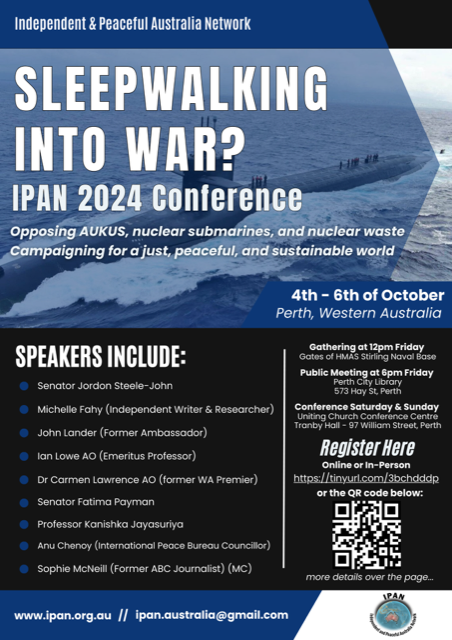
- Opposing AUKUS, nuclear submarines and nuclear waste
- Campaigning for a just, peaceful and sustainable world
Perth October 4th – 6th, 2024 https://ipan.org.au/event/ipan-conference-2024-sleepwalking-into-war/
Australian nuclear news Oct 1 -7.

Headlines as they come in:
- Dutton’s nuclear remarks spark calls for clarity on Queensland LNP’s energy plan
- At last, Dutton spells out his nuclear power play – 12 more years of coal (if it lasts)
- On the contrary, Mr Dutton, nuclear generated electricity is not “emissions free”.
- What nuclear power in the United States tells us about the Coalition’s controversial energy policy
- Hey Australia, Ontario is no model for energy and climate policy.
- Dutton at odds with Queensland LNP over nuclear plans
- If Peter Dutton has a better understanding of the cost of building nuclear, then let’s see it.
- AustralianSuper ESG option invested in nuclear weapons: report ALSO at https://antinuclear.net/2024/10/01/1-australiansuper-esg-option-invested-in-nuclear-weapons-report/.
- Big Super is still investing in nuclear weapons: report.
- Lawmakers to Investigate Faulty Sub, Carrier Welding at Newport News Shipbuilding.
- ‘Cheaper with nuclear’: What will Dutton’s nuclear plan really cost?
Indonesia, Solomon Islands join countries banning nuclear weapons, putting Australia at odds with neighbours
ABC, By Lachlan Bennett and Erwin Renaldi, 29 Sept 24.
Indonesia, a country of 275 million and one of Australia’s closest neighbours, is stepping up efforts to enforce a global ban on nuclear weapons.
This week, it officially joined the United Nations Treaty on the Prohibition of Nuclear Weapons — confirming its ratification of the pact along with Solomon Islands and Sierra Leone.
Indonesia’s Ministry of Foreign Affairs said in a statement it would put “moral and political pressure on nuclear weapon states to stop their development”.
The treaty, which came into force in 2021, now boasts almost 100 signatories.
But it has thus far failed to secure Australia or the big nuclear powers: China, the US, Russia, India, the UK and France.
Amid rising tensions in the Asia-Pacific, many smaller nations want the bomb banned before it’s too late.
Why hasn’t Australia signed the new prohibition treaty?
Australia has a long history of supporting anti-nuclear weapons initiatives.
This includes helping to establish the 1996 Comprehensive Nuclear Test Ban Treaty and the 2010 Non-Proliferation and Disarmament Initiative.
Most importantly, Australia’s efforts are underpinned by the Treaty on the Non-Proliferation of Nuclear Weapons — which it signed in 1970.
That treaty has 191 signatories, more than any other arms disarmament agreement in history, and has overseen a decline in global stockpiles and countries including South Africa and Ukraine agreeing to relinquish their arsenals.
But international relations lecturer Muhadi Sugiono, from Gadjah Mada University in Indonesia, said non-proliferation alone had failed to force nuclear powers to abandon their weapons programs.
“It is impossible, in fact, to expect the Non-Proliferation of Nuclear Weapons Treaty will achieve this goal,” he said.
“There is no legal framework which demands them to do so.”………………………………………………………………………
Is Australia really serious about banning nukes?
Despite Australia’s strong anti-nuclear activities, its alliance and reliance on nuclear superpower the US has raised eyebrows among advocates.
Dr Sugiono said Indonesian authorities recognised Australia’s “very, very strong” opposition to nuclear proliferation.
“But at the same time, the position is very ambiguous because Australia is very close to the US,” he said.
These concerns were brought into focus during a Senate hearing in 2023, when the Defence Department was grilled about Australia’s commitment to the South Pacific Nuclear Free Zone.
That treaty prohibits the stationing of nuclear explosives on Australian territory.
However, the United States’ policy of “neither confirming or denying” the presence of its weapons raised suspicions about what might be onboard visiting US aircraft…………………………………………………..
University of Sydney international relations professor Justin Hastings said that explains why most signatories of the new prohibition treaty were “non-aligned states” — in other words, countries that are neither allied with Western powers or their strategic rivals like China and Russia.
“Australia and many other countries want to have their cake and eat it too,” he said.
“They don’t have nuclear weapons, but they do want to benefit from the extended deterrence that comes from other countries having nuclear weapons.”
What does AUKUS have to do with it?
The optics were further clouded by the signing of the AUKUS defence pact with the US and UK, even though it will bring nuclear-powered submarines and not nuclear weapons to Australian shores.
The Indonesian government said it was blindsided by the announcement, forcing Australian diplomats to rush to calm the anxieties in South-East Asia and emphasise that Australia has no desire to obtain nuclear weapons.
International Campaign to Abolish Nuclear Weapons coordinator Tim Wright said signing the prohibition treaty would help Australia allay the concerns of its Pacific neighbours and “create additional guardrails against nuclear weapons”.
And Australia wouldn’t have to end its alliance with the US, given other allies like the Philippines have already signed.
“There would clearly be issues that arise in relation to the alliance that would need to be dealt with,” Mr Wright said.
“But there are precedents that we can point to that suggests that this wouldn’t spell an end to the alliance, as some people have feared.”
Why is there a new treaty, when we’ve already got one?
The prohibition treaty is designed to work in conjunction with existing non-proliferation agreements and fill a “legal gap” to ensure nuclear nations eliminate their weapons……………………………………………………
The new treaty also contains provisions to people and places impacted by nuclear testing, such as the Pacific, which saw hundreds of bombs denoted over several decades.
“It’s not just a treaty about disarmament, it’s also a treaty for nuclear justice,” Mr Wright said.
“There’s a real strong sense of regional solidarity in advancing disarmament, this understanding that people in the region have suffered.”
So what does this mean for Australia’s relations in the region?…………………………………. https://www.abc.net.au/news/2024-09-29/indonesia-ratifying-nuclear-pact-what-it-means-for-australia/104401610—
In the Woomera Manual, International Law Meets Military Space Activities
by David A. Koplow, September 12, 2024, https://www.justsecurity.org/100043/woomera-manual-international-law-military-space/
The law of outer space, like so much else about the exoatmospheric realm, is under stress. The prodigious growth in private-sector space activities (exemplified by SpaceX’s proliferating Starlink constellation, and other corporations following only shortly behind) is matched by an ominous surge in military space activities – most vividly, the creation of the U.S. Space Force and counterpart combat entities in rival States, the threat of Russia placing a nuclear weapon in orbit, and China and others continuing to experiment with anti-satellite weapons and potential techniques. The world is on the precipice of several new types of space races, as countries and companies bid for first-mover advantages in the highest of high ground.
The law of outer space, in contrast, is old, incomplete, and untested. A family of foundational treaties dating to the 1960s and 1970s retains vitality, but provides only partial guidance. Space is decidedly not a “law-free zone,” but many of the necessary guard rails are obscure, and few analysts or operators have ventured into this sector.
A new treatise, the Woomera Manual on the International Law of Military Space Activities and Operations, has just been published by Oxford University Press to provide the first comprehensive, detailed analysis of the existing legal regime of space. As one of the editors of the Manual, I can testify to the long, winding, and arduous – but fascinating – journey to produce it, and the hope that it will provide much-needed clarity and precision about this fast-moving legal domain.
Military Manuals
This Manual follows a grand tradition of prior efforts to articulate the applicable international military law in contested realms, including the 1994 San Remo Manual on Naval Warfare, Harvard’s 2013 Humanitarian Policy and Conflict Research Manual on Air and Missile Warfare, and the 2013 and 2017 Tallinn Manuals on Cyber Operations. The Woomera Manual was produced by a diverse team of legal and technical experts drawn from academia, practice, government, and other sectors in several countries (all acting in their personal capacities, not as representatives of their home governments or organizations). The process consumed six years (slowed considerably by the Covid-19 pandemic, which arrested the sequence of face-to-face drafting sessions).
The Manual is co-sponsored by four universities, among other participants: the University of Nebraska College of Law (home of Professor Jack Beard, the editor-in-chief), the University of Adelaide (with Professor Dale Stephens on the editorial board), the University of New South Wales—Canberra, and the University of Exeter (U.K.) The name “Woomera” was chosen in recognition of the small town of Woomera, South Australia, which was the site of the country’s first space missions, and in acknowledgement of the Aboriginal word for a remarkable spear-throwing device that enables greater accuracy and distance.
Comprehensive Coverage of a Broad Field
Three features of the Woomera Manual stand out. The first is the comprehensive nature of the undertaking. The Manual presents 48 rules, spanning the three critical time frames: ordinary peace time, periods of tension and crisis, and during an armed conflict. There may be a natural tendency to focus on that last frame, given the high stakes and the inherent drama of warfare, but the editors were keen to address the full spectrum, devoting due attention and analysis to the background rules that apply both to quotidian military space activities and to everyone else in space.
Complicating the legal analysis is the fragmentation of the international legal regime. In addition to “general” international law – which article III of the Outer Space Treaty declares is fully applicable in space – two “special” areas of law are implicated here. One, the law of armed conflict (also known as international humanitarian law) provides particularized jus in bello rules applicable between States engaged in war, including wars that begin in, or extend to, space. But the law of outer space is also recognized as another lex specialis, and it accordingly provides unique rules that supersede at least some aspects of the general international law regime. What should be done when two “special” areas of international law overlap and provide incompatible rules? The Woomera Manual is the first comprehensive effort to unravel that riddle.
The Law as It Is
A second defining characteristic of this Manual is the persistent, rigid focus on lex lata, the law as it currently is, rather than lex ferenda, the law as it may (or should) become. The authors, of course, each have their own policy preferences, and in their other works they freely opine about how the international space law regime should evolve (or be abruptly changed) to accommodate modern dangers and opportunities. But in this Manual, they have focused exclusively on describing the current legal structure, concentrating on treaties, customary international law, and other indicia of State practice. This is not the sort of manual in which the assembled experts “vote” on their competing concepts of the legal regime; instead, Woomera addresses what States (the sources and subjects of international law) say, do, and write. The authors have assembled a monumental library of State behaviors (including words as well as deeds, and silences as well as public pronouncements), while recognizing that diplomacy (and national security classification restrictions) often impede States explaining exactly why they did, or did not, act in a particular way in response to some other State’s provocations.
One feature that enormously facilitated the work on the Manual was a phase of “State engagement.” In early 2022, the Ministries of Foreign Affairs and Defense of the government of the Netherlands circulated a preliminary draft of the Woomera Manual to interested national governments and invited them to a June 2022 conference in The Hague to discuss it. Remarkably, two dozen of the States most active in space attended, providing two days of sustained, thoughtful, constructive commentary. The States were not asked to “approve” the document, but their input was enormously valuable (and resulted in an additional several months of painstaking work in finalizing the manuscript, as the editors scrambled to take into account the States’ voluminous comments and the new information they provided).
Space as a Dynamic Domain
Third, a manual on space law must acknowledge the rapidly-changing nature and scope of human activities in this environment, and the great likelihood that even more dramatic alterations are likely in the future. Existing patterns of behavior may alter abruptly, as new technologies and new economic opportunities emerge. The Manual attempts to peer into the future, addressing plausible scenarios that might foreseeably arise, but it resists the temptation to play with far-distant “Star Wars” fantasies.
The unfortunate reality here is that although the early years of the Space Age were remarkably productive for space law, the process stultified shortly thereafter. Within only a decade after Sputnik’s first orbit, the world had negotiated and put into place the 1967 Outer Space Treaty, which still provides the cardinal principles guiding space operations today. And within only another decade, three additional widely-accepted treaties were crafted: the 1968 astronaut Rescue Agreement, the 1971 Liability Convention, and the 1975 Registration Convention, as well as the 1979 Moon Convention (which has not attracted nearly the same level of global support and participation). But the articulation of additional necessary increments of international space law has been constipated since then – no new multilateral space-specific treaties have been implemented in the past four decades, and none is on the horizon today.
Sources and Shortcomings of International Space Law
The corpus of international space law is not obsolete, but it is under-developed. We have the essential principles and some of the specific corollaries, but we are lacking the detailed infrastructure that would completely flesh out all those general principles. Some important guidance may, however, be found in State practice, including the understudied negotiating history of the framework treaties for space law, particularly the Outer Space Treaty. The Manual provides important insights in this area, notably with respect to several ambiguous terms embedded in the treaties.
The authors of the Woomera Manual, therefore, were able to start their legal analysis with the framework treaties – unlike, for example, the authors of the Tallinn Manuals, covering international law applicable to cyber warfare, who had to begin without such a structured starting point. Still, the Woomera analysis confronted numerous lacunae, where the existing law and practice leave puzzling gaps. The persistent failure of the usual law-making institutions to craft additional increments of space arms control is all the more alarming as the United States, NATO, and others have declared space to be an operational or war-fighting domain.
Conclusion
It is hoped that the process of articulating the existing rules – and identifying the interstices between them – can provide useful day-to-day guidance for space law practitioners in government, academia, non-governmental organizations, the private sector, and elsewhere. The prospect of arms races and armed conflict in space unfortunately appears to be growing, and clarity about the prevailing rules has never been more important. It is a fascinating, dynamic, and fraught field.
Marles, with all pretension, flogging a dead seahorse

By Paul Keating, Sep 28, 2024, https://johnmenadue.com/marles-with-all-pretention-flogging-a-dead-seahorse/
Richard Marles and his mate, the US defence secretary, are beginning to wilt under the weight of sustained comment in Australia critical of the AUKUS arrangement.
Marles, unable to sustain a cogent argument himself, has his US friend propping him up in London to throw a 10,000-mile punch at me – and as usual, failing to materially respond to legitimate and particular criticisms made of the AUKUS arrangement.
The US Defence Secretary, Lloyd Austin, claims AUKUS would not compromise Australia’s ability to decide its own sovereign defence issues, a claim made earlier by Richard Marles and the prime minister.
But this would only be true until the prime minister and Marles got their phone call from the president, seeking to mobilise Australian military assets – wherein, both would click their heels in alacrity and agreement. The rest of us would read about it in some self-serving media statement afterwards. As my colleague, Gareth Evans, recently put it, “it defies credibility that Washington will ever go ahead with the sale of Virginias to us in the absence of an understanding that they will join the US in any fight in which it chooses to engage anywhere in our region, particularly over Taiwan”.
In London, Marles claimed that the logic behind AUKUS matched my policy as prime minister, in committing to the Collins class submarine program. This is completely untrue.
The Collins class submarine, at 3,400 tonnes, was designed specifically for the defence of Australia – in the shallow waters off the Australian continental shelf.
The US Virginia class boats at 10,000 tonnes, are attack submarines designed to stay and stand on far away station, in this case, principally to wait and sink Chinese nuclear weapon submarines as they exit the Chinese coast.
At 10,000 tonnes, the Virginias are too large for the shallow waters of the Australian coast – their facility is not in the defence of Australia, rather, it is to use their distance and stand-off capability to sink Chinese submarines. They are attack-class boats.
When Marles wilfully says “AUKUS matches the Collins class logic” during the Keating government years, he knows that statement to be utterly untrue. Factually untrue. The Collins is and was a “defensive” submarine – designed to keep an enemy off the Australian coast. It was never designed to operate as far away as China or to sit and lie in wait for submarine conquests.
And as Evans also recently made clear, eight Virginia class boats delivered in the 2040s-50s would only ever see two submarines at sea at any one time. Yet Marles argues that just two boats of this kind in the vast oceans surrounding us, materially alters our defensive capability and the military judgment of an enemy. This is argument unbecoming of any defence minister.
As I said at the National Press Club two years ago, two submarines aimed at China would be akin to throwing toothpicks at a mountain. That remains the position.
The fact is, the Albanese Government, through this program and the ambitious basing of American military forces on Australian soil, is doing nothing other than abrogating Australia’s sovereign right to command its own continent and its military forces.
Marles says “there has been demonstrable support for AUKUS within the Labor Party”. This may be true at some factionally, highly-managed national conference — like the last one — but it is utterly untrue of the Labor Party’s membership at large – which he knows.
The membership abhors AUKUS and everything that smacks of national sublimation. It does not expect these policies from a Labor Government.
Nuclear Concerns – Hiroshima, Maralinga and Dutton’s Australia
By Michele Madigan, Australian Idependent Media, 28 Sept 24
As always, on August 6th we commemorated the 1945 bombing of Hiroshima and later Nagasaki, when many lives were immediately obliterated and the lives of so many more, the Hibakusha were set on a terrifying trajectory of post bomb living.
This year’s commemoration brought back to my mind, one, I think, of the most privileged moments of my life. In 2018 in association with ICAN (International Campaign Against Nuclear Weapons) Australia, the Peace Boat – a Japan-based international NGO which promotes peace, human rights, and sustainability – docked at Adelaide’s Outer Harbour. Unsurprisingly the onshore meeting place at nearby Port Adelaide which ICAN had arranged for other interested people to gather, was packed. Circle conversations were a key part of the gathering and thus it was where I met my first Hibakusha.
I was honoured to be in a particular circle with Yalata/Maralinga Anangu including Mrs and the now late Mr Peters and the former Yalata Chairperson, the now late Ms M. Smart (OAM) Karina Lester was there as both nuclear survivor, Yami Lester’s daughter and Yankunytjatjara/Pitjantjatjara interpreter. The Hibakusha was a survivor from the bomb the Americans dropped on Nagasaki on August 9th 1945. Next to him sat the man who was a 2011 Fukushima survivor; then the Japanese interpreter. Then the three, perhaps middle-aged elegant Japanese women, intensely interested though presumably too young to have been direct witnesses.
Everything about being part of that circle was a sacred moment, including being in the presence of Mr Taneka Terumi who since childhood had suffered so much as one of the 100,000 Nagasaki Hibakusha. But the part that has stayed with me the most has been the image of seeing each of the Japanese lean forward in such astounded interest on hearing they were in the presence of people from Australia who were first and second generation nuclear survivors. And from a series of atomic bombs dropped on their country. Over a number of years. And by an ally.
The British nuclear tests of the 1950s and 1960s were firstly at Emu Fields and later, further south, on what has come to be known as the Maralinga Lands. Unsurprisingly, since this time many Aboriginal people in South Australia, especially from the western half of our vast state, have either suffered themselves, or have connections to those who have suffered the intergenerational effects of the fallout. Thus many continue to have the utmost suspicion of all things nuclear. Certainly this knowledge was a key trigger for the Barngarla Peoples – whose first anniversary victory over the latest proposed federal nuclear dump at Kimba we recently commemorated on August 10th.
They, like many other Australians, know that there is no safe level of ionising radiation; or to be more precise, there is no level of exposure below which there is no risk of inducing cancers.
In contrast, it’s abundantly clear in these past months, courtesy certainly of the Murdoch press, the present Opposition Leader has a fascination with things nuclear. This is despite the truth of the oft cited shorthand anti-nuclear power mantra: unnecessary, unsafe, untimely, and (eyewateringly) expensive.
On September 25th the Sydney Morning Herald, however, via reporter Nick Toscante published the warning from ‘Energy giant AGL’ to Peter Dutton on his nuclear plan:
“Power giant AGL says ‘Australia has reached a critical juncture in the renewable energy transition and has no time to waste on the Coalition’s controversial pitch to build nuclear generators’.“
Time is indeed a crucial factor and to explain this and the other crucial factors I acknowledge various resources, including Friends of the Earth’s Don’t Nuke The Climate website.
TOO SLOW: Despite the Coalition’s extremely optimistic hopes to the contrary, as well as AGL, the CSIRO and others say a nuclear power plant of any size would not be operational in Australia until well after 2040. Too Late! for our Pacific neighbours (and indeed our own Torres Strait Islanders). To quote the Hindustan Times 30/8, ‘the future is now lapping at their shores.’ For the rest of Australia, with August 31, 2024 the hottest winter day on record, waiting another 16 years is certain invitation for increasingly more fires, floods, droughts and general catastrophic disasters – of the first week of spring 2024.
UNNECESSARY: Continuous electricity generation is also known as baseload power.
The oft repeated mantra “When the sun doesn’t shine and the wind doesn’t blow…” pointing to renewables’ perceived lack of baseload power was used by previous Australian governments and other proponents to cite the perceived unreliability of renewables and hence the absolute necessity of maintaining the coal industry here – at least to fill in the gap. Seemingly (and perhaps only seemingly) under the present Opposition its allegiance has shifted to nuclear. As well, the Minerals Council is a keen promotor of gas.
However, here are the facts: already renewables currently supply about 40 per cent of the grid’s electricity, and the Albanese government is aiming to have renewables supply 82 per cent of the grid by 2030. My own state of SA is already a world leader in renewable energy achieved with solar and wind, with Renew Economy’s Giles Parkinson (July 10th article) wondering why not more credit is given to this standout achievement. Parkinson quotes SA Energy Minister Koutsantonis’ jubilant announcement that with recently secured federal funding, South Australia would achieve 100 per cent renewable electricity as early as 2027.
At present in SA alone there are four additional batteries sites being constructed.
Unsurprisingly, the transmission lines in Port Augusta that the Opposition project expects to use for their nuclear project are already nearly full from new renewables. And in contrast with the flexibility of renewables, nuclear plants cannot be turned off at short notice.
TOO EXPENSIVE: ……………………………………………
TOO DANGEROUS: …………………………….
What of the impact on our driest continent? A significant fact is surely that a single nuclear power reactor operating for a single day typically consumes 36‒65 million litres of water.
Federal Environment Minister Bowen recently released work done by the ALP re impacts of nuclear power on agriculture (water consumption, accidents risks): Joint Ministerial Statement on Nuclear Reactors on Agricultural Land. An estimated 11,955 farms are situated within 80km of the seven nuclear reactors that the Federal Opposition has proposed for construction across regional Australia.
…………………………………………So WHY? One would think that with all the negatives listed above this would be the end of the story. Why would Peter Dutton reverse the previous Opposition policy to ban nuclear power?
Friends of the Earth expert Dr Jim Green and other environmentalists reveal a key reason:
“In fact, nuclear power would slow the shift away from fossil fuels, which is why fossil-fuel funded political parties and politicians support nuclear power (e.g. the Liberal / Nationals Coalition) and why organisations such as the Minerals Council of Australia support nuclear power. As Australian economist Prof. John Quiggin notes, support for nuclear power in Australia is, in practice, support for coal.”
Finally: a frightening thing for our democracy including the power of the States is the reality that the Coalition, if it were to gain federal power, plans to set up their own Nuclear Authority. This would simply ride over any Traditional Owner concern, any community concern and perhaps most frightening of all, could simply overturn any State jurisdiction. It would seem that the only way to ensure the Opposition’s nuclear plans are given no chance to come to fruition is to ensure they do remain just that: the Opposition’s nuclear plans.
Certainly the Opposition has made it increasingly clear that it has no ambition to respect Australian’s commitment to the Paris Agreement. As Mrs Crombie, a key leader of the Kupa Piti Kungka Tjuta’s 1998-2004 successful national no nuclear dump campaign used to wonder, “Haven’t white people got grandchildren?” In 2024, Wendy Farmer, co-ordinator of the seven proposed nuclear power sites opposition communities has the same question: “Why would we do it and why would we waste the future generations?” https://theaimn.com/nuclear-concerns-hiroshima-maralinga-and-duttons-australia/
TOO IMPOSSIBLE: Just taking SMRs as one example: It seems to be of absolutely no consequence to federal Opposition members – in fact do they even know – that the Small Nuclear Reactors which they are proposing for Port Augusta SA and Muja WA do not actually yet exist? Certainly not in any OECD country.
TODAY. I would rather have tough-guy macho men, than slimy sweet-talk hypocrites


Well, I’m thinking about the big military leaders, like Austin Lloyd, the USA’s Defense Secretary. He’s no wimp . For one thing – he looks the part – he’s a big tough guy in an imposing uniform. He got lotsa medals for bravery in the invasion of Iraq . A four-star general, he was the commander of U.S. forces in Afghanistan. Then he left the military to join the weapons-making firm Raytheon. Lloyd is a strong supporter of Israel, and of Saudi Arabia. He ordered air strikes against Syria. He’s ready to wage war against Iran, when that time is “needed”. Lloyd has declared “America’s commitment to Israel’s security is ironclad. It is not negotiable. And it never will be.”
So – nobody can accuse Lloyd of weakness, of cowardice. We know where he stands – ready to lead the USA into its next war.
And as for the war in Ukraine – Austin has been an allout supporter of Ukraine, and devout American hater of Russia. BUT, he is opposed to the plan to supply Ukraine with long range attack missiles to send deep into Russia. He doesn’t see any military reason for this drastic step that would really provoke Putin. Previously, Austin rejected a plan for a no-fly zone over Ukraine. He saw it as not militarily useful and “to enforce that no-fly zone, you’ll have to engage Russian aircraft. And again, that would put us at war with Russia.”
There’s the clue – a “military reason”. Austin doesn’t mind war. It’s his business. But he’s not keen on unnecessary actions that are not useful militarily, but could bring chaos upon us. We know to be wary of belligerents like Austin, but at least there’s a certain logic in his actions.
Then we come to The case of the good-looking slim and silver-haired Antony Blinken in his lovely suits, (and he even plays the guitar). Here we have the ultimate in what a diplomat should be – well-spoken, charming, calming – just what you need for peaceful communication between nations?
Blinken struts the world stage, making motherhood statements about protecting civilians, promoting peace, human rights, and harmony – and sounding so good! All this lovely talk is a cover-up for what he is really supporting – American military hawkishness and Zionist genocide.
Blinken has consistently promoted US military interventions. During the Obama administration, Blinken pushed strongly for the overthrow of Libyan president Muammar al-Gaddafi. In the years before he became Secretary of State, Blinken co-founded and worked for the secretive WestExec Advisors firm, which lobbied the Pentagon on behalf of weapons-making companies.
In Blinken’s Senate confirmation hearing, he affirmed that he would be belligerent towards China and Venezuela. Even while he publicly supported U.S. policy for reviving a deal with Iran, he made belligerent statements against Iran.
And that is the typical Blinken way – say one thing, while promoting the opposite in action.
Blinken supports the plan for long-range missiles to be supplied to Ukraine – according to reports in the Guardian and the New York Times.
Not that I’m a fan of Lloyd Austin. Indeed, just like Blinken, Austin has made $millions from his work for weapons industries. As of October 2020, his Raytheon stock holdings were worth roughly $500,000 and his compensation, including stock, totaled $2.7 million. He was a partner in another weapons investment company Pine Island Capital, in which Antony Blinken is, or was, also involved.
Finally – my point is – I worry about the smarmy types like Antony Blinken. He is the epitome of the liars and hypocrites who cover up for governments. Ever in the media, Blinken lulls the world, including Americans, into the belief that America wants peace, that zealots like Zelensky and Netanyahu are right, that somehow – don’t worry – all will be well.
But ,worse than Lloyd Austin, Blinken doesn’t even grasp the military realities. At least Lloyd Austin doesn’t want to plunge us into World War 3 for the sake of a pointless military exercise like letting Ukraine send long range missiles to Moscow.
Memo to Dutton: It’s the final quarter, you’d better start kicking

David Crowe, Chief political correspondent, September 26, 2024
The game plan that turned Anthony Albanese from an opposition leader to a prime minister is known by a simple phrase he used for three years before he gained the top job. “I said that we had a plan: kick with the wind in the fourth quarter, outline our policies close to the election,” he said in the weeks after Labor took power.
Albanese tends not to use the phrase these days. No prime minister can tell voters they will only bother with big policies when the election comes. That is true even if it is a plain fact that Labor is working on new measures for the campaign ahead – and that changes to negative gearing may end up in the surprise package.
Peter Dutton, by contrast, lives the Albanese motto every single day. The opposition leader is holding back on every policy that would normally shape an Australian election: on the economy, the cost of living, housing and defence.
Even the glaring exception to that statement – his proposal for seven nuclear power stations – confirms the flimsiness of the Liberal policy platform. Dutton and his energy spokesman, Ted O’Brien, are incredibly coy about how this policy might work. What would it cost? How long would it take? What replaces our ageing coal-fired power stations while we wait for nuclear?
“We will release our costings in due course – at a time of our choosing,” Dutton said in a speech to a business audience on Monday. Sure, it is common for opposition leaders to reveal their full costings shortly before the election. But they tend to put their big-picture policies on the agenda well before that final stage.
Dutton is running out of time. He is acting as if the last phase of this term of parliament is still months away. In fact, the final quarter is already upon us. It started last month, assuming the election is as late as May. And Dutton is yet to prove he can kick when it counts.
Liberals make a fair point about how to judge their policies: they may not have that many, but the ones they have are big and bold. This is absolutely true of the nuclear policy. No matter how many voters were alarmed at the Labor plans for negative gearing in 2019, the prospect of a nuclear accident may frighten a few more. It is a big idea and a huge political risk.
Dutton has leapt ahead of Albanese on a few fronts. He called in May last year for a ban on advertising sports betting during game broadcasts – an idea on which federal cabinet is yet to decide. He backed an age ban on social media earlier this year, months before Labor, thanks to early work by Coalition communications spokesman David Coleman…………………………………………………………………………..
Nothing ventured, nothing gained. Dutton has the wind behind him in the opinion polls but looks reluctant to risk this good fortune by telling Australians what he would do with power. ……………………………………….
There is very little pressure on Dutton to move any faster because he has a disciplined frontbench and party room that waits for him to make the big calls on policy timing, as well as a supportive conservative media that tells him he is outsmarting Albanese at every turn. He avoids press conferences in Parliament House, so the press gallery gets relatively few opportunities to question him. He has a narrow list of preferred TV and radio spots. The media strategy spares him any exposure to long interviews that might test him on what he would do if he was running the country.
………………….. This is not proof that voters are buying what Dutton is selling, they say. After all, nobody is sure what he is selling just yet.
The Labor tacticians could be totally wrong, but the Liberals are certainly taking their time. If Dutton wants to kick with the wind in the final quarter, he will need to run a little faster. https://www.smh.com.au/politics/federal/memo-to-dutton-it-s-the-final-quarter-you-d-better-start-kicking-20240926-p5kdn5.html?fbclid=IwY2xjawFi2ChleHRuA2FlbQIxMQABHeggdYlx-0-WJO5vDD_9NYYsmgvm4WRwBII811EpOipDFB_gAdNsefsDnA_aem_h6jj8XixlRUr13A9QS0T-Q
Renewable and Energy storage jobs will soon overtake those in coal and gas
ReNewEconomy Jay Rutovitz, Chris Briggs & Eleanor Gerrard, Sep 26, 2024
The electricity workforce will need to double in five years to achieve Australia’s 2030 renewable energy target, our new report finds. More than 80% of these jobs will be in renewables. Jobs in energy storage alone will overtake domestic coal and gas jobs (not including the coal and gas export sector) in the next couple of years.
The Australian Energy Market Operator (AEMO) updates its Integrated System Plan every two years. It’s a blueprint for the energy transition from coal to renewable energy. The plan lays out scenarios for how the electricity system might change to help put in place all the elements needed to make the transition happen.
AEMO and the RACE for 2030 co-operative research centre commissioned the Institute for Sustainable Futures to undertake modelling on the workforce needed for this transition. The “step change” scenario in the Integrated System Plan is broadly aligned with the 2030 renewables target. Under this scenario, we found the electricity workforce would need to grow from 33,000 to peak at 66,000 by 2029.
Rooftop solar and batteries together are projected to account for over 40% of these jobs. Wind farms will employ around one-third and solar farms just under 10%. Jobs would also treble in transmission line construction to connect renewables in regional areas to cities and other states in the next few years.
Job growth would surge in a ‘renewable energy superpower’
In the “green energy export” scenario, Australia becomes a “renewable energy superpower”. The country uses renewable energy to export green hydrogen and power heavy industry. In this scenario, the electricity workforce would almost treble to 96,000 by the late 2020s.
By 2033, after construction peaks, more than half of electricity sector jobs will be in operations and maintenance. This applies to both the step change and green energy export scenarios………………………………………………………………………………………………………………………………………………………………………….
https://reneweconomy.com.au/energy-storage-jobs-will-soon-overtake-those-in-coal-and-gas/
Stuck on repeat: why Peter Dutton’s ‘greatest hits’ on nuclear power are worse than a broken record.

Guardian, Graham Readfearn, 26 Sept 24
So far there are no costings and no details on what type of reactors there would be, their size or who would build them.
Usually you need a few genuine releases under your belt before you start putting out “greatest hits” albums, but when it comes to spruiking nuclear this hasn’t stopped Peter Dutton.
This week, the opposition leader gave a speech that some hoped – perhaps naively – would add some more detail to the Coalition’s scant policy proposal to build nuclear reactors at seven sites around Australia.
But instead, Dutton delivered a familiar run-down of “greatest hits”; nuclear will mean cheap power, everyone else is going nuclear (so why shouldn’t we?), and renewables are unreliable (did you know, for example, and I bet you didn’t, that “solar panels don’t work at night” or that “turbines don’t turn on their own”?).
Perhaps Dutton is banking on the illusory truth effect where, regardless of the truthfulness of a statement, the more people hear it the more they’re inclined to accept it.
So far there are no costings, no details on what type of reactors or how large they will be, or who will build them. We do know Dutton wants to fund them through the taxpayer.
But let’s run through the track listing.
Renewables-only redux
Take, for example, Dutton’s claim in his speech, at the Centre for Economic Development Australia in Sydney, that Labor is pursuing a “renewables-only” policy for the electricity grid – a phrase he repeated seven times.
Just as it has been for many months, the “renewables-only” claim is false.
While it’s true Labor does want the electricity grid dominated by solar and wind, backed up by storage such as batteries and pumped hydro, the current plan also includes gas-fired power that would act as back-up if solar or wind levels dropped too low…………………………………………………………………………………………………………………………….
28,000km – again
Also getting another go on the turntable was Dutton’s claim the government’s plan would require “28,000km of new transmission lines”.
The actual figure, according to AEMO, is 10,000km – or about a third of Dutton’s claim.
Only under a scenario where Australia gets very aggressive on green energy exports, such as hydrogen, does AEMO think you might need another 10,000km or more of transmission lines.
This has been pointed out before, but, like a broken record, Dutton continues to repeat it.
The nuclear train?
In a statement that will surprise nobody, Dutton said even if the various state and federal bans on nuclear power generation were lifted “we can’t switch nuclear power on tomorrow”.
“But what we can do is ensure that Australia doesn’t miss the nuclear train,” he said.
An independent report on the status of that global “nuclear train” was published last week.
The 500-page World Nuclear Industry Status report said in 2023 a record US$623bn was invested into non-hydro renewable energy, which was “27 times the reported global investment decisions for the construction of nuclear power plants”.
As of July, the report said there were 59 reactors under construction, 10 fewer than a decade ago, with almost half being built in China. Some 23 of those reactors were behind schedule………………………… more https://www.theguardian.com/environment/commentisfree/2024/sep/26/stuck-on-repeat-why-peter-dutton-greatest-hits-on-nuclear-power-are-worse-than-a-broken-record
Dutton’s nuclear plan would mean propping up coal for at least 12 more years – and we don’t know what it would cost
Alison Reeve, Deputy Program Director, Energy and Climate Change, Grattan Institute, 25 Sept 24, https://theconversation.com/duttons-nuclear-plan-would-mean-propping-up-coal-for-at-least-12-more-years-and-we-dont-know-what-it-would-cost-239720
Opposition leader Peter Dutton has revealed the Coalition’s nuclear energy plan relies on many of Australia’s coal-fired power stations running for at least another 12 years – far beyond the time frame officials expect the ageing facilities to last.
The claim has set off a new round of speculation over the Coalition’s plans – the viability of which has already been widely questioned by energy analysts.
Dutton offered up limited detail in a speech on Monday. He also revealed the plan relies on ramping up Australia’s gas production.
It seems increasingly clear the Coalition’s nuclear policy would prolong Australia’s reliance on coal, at a time when the world is rapidly moving to cleaner sources of power.
Coal: old and tired
The Coalition wants to build nuclear reactors on the sites of closed coal plants. It says the first reactors could come online by the mid-2030s. However, independent analysis shows the earliest they could be built is the 2040s.
Now it appears the Coalition’s plan involves relying on coal to provide electricity while nuclear reactors are being built. On Monday, Dutton suggested coal-fired electricity would be available into the 2030s and ‘40s.
But this is an overly optimistic reading of coal’s trajectory. The Australian Energy Market Operator says 90% of coal-fired power in the National Electricity Market will close by 2035.
All this suggests the Coalition plans to extend the life of existing coal plants. But this is likely to cost money. Australia’s coal-fired power stations are old and unreliable – that’s why their owners want to shut them down. To keep plants open means potentially operating them at a loss, while having to invest in repairs and upgrades.
This is why coal plant owners sought, and received, payments from state governments to delay exits when the renewables rollout began falling behind schedule.
So who would wear the cost of delaying coal’s retirement? It might be energy consumers if state governments decide to recoup the costs via electricity bills. Or it could be taxpayers, through higher taxes, reduced services or increased government borrowing. In other words, we will all have to pay, just from different parts of our personal budgets.
Labor’s energy plan also relies on continued use of coal. Dutton pointed to moves by the New South Wales and Victorian governments to extend the life of coal assets in those states. For example, the NSW Labor government struck a deal with Origin to keep the Eraring coal station open for an extra two years, to 2027.
However, this is a temporary measure to keep the electricity system reliable because the renewables build is behind schedule. It is not a defining feature of the plan.
New transmission is essential under either plan
Dutton claims Labor’s renewable energy transition will require a massive upgrade to transmission infrastructure. The transmission network largely involves high-voltage lines and towers, and transformers.
He claims the Coalition can circumvent this cost by building nuclear power plants on seven sites of old coal-fired power stations, and thus use existing transmission infrastructure.
Labor’s shift to renewable energy does require new transmission infrastructure, to get electricity from far-flung wind and solar farms to towns and cities. It’s also true that building nuclear power stations at the site of former coal plants would, in theory, make use of existing transmission lines, although the owners of some of these sites have firmly declined the opportunity.
But even if the Coalition’s nuclear plan became a reality, new transmission infrastructure would be needed.
Australia’s electricity demand is set to surge in coming decades as we move to electrify our homes, transport and heavy industry. This will require upgrades to transmission infrastructure, because it will have to carry more electricity. Many areas of the network are already at capacity.
So in reality, both Labor’s and the Coalition’s policies are likely to require substantial spending on transmission.
1 This month

of the week – Australians for War Powers Reform (AWPR)
To see nuclear-related stories in greater depth and intensity
 Antinuclear