Prominent Americans to wage ‘World War Zero’ against climate change
 John Kerry Launches Star-Studded Climate Coalition, NYT, By Lisa Friedman, Nov. 30, 2019 WASHINGTON — John Kerry, the former senator and secretary of state, has formed a new bipartisan coalition of world leaders, military brass and Hollywood celebrities to push for public action to combat climate change.
The name, World War Zero, is supposed to evoke both the national security threat posed by the earth’s warming and the type of wartime mobilization that Mr. Kerry argued would be needed to stop the rise in carbon emissions before 2050.
The star-studded group is supposed to win over those skeptical of the policies that would be needed to accomplish that.
Former presidents Bill Clinton and Jimmy Carter are part of the effort. Moderate Republican lawmakers like Arnold Schwarzenegger, the former governor of California, and John Kasich, the former governor of Ohio, are on the list. Stars like Leonardo DiCaprio, Sting and Ashton Kutcher round out the roster of more than 60 founding members.
The star-studded group is supposed to win over those skeptical of the policies that would be needed to accomplish that.
Former presidents Bill Clinton and Jimmy Carter are part of the effort. Moderate Republican lawmakers like Arnold Schwarzenegger, the former governor of California, and John Kasich, the former governor of Ohio, are on the list. Stars like Leonardo DiCaprio, Sting and Ashton Kutcher round out the roster of more than 60 founding members.
“We’re going to try to reach millions of people, Americans and people in other parts of the world, in order to mobilize an army of people who are going to demand action now on climate change sufficient to meet the challenge,” Mr. Kerry said in an interview.
The launch of the new group on Sunday comes as diplomats gather in Madrid on Monday for global climate negotiations aimed at strengthening the 2015 Paris Agreement, from which President Trump has vowed to withdraw next year. Earlier this week the United Nations found that the world’s richest countries, responsible for emitting more than three-fourths of planet-warming pollution, are not doing enough to keep Earth’s temperature from rising to dangerously high levels. Net carbon emissions from the two largest polluters, the United States and China, are expanding……….. https://www.nytimes.com/2019/11/30/climate/john-kerry-climate-change.html?smid=tw-nytclimate&smtyp=cur
U.S. Government effectively boycotting COP25 climate conference
 US will ‘protect its interests’ at COP25 climate conference, No senior members of Donald Trump’s administration will attend COP25. https://www.sbs.com.au/news/us-will-protect-its-interests-at-cop25-climate-conference 2 Dec 19, The US will send a diplomatic team but no senior members of Donald Trump’s administration to a global climate change conference starting in Spain on Monday, according to a statement.However, in an effort to raise the US profile in Madrid, House speaker Nancy Pelosi will led a 15-member congressional delegation to “reaffirm the commitment of the American people to combating the climate crisis”.
The US, at Mr Trump’s direction, is withdrawing from the Paris climate accord, which set a goal of limiting global temperature rises to well within two degrees Celsius from pre-industrial levels.
Spain stepped in to host the COP25 meeting, which seeks to boost commitments to fight climate change, after Chile pulled out due to civil unrest.
“The United States will continue to participate in ongoing climate change negotiations and meetings – such as COP25 – to ensure a level playing field that protects US interests,” the US State Department said Saturday.
The US team will be headed by ambassador Marcia Bernicat, principal deputy assistant secretary of state for oceans and international environmental and scientific affairs.
Ms Pelosi, calling climate change “the existential threat of our time,” announced a delegation of Democrats drawn from both the House and the Senate, with no members of Mr Trump’s Republican party.
The president has cast the Paris climate accord as elitist and unfair to the US, saying when announcing his decision to withdraw that he was “elected to represent the citizens of Pittsburgh, not Paris”.
But scientists say the accord is vital to check the worst damage from global warming, such as increasing droughts, rising floods and intensifying storms.
The US is the world’s second biggest emitter of greenhouse gases after China, and is the only country to pull out of the Paris agreement.
The final US withdrawal from the landmark accord is scheduled for 4 November, 2020, a day after the next presidential election.
Several Democratic presidential aspirants have said that, if elected, they would immediately return to the agreement.
Public opinion: for the first time, Environment is Australians’top concern
 Environment is prime worry for the first time: poll, The Age Matt Wade Environment is prime worry for the first time: poll, The Age Matt Wade
December 2, 2019 The environment has for the first time surpassed healthcare, cost of living and the economy to be the number one concern for Australians.
The Ipsos Issues Monitor,which asks a representative sample of Australians to select the three top issues facing the nation, found 32.1 per cent rated the state of the environment among their biggest worries in November – the highest share in the decade-long history of the survey. The result follows devastating spring bushfires in NSW and Queensland and worsening drought conditions in many regional areas. These events have been widely attributed to climate change caused by global warming. The survey shows anxiety about the state of the environment has risen steadily since the middle of the decade…. https://www.theage.com.au/national/environment-is-prime-worry-for-the-first-time-poll-20191201-p53fu5.html |
|
|
Renewable South Australia posts lowest wholesale prices for second month in row — RenewEconomy

South Australia’s switch to wind and solar starts to pay off, with the renewable state posting the lowest wholesale prices in Australia’s main grid for second month in a row. The post Renewable South Australia posts lowest wholesale prices for second month in row appeared first on RenewEconomy.
via Renewable South Australia posts lowest wholesale prices for second month in row — RenewEconomy
Why is pumped hydro in Australia not used very much? — RenewEconomy

Experience with Australia’s current small fleet of pumped hydro power stations suggests a fleet of smaller projects might be a better idea than the massive Snowy 2.0 scheme. The post Why is pumped hydro in Australia not used very much? appeared first on RenewEconomy.
via Why is pumped hydro in Australia not used very much? — RenewEconomy
December 1 Energy News — geoharvey

Opinion: ¶ “In The Fight Against Climate Change, No One Can Stand On The Sidelines” • Kristalina Georgieva, managing director of the International Monetary Fund: We can avoid this bleak future, and we know what we have to do – reduce emissions, offset what cannot be reduced, and adapt to new climate realities. No individual […]
The day rooftop solar met two thirds of South Australia’s total demand — RenewEconomy

The change in South Australia’s grid continues to surprise energy experts, and is now accelerating towards its net 100 per cent renewable target. The post The day rooftop solar met two thirds of South Australia’s total demand appeared first on RenewEconomy.
via The day rooftop solar met two thirds of South Australia’s total demand — RenewEconomy
Heating & cooling to go renewable and provide demand response — RenewEconomy

ARENA has today announced $6.5 million in funding to the Australian Institute of Refrigeration, Air Conditioning and Heating (AIRAH) to develop a pathway to low emissions for the Heating, Ventilation, Air-Conditioning and Refrigeration (HVAC&R) sector. The post Heating & cooling to go renewable and provide demand response appeared first on RenewEconomy.
via Heating & cooling to go renewable and provide demand response — RenewEconomy
Australia’s emissions fall ever so slightly, but only because of drought and floods — RenewEconomy

Drought and floods drive slight fall in Australia’s emissions as Taylor denied an early pass to skip Parliament and head to Paris. The post Australia’s emissions fall ever so slightly, but only because of drought and floods appeared first on RenewEconomy.
via Australia’s emissions fall ever so slightly, but only because of drought and floods — RenewEconomy
Barnaby Joyce auctions lump of coal – in a glass jar – at Nationals dinner — RenewEconomy

Barnaby Joyce auctions lump of coal – and a “start Adani” t-shirt worn by his good mate Matt Canavan – at Nationals dinner. The post Barnaby Joyce auctions lump of coal – in a glass jar – at Nationals dinner appeared first on RenewEconomy.
via Barnaby Joyce auctions lump of coal – in a glass jar – at Nationals dinner — RenewEconomy
Australian solar PV integrated window technology gains US approval — RenewEconomy

Australian building integrated PV company ClearVue wins certification, opening up access to massive US market. The post Australian solar PV integrated window technology gains US approval appeared first on RenewEconomy.
via Australian solar PV integrated window technology gains US approval — RenewEconomy
Other states should follow NSW demand reduction scheme with PERCs and DREDs — RenewEconomy

NSW’s demand reduction scheme offers sensible and practical policies to deal with rising peak demand – an approach that should be embraced by other state governments. The post Other states should follow NSW demand reduction scheme with PERCs and DREDs appeared first on RenewEconomy.
via Other states should follow NSW demand reduction scheme with PERCs and DREDs — RenewEconomy
The nuclear industry – an unsustainable water-guzzler
Ethics of Nuclear Energy Abu-Dayyeh (P.hD) Amman – H.K. of Jordan Ayoub101@hotmail.com E_case Society (President) www.energyjo.com [Extract]
“…….4- Sustainability
Environmental Ethics is perceived as the practical dimension of ethics concerning environmental issues. It is also conceived by some as an “education for sustainability”, and “an important vehicle to transmit values, to change attitudes and to motivate commitment” (40). Therefore, sustainability is a crucial element in our moral decision over the choice of energy.
The new technologies in shale-gas extraction are expected to extend the life-time of gas reserves worldwide many folds the life span predicted for oil reserves, which are unlikely to last more than 40 years. On the other hand, uranium reserves of high concentrations (above 1000 ppm) mainly exist in Canada and Australia (41), as can be seen in Figure 2: [on original]
Therefore, considering the present consumption of uranium U3O8 per year, which stands at around 70,000 tonnes, the world reserves of around 3.5 million tonnes will not last more than 50 years. A report published in the International Journal of Green Energy in 2007 suggests that if a nuclear renaissance is expected soon, according to the myth of a nuclear renaissance which the nuclear lobbies and the IAEA are trying to promote, the uranium reserves will only be sufficient to keep the world’s nuclear reactors functioning for only 16.5 years (42). In another words, most of the reactors that are proposed now for future investment would practically be out of enriched fuel soon after they are commissioned.
The other choice out of this impasse would be to acquire fuel from reprocessing of depleted fuel and from the plutonium of nuclear warheads that has been neutralized after the cold-war. However, this industry is extremely complicated, risky and it’s environmental impact is highly controversial; two reprocessing plants had already been shut down after Fukushima, one in Japan; the Rokkasho Reprocessing Program; which economical feasibility has already been questioned by Sakurai Yoshiko and Inose Naoki. A governmental committee estimated the cost of reprocessing existing nuclear waste in Japan at 18.8 trillion yen (43); around 200 Billion US$; the second facility shut down was in the UK at Sellafield.
After the Japanese disaster at Fukushima on March 11, 2011 the maximum world capacity of fuel reprocessing at the present time has become around 20% of the total depleted fuel produced all around the world, thus causing a serious set-back; not only for providing a new source of fuel, but also to depositing depleted fuels at lower radioactive level and less segregating radioactive isotopes.
We can thus conclude that fission-fuel technology is not a sustainable source of energy for the future……
Even if the depletion of uranium is postponed much further, it remains an unsustainable source of energy per excellence, particularly if water, energy and CO2 emissions are taken into consideration as shown in Figure 3.
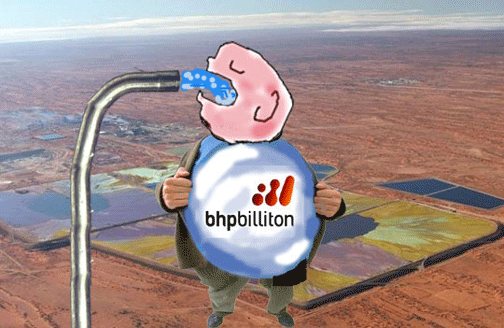
If we take the Olympic Uranium Project as an example we can see that more than 3402 KL of water is needed for each tonne of U3O8 mined, this number is more than doubled at the Beverley Mines. If we add the amount of water needed for all the by-products, such as enrichment of fuel, cooling the reactors, etc. we can say that huge amounts of water are consumed in the overall process. The poorer the grade of uranium ore is the more water is needed. The Australian Olympic and Beverly mines ore grade are around 640-1800 ppm, so we can postulate the much larger amount of clean water are needed for poorer quality, at 200 ppm or even less!
Each tonne also consumes more than 1700 GJ of energy and can emit more than 320 tonnes of CO2 for each tonne U3O8 produced. [table on original]……”
Ethics – Australia and the climate and nuclear threats
It would be funny, if it were not so serious. Australia, the continent already experiencing the effects of global heating, and with a government now contemplating starting the nuclear industry, – seems to be sleeping on, in comfortable ignorance about what is happening.
We all know – it is dinned into us daily – that it’s all about economics.( And sport). All our actions are justifiable if they can be show to further economic growth.
Who dares mention ethics?

What if decisions and actions were determined by the principle of acting decently and truthfully?
Then politicians, academics, journalists and other opinion leaders would have to speak clearly in plain words, about bushfires, the Murray Darling rivers, floods, and pollution. Then solutions would be chosen for environmental protection, and for the public good. The public good would include our Pacific neighbours, and indeed, Australia’s role in the global community.
Of course, there would be costs – changes in lifestyle, in employment, in our use of energy and other resources, in increased taxation. It would require fairness to disadvantaged groups, and to those most affected by extreme weather.
It’s about time that ETHICS came back into public thinking and action.
Australia is now led by a man who is ignorant of all but advertising and marketing slogans. Our politicians, obsessed with one aim, to keep their seats in Parliament, cannot be relied upon to understand the ethics of Australia’s situation – as the canary in the mine of climate and nuclear threats.
Still – there are thousands of Australians, especially indigenous Australians, and many groups like the Australian Conservation Foundation, and Friends of the Earth who do “get it”, and who lead the pressure on governments to really face up to these dangers.
“Intermediate Level” nuclear wastes for South Australian are really “High Level”
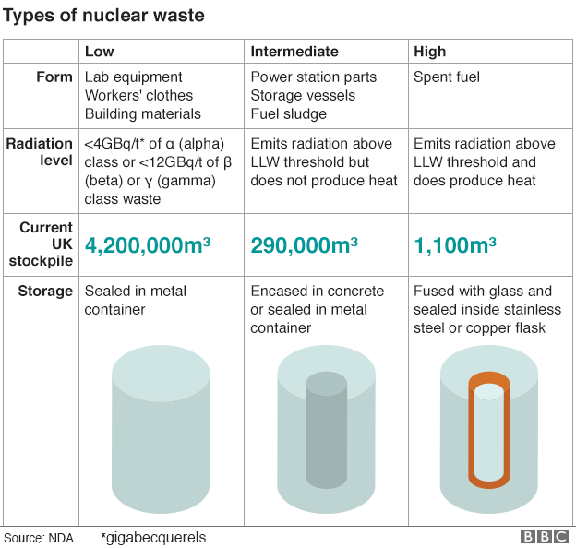
Barb Walker shared a post. Fight To Stop Nuclear Waste In The Flinders Ranges. Relaying important information at the request of Dr. Susi Andersson
Intermediate level radioactive waste (ILW) is not the gloves, masks and gowns mentioned by Alan Moskwa (Nuclear Safety (26/11/19). Australia’s intermediate level waste (ILW) includes the spent fuel elements of the HIFAR (Australia’s first) reactor, which are classified as high level waste in many other countries. In ANSTO’s words, 98% of their ILW is waste specific to the post reactor processing of uranium targets to produce Mo-99 and other radiopharmaceuticals.
Dr. S Andersson https://www.facebook.com/groups/941313402573199/
1 This month.

PETITION – To: Prime Minister Anthony Albanese and the Australian Labor Government

of the week – Australians for War Powers Reform (AWPR)
To see nuclear-related stories in greater depth and intensity
 Antinuclear