Emergency leaders say nuclear reactors pose unnecessary risk

November 27, 2024, by: The AIM Network, Emergency Leaders for Climate Action. https://theaimn.com/emergency-leaders-say-nuclear-reactors-pose-unnecessary-risk/
NUCLEAR REACTORS WOULD introduce significant and unnecessary risk to Australian communities and emergency responders, including firefighters already stretched by escalating climate fuelled disasters, warns Emergency Leaders for Climate Action (ELCA) in a submission to the parliamentary inquiry into nuclear power generation in Australia.
Greg Mullins, speaking on behalf of 38 former fire and emergency service chiefs from across Australia said: “Our firefighters are on the frontlines of escalating climate fuelled disasters, like bushfires and floods, fuelled by climate pollution. They’re not trained or equipped to deal with nuclear emergencies that could arise from nuclear reactors or the transportation and storage of radioactive waste.”
The ELCA submission highlights that nuclear reactor emergency planning and management has not been addressed by proponents of nuclear energy and emphasises that Australian emergency services lack the experience and resources to handle potential nuclear emergencies.
“Australian emergency services would have to be built up from scratch to respond to nuclear disasters, with no costings or plans in place to achieve this. There are no fully staffed urban fire service stations near the proposed sites for nuclear reactors, and it’s neither feasible nor reasonable to expect volunteer bushfire fighters to handle such high-risk emergencies,” said Mr Mullins
“I oversaw the deployment of Australian firefighters to assist in the wake of the earthquake and tsunami that led to the Fukushima disaster, where the chaos and devastation caused by nuclear failures was stark. First responders, many of them civilian firefighters, were thrown into situations they weren’t trained for. That’s not a risk we should take in Australia, no matter how remote.
“There are no safety or environmental frameworks in place to manage the risks of nuclear reactors or to safely transport and store radioactive waste in Australia.
“Placing nuclear reactors in disaster-prone areas like Latrobe, Lithgow, Singleton, and South Burnett would add to the burden emergency services already face responding to worsening bushfires, floods, and storms.
Beyond the safety risks, former Commissioner Mullins called the proposal a “dangerous distraction” from the energy solutions Australia urgently needs right now. “Every coal-fired power station will shut down before a single watt of nuclear power can enter our system. Nuclear reactors simply cannot be built quickly to address the urgent task of slashing pollution and reducing climate disaster risks right now.
“Our communities and emergency services are bearing the brunt of worsening disasters driven by burning coal, oil and gas. We don’t have the luxury of waiting decades for new power stations, we must slash climate pollution now to protect Australians. Australia can’t afford to risk our energy security, economy and safety on a nuclear fantasy when renewables can cut pollution today and help ensure a safer future for our kids.”
About Emergency Leaders for Climate Action: We are 38 former senior Australian fire and emergency service leaders who have observed how climate change is driving increasingly catastrophic extreme weather events that are putting lives, properties and livelihoods at greater risk and overwhelming our emergency services.
Canada’s nuclear waste organisation joins forces with the Australian Radioactive Waste Agency
World Nuclear News, November 25, 2024
Canada’s Nuclear Waste Management Organization said it recently signed a
new co-operation agreement with the Australian Radioactive Waste Agency
at a ceremony in the Australian Parliament in Canberra. The NWMO and
ARWA will collaborate on a range of issues related to the safe
management of radioactive waste, including the important topic of
reconciliation with Indigenous peoples.
The NWMO said it was honored to
learn from the experiences of Aboriginal Australians and Torres Strait
Islanders during the visit and it “looks forward to a relationship of
partnership and knowledge-sharing”.
Coalition-linked nuclear expert questioned by parliament over coal industry ties

by political reporter Tom Lowrey, 22 Nov 24, https://www.abc.net.au/news/2024-11-22/coalition-nuclear-expert-questioned-coal-funding/104629770
In short:
A Labor-led committee has questioned a nuclear expert with close links to the Coalition over whether he made a potentially misleading statement to parliament over his funding for research.
Adjunct professor Stephen Wilson told a committee hearing he had not received funding from the “fossil fuel” sector, but government MPs are pointing to comments that contradict that.
What’s next?
Professor Wilson has denied that he “personally received payment from ‘fossil fuel’ companies” to fund his work looking into nuclear power.
A nuclear expert from the University of Queensland and a conservative think-tank have been questioned over possibly misleading parliament over funding for his work.
Parliamentary officials, writing on behalf of the Labor-led committee looking into nuclear power, have written to adjunct professor Stephen Wilson to clarify his ties to the coal industry.
In response to questions from the ABC, Professor Wilson said he had not “personally” received funding from the “fossil fuel” sector for his work on nuclear power.
Professor Wilson gave evidence to the inquiry last month in his capacity as a nuclear expert with the Institute of Public Affairs, a conservative think-tank.
He has been regularly cited by the Coalition as an advocate for the technology, which forms the centrepiece of the Coalition’s energy policy heading into the next election.
Professor Wilson travelled to North America with shadow energy minister Ted O’Brien on a nuclear study tour in 2023, including meetings with executives from nuclear giant Westinghouse.
He has also spoken at events with Mr O’Brien, criticising the current government’s renewables-led energy approach and talking up the potential of nuclear power.
During the evidence Professor Wilson gave to the nuclear inquiry in October, he was asked if he had “accepted donations from the fossil fuel industry to fund your research on energy”.
“No, I have not,” he replied.
n a letter sent this week, officials have pointed to comments made by Professor Wilson in a speech delivered to an IPA event in mid-2023.
In a transcript of the speech, Professor Wilson describes his work with the IPA’s energy security research program, and thanks donors for their support.
“I have taken on the challenge of working with Scott [Hargreaves] and the IPA staff, supported and encouraged by the far-sighted group of donors that Nick Jorss is bringing together,” he said.
Mr Jorss is the executive chairman of coal miner Bowen Coking Coal, and chair of lobby group Coal Australia.
The letter seeks “clarification on what appears to be contradictory information on the issue of donorship”.
The committee now questioning Professor Wilson was set up by the government in the House of Representatives to scrutinise nuclear power, which the Coalition has committed to ahead of the next election.
Professor Wilson has been cited by Opposition Leader Peter Dutton in speeches making the case for the Coalition’s proposed pivot to nuclear power.
In a speech in July last year, Mr Dutton quoted Professor Wilson calling on Australia to “prepare real options to deploy nuclear energy … in case we need them.”
The ABC contacted Professor Wilson with questions over the sources of his funding, and whether he had misled the committee.
In response, he denied having directly receiving funding from ‘fossil fuel’ sources for his work.
“I have not personally received payment from ‘fossil fuel’ companies for my research into the need for Australia to embrace carbon-free, nuclear energy,” he said.
“I have advocated strongly for years, in my own capacity, for energy policy to be developed and implemented on a rational basis.
“As an energy engineer and economist with 30 years’ experience in the economics and dynamics of energy systems around the world, and electricity and resources markets, I understand how vital it is for Australia to have energy security. Encouragingly, more and more Australians are starting to share this view.”
Week to 25 November – nuclear and related news

Some bits of good news –‘My Life Changed Completely’: How Kenya Turned Us vs. Them Into Water for All.
The global energy transition will cost a lot less than we think.
He’ll try, but Trump can’t stop the clean energy revolution.
China’s desertified land area shrinks by 65 million mu since 2012.
TOP STORIES. Trump’s Cabinet Picks Aren’t Looking Good For Peace In Ukraine. On Way Out, Reckless Biden Allows Deep Russia Strikes.
UK Sees Privatization ‘Opportunities’ in Ukraine War
Beyond one million
years: The intrinsic radiation hazard of high-level nuclear wastes.
The 1.5C Climate Goal Is Dead. Why Is COP29 Still Talking About It?
Nuclear fusion: neither imminent nor relevant to climate change.
Climate. ‘The sixth great extinction is happening‘, conservation expert warns – ‘Window of time to save climate is closing’. Climate crisis to blame for dozens of ‘impossible’ heatwaves, studies reveal. ,COP29: Baku breakthrough disappoints, but should still trigger a fresh wave of climate finance.
Noel’s notes. Danger of a nuclear catastrophe as Ukraine sends missiles to Kursk area in Russia
AUSTRALIA. Albanese government gives firm ‘no’ to joining UK-US agreement to advance nuclear technology, Signing US/UK nuclear deal would shred Australia’s credibility: Turnbull. Trump, AUKUS and Australia’s Dim Servitors. Nuclear is not really back. More Australian nuclear news at https://antinuclear.net/2024/11/20/australian-nuclear-news-headlines-18-25-november/
NUCLEAR ITEMS
| CLIMATE. Nuclear reactor cooling systems threatened by global heating. |
| CIVIL LIBERTIES. Germany and US Are in a Race to the Bottom on Suppressing Pro-Palestine Speech. USA. House Passes Chilling ‘Nonprofit Killer’ Bill With 15 Democrats Voting ‘Yes’. |
| ECONOMICS. Nuclear Industry Association members seek to expand into weapons sector. Great British Nuclear to put £1.8bn worth of mini-nuke contracts up for grabs. Shares in nuclear reactor company OKLO bite the dust. The enriched uranium market is all at sea, with USA the largest importer of Russian material ALSO AT …https://wordpress.com/post/nuclear-news.net/292122 |
| EMPLOYMENT. East Suffolk Council offering grants to convert homes to accommodate nuclear workers.. |
| ENERGY. Big batteries and EVs to the rescue again as faults with new nuclear plant cause chaos on Nordic grids.Solar power: Germany’s national, federal highways could host 54 GW of PV. |
| ENVIRONMENT. Thornbury MP fights for Hinkley Point environmental protections. Somerset church would ‘become’ island if ‘ham-fisted’ Hinkley saltmarsh plans go-ahead. |
| HEALTH. Gender and Ionizing Radiation: Towards a New Research Agenda Addressing Disproportionate Harm ALSO AThttps://nuclear-news.net/2024/11/23/1-a-gender-and-ionizing-radiation-towards-a-new-research-agenda-addressing-disproportionate-harm/ ‘Starmer – meet us before it’s too late,’ nuclear test veterans say. Britain’s Nuclear Bomb Scandal: Our Story review – how the UK’s atomic testing programme devastated lives. Radiation: Call to Action! Stop LANL Tritium Venting and Protect the Most Vulnerable. Why iodine pills are not a silver bullet to protect against nuclear radiation. NFLA submarine champion raises concerns over Clyde Tritium contamination. |
| LEGAL.International Criminal Court issues arrest warrants for Netanyahu, Gallant. https://www.youtube.com/watch?v=D0hLXFsYW8oPilgrim Worker Claims He Was Poisoned by Radiation.Regulators update guidance on contamination of ground and water on nuclear licensed sites. |
| MEDIA. NY Times killed investigation of Israeli hooligans, internal email reveals – https://www.youtube.com/watch?v=e7dcM22hPOENew Book. The Scientists Who Alerted Us To The Dangers of Radiation. |
| POLITICS. Russia’s Revised Nuclear Doctrine and the NATO-Russia Ukrainian War. Who Is Authorizing Biden’s Nuclear Brinkmanship While The President’s Brain Is Missing? https://www.youtube.com/watch?v=0zeoPWJ_s3s Biden’s Missile . Crisis: Trump’s Election Is Also a Win for Tech’s Right-Wing “Warrior Class”. Iran warns West: abandon pressure or face more uranium enrichment. What would Iran do: A race to the bomb or a deal with Trump? Immoral Senate votes down resolutions to end US weapons fueling Israel’s genocide in Gaza. Scandal-ridden company SNC Lavalin, now calling itself AtkinsRéalis, strongly lobbying Ontario government to build its Candu nuclear reactors. Norfolk MP criticised for ‘anti-nuclear’ stance for Bacton. |
| POLITICS INTERNATIONAL and DIPLOMACY. High-Precision, Long-Range NATO Missiles Against Russia: Why Now? Iran has offered to keep uranium below purity levels for a bomb, IAEA confirms.European states vow to arrest Israeli PM. US one shy of becoming an Ace in blocking genocide ceasefire resolutions in UN. In 14-1 UN Security Council Vote, Lone US Veto Kills Gaza Cease-Fire Resolution. Trump opposes Israel annexation of West Bank, Republican sources say. Households receive chilling leaflet urging them to prepare for war and grim nuclear attack. |
| SAFETY. Power Out at Ukraine Atomic Plants After Russian Missile Strikes. Congress wants to turn the nuclear regulator into the US industry’s cheerleader—again. Reading road sees suspected nuclear warhead convoy. Japan / Blow For Nuclear Programme As Regulator Blocks Tsuruga-2 Restart. |
| SECRETS and LIES. UK Defence secretary to seek ‘missing’ nuclear test records. |
| SPINBUSTER. Nuclear Propaganda Exposed. Nuclear hype ignores high cost, long timelines. |
| TECHNOLOGY. Why EDF’s Hinkley C nuclear power plant will probably not be running before 2035.Will New Brunswick choose a “small, modular” nuclear reactor – that’s not small at all (among other problems)? Nuclear ‘Renaissance’ Recalls Past Boondoggles, Legacy of Failures. |
| WASTES. Decommissioning: Hunterston B decommissioning approved |
| WAR and CONFLICT. Report: Ukraine Fires British Storm Shadow Missiles Into Russia. Report: Biden Allows Ukraine To Strike Russia With Long-Range US Missiles.Russia Says US Missile Defense Base in Poland Is a Potential Target. Israeli strikes hit ‘component’ of Iran’s nuclear programme: Netanyahu. UN report is shows threat of nuclear war is ever present. |
| WEAPONS and WEAPONS SALES.Report: US and European Officials Discussed Giving Ukraine Nuclear Weapons. Fleet of drones is spotted over major US airbase in Britain where they are building facilities to house nuclear weapons. |
Submissions to Parliamentary Inquiry into nuclear power generation in Australia – (Part one).
The Committee will inquire into matters referred to in the resolution of appointment and is required to present its final report by no later than 30 April 2025. https://www.aph.gov.au/Parliamentary_Business/Committees/House/Select_Committee_on_Nuclear_Energy/Nuclearpower
Submissions to this Inquiry have now closed, and are being published at https://www.aph.gov.au/Parliamentary_Business/Committees/House/Select_Committee_on_Nuclear_Energy/Nuclearpower
So far, 202 submissions have been published. My plan is to go through them all. So far, I have read through just the first 20 submissions 19 by male writers, one female. 12 were opposed to nuclear power, 7 were in favour of nuclear power, and one was unable to be read.
Arguments were around topics of energy needs, indigenous concerns, environmental impacts, and radioactive waste. I plan to outline these as I read through more submissions.
Nuclear is not really back

Think the Cop29 climate summit doesn’t matter? Here are five things you should know,
Adam Morton in Baku, Guardian, Sat 23 Nov 2024
…………………………………………………..Some media outlets went to great lengths this week to claim that nuclear energy was at the centre of Cop29 talks, and Bowen had been embarrassed by Australia not signing up to a UK-US civil nuclear deal.
Take it from a reporter on the ground: this has no basis in fact.
The UK made a mistake by listing on a press release Australia and another nine countries that it said it expected would sign up to a Generation IV International Forum on nuclear. That sentence were quickly removed once it was pointed out that no one had checked and it wasn’t true. Instead, Australia will continue as an observer, as it was in the forum’s previous iteration.
The slip-up had no obvious impact on the relationship between the countries – Bowen and his UK counterpart, Ed Miliband, held an event to sign a renewable energy agreement shortly after the story broke. And nuclear has been barely visible as an issue at the talks.
Thirty-one countries have signed up to a side pledge to triple nuclear power capacity by 2050, with six new countries joining at Cop29. But the global focus is renewable energy. Cop28 agreed global investment in renewables needs to be tripled by 2030, and the bulk of the non-fossil energy investment is going that way.
Only one country that signed the pledge to triple nuclear, Slovakia, has started work on planning a new plant in the past year. And those plants take about 20 years to build…………………………………………………………. fact.”
https://www.theguardian.com/environment/2024/nov/22/think-the-cop29-climate-summit-doesnt-matter-heres-five-things-you-should-know
Consultation, full disclosure, and an environmental audit: Nuclear Free Local Authorities’ triple demand of Australian government over nuke sub waste dump down under

the NFLAs have raised our fundamental objections to any siting of nuclear powered, and possibly nuclear armed, submarines at Garden Island as a violation of Australia’s legal commitments as a signatory to the Treaty of Rarotonga, which established a South Pacific nuclear free zone. The proposal will increase military tensions with China and make Rockingham a target for a counterstrike should war break out.
a White House paper states that Australia ‘has committed to managing all radioactive waste generated through its nuclear-powered submarine program, including spent nuclear fuel, in Australia’.
NFLA 22nd Nov 2024
With an international outlook and solidarity in mind, in response to a consultation by the Australian Federal Government, the UK / Ireland Nuclear Free Local Authorities have posted their objections to plans to station nuclear-powered subs and establish a waste dump in Western Australia.
As part of the AUKUS military pact established between Australia, the United Kingdom and United States, Australia intends to acquire a fleet of nuclear powered submarines, powered by reactors built by Rolls-Royce in Derby, as well as permitting Royal Navy and United States Navy nuclear submarines to operate from Australian naval bases.
In March 2023,the AUKUS Nuclear-Powered Submarine Pathway was announced by the three partners centred on the HMAS Stirling Naval Base on Garden Island in Western Australia’s Cockburn Sound. The Australian Government has allocated AUS $8 billion for base improvements.
Under the AUKUS ‘Force Posture Agreement’, from 2027, US Virginia Class submarines are to be stationed here, with British Astute submarines joining them on rotation in the 2030’s. Around this time, the base will also become the home port of Australia’s first nuclear powered submarines, with three and up to five Virginia Class submarines being purchased from the US (subject to Congressional approval).
The Federal Government has passed new legislation to allow for the domestic storage of nuclear waste from all these submarines, and in July after a limited consultation the Australian Radiation Protection and Nuclear Safety Agency (ARPANSA) issued a licence to the Australian Submarine Agency to prepare a nuclear waste storage site at the base. Without it, visiting United States and British nuclear-powered submarines could not undertake maintenance in Australia, so the nuclear dump is seen as essential to the pact.
The extent and nature of the waste to be stored, and for how long it would be stored, remains unclear. The Conservation Council of Western Australia (CCWA) complained to the regulatory authorities that: ‘The consultation documents provided no details about the volume of waste or how long it would be stored at the island. They also made confused and misleading claims about the types of low-level waste that would be accepted’.
Whilst regulators insist that it would be low-level waste, this claim has been refuted by critic Australian Green Senator David Shoebridge who said the Federal legislators were told in a Senate Estimates Hearing by the Australian Submarine Agency that it would include intermediate waste. It is also contradicted by a White House paper which states that Australia ‘has committed to managing all radioactive waste generated through its nuclear-powered submarine program, including spent nuclear fuel, in Australia’.
This waste would include US Virginia-class submarine reactors, which each weigh over 100 tonnes and contain over 200 kilograms of highly enriched uranium. Ian Lowe, an expert on radiation health and safety, told The Conversation in March 2023 that when the first three AUKUS submarines are at the end of their lives — 30 years from when they are commissioned — Australia will have 600 kilograms of ‘spent fuel’ and ‘potentially tonnes of irradiated material from the reactors and their protective walls’. The fuel being weapons-grade will require ‘military-scale security’.
Australian campaigners have also complained bitterly that the submarine base and the storage site are located in the wrong place.
Mia Pepper, Campaign Director at the CCWA, said that ‘Garden Island in one of the most pristine and diverse environments in the Perth region’ and that ‘This plan for both nuclear submarines and nuclear waste storage will inevitably impact access to parts of Cockburn Sound and Garden Island’.
And when responding to ARPANSA, the CCWA stated that the facility is ‘within an area of dense population’ and in the vicinity of ‘important and diverse heavy industrial facilities, including a major shipping port’. The CCWA also raised the ‘unaddressed community concerns regarding an accident’ on the site and complained about the ‘lack of transparency and rigour’ throughout the regulatory process.
Nor is there any long-term solution to storage. Garden Island would be seen as a temporary store, but it is unclear for how long. A Federal Government proposal to establish a nuclear waste dump at Kimba was resisted by local Indigenous people who launched a successful legal challenge to defeat the plan.
In its response to the consultation being conducted by the Australian Department of Climate Change, Energy, the Environment and Water, the NFLAs have raised our fundamental objections to any siting of nuclear powered, and possibly nuclear armed, submarines at Garden Island as a violation of Australia’s legal commitments as a signatory to the Treaty of Rarotonga, which established a South Pacific nuclear free zone. The proposal will increase military tensions with China and make Rockingham a target for a counterstrike should war break out.
We also called on the Federal Government to conduct a proper consultation and make a full disclosure of the facts, and requested that officials conduct a full environmental audit of the likely impact of the waste storage site…………………………………………. https://www.nuclearpolicy.info/news/consultation-full-disclosure-and-an-environmental-audit-nflas-triple-demand-of-australian-government-over-nuke-sub-waste-dump-down-under/
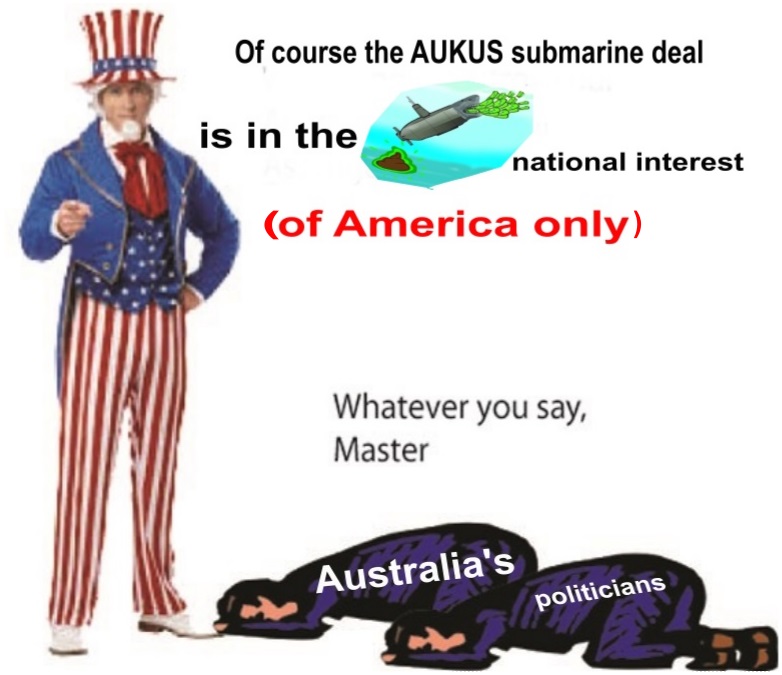
Trump, AUKUS and Australia’s Dim Servitors
November 22, 2024, Dr Binoy Kampmark, https://theaimn.com/trump-aukus-and-australias-dim-servitors/
There is something enormously satisfying about seeing those in the war racket worry that their assumptions on conflict have been upended. There they were, happily funding, planning and preparing to battle against threats imagined or otherwise, and there comes Donald Trump, malice and petulance combined, to pull the rug from under them again.
What is fascinating about the return of Trump to the White House is that critics think his next round of potentially rowdy occupancy is going to encourage, rather than discourage war. Conflict may be the inadvertent consequence of any number of unilateral policies Trump might pursue, but they do not tally with his anti-war platform. Whatever can be said about his adolescent demagogic tendencies, a love of war is curiously absent from the complement. A tendency to predictable unpredictability, however, is.
The whole assessment also utterly misunderstands the premise that the foolishly menacing trilateral alliance of AUKUS is, by its nature, a pact for the making of war. This agreement between Australia, the UK and the US can hardly be dignified as some peaceful, unprovocative enterprise fashioned to preserve security. To that end, President Joe Biden should shoulder a considerable amount of the blame for destabilising the region. But instead, we are getting some rather streaky commentary from the security wonks in Australia. Trump spells, in the pessimistic words of Nick Bisley from La Trobe University, “uncertainty about just what direction the US will go.” His policies might, for instance, “badly destabilise Asia” and imperil the AUKUS, specifically on the provision of nuclear–powered submarines to the Royal Australian Navy. On the last point, we can only hope.
The Australians, being willing and unquestioning satellites of US power, have tried to pretend that a change of the guard in the White House will not doom the pact. Australian Foreign Minister Penny Wong expressed a “great deal of confidence” that things would not change under the new administration, seeing as AUKUS enjoyed bipartisan support.
Australia’s ambassador to the US, Kevin Rudd, is also of the view that AUKUS will survive into the Trump administration as it “strengthens all three countries’ ability to deter threats, and it grows the defence industrial base and creates jobs in all three countries.”
Another former ambassador to Washington, Arthur Sinodinos, who also occupies the role of AUKUS forum co-chair, has pitched the viability of the trilateral pact in such a way as to make it more appealing to Trump. Without any trace of humour, he suggests that tech oligarch Elon Musk oversee matters if needed. “If Musk can deliver AUKUS, we should put Musk in charge of AUKUS, and I’m not joking, if new thinking is needed to get this done,” advises the deluded Sinodinos.
The reasoning offered on this is, to put it mildly, peculiar. As co-head of the proposed Department of Government Efficiency, Musk, it is hoped, will apply “business principles” and “new thinking”. If the Pentagon can “reform supply chains, logistics, procurement rules, in a way that means there’s speed to market, we get minimum viable capability sooner, rather than later.”
These doltish assessments from Sinodinos are blatantly ignorant of the fact the defence industry is never efficient. Nor do they detract from the key premise of the arrangements. Certainly, if an anti-China focus is what you are focusing on – and AUKUS, centrally and evidently, is an anti-China agreement pure and simple – there would be little reason for Trump to tinker with its central tenets. For one, he is hankering for an even deeper trade war with Beijing. Why not also harry the Chinese with a provocative instrument, daft as it is, that entails militarising Australia and garrisoning it for any future conflict that might arise?
Whatever the case, AUKUS has always been contingent on the interests of one power. Congress has long signalled that US defence interests come first, including whether Australia should receive any Virginian class submarines to begin with.Trump would hardly disagree here. “Trump’s decisions at each phase of AUKUS cooperation will be shaped by zero-sum balance sheets of US interest,” suggests Alice Nason of the University of Sydney’s US Studies Centre rather tritely.
If Trump be so transactional, he has an excellent example of a country utterly willing to give everything to US security, thereby improving the deal from the side of Washington’s military-industrial complex. If there was one lingering, pathological complaint he had about Washington’s NATO allies, it was always that they were not doing enough to ease the burdens of US defence. They stalled on defence budgets; they quibbled on various targets on recruitment.
This can hardly be said of Canberra. Australia’s government has abandoned all pretence of resistance, measure or judgment, outrageously willing to underwrite the US imperium in any of its needs in countering China, raiding the treasury of taxpayer funds to the tune of a figure that will, eventually, exceed A$368 billion. Rudd openly acknowledges that Australian money is directly “investing into the US submarine industrial base to expand the capacity of their shipyards.” It would be silly to prevent this continuing windfall. It may well be that aspect that ends up convincing Trump that AUKUS is worth keeping. Why get rid of willing servitors of such dim tendency when they are so willing to please you with cash and compliments?
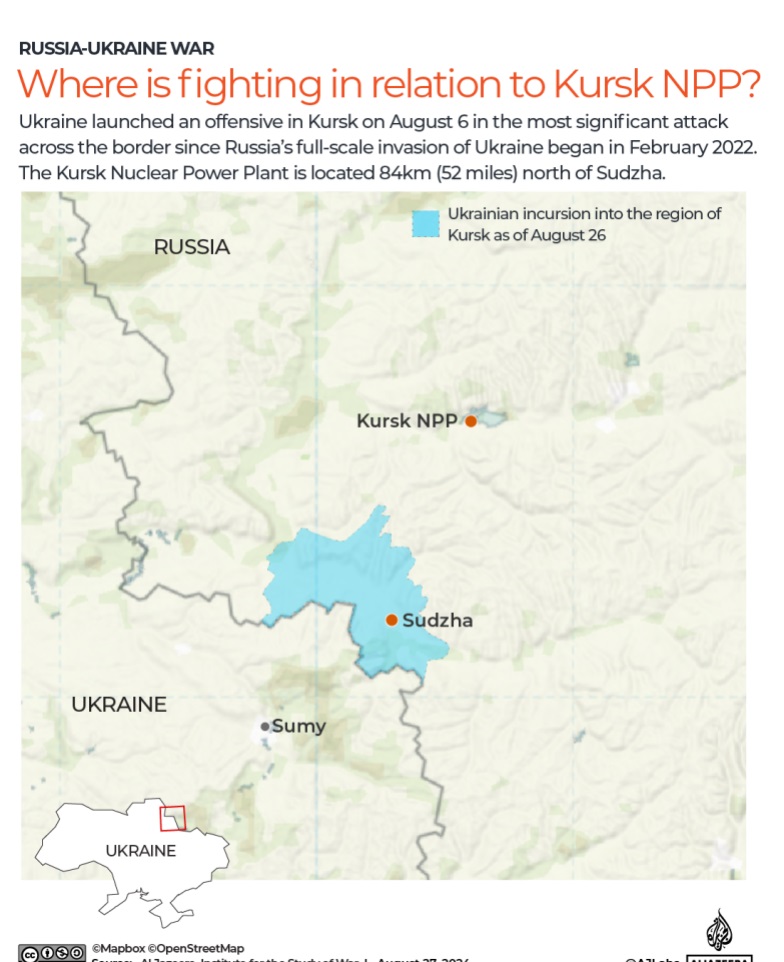
TODAY. Danger of a nuclear catastrophe as Ukraine sends missiles to Kursk area in Russia
We keep getting told how very dangerous it is for the Russians to be sending drones and now missiles into Ukraine, above all, because they might hit Zaporizhzhia and other nuclear facilities. And yes, this is true, (although the Russians have been relatively restrained, so far, about use of missiles).
We all do know how awful this war is, and what radiological devastation would be released, if the Russians, or the Ukrainians, struck the Zaporizhzhia Nuclear Power Station, the largest in Europe. Rafael Grossi of the International Atomic Energy regularly reminds us of that danger, – (while almost simultaneously touting nuclear power stations as so very safe, and the essential cure for climate change.)
But what we don’t hear about – in our the media’s joyous promotion of a Ukrainian victory over Russia,- is the grave danger posed by American and British missiles fired by the Ukrainians into the Russian area of Kursk.
All sorts of “good reasons” for the Ukrainians doing this – to lower the morale of Russians, to destroy masses of North Korean troops gathering in the area, to hold onto a piece of Russian land as a bargaining chip if ever there’s a negotiation with Russia.
But no mention of Kursk nuclear power station, with its four Soviet RBMK-1000 reactors. The 2 operating reactors have no protective dome.– the same design as those at the Chernobyl nuclear plant which in 1986 became the scene of the world’s worst civilian nuclear disaster. Construction of the Kursk-2 power plant is under way, using essentially new reactors of the VVER-510 type, which began in 2018. The Kursk NPP is among the three largest nuclear facilities in the country.

In August 2024, the remains of a Ukrainian drone were found within the area of the Kursk nuclear power plant, located roughly 100 metres (328 feet) from the plant’s spent fuel nuclear storage facility.
Ukraine fired at least 10 British-provided Storm Shadow missiles into Russia’s Kursk Oblast, The Wall Street Journal and several other media outlets reported on Wednesday.
You have to look to alternative media, to get any grip on what is happening in this conflict. Dave DeCamp , writes in ANTIWAR:
The US and the UK reportedly authorized Ukraine’s use of the Storm Shadows in strikes on Russian territory after President Biden gave the green light for Ukraine to use the ATACMS, US-made missiles with a range of about 190 miles. Ukraine launched ATACMS into Russia for the first time on Tuesday.
Both the Storm Shadows and ATACMS require intelligence from Western countries for Ukraine to fire them, meaning the US and NATO are now directly supporting long-range strikes on Russian territory.
Our corporate Western media continues with its sacred utterance that “Ukraine must and will defeat Russia”. We never hear about the previous 8 long years of the Ukraine government’s war against its own region in the Donbass, a largely Russian-speaking region, which wanted to keep its autonomous status, supposedly guaranteed by the Minsk agreements . All this precipitated Russia’s action in February 2022. Zelensky was originally elected on a platform of honouring this agreement and negotiating with Russia.
But I digress.
The thing is, we are not being told the truth about this war. And Kursk is a kind of flashpoint that the Western mindset apparently does not understand.
The battle of Kursk
It is ironic that the battle of Kursk in 1943, the single largest battle in the history of warfare , is regarded as the “last gasp of Nazi aggression“. The Nazis invaded Kursk, but were defeated by the Russian forces. Russia lost an estimated 800,00 casualties. This battle, along with the Battle of Stalingrad several months earlier, is regarded as a turning point in World War 2.
It is sad, that in recent commemorations of World War 2, the role of Russia in defeating the Nazis is somehow erased. Oh well, we know from Hollywood’s portrayal of this war, it was the Americans who beat the Nazis.
NATO supports the missile attacks on Russian territory. It is possible that Kursk – the scene of a huge defeat of the 1943 German Nazi war machine, – could now be destroyed by the NATO-USA war machine, which includes Germany
Signing US/UK nuclear deal would shred Australia’s credibility: Turnbull
Australia would kill its credibility internationally if it were to embrace domestic nuclear power to please key foreign allies, Malcolm Turnbull has warned, accusing the Coalition of gaslighting voters over power prices.
Amid a heated fight in parliament over a nuclear agreement signed by the United States and the United Kingdom at the COP29 talks in Azerbaijan this week, the former prime minister said Australia had distinct advantages on renewable energy and must make decisions in its national interest.
“The job of the Australian prime minister is to stand up for Australia and recognise Australia has distinct interests and distinct characteristics,” Mr Turnbull told The Australian Financial Review.
“Simply falling into line and being some sort of sycophantic copier of everybody else’s agendas doesn’t bring you in any respect.”
The former Liberal leader’s comments followed Britain and the US signing a deal for civil nuclear collaboration at the summit in Baku, part of plans to combine billions of dollars for research and development of new technologies.
An early version of the British government’s statement announcing the deal said Australia would be among a number of other countries signing on. But the UK government conceded on Tuesday that Australia had been included in the statement erroneously.
The original statement, viewed by the Financial Review, said countries signing on would include Canada, France, Japan, South Korea, South Africa, China, Switzerland and Australia.
But the updated agreement, published online by UK Energy Secretary Ed Miliband, has the names of participating countries removed and says only that Russia will remain excluded because of its invasion of Ukraine.
A spokeswoman for Energy Minister Chris Bowen, who is representing Australia at the talks, ruled out any participation, noting Australia had no nuclear energy industry and a federal ban on nuclear power is in place.
The government said Australia would remain as an observer to the deal, and support scientists in other nuclear research fields.
In question time on Wednesday, Acting Prime Minister Richard Marles accused the Coalition of exaggerating the significance of the statement.
“Every expert out there makes it completely clear that what we are awaiting is a 20-year duration before we could reasonably expect to have nuclear energy in this country, were we to go down that path,” he said.
“Even then, all we are talking about is a contribution of 4 per cent to the electricity grid.
“What we are pursuing is policies in the here and now, which are being pursued around the world: firmed renewable energy, which is the cheapest form of energy, which is being brought online around the world.”
Mr Dutton accused the government of a stubborn refusal to consider nuclear, as countries including South Korea, Turkey and Nigeria had joined another pledge to triple global nuclear power by 2050. He said nuclear could “reduce emissions and deliver energy at a reasonable cost”.
Long a critic of Mr Dutton’s leadership, Mr Turnbull said nuclear would not complement renewable energy.
“That is nonsense. That’s gaslighting, quite frankly,” he said. “What complements renewables is something that is flexible. We have 4 million households in Australia. Over a third of all Australian homes have got solar panels on. It’s the highest percentage of solar household solar penetration in the world.”
Tom McIlroy is the Financial Review’s Canberra Bureau Chief based in the press gallery at Parliament House. He was previously the AFR’s political correspondent. Connect with Tom on Twitter. Email Tom at thomas.mcilroy@afr.com
Paul Smith edits the technology coverage and has been a leading writer on the sector for 20 years. He covers big tech, business use of tech, the fast-growing Australian tech industry and start-ups, telecommunications and national innovation policy. Connect with Paul on Twitter. Email Paul at psmith@afr.com
Albanese government gives firm ‘no’ to joining UK-US agreement to advance nuclear technology
The Conversation, November 19, 2024, Michelle Grattan, Professorial Fellow, University of Canberra
The Albanese government has been put on the spot by a new agreement – which it has declined to join – signed by the United Kingdom and the United States to speed up the deployment of “cutting edge” nuclear technology.
The original version of the British government’s press release announcing the agreement said Australia, among a number of other countries, was expected to sign it.
But the reference was removed from the statement.
The UK Energy Secretary Ed Miliband and the US deputy Secretary of Energy David Turk signed the agreement in Baku during COP29…….
A spokesperson for Energy Minister Chris Bowen, who is at the COP meeting, said: “Australia is not signing this agreement as we do not have a nuclear energy industry.
“We recognise that some countries may choose to use nuclear energy, depending on national circumstances.
“Our international partners understand that Australia’s abundance of renewable energy resources makes nuclear power, including nuclear power through small modular reactors, an unviable option for inclusion in our energy mix for decarbonisation efforts.”
Australia would remain as observers to the agreement to continue to support its scientists in other nuclear research fields, the spokesperson said………
In parliament, acting Prime Minister Richard Marles said for Australia to pursue a path of nuclear energy would add $1200 to the bills of each household in this country.
………………………Update: UK government seeks to clear things up
Later The Guardian reportred: “The UK government has conceded it made a mistake in including Australia in a list of countries that has signed up to a US-UK civil nuclear deal”. https://theconversation.com/albanese-government-gives-firm-no-to-joining-uk-us-agreement-to-advance-nuclear-technology-244041
Rio Tinto to take full control of controversial mine in Kakadu
By Simon Johanson, 20 Nov 24, https://www.smh.com.au/business/companies/rio-tinto-moves-to-shut-down-controversial-mine-in-kakadu-20241120-p5ks2q.html
The last chapter in one of Australia’s big environmental battles is set to play out after mining giant Rio Tinto moved to take full control of the controversial Ranger uranium mine near the World Heritage-listed Kakadu National Park.
Rio, the world’s second-biggest miner by market value, told the ASX on Wednesday it will compulsorily acquire the remaining shares it does not own in its subsidiary Energy Resources of Australia (ERA), taking control of the contentious Ranger uranium mine and neighbouring Jabiluka deposit, one of the world’s richest known sources of untapped uranium.
ERA wound up its uranium oxide operation at Ranger in 2021, but the cost of rehabilitating the mine is on track to exceed $2.2 billion and concerns have lingered among traditional owners, the Mirarr people, about ERA’s intentions, particularly after it applied for a 10-year mining lease extension over Jabiluka in March this year.
Rio, which owned a large stake in ERA, began working with ERA on rehabilitating the mine in 2021. ERA was legally required to rehabilitate the operation by 2026 estimating it would cost $500 million, but budget blowouts and differences between ERA’s board and Rio led to a fractious relationship with its majority shareholder before Rio reached an agreement with ERA to take over management of the mine’s rehabilitation in April this year.
The push to mine Jabiluka at one stage sparked fierce opposition among traditional owners and environmental campaigners in 1998. Thousands of protesters took part in a human blockade at the site and hundreds were arrested in the ensuing clampdown.
The lease area covers a sacred site with hundreds of ancient rock art galleries. In the end, Jabiluka was never mined, and ERA pledged it would not develop the area as long as the Mirarr remain opposed to it.
Rio’s Australia chief executive Kellie Parker reaffirmed the dual London-Australia listed miner had “no intention to invest in mining or development of the Jabiluka deposit”.
“Proceeding with compulsory acquisition, after participating for our full entitlement in the ERA capital raising, underlines our commitment to Ranger’s rehabilitation,” Parker said.
Australian Conservation Foundation campaigner Dave Sweeney said Rio’s takeover of Ranger brings certainty to the delivery of rehabilitation works.
“There is a massive shortfall in funding for the Ranger clean-up and Rio has deeper pockets, more talent and greater reputational exposure than ERA,” Sweeney said.
ERA launched a capital raising in October that resulted in $766.5 million to fund rehabilitation of the Ranger mine. Rio bought its maximum entitlement in the raising, which pushed its shareholding up from 86 per cent to 98 per cent.
It immediately said it would move to mop up the remaining shares held by minority investors in ERA under the compulsory acquisition rules of the Corporations Act for the same price, $0.002 per ERA share, as the entitlement offer.
“We remain committed to the successful rehabilitation of the Ranger Project Area to a standard that will establish an environment similar to the adjacent Kakadu National Park, a World Heritage site,” Parker said.
ERA’s board said it would keep shareholders informed of any subsequent developments and steps taken by Rio Tinto.
The global miner’s purchase of new shares under the capital raising will boost its voting power in ERA to 98.43 per cent, overwhelming a vocal minority of shareholders who were seeking to block Rio boosting its stake and who have been pushing for the Jabiluka deposit to be developed.
Britain’s Nuclear Bomb Scandal: Our Story review – how the UK’s atomic testing programme devastated lives

Trauma, terror and potential medical effects that last for generations – those who experienced the fallout of nukes in Australia and the Pacific tell their horrifying tale
Jack Seale, Thu 21 Nov 2024 https://www.theguardian.com/tv-and-radio/2024/nov/20/britain-nuclear-bomb-scandal-our-story-review
Grenfell, the Post Office, infected blood, Hillsborough … Britain has witnessed a long series of injustices where walls of silence and lies have stopped the powerless inconveniencing the powerful by telling their whole truths. To that list, in the section where further disclosure is still urgently required, we should add the UK’s nuclear testing scandal. This calmly scathing documentary sets out the case.
Post-second world war, the US and the USSR engaged in a nuclear arms race, and Britain – desperate to cling to its place at the world’s top table – felt obliged to join them. As it tried to keep up with developments in atomic and hydrogen bombs, nuclear tests were desired, but letting off nukes anywhere near regular British citizens was politically unviable, so distant lands were sought and human guinea pigs identified.
The locations chosen were Pacific atolls and the Australian outback and coast; the unwitting human test subjects were, as well as the local people, around 39,000 British and Commonwealth servicemen and scientists. Between 1952 and 1963, they witnessed 45 atomic and hydrogen bombs being detonated, along with hundreds of other radioactive experiments. Many of those affected, who had been stationed at the blast sites so the effects on humans could be monitored, are interviewed in this film.
Leading the talking heads are British veterans who, as young men in the 1950s and 60s, were offered the chance to sail halfway around the world to serve their country. Initially, when they arrived at, say, Christmas Island or the Monte Bello archipelago off the coast of north-western Australia, they were in paradise, living a life of sunshine, beer, seafood and beach football with, as one says, “no idea what we were letting ourselves in for”. Now, they live with cancers and other health problems they are convinced are linked to what they experienced – or with the traumatic memories of coming face to face with humanity’s most powerful, awful creation.
Not every study has backed the men’s claims about the negative health impacts of the nuclear tests, but plenty have and, in any case, the problem is that the picture is incomplete. Court cases and dogged freedom of information requests have been required to access records from the Ministry of Defence, the existence of which the MoD had previously denied. But the veterans still wouldn’t have enough to claim for compensation, even if Britain had an equivalent to the nuclear-testing compensation schemes that exist in other countries.
Here and now, we have the men’s own testimony, which is frightening. Their recollection of sitting on a beach with their bare hands over their eyes, waiting for an unholy explosion to go off in the sea behind them, is eerie and nightmarish. One man’s memory of being flown in a plane through a mushroom cloud, looking down at a crimson inferno below before being flipped upside down by the force of the explosion, is hard to even comprehend.
Almost more upsetting are the tales of what came next, particularly among the men’s offspring. Children were born with disabilities and disfigurements; grandchildren show signs of genetic defects. The official line remains that there is no correlation between this and the tests, and that “no information is withheld from veterans”. The veterans, bitterly and tearfully, disagree.
Then there is the small matter of the Indigenous Australians whose ancestral homelands were deemed to be uninhabited before British nuclear tests were carried out. At Emu Field in south Australia in 1953, warnings about the prevailing wind were ignored, and the radioactive cloud was blown towards an Indigenous community that included the late Yami Lester, who was blinded by radiation exposure and became an anti-nuclear campaigner. We hear his famous description, given in 1999, of “this black mist coming over and quietly rolling through the mulga trees, black and shiny, oily looking”. Community members reported unusual, serious health issues within hours.
There is also an interview with Australian air force veteran and whistleblower Avon Hudson, who risked imprisonment to draw attention to the effects of the tests at Maralinga, a little south of Emu Field. Hudson, a resolute but deeply sad man, leads the film-makers to the programme’s starkest image: the cemetery in the small military town of Woomera, with its rows of tiny graves. The surge in infant deaths and stillbirths was never satisfactorily explained.
Hudson fought for a royal commission, which convened in 1984 and went some way to healing the damage done in Australia, but the surviving Brits – now grandfathers, sharp of mind but with faces etched by worry, and with their time running out – are still waiting for a public inquiry, for compensation, and for the release of their own full medical records. Answering their questions honestly looks like the least we can do.
Britain’s Nuclear Bomb Scandal: Our Story aired on BBC Two and is on iPlayer.
Australia mistakenly included on list of countries joining US-UK civil nuclear deal, British government says

Albanese government denies media reports it is signing up to collaboration to share advanced nuclear technology
Guardian Adam Morton in Baku and Sarah Basford Canales, 19 Nov 24
The UK government has conceded that Australia was mistakenly included on a list of countries that were expected to sign up to a US-UK civil nuclear deal.
The Albanese government flatly denied media reports on Tuesday that it would join the UK and the US in a collaboration to share advanced nuclear technology. The UK and the US announcement said they would speed up work on “cutting-edge nuclear technology”, including small modular reactors, after inking a deal at the Cop29 UN climate summit in the Azerbaijani capital of Baku.
The UK government’s original media release noted Australia was one of 10 countries “expected” to sign on to the agreement, but mention of Australia was removed a short while later. The other nine countries were also removed…………………………………………………………………..
………… The acting prime minister, Richard Marles, told question time Australia was not signing up to the deal.
“It is an agreement which goes to civil nuclear energy – that means nuclear reactors which provide energy to cities and to electricity grids, and we do not have that in this country, and so as a result … this agreement is not relevant to Australia,” Marles said.
The Australian climate change and energy minister, Chris Bowen, and the UK minister for energy security and net zero, Ed Miliband, on Tuesday morning in Baku signed a climate and energy partnership to cooperate on renewable energy technology and investment and help “coordinate global climate action under the Paris agreement”. https://www.theguardian.com/environment/2024/nov/19/australia-mistakenly-included-on-list-of-countries-joining-us-uk-civil-nuclear-deal-british-government-says
AUKUS will ‘cannibalize’ other programs with no budget boost: Former top Aussie general
At the same conference, US Deputy Secretary of State Kurt Campbell urged the incoming Trump administration to work closely with Australia and New Zealand to counter a “relentless” China and not to turn inward.
BREAKING DEFENSE, By Colin Clark November 20, 2024
SYDNEY — Sounding the alarm that the AUKUS nuclear submarine deal will eat into non-naval priorities, the former head of the Australian Defense Force today called for a significant boost in defense spending, up to 3 percent of GDP.
Sir Angus Houston was Australia’s top military officer from 2005-2011 and was tapped to co-lead the recent Defense Strategic Review, making him a key, respected voice on matters of defense. While the DSR TKTKT, his comments today reflect what he sees as changed situation. The review and its Integrated Investment Plan projected a $55.5 billion AUD budget for 2024-25, rising to $67.9 billion in 2027-28 — roughly 2.2 percent of GDP.
………………………in comments at the US Studies Centre here, Houston made clear he wasn’t just talking about spending more because of the threats. He made an important structural point, that Australia must increase its defense spending so that buying and building nuclear powered attack submarines — the AUKUS program with the US and UK — does not consume too much of the defense budget.
Houston said the AUKUS boats “must be a net addition to Australia’s military capability. The only way they can be a net addition to Australian military capability is to increase our defense spending by 3 percent plus of GDP as we move into and through the 2030s.”
If that does not happen, it will mean the military can only buy the subs “through the cannibalization of other military capability. So that is the challenge for us. And I don’t think either side of the body politic in Australia has really come to terms with that.”
The question of whether AUKUS will eat up other programs for the Australian defense community has been an open one ever since the project, the most expensive endeavor in the country’s history, was launched. Officials have largely towed the line that the Lucky Country can do everything.
………………………………..there may be signs of budget pressure emerging already. Earlier this month, Australia killed a $5.3 billion AUD satellite contract with Lockheed Martin, with one analyst saying more cuts will likely have to happen as the true cost of AUKUS emerges.
The current government in Canberra has pledged to increase defense spending by $50.3 billion over the next decade, with the plan being to hit $100 billion by 2033. That would put the country at 2.4 percent — well below what Houston believes is needed……………………………………………………………………………………………
Unlike some NATO countries, which Trump has criticized for spending too little, Australia has committed more than $6 billion USD to expanding the tripartite sub industrial base and plans to spend a total of $368 billion on Virginia- and SSN AUKUS-class subs. https://breakingdefense.com/2024/11/former-top-aussie-general-warns-aukus-will-cannibalize-other-programs-with-no-defense-boost/
1 This month.

Australians deserve the truth
about
AUKUS – https://aukuspublicinquiry.com/
30 July – WEBINAR (Free) – Is Nuclear Power the Solution to Climate Change? https://my.acaw.org.au/event/acaw-is-nuclear-power-the-solution-to-climate-change
18:30 – 19:45 ACST
19:00 – 20:15 AEST


PETITION – To: Prime Minister Anthony Albanese and the Australian Labor Government

of the week – Australians for War Powers Reform (AWPR)
To see nuclear-related stories in greater depth and intensity
 Antinuclear