Submission- Robert Coney -re new agreement on Naval Nuclear Propulsion- this must not stand – its only purpose being to attack China
The AUKUS submarines will not be here to defend Australia, but only to attack China in a subordinate role with the American forces.
Do we buy guns in support of an American led war of aggression? Or commit that funding to the wellbeing of our people?
Submission no.16
AUKUS. This is a horror for which I now fear for the lives of my children and their children.
This is now changing the direction of Australia for the next forty or fifty years.
We have never seen anything like this in peacetime Australia. At any stage.
This must not stand.
The horrors of AUKUS
Firstly, the automatic involvement in war.
We have already been tied to the United States by the bases – by Pine Gap, by North West
Cape, by the Space Surveillance Telescope that take us into space warfare, by the many
other Australian bases to which the US has access.
We are already tied in, hard-wired in many cases, to the American war machine.
And the ADF is barely an autonomous force today.
But AUKUS takes us very much further down that road.
We already know what the submarines are there for.
This is a politically-driven, call-from-Washington-inspired scheme for long-range, long endurance nuclear-powered submarines whose only rational use is to attack China.
The AUKUS submarines will not be here to defend Australia, but only to attack China in a
subordinate role with the American forces.
What could $368 billion in funding – $12 billion per annum for the next 30 years – fund for
Australia and Australians?
That is the question Australians must ask.
With Australia facing the most severe housing crisis in our history, rising cost of living,
increasing inequality, the pressing need to reform our schools, health, disability and aged
care systems, and the critical need to transform our energy systems and reduce our carbon
emissions to net zero, we face a choice.
Do we buy guns in support of an American led war of aggression? Or commit that funding to
the wellbeing of our people?
What, could $368 billion dollars achieve in developing relations with our close neighbour,
Indonesia, and the Association of South East Asian Nations?
Do we forget that any possible aggression – and there is absolutely no sign of it – from China,
would be first experienced by our ASEAN neighbours?
I believe AUKUS must not stand.
South Australia is aiming for 100% renewable energy by 2027. It’s already internationally ‘remarkable’
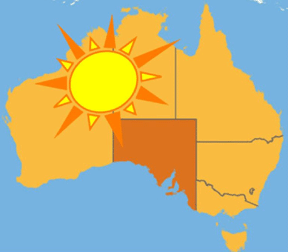
Experts say the state’s approach could provide a template for what can be achieved elsewhere.
Eight years ago, South Australia’s renewable energy future was in doubt as an extraordinary statewide blackout saw recriminations flow.
On 28 September 2016, a catastrophic weather event sent the entire state into system black. Around 4pm, some 850,000 homes and businesses lost power as supercell thunderstorms and destructive winds – some travelling up to 260km/h – crumpled transmission towers, causing three major power lines to trip.
Almost immediately, and despite advice to the contrary, members of the federal government sought to blame the blackout on wind and solar, with the then prime minister, Malcolm Turnbull, saying several state governments had set “extremely aggressive, extremely unrealistic” renewable energy targets.
Instead of relenting,SA chose to persevere. It now leads the world in the integration of variable, or weather-dependent, renewables.
Wind and solar power in South Australia grew to 75% in 2023, with few other systems reaching comparable levels. For instance, frontrunner Denmark achieved 67% in the same year.
The International Energy Agency says demonstrating the ability to power a large grid with wind and solar is crucial in the context of climate change, and South Australia’s share is “remarkable”.
The state government is now attempting to legislate a target of 100% renewable energy by 2027. Experts say the state’s approach could provide a template for what can be achieved elsewhere.
Energy specialist Dr Gabrielle Kuiper says powering a jurisdiction of almost 2 million people with majority wind and solar is a globally significant achievement.
“One of the most impressive things about that feat, from a technical point of view, is there have also been periods, starting in September last year, where the entire state was powered by rooftop solar alone,” Kuiper says.
On New Year’s Eve 2023, rooftop solar met 101.7% of South Australia’s energy needs for 30 minutes. Australia’s energy operator says that’s a world record for a grid of that size. Its engineering roadmap seeks to enable similar milestones throughout the national grid.
Daniel Westerman, chief executive of the Australian Energy Market Operator, says the “world-leading” rooftop solar contribution is made possible by power system equipment providing security, smarter connections between rooftop solar and the grid, and policies which protect consumers from unwanted disruptions.
Dr Susan Close, South Australia’s deputy premier and climate change minister, was a government minister during the 2016 statewide blackout. She believes the then federal government’s reaction at the time, blaming the state’s renewable energy, was “unfair and unsubstantiated”.
But if anything, she says the unhelpful response from Canberra hardened the state’s resolve. “In South Australia, the vast majority of people were proud of what we were doing, and simply wanted us to make sure that it was as secure and stable as possible,” Close says.
Close says the state’s energy shift hasn’t happened by chance. World-leading climate laws, consistent policy and a supportive planning system attracted investment and helped the state gain an early advantage under federal renewable energy targets. High retail power prices combined with a generous feed-in tariff scheme (now finished) to drive early uptake in rooftop solar. Now every second home in the state has solar installed.
Johanna Bowyer, lead analyst at the Institute for Energy Economics and Financial Analysis, said while South Australia does have fantastic wind and solar resources, “that’s the case for a lot of Australia”. Crucially, coal power stations were allowed to close under market conditions, she said. “They didn’t subsidise it to stay open for longer, like what is happening in New South Wales with Eraring.”
As coal generation was phased out, renewable energy grew to fill the gap.
Proposed changes to South Australia’s Climate Change Act include a 100% net renewable energy target, formalising statements by the energy minister earlier in the year.
The “net” terminology recognises that interstate transmission lines – connecting South Australia to Victoria and eventually NSW – will continue to share electricity across state borders.
The amendments also include a 60% emissions reduction target by 2030 – compared to 43% federally, and 50% in Queensland, NSW and Victoria – and a framework for timely updates along the pathway to net zero by 2050.
Kirsty Bevan, chief executive of the Conservation Council of SA, says the state’s “trailblazing renewable energy transition” puts it in a unique position to adopt much stronger emissions targets than other state governments. The council supports the renewable energy and 2030 emissions targets, but is keen to see the net zero target date brought forward.
“We should be proud of our past renewable energy accomplishments, but also build upon and capitalise on those accomplishments – to the benefit of all South Australians, our nature, and our shared planet,” Bevan said.
The state government’s focus is on stability, flexibility and reliability, with more large-scale battery storage following in the footsteps of the Hornsdale battery (the world’s biggest when it was activated), and hydrogen part of the plan to soak up excess wind and sun.
Kuiper says the secure and reliable system is made possible thanks to investment in storage, smarter management and grid flexibility. But the key to SA’s success isn’t merely technical, she says, it’s also political.
“The bipartisan support for renewable energy in South Australia has been really significant. It’s given investors a sense of certainty,” Kuiper said.
“I think there are lessons at a federal level, particularly for the federal opposition, about what can be achieved if you provide consistent support to this vitally important industry – that’s important for the domestic economy and for Australia’s development of export industries into the future.”
The aim of 100% net renewables was initially set under the Marshall Liberal government, with the Malinauskas Labor government bringing the date forward.
Close acknowledges the opposition’s part in supporting the state’s decarbonisation, adding that the current bill protects to a degree from “a sudden shift in temperament from the other side of politics.”
She says there’s no reason the energy and cultural transition in South Australia couldn’t be replicated in other parts of the country.
“The sooner you start, the easier it is,” she said. “The real cost is in being the last ones to make the change. And so we wish our interstate colleagues well in making that shift.”
Submission- Jim Hazzard -re new agreement on Naval Nuclear Propulsion- let’s dump AUKUS, and not be at war with China
Submission no. 15
Australians were never asked their opinion on AUKUS but thankfully we now have. Morrison gave Opposition leader Albanese one day to agree to the proposal on which the USA wanted bi-partisan unity.
Lets take Auatralia off the hook for $368 billion to be paid to US and UK weapons
manufacturers so we can fight our biggest trading partner China. China does not want a
war against Australia.
US and UK are under zero obligation to deliver the submarines and if they don’t Australia
won’t get it’s money back.
We have an obligation to build infrastructure for Australia: The bradfield scheme,
Hospitals, Schools, Housing instead of a US war with China. So let us dump AUKUS and
be a sovereign nation at peace with China and the world, Yours faithfully, James
Hazzard
Mining bash to dish up nuclear as PM pushes future plan
FBC News, By Marion Rae (AAP) in Canberra, September 9, 2024
Mines are being mothballed even as Anthony Albanese calls for a future made in Australia with battery minerals and clean energy – not nuclear – at its heart.
As the world goes for net zero, the resources industry is “front and centre” in the government’s plan for Australia to make the most it, the prime minister will tell a Minerals Week dinner on Monday.
“The global imperative to cut emissions is Australia’s opportunity to grow our economy – and diversify it. That’s what I mean when I talk about a future made in Australia,” he says, according to a copy of his speech.
Making government “a catalyst for new investment in critical minerals at every stage”, the nation will build new industrial centres powered by clean energy.
But sector leaders say red and green tape must be cut and, with energy demand expected to double by 2050, all technologies – including nuclear – will be required to meet future energy needs…………………………………….. https://www.fbcnews.com.fj/world/mining-bash-to-dish-up-nuclear-as-pm-pushes-future-plan/
Nuclear news and more – week to 10 September

Some bits of good news – Norway’s Forests Have More Than Tripled in a Hundred Years. Zimbabwe’s endangered black rhinos are finally making a comeback. LIXIL-UNICEF partnership improves sanitation and hygiene for 12.7 million people.
TOP STORIES.
Starmer permanently ties UK nuclear arsenal to Washington.
The billions for Sizewell C show Labour’s shameful nuclear hypocrisy.
The US empire is hidden in plain sight. The US Empire Can Exist Only In A Continuous State Of Mass Military Violence.
Climate. Summer 2024 was world’s hottest on record. African nations are losing up to 5% of their GDP per year with climate change, a new report says. ‘Dangerously hot’ weather roasts US west as brutal summer continues.
Noel’s notes. Yah wouldn’t know it was happening – USA military might and toxic nuclear waste quietly infiltrating Australia? The Anglophone nations ganging up to dominate the rest of the world, mindlessly obeying the USA.
************************
AUSTRALIA Basing US Nuclear Subs at Stirling on Garden Island makes Western Australia a nuclear target, while risking “catastrophic conditions” in a N-Sub reactor accident. Submission- G.H. Toll -re new agreement on Naval Nuclear Propulsion- Australia should pursue an independent non aligned foreign policy. The massive new projects propelling South Australia towards 100 per cent net renewables. More Australian news headlines at https://antinuclear.net/2024/09/05/australian-nuclear-news-headlines-sept-5-9/
NUCLEAR ITEMS
| CLIMATE. Developing a plan B for nuclear power in Washington, to cope with global heating. | ECONOMICS. “Subsidy for UK nuclear build calls funding into question”. NuScale Power: Cash Burn, Dilution And Insider Selling. | ENERGY. South Australia is aiming for 100% renewable energy by 2027. It’s already internationally ‘remarkable’ Renewables beat nuclear – even with full balancing included. |
| ENVIRONMENT. How much water does nuclear really need? ALSO AT https://antinuclear.net/2024/09/05/2-a-how-much-water-does-nuclear-really-need/ | EVENTS. 20 -22 September #NoWar2024 Conference: Resisting the USA’s Military Empire. 21-22 September. Peace, Nature and Co-operation in the Baltic and Arctic. International Online/Offline Conference & Round Table Discussions | HEALTH. Leukaemia, lymphoma, and multiple myeloma mortality after low-level exposure to ionising radiation in nuclear workers (INWORKS): updated findings from an international cohort study. |
| HISTORY. Declassified files reveal plans for nuclear power plant in Tyrone, Northern Ireland. | LEGAL. An arms embargo on Israel is not a radical idea — it’s the law. | MEDIA. Chernobyl Roulette by Serhii Plokhy review – gripping account of wartime chaos at Ukraine’s nuclear plant. Physicist MV Ramana on the problem with nuclear power, |
| POLITICS.Israel’s plan for Gaza comes into view . Inside UK Labour’s plans for a new nuclear age -ALSO AT https://nuclear-news.net/2024/09/05/1-b1-inside-uk-labours-plans-for-a-new-nuclear-age/ A staggering £5.5bn more of UK taxpayers’ money to be thrown at this white elephant, Sizewell C nuclear. Ed Miliband considers scrapping planned nuclear plant. Ynys Môn MP calls for UK Government clarity on Wylfa site. Will new UK nuclear power station plan be scrapped? SNP activists whoop as leader John Swinney tells party conference an independent Scotland will give up nuclear deterrent and rejoin the EU. Controversy Surrounds Kazakhstan’s Nuclear Referendum, | POLITICS INTERNATIONAL and DIPLOMACY. Iran desperately needs a nuclear deal to save its battered economy. Netanyahu to Biden…’We can’t complete the genocidal ethnic cleaning of Gaza without you.’ Japan PM hopeful Kono calls for US assurances to deter nuclear ambitions. |
| RADIATION. Rare photos show Earth’s fatal hotspot that can kill any human standing nearby in just five minutes. The scientific nature of the linear no-threshold (LNT) model used in the system of radiological protection. | SAFETY.Seismic Showdown Coming at Diablo Canyon.AEA’s Grossi says Zaporizhzhia cooling tower likely to be demolished. New images raise concerns over state of UK nuclear submarines. Former Palisades engineering director has misgivings about the plant’s historic restart effort. |
| SECRETS and LIES. ICC prosecutor says world leaders ‘threatened’ him over Israel arrest warrants. Boris Johnson faces ‘serious questions’ over new business with uranium entrepreneur. Victoria Nuland, former US deputy secretary of state, confirms West told Zelensky to abandon peace deal. | SPACE. EXPLORATION, WEAPONS. Whoopsie, SpaceX Blew Up Two Rockets and Punched a Massive Hole in One of Earth’s Layers |
| ECHNOLOGY.Small Modular Nuclear Reactors (SMRs) in Canada. Delays, debts and false promises — inside France’s nuclear nightmare – ALSO AT https://nuclear-news.net/2024/09/06/2-a-delays-debts-and-false-promises-inside-frances-nuclear-nightmare/ Why nuclear-powered commercial ships are a bad idea. France still faces problems in starting up long-delayed super-expensive Flamanville nuclear reactor. France’s newest nuclear reactor shuts itself down. Nuclear Fusion’s public-relations drive is obscuring the challenges that lie ahead. | WASTES. Complex compensation scheme represents tacit admission that nuke dump causes blight. Which rural area will take the UK’s nuclear waste? A robot resumes mission to retrieve a piece of melted fuel from inside a damaged Fukushima reactor. TEPCO restarts debris extraction attempt at Fukushima plant. |
| WAR and CONFLICT. America’s New Nuclear War Plan: Time to Panic? | Amb. Jack Matlock, Col. Larry Wilkerson, Ted Postol. Project 2025’s stance on nuclear testing: A dangerous step back. Netanyahu ‘torpedoed’Palestinian peace talks – CNN. 9700 Ukrainian Soldiers Killed Invading Russia. | WEAPONS and WEAPONS SALES.Nuclear Roulette: The U.S. Nuclear Employment Guideline. US arms advantage over Russia and China threatens stability, experts warn. White House pushes for AUKUS to move to ‘pillar two’ weapons focus. Ukrainian Tipping Points: UPDATE. Israeli Official: Without US Aid, Israel Couldn’t Sustain Gaza Operations for More Than a Few Months . Israel’s nuclear arsenal poses major threat to global peace’. UK suspends 30 arms exports to Israel over Gaza war crimes concerns. South Africa halts artillery shells to Poland over fears they will be used against Russia.Indian nuclear weapons, 2024. North Korea’s Kim Jong Un says country to increase number of nuclear weapons, KCNA says. |
Submission- Helen Breed -re new agreement on Naval Nuclear Propulsion- sheer lunacy, profits only the US and UK
Submission no.14
I am writing to inform you of my opposition to AUKUS.It is sheer lunacy that we
have put ourselves in a position which only profits the US and UK.
We do not need to go to war with a country that is our largest trading partner.
I am sick and tired of being dragged into wars that the US orchestrate in one way or
another.
We can’t afford to outlay these sums of money and as I see it, for no benefit. There is a
crisis happening in our own country which we need to address.
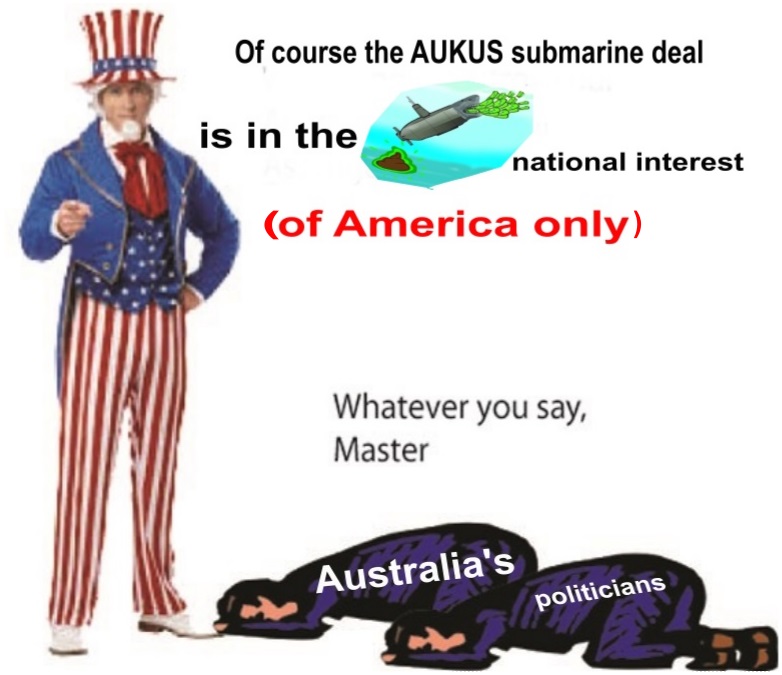
Submission- G.H. Toll -re new agreement on Naval Nuclear Propulsion- Australia should pursue an independent non aligned foreign policy.
Submission no. 13
I wish to express my complete opposition to the Aukus agreement.
Australia should pursue an independent non aligned foreign policy.
We should not ratify this Aukus agreement and should refuse to continue to humiliate
ourselves by acting as a vassal state for the will of the USA.
Yours sincerely,
Mr G H Toll
Australian citizen and fully emerged Australian elder.
Voter
Melbourne
Submission- Joseph Philippa-re new agreement on Naval Nuclear Propulsion- Much to lose and nothing to gain

COMMENT. Joseph Philippa puts it all so succinctly!
Submission no. 12 – Much to lose and nothing to gain.
The ability of the US and UK to walk away from the deal with a year’s notice, taking
everything with them, with no clawback for Australia.
No mechanism for Australia to receive funding from the US and UK, only Australia to
the US and UK.
Puts Australia on the hook to indemnify the US and UK for any “liability, loss, costs,
damage, or injury” associated with the use of nuclear submarines.
It allows the US and UK to determine the price of highly enriched uranium it is selling
to Australia.
It also allows the US and UK to intervene in Australia’s relations with the International
Atomic Energy Agency
For Australia to meet emissions reduction targets, we don’t need nuclear energy
Pearls and Irritations, By Brendan Mackey and David LindenmayerSep 9, 2024
The Federal Opposition’s energy policy includes the construction of nuclear power plants. Peter Dutton says that we need them because Australia’s emissions reduction target of 43% on 2005 levels by 2030 is unachievable. Is this true? We argue that it is not – and especially if the Australian Government works with state and territory governments to stop native forest logging and land clearing.
Ending land clearing and halting logging of native forests would achieve a reduction of between 14.5 million and 37.5 million tonnes of carbon dioxide equivalent a year. This is greater than the annual reduction of 14.2 million tonnes of carbon dioxide equivalent needed to meet Australia’s 2030 target. A major reduction in emissions from logging and clearing forests would be sit admirably along Australia’s efforts to transition from fossil fuels to clean energy – which is now 40% of the electricity market (up from 15% a decade ago).
This is an entirely feasible proposition, as ending native forest logging will serve to further stimulate investment in the plantation sector – where there are the most jobs and the best profits in the forest industry. Indeed, 90% of all sawn timber in Australia (to make roof trusses, floorboards and furniture) already comes from plantations. Native forest logging generates predominantly woodchips, paper pulp and packaging (and not high-quality timber products). Plantations employ, on average, three times more people per ha of trees than do native forests. In addition, the capital investment needed for one full-time equivalent position in a native forest logging operation is almost 10 times that needed for a full-time equivalent in a plantation…………………………………………………………….. more https://johnmenadue.com/for-australia-to-meet-emissions-reduction-targets-we-dont-need-nuclear-energy/
Basing US Nuclear Subs at Stirling on Garden Island makes Western Australia a nuclear target, while risking “catastrophic conditions” in a N-Sub reactor accident.

Briefer by David Noonan, Independent Environment Campaigner, 07 Sept 2024
What price should West Australian’s pay for AUKUS ? see “AUKUS: The worst defence and
foreign policy decision our country has made” by ex-FA Minister Gareth Evans (17 August 2024):
“… the price now being demanded by the US for giving us access to its nuclear
propulsion technology is, it is now becoming ever more clear, extraordinarily high.
Not only the now open-ended expansion of Tindal as a US B52 base; not only the
conversion of Stirling into a major base for a US Indian Ocean fleet, making Perth
now join Pine Gap and the North West Cape – and increasingly likely, Tindal – as a
nuclear target …”
No Emergency capability exists to respond to a nuclear weapons strike on Stirling off Freo
Nor can Federal and WA Labor claim to have a ‘social license’ for a US N-Sub Base at Stirling
while failing to inform affected community of the nuclear Health & Safety risks they could face.
Community has a basic ‘Right to Know’, a right to full disclosure of nuclear risks in advance of
decisions. A Labor Bill to declare Stirling a “Designated Nuclear Zone” is before Parliament
after a Senate Report. Now 3 yrs into AUKUS, it is long past time for Labor to inform community.
Federal & WA Labor Ministers Joint Ministerial Statement on Nuclear Reactors on Agricultural
Land (18 July 2024) have tackled Dutton over his crazy nuclear ‘power’ reactors at Muja, citing
accident impacts out to 80 km, but Labor fails to be transparent on nuclear risks they impose.
Federal and WA Labor have failed to make public required Health Impact Studies and
Nuclear Accident Scenario Modelling for US N-Sub visits and for a N-Sub Base at Stirling.
The WA State Hazard Plan “HAZMAT Annex A Radiation Escape from a Nuclear Powered
Warship” (update 20 Nov 2023) provides only scant over-view information to the public.
Federal Emergency provisions apply in event of a US N-Sub reactor accident at Stirling. The
federal civilian nuclear safety regulator ARPANSA sets out required Health Impact Studies,
Emergency response measures and Zones that are to be put in place (see “Guide for Radiation
Protection in Emergency Exposure Situations, Part 1 & 2, 2019).
A Defence Operations Manual “OPSMAN 1” (update 2023) is supposed to ‘operationalise’ the
Emergency measures for US N-Sub nuclear reactor accidents in Australian Ports and waters.
An “Urgent Protective Action Zone” of up to 2.8 km radius around the site of a US N-Sub
accident requires an Evacuation Plan for workers and affected residents. An “Extended
Planning Distance”, where “the surrounding population may be subject to hazards”, is set at
‘several kms’ around an accident site. This can extend to 5 km in UK N-Sub Emergency Zones.
ARPANSA and Defence also require studies of a local population out to 15 km from a US NSub mooring – as you can’t tell how far a radioactive pollution plume will spread by wind…
Children are at untenable Health risk in a nuclear strike OR in a US N-Sub reactor accident:
In a military nuclear reactor accident at Stirling the ARPANSA Guide Part 2 (p.18-19 & Table 3.1)
‘authorises’ ionising radiation health exposures to affected civilian workers AND to residents
and their children at a high dose of up to 50 mSv (milli-Sievert). Firty times more than Health
Authorities recommended maximum allowed dose of 1 mSv per year for members of the public.
Exposed residents and especially children need to be able to take stable iodine tablets ASAP to
try to reduce the radiological health risk of contracting thyroid cancer. Evacuees could have to
undergo ‘decontamination’ and need medical treatment, care which may have to be ongoing.
.
The Impact of Nuclear Weapons on Children (ICAN Report, August 2024) “shows in compelling
and often gut-wrenching detail, it is children who would suffer the most in the event of a nuclear
attack against a city today”. The Report is a dire warning that urgent action is needed to rid the
world of nuclear weapons. Australia must Sign & Ratify the Nuclear Weapons Ban Treaty.
WA Emergency workers could face “catastrophic conditions” at a N-Sub reactor accident:
In event of a severe US N-Sub reactor accident at Stirling the ARPANSA “Guide for Radiation
Protection in Emergency Exposure Situations (The Guide Part 2, p.18-19 & Table 3.1) authorises
“actions to prevent the development of catastrophic conditions” by designated WA workers.
‘Category 1 Emergency workers’ could “receive a dose of up to 500 mSv”, a dangerously high
ionising radiation dose exposure that is up to 500 times the public’s max allowed annual dose:
“Emergency workers may include workers employed by an operating organisation, as
well as personnel of response organisations, such as police officers, firefighters,
medical personnel, and drivers and crews of vehicles used for evacuation. …
- Category 1: Emergency workers undertaking mitigatory actions and urgent protective
actions on-site, including lifesaving actions, actions to prevent serious injury, actions
to prevent the development of catastrophic conditions that could significantly affect
people and the environment, and actions to prevent severe tissue reactions. … They
may also receive a dose of up to 500 mSv for life saving actions, to prevent the
development of catastrophic conditions and to prevent severe tissue reactions.”
The ARPANSA Guide Part 1 (Annex A, p.64 Table A.1, 2019) states in stark terms that Emergency
workers can be called upon to ‘volunteer’ for actions “to prevent the development of
catastrophic conditions” in event of a severe US N-Sub nuclear reactor accident:
“… under circumstances in which the expected benefits to others clearly outweigh
the emergency worker’s own health risks”.
As evidence of the extent of nuclear risks to the health of Emergency workers, the ARPANSA
Guide Part 1 (Annex A, p.63) requires female workers to be excluded from these roles:
“…female workers who might be pregnant need to be excluded from taking actions
that might result in an equivalent dose exceeding 50 mSv”
Note: the ‘safety’ of N-Subs in UK Ports has been found seriously wanting, see a Report (2009)
by Large and Associates Consulting Engineers on UK off-site Emergency Planning Measures.
White House pushes for AUKUS to move to ‘pillar two’ weapons focus
SMH, By Peter Hartcher, September 9, 2024
The US is pushing for the AUKUS partnership to launch some world-leading new military technology projects before Joe Biden’s presidency ends, amid signs of growing impatience with the initiative.
The US National Security Adviser, Jake Sullivan, revealed in an interview at the White House that he wanted to see “two or three signature projects launched and under way by the time the administration finishes” on January 20.

While he expressed satisfaction with progress on so-called pillar one of AUKUS, the submarine program, his timeline for pillar two’s cutting-edge tech scheme puts new pressure on the three countries’ military and scientific agencies to deliver in the next five months.
It is three years ago this month that the leaders of the US, UK and Australia announced the joint technology initiative. In the meantime, China has extended its advantage in critical technologies, according to a report last week by the Australian Strategic Policy Institute.
A former senior official in the Trump administration expressed frustration: “On the science and technology side, I think there are problems because we’re not moving fast enough,” said Nadia Schadlow, Deputy National Security Adviser to the former president.
“If AUKUS doesn’t perform, if it doesn’t do what it’s supposed to do and what we said it would do, we almost might be better off without it because if we can’t fulfil our objectives, we almost look weaker.”
Pillar two of AUKUS was assigned eight priority research fields: advanced cyber, artificial intelligence, quantum technologies, undersea capabilities, hypersonics, electronic warfare, innovation, and information sharing……………………
officials said privately that there were problems of co-ordination, that each of the country’s systems was different and moved at different speeds…………………………. https://www.smh.com.au/politics/federal/white-house-pushes-for-aukus-to-move-to-pillar-two-weapons-focus-20240908-p5k8s5.html
Yah wouldn’t know it was happening. USA military might and toxic nuclear waste quietly infiltrating Australia?

I think that you’ve got to give credit to the corporate media, especially the Australian media.
I dunno about the rest of you, but I am pretty much numbed by the blanketing of all news for weeks on end, with coverage of the Olympics. Former Liberal Prime Minister Malcolm Fraser wished that politics should be relegated to page 3,with sport at the front page. He would be delighted with today’s situation where sport occupies about the first 37 pages of the news.
In Melbourne, we are about to come up for air after being submerged in Olympics news, only to face the next inundation, which is of course Australian Rules Football.
But the media here will dutifully make an exception for news about an enormous weapons industry fest now being held in Melbourne. No doubt there’ll be condemnation of those evil protestors who want to stop this wonderful industry – that brings in the dollars in weapons sales to places like Israel and Ukraine – so good for the Australian economy!
There are bits of news that just do not surface at all.
There’s a government Review going on – that just about nobody has heard about – https://www.defence.gov.au/about/reviews-inquiries/review-woomera-prohibited-area-coexistence-framework .
It’s all about how the government uses a large stretch of land in South Australia – almost certainly a quiet introduction to the idea of dumping USA’s AUKUS nuclear waste there. They very quietly called for Submissions by September 6th.

So pretty much nobody knew anything about that. (One investigative nuisance – David Noonan actually managed to get a Submission in)
Australians are pretty much conditioned now, to know that the only important news is sport, preferably with Australia winning, – (because it’s the only thing we’re good at, isn’t it?). Some Aborigines might be anxious to learn that South Australian land, already polluted by British nuclear bomb tests in the 1950s, is going to get another burst of nuclear weapons pollution from our “friends” the UK and USA.
But last year, the Australian media managed to kill off any plan for the Aborigines to have a Voice to Parliament. This year, media silence on the AUKUS nuclear waste plan will probably be even more effective in removing any Aboriginal objection from the process.
New images raise concerns over state of UK nuclear submarines
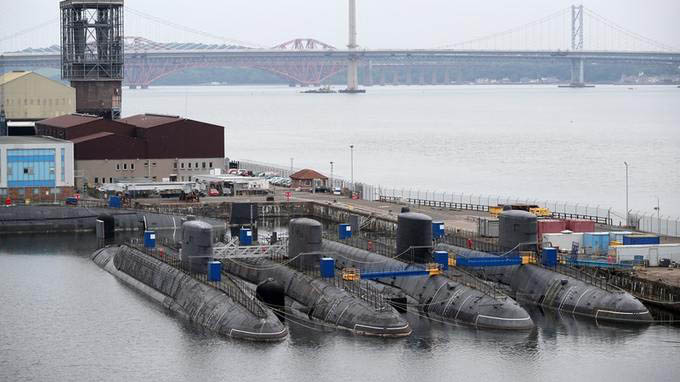
The National By Xander Elliards 8th September 24
CONCERNS have been raised that the deteriorating state of the UK’s nuclear submarines is “potentially putting the vessel and her crew at risk”.
Alarm bells were rung after the Ministry of Defence (MoD) announced last week that Defence Secretary John Healey had joined one of the UK’s four Vanguard-class submarines as it returned to dock at Faslane.
An image shared by the MoD showed Healey looking at the submarine, which appeared covered in algae, slime and rust along its entire length.
Further photos taken by locals living near the HM Naval Base Clyde showed the submarine was missing numerous patches of anechoic tiles – which line the exterior to help hide the submarine from sonar.
The submarine is thought to have been on patrol since mid-March, meaning it had spent around 160 days underwater.
In March, HMS Vengeance returned to Faslane after 201 days underwater – reported to be the second-longest patrol ever – directly following a mission which lasted 195 days. Patrols on the previous Polaris generation of nuclear submarines averaged 60-70 days, according to the Campaign for Nuclear Disarmament (CND)
HMS Vengeance is one of four Vanguard-class submarines, which were each built with a 25-year lifespan – a limit imposed by the lifespan of major components – and either commenced sea trials or saw their reactor go critical in 1992, 1994, 1996, and 1999. The UK Government noted in 2007 that it “should be possible” to extend these lifespans by five years to a total of 30.
At least one submarine is meant to be patrolling the oceans at any time in order to deliver a nuclear strike if the UK Government orders it. However, the ageing fleet meant that essential works had to be carried out to keep the submarines seaworthy, placing higher pressure on the remaining boats.
In January, alarm bells had been rung after Dominic Cummings, a key adviser during Boris Johnson’s time in Downing Street, said there was a hidden “scandal of nuclear weapons infrastructure” which he called a “dangerous disaster and a budget nightmare of hard-to-believe and highly classified proportions”.
Issues with ageing equipment nearly led to a major disaster in 2022 after a broken depth gauge meant one nuclear submarine was continuing to descend despite unknowingly approaching “crush depth”.
On Saturday, the Daily Mail reported that none of the UK’s attack submarines are currently at sea, and the majority (16 out of 25) of the country’s warships are broken down, being modified, or undergoing trials. Retired rear admiral Chris Parry called the situation “utterly dire”.
In May 2023, HMS Vanguard finally completed a seven-and-a-half-year refit, and in March 2024, work on HMS Victorious was also completed. The final boat in the fleet is called HMS Vigilant, but it is not clear which of the four were greeted by Defence Secretary Healey at Faslane last week.
Responding to the nuclear-armed submarine returning to Faslane, Chris McEleny, Alba Party’s general secretary and a former MoD employee, said: “The latest sight of a Vanguard-class submarine returning to base caked in algae is very concerning. And, yet again we see anechoic tiles are missing, potentially putting the vessel and her crew at risk.
“The lengthy patrols should also spark concerns as to whether or not subs are going out on patrol with increased payloads due to concern over the half-life.
“The MoD have, as usual, failed to provide basic guarantees in regards to the safety-critical implications of these prolonged patrols.”…………………………..
Lynn Jamieson, the chair of the Scottish CND, claimed that the “UK’s nuclear weapons system is a shambles but that does not capture the absurdity and seriousness of its dangers”.
“The longer at sea, the more mental and physical stress on the crew and the more chance of accidents,” she went on. “The older the submarine the more the risks of unplanned radioactive leaks and other such incidents.
“The cost of keeping the ageing nuclear weapon system going and simultaneously building a replacement grows while public services are drastically cut. In 2023 alone, it cost £6.5 billion [according to a report from the independent Nuclear Information Service] and it will be even more this year.”……….
Jamieson said the UK Government should show “true leadership [and] scrap the old system and its replacement rather than continuing to valorise a capacity for genocide that puts the world in peril, a target on our backs and risks in our backyard”.
SNP MSP Bill Kidd, the co-president of Parliamentarians for Nuclear Non-Proliferation and Disarmament (PNND), said Scotland was the “dumping ground for nuclear leaks and discharges into our waters and coasts and we are the target for any potential nukes an enemy would fire at”.
“Nothing is planned to change in all this as far as Westminster is concerned – and that means Labour every single bit as much as Tories”, he said……………………………….. https://www.thenational.scot/news/24568990.new-images-raise-concerns-state-uk-nuclear-submarines/
Submission- Tom Warwick -re new agreement on Naval Nuclear Propulsion- not in the public interest, designed to provoke China
The other partners in the deal take no risk and Australia agrees to accept all the risks and nuclear waste. The government who agreed to this deal is not acting in the interest of the people and is either naive or traitorous
China does not want war with Australia, China has not fired a shot in 40 years, China is trying to prove that their model of prosperity without war is superior and they are successful in doing so.
Submission no 11 https://www.aph.gov.au/Parliamentary_Business/Committees/Joint/Treaties/NuclearPropulsion/Submissions
Dear senate committee, I am a member of the Australian public, and a voter in the electorate of
Durack. I represent myself and the ordinary people of Australia.
The AUKUS deal is not in the interest of the Australian people.
The opportunities forgone by spending an exorbitant $368B on nuclear submarines is enormous, we
have great need in this country for public spending on social programmes, social and commercial
infrastructure.
Not only does the AUKUS spending not produce social good it is harmful and causes risks to
Australian society.
The other partners in the deal take no risk and Australia agrees to accept all the risks and nuclear
waste. The government who agreed to this deal is not acting in the interest of the people and is
either naive or traitorous. If naïve the government should be removed, if traitorous the government
must be prosecuted and severely punished.
The submarines are not defensive in nature, the reason why nuclear has been chosen is that they
can operate far off shore and not in Australian territorial waters to provoke and possibly attack an
adversary far away, and though it has not been explicitly stated China is the object of this
antagonism, our largest trading partner and the nation upon who most of our prosperity depends.
China does not want war with Australia, China has not fired a shot in 40 years, China is trying to
prove that their model of prosperity without war is superior and they are successful in doing so.
AUKUS is not in the public interest
AUKUS has never been demanded by the Australian people
AUKUS places an excessive financial burden in the public purse, funds that could be much
better spent on public infrastructure.
There are no guarantees that Australia will receive anything from AUKUS except public debt,
nuclear waste from Britain and USA and risk.
AUKUS is provocative to our most valuable trading partner
Please cancel AUKUS now.
Submission- Dr Marty Branagan -re new agreement on Naval Nuclear Propulsion- it’s the worst foreign policy mistake
It will contribute to a regional arms race which could have disastrous consequences.
China and Australia have a mutually-beneficial trade relationship which this deal will harm.
a growing national movement which wants an end to AUKUS
Submission no. 10 https://www.aph.gov.au/Parliamentary_Business/Committees/Joint/Treaties/NuclearPropulsion/Submissions
The acquisition of a fleet of nuclear-powered submarines (some of them second-hand) costing up to
A$368 billion is the largest defence project since World War Two and the worst foreign policy
mistake since a failed bid to introduce conscription during World War One, according to former
prime minister Paul Keating. Occurring with little public consultation, it was supported by a ‘Red
Alert’ series of fearmongering front-page articles in Australia’s ‘Nine’ newspapers in consultation
with the Australian Strategic Policy Institute, which has close ties to arms dealers, and which argued
for greater defence capabilities to resist a supposedly imminent war with China. Yet China and
Australia have a mutually-beneficial trade relationship which this deal will harm. It will contribute to
a regional arms race which could have disastrous consequences. It is already shifting valuable
resources away from the more pressing threat of global warming facing both countries. The cost is
massive at a time of desperate need for social housing and cost-of-living relief; for that money, far
more people could be employed in education, health, housing, agricultural, environmental and social
service
The project can be cancelled with a year’s notice according to a revamped AUKUS agreement tabled
in federal parliament, and there’s no guarantee whether an almost $5 billion payment to the USA
will be refunded if no nuclear-powered boats are delivered. Australia has also agreed to indemnify
the US and UK against any loss or injury connected to nuclear materials transferred here. Resistance
has been fierce, with a series of protests against plans for a new submarine base in Port Kembla,
some drawing 5,000 protesters. The South Coast Labor Council, consisting of unions representing
50,000 workers, fear the base could choke a nascent clean energy sector by taking up scarce land
and ushering in security curbs, while the permanent presence of U.S. warships would be a nuclear
target. Environmentalists are concerned about the fact that ‘Australia shall be responsible for the
management, disposition, storage, and disposal of any spent nuclear fuel and radioactive waste
resulting from the operation of Naval Nuclear Propulsion Plants’. The ‘Marrickville Declaration’ by 30
community groups such as the Anti-AUKUS Coalition is part of a growing national movement which
wants an end to AUKUS, claiming that its cost and the open-ended commitment to foreign military
priorities are to the detriment of priorities for a resilient, safe and peaceful Australian society. It also
violates Australian sovereignty and our commitment to a nuclear-free Pacific under the Treaty of
Rarotonga (the South Pacific Nuclear Free Zone Treaty).
Australia’s primary threat is global warming and extreme weather events such as the catastrophic
Lismore floods and 2019-20 bushfires. We would be better served by new fire-fighting planes and
conversion from military operations to disaster response and emergency relief services. Increased
spending on foreign aid, cultural ties, diplomacy, refugee resettlement and nonviolent defence
would strengthen regional peace more cheaply and with a lower environmental footprint.
Dr Marty Branagan
Senior Lecturer in Peace Studies
University of New England
15 August 2024
1 This month

of the week – Australians for War Powers Reform (AWPR)
To see nuclear-related stories in greater depth and intensity
 Antinuclear