
Solar Victoria’s online application portal to re-open Thursday September 5 at 9am, with around 6,000 home solar rebates still up for grabs. The post Victoria rooftop solar scheme to re-open Thursday – 6,000 rebates still on offer appeared first on RenewEconomy.
via Victoria rooftop solar scheme to re-open Thursday – 6,000 rebates still on offer — RenewEconomy
September 5, 2019
Posted by Christina Macpherson |
Uncategorized |
Leave a comment

New nuclear arms race brings higher risk of global catastrophe, The New Daily, Quentin Dempster@QuentinDempster 2 Sept 19The world is at its highest risk of a global catastrophe in decades, thanks to an unpredictable resumption in the nuclear arms race.
Veteran defence and security analyst Brian Toohey has warned that talk of war between the West, and China and Russia, along with brinkmanship with North Korea and Iran, has escalated the conditions that can lead to catastrophic accidents and mistakes.
Adding to the potential for disastrous nuclear consequences, Mr Toohey’s latest book – to be published this week – reveals that “many missile control systems can now be hit by a wide range of previously unknown cyber-warfare tools available to terrorists, hoaxers and governments”.
Mr Toohey’s book, Secret – The Making of Australia’s Security State, outlines a terrifying situation where nuclear weapons continue to exist in massive numbers………
Australia is complicit
Mr Toohey said Australia continued to rely on the US “nuclear umbrella” and was directly complicit in the US nuclear program through the Pine Gap and North West Cape intelligence and communications bases linked to US submarines tasked to detect and destroy Russian and Chinese nuclear-armed submarines.
Coalition governments in Australia had declined to push for nuclear disarmament, with former prime minister Malcolm Turnbull refusing to support a 2017 United Nations resolution to establish a legally binding treaty prohibiting the development or possession of nuclear weapons.
The Turnbull government refused to congratulate ICAN after it was awarded the Nobel Peace Prize in December 2017.
Mr Turnbull later declared that Australia and the US were “joined at the hip”.
The Canberra Commission on the Elimination of Nuclear Weapons concluded in 1996 that “the proposition that nuclear weapons can be retained in perpetuity and never used – accidentally or by decision – defies credibility”.
The only complete defence was the elimination of nuclear weapons with a strong international verification regime to convince the existing nuclear powers to disarm.
Calls for Australia to join the race
Current calls for Australia to consider a nuclear arms capability for its submarines to deter an invasion from China re-emerged from strategic think tanks and academics.
“It is doubtful if China’s relatively small nuclear forces could survive a US attack. The US has a total of 6550 warheads –1350 deployed on long-range missiles and bombers – compared to China’s total of 280,” Mr Toohey writes.
“Ever since George W Bush unilaterally abandoned the Anti-Ballistic Missile Treaty, the US has deployed conventional missiles on ships and land that can destroy nuclear-armed ballistic missiles.”
“Its attack submarines can track and sink China’s four ballistic-missile submarines. This means China must expand its nuclear forces to ensure that enough retaliatory missiles would survive to deter a first strike”.
Quentin Dempster is a Walkley Award-winning journalist, author and broadcaster. He is a veteran of the ABC newsroom. He was awarded an Order of Australia in 1992 for services to journalism nuclear-arms-race/
September 3, 2019
Posted by Christina Macpherson |
AUSTRALIA - NATIONAL, politics, weapons and war |
Leave a comment
The legacy of Chernobyl: Zombie reactors and an invisible enemy ABC News, Foreign Correspondent By Europe correspondent Linton Besser, Mark Doman, Alex Palmer and Nathanael Scott, 3 Sep 2019
“…………… Victims of contaminated food
While there are areas close to the crippled reactor which are perfectly safe, throughout vast stretches of the north-west of the country, many kilometres away, Ukrainians are still grappling with the legacy of the Chernobyl eruption.
The Australian Government’s official travel advice for this region warns tourists not to eat dairy, game, fruits or vegetables “unless they are imported”.
But in a country as poor as Ukraine, where many still subsist on what they can grow themselves, that’s a luxury few can afford.A study of 14 villages in Rivne — a province 200km west of the reactor — found radioactive milk at more than 12 times the safe level for children. That study was conducted between 2011 and 2016 and published last year, 32 years after the explosion. [PITURE HERE]
The paper warned that in the absence of protective measures for the rural population, the radiation poisoning could continue until at least 2040.It’s primarily Ukraine’s youth — including the grandchildren of those who lived through the disaster — who are now paying for it.
 Nine-year-old Kristina, from the small village of Lugove to the west of Kiev, is one of them.
“Sometimes I feel sick,” she told Foreign Correspondent. “I have a headache and my stomach goes around.” In fact, Kristina has an enlarged pancreas and thyroid. She’s suffering the ill effects of consuming contaminated food.
Kristina’s condition is carefully monitored at the Institute of Specialised Radiation Protection on the outskirts of Kiev. The facility was established just months after the accident, and it is still taking on hundreds of new patients every year. All of them are children.
“[They] do not understand what Chernobyl was, the kind of catastrophe [it was],” the institute’s chief nurse, Nataliya Moshko, said. Often, the children do not believe they are sick at all.Still, it’s better than it was. When she first began in nursing, Nataliya was caring for children diagnosed with terminal cancer, “because of the consequences of the Chernobyl disaster”.
Now long dead, she insisted, “I remember every one”.
The legacy of the accident endures. As of January, of the 2.1 million people registered with Ukraine’s health authorities for treatment for Chernobyl-related illnesses, 350,000 were children.
“The problem is that the Chernobyl disaster with its consequences was not solved very quickly at that time,” Nataliya said. “And now these vast territories of Ukraine, and many, many thousands of people are contaminated.”The children spend weeks in the hospital to receive treatment, but also to be fed a clean diet. If and when their symptoms ease, and they’re discharged, they return home to the same contaminated environment which made them ill in the first place.
Food markets across the country are required to test local produce for the two isotopes which persist in the environment — Strontium-90 and Caesium-137.
Berries, mushrooms and milk contaminated by radiation are meant to be discarded, but reports abound of radioactive berries being merely discounted instead.On a visit to a testing laboratory attached to one large fresh produce hall in Kiev, officials take great care in demonstrating the rigour with which they test for Caesium-137.
But when asked how they went about checking for the Strontium isotope, they shrug their shoulders; there’s no money for the equipment needed to do so……… https://www.abc.net.au/news/2019-09-03/chernobyls-radioactive-legacy-zombie-reactors-an-invisible-enemy/11432430
September 3, 2019
Posted by Christina Macpherson |
General News |
Leave a comment

Predicted Track mapped with Nuclear Power Stations (Skulls) after satellite pictures and St. Lucie NPS image. Forecast further below. Hurricane Dorian at 7.21 AM EDT, Sept 2, 2019 Hurricane Dorian at 8.51 AM EDT, Sept 2, 2019 St. Lucie Nuclear Power Station. Yes, it’s really sitting out there on the Atlantic on a barrier island. […]
via Hurricane Dorian 8 AM Advisory & Predicted Track Mapped with Nuclear Power Stations — Mining Awareness +
September 3, 2019
Posted by Christina Macpherson |
Uncategorized |
Leave a comment
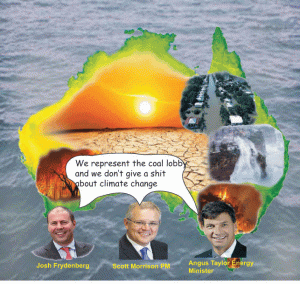 The Coalition is now taking yet another slice of that pudding. Unlike New Zealand, Germany, France, the UK and others, it will continue to draw on unused emission “credits” from the Kyoto era, which expires next year, to meet the modest 2030 target it set for itself in Paris four years ago.
With the exception of two brief years when a carbon price was in operation, emissions have continued to rise. So the Morrison government, like its predecessors, doesn’t mention them. Instead it refers repeatedly to “our target”, which we are meeting “in a canter”.
Australia has now been playing its Kyoto card for over 20 years, and shows no sign of ending the deception.
Kyoto is a magic pudding that keeps on giving.
Is mindless planet-trashing the way to go? http://southwind.com.au/2019/09/03/is-mindless-planet-trashing-the-way-to-go/ 3 September 2019 by Peter Boyer
The Morrison government is engaging in the kind of international chicanery we used to associate with tinpot dictatorships. When the United Nations emerged out of World War II, Australia was widely recognised as a model international citizen, a light helping to guide the world in a new age of diplomacy.
Civilisation’s answer to the wreckage left by nationalism was the UN’s multilateral world order. Both Coalition and Labor leaders knew that it gave a leg up to a middle-sized power like Australia, and worked hard to build our country’s reputation as a good global citizen.
Many older northern nations struggled with the new order, but Australia punched above its weight, notably in environmental advocacy. We led the world in pressing for UN measures to protect natural values in our part of the world, including the Southern Ocean and Antarctica.
Our efforts were noticed. We secured the first UN presidency. UNESCO’s World Heritage committee held its first southern hemisphere meeting in Sydney, and the first Antarctic Treaty meeting was held in Canberra. We hosted the headquarters, in Hobart, of the Commission for the Conservation of Antarctic Marine Living Resources (CCAMLR).
At the UN’s Earth Summit in 1992 Australia lobbied hard for the proposed framework convention on climate change and quickly ratified its agreement. Everyone expected as much. We had the reputation of taking a holistic view, supporting best collective outcomes.
But then something changed. Australia demanded special treatment at the 1997 Kyoto climate conference. Most developed countries agreed to lower their carbon emissions, but Australia was allowed a significant increase over 1990 levels.
That wasn’t all. Continue reading →
September 3, 2019
Posted by Christina Macpherson |
AUSTRALIA - NATIONAL, climate change - global warming, politics |
Leave a comment
The official death toll from Chernobyl is disputed, but a UN report into the “true scale of the accident” found as many as 4,000 people could die as a result of radiation exposure.
The legacy of Chernobyl: Zombie reactors and an invisible enemy ABC News, Foreign Correspondent By Europe correspondent Linton Besser, Mark Doman, Alex Palmer and Nathanael Scott, 3 Sep 2019, As the Soviet Union grappled with the scale of the disaster unfolding at Chernobyl, radioactive material spewed into the environment.
In the immediate aftermath of the 1986 explosion inside reactor number four of the nuclear power plant, dozens of first responders received fatal doses of radiation, forests surrounding the reactor were poisoned, and nearby waterways were contaminated.
Despite attempts to douse the fire in the core with sand, boron and lead, the reactor burnt for 10 days, releasing huge amounts of radioactive materials beyond the plant’s perimeter.
Three decades on from what is considered to be one of the worst nuclear accidents in history, the fallout from Chernobyl continues to impact lives.
Carried in the prevailing weather patterns, the radioactive particles pouring out of reactor four spread rapidly. Continue reading →
September 3, 2019
Posted by Christina Macpherson |
General News |
Leave a comment
INTERVIEW-Ocean treaty needed to tackle ‘deep trouble’, says UN envoy, http://news.trust.org/item/20190831063635-oygwk/, by Adela Suliman | @adela_suliman | Thomson Reuters Foundation, Saturday, 31 August 2019 The oceans are increasingly threatened by global warming, acidification and pollution, and the impacts will affect us all, warned the U.N. oceans envoy. By Adela Suliman
STOCKHOLM, Aug 31 (Thomson Reuters Foundation) – The world’s seas are increasingly threatened by global warming, acidification and pollution, making it crucial to agree on a global treaty to protect them, the U.N. oceans envoy said.
Peter Thomson warned in an interview with the Thomson Reuters Foundation that the oceans were “in deep trouble”.
“It is worse than we think and there are no easy solutions,” he said at World Water Week in Stockholm this week, as the latest round of talks on a treaty wound up in New York.
The first global ocean treaty is due to be agreed in the first half of 2020. But on Friday environmental group Greenpeace said the negotiations were “disappointing” so far, blaming a lack of political will to secure a “progressive outcome”.
Thomson said a “comprehensive global regime” was needed to accelerate action to protect waters beyond national jurisdictions.
“It is critical in these challenging times for planetary environmental conditions that we develop a binding treaty for the conservation and sustainable use of marine biodiversity in the ocean,” he said.
A flagship scientific report warned this year that two-thirds of the ocean area was already affected by growing human impacts, primarily from stressors linked to global warming.
Climate change and the oceans were “intimately linked”, Thomson said, adding humanity was on a “totally irresponsible course” by not tackling global warming urgently enough. In 2015 nearly 200 nations signed up to the Paris Agreement that aims to keep the rise in average global temperatures to “well below” 2 degrees Celsius (3.6F) above pre-industrial times, and ideally to 1.5C.
“(Climate change) is going to have huge human impact and there will have to be a change of occupations, a change of domiciles,” Thomson warned.
Fishing communities and coastal dwellers would be worse off and needed support to adapt in a warmer world, he added.
A set of global development goals to be met by 2030 include conserving and using oceans, seas and marine resources wisely.
Much of the planet’s rainwater, drinking water, food and weather systems are provided or regulated by the sea.
“Every second breath you take comes from oxygen from the ocean,” said Thomson, a Fijian diplomat.
But seawater warming and acidification could change the chemical composition of the oceans, with profound effects for humans, he warned.
TURNING THE TIDE?
Pollution, including plastic, industrial waste, sewage and fertiliser, poses a serious threat to marine life, Thomson said.
“There are over 500 ‘dead zones’ all over the world where actually no life exists because of what’s coming down those rivers by way of pollution,” he said.
Meanwhile, irresponsible fishing practices have depleted fish stocks and are “part of the human tragedy of ending biodiversity”, he added.
Billions of people depend on oceans for their food and livelihoods, but the U.N. Food and Agriculture Organization has said nearly 90% of fish stocks are over-fished or fully exploited as global demand rises.
Thomson said, however, that pollution and over-fishing were “very fixable” with better environmental management.
Individual action had begun to make inroads – from public beach clean-ups to how people shop and vote.
Climate change, on the other hand, was a more “pernicious” threat to the Earth’s water, he said.
The U.N. climate science panel is due to publish a special report in late September on how climate change is affecting the world’s oceans and frozen water. Thomson said it would be a “guiding light” for future international protection efforts by providing scientific insight on how global warming is affecting life in the sea.
“The report will no doubt provide further support for dramatic scaling up of political ambition (to act),” he said.
“It’s no time to be sitting around philosophising … The changes have to be made now
September 3, 2019
Posted by Christina Macpherson |
General News |
Leave a comment
Will Antarctic Ice Doom Us All? A new study arrives at some disturbing numbers, https://www.sierraclub.org/sierra/will-antarctic-ice-doom-us-all-methane BY
CHLOE ZILLIAC |
SEP 2 2019
For years, scientists have struggled to figure out exactly how much methane is trapped under the ice at the north and south poles and what it would mean for global temperatures if climate change melted enough ice to release that methane into the atmosphere. A new study published in Nature Communications provides the most comprehensive estimate to date: a staggering 80 to 480 gigatons. That’s a wide range, but even at the low end, it’s astonishing. For context, all the cattle and other domestic animals around the world produce an estimated .08 gigatons of methane annually. Eighty gigatons is 1,000 times that amount.
The study, led by Jemma Wadham, a professor at the University of Bristol School of Geographical Sciences and Cabot Institute for the Environment, synthesized prior scientific research on the ice sheets. The study found that ice sheets, while seemingly inert, are intimately connected to the global carbon cycle in ways that both store and release carbon.
In Antarctica, blinding-white ice stretches as far as the eye can see and air temperatures usually stay well below freezing. But scientists have concluded it’s likely that under the ice lies vast stores of organic carbon and methane, created by the slow decomposition of ancient vegetation and marine life that thrived during the Paleocene–Eocene Thermal Maximum, a period 55 million years ago, when Antarctica was teeming with greenery and wildlife (and much of the rest of the earth was uninhabitable). As the climate cooled, the remains of soils, plant and animal life—or marine life, in the case of marine-based ice sheets—became sediment trapped far below the ice. There, microorganisms converted some of it to methane, a potent greenhouse gas.
“This methane is preserved because it is cold and there is enough pressure from the weight of the ice above it,” says Lev Tarasov, associate professor in the Department of Physics and Physical Oceanography at Memorial University and one of the study’s authors. But, says Tarasov, climate change is starting to shift the conditions that have held methane deposits for millions of years. The study’s authors are especially concerned about destabilization in the West Antarctic Ice Sheet, where warm water, imported by shifting wind patterns, is washing up against the ice shelves, causing melting even where air temperatures remain frigid. As the ice shelves grow thinner, the possibility arises that large stores of methane will escape, taking greenhouse gas levels past the global levels that the UN Framework Convention on Climate Change (UNFCC) agreed are the maximum levels to limit warming to 2°C (3.6°F) by 2100.
But as they melt, ice sheets could also help remove carbon dioxide from the atmosphere by drawing it into the ocean. When glaciers grind against the bedrock below them, they create a fine, nutrient rich “rock flour.” As ice sheets melt, some of these nutrients are absorbed by surrounding marine ecosystems, adding vital nutrients that increase microorganism populations, which then suck up dissolved carbon dioxide from the surface level of the ocean. When the microorganisms die, they sink to the bottom of the ocean, taking the carbon dioxide with them, where it forms a carbon-rich sediment.
Tarasov hesitated to quantify how much carbon these microorganisms could take out of the atmosphere—and how much that could mitigate the climate damage caused by the escaped methane. A question like this is one of the hardest to answer, says Tarasov, because relatively small changes in the carbon cycle can lead to huge impacts.
“The problem with understanding the carbon cycle is it depends on the small difference between really big numbers. There is lots of carbon going from the oceans to the atmosphere, or from the atmosphere to the oceans. It just takes small little changes to shift everything around.”
September 3, 2019
Posted by Christina Macpherson |
General News |
Leave a comment
Skin cancer risk in athletes: The dangers of ultraviolet radiation, Science Daily
- Date:
- August 30, 2019
- Source:
- The Physiological Society
- Summary:
- The dangers of ultraviolet radiation exposure, which most often comes from the sun, are well-known. Researchers discuss how broad its effects can be, from premature aging to cancer, and how this can be influenced by different skin tones and the use of sunscreen
- …….. Athletes ranging from hikers, to tennis and runners exceed the recommended ultraviolet exposure limit by up to eight-fold during the summer and autumn months. While regular physical activity is associated with a reduced risk of most cancers, skin cancer is an exception. For malignant skin cancer, those in the 90th percentile for physical activity have an increased risk of cancer than those in the 10th percentile. Sun protection in these groups is especially important as multiple studies demonstrate an elevated risk of skin cancer for those who regularly participate in outdoor sports or exercise.
- The ultraviolet radiation spectrum is categorized by wavelength as UV-A (320-400 nm), UV-B (290-320 nm), and UV-C (200-290 nm) and the biological effects vary per type. UV-A constitutes around 95% of ultraviolet radiation that reaches the earth’s surface, with the remainder being UV-B. In the skin, UV-A is able to reach the skin’s blood circulation but most of UV-B is absorbed in the outer layers of the skin (called the epidermis and upper dermis) due to its shorter wavelengths.
Skin pigmentation is another factor that affects our response to sun exposure. UV radiation affects the body’s ability to create two important substances, vitamin D and folate, which contribute to both a health pregnancy and early childhood development. It helps vitamin D be synthesised, whereas it causes folate to break down.
There is a theory that suggests that early human populations, living in equatorial Africa, evolved skin pigmentation to protect themselves from folate degradation. This theory also says that depigmentation then occurred as humans moved away from the equator to allow for higher levels of vitamin D synthesis.
- The ultraviolet radiation spectrum is categorized by wavelength as UV-A (320-400 nm), UV-B (290-320 nm), and UV-C (200-290 nm) and the biological effects vary per type. UV-A constitutes around 95% of ultraviolet radiation that reaches the earth’s surface, with the remainder being UV-B. In the skin, UV-A is able to reach the skin’s blood circulation but most of UV-B is absorbed in the outer layers of the skin (called the epidermis and upper dermis) due to its shorter wavelengths.
Skin pigmentation is another factor that affects our response to sun exposure. UV radiation affects the body’s ability to create two important substances, vitamin D and folate, which contribute to both a health pregnancy and early childhood development. It helps vitamin D be synthesised, whereas it causes folate to break down.
There is a theory that suggests that early human populations, living in equatorial Africa, evolved skin pigmentation to protect themselves from folate degradation. This theory also says that depigmentation then occurred as humans moved away from the equator to allow for higher levels of vitamin D synthesis….. https://www.sciencedaily.com/releases/2019/08/190830115553.htm
September 3, 2019
Posted by Christina Macpherson |
General News |
Leave a comment

Opinion: ¶ “Investors Are Leading The Climate Change Charge Towards Zero Emissions And Cleaner Fuels While Governments Lag Behind” • Financial giants from Europe, China, Japan, the US, Australia, and elsewhere can see the looming risks and rewards, and they are not waiting for policymakers to signal what needs to be done. [South China Morning […]
via September 2 Energy News — geoharvey
September 3, 2019
Posted by Christina Macpherson |
Uncategorized |
Leave a comment
 It’s not that climate change is getting any better – it’s just that there were fewer news articles about it this week. There was a pretty desperate call from Pope Francis for governments to act.
One weather news item that is getting a lot of coverage is Hurricane Dorian -. not necessarily caused by climate change, but exacerbated by it. It’s of particular interest because of the St. Lucie and Turkey Point nuclear power stations on alert in Florida, potentially in its path. https://www.youtube.com/watch?v=YERxqsFXRQ0
August, the month when we remember the nuclear bombing of Hiroshima and Nagasaki,– has been an ominous month for bringing us all closer to World War 3. Donald Trump moved to trash all the nuclear arms agreements, that might put the brakes on international conflict. Pentagon experts recommended Artificial Intelligence to control nuclear weapons. There have been at least 3 occasions when the imagination and intuition of a human being has just narrowly saved the world from a nuclear holocaust. https://www.youtube.com/watch?v=ZGsrO3klcAs
A bit of good news. Spanish group gives summer holidays to kids from Chernobyl’s polluted region.
AUSTRALIA
NUCLEAR
CLIMATE. Queensland extinguishes native title over Indigenous land to make way for Adani coalmine. Indigenous landowner challenges Environment Minister Sussan Ley’s decision for coal mine.
RENEWABLE ENERGY. NSW coal city, Newcastle, sets sights on 100 per cent renewables. Victoria government triples number of home solar rebates for September. Solar and giant “water battery” to slash university’s grid consumption by 40%.
They are trying to break Julian Assange “physically and psychologically”. Injustices to Julian Assange in British prison. (Why is Australia making a huge fuss about an Australian detained in China, but ignoring Assange?)
Climate change is destabilising the Earth’s marine environment. ‘12 Years to Act on Climate Change’ – what does this really mean?
Nuclear winter – the global threat to life. A freezing and deathly aftermath would follow a US-Russian nuclear war.
BRAZIL. International calls for urgent action on climate, as new fires rage in Amazon forests.
September 2, 2019
Posted by Christina Macpherson |
Christina reviews |
Leave a comment
How many know that, on behalf of us all, ANSTO is already preparing the groundwork for the deployment of Gen VI reactors in the 2030s?
ANSTO stooge Prof Edwards speaking to the Prerequisites Standing Committee “…….. Australia …. has chosen, ….. supporting two reactors: the very high temperature reactor and the molten salt reactor.”
in terms of the reactors Australia has chosen, we’re supporting two reactors: the very high temperature reactor and the molten salt reactor. The very high temperature reactor is probably the highest technology readiness level, or TRL, in that there are a couple being constructed in China at the moment. As part of the generation forum, I will be visiting those in October. They’ve actually started co-commissioning those plans. …. Those two reactors are particularly suitable for Australia
September 2, 2019
Posted by Christina Macpherson |
AUSTRALIA - NATIONAL, politics |
Leave a comment
John Quiggin’s reply to the AFR’s misleading headline, and Aaron Patrick’s article:
“This is a typical gotcha from Aaron Patrick. My view is that, if we could get a substantial carbon price (at least $50/tonne) now, it would be worth removing the existing nuclear ban. As I’ve written elsewhere, nuclear power can’t get started here for at least 20 years, and in the meantime renewables would wipe out all coal and most gas.”
Left support for NSW nuclear power industry, Australian Financial Review https://www.afr.com/companies/energy/left-support-for-nsw-nuclear-power-industry-20190830-p52mji Aaron Patrick Senior Correspondent
Sep 2, 2019
Left-wing economist John Quiggin has urged the NSW Parliament to legalise nuclear power, making the University of Queensland academic the most prominent environmentalist to support the controversial energy source.
Economist John Quiggin supports nuclear power. [?]
Professor Quiggin told a NSW parliamentary inquiry into uranium mining and nuclear power that the ban should be lifted simultaneously with the introduction of a price charged for emitting Greenhouse gases.
“The Parliament should pass a motion … removing the existing ban on nuclear power,” he said in a written submission. “Nuclear power is not viable in the absence of a carbon price.”
The inquiry, one of three similar under way, is seen by some Coalition MPs as the start of a long process of convincing voters to support nuclear reactors to replace the state’s ageing coal power stations, including Liddell in the Hunter Valley, which is due to close after the summer of 2023……..
The Minerals Council of Australia, a lobby group, successfully pushed for a federal parliamentary inquiry into nuclear, which is examining the feasibility of a new generation of compact power plants that are meant to be safer and much cheaper than the huge stations that supply about 11 per cent of the world’s electricity……..
The NSW inquiry is the result of a private members bill introduced by state One Nation leader Mark Latham that would allow uranium mining. Nuclear power is banned in NSW under federal and state regulations…….
The biggest impediment to development of the industry is opposition from the Labor and Greens parties, environmental groups and left-wing think tanks such as The Australia Institute.
The conditional support of left-wing academics such as Professor Quiggin could, over time, lessen opposition to nuclear power, which supporters say could be used as a back up for wind and solar power.
In Victoria a parliamentary inquiry began two weeks ago at the request of a Liberal Democrat MP, David Limbrick.
The 12-month inquiry will explore if nuclear energy would be feasible and suitable for Victoria in the future, and consider waste management, health and safety and industrial and medical applications, AAP reported.
Aaron Patrick is The Australian Financial Review’s Senior Correspondent. He writes about politics and business. Connect with Aaron on Twitter. Email Aaron at apatrick@afr.com.au
https://www.afr.com/companies/energy/left-support-for-nsw-nuclear-power-industry-20190830-p52mji
September 2, 2019
Posted by Christina Macpherson |
AUSTRALIA - NATIONAL, media |
Leave a comment
Before the nuclear lobby has even got the Australian Parliament to overturn Australia’s legislation prohibiting nuclear power, they are launching their “win hearts and minds”action.
With this catchy title “Stand Up For Nuclear”- they are holding a rally on Sunday October 20, 2019 at 3 PM – 6 PM at an undisclosed location in Collins St Melbourne.
Their lying propaganda claims that:
“”Only nuclear can lift all humans out of poverty while protecting the natural environment.
anti-nuclear activists are funded by natural gas and renewable energy interests.” – (that’s news to me – 12 years of running this site I have received zero funding)

September 1, 2019
Posted by Christina Macpherson |
AUSTRALIA - NATIONAL, spinbuster |
Leave a comment
 Noel Wauchope 31 Aug 19
He’s an expert at it.
What the nuclear industry wants is the removal of Australia’s Federal and State legislation that prohibits the nuclear industry in Australia.
Ziggy delivers.
Sure, he makes motherhood statements about nuclear dangers, about costs etc. He even gives a subtle little tick to that distracting fantasy – small modular nuclear reactors.
But Ziggy faithfully conveys the central message of the global nuclear lobby to Australia:
September 1, 2019
Posted by Christina Macpherson |
Christina reviews |
Leave a comment






 Noel Wauchope 31 Aug 19



 Antinuclear