AI goes nuclear
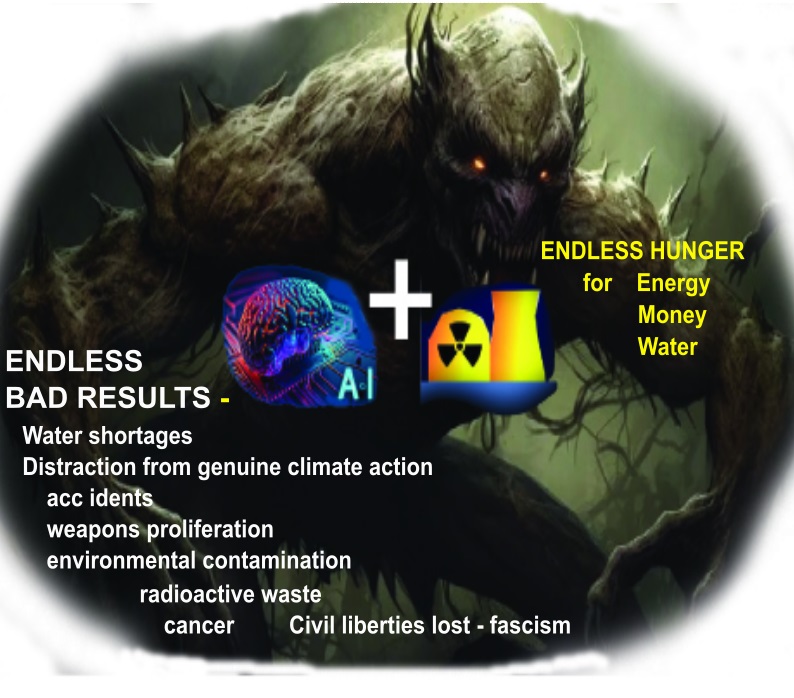
Big tech is turning to old reactors (and planning new ones) to power the energy-hungry data centers that artificial intelligence systems need. The downsides of nuclear power—including the potential for nuclear weapons proliferation—have been minimized or simply ignored.
Bulletin, By Dawn Stover, December 19, 2024
When Microsoft bought a 407-acre pumpkin farm in Mount Pleasant, Wisconsin, it wasn’t to grow Halloween jack-o’-lanterns. Microsoft is growing data centers—networked computer servers that store, retrieve, and process information. And those data centers have a growing appetite for electricity.
Microsoft paid a whopping $76 million for the pumpkin farm, which was assessed at a value of about $600,000. The company, which has since bought other nearby properties to expand its footprint to two square miles, says it will spend $3.3 billion to build its 2-million-square-foot Wisconsin data center and equip it with the specialized computer processors used for artificial intelligence (AI).
Microsoft and OpenAI, maker of the ChatGPT bot, have talked about building a linked network of five data centers—the Wisconsin facility plus four others in California, Texas, Virginia, and Brazil. Together they would constitute a massive supercomputer, dubbed Stargate, that could ultimately cost more than $100 billion and require five gigawatts of electricity, or the equivalent of the output of five average-size nuclear power plants.
Microsoft, Amazon, Apple, Google, Meta, and other major tech companies are investing heavily in data centers, particularly “hyperscale” data centers that are not only massive in size but also in their processing capabilities for data-intensive tasks such as generating AI responses. A single hyperscale data center can consume as much electricity as tens or hundreds of thousands of homes, and there are already hundreds of these centers in the United States, plus thousands of smaller data centers.
In just the past year, US electric utilities have nearly doubled their estimates of how much electricity they’ll need in another five years. Electric vehicles, cryptocurrency, and a resurgence of American manufacturing are sucking up a lot of electrons, but AI is growing faster and is driving the rapid expansion of data centers. A recent report by the global investment bank Goldman Sachs forecasts that data centers will consume about 8 percent of all US electricity in 2030, up from about 3 percent today

Bill Gates, Jeff Bezos, Elon Musk, Mark Zuckerberg, Larry Ellison, and other so-called “tech bros” who also happen to be among the world’s richest men have thought about how the energy industry can—or must, in their view—keep pace with AI’s rapid growth while also enabling Big Tech to meet its climate commitments. They have all come to the same conclusion: Nuclear energy, whatever it costs, is the only viable solution.
In a rash of recent announcements, Big Tech companies have declared that they will either be reviving existing nuclear power plants, developing next-generation nuclear reactors, or both. Dollars are also flowing to nuclear fusion projects—even though many physicists think commercial fusion power plants that generate electricity are at least decades in the future, if they ever can be built. The federal government is not only supporting this nuclear-powered vision but also subsidizing it in the name of “clean energy.” However, both the government and the tech industry are largely ignoring the known and significant downsides of nuclear power—including high costs, long construction times, accidents, nuclear weapons proliferation risks, and environmental contamination from uranium mining and radioactive waste disposal.
Betting on nuclear. Again.

In Pennsylvania, Microsoft has plans to revive Three Mile Island. For people old enough to remember that name, it’s synonymous with the demise of nuclear power in the United States. Forty-five years ago, a partial reactor meltdown at the Three Mile Island nuclear power plant 10 miles south of Harrisburg, Pennsylvania, gripped the nation and exposed nearly two million people to radiation. It was the worst accident in the history of the US commercial nuclear power industry.
The failed reactor never operated again, but a similar reactor built on the same island in the Susquehanna River was restarted six years after the accident and later received a license extension until 2034. That reactor was shut down in 2019 after its owner, Constellation Energy, was unable to secure subsidies from the state of Pennsylvania and deemed the reactor a financial albatross. Now, however, Constellation plans to reopen the reactor and sell 100 percent of the electricity that will be generated by it—enough to power 800,000 homes—to Microsoft………………………………………………………………………………………………..
The sudden interest in nuclear energy is largely due to AI, which is rapidly transforming the tech industry. Electric utilities are forecasting the nation will need the equivalent of 34 new, full-size nuclear power plants over the next five years to meet power requirements that are rising sharply after several decades of falling or flat demand.
Microsoft, Amazon, and other tech giants are not interested only in reviving existing nuclear plants. They are also funding the development of next-generation nuclear reactors. ……………………………………………………………….
Counting “compute”
Globally, electricity demand is also soaring and is now expected to be 6 percent higher in 2035 than the International Energy Agency forecast just a year ago. Electricity consumption by data centers, of which there are already 11,000 worldwide, could reach more than 1 million gigawatt-hours in 2027—about as much total electricity as Japan now uses annually, according to a recent analysis by the agency……………………………………………………………………………………………………………..
An analysis done by OpenAI in 2018 found that the amount of “compute” required to train the largest AI models was doubling every three to four months. An analysis of more recent models reports that the training requirements multiplied by four to five times annually during the past four years………………………………………………………………..
Based solely on current trends, power consumption at US data centers is projected to grow by about 10 percent annually between now and 2030. By one estimate, the exponential growth of AI could consume nearly all the world’s energy production by 2050……………………………………………
In the meantime, data centers are being built faster than energy capacity is expanding. The rapid growth of this sector has not been adequately figured into climate models and is rarely mentioned as a safety concern about AI. In the March 2023 “pause” letter that called on AI labs to stop training the most powerful AI systems for at least six months, tech experts expressed concern about losing jobs—or even control of civilization—but not about climate impacts.
The AI boom is heavily dependent on power-hungry graphics processing units,…………………………………………………………………………………………………………………………………………………………………..
A dirty secret
Whether it’s chip manufacturing or bot training and chatting, where will the energy for AI activity come from? Big tech companies have been prominent in efforts to move toward a carbon-free economy. But with the rise of AI, tech-related emissions are going up.
…………………………………………………… the AI boom has pushed climate goals aside. Microsoft’s emissions, for example, are up by 30 percent since 2020. Google’s emissions have risen by almost 50 percent over the past five years. “As we further integrate AI into our products, reducing emissions may be challenging due to increasing energy demands from the greater intensity of AI compute, and the emissions associated with the expected increases in our technical infrastructure investment,” Google acknowledged in its 2024 environmental report.
………………………………………………………………………………………………………… there is no solid evidence that AI can deliver a quick fix for the climate crisis. In fact, AI is also helping the oil and gas industry increase production of fossil fuels. In Guyana, for example, ExxonMobil is using AI “to determine the ideal parameters for drilling” in deep water. For now, at least, AI’s massive environmental footprint is more of a climate problem than a solution.
Is this the “nuclear renaissance”?
As AI’s energy demands grow more intense, and it becomes increasingly clear that the expansion of wind and solar power cannot keep pace, tech leaders have set their sights on nuclear energy.
So nuclear hype has flowed like champagne at a wedding reception.

Proponents of nuclear power have been predicting a “nuclear renaissance” for nearly a quarter-century. But nuclear has never been cost-competitive with other energy sources, and that is unlikely to change anytime soon. The US Energy Information Administration’s Annual Energy Outlook 2023 projected that renewable power would continue to outcompete nuclear, even in scenarios that predict aggressive cost declines for nuclear.
The Biden administration embraced subsidies to keep existing nuclear power plants online and reopen closed ones—for example, a $1.52 billion loan guarantee from the Energy Department is what made it possible for the owner of the shuttered Palisades nuclear plant to announce plans for a reopening. “In 2022, utilities were shutting down nuclear reactors; in 2024, they are extending reactor operations to 80 years, planning to uprate capacity, and restarting formerly closed reactors,” the Energy Department approvingly noted in a report released at the end of Climate Week NYC in late September.
The White House also recently offered $900 million in new funding for small reactors. In its initiative for AI, the Energy Department waves vaguely at plans to “unlock new clean energy sources, optimize energy production, and improve grid resilience.”

“We’re looking at a chance to build new nuclear at a scale not seen since the ‘70s and ‘80s,” Secretary of Energy Jennifer Granholm said at the opening plenary of the American Nuclear Society annual conference in June.
The Energy Department sees potential for a “commercial liftoff” that could triple US nuclear capacity by 2050 and puts a positive spin on AI’s role in boosting nuclear: “AI and data center load growth is aligning the fundamentals for new nuclear with requirements for 24/7 power, valuing decarbonization, and investment in new generation assets.”
Despite this federal support, the nuclear renaissance so far lacks an order book for new nuclear plants that are actually being constructed. What it does have, as noted in the White House’s “liftoff” report, is “a set of customers who are willing and able to support investment in new nuclear generation assets.” Namely, big tech companies that can afford to pay big electricity bills…………………..
Although tech titans currently have ample funds to invest in energy, the cost curve for AI is going up. The expense of powering chatbots is already climbing so fast that companies are holding back their newest versions from the public.
Existing nuclear power can’t satisfy the demand for energy that is not only more abundant but also cheaper. “We still don’t appreciate the energy needs of this [AI] technology,” lamented OpenAI CEO Sam Altman at the World Economic Forum in Davos in January. “There’s no way to get there without a breakthrough.” Altman, who has warned that AI’s “compute costs are eye-watering,” called for increased investment in nuclear fusion as well as fission.
The fission (and fusion) frenzy
In addition to OpenAI, Altman also chairs Oklo, a nuclear power startup that went public last year when it merged with a special purpose acquisitions company that Altman also chairs. Oklo plans to build its first liquid metal-cooled sodium fast reactor at Idaho National Laboratory in 2027. However, the company’s initial application for a license was denied—for lack of information—by the Nuclear Regulatory Commission in January 2022 and has not yet been re-submitted.
In August 2023, the Pentagon announced an “intent to award” a contract to Oklo for a small modular reactor at an Air Force base in Alaska. However, the deal was quietly revoked a month later.
Despite setbacks like these, Altman sees the future of nuclear energy and AI as inextricably linked. “I don’t see a way for us to get there without nuclear,” he told CNBC last year.
Retired Microsoft co-founder Bill Gates is not as worried about AI’s energy demands as Altman is, but he too is bullish on nuclear energy. Among his multiple investments in nuclear startups is a company called TerraPower, which has received funding from the Energy Department and Los Alamos National Laboratory to develop a sodium-cooled fast reactor similar to Oklo’s.
Gates has invested more than $1 billion in a TerraPower plant that broke ground in Kemmerer, Wyoming, in June. TerraPower says the reactor will be operational by 2030. But construction of the plant’s Natrium reactor has not yet begun, nor has it been approved by the Nuclear Regulatory Commission (NRC), which is still conducting safety and environmental reviews.
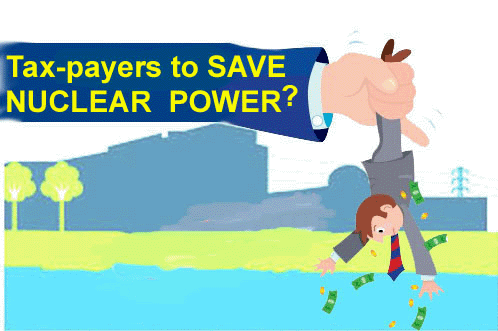
Gates issued a celebratory announcement calling the science behind the reactor “super cool.” Not mentioned in the announcement is the estimated price for the 345-megawatt reactor: $4 billion, of which the federal government is contributing half. Even if the project comes in on budget (which would make it exceptional among US nuclear reactors of the past several decades), it will be more expensive than comparable gas or renewable projects.
Microsoft and Google are also placing bets on nuclear. Earlier this year, Microsoft hired a director of nuclear technologies and a director of nuclear development acceleration to lead the company’s strategy for powering AI advances with small, onsite nuclear reactors—as well as buying energy from larger conventional reactors such as Three Mile Island. Microsoft, which has invested $13 billion in OpenAI and owns almost half of its equity, plans to use AI to expedite the process of getting nuclear plants approved and has been training an AI model on regulatory and licensing documents.
Google last month signed an agreement to buy a total of 500 megawatts of generating capacity—about half the output of a conventional nuclear reactor—from six to seven Hermes small modular reactors designed by Kairos Power. Google aims to deploy the reactors next to Google data centers by 2030. This past summer, Kairos broke ground on an NRC-permitted demonstration reactor in Oak Ridge, Tennessee. It was the first non-water-cooled US reactor approved for construction in more than 50 years.
Michael Terrell, senior director for energy and climate at Google, said the agreement with Kairos could help the company support AI technologies and “reliably meet electricity demands with carbon-free energy every hour of every day.”

Wealthy tech companies and individuals are investing in nuclear fusion as well as fission. Peter Thiel, who co-founded PayPal and was the first outside investor in Facebook, joined Altman in backing a fusion startup called Helion, which claims it will begin producing electricity from its first commercial reactor by 2028 and will sell it to Microsoft.
Breakthrough Energy Ventures, a venture capital firm founded by Bill Gates, has invested in Helion and three other fusion startups. One of those ventures, an MIT spinoff company called Commonwealth Fusion Systems, is also backed by Amazon CEO Jeff Bezos and has received $1.8 billion in second-round venture capital. Commonwealth announced earlier this week that it has leased land to build a commercial-scale fusion power plant in Virginia, but the company has not yet secured any permits or customers.
Critics such as Daniel Jassby, the former principal research physicist at the Princeton Plasma Physics Lab, have called the excitement surrounding these fusion projects “over-the-top and unjustified.”………………………………………………………………………………………
The downsides of nuclear
Despite massive infusions of money from corporations, billionaires, and governments, nuclear is not a sure bet. Around the world, large reactors have repeatedly come in over budget and behind schedule, and although they require lower initial capital investment, smaller reactors are likely to be even less economic than the larger ones that now exist, in terms of the cost of the electricity they produce.
“Very few of the proposed SMRs have been demonstrated, and none are commercially available, let alone licensed by a nuclear regulator,” wrote Allison Macfarlane, who chaired the NRC a decade ago and now directs the School of Public Policy and Global Affairs at the University of British Columbia, in an essay published last year by IAI News.The only SMR reactor design certified by the NRC is the NuScale Power reactor, which received more than $200 million in federal support and was slated to be built at the Idaho National Laboratory. But the projected cost of building the reactor ballooned between 2020 and 2023; its only committed utility customer dropped out, and the project was canceled a year ago.
The only new nuclear reactors that have been built in the United States in the past 30 years are Vogtle Units 3 and 4 in Georgia. These Westinghouse AP1000 pressurized water reactors were the nation’s first “advanced” reactors, but they ended up costing $35 billion (more than twice as much as originally projected) and were completed seven years behind schedule.
There are more than 50 designs for new reactors, and the tech giants investing in nuclear do not seem to be working toward a standardized design—something that many nuclear experts recommend as the best way to get plants approved and built quickly and affordably.
Cost and time are not the only obstacles that must be overcome if nuclear is to meet the AI-energy problem. The work force needed to build a host of nuclear projects has dwindled as plants have closed and not been replaced. Also, none of the proposed new projects has included any new ideas for what to do about the radioactive waste generated not only by reactors by also by uranium mining. There is still no permanent repository for long-lived radioactive waste in the United States.
Radioactive waste isn’t just a disposal problem, either. “Bill Gates should be worried about reprocessing and proliferation,” said Alex Glaser, a nuclear security expert at Princeton University and a member of the Bulletin’s Science and Security Board.
Concepts like the Oklo fast reactor would produce fissile material that bad actors could use to make nuclear weapons. Oklo and other nuclear startups propose to reprocess their waste to keep costs down. But that reprocessing produces plutonium that could be diverted for use in nuclear weapons. The United States rejected reprocessing in the 1970s after determining that the potential for proliferation made it too risky for commercial use.
n all the hype about AI and nuclear, there is scant mention of nuclear weapons proliferation to more countries or the risk that fissile material could be acquired by (or provided to) terrorists. Nor is there much attention to the vast amounts of raw materials and water required for the growth of both AI and nuclear energy, or the electronic waste generated by chip manufacturing and data centers.
A conversation of a few dozen questions with an AI chatbot may require a half-liter of water. A large data center consumes more than a million gallons of water daily, and some data centers are being built in places where water is already scarce.
Developers are loathe to reveal how much water they use, but after a legal battle with an Oregon newspaper, Google finally agreed to reveal that its data centers in The Dalles consume 29 percent of the town’s water supplies. Google plans to build two more data centers there.
No roadmap for “responsible” AI
AI has been compared to electricity—a utility that people soon won’t be able to live without. But there is currently no framework for regulating this new utility, and AI’s energy demands have been given short shrift in the many discussions of AI’s safety risks……………………………………………………………………………………….
Both incoming vice president JD Vance and Elon Musk, who have the president-elect’s ear at the moment, are strongly pro-nuclear. “Broligarchs” Musk and Peter Thiel played significant roles in the recent presidential campaign. Thiel reportedly had a hand in pushing for JD Vance, who had previously worked for him, as Trump’s vice presidential pick…………………….
The tech bros now have a clear path to the unfettered growth of AI and are already pressing Trump to review federal AI policy and weed out laws and regulations that “may be unnecessarily impeding AI adoption.”
Silicon Valley’s AI gold rush aligns almost perfectly with aspirations at Mar-a-Lago, where AI is seen as a must-win race with China. But a second race is also afoot, one in which skyrocketing US electricity demand may outpace supplies, perhaps leading to power outages and utility rate increases of up to 70 percent by 2029.
History suggests nuclear will be a slow starter in that race. https://thebulletin.org/2024/12/ai-goes-nuclear/#:~:text=Big%20tech%20is%20turning%20to,that%20artificial%20intelligence%20systems%20need.
Letter re: Canada selling fission Uranium to OZ.
Ken Collier, Subject: Canada allows sale of fission Uranium to Australian company
To: Justin Trudeau <justin.trudeau@parl.gc.ca 21 Dec 24
Adding to the very evident dangers of nuclear power generally, a topic well-covered in previous correspondence from myself and many others (https://nuclearwastewatch.weebly.com/ ; https://wethenuclearfreenorth.ca/you-can-help/educational-materials/ ; https://www.ccnr.org/index.html , I see further concerns. The conditions set by Industry Canada about limiting Chinese funding are feeble, to be generous. Anyone familiar with accounting techniques know how easy it is to side-step regulations and limits like those stated. All that is needed is a slight change in categories of expenditure, say, from administration to sales, or exploration to promotion, or human resources to fees, to avoid the intent of the provisions about Chinese funding.
Surely approval from Investment Canada is not all that is needed to let this unwise sale go ahead. Scientific, technical and environmental concerns should also be addressed. In the best case, sales of fission Uranium should just not be allowed.
Canada clears Paladin’s $789 million Fission Uranium takeover, By ReutersDecember 18, 2024
- Paladin gets clearance from Investment Canada
- Canada conditions include no China funding
- Buyout opens way to North American markets
MELBOURNE, Dec 19 (Reuters) – Australia’s Paladin Energy (PDN.AX), opens new tab has received the final green light it needed from Canadian authorities to buy Fission Uranium (FCU.TO), opens new tab in a C$1.14 billion ($789.1 million) deal that cements is position as a major global producer, it said on Thursday.
Paladin got the clearance under the Investment Canada Act on Wednesday and said the deal under which it would acquire Fission’s advanced PLS project in Saskatchewan was expected to be completed by early January 2025.
The clearance comes as prices for the nuclear fuel surge on expectations of a demand spike as the energy transition unfolds. Shares fell 1.8% amid weakness in the mining sector.
The Canadian government in October stepped in to review the proposed tieup on national security grounds, raising concerns it may be derailed by the county that has become increasingly sensitive towards strategic resource firms being taken over by overseas buyers.
Paladin has agreed to several conditions Canada has attached to the merger including not to use any China-sourced finance for funding PLS, or to sell PLS’s uranium directly or indirectly to any China customers beyond China General Nuclear Power Group, which has an existing offtake agreement, it said.
Canada in July cracked down on big mining takeovers, saying it would only approve foreign buyouts of large Canadian firms involved in critical minerals production “in the most exceptional of circumstances.”The Canadian government in October stepped in to review the proposed tieup on national security grounds, raising concerns it may be derailed by the county that has become increasingly sensitive towards strategic resource firms being taken over by overseas buyers.
Paladin has agreed to several conditions Canada has attached to the merger including not to use any China-sourced finance for funding PLS, or to sell PLS’s uranium directly or indirectly to any China customers beyond China General Nuclear Power Group, which has an existing offtake agreement, it said.
Canada in July cracked down on big mining takeovers, saying it would only approve foreign buyouts of large Canadian firms involved in critical minerals production “in the most exceptional of circumstances.”
Coalition’s eye-watering nuclear price tag could buy solar for every Australian home that doesn’t have it (five times over)
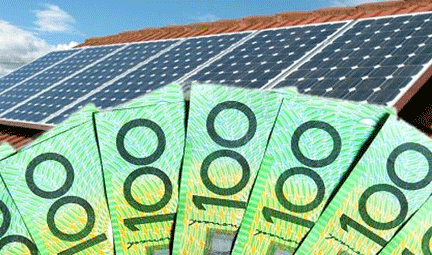
Australian Conservation Foundation, Josh Meadows, 13 Dec 24, https://www.acf.org.au/nuclear-price-tag-could-buy-solar-for-every-australian-home-five-times-over
ANALYSIS from the Australian Conservation Foundation has found for just one-fifth of the Coalition’s nuclear price tag, the government could install rooftop solar on every house in the country that doesn’t already have it.*
And for less than half (42%) of the $331 billion, the government could also install a battery system on every Australian house that doesn’t already have one.
“For just a fraction of what the Coalition says its nuclear ideas will cost, the government could pay for the installation of rooftop solar on every house in Australia, saving households $1,300 a year and generating clean, sustainable energy to power our homes far sooner,” ACF CEO Kelly O’Shanassy said.
“The CSIRO’s GenCost work and multiple independent analyses consistently rank nuclear as Australia’s most expensive energy option.
“The Coalition’s assumptions defy lived experience of the nuclear industry overseas, where nuclear projects routinely run over time and over budget, leaving taxpayers to pick up the tab.
“In the unlikely event the Coalition’s nuclear ideas ever go ahead, we would be waiting at least 20 years for the reactors. That is far too slow to be an effective response to the climate crisis, which is affecting Australians right here, right now. We don’t have two decades to waste.
“Instead of nuclear, Australia’s energy sector is investing heavily in renewable technologies, which already supply 40 per cent of Australia’s electricity.
“The Coalition’s plan is full of holes. It lacks fundamental detail on reactor types, the proportion of nuclear slated for the national grid, as well as site preparation, assessment, licencing and regulatory costs.
“Today’s announcement conveniently ignores the massive costs and risks that come with storing this highly toxic material for thousands of years. The renewables transition is already powering ahead. We don’t need this nuclear distraction. Australia’s energy future is renewable, not radioactive.”
* ACF’s analysis shows the cost of installing solar PV systems on the 6.9 million Australian dwellings that don’t already have solar would be around $63 billion. Calculations based on the average installation cost for a 10kw solar system, at $9,120 in NSW and average battery installation costs at $13,000 (AGL). Does not include inverter costs.
Power, control and symbolic masculinity: How Freud might diagnose the pro nuclear lobby
ReNewEconomy, Giles Parkinson, Dec 19, 2024
When faced with arguments for nuclear power in Australia, many in the energy industry scratch their heads and wonder where they are coming from – the fossil fuel lobby, political ideology and other vested interests are often cited as the reasons, along with a hatred of renewables.
On close inspection, nuclear – at least in Australia – makes no sense on an economic, climate or even grid engineering and management perspective.
But maybe the problem runs deeper than that. John Poljak, a founder at Keynumbers and something of a data nerd (it appears) pondered the question and decided to ask ChatGPT for an answer.
“Australia’s nuclear debate is as polarising as it gets, with two starkly opposed camps,” Poljak writes on LinkedIn. “Let’s be honest – facts alone aren’t likely to sway minds here. So why not take a different approach and explore the deeper psychological forces at play?
So he asked ChatGPT why people might prefer nuclear over renewables.
“For a balanced perspective, I’ve also asked ChatGPT to explore the reverse scenario: Why might the ‘patient’ prefer renewables over nuclear? The answer might surprise you!”
Or, may be – if you have met some nuclear boosters – the answer won’t surprise you at all. We decided we couldn’t do any better than simply reprint the answers, as published on LinkedIn by Poljak.
See what you think. Despite the positive prognosis, we’re not convinced the pro-nuclear lobby is going to sign up for the recommended treatment.
Oh, and if you are interested in pursuing the issue further, here is another musical perspective on the Coalition nuclear proposal, from a group that call themselves the NEMChat Singers, Stake it on the Atom.
The subject group demonstrates a pronounced preference for nuclear energy over cheaper renewable alternatives. From a Freudian psychoanalytic perspective, this preference may be interpreted as stemming from underlying unconscious drives, particularly those related to power, control, and symbolic masculinity.
- The Symbolism of Nuclear Power: Nuclear energy serves as a potent phallic symbol – a technological manifestation of potency, authority, and industrial mastery. The size, complexity, and centralization of nuclear facilities mirror the patriarchal ideals of dominance, precision, and order. For individuals navigating the existential anxieties of middle age – such as waning virility, diminishing career dominance, and an encroaching sense of societal irrelevance – nuclear power provides an unconscious projection of strength and continuity.
Fear of Fragmentation (Dispersed Renewables): Renewable energy, particularly solar and wind, is decentralized, diffuse, and perceived as inherently “feminine” in its relationship to nature, fluidity, and “soft power.” To the Freudian psyche, this challenges the hierarchical, centralized models of energy production that resonate with a paternal superego. Renewables may unconsciously symbolize a loss of control and traditional authority, evoking latent anxieties about societal shifts away from rigid masculinity.
- Latency of Childhood Influences: Many members of this cohort were raised during the Cold War era when nuclear technology was framed as an apex of human achievement. Early life exposure to narratives of nuclear power as an emblem of progress and invincibility may resurface as repressed nostalgic idealization, leading to its advocacy in adulthood.
Treatment Recommendation
- Confrontation of Symbolic Associations: A structured exploration of the symbolic meanings attributed to nuclear versus renewable energy may help subjects recognize their emotional attachments. Psychoeducation regarding the symbolic neutrality of energy sources could loosen the phallic projections onto nuclear power.
Embrace of Decentralized Power Structures: Group therapy focused on reimagining control and security within decentralized systems (e.g., community-owned solar power) could facilitate emotional acclimatization to renewables. Subjects may benefit from recognizing renewable energy as a cooperative expression of resilience rather than a threat to hierarchical order.
- Midlife Reorientation Therapy: Addressing unconscious fears surrounding aging and obsolescence through therapy targeting generativity (Erikson’s stage of psychosocial development) can channel these drives into productive societal advocacy. Renewable energy can be framed as a forward-looking, legacy-building effort rather than a diminishment of traditional ideals.
Prognosis
With appropriate intervention, prognosis is favorable. By fostering awareness of the unconscious biases at play, subjects can transition from rigidly defending nuclear power as a symbolic “bulwark” to embracing renewables as an adaptive, generative solution for the future. Such a shift may alleviate underlying anxieties, promoting psychological reconciliation between their self-image and societal change…………………………………………………………………………………………………………………………….. more https://reneweconomy.com.au/power-control-and-symbolic-masculinity-how-freud-might-diagnose-the-pro-nuclear-lobby/
Dutton’s nuclear plan a “con job” and a recipe for blackouts, says Bowen

Giles Parkinson, Dec 19, 2024, https://reneweconomy.com.au/duttons-nuclear-plan-a-con-job-and-a-recipe-for-blackouts-says-bowen/
Federal energy and climate minister Chris Bowen has lambasted the federal Coalition’s nuclear power plans, describing them as a recipe for blackouts and a “con job”, and has expressed astonishment at Peter Dutton’s assumption of a grid that will use 40 per cent less power than forecast.
Dutton’s nuclear costings – revealed last Friday – and some of its major assumptions have been widely dismissed, even mocked, by the energy industry, although the proposal has garnered support from some with strong connections to the fossil fuel industry.
The reason for that is the Coalition’s focus on extending the life of the country’s ageing coal fired power generators, increasing the dependence on gas, and the implications for renewables, which will largely be stopped in their tracks, and climate targets, which will be ripped up and ignored.
The Coalition says it can get the first nuclear power plant running by the mid 2030s – a target most in the industry find laughable. But its own modelling confirms that most of the planned 14 GW will not be delivered until the mid 2040s, which means it must run ageing coal generators for another two decades.
“This is a recipe for blackouts and unreliability,” Bowen says in the latest episode of Renew Economy’s weekly Energy Insiders podcast. “Sweating the coal assets for longer, I mean, these coal fired power stations are not getting younger. None of us are.
“Just this week, we’ve had 3.4 gigawatts of coal out in the NEM (National Electricity Market, the main grid) and three gigawatts of that was unplanned, ie breakdowns, unexpected breakdowns, three gigawatts out this week.
“Now, the grid’s coped okay, even though it’s been very hot, but you’d still rather not have three gigawatts out, and that’s only going to get worse the longer you rely on coal.”
Indeed, the Australian Energy Market Operator has made it abundantly clear, and even the coal plant owners agree, that the biggest threat to reliability on the grid is the unplanned and sudden losses of big fossil fuel generators, particularly coal.
Over the last two weeks, AEMO has managed the heatwaves and the multiple outages and has turned to more demand and supply flexibility to help manage the situation, including putting several big batteries on standby – a protocol it is now using when the grid faces demand highs, and demand lows.
It is this focus on flexibility that is undermining the case for existing, let alone new even larger “always on” baseload power stations.
Many analysts say there is simply not enough room in the grid. In a submission released this week, Tesla said there was room for barely 1 GW of “baseload” without severe curtailment of household solar.
The Coalition, however, says it is determined to power on, but its costings have also come under heavy criticism – both on the assumed price and timeline of building new nuclear from a standing start, but also its assumption that electricity demand would fall more than 40 per cent below forecasts.
In the energy world, it is generally assumed that less primary energy will be used in an electrified world. But that’s because inefficient fossil fuel engines and generators (in cars, homes and on the grid) are replaced by more efficient inverter based technologies – wind, solar and battery storage.
That means less energy is needed overall (because around two thirds of energy from fossil fuels is lost as waste heat), but more electricity will produced on the world’s grids. The Coalition modelling shuts its eyes to that evolution, and assumes that electrification does not happen and fossil fuels are still burned in huge quantities.
“I spent a fair bit of time thinking about how they (the Coalition) might try and make nuclear look cheaper, and I’ve got a confession to make,” Bowen tells Energy Insiders.
“Not in my wildest dreams did I suspect that they would just assume we need less electricity. So they’ve said we’re going to need 40% less electricity than AEMO’s Step Change scenario.
“And guess what? Who knew if you make 40% less electricity, it’s roughly 40% cheaper. I mean, who would have figured? I mean, what a con job. We all know that nuclear is the most expensive. They had to find a way of pretending it isn’t.”
On Labor’s own policies, Bowen says that the Capacity Investment Scheme, which released the winners of the first major generation tender last week, is working better than expected, with 6.4 GW of capacity awarded rather than the planned 6 GW, and all representing new projects that have not begun construction.
“It’s working better than I thought it would,” Bowen says.
“And that’s a very encouraging thing. The value and the quality of the projects we’re having coming forward means that we can award more than we were intending.
“No, I won’t be giving tenderers an opportunity to know what our reserve price is. That’s not how an auction works, but (the result) meant that I could also announce for the next round that we’re going to target, in effect, 10 gigawatts, four gigawatts of dispatchable and six gigawatts of generation for tenders three and four.
“That’s huge, and that really means that those projects will get into the planning system faster and the emos connection process faster and help us get to our target.
“The only disappointing thing about this round, from my point of view, was the lack of projects that we could award in Tasmania.
“I want to see more Tasmanian projects come forward, and … we have provided feedback to Tasmanian bidders about that …. we’ve got to ensure that we might get more Tasmanian projects into the future.”
However, Bowen says there is more to do, and he is hopeful – should Labor be re-elected and he remains in the portfolio – to make more reforms.
“We’ve made good progress in the first three years, but not yet good enough, in my view, and you really need a good long stretch in a job like this to, you know, bed down the reforms and make them work properly, and keep the momentum growing going and and learn as you go,” he says.
“Obviously, you know, you just get, you just get more proficient on things like the CIS, etc, as you build the experience collectively in the department.
“I would say the next term … should we get one, as I hope and expect we will, is that it’s a combination of consolidation, so a whole bunch of things that are well underway just need to be bedded down and consolidated, including the CIS, including the new vehicle efficiency standards that … have been in the too hard basket for so long, but don’t actually come in until the first of January.
“So they haven’t had any impact yet, to be honest, but they will. Same with the safeguards reforms, again, big and huge and difficult to do, but it has got to be bedded down and continued with and so there’s so much at stake.
“And then there’s the what’s next? And of course, we’ll go through the process of the 2035 target, the climate change authority advice to sector plans. All that process is underway, but I really see it now as a bit of a continuum.
“Having made good progress in the first two and a half to three years, got to build on it, bed it down, continue it. And it’s just unthinkable to me that we would, you know, having made this good progress, then stop, rip some of it up and go backwards, as the alternative would suggest.”
To hear more from Bowen on those plans and more, you can listen to the full episode here once its published later today.
Dutton’s nuclear plans need detailed timeline
The Age, December 18, 2024
Peter Dutton’s plan to use nuclear power to replace coal plants hinges around the first nuclear plant coming online in the late 2030s, with use of coal plants being strung out until then. However, under his plan coal will be needed at least until the last of the seven nuclear plants is on line.
It is most likely to be way beyond 2050, maybe late 2060s or 2070s, quite optimistically allowing five years between nuclear plants coming online, and yet Dutton’s comparative costs against Labor’s plans are truncated at 2050.
What we need is an outline implementation plan that includes all seven plants, not just the first, and the capital costs involved to keep coal stations running for what will be multiple times their initial design lives.
Lawrence Gebert, Blackburn more https://www.theage.com.au/politics/federal/dutton-said-a-reactor-s-waste-would-fill-a-coke-can-try-27-000-of-them-20241218-p5kz75.html
Dutton said a reactor’s waste would fill a Coke can. Try 27,000 of them

ByMike Foley, December 19, 2024, https://www.theage.com.au/politics/federal/dutton-said-a-reactor-s-waste-would-fill-a-coke-can-try-27-000-of-them-20241218-p5kz75.html [interesting excellent graphics on original]
Australia would confront an unprecedented security and environmental task under the opposition’s nuclear energy plan, which would generate 880 barrels full of highly radioactive spent fuel each year and require secure storage for hundreds of thousands of years.
Last week, Opposition Leader Peter Dutton revealed the details of his long-awaited energy policy, which would build 14 gigawatts of nuclear energy generation by 2050 to back up renewable power without generating greenhouse gas emissions.
A typical large-scale nuclear reactor, with a 1-gigawatt capacity, usually generates 30 tonnes of spent fuel a year, according to the World Nuclear Association. This nuclear waste would fill 10 cubic metres, or 10,000 litres.
The opposition claims it would have its first nuclear reactor up and running by 2037, and the entire fleet – on up to seven sites with multiple reactors on each – built before 2050.
When all reactors are operating, the 14 gigawatts of nuclear capacity would produce 140 cubic metres, or 140,000 litres, of waste a year.
This would fill 880 oil barrels, each holding 159 litres.
The Coalition, which was contacted for comment, plans to store nuclear power waste at the same facility that will store it for Australia’s planned nuclear submarines under the AUKUS program. “The prime minister signed up to the nuclear submarines and therefore sent a very clear message to Australians that there are no safety concerns about the latest technology,” Dutton said last Friday.
Opposition energy spokesman Ted O’Brien said on Thursday that nuclear energy was the world’s safest form of power generation.
“Thirty-two nations safely manage nuclear power plants today and 50 more are looking at introducing nuclear for the first time,” O’Brien said in a statement.
The spent fuel from a nuclear reactor contains highly radioactive material. Exposure to high levels of radiation can cause skin and blood damage, cataracts, infertility, birth defects and cancer, according to the World Health Organisation.
According to the World Nuclear Association, nuclear waste is stored safely around the world and has not caused harm to human health.
The opposition has stated their reactors have an 80-year lifespan, which means they will generate 70,400 barrels over their lifetime.
Using Dutton’s can metric, the 140 cubic metres of spent fuel each year would fit into 373,333 cans, or almost 27,000 cans per reactor.
Over 80 years, Dutton’s fleet of reactors would generate 29,866,640 cans full of waste – more than 2.1 million cans per reactor.
Australia generates intermediate-level nuclear waste, which can include used clothing and equipment from nuclear facilities.
Each year, about 40 cubic metres of low-level waste and 5 cubic metres of intermediate-level radioactive waste are generated by Australia’s Lucas Heights nuclear facility outside Sydney, which creates research and medical products. The waste is stored onsite.
Australia would also generate considerable low- and intermediate-level nuclear waste if it had a fleet of 14 reactors, on top of the millions of barrels worth of spent nuclear fuel.
Most countries with nuclear reactors permanently store spent fuel and other nuclear waste in secure facilities, often onsite at power plants. Some spent fuel can also be reprocessed for use again in reactors.
Australia has committed to operate nuclear submarines under the AUKUS pact, and to develop by 2050 a permanent storage facility for the waste generated from their reactors, to be located somewhere in the country on Defence land. Many have speculated the most likely site is Woomera in South Australia.
The Albanese government last year abandoned plans for a facility to take medical waste at Kimba in rural South Australia due to community opposition.
Renewable energy also has waste issues.
In 2023, Australia had 110 operational wind farms, of which 31 were more than 15 years old, according to the Clean Energy Council.
An estimated 15,000 tonnes of waste from wind turbine blades will be created in Australia by 2034, and up to 4000 tonnes a year. The Clean Energy Council said at least 85 per cent of a wind turbine can be recycled.
A report by the University of NSW Australian Centre of Advanced Photovoltaics forecast the total volume of disused solar panels would reach 1 million tonnes by 2035.
About 95 per cent of a solar panel can be recycled. However, there is not yet a large-scale recycling industry in place to handle the industry’s growing waste.
‘Don’t want nuclear power’: Wild scenes as protestors storm Perth’s CBD during inquiry into nuclear energy.
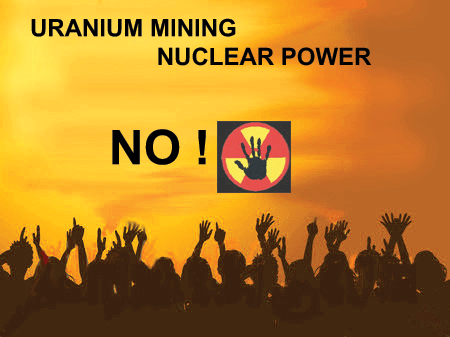
Wild scenes have erupted in one Aussie city’s CBD as protestors stormed the area during an inquiry into nuclear energy – with one protest leader calling it a “front” for the “fossil fuel industry”.
Emma Kirk, news.com.au December 18, 2024 -NewsWire
Wild scenes have erupted in Perth’s CBD after protestors attempted to crash an inquiry into nuclear power being held in the city.
Members from Nuclear Free WA, community groups and the public provided evidence to the inquiry on Tuesday, but it was not open to everyone.
Nuclear Free WA convener Liam Lilly said the Perth protest was an opportunity for people who could not attend the inquiry to have their voices heard in opposition to nuclear power in Australia.
Protestors were allegedly blocked from entering an inquiry held in the southwest town of Collie earlier this year, where a nuclear energy power station has been proposed.
Mr Lilly said it showed how much of a democratic process and the type of democratic values the proponents of the proposal were trying to push.
“They are just trying to bury opposition to these proposals and not have a fair democratic process in that regard,” he said.
“We do not want nuclear power in WA, we have better options in renewables.
“We also have great concerns about the longevity of waste products which remain radioactive for tens of thousands of years, if not hundred thousands.
“Unfortunately, the Coalition want to go ahead with nuclear.” Mr Lilly said in the time it would take Australia to move towards nuclear energy the climate crisis would be exacerbated.
“This is just a front for the coalition to extend the life of the fossil fuel industry,” he said……………………………………..
Climate Change and Energy Minister Chris Bowen said Australia needed new, cheap power now, not expensive power in 20 years.
“Ageing, expensive and unreliable coal plants are closing and we have to fill the gap. Dutton’s nuclear scheme would have us short on power for two decades – a sure-fire recipe for rolling and expensive blackouts,” he said. https://www.news.com.au/national/western-australia/dont-want-nuclear-power-wild-scenes-as-protestors-storm-perths-cbd-during-inquiry-into-nuclear-energy/news-story/4ac311659be07d70160723983dc08b0b
World’s largest iceberg on the move again after months spinning on the spot
The iceberg is about three times the size of New York City and more than twice the size of Greater London
Rituparna Chatterjee, Independent 15th Dec 2024, https://www.independent.co.uk/climate-change/news/world-largest-iceberg-a23a-moving-antarctic-b2664564.html
The world’s largest iceberg is on the move again after decades of being grounded on the seafloor and more recently spinning on the spot, according to the British Antarctic Survey (BAS).
The mega A23a iceberg has broken free from its position north of the South Orkney Islands and is now drifting in the Southern Ocean, scientists said.
“It’s exciting to see A23a on the move again after periods of being stuck. We are interested to see if it will take the same route the other large icebergs that have calved off Antarctica have taken. And more importantly what impact this will have on the local ecosystem,” Dr Andrew Meijers, an oceanographer at the BAS, said.
The iceberg, known as A23a, split from the Antarctic’s Filchner Ice Shelf in 1986. But it became stuck to the ocean floor and had remained for many years in the Weddell Sea.
Scientists anticipate that A23a will continue its journey into the Southern Ocean following the Antarctic Circumpolar Current, which is likely to drive it towards the sub-Antarctic island of South Georgia. In that region it will encounter warmer water and is expected to break up into smaller icebergs and eventually melt.
Less power, more climate pollution: Four ways Dutton is cooking the books on nuclear
Climate Council , 13 Dec 24
“PETER DUTTON’S NUCLEAR numbers have more holes than Swiss cheese, leaving out big ticket items like the costs of dealing with radioactive waste,” says the Climate Council CEO Amanda McKenzie, slamming the Federal Coalition’s misleading modelling.
“Dutton must be honest with the Australian people. CSIRO tells us nuclear is double the cost of renewables, no amount of dodgy accounting can change the facts.”
Nicki Hutley, Climate Councillor and economist, said: “It’s shocking to see the Federal Coalition knowingly mislead Australians on the true costs of nuclear. If we’re going to debate the economics of energy it must be based. on real-world evidence – not dodgy modelling that obscures the real price tag.”
The Climate Council has identified four ways that the Federal Coalition appear to be cooking the books with their dodgy nuclear numbers:
1) Ignoring the costs of keeping our ageing coal-fired generators operating for longer, which would cost a bomb in constant maintenance and fault repairs, and produce far more climate pollution.
2) Failing to account for Australia’s growing electricity needs, producing up to 45% less power than our current plan by 2050. The Australian Electricity Market Operator expects power generation to double by 2050, and assuming any less is inaccurate.1
3) Underestimating the cost and timeline of building nuclear reactors, which international experience has shown cost on average 2.2 times more to build than their initial estimate, and take at least 15 years for construction alone.
-Advertisement-
4) Excluding significant and certain costs from their estimates, including the costs of managing highly radioactive nuclear waste.
Nicki Hutley, Climate Councillor and economist, said: “Nuclear doesn’t add up for Australia. The CSIRO tells us that nuclear energy will cost twice as much as renewables, and the risks of further budget and bill blowouts are simply not worth it. International experience has proven that nuclear is a financial black hole, with the average project costing more than double its original estimate, and projects like the UK’s Hinkley Point C costing triple. We’re already seeing renewables deliver power faster and at lower cost today.”
Amanda McKenzie, CEO of the Climate Council, said: “The Federal Coalition’s nuclear scheme would send our kids’ future up in smoke. Waiting up to 20 years for nuclear reactors means burning coal and fossil gas longer—adding 1.5 billion tonnes of climate pollution by 2050. That means more deadly bushfires, floods, and heatwaves.”
Greg Bourne, energy expert and Climate Councillor, said: “Australians can’t afford to wait 20 years for nuclear. All our coal-fired generators are due to close before even the first nuclear reactor could be built, and keeping our old coal clunkers running past their use-by-date presents a critical risk to our energy security. We need more renewables backed by storage now so it’s online before more coal is retired.”
Amanda McKenzie, CEO of the Climate Council, said: “Investing in renewable power backed by storage is the only way we can tackle climate change and replace our ageing coal fleet this decade. More than four million Australian households have already put solar panels on their roofs, saving $3 billion a year on electricity bills. Expanding access to rooftop solar will cut bills further, reduce climate pollution, and drive a cleaner, safer energy future. Let’s focus on what’s already working.”
1 Based on total generation implied by 14 GW of nuclear capacity, providing 38% of total generation at an 89% capacity factor.
Inquiry into Nuclear Power Generation in Australia travels to Collie for public hearing

- By Bridget McArthur
- Anthony Pancia
- ABC South West WA 17 Dec 24, https://www.abc.net.au/news/2024-12-16/collie-inquiry-into-nuclear-power-generation-in-australia-/104732722
In short:
The South West town of Collie is in the spotlight once again as the federal government hosted an inquiry into nuclear energy.
The WA government is in the middle of transitioning the town away from coal by 2030.
What’s next?
The federal Opposition wants to turn the site of one of Collie’s coal fired stations into a small modular reactor if elected.
Usually the domain of the blue collar worker, the small town of Collie has played host to numerous federal politicians in tailored suits in recent months.
Both parties have sent their leaders and a steady stream of federal and state MPs to talk about their respective energy plans to the community, which is expecting to transition away from coal by 2030.
On Monday, the federal parliament’s Inquiry into Nuclear Power Generation in Australia travelled to the town, 200km south of Perth, to hear the views of local experts and residents on the prospect of having a nuclear power plant in their backyard.
The proposal
The Coalition has identified Collie’s coal fired power station as one of seven sites where it would like to build a nuclear plant if elected.
Under the proposed policy, Collie would host a small modular reactor (SMR).
Small modular reactors have a capacity of up to 300 megawatts per unit — about a third of traditional plants.
Currently none are in commercial operation in any Organisation for Economic Co-operation and Development (OECD) country.
Several are in planning stages but they remain largely theoretical and the lack of completed projects makes it difficult to accurately project costs.
On Friday, the Opposition released a report detailing cost and time estimates for rolling out its nuclear plan.
However, it did not include reference to Collie or SMRs.
Coalition says there’s support for nuclear
The gap in existing commercially operational SMR projects internationally was a central sticking point in the Collie hearing.
Shadow Assistant Minister for Trade and Federal Member for O’Connor Rick Wilson said more than two-thirds of respondents he had surveyed supported the Coalition’s nuclear plan.
He said he had sent a hard copy survey to every house in Collie and followed it up with a targeted social media survey.
Traditional owners at hearing
Noongar elder Phillip Ugle said at the hearing he held concerns about the impact a nuclear reactor could have on local waterways, which he said were central to cultural ceremonies.
He also said traditional owners should have been the first group the Opposition spoke to about the proposal.
The deputy chair of the hearing, Liberal MP Ted O’Brien, said there would be a two-and-a-half year consultation process in each location.
He asked the panel of traditional owners if they had any advice for how they would like to see those consultations run.
Noongar elder Karim Khan said he felt it was late in the game to be asking this question.
South West Aboriginal Corporation Gnaala Karla Booja CEO Bruce Jorgensen said the group had not yet asked its more than 1,000 members for their opinions as they felt they did not have enough information.
Workers confused
Representatives from WA’s Electrical Trades Union (ETU) and Australian Manufacturing Workers Union (AMWU) said workers had been thrown back into uncertainty over their futures.
AMWU WA branch secretary Steve McCartney said workers had just made peace with and begun to embrace the Just Transition plan, focused on renewable energy and battery storage.
“There’s been a lot of consultation with the whole public. Everyone knows what’s happening here,” he said.
ETU WA branch organiser Simon Brezovnik said the “nuclear fantasy” had sewn chaos and uncertainty among workers.
Edith Cowan University Associate Professor Naomi Joy Godden said the community had the right to continuing consent over what happens to their community.
“This dialogue around nuclear has not happened yet and certainly the proposal was launched onto the community [without] any level of dialogue that is required,” she said.
The last hearing of the parliamentary inquiry will happen on Tuesday in Perth.
A final report is due by the end of April 2025.
Solar switch off: Dutton’s nuclear plan amounts to declaration of war against household energy systems
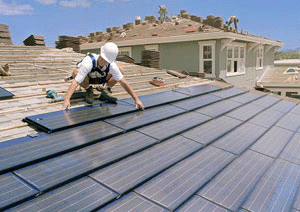
Giles Parkinson, Dec 16, 2024, https://reneweconomy.com.au/solar-switch-off-duttons-nuclear-plan-is-a-declaration-of-war-against-household-energy-systems/
Did you notice the headlines when Australia’s energy regulators gave notice of new protocols that would allow rooftop solar systems to be switched off – maybe once a year in an emergency to ensure that the lights stay on?
Imagine, then, the potential response to news that rooftop solar system might have to be switched off, or curtailed, on an almost daily basis – just to accommodate the 14 gigawatts of nuclear power that the Coalition says it intends to jam into the Australian grid should it be returned to government.
That is the reality from Peter Dutton’s focus on large centralised, baseload power systems, which, to be successful, must put a stop of the switch towards distributed and flexible consumer energy resources, much of it owned and operated by households and small businesses.
The Dutton nuclear plan has already shocked many with its cavalier disregard for climate science, grid engineering, energy reliability, and the costs to the country and consumers.
It says it is unable to say if or when its power plan might deliver a reduction in energy prices, but the biggest shock of all might be what it means for households, and the consumer energy resources (CER) that they might want to own – rooftop PV, home batteries and electric vehicles.
Basically, it assumes that the growth of CER and the electrification of home heating, cooling and other gas use is stopped.
The dominance of the grid is retained, initially by the big utilities who have so comprehensively screwed consumers in recent years, and then by big government, who will have to be the owners of the nuclear plants because no private investor will risk its money on the technology.
Some in the industry are describing this as an effective declaration of war against household solar and consumer resources on behalf of the fossil fuel industry and nuclear ideologues – a triumph of big government over the rights and opportunities of individual households and businesses.
Federal energy minister Chris Bowen has seized on this, and held a press conference over the weekend with the head of the Smart Energy Council to underline the fact that rooftop solar systems may have to be heavily curtailed – switched off, in effect, on a daily basis to accommodate Dutton’s nuclear plans.
This is supported by the likes of Tesla, which in a late submission to the federal nuclear inquiry sent on Friday says that rooftop PV will have to “severely curtailed” to accomodate nuclear power. Tesla says there is no room on the main grid for more than 2 gigawatts of “baseload power”.
But, first, a recap on what the Coalition has said it will do to accommodate its proposed fleet of 14 gigawatts of nuclear power capacity.
It has made clear it will scrap Australia’s near term Paris climate target, and delay any meaningful emission cuts until the 2040s because it wants to keep burning coal and gas, rather than installing wind, solar and storage.
It has vowed to cancel at least half of the proposed offshore wind zones, and rip up contracts signed by the government.
The Coalition’s own modelling suggests that the roll out of large scale wind and solar will be slowed to a crawl, but it offers no explanation as to how energy reliability will be maintained when it seeks to force two thirds of the country’s ageing and increasingly decrepit coal fired power station to stay on line until the 2040s.
We now know it will cost NSW up to $450 million to keep half of the 42-year-old Eraring coal generator on line for an extra two years – so how much will it cost to extend the life of an entire fleet of similarly aged generators, some even older, for another decade? The Coalition doesn’t say.
The Coalition claims nuclear will cost $264 billion less than Labor’s renewable focused plan. But its own modelling makes clear this is not the case, and that number comes from comparing two completely different scenarios.
And on a like for like basis, the difference is much smaller, just $64 billion, and that number is rubbery at best is only because it models 13.2 GW of new nuclear built at a cost of just $140 billion, even though it is costing the UK, with a nuclear arsenal and long established civilian nuclear industry, $92 billion to build a single 3.2 GW nuclear plant.
The Coalition has refused to say how, or even if, consumer prices will fall given the greater dependence on expensive and polluting fossil fuel generation over the next two decades, followed by the construction of the most expensive source of generation, nuclear.
But its own modelling depicts a dystopian future that should concern all households. It assumes significantly less electricity production, suggests a much smaller economy and a slow take up of electrification and electric vehicles.
This is critically important. Almost every energy expert in the country predicts that more than half of all electricity production by the 1940s will come from consumers themselves – through rooftop solar, smart appliances and supported by household batteries and EVs that will provide crucial support for the grid.
In the Coalition’s plan, this does not exist.
And the reason for that is quire simple: If the Coalition’s fleet of nuclear power plants are to deliver the modelled 38 per cent of all power generation, they will need to be operating at very high capacity factors, meaning they will seek to be “always on”.
That means generating at or near 13 GW at all times. Even in the middle of the day, when rooftop solar has been eating into demand to such an extent that minimum “operating” demand levels – the demand that must be met by large scale energy sources – has already fallen to 10 GW.9
Another 50 GW of rooftop solar is predicted by the time that the Coalition’s nuclear power plants are built.
Federal energy and climate minister Chris Bowen says this would result in rooftop solar being curtailed about 67 per cent of the time – or several hours a day, every day, on average, and a lot not being installed.
“What we would see is solar, Australia’s booming solar industry stopped in its tracks,” Bowen said.
“Analysis shows that more than 60% of the rooftop solar operating during the day would have to be switched off in that circumstance, couldn’t feed into the grid.
“More than 60% on a regular basis, would just not be able to operate and feed into the grid at any particular time.
“Now that undermines the fundamental economics of the rooftop solar industry, which is developed in Australia in no small part due to the Renewable Energy Target the previous Labor government put in place, which the Liberal Party opposed, which Tony Abbott tried to abolish, and which they still don’t believe in.”
SEC chief executive John Grimes agreed, noting that there are 4 million households and small business owners saving money with rooftop solar.
“This is a solar stopper policy. Peter Dutton wants to take that away from Australians, and worse than that, he wants to take away the pathway for the 4 million more who want to get solar on their rooftop.
“What we should be doing is backing in the government scheme to make solar cheaper for all Australians. We should be putting solar on every rooftop, because that is the pathway to cost of living reductions.”
Others agree. Tesla, the Australian market leader in electric vehicles and household batteries, says rooftop solar will have to be “severely curtailed” if nuclear is jammed into the grid. It says there is barely room for 1 GW of baseload in big grids such as NSW and Queensland, and no room at all in South Australia and Western Australia.
“Any large-scale build out of this type of inflexible baseload supply will therefore be impacted by minimum generation levels, resulting in either low-capacity factors for the nuclear plants and/or unit decommitment (bidding out of the market), or severe curtailment of cheaper rooftop solar and renewables,” Tesla writes
Dutton’s obsession with baseload, and his failure to understand the flexibility and advantages of consumer resources and new technologies, was revealed on Friday when he sought to demonise rooftop solar by claiming it could not charge an EV and a household battery at the same time.
Of course, that is complete nonsense. But it continues a disturbing theme among the Coalition front bench, who have taken turns to mock EVs, big batteries, and in Duttons’s case even make fun of the fact that climate change is threatening the very existence of low-lying Pacific nations.
Clean Energy Council chief Kane Thornton says Dutton’s plan will be a massive shock and concern to investors who have invested $40 billion into large-sale renewable energy in Australia since 2020.
“A nuclear-powered energy grid would also be a disaster for the four million Australian homes that have already installed a rooftop solar system as a way to lower their power bills,” Thornton said in a statement.
“These systems would have to be switched off regularly if Australia was to move to inflexible nuclear power.
“This would be absurd, forcing the cheapest form of generation on people’s homes to turn off so that the most expensive could continue to operate around the clock.”
Folly of Fission Impossible exposed by the fiscal facts
The Age 15th Dec 2024 , Ian Walker, Leonay
I worked in the nuclear energy business in England in the 1960s and I have monitored disappointment after disappointment for the past 50 years (“Coalition nuclear plan a risk to growth”, December 14). The Fast Breeder reactors haven’t worked. The Tokamak “Donut” fission reactor was abandoned by Harwell (in Britain) in the 60s only to be “invented” by the Russians in the 70s. It’s still failing to make progress. There have been many proposals to improve reactor efficiency, none of which have won universal acceptance. Small modular nuclear power plants are still in development, by fewer participants. They might work one day; let’s hope it’s before Earth’s supply of uranium runs out in 80 years’ time.
Tony Lewis, Mount Victoria, I have an array of solar panels on my roof, rated at 13,000 watts. The total cost of such panels, including all wiring and electronics, is $10,000 in today’s prices. That is $800 per kilowatt. The CSIRO estimates the capital costs of a 2200Mwe nuclear power station, in the range of one of Peter Dutton’s nuclear power stations, is $7675 to $12,500 per kilowatt. That is a minimum of a 10-fold increase in costs over what Australians will now pay for their rooftop solar panels. I pay no electricity bills and the 13,000 watts of panels also charges my EV for free.
Nuclear power stations have huge running costs. Rooftop solar panels have zero running costs for a life span of at least 25 years. We can now run not only our homes but our cars for zilch. Will Chris Bowen stop telling the public the costs of nuclear power are twice as expensive than solar? For domestic purposes nuclear power is at least 10 times more expensive.
Wind, solar, and hydro energy are cheap and proven and they are being adopted on a worldwide scale. Cost reductions continue to happen. These investments should last, with maintenance, for four billion years. A good battery changes everything. Put your money on the vast amount of research achieving a battery breakthrough.
Margaret McDonald, Deakin (ACT), Australia is one of the driest places on earth, with erratic or inadequate rainfall and devastating droughts. Nuclear power plants require enormous amounts of water to function. The examples that are being talked about at the moment are all located in the northern hemisphere in countries like Canada and Britain, where lack of water is not an issue. Where is the water going to come from? Which farmers are going to lose their water allocation? Which towns are going to have their water supply reduced? None of these issues are being addressed.
Robyn Lewis, Raglan, Dutton predicts Australia will need less electricity in 2050 than the government is planning for. If the nuclear plan goes ahead, Australians will be using candles because they will not be able to afford to turn the lights on. The exorbitant cost will probably mean higher taxes and bigger power bills.
Paul Fletcher, Berowra, We know the installation of solar-generated electricity is accelerating as we head towards 2030. What will be the financial impact of the Coalition’s nuclear energy plan on the 4 million (or so) domestic homeowners with existing solar generation systems? A nuclear power generation plant has to be operational about 90 per cent of the time. Which I presume means that 90 per cent of the operational time, each nuclear plant must be able to sell all of its electricity to paying consumers. Does the Coalition propose to block our solar-generated electricity exports to the grid during the day and take away the rebates we currently get from our exports to the grid? It appears quite clear the Coalition is proposing that all solar from households will be switched off by the grid operators in each state during the peak solar generation hours during the day. That will affect our solar investments. https://www.theage.com.au/national/nsw/folly-of-fission-impossible-exposed-by-the-fiscal-facts-20241215-p5kygj.html
Coalition’s nuclear plan will hit Earth with 1.7bn extra tonnes of CO2 before 2050, experts warn

Adam Morton, Guardian, 17 Dec 24
Peter Dutton’s path ‘would be an absolute failure’ in decarbonising the electricity sector and meeting Australia’s emission targets, analyst says.
Coalition’s nuclear plan will hit Earth with 1.7bn extra tonnes of CO2 before 2050, experts warn
Peter Dutton’s path ‘would be an absolute failure’ in decarbonising the electricity sector and meeting Australia’s emission targets, analyst says
- Follow our Australia news live blog for latest updates
- Get our breaking news email, free app or daily news podcast
Adam Morton Climate and environment editorTue 17 Dec 2024 01.00 AEDTShare
Australia would emit far more climate pollution – more than 1.7bn extra tonnes of carbon dioxide – between now and 2050 under the Coalition’s nuclear-focused plan than under Labor’s renewable energy dominated policy, analysts say.
The opposition last week released modelling of its “coal-to-nuclear” plan that would slow the rollout of renewable energy and batteries and instead rely on more fossil fuel generation until a nuclear industry could be developed, mostly after 2040.
Experts have questioned whether that would be possible while maintaining a reliable grid, given the country’s ageing coal plants have suffered regular planned and unplanned outages.
Using the modelling report relied on by the Coalition – which was formulated by the consultancy Frontier Economics – experts have also calculated the emissions that would result from extending the life of coal plants beyond what is expected under Labor.
Under a “step change” scenario in transforming the source of electricity, which is roughly in line with Labor’s plan to have 82% of electricity from renewable energy by 2030, it is forecast about 90% of the country’s remaining coal-fired capacity would shut by 2035. The Coalition assumes about a third of existing coal capacity would shut by that date.
Dylan McConnell, an energy systems expert at the University of New South Wales, said this would lead to more than 1bn tonnes of CO2 being pumped into the atmosphere by 2051 under the Coalition’s preferred path. A separate analysis by economist Steven Hamilton, published in the Australian Financial Review, produced a similar result.
They found the nuclear plan would result in cumulative emissions from the electricity grid of more than 1.6bn tonnes between 2025 and 2051. Labor’s policy – moving more rapidly to running on renewable energy supported by batteries, pumped hydro, transmission lines and “fast start” gas plants – would be expected to result in a little more than 600m tonnes over that time.
“It shows [the nuclear policy] would be an absolute failure in decarbonising the electricity sector and meeting our emissions reduction goals,” McConnell said.
He said total additional emissions under the Coalition’s preferred path would be significantly higher again as it also assumed less “electrification” – a lower uptake of electric vehicles, a longer life for petrol cars, and that industry and households would burn more fossil fuels, particularly gas, rather than switch to renewable energy.
The convener of Climate 200, Simon Holmes à Court, also a director of The Superpower Institute, estimated this “progressive change” path backed by the Coalition would lead to an extra 723m extra tonnes of CO2 by 2050 from transport and industry in addition to the extra 1bn tonnes from the power grid.
Australia’s total annual emissions are about 440m tonnes of CO2. If correct, the extra 1.7bn tonnes of pollution that could be released under the Coalition’s preferred path compared with Labor’s plan could add about four years worth of pollution to the atmosphere over the next 25 years.
Within the electricity grid, Hamilton said the Coalition’s plan would lead to 2 ½ times more emissions than Labor’s plan.
He said that would mean Australia could “say goodbye” to its international climate commitments, including a 43% cut in emissions by 2030 compared with 2005 levels…………………………………… more https://www.theguardian.com/australia-news/2024/dec/16/coalition-nuclear-plan-will-hit-earth-with-1bn-extra-tonnes-of-co2-before-2050-experts-warn?CMP=share_btn_url
Dutton says nuclear will cost $331 billion. Chalmers adds $4 trillion to that

The Age, By Shane Wright and Mike Foley, December 17, 2024
A nuclear Australia would grow 12 per cent slower every year until 2050, according to government analysis of Opposition Leader Peter Dutton’s power plan, with economists warning that less energy for the country will lead to a smaller economy.
The long-awaited economic costings of Dutton’s nuclear energy policy, released last week, revealed the opposition is banking on an electricity grid that ends up 40 per cent smaller by 2050 than the government’s plan, which predicts the country to be almost entirely powered by renewables.
Government figures revealed to this masthead project that under Labor’s energy plan the economy would grow at 2.12 per cent a year. But under the opposition’s plan for a smaller grid, the figures state the economy would grow at 1.89 per cent a year.
That equates to a 12 per cent difference in annual economic growth, compounding each year.
The government has not provided this masthead with the analysis used to produce these figures.
Treasurer Jim Chalmers, while not revealing his expectation of how large the economy will be, said the cost to Australia under the opposition’s proposal would equate to $4 trillion by 2050.
“What these characters are proposing is a recipe for less growth in a smaller economy, with less energy at higher prices,” Chalmers said, referring to CSIRO findings from earlier this month that nuclear energy is at least 50 per cent more expensive than renewables.
“It means an economy which is $294 billion smaller by 2050, and the lost output between now and then would be about $4 trillion.”
………………………………………………………..Treasurer Jim Chalmers, while not revealing his expectation of how large the economy will be, said the cost to Australia under the opposition’s proposal would equate to $4 trillion by 2050.
“What these characters are proposing is a recipe for less growth in a smaller economy, with less energy at higher prices,” Chalmers said, referring to CSIRO findings from earlier this month that nuclear energy is at least 50 per cent more expensive than renewables.
“It means an economy which is $294 billion smaller by 2050, and the lost output between now and then would be about $4 trillion.”
…………………………………………….One key reason the Coalition’s plan forecasts lower demand is it predicts fewer people will be driving electric vehicles.
The government’s ambitious renewable plan is based on a scenario identified by the Australian Energy Grid Operator that assumes the capacity of the country’s electricity grid will need to nearly quadruple in the next 25 years.
However, the opposition’s model assumes the grid will only grow just over half as much and also assumes some existing energy-intensive businesses will either reduce their power usage or disappear.
The opposition’s forecast for the energy grid, based on energy market operator modelling of a scenario where electricity grows more modestly than forecast by the government, assumes electricity demand from heavy industry drops about a third between 2027 and 2030.
That could spell bad news for aluminium smelters like those located in NSW’s Hunter Valley and Portland, in Victoria, which are the largest individual electricity customers in the grid and major regional employers.
Australian Aluminium Council chief executive Marghanita Johnson said smelters used about 10 per cent of all the electricity in the grid, and the industry may have to shut if power costs become internationally uncompetitive.
“The next five years are critical for Australia’s aluminium sector,” Johnson said. “High energy costs, regulatory uncertainty, and more attractive policies in competitor nations make the future of our industry far from certain.”
……………………………………………Grattan Institute energy and climate change deputy program director Alison Reeve said the issue of electricity grid planning hinged on assumptions about economic growth.
“If you choose to have a larger economy, you will need a larger electricity grid,” Reeve said.
Independent economist and member of the advocacy group Climate Council Nicki Hutley said it was illogical to argue that power supply can be reduced as much as the opposition plans to do without also reducing economic growth.
“You can’t curtail the supply side to the degree that the nuclear plan does while using the most expensive form of energy without it increasing energy costs,” Hutley said.
The Australian Industry Group, which represents big energy users like manufacturers and smelters, said its members depended on the delivery of reliable and affordable power.
“Energy-intensive industries like aluminium, steel and ammonia are vital and should be able to make an even bigger contribution to our national economy if Australia delivers on our potential for energy advantage,” said AIG principal national adviser Tennant Reed.
“But they could shrink or exit altogether if they can’t secure energy that is internationally competitive, sufficiently reliable and clean enough to meet expectations from investors, customers and policymakers.” https://www.theage.com.au/politics/federal/dutton-says-nuclear-will-cost-331-billion-chalmers-adds-4-trillion-to-that-20241216-p5kymd.html
1 This month


Help Aunty Sue Protect Her Land and Sacred Sites From Destructive Rocket Testing.
.

Australians deserve the truth
about
AUKUS – https://aukuspublicinquiry.com/

PETITION – To: Prime Minister Anthony Albanese and the Australian Labor Government

of the week – Australians for War Powers Reform (AWPR)
To see nuclear-related stories in greater depth and intensity

