Warning on the likely police surveillance of young climate protestors
 Large Man Looking At Co-Worker With A Magnifying Glass — Image by © Images.com/Corbis Young climate activists ‘most at risk’ of being spied on by AFP, New Daily, Cait Kelly, Reporter, 16 July 19 “They’re the most at risk because of their social media habits, they’re a lot more vocal. As a community they’re the most likely to be targeted,” he told The New Daily. Under the metadata laws passed in 2015 the Australian Federal Police force (AFP) has the power to view the metadata of citizens who are deemed as a risk to national security, up to two years old without a warrant. Dr Shanapinda argues that both Liberal and National politicians have highlighted young climate change activists, Adani protestors and The Greens as threats. “Senior members of the government have labelled the protest actions of the young people and the Greens … as threats to national security and the national economic interests, openly in national media,” he said. During the federal election, Prime Minister Scott Morrison warned that The Greens are a greater political threat to national and economic security than Clive Palmer or Pauline Hanson. Dr Shanapinda said that these concerns over Greens policies, and young protestors could open the door to party members and activists having their metadata watched. “Opposing the Adani coal mine and protesting against it, on climate change on ideological bases, may therefore legally be categorised by the government as posing a threat to national security, if the government wanted to, because of its economic and job creation value,” Dr Shanapinda said. Protestors having their phones used against them has become an increasing issue around the globe…… https://thenewdaily.com.au/news/2019/07/16/metadata-activists-climate/ |
|
New research shows deadly plutonium levels – high radioactivity in Marshall Islands
Nuclear isotopes on Marshall Islands up to 1000 times higher than Chernobyl or Fukushima https://www.news.com.au/technology/environment/nuclear-isotopes-on-marshall-islands-1000-times-higher-than-chernobyl-or-fukushima/news-story/eaacb5841fec37b39d8a907353dceb50, 17 July 19, Between Australia and Hawaii are islands where locals were banished due to nuclear testing. New research reveals the extent of the problem. Rohan Smith@ro_smith
Never mind Chernobyl and Fukushima.
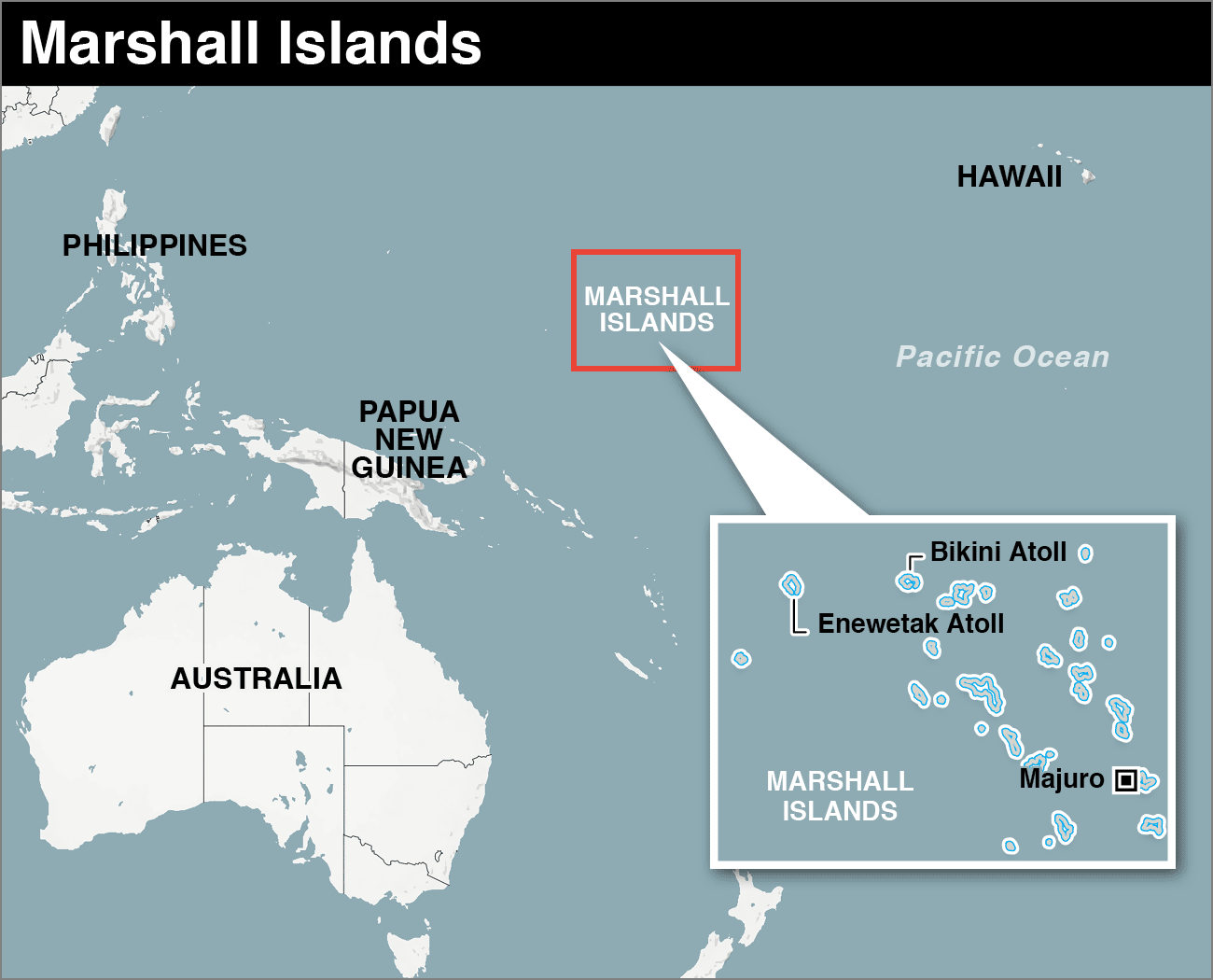
New research shows a tiny island halfway between Australia and Hawaii has concentrations of nuclear material up to 1000 times higher than at two well-known meltdown locations in Ukraine and Japan.
Research carried out by Columbia University and published this week shows deadly plutonium levels are far higher than previously thought on the Marshall Islands. The group of 29 atolls was subject to 67 US nuclear tests between 1946 and 1958, with locals forced to flee as the country dropped bomb after bomb in paradise.
The United States entombed nuclear waste under a dome on the island of Runit that some believe is leaking into the Pacific Ocean. However the real impact of the contamination is only now being realised.
Researchers wrote that two atolls, Bikini and Enewetak, “were used as ground zero” and took the brunt of the impact.
On Enewetak, the first-ever hydrogen bomb was tested. But Bikini was the site of the world’s largest-ever hydrogen bomb test — known as Castle Bravo.
The tests, researchers say, “caused unprecedented environmental contamination and, for the indigenous peoples of the islands, long-term adverse health effects”.
Researchers tested levels of radioactive isotopes in soil and food sources and found “a real concern” on Runit where the huge dome was designed to contain radiation but is not working.
“The presence of radioactive isotopes on the Runit Island is a real concern, and residents should be warned against any use of the island,” researchers said.
“Moreover, wash-off of existing isotopes off the islands into the ocean from weathering and continued sea level rise continues to threaten, further contaminating the lagoon and the ocean at large.”
On Bikini, researchers found concentrations of particular radioactive material “were up to 15-1000 times higher than in samples from areas affected by the Chernobyl and Fukushima disasters”.
Though residents were banished from the Marshall Islands during the height of the Cold War, many have returned. The Los Angeles Times reports more than 600 people call Enewetak, Runit and Enjebi home.
Jan Beyea, a retired radiation physicist, told the newspaper: “Implicitly, I think these results might caution efforts to return because of the readings found.”
News.com.au previously reported rising sea levels were degrading the concrete dome at Runit, and the US Department of Energy concluded the “burial site” was leaking highly toxic waste.
Locals refer to it as “the poison” and have already been complaining of birth defects and high cancer rates.
After Castle Bravo, islanders more than 160km away mistook fallout for snow. It “caused skin burns, hair loss, nausea and eventually cancer” in many who were exposed, the Times reports.
The warnings from researchers clash with advice from the US Government, which signed a memorandum of understanding with the Republic of the Marshall Islands agreeing it was safe for those who wished to return home.
In the Marshall Islands, the most common cause of death is diabetes, which is related to a thyroid disorder. The second most common cause of death is cancer.
The population of the Marshall Islands is around 70,000 people, with local Marshallese people allowed to live and work in the US without a visa as part of the reparations for the nuclear testing that took place.
Over a third have already moved to the US. It is said when you leave the Marshall Islands, you buy a one-way ticket.
— Additional reporting by Phoebe Loomes
Heat wave impacting France’s nuclear power plants
July 2019 – world’s hottest month on record
July on course to be hottest month ever, say climate scientists
If global trends continue for another fortnight, it will beat previous two-year-old record, Guardian, Jonathan Watts @jonathanwatts17 Jul 2019 Record temperatures across much of the world over the past two weeks could make July the hottest month ever measured on Earth, according to climate scientists.
Can we REALLY be optimistic about the health of space travellers?
 An analysis of all living and dead astronauts and cosmonauts shows that radiation hasn’t contributed meaningfully to their mortality rates. Astronomy, By Korey HaynesJuly 5, 2019 ………… they found no trend in the deaths suggesting any common cause, meaning radiation didn’t play a major role in the health outcomes of the astronauts and cosmonauts they studied.
Of course, this doesn’t mean humans are in the clear.
“We would expect that at some level of dose there should be adverse health effects,” Reynolds says. “We keep getting the answer ‘no.’ This doesn’t mean radiation isn’t harmful or greater doses wouldn’t be. But so far the doses have been low enough that we don’t see anything.”
That’s probably because the vast majority of space farers so far have spent most or all of their time in Earth orbit, where Earth’s magnetic fields still protect them from the majority of harmful space radiation. Only those 24 astronauts who ventured to the Moon went beyond Earth’s radiation protection, and they stayed for just a few days.
Reynolds says that it’s difficult to draw meaningful results from that tiny sub-sample of people.
By contrast, a Mars mission might last multiple years, and would take place almost entirely beyond Earth’s shielding.
Other researchers are looking at alternative ways of testing the dangers of radiation exposure. But it’s possible that the next round of human space explorers will be guinea pigs, much like the first generation, and only time will tell how radiation has affected them.http://www.astronomy.com/news/2019/07/space-radiation-hasnt-contributed-to-astronaut-mortality–yet-study-shows
Glum future for Japan’s nuclear industry
the damage from nuclear accidents can be catastrophic, in addition to the challenges posed by nuclear waste disposal. The Fukushima disaster has led to strong opinions that Japan should denuclearize, and this is still the case.
…. ………The fact is that the economic benefits of nuclear power have been losing their shine. Because of the sharp hike in safety standards imposed by the Nuclear Regulation Authority after the Fukushima disaster, exorbitant safety upgrades nearly equal in cost to building a new reactor are being installed at each site. To get a return on investment, this intensive capital spending will require long-term operation and high utilization rates, but the need to get local consent to operate and to respond to dozens of lawsuits from anti-nuclear residents is making stable operations difficult. Reactor operations are also capped at 60 years. Nuclear power could potentially be a source of cheap electricity, depending on the utilization rate and other conditions, but there’s also a possibility it won’t. ……
The impact of the Fukushima disaster, however, was enough to completely overshadow the benefits. The majority of the public is still against nuclear power. In light of persistent public opinion, Japan’s nuclear power business has been surrounded by three big uncertainties.
The first is political uncertainty. The administration of Prime Minister Shinzo Abe, despite its long-term stability, has not provided enough support to the nuclear power business. In addition, the government has entrusted the utilities with the job of gaining local consent.
The safety agreements that stipulate the rules of the industry, such as disclosure of information to the host governments, are not legally binding. But running reactors would be next to impossible without local consent based on such agreements. Whenever there’s an election, the utilities are thrown into confusion, and if a new leader is elected, they will initiate communication from scratch.
The second is policy uncertainty. Japan has fully liberalized the retail power sector. In a liberalized market, reactors for which returns on investment have fully recovered could have high cost competitiveness, but there will likely be no companies that will take up the challenge of building new ones.
Since nuclear plants require huge capital, curbing fundraising costs to a low level would have a big impact on competitiveness, but cheap fundraising is something that cannot be expected in a liberalized market. …….
The third is regulatory uncertainty. It has become quite common for reactor safety reviews to take multiple years because of inadequate communication between utilities and regulators. The U.S. has a presidential executive order that stipulates regulation shall not be undertaken unless the potential benefits to society from regulation outweigh the potential costs of dealing with the regulation.
Though Japan has no such principles, appropriate oversight on regulatory activities is being called for to check whether the public is suffering from any disadvantages from unforeseeable regulatory activities. In the meantime, the finishing blow is the plethora of lawsuits that have been filed demanding the halt of nuclear power plants……..
When utilities are placed in such an uncertain environment, it is a foregone conclusion that the nuclear power business will become unsustainable and there will be no future for it in Japan…..https://www.japantimes.co.jp/news/2019/07/16/business/future-nuclear-power-japan/#.XS-PhOszbGg
Defence signs contract to power Darwin bases with solar and battery storage — RenewEconomy

Defence bases in Darwin to source solar and battery storage after deal signed with Lendlease. The post Defence signs contract to power Darwin bases with solar and battery storage appeared first on RenewEconomy.
via Defence signs contract to power Darwin bases with solar and battery storage — RenewEconomy
Alinta signs up for huge solar and battery project in South Australia — RenewEconomy

200MW S.A. solar project that proposes to add “one of the largest” batteries in the Southern Hemisphere secured power purchase agreement with major utility, Alinta Energy. The post Alinta signs up for huge solar and battery project in South Australia appeared first on RenewEconomy.
via Alinta signs up for huge solar and battery project in South Australia — RenewEconomy
Construction starts at Northern Territory’s largest solar farm — RenewEconomy

Construction commences at 25MW Katherine Solar Farm as Northern Territory begins shift towards target of 50% renewables by 2030. The post Construction starts at Northern Territory’s largest solar farm appeared first on RenewEconomy.
via Construction starts at Northern Territory’s largest solar farm — RenewEconomy
July 17 Energy News — geoharvey

Opinion: ¶ “What Happens When Parts Of South Asia Become Unlivable? The Climate Crisis Is Already Displacing Millions” • South Asia is already suffering as a result of climate change, a crisis caused by the developed world’s consumption patterns and fossil fuel-driven capitalism. Extremes of weather are driving people from their homes. [CNN] ¶ “High […]
A description of Onkalo, the Finnish GDF – a burial site for nuclear waste — Cumbria Trust
In his recently published book, Underland, Robert Macfarlane describes in great detail the Finnish approach to burying its inventory of nuclear waste, and the need to warn future societies to avoid reopening the facility for hundreds of thousands of years. That is a remarkably complex problem, as Robert illustrates. The author is also reassured by […]
via A description of Onkalo, the Finnish GDF – a burial site for nuclear waste — Cumbria Trust
Australia’s first compressed air energy storage system gets development approval — RenewEconomy

S.A. government awards planning approval for compressed air energy storage system, a national first and another big step forward for clean energy in Australia. The post Australia’s first compressed air energy storage system gets development approval appeared first on RenewEconomy.
via Australia’s first compressed air energy storage system gets development approval — RenewEconomy
Five years after carbon price repeal, Australia remains in policy abyss — RenewEconomy

Five years to the day since the repeal of the carbon tax, emissions and electricity prices have both increased, and the Australian economy is slowing. So, what was the point? The post Five years after carbon price repeal, Australia remains in policy abyss appeared first on RenewEconomy.
via Five years after carbon price repeal, Australia remains in policy abyss — RenewEconomy
11,000 Wikileaks documents related to Fukushima — Fukushima 311 Watchdogs

Global intelligence file dumps from wikileaks involving Fukushima: 262 files on cesium: https://wikileaks.org/gifiles/?q=Cesium+2011&mfrom=&mto=&title=¬itle=&date=&nofrom=¬o=&count=50&sort=0&file=&docid=&relid=0#searchresult 282 files iodine: https://wikileaks.org/gifiles/?q=Iodine+2011&mfrom=&mto=&title=¬itle=&date=&nofrom=¬o=&count=50&sort=0&file=&docid=&relid=0#searchresult 2470 files meltdown: https://wikileaks.org/gifiles/?q=Meltdown+2011&mfrom=&mto=&title=¬itle=&date=&nofrom=¬o=&count=50&sort=0&file=&docid=&relid=0#searchresult 4062 files reactor: https://wikileaks.org/gifiles/?q=Reactor+2011&mfrom=&mto=&title=¬itle=&date=&nofrom=¬o=&count=50&sort=0&file=&docid=&relid=0#searchresult 344 files uss ronald reagan: https://wikileaks.org/gifiles/?q=Uss+ronald+2011&mfrom=&mto=&title=¬itle=&date=&nofrom=¬o=&count=50&sort=0&file=&docid=&relid=0#searchresult 4131 files fukushima: https://wikileaks.org/gifiles/?q=Fukushima+2011&mfrom=&mto=&title=¬itle=&date=&nofrom=¬o=&count=50&sort=0&file=&docid=&relid=0#searchresult 1063 files on blackout (mixed batch): https://wikileaks.org/gifiles/?q=Blackout+2011&mfrom=&mto=&title=¬itle=&date=&nofrom=¬o=&count=50&sort=0&file=&docid=&relid=0#searchresult
via 11,000 Wikileaks documents related to Fukushima — Fukushima 311 Watchdogs
Investors asked to support accelerated retirement of AGL’s coal fleet — RenewEconomy

Market Forces seeks the support of super funds for its shareholder resolution pushing AGL to accelerate its transition out of coal. The post Investors asked to support accelerated retirement of AGL’s coal fleet appeared first on RenewEconomy.
via Investors asked to support accelerated retirement of AGL’s coal fleet — RenewEconomy
1 This month.

Australians deserve the truth
about
AUKUS – https://aukuspublicinquiry.com/
Australians deserve the truth
about AUKUS

PETITION – To: Prime Minister Anthony Albanese and the Australian Labor Government

of the week – Australians for War Powers Reform (AWPR)
To see nuclear-related stories in greater depth and intensity
 Antinuclear