Time to stop ignoring the climate threat to world heritage — RenewEconomy

The World Heritage list comprises more than 1,000 of our planet’s most important natural and cultural heritage sites – and they are increasingly vulnerable to climate change. The post Time to stop ignoring the climate threat to world heritage appeared first on RenewEconomy.
via Time to stop ignoring the climate threat to world heritage — RenewEconomy
Lal Lal wind farm’s Yendon section now connected to Victoria grid — RenewEconomy

Part of the massive Victorian wind farm that will help supply Australian packaging giant Orora with 80% renewables is now sending power to the grid. The post Lal Lal wind farm’s Yendon section now connected to Victoria grid appeared first on RenewEconomy.
via Lal Lal wind farm’s Yendon section now connected to Victoria grid — RenewEconomy
South Australia the leader in energy efficiency
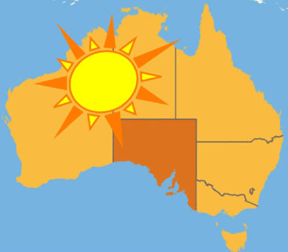
 South Australia leads push for energy efficiency, India Murphy,
  ,
,
Air-conditioning: its threat to the global climate
 Air conditioning is the world’s next big threat https://www.smh.com.au/business/markets/air-conditioning-is-the-world-s-next-big-threat-20190629-p522hd.html , By Chris Bryant, June 29, 2019 The vast majority of Americans and many Australians have air conditioning, but in Germany almost nobody does. At least not yet.
So when temperatures in Berlin rose to an uncomfortable 37 Celsius this week – a record for the month of June – I was uncommonly delighted to go to the Bloomberg office, where it’s artificially and blissfully cool.
By letting people in overheated climates concentrate on their work and get a good night’s sleep, air conditioning has played a big part in driving global prosperity and happiness over the past few decades – and that revolution has still barely begun.
About half of Chinese households have this modern tool, but of the 1.6 billion people living in India and Indonesia, only 88 million have access to air conditioning at home, Bloomberg New Energy Finance noted in a recent report.
For many, relief is in sight. Because of the combination of population growth, rising incomes, falling equipment prices and urbanisation, the number of air-conditioning units installed globally is set to jump from about 1.6 billion today to 5.6 billion by the middle of the century, according to the International Energy Agency.
That’s encouraging news for US manufacturers of cooling systems such as Carrier (United Technologies Corp), Ingersoll-Rand and Johnson Controls International.
And because much of this growth will happen in Asia, Chinese companies such as Gree Electric Appliances, Qingdao Haier, Midea Group and Japan’s Daikin Industries Ltd should be big beneficiaries.
There’s just one glaring problem: What will all this extra demand for electricity do to the climate?
Carbon dioxide emissions rose another 2 per cent in 2018, the fastest pace in seven years. That increase was alarming in its own right, given what we know about the unfolding climate emergency.
But the proximate cause was especially troubling: Extreme weather led to more demand for air conditioning and heating in 2018, BP explained in its annual review of energy sector.
It’s not too hard to imagine a vicious cycle in which more hot weather begets ever more demand for air conditioning and thus even more need for power. That in turn means more emissions and even hotter temperatures.
That negative feedback loop exists at a local level too. Air-conditioning units funnel heat outside, exacerbating the so-called “urban heat island” effect, which makes cities warmer than the countryside.
BNEF expects electricity demand from residential and commercial air conditioning to increase by more than 140 per cent by 2050 – an increase that’s comparable to adding the European Union’s entire electricity consumption. Air conditioning will represent 12.7 per cent of electricity demand by the middle of the century, compared to almost 9 per cent now, it thinks.
Thankfully, much of that extra demand will be met by solar power (the need for cooling is highest during daylight hours). But because temperatures don’t always return to comfortable levels when the sun goes down, there’s a danger some will be supplied by fossil power.
‘Passivhaus’ and LED revolution
Buildings have long been a blind spot in climate discussions even though they account for about one-fifth of global energy consumption. The inefficiency of air-conditioning systems or badly designed homes and offices simply aren’t as eye-catching as electric cars and making people feel ashamed about flying.
At least Germany’s “passivhaus” movement, a way of building homes that require very little heating or cooling, voluntary standard for energy efficiency in buildings, shows some people are starting to recognise the danger.
There are lessons to be learned from the world of lighting too. The LED revolution was spurred by innovation but also by better energy efficiency labelling on products and the phasing out of out-of-date technology. Something similar needs to happen with air conditioning.
There was a big step forward in January when the Kigali Amendment to the Montreal Protocol came into force. Though not well known, its aim is to phase out the use of potent greenhouse gases called hydrofluorocarbons, which are used widely in air conditioning systems. Unless substituted, these alone could cause 0.4C of additional warming by the end of the century.
Yet true to form, President Donald Trump’s administration hasn’t yet submitted Kigali to the Senate for ratification, even though American manufacturers would benefit from demand for the new technologies that it would spawn.
Trump knows all about the importance of good air con. He spends much of his time at his Palm Beach country club, a place that couldn’t exist without it.
Chris Bryant is a Bloomberg Opinion columnist covering industrial companies. He previously worked for the Financial Times.
Will Scott Morrison repeat John Howard’s mistake, and join in military action against Iran?
 Acting on Iran has painful shades of joining the US in Iraq The Age, Tony Walker, 1 July 19, Here’s a word of advice to Prime Minister Scott Morrison. Unless he wants to risk a smudge on his reputation of the sort that accompanies John Howard to this day: don’t get involved in conflict with Iran beyond limited naval engagement in a Gulf peace-keeping role.
When we read that Canberra is open to joining an international effort to ratchet up pressure on Iran “in consultation with our allies and partners”, this invites disquieting questions.
If Morrison is talking about involvement in a “global coalition”, as described by the hawkish US Secretary of State Mike Pompeo, then he might remind himself of what happened when Australia last lent itself to a so-called “Coalition of the Willing”.
That was 17 years ago in 2002 when John Howard – as one of the “three amigos” with Britain’s Tony Blair and Spain’s Jose Maria Aznar – joined George W. Bush in promoting a disastrous invasion of Iraq.
Only World War II, which absorbed one-third of American GDP, or $4 trillion in today’s dollars, has cost more than the Iraq debacle at $1 trillion (a total $2 trillion if Afghanistan is included).
These are the measurable costs in people, materiel and nation building. Incalculable are the ongoing costs of the destabilisation of the entire Middle East, and the empowerment of Iran…..
In a multi-year assignment in the Middle East I reported the Iran-Iraq war (1980-88); the first Gulf War (1990-1991), in which the US and its allies routed the Iraqi military; and the invasion of Iraq (2003). If I learned anything from those experiences it is that wars are easier to start than to finish. …..
Morrison is surrounded by a weak national security team. The national security committee of cabinet does not include one individual with credible security experience. …….
Morrison might remind himself that Canada’s then-prime minister, Jean Chretien, kept his country out of the Iraq war. The sky did not subsequently fall in on Ottawa.
All this is relevant today given that Morrison found himself last week in the presence over dinner of the two most hawkish members of the Trump administration. Secretary of State Pompeo and National Security Adviser John Bolton both advocated air strikes against Iranian targets in retaliation for suspected Iranian attacks on gulf oil facilities before the President, at the 11th hour, called off military action.
Bolton has been an intemperate advocate of regime change in Tehran. In an interview with The Australian newspaper, Pompeo said Australia had a key role in a “global coalition”. What that means is anyone’s guess.
Morrison would be well advised not to be suckered into joining a counter-punch against Iran. His response to requests for any significant Australian military involvement should be emphatically: No. https://www.theage.com.au/world/middle-east/acting-on-iran-has-painful-shades-of-joining-the-us-in-iraq-20190628-p5227h.html
A race against time — Beyond Nuclear International

An ICAN founder dedicates his life to ending nuclear weapons
A grandmother explains the Australian Religious Response to Climate Change

Our Future || Caring for planet is a moral responsibility https://www.canberratimes.com.au/story/6244511/caring-for-planet-is-a-moral-responsibility/?cs=14246 Thea Ormerod, 30 June 19
I am a grandmother with eight grandchildren. Sometimes I lie awake at night worrying about how our changing climate is going to affect their future.
I attend the church of Our Lady of Fatima at Kingsgrove.
It was signed by 153 religious leaders from across the spectrum, many of them in very senior roles.
Climate change and the burning of fossil fuels is a moral issue. Saving the world is a spiritual matter. I don’t interpret spiritual as “other worldly”.
Spirituality for me is about being responsible and reasonable, which shows in healthy relationships.
You see the fruits in laughter, peace and kindness towards each other. In his time on earth, Jesus himself was less interested in rules and who was or wasn’t praying.
He was interested in who was caring about people, especially people who are suffering.
Today, the people who have been hit hardest by climate change are mostly in developing countries, and they’ve done nothing to contribute to the problem.
Those suffering most in Australia are largely people in rural and regional areas. They are on the frontline of droughts, bushfires, intense heat and flooding, left grieving for lost herds and ruined crops.
But people in these areas are being sold short by politicians who are not planning for a more sustainable future, which includes an orderly transition away from the mining and burning of fossil fuels.
Many other nations are making big commitments to reduce emissions but Australia is out of step.
Our elected representatives may think politics is not about religion or spirituality. But it is about morality and caring about people.
Tiny nations challenge Australia’s carbon ‘carryover credits’
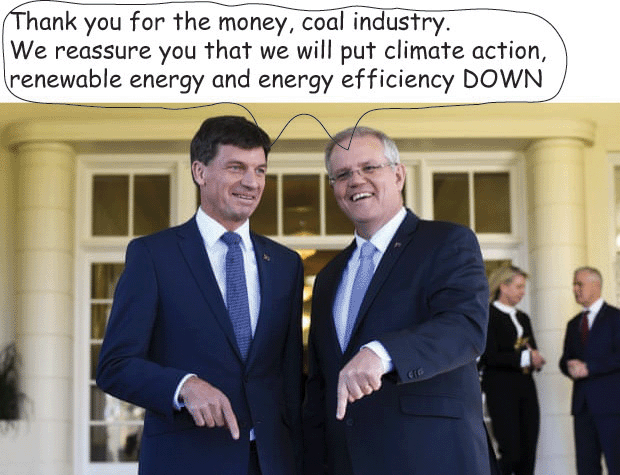
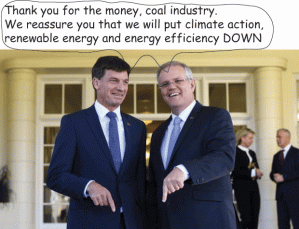 Tiny nations challenge Australia’s carbon ‘carryover credits’ SMH Peter Hannam, June 30, 20Nations from Senegal to Tuvalu have used a United Nations climate conference to challenge the Morrison government’s use of carbon “carryover credits” to virtually halve Australia’s abatement ambition out to 2030.
The conference that wrapped up at the end of last week in Bonn, Germany, debated among other things, the rules of the Paris Agreement.
The discussions included whether nations including Australia should be allowed to count the surplus it expects to generate during the Kyoto Protocol period that runs to 2020.
On the government’s projections, 328 million tonnes of Australia’s pledged cut of about 695 million tonnes of carbon dioxide equivalent could be met by counting the Kyoto surplus for the Paris pledge over the decade from 2021-2030.
Among the nations that opposed the use of “carryover credits” at the Bonn conference included the Association of Small Island states, including Tuvalu.
South Korea, the European Union and New Zealand were also against using Kyoto surplus, according to Kate Dooley, a researcher with the the Climate and Energy College at the University of Melbourne, who was an observer at the Bonn conference.
“Discussions here in Bonn have made it clear that most countries do not accept the carry-over of Kyoto units into the Paris Agreement,” Dr Dooley said.
“The world’s most vulnerable countries have spoken out to say that accounting tricks, such as those the Australian government intends to use, are not consistent with limiting warming to 1.5 degrees.”
…….. The Bonn talks were largely focused on preparing the rules for Article 6 of the Paris Agreement ahead of a Conference of the Parties (COP25) summit in Santiago, Chile later this year. The article is one of the main unresolved issues from the pact signed in Paris in 2015.
The Carbon Pulse newswire said while the new text agreed at Bonn had the potential to scupper Australia’s plans to use Kyoto credits without a specific prohibition in place they would still be able to be banked.
Still, the newswire quoted Gilles Dufrasne of Carbon Market Watch as raising the issue of how such credits had undermined nations’ abatement efforts.
“We have seen how damaging this has been under the Kyoto Protocol and we cannot afford to repeat the experience under the Paris Agreement,” Mr Dufrasne said. “It is very important that [Kyoto Protocol] units are not allowed for use towards [national targets}.” https://www.smh.com.au/environment/climate-change/tiny-nation-s-challenge-australia-s-carbon-carryover-credits-20190630-p522n0.html
Chernobyl has blown up twice — Beyond Nuclear International

First the reactor, and now the astonishingly good TV series
via Chernobyl has blown up twice — Beyond Nuclear International
Dispute in USA over reclassifying some high level nuclear waste
 If USA can change some high level nuclear waste to “low level”, might not ANSTO be tempted to do
  the same for Lucas Heights’ nuclear waste?
  ANNETTE CARY
A top Department of Energy official is fighting what he says are misconceptions about a new policy on which Hanford and other nuclear weapons complex waste must be treated and disposed of to the stringent standards required for high level radioactive waste.
The DOE undersecretary for science, Paul Dabbar, said as of now there is no change proposed for waste handled as high level at Hanford.
“We’re proposing nothing here,” he said. “We don’t have any plans to propose anything in Washington state.”
But key state of Washington officials are not buying his explanation……..
When the new DOE policy on classifying high level waste was announced earlier this month, Washington state Gov. Jay Inslee and Attorney General Bob Ferguson said in a joint statement that all options would be considered to stop “this reckless and dangerous action.”
STATE: HANFORD WASTE COULD BE RECLASSIFIED Continue reading
Chernobyl — daryanenergyblog

HBO’s Chernobyl series has gotten a lot of people talking about that fateful night back in April 1986. While I’ve not seen the series in full yet, I am sufficiently familiar with the accident to know the chain of events. And from what I have seen, they seem to have mostly engaged in a lot […]
June 30 Energy News — geoharvey

Opinion: ¶ “American Farmers Can’t Afford This Administration’s Climate Apathy” • If only American farmers had the luxury of sharing this administration’s indifference to climate change. While millions of farmers are reeling from damage by rapidly shifting weather patterns, Trump’s agriculture chief just advises them to check the weather forecast. [The Hill] ¶ “How James […]
G-20: Trump Deeply Disgraces and Damages the USA with his Fawning Bromance with Putin; Trump Again Refuses to Reveal Discussions with Putin — Mining Awareness +

“Trump deeply disgraces & damages our nation in his fawning bromance with Putin—an engraved invitation to Russian military agents reving up their 2020 machine for hacking, disinformation, deceptive social media & newer weapons of sabotage” (US Senator Blumenthal, 28 June 2019) From US Senator Reed: “Reed: Instead of Joking About Russian Interference in U.S. Elections, […]
Trump Praises Saudi Crown Prince at G-20 Meeting — Mining Awareness +

From VOA News: “Trump Praises Saudi Crown Prince at G-20 Meeting By VOA News June 28, 2019 09:23 PM VOA’s White House Bureau Chief Steve Herman in Osaka, Japan, and Dorian Jones in Istanbul contributed to this report. U.S. President Donald Trump praised Saudi Arabia’s Crown Prince Mohammed bin Salman as the two met on […]
via Trump Praises Saudi Crown Prince at G-20 Meeting — Mining Awareness +
Australian PM fawns over Trump and Bin Salman – how low can we sink?
 I dunno about the rest of yers- but as a dinkum Aussie, I personally felt quite sick, at the sight of our Prime Minister Scott Morrison at the G20 summit, cosying up to Mohmmed Bin Salman, leader of the murderous Saudi Arabian regime.
And further, I felt vomitus, at the sight of Morrison fawning over that nasty piece of work, Donald Trump.
You know how low this once proudly humanitarian nation, Australia, has sunk, when our PM gets high praise from the likes of Trump.
1 This month.

Australians deserve the truth
about
AUKUS – https://aukuspublicinquiry.com/
Australians deserve the truth
about AUKUS


PETITION – To: Prime Minister Anthony Albanese and the Australian Labor Government

of the week – Australians for War Powers Reform (AWPR)
To see nuclear-related stories in greater depth and intensity
 Antinuclear