Norway and Sweden still affected by radioactive fallout from Chernobyl nuclear accident
Chernobyl: 33 Years On, Radioactive Fallout Still Impacts Scandinavian Farmershttps://www.forbes.com/sites/davidnikel/2019/06/08/chernobyl-33-years-on-radiation-still-impacts-scandinavian-farmers/#390eeebd949f, David Nike 8 June 19
The smash-hit HBO series ‘Chernobyl’ has introduced an entire new generation to the nuclear disaster that shook the world in 1986. Initially covered up by Soviet authorities, the disaster only came to light when nuclear power stations in Sweden – hundreds of miles away – detected high levels of radiation and began to ask questions. 33 years later, radiation remains a problem in both Sweden and Norway especially for farmers.
“Who would have thought that a small northern Norwegian mountain village could be hit by a nuclear accident in Europe. Overnight we were powerless. The Chernobyl accident shows that our food production is vulnerable. It’s scary,” sheep farmer Laila Hoff from Hattfjelldal told Norwegian state broadcaster NRK. She said all meat had to be destroyed in the first year following the accident. But even now in 2019, animals in 37 Norwegian municipalities are subject to radiation testing and control before they can be slaughtered. One leading researcher says it will take “decades” for the controls to no longer be necessary.
How Chernobyl hit farming in Norway and Sweden
The radioactive substance cesium-137 takes many years to break down with an estimated half-life of 30 years. It still exists in the earth in the areas affected by the Chernobyl accident, including large parts of Norway and Sweden. The substance is taken up from the soil by plants and fungi, which in turn are eaten by sheep, reindeer and other grazing animals.
In the wake of the 1986 accident, cesium-137 spread over much of northern and central Scandinavia. The weather conditions were such that Norway and Sweden were two of the countries worst hit outside the Soviet Union. In Sweden, the areas around Uppsala, Gävle and Västerbotten were hardest hit, while in Norway the area between Trondheim and Bodø along with mountainous areas further south suffered, mainly because of rainfall.
The radiation impacted vegetation to varying degrees, but also led to radioactivity in grazing animals, primarily sheep and reindeer. In reindeer calf meat, up to 40,000 becquerels per kilogram (Bq/kg) were measured, with up to 10,000 Bq/kg in sheep meat. Norwegian authorities set the highest acceptable level in meat at just 60 Bq/kg, which led to the widespread feeding of animals with non-contaminated feed. This process of feeding livestock from contaminated pastures with non-radioactive feed for a period to reduce radioactivity in meat or milk is known as nedfôring.
US court weighs if climate change violates children’s rights

 US court weighs if climate change violates children’s rights Business Mirror, By The Associated Press, June 10, 2019 PORTLAND, Oregon—In a courtroom packed with environmental activists, federal judges wrestled last week with whether climate change violates the constitutional rights of young people who have sued the US government over the use of fossil fuels.
Suing to stop sea turtle kills — Beyond Nuclear International

Nuclear plant built on sea turtle nesting beach continues to kill them
via Suing to stop sea turtle kills — Beyond Nuclear International
Washington State Governor and AG on Trump Admin Actions to Undercut Nuclear Cleanup at Hanford — Mining Awareness +

Hanford tanks leak into soil groundwater schematic diagram Ironically, in the early 1990s, the New York Times covered two topics, which I was grateful not to need to worry about – Trump and Hanford nuclear site. Over a quarter of a century later, Hanford still hasn’t been addressed properly, and Trump is president, AND trying […]
June 9 Energy News — geoharvey

Science and Technology: ¶ “Arctic Melt: Threat Beneath The Ice” • The Arctic is heating up twice as fast as the global average, causing massive melting of sea ice. While we know climate change is warming the Arctic air, there is a lot more happening under the ice that we don’t fully understand. We have […]
The health toll of Australia’s uranium nuclear industry – theme for June19
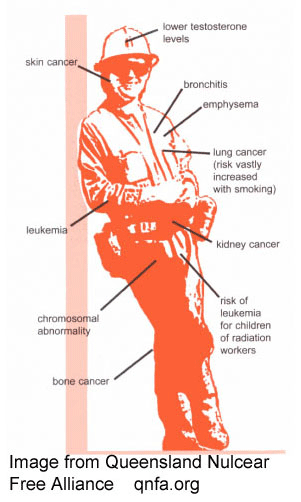 Well -they carefully haven’t kept health records, have they?
OCCUPATIONAL HEALTH AND SAFETY, Parliament of Australia
4.1 The perception that uranium mining has not led to ill health effects in workers has been created through the lack of comprehensive studies on worker health and the failure of Governments to establish a national registry for health workers. …..
Uranium mining, however, presents unique risks over other mining operations. Because of the presence of radioactive elements, uranium miners are at risk not only of immediate health problems, but of delayed fatal effects such as cancer. There is also the potential for radiation exposure to lead to illness and defects in the offspring of uranium miners
RADIATION EXPOSURE FOR URANIUM MINERS. The potentially serious effects of radiation on workers has been shown by previous mines in Australia. Evidence was given to the Committee that 40% of underground workers at the Radium Hill mine in South Australia have died of lung cancer [12]. Even with more recent mining operations it was clear that worker health and safety was not given the priority it deserves. On a trip to the closed Narbarlek mine, the Committee saw worker health records and files left scattered on the floor of an abandoned administrative building. When the Committee visited WMC’s Olympic Dam mine, it saw workers who were not wearing the Thermoluminescent Dial (TLD) badges which register their exposure to radiation. https://www.aph.gov.au/Parliamentary_Business/Committees/Senate/Former_Committees/uranium/report/d05#10
Kirsten Johnson
kirstjohn@aapt.net.au I have a father, uncle and two aunts who all worked at Rum Jungle in the 1960’s. My father and uncle passed away in their 60’s due to lung cancer. My aunt in her 60’s due to breast cancer and my other aunt who is still with us today has also had breast cancer. Surely this cannot be a coincidence and I would like to know if there is information with regards to the health impact that the Rum Jungle uranium mine has had on past workers.
Janet Dickinson nee Litchfield
dickinsonjanet@hotmail.com – I am Kirsten Johnson’s aunt, and sister to Judy, Peter and Kevin Litchfield who passed away with cancer. all having worked at Rum Jungle in the 50’s. My father in law also passed away in 1979, aged 70 from lung cancer, he worked at Rum Jungle for 20 years from 1958. I have just recently been diagnosed with inoperable lung cancer.
 Health effects on Aboriginal people near Ranger uranium mine.
….Since 1981, three years after mining began, at least 120 ‘mishaps’ and ‘occurrences’ — leakages, spillages of contaminated water, and breaches of regulations — have occurred. The Office of the Supervising Scientist has consistently claimed no harm to either the environment or human health — a claim difficult to substantiate. Since completion of the AIATSIS social impact monitoring report in 1984, there has been no monitoring of the social and physical impact on Aboriginal health and well-being, and no agency has specifically investigated the impacts on Aboriginal health.
Exploratory research undertaken in 2005 and 2006 has found a significant overall increase in the incidence of cancer among Aboriginal people in the Kakadu region — some ninety per cent greater than would be expected. We could not determine possible effects on maternal and child health because data on congenital malformations and stillbirths were not available. …. https://aiatsis.gov.au/sites/default/files/products/discussion_paper/dp20-aborigines-uranium-monitoring-health-hazards_0.pdf
Home affairs minister Peter Dutton “knew nothing” about police raids on Australian media offices, and a home!!
 Peter Dutton denies prior knowledge of AFP raids on ABC and News Corp, Guardian, Sarah Martin and Kate Lyons 5 Jun 2019
Following two consecutive days of raids on journalists who had reported on defence matters, Dutton sought to distance himself from the police investigations, saying they were independent from government./////https://www.theguardian.com/australia-news/2019/jun/05/peter-dutton-denies-prior-knowledge-of-afp-raids-on-abc-and-news-corp?CMP=soc_567&fbclid=IwA
Statement by Ita Buttrose, ABC Chair, on the public’s right to know
 http://about.abc.net.au/statements/statement-by-ita-buttrose-abc-chair-on-the-publics-right-to-know/
An untrammelled media is important to the public discourse and to democracy. It is the way in which Australian citizens are kept informed about the world and its impact on their daily lives.
Observance of this basic tenet of the community’s right to know has driven my involvement in public life and my career in journalism for almost five decades.
The raid is unprecedented – both to the ABC and to me.
In a frank conversation with the Minister for Communications, Cyber Safety and the Arts, Paul Fletcher, yesterday, I said the raid, in its very public form and in the sweeping nature of the information sought, was clearly designed to intimidate.
It is impossible to ignore the seismic nature of this week’s events: raids on two separate media outfits on consecutive days is a blunt signal of adverse consequences for news organisations who make life uncomfortable for policy makers and regulators by shining lights in dark corners and holding the powerful to account.
I also asked for assurances that the ABC not be subject to future raids of this sort. Mr Fletcher declined to provide such assurances, while noting the “substantial concern” registered by the Corporation.
There has been much reference in recent days to the need to observe the rule of law.
While there are legitimate matters of national security that the ABC will always respect, the ABC Act and Charter are explicit about the importance of an independent public broadcaster to Australian culture and democracy.
Public interest is best served by the ABC doing its job, asking difficult questions and dealing with genuine whistle-blowers who risk their livelihoods and reputations to bring matters of grave import to the surface. Neither the journalists nor their sources should be treated as criminals.
In my view, legitimate journalistic endeavours that expose flawed decision-making or matters that policy makers and public servants would simply prefer were secret, should not automatically and conveniently be classed as issues of national security.
The onus must always be on the public’s right to know. If that is not reflected sufficiently in current law, then it must be corrected.
As ABC Chair, I will fight any attempts to muzzle the national broadcaster or interfere with its obligations to the Australian public. Independence is not exercised by degrees. It is absolute.
___________________________________________________________
For further information contact:
Peter Munro, ABC Communications
munro.peter@abc.net.au
Oh dear, things are looking crook for the uranium industry
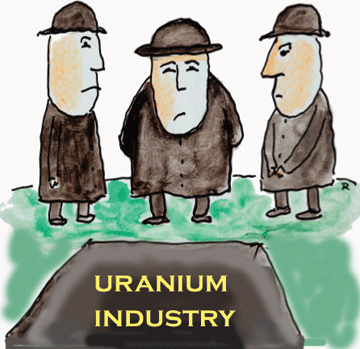 Top Uranium Producer Is Gloomy About Nuclear Power, for Now, Bloomberg, By Will Wade,
  June 7 2019, Don’t expect an upswing in the global uranium market anytime soon.
“In our models, we don’t get excited on the demand side,” said Galymzhan Pirmatov, chief executive officer of Kazatomprom, Kazakhstan’s state-owned mining company that’s the world’s biggest supplier.
With construction of nuclear power plants at a 10-year low, uranium demand remains weak. That’s holding prices so low that mining companies have been wary of increasing production. Kazatomprom’s output will increase about 5% this year, to as much as 22,800 tons, and then will be flat in 2020, Pirmatov said Wednesday in an interview in New York. While he hasn’t yet made a decision on 2021, he doesn’t see much to get excited about, at least in the short term.
“I do believe prices are too low,” he said. Uranium has slumped 15% this year to $24.35 a pound as of Wednesday. Kazakhstan controls about 40% of the world’s supply of the metal, and Kazatomprom accounts for half of that, making it the biggest producer………
U.S. Closings
In the U.S., flush with abundant and cheap natural gas, utilities are closing nuclear plants. The U.S. is also considering whether to impose tariffs on uranium, after two small domestic mining companies filed a trade case last year, arguing that imports are a threat to national security. The Commerce Department concluded its investigation in April, but the results haven’t been made public……..https://www.bloomberg.com/news/articles/2019-06-05/top-uranium-producer-is-gloomy-about-nuclear-power-for-now
Energy and Emissions Reduction Minister Angus Taylor delayed releasing data that shows greenhouse gas levels continue to rise
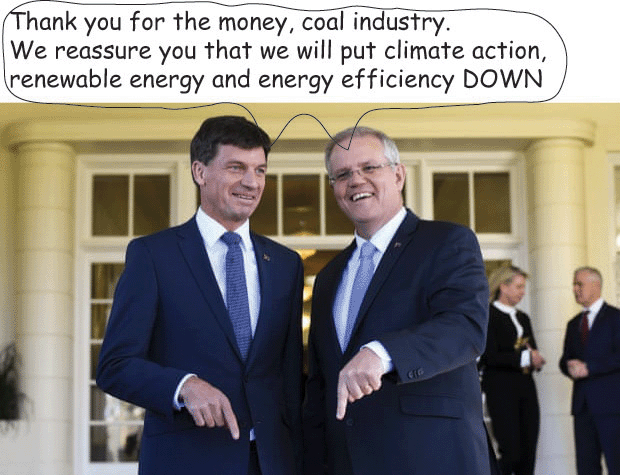 Delayed government data shows greenhouse gas levels continue to rise, Australia’s latest greenhouse gas data shows emissions are continuing to rise, with Labor saying it’s a “fantasy” that the nation will meet reduction targets. SBS, 7 June 19, Labor says it’s a government “fantasy” that Australia is on track to meet its emissions reduction targets, after delayed data showed greenhouse gas levels continue to rise.After missing a parliamentary deadline to report on greenhouse gas levels for the December quarter by last Friday, Energy and Emissions Reduction Minister Angus Taylor released the data on Thursday.
The December quarter figures show a 0.8 per cent increase compared to the previous quarter and a 0.7 per cent rise from the same time last year.
Despite the increase, Mr Taylor maintains Australia is on track to meet its Paris Agreement targets to reduce emissions by 26-28 per cent on 2005 levels by 2030.
“Our plan is laid out to the last tonne,” Mr Taylor told ABC radio on Friday. ……..
Mr Taylor took over responsibility for emissions reduction from former environment minister Melissa Price after the election.
He says Australia is now almost 12 per cent below its 2005 levels and emissions have decreased by 9.5 per cent in 30 years. However, government projections show more than half that target can be achieved through carryover credits from achieving goals of the Kyoto protocol.
Although Australia met its target in the first Kyoto agreement, it allowed for an increase of emissions.
Labor’s energy spokesman Mark Butler says it’s a government “fantasy” that Australia is on track to reach the Paris targets.
Mr Taylor’s announcement focused on the data per capita, while talking up the benefits of LNG.
“Today’s release shows once again that the Liberals will try every trick in the book to avoid scrutiny of their record on tackling climate change,” Mr Butler said.
Calls for a rethink on climate policy
Greens MP Adam Bandt has vowed to chase the government and department for answers over why the release of the data was delayed, and why it was given to select media before being made public.
Mr Taylor insists the government’s climate solutions plan will achieve the Paris target, primarily through paying companies and communities for projects to reduce pollution……..
Vivien Thomson from the Australian Firefighters Climate Alliance has warned that rising emissions are exposing communities to higher risks from more intense bushfires and other extreme weather events.
Ms Thomson says the climate-fuelled disasters stretch the mental and physical limits of firefighters, and cost billions in clean up and recovery costs.
The Climate Council says the government needs to rethink its approach to reducing emissions, as levels have increased over the past four years.
“The prime minister and his new cabinet have an opportunity for a fresh start. We cannot waste another three years,” Climate Council CEO Amanda McKenzie said. https://www.sbs.com.au/news/delayed-government-data-shows-greenhouse-gas-levels-continue-to-rise
USA govt to reclassify some radioactive wastes, to save money, and time
 US to label nuclear waste as less dangerous to quicken cleanup, Guardian, 6 June 19,
 Energy department says labeling some waste as low-level at sites in Washington state, Idaho and South Carolina will save $40bn, The US government plans to reclassify some of the nation’s most dangerous radioactive waste to lower its threat level, outraging critics who say the move would make it cheaper and easier to walk away from cleaning up nuclear weapons production sites in Washington state, Idaho and South Carolina.The Department of Energy said on Wednesday that labeling some high-level waste as low level will save $40bn in cleanup costs across the nation’s entire nuclear weapons complex. The material that has languished for decades in the three states would be taken to low-level disposal facilities in Utah or Texas, the agency said………
Critics said it was a way for federal officials to walk away from their obligation to properly clean up a massive quantity of radioactive waste left from nuclear weapons production dating to the second world war and the cold war.
The waste is housed at the Savannah River Plant in South Carolina, the Idaho National Laboratory and Hanford Nuclear Reservation in Washington state – the most contaminated nuclear site in the country.
Washington’s Governor Jay Inslee, a Democratic presidential candidate, and the state attorney general, Bob Ferguson, said the Trump administration was showing disdain and disregard for state authority.
“Washington will not be sidelined in our efforts to clean up Hanford and protect the Columbia River and the health and safety of our state and our people,” they said in a joint statement.
The new rules would allow the energy department to eventually abandon storage tanks containing more than 100m gallons (378m liters) of radioactive waste in the three states, according to the Natural Resources Defense Council.
The change means that some of the “most toxic and radioactive waste in the world” would not have to be buried deep underground, the environmental group said.
“Pretending this waste is not dangerous is irresponsible and outrageous,” the group’s attorney Geoff Fettus said.
Tom Clements of Savannah River Site Watch, a watchdog group for the South Carolina nuclear production site, called the reclassification of waste “a cost-cutting measure designed to get thousands of high-level waste containers dumped off site”. He said moving the waste to Utah or Texas is a bad idea involving “shallow burial”.
The old definition of high-level waste was based on how the materials were produced, while the new definition will be based on their radioactive characteristics – the standard used in most countries, the energy department said……..
The nuclear site 200 miles (322km) south-east of Seattle contains about 60% of the nation’s most dangerous radioactive waste that’s stored in 177 ageing underground tanks, some of which have leaked.
Cleanup at Hanford has been under way since the 1980s, at a cost of more than $2bn a year.
The energy department said it would immediately begin studying one waste stream at the Savannah River Plant to see if it should be reclassified as low-level waste. https://www.theguardian.com/world/2019/jun/05/us-to-label-nuclear-waste-as-less-dangerous-to-quicken-cleanup?fbclid=IwAR1NuNSVrKbw8rn_rLUwOZlx
The pros and cons of changing the classification of nuclear waste radiation

|
THE TRUMP ADMINISTRATION IS DOWNGRADING TOXIC NUCLEAR WEAPONS WASTE TO CUT DISPOSAL COSTS—SHOULD WE BE WORRIED? https://www.newsweek.com/trump-toxic-nuclear-weapons-waste-disposal-reclassify-1442573 BYON 6/6/19 The Trump administration announced on Wednesday that it is moving forward with plans to reclassify toxic nuclear waste from Cold War weapons research, downgrading some of it from the highest level, in order to cut costs and quicken the disposal process.The waste under review is currently located at three DOE Defense Reprocessing Waste Inventories: the Hanford Site in Washington, the Savannah River Site in South Carolina, and the Idaho National Laboratory.
Environmental campaigners hit back, accusing the Department of Energy (DOE) of risking the health and safety of Americans through what it characterized as a reckless and dangerous departure from decades-long convention in the country’s handling of its nuclear waste. But an expert in nuclear waste management said DOE’s shifting approach is both reasonable and desirable—provided it is transparent with the American public in order to build confidence that it is disposing of the toxic material responsibly and safely. Currently, DOE treats most of its radioactive waste as “high-level” (HLW) because of how it was made rather than classifying it by its characteristics, such as radioactivity. HLW must be buried deep underground when it is disposed of. DOE said in a release that this “one size fits all” approach to waste management has caused delays to permanent disposal, leaving toxic waste stored in DOE facilities, which causes health risks to workers and costs the taxpayers billions of unnecessary dollars. Now, DOE will seek to lower the classification of waste of lesser radioactivity, meaning it can be disposed of with greater ease because it does not need to be stored deep below ground—and both sooner and at a lower cost. Professor Neil Hyatt, an expert in nuclear materials chemistry and waste management at the U.K.’s University of Sheffield, told Newsweek this is potentially a positive change by the DOE. “DOE is proposing to manage waste on the basis of risk rather than how it was produced, which is quite reasonable—and desirable. We would want resources to be focused on dealing with the waste of highest risk,” Hyatt said. “That said, it is important that this is achieved with regard to the risk to health and the environment over the full lifecycle of waste management—including the period of waste disposal, which is some 250,000 years.” Hyatt added: “The new interpretation has the potential to radically change the location, inventory, and nature of waste disposed of, which will be of concern to local communities.” For the new interpretation of HLW to succeed, Hyatt said, those communities will need to be engaged by authorities in a transparent way. “The problem is that the action will be seen as moving the goalposts, for unfair means, whilst the game is in progress,” Hyatt told Newsweek. “If you have agreed that waste is to be classified and managed in a certain way for decades, how do you now build confidence in a new approach? “This cannot be taken for granted. Transparency, effective public engagement and independent expert scrutiny, in evaluating the risk, will be key. But with a new approach comes a new opportunity to get that right.” Another expert concurred. Pete Bryant is a consultant in nuclear waste management and president of The Society for Radiological Protection in the U.K. He also teaches in the field at the University of Liverpool. “By characterizing the waste and classifying it according to its radioactivity and ultimately the risk it poses to human health and the environment, it is possible to dispose of some of the less hazardous waste, reducing the burden of managing them all of HLW,” Bryant told Newsweek. “As long as this is done under appropriate arrangements and checks this will not present a risk to members of the public and the environment,” he said, adding that this is all in line with global standards of toxic waste management. After DOE’s announcement, the Natural Resources Defense Council (NRD), an environmental campaign group, hit out at the imminent reclassification of some HLW. “The Trump administration is moving to fundamentally alter more than 50 years of national consensus on how the most toxic and radioactive waste in the world is managed and ultimately disposed of,” Geoff Fettus, a senior attorney at NRDC, said in a statement. “No matter what they call it, this waste needs a permanent, well-protected disposal option to guard it for generations to come. Pretending this waste is not dangerous is irresponsible and outrageous.” DOE said the change will bring its practices in line with international standards on nuclear waste disposal. |
|
|
It is absurd to question whether we can afford to keep our planet liveable
 Guardian Fiona Harvey 7 June 19, The chancellor has warned against cutting UK emissions to net zero. But failing to act will have dire consequences.
he chancellor, Philip Hammond, has written to the prime ministerto warn against adopting the strict targets on greenhouse gas emissions recommended by the government’s advisers.
His intervention, first reported by the Financial Times (£), raises the important question of whether or not it makes economic sense to save the planet.
If the question sounds absurd, that’s because it is. If we fail to move to a low-carbon economy, the consequences will be dire. According to the Intergovernmental Panel on Climate Change, the body of the world’s leading climate scientists convened by the UN, we must drastically reduce our emissions in the next decade to avoid a catastrophic situation in which droughts, floods, heatwaves and extreme weather across the globe devastate lives, destroy agriculture, lay waste to wildlife and force millions to flee.
Set against that, the costs – of £50bn a year in investment, according to the Committee on Climate Change(CCC), which set out the case last month for a target of net-zero emissions by 2050, or £70bn a year, according to the Department for Business, Energy and Industrial Strategy – of maintaining our current lifestyles and orderly existences are trivial. The UK’s economy is worth roughly £2tn a year at present, so Hammond’s estimate of a £1tn cumulative cost by 2050 amounts to less than half of one year’s GDP in three decades.
Doug Parr, the chief scientist for Greenpeace UK, said: “The Treasury is putting their ideology before our wellbeing, and trying to shape the public debate for political ends. If you want to know whether a policy is good, include the benefits as well as the costs. In this case, the benefits include an economy fit for the 21st century, cleaner air, warmer homes, and maximising the chances of civilisation surviving. If reality doesn’t fit with the Treasury models, it’s the models that need to change.”…….
When we ask whether we can afford to tackle climate change, we are really asking – as the IPCC report and decades of climate science show us – whether we want humanity to survive in anything like our current structures. If our economic system stands in the way of doing so, perhaps it is the economics that are at fault. And economics, like politics, are just a human construct. The physics of the earth’s atmosphere are not. https://www.theguardian.com/environment/2019/jun/06/it-is-absurd-question-whether-we-can-afford-keep-our-planet-liveable
Al Gore – Australia is at climate crossroads, – could lead on renewable energy
 Australia is at a crossroads on climate change, according to Al Gore, SBS, 7 June 19, Former US Vice President turned climate change crusader Al Gore says Australia is at a crossroads on climate, while stopping himself from taking swing at Adani.
Former US Vice President turned climate change crusader Al Gore says Australia is at a crossroads with renewable energy, and risks missing out on the opportunity to capitalise on it by doggedly pursuing fossil fuels.
At a climate conference in Brisbane on Friday, Mr Gore said the country was at the forefront of a renewable energy revolution and well poised to take advantage of it.
“You have the most sun-blessed nation of any other nation in the world,” Mr Gore said in reference to renewable solar energy. “Australia is number one on the list.”
Mr Gore, an outspoken critic of Adani’s proposed mine, said on Wednesday he doubted the proposed Galilee Basin mine was financially viable. ………
He said the country had to make a decision on whether to pursue renewable energy, which he said the Palaszczuk had taken steps toward.
“The history of this period will record that the change (to renewable energy) became unstoppable and that Queensland led the way,” he said.
Ms Palaszczuk vowed to keep investing in renewable energy, insisting it creates jobs while slowing climate change impacts that hammer the state. She reminded regional Queenslanders who voted against Labor in the federal poll that renewable energy had produced 4000 jobs in four years.
She said farmers deal with climate change on a daily basis when they experience floods, droughts and cyclones.
“We understand the need to act on climate change,” Ms Palaszczuk said. https://www.sbs.com.au/news/australia-is-at-a-crossroads-on-climate-change-according-to-al-gore
RADIATION WILL MAKE MARS MISSION DEADLY

EUROPEAN SPACE AGENCY: RADIATION WILL MAKE MARS MISSION DEADLY, https://futurism.com/the-byte/space-radiation-mars-mission-deadly JUNE 5TH 19__DAN ROBITZSKI__
Slow Down
Elon Musk once said he’d likely move to Mars in his lifetime. But before we settle the Red Planet, the European Space Agency (ESA) urges extreme caution.
That’s because it lacks the natural barriers that protect us Earthlings from cosmic radiation, which would put astronauts at risk of deadly health conditions. But they’re working on it — the ESA says it has partneredwith particle accelerators to recreate cosmic radiation in a controlled setting and build shields that can protect future explorers.
Harsh Conditions
“The real problem is the large uncertainty surrounding the risks,” said ESA physicist Marco Durante in the press release. “We don’t understand space radiation very well and the long-lasting effects are unknown.”
Shields Up
The ESA found that a six-month stay on Mars would expose astronauts to “60% of the total radiation dose limit recommended for their entire career.”
As it stands today, we can’t go to Mars due to radiation,” said Durante. “It would be impossible to meet acceptable dose limits.”
READ MORE: Radiation Makes Human Missions to Mars Too Dangerous: ESA [ExtremeTech]
1 This month.

Australians deserve the truth
about
AUKUS – https://aukuspublicinquiry.com/
Australians deserve the truth
about AUKUS


PETITION – To: Prime Minister Anthony Albanese and the Australian Labor Government

of the week – Australians for War Powers Reform (AWPR)
To see nuclear-related stories in greater depth and intensity
 Antinuclear