Carbon dioxide soars to record-breaking levels not seen in 800,000 years, Fox News, 26 May 19, There is more carbon dioxide in the atmosphere than there has been for 800,000 years — since before our species evolved.
On Saturday (May 11), the levels of the greenhouse gas reached 415 parts per million (ppm), as measured by the National Oceanic and Atmospheric Administration’s Mauna Loa Observatory in Hawaii. Scientists at the observatory have been measuring atmospheric carbon dioxide levels since 1958. But because of other kinds of analysis, such as those done on ancient air bubbles trapped in ice cores, they have data on levels reaching back 800,000 years. [8 Ways Global Warming Is Already Changing the World]
During the ice ages, carbon dioxide levels in the atmosphere were around 200 ppm. And during the interglacial periods — the planet is currently in an interglacial period — levels were around 280 ppm, according to NASA.
But every story has its villains: Humans are burning fossil fuels, causing the release of carbon dioxide and other greenhouse gases, which are adding an extra blanket on an already feverish planet. So far, global temperatures have risen by about 1.8 degrees Fahrenheit (1 degree Celsius) since the 19th century or pre-industrial times, according to a special report released last year by the United Nation’s Intergovernmental Panel on Climate Change……
“We keep breaking records, but what makes the current levels of CO2 in the atmosphere most troubling is that we are now well into the ‘danger zone’ where large tipping points in the Earth’s climate could be crossed,” said Jonathan Overpeck, the dean of the School for Environment and Sustainability at the University of Michigan. “This is particularly true when you factor in the additional warming potential of the other greenhouse gases, including methane, that are now in the atmosphere.”
The last time atmospheric carbon dioxide levels were this high, way before Homo sapienswalked the planet, the Antarctic Ice Sheet was much smaller and sea levels were up to 65 feet (20 meters) higher than they are today, Overpeck told Live Science.
“Thus, we could soon be at the point where comparable reductions in ice sheet size, and corresponding increases in sea level, are both inevitable and irreversible over the next few centuries,” he said. Smaller ice sheets, in turn, might reduce the reflectivity of the planet and potentially accelerate the warming even more, he added…….. https://www.foxnews.com/science/carbon-dioxide-soars-to-record-breaking-levels-not-seen-in-800000-years
Skipping School to Stop The Climate Crisis: Greta Thunberg and the Student Protests
A fight for the future as climate change school strikes grow for fourth month running
An estimated 4,000 teenagers and young people turn out in Manchester – and another 1.5m around the world – to demand they inherit a planet that is not dying, The Independent, 27 May 19, Colin Drury, Manchester@colin__drury I t is a hot, sunny day in Manchester and 14-year-old Carmen King is dressed in full black funeral garb, complete with veil and thick white face paint.
“It’s pretty warm,” she says of her outfit. “But then, if adults don’t get it sorted, it’s only going to get hotter anyway.”
The year nine student was one of some 4,000 children, teenagers and young people who flooded into the city centre on Friday to protest against climate change.
They themselves were among an estimated 1.5 million-plus youngsters doing the same in hundreds of towns and cities across the world: in London, Paris and Berlin, of course, but, crucially, in the provinces too, in places – like Manchester – where the battles for hearts and minds are often truly won.
They went on strike from school classes and university lectures, as they have done one Friday a month since February, to demand adults do just one thing: save the planet and their futures…….
Nationally the strikes have been coordinated by the UK Student Climate Networkand come partially in response to a UN report in October, which stated the world’s carbon emissions needed to be halved within 12 years to prevent some of the severest effects of global warming – flooding, droughts, mass displacement – becoming inevitable.
But, because this month’s protest coincided with exam season, there were some expectations that numbers may be down. They decidedly were not……
Japan to push for int’l conference on nuclear waste disposal at June G-20 meet https://mainichi.jp/english/articles/20190525/p2a/00m/0in/006000c 26 May 19, TOKYO — The Japanese government announced May 24 that it plans to arrange an international meeting to consider how to dispose of highly radioactive nuclear waste.
Tokyo is set to get approval for the plan at the Group of 20 Ministerial Meeting on Energy Transitions and Global Environment for Sustainable Growth scheduled for mid-June in Karuizawa, Nagano Prefecture, and aims to launch the first roundtable this autumn.
Nuclear waste is a problem for all countries operating nuclear power plants, and the Japan-backed international summit on cooperating to dispose of it will be a world first. Participating nations are expected to aim for improved cooperation and formulation of an international “basic strategy” on dealing with radioactive waste.
High-level nuclear refuse is usually “vitrified” — mixed with melted glass and solidified — before being deposited in an underground storage facility. Japan’s own disposal plans call for holding the waste for 30 to 50 years to cool it before burying it in stable rock formations at least 300 meters below ground. Finland is already building a major underground disposal site, while its neighbor Sweden is conducting a safety evaluation at the location of its own planned facility. However, there is no precedent for actually operating such an installation, and Japan has not yet even begun the survey process to choose a site.
The Japanese government will thus use the June 15-16 G-20 environment and energy summit meeting to urge member nations to cooperate on realistic solutions. Specifically, Japan will press nations with advanced nuclear disposal technology including those in Europe to share their know-how, and also promote international collaboration among research facilities and staff exchanges. The international roundtable will put together a collection of proposals on a basic nuclear waste disposal cooperation strategy and how to explain the issue to the citizens of member nations.
(Japanese original by Hajime Nakatsugawa, Business News Department)
US conducted nuclear explosion experiment in February, NHK,26 May19,
A US government laboratory says the country held a subcritical nuclear test in the state of Nevada on February 13.
The Department of Energy’s Lawrence Livermore National Laboratory made the announcement on Friday.
The test was the first of its kind since December 2017, and the second under the administration of President Donald Trump. It was the 29th in the United States.
The laboratory says the experiment, dubbed “Ediza,” used high explosives to implode plutonium and captured “numerous, detailed scientific measurements.” ……
The latest test was conducted just before the second US-North Korea summit in February, meaning the Trump administration was demanding Pyongyang abolish its nuclear weapons while it was trying to enhance its own.
Russia launched its new nuclear icebreaker just as Norway and the EU have started helping financially and technically to cleanup one of Russia’s old nuclear waste ships! The US, Europe (including Norway), Canada, and Japan have given billions to Russian nuclear cleanup efforts, freeing Russian funds to develop more nuclear icebreakers, submarines, etc. This goes […]
Opinion: ¶ “State of Global Air 2019 – A Special Report On Global Exposure To Air Pollution And Its Disease Burden” • Scientists, doctors, lung associations, medical journals, and another recent report, State of Global Air 2019, have conducted tens of thousands of studies on such topics. At this point, the message is clear – […]
Angus Taylor to combine energy and emissions reductions, while Melissa Price dumped from environment and replaced by Sussan Ley. The post Taylor gets energy and emissions portfolio, Price dumped from environment appeared first on RenewEconomy.
According to The Committee to Protect Journalists https://cpj.org: “Assange indictment marks alarming new stage in US war on leaks May 24, 2019 12:00 PM ET Mexico City, May 24, 2019 — The Committee to Protect Journalists is alarmed by the U.S. Justice Department’s indictment yesterday of WikiLeaks founder Julian Assange [1] . The administration of […]
From Propublica.org: https://www.propublica.org/series/the-real-bosses-of-new-jersey “A False Answer, a Big Political Connection and $260 Million in Tax Breaks Holtec International gave a false answer in a 2014 New Jersey tax break application connected to political boss George E. Norcross III, a Holtec board member. Five days after WNYC and ProPublica asked about it, lawyers called it “inadvertent” […]
Shadow climate change minister Mark Butler says Labor’s calamitous election loss is no reason to walk away from tough emissions cuts, as a senior party figure described the result of its climate strategy in Queensland as “absolute carnage”.
Labor failed to win office in what was billed as the climate change election, despite having a much bolder policy than the Coalition on cutting greenhouse gas pollution.
The Labor Party’s policy for strong emissions cuts led to “absolute carnage” at the polls in Queensland.CREDIT:AAP
In his first comments since Labor’s defeat Mr Butler, a key architect of the party’s climate position, said all policies would be reviewed however Labor should not abandon strong emissions cuts.
In his first comments since Labor’s defeat Mr Butler, a key architect of the party’s climate position, said all policies would be reviewed however Labor should not abandon strong emissions cuts.
The challenge of tackling climate change is just as important this week as it was last week,” he said.
“And Australia remains in the middle of an energy crisis that is still seeing energy prices continue to rise under this government.” Mr Butler said Labor “remains committed to our obligation to future generations of Australians to take serious action on climate change”.
Climate change protesters flood Melbourne’s CBD, block traffic in call to action, More than a thousand people have marched through Melbourne’s CBD and staged a mock “die-in” for climate change. ABC
Key points:
Activists marched through the city and staged a “die-in” at Bourke and Swanston streets
Organiser Extinction Rebellion called for a Citizens’ Assembly on “climate and ecological justice”
The protest disrupted tram schedules in the city during the march
The protest started with speeches at the Victorian Parliament, then marchers moved through the city to the corner of Bourke and Swanston streets where they staged a “die-in”.
A number of protesters dropped to the ground to lie down in the intersection before moving on to Carlton Gardens.
Protesters young and old chanted “this is our future, there is no plan B” and “what do we want — action, when do we want it — now”.
One of the protest organisers, Extinction Rebellion Victoria, called for governments to set up a “Citizens’ Assembly on climate and ecological justice” to lead environmental policy.
France acknowledges Polynesian islands ‘strong-armed’ into dangerous nuclear tests, Telegraph UK Henry Samuel, Paris, 24 MAY 2019 France has officially acknowledged for the first time that French Polynesians were effectively forced into accepting almost 200 nuclear tests conducted over a 30-year period, and that it is responsible for compensating them for the illnesses caused by the fallout.
The French parliament issued the much-awaited admission in a bill reforming the status of the collectivity of 118 islands in the South Pacific, with MPs saying the change should make it easier for the local population to request compensation for cancer and other illnesses linked to radioactivity.
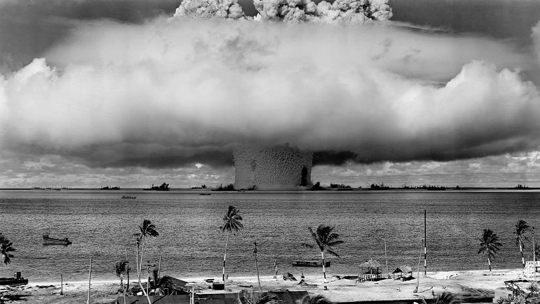
From 1966 to 1996, France carried out 193 nuclear tests around the paradise islands, including Bora Bora and Tahiti, immortalised by Paul Gauguin. Images of a mushroom cloud over the Moruroa atoll, one of two used as test sites along with Fangataufa, provoked international protests.
Charles De Gaulle and subsequent presidents had thanked French Polynesians for their role in assuring the grandeur of France by allowing it to conduct the tests.
But in the parliamentary bill, France acknowledges that the islands were “called upon” – effectively strong-armed – into accepting the tests for the purposes of “building (its) nuclear deterrent and national defence”.
It also stipulates that the French state will “ensure the maintenance and surveillance of the sites concerned” and “support the economic and structural reconversion of French Polynesia following the cessation of nuclear tests”.
Patrice Bouveret of the Observatoire des armements (Armaments Observatory), an independent organisation that has been assessing the impacts of French nuclear testing in Polynesia since 1984, welcomed the reform.
“It recognises the fact that local people’s health could have been affected and thus the French state’s responsibility in compensating them for such damage. Until now, the entire French discourse was that the tests were ‘clean’ – that was the actual word used – and that they had taken all due precautions for staff and locals.”
May. 23, 2019 09: By Grant SmithFrom 2009 to 2012, Gregory Jaczko was chairman of the Nuclear Regulatory Commission, which approves nuclear power plant designs and sets safety standards for plants. But he now says that nuclear power is too dangerous and expensive — and not part of the answer to the climate crisis.
“Nuclear power was supposed to save the planet,” Jaczko wrote in a recent op-ed for The Washington Post. As an atomic physicist, he once endorsed that view. But his years on the NRC changed his mind:
This tech is no longer a viable strategy for dealing with climate change, nor is it a competitive source of power. It is hazardous, expensive and unreliable, and abandoning it wouldn’t bring on climate doom. The real choice now is between saving the planet and saving the dying nuclear industry. I vote for the planet.
Jaczko describes how his experience revealed the pervasive political influence of the nuclear power industry in Congress and among his fellow commissioners. Their opposition derailed much of the safety measures he proposed in the wake of the Fukushima nuclear disaster in Japan. In 2011 an investigative series by the Associated Press detailed the collusion between regulators and the industry to weaken safety standards to keep existing plants economically viable.
Jaczko’s efforts to protect the American public likely cost him his career at the NRC. He now leads an offshore wind power startup and is speaking out at an important juncture for the nation’s energy future.
Electric utilities that operate nuclear plants are boasting of being “carbon free” by mid-century. They insist that their aging nuclear plants must be part of the equation to keep costs down. But even though Japan closed most of its reactors after Fukushima, carbon emissions went down, because the Japanese ramped up energy efficiency and solar investments.
“It turns out that relying on nuclear energy is actually a bad strategy for combating climate change,” Jaczko wrote. “One accident wiped out Japan’s carbon gains. Only a turn to renewables and conservation brought the country back on target.”
Jaczko’s heightened concern for a nuclear accident in the U.S. is also well founded. The former director of the nuclear safety project at Union of Concerned Scientists, David Lochbaum, determined that the industry’s efforts to continue to run aging nuclear plants 20 to 30 years or even longer than their initial licenses allowed for is akin to playing Russian roulette.
Since Fukushima, Germany has ordered the shutdown of all nuclear plants by 2022. Japan has reopened only a few reactors. Even France, long a champion of nuclear power, is ramping down its nuclear fleet because of safety concerns. But in the U.S., the Trump administration and lawmakers in some states continue to support taxpayer-financed subsidies to bail out money-losing nuclear plants. On grounds of both economics and safety, that’s a fool’s bet.









 Antinuclear