Yeelirrie has a low grade of uranium, and Cameco has closed McArthur River mine with a much higher grade
 It’s not worth wiping out a species for the Yeelirrie uranium mine, SBS, BY GAVIN MUDD “……. So are the economic benefits worth wiping out a species?
Short answer: no. But let’s, for a moment, ignore these subterranean animals and look at whether the mine would be beneficial.
Yeelirrie is one of Australia’s largest uranium deposits – and yet it has a low grade of 0.15 per cent (as uranium oxide). This refers to the amount of uranium found in rock. For comparison, the average grade of uranium mines globally is normally 0.1 to 0.4 per cent of uranium oxide (with some higher and others lower).
And Cameco’s Cigar Lake and McArthur River mines in Canada have typically been 15-20 per cent of uranium oxide. Despite such rich ore, McArthur River was uneconomic and closed indefinitely in early 2018.
What’s more, the future of nuclear power is not bright. According to the World Nuclear Industry Status Report, the number of nuclear reactors under construction around the world is at its lowest point in a decade, as renewable energy increases. The amount of nuclear electricity produced each year is flat. And nuclear’s share of global electricity is constantly falling behind renewables……..https://www.sbs.com.au/news/it-s-not-worth-wiping-out-a-species-for-the-yeelirrie-uranium-mine
Bill Shorten questions Environment Minister Melissa Price’s shonky Yeelirrie uranium deal
Labor questions ‘shonky’ WA uranium mine deal, Federal Labor leader Bill Shorten wants to know why Environment Minister Melissa Price approved a controversial WA uranium mine, labelling it a “shonky deal”. SBS 26 Apr 19, Labor leader Bill Shorten says the government has to explain its “shonky” approval for a controversial uranium mine in Western Australia, which occurred the day before the federal election was called.
Canadian-owned Yeelirrie uranium mine, about 500km north of Kalgoorlie, was given the tick of approval by Environment Minister Melissa Price on 10 April, according to an Environment Department document.
Prime Minister Scott Morrison triggered the 18 May election on 11 April……
Labor’s environment spokesman Tony Burke says no detail is known about the approval and is accusing Ms Price of being in hiding.
“I want to find out what on earth has happened,” he told ABC radio……
Greens senator Jordon Steele-John is calling on Labor to tear up the “absolutely disgraceful” approval if it wins government. …..https://www.sbs.com.au/news/labor-questions-shonky-wa-uranium-mine-deal
Extinction Rebellion skillfully used civil disobedience to sound the alarm on the climate emergency
The Greta Thunberg effect: her visit to London in 2 minutes
Why the climate protests that disrupted London were different, Extinction Rebellion skillfully used civil disobedience to sound the alarm on the climate emergency., VOX By Thousands of activists unleashed strategic disorder in London for 10 days to draw attention to the accelerating climate crisis. In costume and in tents, they barricaded roads and bridges at major city landmarks, with more than 1,000 peacefully submitting to arrest.
The coordinated direct actions across the city were organized by Extinction Rebellion, a movement founded last year to demand a more aggressive climate target from the British government: net-zero greenhouse gas emissions by 2025.
With a core message that climate change is an “emergency” that threatens the survival of the human species, Extinction Rebellion sounded a shriller alarm than past climate protests. Members also deployed ostentatious, nonviolent tactics — such as gluing themselves to the Waterloo Bridge — at a scale that “has never been done before,” according to Alanna Byrne, a press coordinator with Extinction Rebellion.
“We know we have disrupted your lives,” the group said Wednesday in a statement. “We do not do this lightly. We only do this because this is an emergency.”
Extinction Rebellion’s urgency and energy on climate change is aligned with a wave of youth climate activism bubbling up in Europe, the United States, and beyond — including a series of student strikes, led by the riveting Greta Thunberg, a 16-year-old from Sweden……..
not all Londoners were unhappy with the disruption, and many tweeted about how much they enjoyed the opportunity to participate.
Extinction Rebellion protesters in London have three key demands
The protestors want three things from the UK government:
- For climate change to be treated as an emergency
- A commitment to net-zero greenhouse gas emissions by 2025
- The creation of a citizen assembly for climate action
“We don’t want to be doom and gloom, but we also think it’s really, really important to use emergency messaging,” said XR’s Byrne. “One of the major problems that we have is that so many people are not aware of the crisis we’re in and we want the government to be talking about it.”
While the UK government is already mired in Brexit negotiations that have continued to drag on, protestors argue that climate change poses an even bigger threat to the long-term health and security of the country and deserves the same, if not more, political attention.
Extinction Rebellion protesters in London have three key demands
The protestors want three things from the UK government:
- For climate change to be treated as an emergency
- A commitment to net-zero greenhouse gas emissions by 2025
- The creation of a citizen assembly for climate action
“We don’t want to be doom and gloom, but we also think it’s really, really important to use emergency messaging,” said XR’s Byrne. “One of the major problems that we have is that so many people are not aware of the crisis we’re in and we want the government to be talking about it.”
While the UK government is already mired in Brexit negotiations that have continued to drag on, protestors argue that climate change poses an even bigger threat to the long-term health and security of the country and deserves the same, if not more, political attention.
………in this moment of crisis, young leaders will keep reminding us of how resourceful humans can be in the face of a challenge. “Sometimes we just simply have to find a way. The moment we decide to fulfill something, we can do anything,” Thunberg said. “And I’m sure that the moment we start behaving as if we were in an emergency, we can avoid climate and ecological catastrophe. Humans are very adaptable: We can still fix this.”
Can the UK fix it to the tune of net-zero emissions by 2025? Why not try? https://www.vox.com/energy-and-environment/2019/4/24/18511491/climate-change-protests-london-extinction-rebellion
Government’s approval of Yeetlirrie uranium mine is bad news for the Liberal Coalition
Yeelirrie uranium mine approval all pain no gain for Coalition THE AUSTRALIAN, Nick Evans, 26 Apr 19,
Environment Minister Melissa Price’s last-minute approval of a major West Australian uranium mine has bought the federal government a world of political pain over a mine that is unlikely to be built in the next decade….. (subscribers only)
A Gripping History of the Nuclear Disaster at Chernobyl
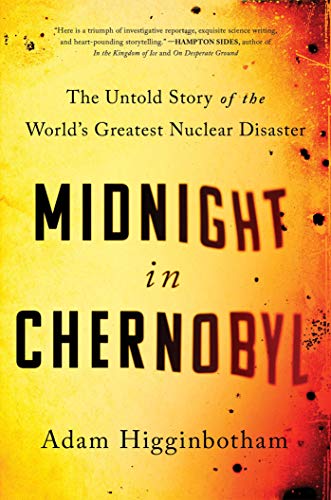 In “Midnight in Chernobyl,” Adam Higginbotham offers a thorough and readable account of one awful night in the Ukraine and its consequences. UnDark, 04.26.2019 / BY Henry Fountain, In “Midnight in Chernobyl,” Adam Higginbotham offers a thorough and readable account of one awful night in the Ukraine and its consequences. UnDark, 04.26.2019 / BY Henry Fountain, WHEN A REACTOR at the Chernobyl nuclear power plant exploded and burned 33 years ago, it generated a radioactive cloud that contaminated parts of the Soviet Union and Europe before dissipating. But the accident also created a fog of misunderstanding and confusion — in large part the result of a deliberate coverup by Soviet authorities — that has been slower to lift. Even three decades later, thorough authoritative accounts of the world’s worst atomic-power disaster are few and far between .
A new book offers perhaps the clearest, and fullest, look at the catastrophe yet. Adam Higginbotham’s “Midnight in Chernobyl,” is a compelling and comprehensive account of one awful night in Ukraine and the consequences that were felt worldwide. Higginbotham’s observations, and his writing, are so sharp there is no need to overdo anything for dramatic effect. Told so clearly and in such detail, the story is dramatic — and horrific — enough. ….
Over the years, a few chronicles of the disaster by Soviet writers have reached Western readers, most notably “The Truth About Chernobyl,” by Grigori Medvedev, a former engineer at the plant, published in 1991. ……
That began to change last year when Serhii Plokhy, a Harvard historian, weighed in with “Chernobyl: The History of a Nuclear Catastrophe.” But Plokhy’s work focused more on the political aftermath, including the downfall of the Soviet Union that followed just five years later, than on the details of the accident. Higginbotham, a British journalist, takes account of the political fallout as well, but the bulk of his book is about the accident and the response and cleanup — primarily the first seven months, which culminated with the rushed completion of the concrete-and-steel sarcophagus that entombed the remains of Unit 4. The author clearly has been captivated by the disaster for years. His interviews for the book began more than a decade ago, and include some of the key surviving characters. He was also aided by the recent declassification of much archival material, especially the deliberations of the various government tribunals that managed (or, more accurately, mismanaged) the response. Higginbotham introduces us to a few people who have never received much notice. Chief among these is Maria Protsenko, the architect of Pripyat, the city of nearly 50,000 that was built for the Chernobyl workers. Like most of the Soviet Union’s privileged atomic cities, Pripyat was a clean, comfortable place, a glorious testament to the Soviet system, and Protsenko’s job for seven years had been to make it even more glorious. Her world changed in an instant when the reactor exploded. Pripyat, just a few miles away, was heavily contaminated immediately, though it took the authorities a day and a half to order an evacuation. (This was just one of many examples of Soviet officialdom’s callousness and irresponsibility in handling the disaster. Another was telling the evacuees to plan to be away for a few days; in reality they would be gone forever.) It’s hard not to feel sorry for Protsenko, who in the space of 36 hours went from proudly planning Pripyat’s expansion to calculating how many buses would be needed to get its residents to safety. (Precisely 1,225, as it turned out.) Ever the dutiful technocrat, she rode the last one, zig-zagging across the ghost city to pick up stragglers. It’s this kind of detail that makes Higginbotham’s book so gripping. His accounts of the “liquidators,” or clean-up workers, are especially riveting — including the “bio robots,” men who had to clean lethally radioactive debris off the roof of the plant by hand after mechanical robots failed, and the workers whose job was to enter the destroyed reactor building itself, hunting for the remaining uranium fuel in an effort to allays fears that another, potentially worse, explosion was possible. No aspect of the disaster and its aftermath are ignored. Higginbotham describes how members of a hunting and fishing association were enlisted to exterminate the dogs and other pets Pripyat residents were forced to leave behind. He recounts the woeful tales of plant operators and first-responding firefighters who lived their final days in a Moscow hospital, having been so heavily irradiated during the accident that they had no chance of survival. He devotes a full chapter to the unprecedented job of building the sarcophagus, which was constructed by thousands of workers, many of whom only toiled for a short time before being sent home, having reached radiation exposure limits. One task was almost suicidal: finding solid supports among the radioactive ruins for the massive roof beams that were lifted by crane operators working behind lead shields. …….. https://undark.org/article/a-gripping-history-of-the-nuclear-disaster-at-chernobyl/ |
|
UK nuclear testing in Australia – Trident anniversary – no cause for celebration.
Trident celebrations ignore Aboriginal victims of British nuclear weapons testing, Green Left, Linda Pearson, April 26, 2019 Issue 1218, Scotland
Campaign for Nuclear Disarmament (CND) General Secretary Kate Hudson said the plan is “morally repugnant” and the organisation is urging supporters to convey their opposition to Defence Secretary, Gavin Williamson. Two Bishops and more than 20 priests have called on Westminster Abbey to cancel the service, which is set to take place on May 3……
The rhetoric of “deterrence” and “defence” is routinely invoked by nuclear-armed states to obscure the horrifying truth about nuclear weapons and justify national security doctrines that rely on them. Nuclear weapons are unique in their destructive power; “designed to indiscriminately kill and destroy thousands of innocent civilians”, as the Bishop of Colchester told The Times last week. This reality was recognised by most of the world’s countries, which voted to ban nuclear weapons in 2017.
Britain’s nuclear weapons program has already destroyed the lives of countless innocent civilians. More than 1200 Indigenous Australians were exposed to radiation during British nuclear weapons testing in the 1950s and 1960s, while many others were displaced. The effects continue to be experienced by their families today. Some are now calling on the British government to apologise for the testing, instead of celebrating Trident.
Nuclear testing in Australia
Britain conducted 12 major nuclear weapons tests in Australia at the Montebello Islands, and at Emu Field and Maralinga in South Australia.
After securing the agreement of the Australian government, the British established a permanent test site at Maralinga in 1955. Seven major and several hundred “minor” tests were carried out there, releasing 100kg of radioactive materials into the surrounding area.
The British and Australian governments of the day demonstrated a callous disregard for the lives of Aboriginal people that is characteristic of the settler-colonial mindset. Permission to conduct the testing was not sought from Aboriginal landowners and the Australian government decided they should not be informed of the risks.
When an Australian scientist asked British authorities about the potential danger to local Aboriginal people, the response was that “a dying race couldn’t influence the defence of Western civilisation”.
Many Aboriginal people were forcibly removed from their land prior to the tests, destroying their way of life. Others experienced serious health issues as a result of their exposure to radiation.
Yankunytjatjara man Yami Lester went blind after a “black mist” from the explosions enveloped his country. Others experienced skin rashes, diarrhea and vomiting. Today, Aboriginal communities in the area experience high rates of diseases associated with the effects of radiation poisoning.
 Yami Lester’s daughter, Karina Lester, and her family played a crucial role in the International Campaign to Abolish Nuclear Weapons (ICAN). They collected and shared stories from the survivors of nuclear weapons testing that were instrumental in convincing 122 states that the only safe way to deal with nuclear weapons is to eliminate them.
ICAN won the Nobel Peace Prize for its efforts to bring about the 2017 United Nations Treaty on the Prohibition of Nuclear Weapons. The historic treaty recognises “the disproportionate impact of nuclear-weapon activities on Indigenous peoples”. The British and Australian governments boycotted the UN negotiations, however, and have ruled out signing the treaty.
No cause for celebration
Karina Lester said “survivors of the British Nuclear Tests carried out on Australian soil in the 1950’s and 1960’s in South Australia’s outback are still haunted. The Indigenous communities still suffer with high numbers of deaths, cancers, respiratory illnesses and autoimmune disease.”
Several attempts to clean up the Maralinga site have been made by British and Australian governments, thanks to the campaigning of survivors like Yami Lester, but contamination at the site remains. In 1995, Aboriginal peoples received just £7.5 million for the loss and contamination of their land. Only £110,000 has been paid to five Aboriginal people to compensate for their exposure to radiation. A class action was blocked by Britain’s Supreme Court in 2013.
Karina Lester said that the affected communities “have had no apology for the wrongdoings on our traditional lands to this day. As the British Government celebrates 50 years with nuclear weapons, Australia’s Indigenous communities in South Australia wear the scars.”
Instead of celebrating, Lester said, “we Indigenous South Australians urge the British government to own up and apologise for your actions…………”https://www.greenleft.org.au/content/trident-celebrations-ignore-aboriginal-victims-british-nuclear-weapons-testing
Chernobyl at 33: More evidence of slow-moving ecological catastrophe
 Chernobyl at 33: More evidence of slow-moving ecological catastrophe, Beyond Nuclear , 26 Apr 19
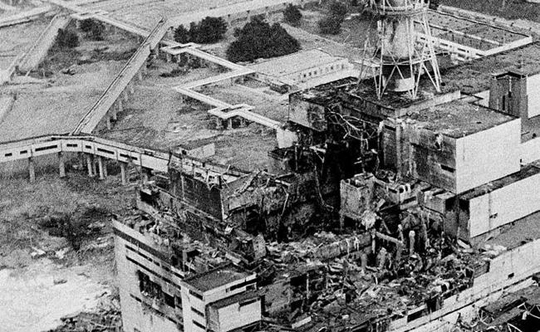
 Chernobyl, the biggest nuclear plant disaster in history, marks 33rd anniversary
|
Gallery: Chernobyl, the biggest nuclear plant disaster in history, marks 33rd anniversary EuroNews, Natalia Liubchenkova 26/04/2019 -Ukraine marks the 33rd anniversary of the Chernobyl disaster, the biggest one in the history of nuclear energy.
|
|
|
It’s not worth wiping out a species for the Yeelirrie uranium mine
 SBS, BY GAVIN MUDD 26 Apr 19, Like the rest of the Western Australian outback, there’s a wonderful paradox where the land appears barren, but is, in fact, rich with biodiversity – and animals are under threat of extinction if the mine goes ahead. The Western Australian outback may look bare at first glance, but it’s teeming with wildlife, often beneath the surface.
The Tjiwarl Traditional Owners have fought any uranium mining on their land for the last 40 years, and the decision by the government wasn’t made public until the day before Anzac Day……..
This region is home to several of Australia’s deposits of uranium and not only holds cultural significance as part of the Seven Sisters Dreaming Songline, but also environmental significance. If the mine goes ahead, groundwater levels would drop by 50cm and wouldn’t fully recover for 200 years. And 2,422 hectares of native vegetation would be cleared.
I visited the site 16 years ago and, like the rest of the Western Australian outback, there’s a wonderful paradox where the land appears barren, but is, in fact, rich with biodiversity.
Native animals living in underground water, called stygofauna, are one such example of remarkable Australian fauna that aren’t obvious at first glance. These animals are under threat of extinction if the Yeelirrie uranium mine goes ahead.
Stygofauna are ecologically fragile
Most stygofauna are very tiny invertebrates, making up species of crustaceans, worms, snails and diving beetles. Some species are well adapted to underground life – they are typically blind, pale white and with long appendages to help them find their way in total darkness.
n 2016, the Western Australian Environmental Protection Agency (EPA) advised against building the Yeelirrie uranium mine because it would threaten the stygofauna species there, despite the proposed management strategies of Cameco Australia, the mine owner.
Stygofauna are extremely local, having evolved in the site they’re found in. This means individual species aren’t found anywhere else in the world. EPA chairman Tom Hatton said:
Despite the proponent’s well-considered management strategies, based on current scientific understanding, the EPA concluded that there was too great a chance of a loss of species that are restricted to the impact area.
And to get to the uranium deposit, the miners need to dig through the groundwater, a little like pulling the plug in the middle of the bathtub. Stygofauna have adapted to living at different levels of the water, so pulling out the plug could dry out important parts of their habitat.
Stygofauna are also susceptible to any changes in the chemistry of the groundwater. We simply do not know with confidence what mining will do to the groundwater chemistry at Yeelirrie in the long term. Various wastes will be backfilled into former pits, causing uncertainty for the welfare of surrounding stygofauna.
The approval conditions suggest that the mine should not be allowed to cause extinction – but if this does happen, nothing can be done to reverse it. And there would be no penalty to Cameco either – which has said it can’t guarantee such a condition can be met………..https://www.sbs.com.au/news/it-s-not-worth-wiping-out-a-species-for-the-yeelirrie-uranium-mine
April 26 Energy News — geoharvey

Opinion: ¶ “What That Flashy Renewable Energy Paper Got Wrong” • A much talked-about paper from the University of Chicago says renewable energy mandates have high costs. But the paper, which was not peer-reviewed, has serious problems. Its most recent data is from 2015, when costs were 50% higher than they are today. [Natural Resources […]
Australian wave power technology tapped to power Spanish Canary Island — RenewEconomy

WA-based Bombora Wave Power to supply 4MW of its mPower technology to help wean fourth largest of Spanish Canary Islands, Lanzarote, off diesel. The post Australian wave power technology tapped to power Spanish Canary Island appeared first on RenewEconomy.
via Australian wave power technology tapped to power Spanish Canary Island — RenewEconomy
Labor commits $10M to boost CSIRO climate science centre capabilities — RenewEconomy

A Shorten Labor Government will commit $10 million to boost the capabilities of the CSIRO Climate Science Centre, better coordinate Australian climate science and develop an Australian climate science capability plan. The post Labor commits $10M to boost CSIRO climate science centre capabilities appeared first on RenewEconomy.
via Labor commits $10M to boost CSIRO climate science centre capabilities — RenewEconomy
Washington becomes sixth US state to commit to 100% renewables — RenewEconomy

The state-led drive towards 100% renewable energy in US continues at breakneck speed as Washington State pass bill requiring 100% carbon-free power by 2045 and coal phase-out by 2025. The post Washington becomes sixth US state to commit to 100% renewables appeared first on RenewEconomy.
via Washington becomes sixth US state to commit to 100% renewables — RenewEconomy
Renewables delivered record 77% of German power on Easter Monday — RenewEconomy

Power production from renewables in Germany hit a new record high on Easter Monday, delivering 77% of net public electricity supply, and more than demand at certain times. The post Renewables delivered record 77% of German power on Easter Monday appeared first on RenewEconomy.
via Renewables delivered record 77% of German power on Easter Monday — RenewEconomy
Nuclear power, climate change, and the Australian election – theme for May 19
 No wonder that Australians have a poor opinion of politicians. In the lacklustre lot that is
  lining up for the May 19 federal election there’s no vision- just personal sniping and seemingly endless promises of money for every local cause, (combined with promises of tax cuts). Labor’s a bit better, as in Labor, there seems to be an understanding that taxes are necessary, if the government is to provide services.
The media can be depended on to depict this election as a personality contest, American style. So, we get Liberals’ Scott Morrison talking about climate change, to one audience, while enthusing about the coal industry, to another. Meanwhile Labor’s Bill Shorten damning Adani’s coal project to one audience, and promoting it to the coal-happy electorates.
As for nuclear power, nuclear waste, and the uranium industry it’s as if Liberal and Labor have made a pact to just not mention these issues. When pressed for answers, both mouth wishy washy statements, though Bill Shorten has been forced to aknowledge Labor’s anti-nuclear policy, and Australia’s law banning the nuclear industry. The media collude with Liberal and Labor in keeping mum about the plan for a nuclear waste dump in rural South Australia.
The government’s Minister Against the Environment, Melissa Price, announced approval of Cameco’s Yeelirire uranium mine project in Western Australia. I bet that that the Liberals wish that had been kept quiet – one little snag, and an opportunity for Labor to play “holier than thou”
1 This month.

Australians deserve the truth
about
AUKUS – https://aukuspublicinquiry.com/
Australians deserve the truth
about AUKUS


PETITION – To: Prime Minister Anthony Albanese and the Australian Labor Government

of the week – Australians for War Powers Reform (AWPR)
To see nuclear-related stories in greater depth and intensity
 Antinuclear