Victoria leads again as rooftop solar installations set another monthly record — RenewEconomy

Victoria has retained its spot as the biggest market for rooftop solar in February, as the country-wide installation of rooftop solar set another monthly record in February. Data compiled by industry statistician Sunwiz shows that 164MW was installed in February, a record for the month and the third best month ever. The installation rate for……
via Victoria leads again as rooftop solar installations set another monthly record — RenewEconomy
Time to clean up our climate act – KonMari style — RenewEconomy

Does it spark joy? Japanese Queen of Clean Marie Kondo could teach the federal government a thing or two about building an effective – and vote-winning – climate policy. The post Time to clean up our climate act – KonMari style appeared first on RenewEconomy.
via Time to clean up our climate act – KonMari style — RenewEconomy
The week that has been, in nuclear and climate news Australia
 Well, Donald Trump and Kim Jong had a nice little photo-shoot in Vietnam. Nothing actually came of it. But , look on the bright side. It could have been a lot worse. Meanwhile USA and South Korea officially call off annual military exercises amid nuclear talks with North Korea.
Climate change’s impact on the oceans is already affecting marine life, and the world’s seafood stocks are declining. How to face what is happening – global environmental collapse. Good news – The young are stepping up to the climate challenge – The Sunrise Movement
AUSTRALIA
- Victoria’s major bushfires still out of control. Over 2000 firefighters working to contain bushfires around Victoria. How bushfires generate their own weather.
- Warm autumn likely to follow Australia’s hottest summer on record. Climate crisis – heating oceans affecting Tasman Sea marine life, and seafood industries. Drought wipes billions from Australian farm production.
- Climate experts warn the Australian government about the nations climbing greenhouse has emissions. Unique to Australia – the use of climate funding for upgrading COAL -FIRED plants !! New South Wales election – 3 Independent MP’s gather strength for climate action. Australia’s Energy Minister, Angus Taylor, lying about Australia’s greenhouse emissions.
NUCLEAR. Friends of the Earth congratulates “The Advertiser” on its coverage of the safety dangers of Kimba nuclear waste dump plan. Minister Canavan incorrect in saying that terrorism risks had not been raised. Matt Canavan, Minister for Resources (not very bright) , got very flustered about nuclear waste dump safety issues. Dept of Industry Innovation and Science promoting nuclear waste dump to Aboriginal group. Three people treated at Sydney’s Lucas Heights nuclear facility after chemical spill.
Olympic Dam Uranium Mine Major Development Declaration
Long delayed realisation of Australia’s brutal history of massacres of Aboriginal people.
RENEWABLE ENERGY. It’s time for Australia’s renewables industry to go all in. South Australia’s second biggest solar farm begins production.
Climate experts warn the Australian government about the nations climbing greenhouse has emissions
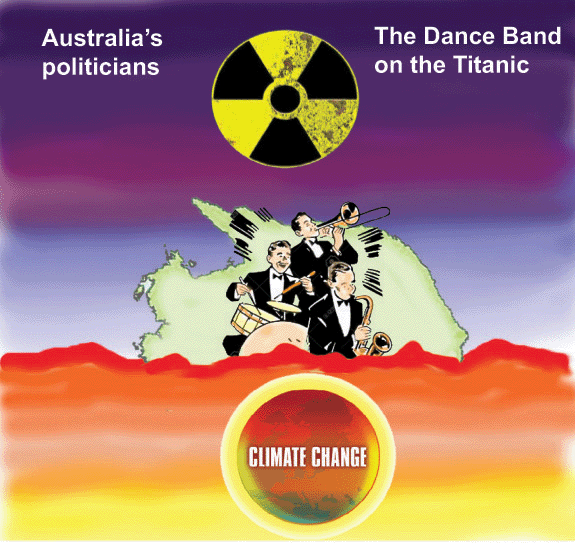 Coalition’s climate armour takes beating, SBS, News 4 Mar 19, A group of climate experts has issued a joint statement to the government, calling for a 45-to-65 per cent emissions reduction target on 2005 levels by 2030. A group of climate science experts has warned the government Australia needs more policies to cut greenhouse gas pollution in line with international obligations.
“Climate change is becoming an economic wrecking ball and it’s already having an impact,” the Climate Council’s Will Steffen said on Monday, calling for an emissions reduction target of 45-to-65 per cent below 2005 levels by 2030, instead of 26-to-28 per cent.
The joint statement was released after the government’s emissions data revealed last week showed a 0.9 per cent increase on levels in the September quarter compared to the previous year.
While emissions are declining in the electricity sector, this progress is outweighed by rises in transport and industrial energy, fuelled by a 19.7 per cent increase in LNG exports.
Climate Council spokesman and former head of BP Australasia Greg Bourne says the government’s recent policy announcements – including $2 billion for the Climate Solutions Fund – are unlikely to make a significant difference.
“Pollution has increased year on year under the government’s recently re-badged Emissions Reduction Fund,” he said.
“This is a failed policy because it does not effectively tackle pollution from fossil fuels, which contribute the lion’s share to the climate problem.”……. https://www.sbs.com.au/news/coalition-s-climate-armour-takes-beating
A climate-changed future – Australia’s marine heatwave disrupting ocean life
In the summer of 2017-18, the intense marine heatwave was combined with a land-based heatwave, together covering four million sq km. Scientists foundthe extreme weather event caused unprecedented loss of glacial ice in the New Zealand Southern Alps, changes to wine-grape harvests, and major disruption of marine ecosystems including kelp habitat loss, new species invasions and fisheries season changes.
This year the National Institute of Water and Atmospheric Research in New Zealand reported that sea surface temperatures in the Tasman were again above average.
Like coral reefs and tropical rainforests, the ocean suffers the slow torture of climate change peppered with high-intensity hits from extreme weather.
A window into the future
Marine heatwaves are generally out of sight and out of mind until one gets so bad it becomes impossible to ignore, says CSIRO research scientist Alistair Hobday.
A marine heatwave happens when the ocean temperature is much warmer than usual for the time of year from sunlight heating the surface water or warm water being brought via ocean currents – or both.
Climate change is causing marine heatwaves to happen more frequently and with more intensity. There may not be scorched earth or destroyed homes left in its wake, but a marine heatwave impacts our future in different ways – and serves as a warning. ……… https://www.theguardian.com/environment/2019/mar/05/australias-marine-heatwaves-provide-a-glimpse-of-the-new-ecological-order
Drought wipes billions from Australian farm production
ABC Rural By national rural reporter Kath Sullivan 4 Mar 19.The value of all that is farmed in Australia has fallen to $58 billion, from $63.8 billion two years ago.
In its latest commodity report, released today, ABARES found improved commodity prices and the low Australian dollar had softened the decline, largely driven by drought.
“Drought in the eastern states significantly reduced the 2018–19 winter crop, but one of the largest Western Australian harvests on record has provided a buffer to the national total,” it said.
Livestock industries also contributed to the decline, with ABARES reporting the volume of livestock products dropped by 2 per cent this year.
“Milk and wool production have been affected by the drought, and a significant decline in live animal exports also contributed to the fall,” it said.
“This is largely because of cessation in live sheep exports during the northern hemisphere summer months.”
ABARES reported that floods in Queensland last month could further reduce the volume of live cattle exports…….. https://www.abc.net.au/news/2019-03-05/value-of-australian-farm-production-drops-abares-figures/10867294
Victoria’s major bushfires still out of control
Victoria bushfires: Major blazes still out of control as residents may be allowed to return home
By 9News Staff, 6:03am Mar 5, 2019 Five of the 29 bushfires burning in Victoria this morning are still out of control this morning stretching across 59,000 hectares of land.
A cooler weather change that is moving over the state has seen yesterday’s ‘Emergency’ warning zones downgraded to a ‘Watch and Act’ level, however authorities have warned that four major fires are still out of control.
Those incidents include the largest blaze still raging in Victoria at the Bunyip State Park which is still sparking spot fires in multiple areas…….https://www.9news.com.au/2019/03/04/18/10/news-melbourne-bushfires-bangholme-dandenong-south-fire
South Australia Labor politicians to visit Port Augusta on 14 March

South Australia’s Labor politicians Peter Malinauskas, (Leader of the Opposition) and Justin Hanson are coming to Port  Augusta to (in their words) “listen and hear your thoughts on what is important to you and your community”. Only a half hour visit – but plenty of time to make our voices be heard!
Thursday 14th March 1pm – 1.30pm…..Gladstone Square
Russia officially halts Intermediate-Range Nuclear Forces Treaty (INF)
Russia officially suspends INF Treaty with US, https://www.aljazeera.com/news/2019/03/russia-officially-suspends-inf-treaty-190304143410145.html
Vladimir Putin signs decree suspending Russia’s obligations under key nuclear arms pact with US. Russia’s President Vladimir Putin has signed a decree suspending Moscow’s participation in a key Cold War-era nuclear arms control treaty, following a similar move by the United States.
In a statement on Monday, the Kremlin said the suspension would last until the US “ends its violations of the treaty or until it terminates”.
In February, Washington gave notice of its intention to withdraw from the landmark 1987 Intermediate-Range Nuclear Forces Treaty (INF), which was established as a major safeguard against nuclear war.
The move by US President Donald Trump set the stage for the bilateral pact’s termination in six months.
Washington accuses Moscow of developing and deploying a cruise missile that violates provisions of the treaty that ban the production, testing and deployment of land-based cruise and ballistic missiles that have a range between 500km and 5,500km.
US officials have also expressed concerns that China, which is not party to the pact, was gaining a significant military advantage in Asia by deploying large numbers of missiles with ranges beyond the treaty’s limit.
Russia has denied any breaches, instead, charging that it was the US that had flouted the pact by deploying missile defence facilities in Eastern Europe that could fire cruise missiles instead of interceptors.
Washington rejects the claim.
The collapse of the treaty has stoked fears of a replay of a Cold War-era European missile crisis during the 1980s, when the US and the Soviet Union both deployed intermediate-range missiles on the continent.
Putin has previously said Russia would seek to develop medium-range missiles, but would not deploy them in the European part of the country or elsewhere unless the US does so.
NATO has supported the US’s decision to withdraw from the pact, but many European leaders have voiced fears over the consequences of its demise.
China has also urged Russia and the US to preserve the treaty.
Long delayed realisation of Australia’s brutal history of massacres of Aboriginal people
As the toll of Australia’s frontier brutality keeps climbing, truth telling is long overdue, The myth of benign, peaceful settlement persists today – even as historians reveal a far more sinister picture
• The Killing Times: the massacres of Aboriginal people Australia must confront
• A massacre map of the frontier wars – interactive
Guardian by Paul Daley, 4 Mar 19
“………… The Australian Museum estimates that pre-European invasion in 1788, about 750,000 Indigenous people (representing some 700 language groups) inhabited the continent that would become Australia. This figure may well be an underestimate.
Little over a century later, by federation in 1901, the Aboriginal and Torres Strait Island population had diminished to some 117,000. Black-white warfare and organised massacres, no matter how you define them, with police, British soldiers, native police, militia and raiding parties as the perpetrators, accounted for many tens of thousands of deaths. Individual acts of violence – including shootings, poisonings, torture and illegal incarceration – killed many more. Battle wounds, starvation (owing to the depletion of traditional hunting grounds) and disease – all of which can also be directly linked to invasion and frontier conflict – killed countless others.
Yet the historiographic confect of benign, peaceful settlement and the unexplained “passing” or “extinction” of the “natives” pervaded well into the 1960s, replete with the deception that very few Aboriginal people died violently during pastoral and urban expansion and dispossession. Things began to change with the emergence of a new, more inquisitive, less empire-centric cohort of historians and writers who, not content with the Anglophile colonial trope of terra nullius and benevolence to the Indigenes, began to commit truth to the page………..
In the 1970s and 1980s a number of historians – among them Henry Reynolds, Marilyn Lake and Richard Broome – began focusing on frontier violence, using the colonial records, newspaper archives and family histories (including generational oral accounts of killings).
Reynolds is acknowledged as the first Australian historian to make a calculated continental estimate of the number of Aboriginal and Torres Strait Islanders who died violently in Australian frontier conflict. In his 1981 book, The Other Side of the Frontier, and after at least a decade’s research Reynolds estimated the figure at about 20,000……….
Reynolds speaks of the significance of Evans and Ørsted-Jensen’s research on the numbers of killings in colonial Queensland.
Based on an extrapolation of native police documentation, they estimated (conservatively) that as many as 60,000 Aboriginal people died in frontier violence in Queensland alone.
The national implications of the figure are profound; the wars that raged across this continent from 1788 did, it seem, claim more Indigenous lives than 62,000 Australian service personnel who died in the first world war………… https://www.theguardian.com/australia-news/2019/mar/04/as-the-toll-of-australias-frontier-brutality-keeps-climbing-truth-telling-is-long-overdue
The unimaginable toxicity of Fukushima reactor’s molten nuclear debris – robots the only hope for cleanup
For Fukushima’s nuclear disaster, robots may be the only hopeThe 2011 meltdown in Japan is still too hot for humans to handle. Send in the machines. CNet BY ROGER CHENG, MARCH 4, 2019 ………. I’m inside the cavernous top of the Unit 3 reactor in the Fukushima Daiichi Nuclear Power Plant. Yes, that Fukushima Daiichi, site of the world’s worst nuclear disaster.
Unit 3 was one of three reactors crippled on March 11, 2011, after a 9.0 earthquake struck 80 miles off the coast of Japan. (Units 4, 5 and 6 at Daiichi weren’t operating at the time.) The temblor shook so violently it shifted the Earth’s axis by nearly 4 inches and moved the coast of Japan by 8 feet. Eleven reactors at four nuclear power plants throughout the region were operating at the time. All shut down automatically. All reported no significant damage.
An hour later, the tsunami reached shore.
Two 50-foot-high waves barreled straight at Fukushima Daiichi, washing over coastal seawalls and disabling the diesel generators powering the plant’s seawater cooling systems. Temperatures inside the reactors skyrocketed to as high as 5,000 degrees Fahrenheit.
Fuel rods became molten puddles of uranium that chewed through the floors below, leaving a radioactive cocktail of fuel rods, concrete, steel and melted debris. Molten fuel ultimately sank into the three reactors’ primary containment vessels, designed to catch and secure contaminated material.
Next Monday marks the eighth anniversary of the earthquake. Since then, Japanese energy giant Tokyo Electric Power Company, or Tepco, has cleared enough of the rubble on the top floor of the Unit 3 building to allow for my 10-minute visit.
I gaze up at the massive barrel vault ceiling, trying to get a handle on the sheer scale of everything. Radiation levels are too high for me to linger. My quickening pace and breath are betrayed by rapid flapping noises coming from the purple filters on both sides of my respirator mask.
At the far end of the room, there’s an enormous orange platform known as a fuel-handling machine. It has four giant metal legs that taper down, giving the structure a sort of animalistic look. Thin steel cables suspend a chrome robot in the center of the frame. The robot, largely obscured by a pink plastic wrapper, is equipped with so-called manipulators that can cut rubble and grab fuel rods. The robot will eventually pull radioactive wreckage out of a 39-foot-deep pool in the center of the room.
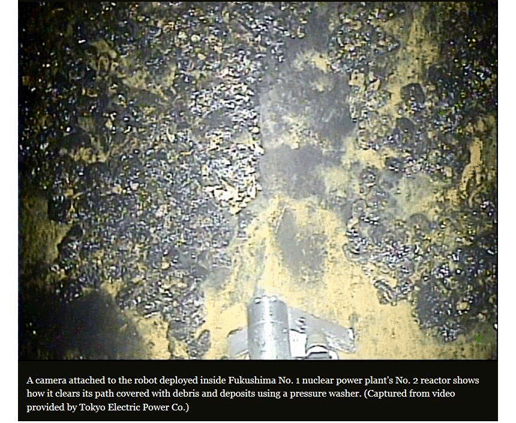
It’s just one of the many robots Tepco is using to clean up the power plant. It’s why I came to Japan this past November — to see how robots are working in one of the most extreme situations imaginable.
The Japanese government estimates it will cost $75.7 billion and take 40 years to fully decommission and tear down the facility. The Japan Atomic Energy Agency even built a research center nearby to mock up conditions inside the power plant, allowing experts from around the country to try out new robot designs for clearing away the wreckage.
The hope is that the research facility — along with a drone-testing field an hour away — can clean up Daiichi and revitalize Fukushima Prefecture, once known for everything from seafood to sake. The effort will take so long that Tepco and government organizations are grooming the next generation of robotics experts to finish the job. …….
Two years ago, Tepco erected a dome over the Unit 3 reactor and fuel pool so that engineers could bring in heavy equipment and now, us.
Roughly 60 feet below me, radiation is being emitted at 1 sievert per hour. A single dose at that level is enough to cause radiation sickness such as nausea, vomiting and hemorrhaging. One dose of 5 sieverts an hour would kill about half of those exposed to it within a month, while exposure to 10 sieverts in an hour would be fatal within weeks.
Unit 3 is the least contaminated of the three destroyed reactors.
 Radiation in Unit 1 has been measured at 4.1 to 9.7 sieverts per hour. And two years ago, a reading taken at the deepest level of Unit 2 was an “unimaginable” 530 sieverts, according to The Guardian. Readings elsewhere in Unit 2 are typically closer to 70 sieverts an hour, still making it the hottest of Daiichi’s hotspots.
The reactors’ hostile environments brought most of the early robots to their figurative knees: High gamma radiation levels scrambled the electrons within the semiconductors serving as the robots’ brains — ruling out machines that are too sophisticated. Autonomous robots would either shut down or get snared by misshapen obstacles in unexpected places.
The robots also had to be nimble enough to avoid disturbing the volatile melted fuel rods, essentially playing the world’s deadliest game of “Operation.” At least initially, they weren’t. “Fukushima was a humbling moment,” says Rian Whitton, an analyst at ABI Research. “It showed the limits of robot technologies.”………….. https://www.cnet.com/news/for-fukushimas-nuclear-disaster-robots-may-be-the-only-hope/
How to face what is happening – environmental collapse

Rethink Activism in the Face of Catastrophic Biological Collapse, Dahr Jamail and Barbara Cecil, Truthout,
PART OF THE TRUTHOUT SERIES How Then Shall We Live? 4 Mar 19,
It may be that when we no longer know what to do
we have come to our real work,
and that when we no longer know which way to go,
we have begun our real journey.
The mind that is not baffled is not employed.
The impeded stream is the one that sings.
― Wendell Berry
Anyone who thinks there is still time to wholly remedy the situation must answer the question: How do we remove all the heat that’s already been absorbed by the oceans? Invigorated activism, as heartening and important as it is, is not going to completely stem these tides.
Thus, the third level of activism, adaptation, comes into focus.
Trump administration still keenly pursuing sale of nuclear technology to Saudi Arabia
 Team Trump Keeps Pushing Deal to Send Nuclear Tech to Saudis
Congress raised ‘grave concerns’ about the Trump administration’s past attempts to send nuclear technology to the Saudis. But Team Trump isn’t done trying. The Daily Beast, Erin Banco, Betsy Woodruff 03.04.19 The Trump administration is still actively working to make a deal to send U.S. nuclear technology to Saudi Arabia, according to two U.S. officials and two professional staffers at federal agencies with direct knowledge of those conversations. American energy businesses are still hoping to cash in on Riyadh’s push for energy diversification,
Alinta, Snowy, Engie, EnergyAustralia fail to meet renewable energy target — RenewEconomy

Regulator confirms leading energy retailers did not bother to meet renewable energy target in 2018, and will make huge profits playing the market over the next three years. The post Alinta, Snowy, Engie, EnergyAustralia fail to meet renewable energy target appeared first on RenewEconomy.
via Alinta, Snowy, Engie, EnergyAustralia fail to meet renewable energy target — RenewEconomy
What will a Tesla Model 3 EV cost in Australia? Find out here — RenewEconomy

Wondering how much the Model 3 will cost for Australian buyers? This handy calculator might help. The post What will a Tesla Model 3 EV cost in Australia? Find out here appeared first on RenewEconomy.
via What will a Tesla Model 3 EV cost in Australia? Find out here — RenewEconomy
1 This month.

Australians deserve the truth
about
AUKUS – https://aukuspublicinquiry.com/


PETITION – To: Prime Minister Anthony Albanese and the Australian Labor Government

of the week – Australians for War Powers Reform (AWPR)
To see nuclear-related stories in greater depth and intensity
 Antinuclear