Scott Morrison should be careful what he prays for: fast-tracking the Tasmania battery of the nation project only makes sense if Australia fast-tracks the exit of coal generation and lifts emission cuts to 50% by 2030. The post Tasmania’s Battery of the Nation plan only makes sense when coal retires appeared first on RenewEconomy.
Risk of terrorism at radioactive waste site kept secret from residents near earmarked sites,Jade Gailberger, Federal Political Reporter, The Advertiser February 24, 2019 https://www.adelaidenow.com.au/news/south-australia/risk-of-terrorism-at-radioactive-waste-site-kept-secret-from-residents-near-earmarked-sites/news-story/2d275aa3353d665011b9b4792b5dea17
The risk of terrorist activity at a radioactive waste site, including the removal of drums for use in a “dirty bomb”, has been kept secret from residents near two sites earmarked for a new national dump.
As the communities of Hawker and Kimba remain divided on the site selection for a new waste site, documents obtained under Freedom of Information laws reveal the Defence Department identified a potential risk of terrorist activity at a dump at Woomera.
The revelation has cemented the security concerns of residents, who say they have been ignored by Government officials.
The now closed Koolymilka dump, situated on Defence land at Woomera, was licensed for temporary radioactive waste storage but has not taken new material since 2010.
An emergency response plan for the site, which still houses waste that is anticipated to be transferred to a national facility, details scenarios that may affect it including:
TERRORISTS removing drums to make a “dirty bomb”.
MISSILE and aircraft strikes, fire, flood or a storm in Woomera that could damage the building and cause contamination if drums ruptured.
CIVILIAN protest activity.
Defence has said it has no responsibility to inform the public of the risks because the new waste dump is an Industry Department project.
Kimba farmer Peter Woolford, who is opposed to radioactive waste storage on agricultural land, said security, terrorism and fire concerns at a national site had been raised but “fobbed off” by officials who claimed it “would be safe”.
“The (Industry) Department continually says it is going to be open and transparent but you have to obtain FOI documents to get the full story,” he said. “It’s an issue that the department should be … explaining.”
Centre Alliance Senator Rex Patrick said communities had been denied information needed to make an informed decision about a dump in their region.
At a Senate estimates hearing last week, Mr Patrick asked if the Industry Department had briefed the communities about potential terrorism. Industry Minister Matt Canavan said: “I have never been provided with any advice that this is at all a risk … this has never been raised as an issue”.
The Industry Department said the new dump would pose “no security or safety risk to the community” and “significant detail” on safety and security had been made public.
The Australian Nuclear Science and Technology Organisation said 14 of 45 jobs at the new dump would be security.
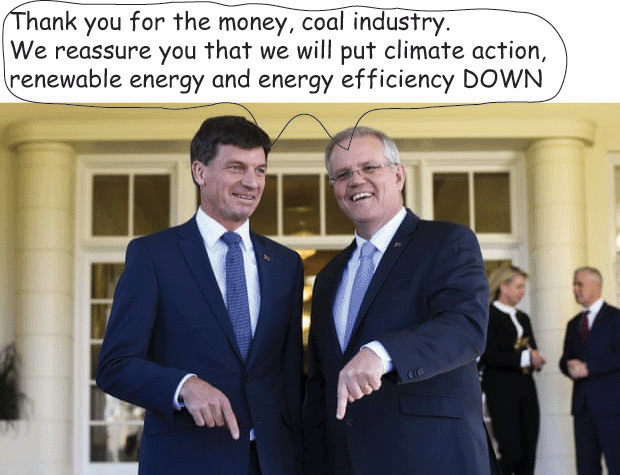
As of today, the federal government will be using taxpayer dollars to cut emissions and keep the left happy while, to keep the right happy, underwriting new coal fired power…. (Subscribers only )
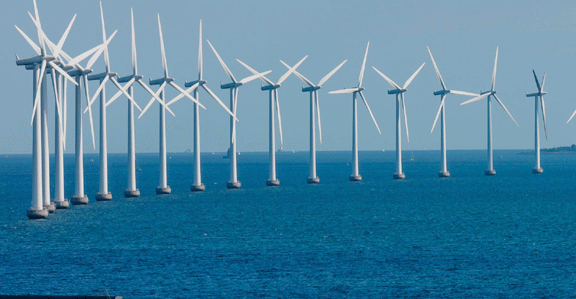
Development of Australia’s first offshore wind farm, which would power up to 1.2 million homes, has been stalled by Energy Minister Angus Taylor’s failure to sign off on an exploration license allowing a detailed assessment of the wind resource to commence.
Development of Australia’s first offshore wind farm, which would power up to 1.2 million homes, has been stalled by Energy Minister Angus Taylor’s failure to sign off on an exploration license allowing a detailed assessment of the wind resource to commence.
The Department of the Environment and Energy confirmed during Senate Estimates that an evaluation of the project has been undertaken, a plan for a customised exploration license developed, and a briefing and recommendations provided to the Energy Minister, but that the project can progress no further without the Minister granting the exploration license.
The Star of the South project seeks to construct 250 wind turbines in Commonwealth waters off the coast of Victoria’s Gippsland region, generating up to 20 per cent of Victoria’s electricity needs and feeding the power into the National Electricity Market via an underground cable to the Latrobe Valley.
The Maritime Union of Australia said the project — which the company claims will create up to 12,000 manufacturing and construction jobs and slash Australia’s carbon emissions — appeared to be falling victim to the Morrison Government’s ideological hatred of renewable energy.
MUA Deputy National Secretary Will Tracey said the exploration license awaiting approval did not allow construction to commence and was simply about allowing the use of floating buoys and platforms off the Gippsland coast to gather wind and wave observations.
“We have a major wind project that would create thousands of jobs and provide clean, reliable energy for more than a million Australian households, but because of their ideological hatred of renewable energy the Morrison Government appears to be actively stalling its development,” Mr Tracey said.
“The Star of the South project has been in the works since 2012, yet in this time no legislation has been put forward, no regulatory framework put in place, and no responsible agency nominated, despite offshore wind being an established industry internationally.
“Now we have revelations from Senate Estimates that Energy Minister Angus Taylor has been briefed on the project and presented with recommendations, yet the exploration license continues to sit on his desk gathering dust.
“Rather than support renewable energy projects, under the Morrison Government we can’t even get approval for a few wind measurement buoys off the Gippsland coast.
Energy Minister Angus Taylor must get off his hands and immediately allow the Star of the South wind project to move forward to the exploration stage.”
Mr Tracey said offshore wind generation was a mature industry internationally which has successfully operated for two decades, but Australia was falling behind, putting future employment opportunities at risk.
“This project isn’t just about generating renewable energy and tackling climate change, it’s about creating secure jobs for the future, particularly for workers who are being displaced from the offshore oil and gas industries,” he said.
“The Federal Government urgently needs to put in place a plan to support the development of the offshore wind industry, including a clear regulatory framework, along with the right port infrastructure and specialised construction vessels to roll out this project and others like it as quickly as possible.”
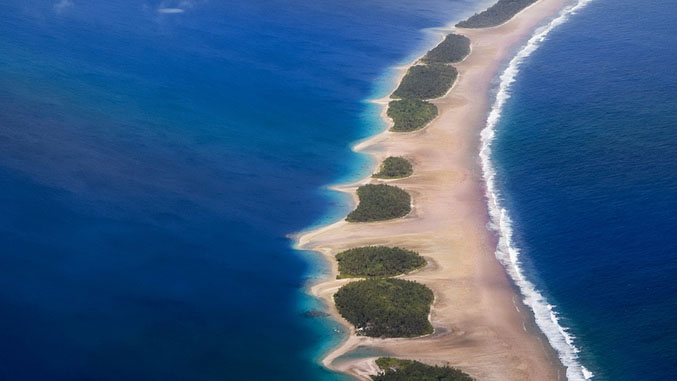
Climate change forces low-lying Marshall Islands to ‘elevate islands’, Climate change has left the low-lying Marshall Islands with little choice but to consider drastic measures. https://www.sbs.com.au/news/climate-change-forces-low-lying-marshall-islands-to-elevate-islands, 24 Feb 19, The far-flung Marshall Islands needs to raise its islands if it is to avoid being drowned by rising sea levels, President Hilda Heine has warned.
It cited an increasing frequency of “inundation events, severe droughts, coral bleaching events, and… looking forward, there is very good reason to believe that conditions and prospects for survival will only worsen.”
Most of the islands are less than two metres (6.5 feet) above sea level and the government believes physically raising the islands was the only way to save the Marshall Islands from extinction.
They have not yet outlined specifics of how this would be achieved expect to have plans formulated by the end of the year. In the meantime, they are keeping a close watch on the ambitious City of Hope project on an artificial island in the Maldives as a viable option.
To lay the foundations of the city – which is expected to accommodate 130,000 people when completed in 2023 – sand is being pumped onto reefs from surrounding atolls and it is being fortified with walls three metres above sea level, which will make it higher than the tallest natural island in the Maldives.
“Whatever approach is selected, it will involve selecting islands to raise, add to, or build upon” Heine said.
“All Marshallese stakeholders, but especially traditional landowners, need to be at the forefront of this discussion if we are ever going to move the conversation forward.”
The Marshall Islands also aims to increase engagement with the three other all-atoll nations – Kiribati, Tuvalu and the Maldives – on climate issues.
“As a group, the atoll nations need to come together to formulate their unique concerns and develop their positions and plans and identify financial needs related to climate impacts,” said Heine, who chairs the Coalition of Atoll Nations Against Climate Change.
‘Everyone loves solar’: Climate action heats up as NSW election issue, Brisbane Times By Peter Hannam February 23, 2019 NSW voters, including conservative ones, want the state government to step up action on climate change, including boosting renewable energy, two separate polling sets show.
A statewide Essential survey conducted February 6-11 for the Nature Conservation Council of 544 respondents found 51 per cent were more likely to back a party boosting clean energy and 18 per cent less likely. Among those identifying as Liberal or National supporters, the ratio was 43 per cent in favour and a quarter against.
Three separate uComms surveys for Greenpeace, each of more than 600 respondents conducted in marginal seats of Ballina, Coogee, and Penrith, found higher support for renewable energy.
In Penrith, for instance, 60 per cent of Liberal voters said they were more likely to support a party investing in renewables and 30.7 per cent less likely. In Coogee, 52.1 per cent of Liberal voters were more likely to back a party with such policies, and 38.6 per cent against.
In Ballina, 65 per cent of National supporters agreed rooftop solar and batteries would cut household power bills for homeowners and renters, while 32.8 per cent disagreed.
The polling comes amid another torrid period of extremes. NSW smashed heat records in January, with temperatures almost six degrees about average and two degrees above the previous record set in bushfire-scorched January 1939.
Much of the state remains in severe drought – with 2019 off to a dry start amid rainfall levels typically less than a fifth of normal levels – sending reservoir levels tumbling and contributing to a series of mass fish kills and algal bloom outbreaks in the Darling and other rivers.
While climate scientists have yet to determine the role climate change is having, the background warming of more than a degree over the past century across Australia is raising the likelihood of heatwaves. Climate models also point to a long-term drying trend across southern Australia, including NSW, with more to come.
No policy’
The onus to demonstrate action to tackle climate change appears to fall heavier on the Coalition if the polling and last December’s federal byelection for the Sydney seat of Wentworth are any guide, Kate Smolski, chief executive of the Nature Conservation Council, said.
“Voters deserted the Liberals in Wentworth over climate change, and [this month’s] poll shows that it’s a statewide phenomenon,” Ms Smolski said.
“This is bad news for the Berejiklian government, which after eight years of Coalition rule still doesn’t have a climate change policy or a renewable energy target.”……..
the Greens plan to introduce a carbon change bill, including a broad carbon price, to reach the net-zero emissions goal by 2040.
“We need targets with teeth if we are going to actually decarbonise,” Cate Faehrmann, Greens environment spokeswoman, said. “That is why I have developed legislation which sets binding targets to reach net-zero emissions by 2040 and gives ordinary citizens the power to prosecute government ministers who are not serious about meeting these targets.”
Jeremy Buckingham, the former Greens and now independent MP, said policies are needed to tackle emissions from agriculture, industry and transport.
The Sea of Galilee: A Sea of Miracles Disappearing
Where Jesus once preached, the holy waters are draining away,Climate change and conflict have left the river Jordan a stagnant stream and the Sea of Galilee critically low, Guardian, Oliver Holmes Sun 24 Feb 2019
If Jesus were alive today, he might reconsider a baptism in the river Jordan; there’s a good chance he’d pick up an eye infection. Faecal bacteria in the pungent, murky waters have risen in recent years to up to six times the recommended levels.
Once a raging torrent, the lower Jordan has been starved of water to become a stagnant stream, filled with sewage and dirty run-off from farms. Around 95% of its historical flow has been diverted by agriculture during the past half-century. And the river’s primary source, the Sea of Galilee – where Christians believe the son of God walked on water – has for years been dammed to prevent its demise.
Biblical bodies of water in the Holy Land, eternalised in Christian, Jewish and Muslim ancient texts as godly, are now facing very human threats: climate change, mismanagement and conflict.
Following five consecutive years of drought, the Sea of Galilee has sunk to a 100-year low. A number of small islands have emerged at the water’s surface, and several holiday homes that were built on the shoreline now stand at least 100 metres from the boggy edge.
Overuse has also taken its toll. Last summer, the level of the lake dropped close to a black line, a level at which it could lose its status as a freshwater body. “The black line is our best guess of that point,” says Gidon Bromberg, the Israeli director of EcoPeace, an organisation of Israeli, Palestinian and Jordanian environmentalists. “It was tens of centimetres above the black line,” he says, adding that such a shallow depth has not been seen in records taken over the past century.
As the lake’s level falls, it cannot wash away salt fast enough, and its salinity rises. If the Sea of Galilee’s waters were left to hover around the black line, its flora and fauna would start to perish. A glimpse of the lake’s grim future might be seen 350km downriver at the lowest place on the planet: the Dead Sea, a body almost devoid of fish and plant life. “Once the lake becomes saline, that could be irreversible,” says Bromberg, speaking at the muddy edge of the water, reeds poking up behind him………
As long as the Sea of Galilee is under threat, the river Jordan will be too. And their eventual deaths could have explosive ramifications as water in this region has been a key source of conflict. The river Jordan is shared by Israel, the occupied Palestinian territories, Jordan and Syria, all of which use its depleting reserves………
EcoPeace hopes that good water management will spur on peace to the region. Bromberg is now advocating for a deal in which Israel, which is on the Mediterranean, supplies desalinated water to Jordan. In exchange, Jordan, which is low on water but full of open desert with 320 sunny days a year, will supply solar power.
NSW election: our chance to vote 1 for climate and health, Croakey, Editor: Mark Ragg Author: John Van Der KallenJohn Van Der Kallen is a rheumatologist and the NSW Chair of Doctors for the Environment Australia. February 21,2019The Lancet has described tackling climate change as the ‘greatest global health opportunity of the 21st century.’ The upcoming NSW election is one of those opportunities to improve our health, but we need to vote for politicians who will take climate change seriously.
Tackling climate change will involve moving rapidly to renewable energy. It is encouraging to hear the NSW Labor party proposing seven gigawatts of new reliable renewable energy to power more than three million homes in the state by 2030. This is a good start on our way to 100% green power.
Stopping emissions from coal-fired power stations will immediately improve our health with fewer deaths, cardiovascular disease, low birth weight babies, premature babies and new cases of diabetes. Tightening the licences on coal fired power stations to reduce pollution, as well as putting a price on pollution by increasing the load based licencing fee, will further improve health.
Extreme weather events
Climate change is impacting on our health everyday through extreme weather events such as more severe fires, floods, droughts and heat waves. For Australia, January was the all-time hottest month. Hot weather exacerbates the urban heat effect resulting in huge discrepancies in temperatures from eastern to western Sydney. It worsens ozone pollution and puts more pressure on our emergency services. It is risking our food and water security. Most importantly, it causes an increase in deaths.
And this is only the beginning. Global temperatures are going to increase even if we were able to reduce our emissions to zero overnight.
With the right policies, there are many opportunities to improve our health in ways that will also mitigate against climate change. It’s a win-win situation.
Fortunately, many of the climate change sceptics are starting to understand climate change. For those who still don’t accept the science, the recent judgement in the Rocky Hill open cut coal mine case has made an impact. The mine was rejected for a number of reasons including its implications for climate change. In this judgement, the chief justice of the Land and Environment court stated: ‘All anthropogenic greenhouse gas emissions contribute to climate change…. The increased greenhouse concentrations in the atmosphere have already affected, and will continue to affect, the climate system.’
No more room for fossil fuel developments
So, it is now stated in law that humans are making climate change worse and that there is no room for further fossil fuel developments. This has caused massive concern within the fossil fuel industry. It is interesting to see how some politicians and some newspapers have responded by trying to discount this judgement. It has even resulted in the NSW Bar having to defend the Chief Justice!
Coal is not the only fossil fuels that needs to stay in the ground. Unconventional gas (UCG) is one of those fossil fuel developments which will also make climate change worse. It is imperative that this industry is not developed any further. UCG is not a transition fuel as some political parties would have us believe. The fugitive emissions alone are sufficient to negate any perceived benefit of UCG over other fossil fuels……..https://croakey.org/nsw-election-our-chance-to-vote-1-for-climate-and-health/
Disaster-hit Fukushima still short of 2020 Games volunteers, Japan Today Feb. 24 FUKUSHIMA
Fukushima Prefecture is still well short of its target for recruiting volunteers to help it stage some events at the 2020 Tokyo Olympics and Paralympics — a setback to its efforts to showcase its recovery from the 2011 earthquake, tsunami and nuclear disaster.
With the deadline for recruitment approaching at the end of this month, the northeastern prefecture, which is to host several softball and baseball games, was only a third of the way to its target of 1,500 volunteers.
Of the 503 people who had applied as of early February, 70 percent were in their 40s or above, with much lower participation from those in their teens and 20s, according to the prefecture.
Prefectural officials said the low number of applicants may be because the schedules for most of the games have yet to be set, while also acknowledging that promotion efforts have barely paid off.
One of the main themes of the Tokyo games is to demonstrate Japan’s reconstruction from the 2011 disasters and Fukushima, one of the hardest-hit areas, wants to use the opportunity to show the progress it has made and convey a message of gratitude for support. It also hopes to promote inbound tourism.
The prefecture has increased events for recruiting volunteers at company offices and colleges, while seeking to reassure potential volunteers that they can always change their minds later and withdraw their applications……..
Scott Morrison to reboot Tony Abbott’s emissions reduction fund with $2bn PM to announce ‘climate solutions fund’ to appeal to voters concerned about Coalition’s record , Guardian, Katharine Murphy Political editor@murpharoo, 25 Feb 2019
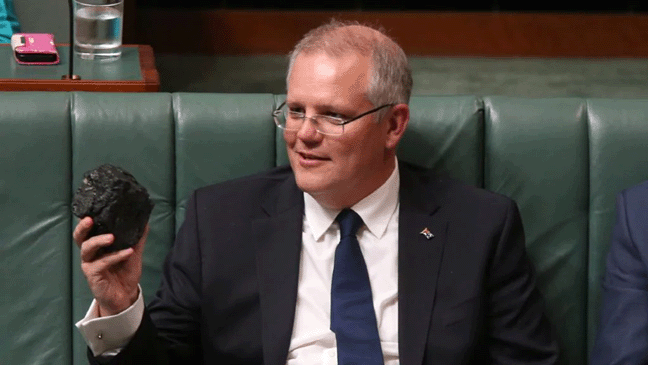
Scott Morrison will attempt to appeal to voters deeply concerned that the Coalition has been been wreckers on climate change by rebadging Tony Abbott’s emissions reduction fund as a “climate solutions” fund – with $2bn to be rolled out over 10 years.
Attempting to draw a line over years of destructive in-fighting within the Coalition that has cruelled various emissions reduction policies, the prime minister will use a speech in Melbourne on Monday to launch a new package of measures on climate change, saying his government acknowledges and accepts the challenge “but we do so with cool heads, not just impassioned hearts”.
The emissions reduction fund is a vestige of Abbott’s heavily criticised Direct Action policy. Funded by taxpayers initially at $2.5bn, the ERF pays farmers and businesses to cut carbon dioxide pollution to below what it would otherwise be. But an investigation by Guardian Australia last year found it was often difficult to determine if the fund was offering value for money.
Morrison will confirm on Monday the ERF will be rebadged a “climate solutions fund” and given a 10-year funding profile. The rebooted fund will partner with farmers, local governments and businesses to deliver “practical climate solutions” across the economy that reduce carbon emissions.
The prime minister will also continue to assert that Australia will meet its Paris target despite the trend of rising emissions in the economy that has been evident in the government’s own figures since the abolition of the carbon price in 2013.
But a chart released in advance of Monday’s speech makes it clear the looming abatement exercise will rely significantly on accounting measures as well as on practical emissions reduction.
According to projections done last December, the government will count a 367 megatonne abatement from carry-over credits (an accounting system that allows countries to count carbon credits from exceeding their targets under the soon-to-be-obsolete Kyoto protocol periods against their Paris commitment for 2030) to help meet the 2030 target.
It is also factoring in emissions reduction from Turnbull’s pet project, the Snowy 2.0 expansion (which the Morrison government has not yet formally signed off on); energy efficiency measures; an electric vehicle strategy (that it has not yet unveiled); the rebadged climate solutions fund; additional hydro projects and just under 100Mt of abatement from “technology solutions” (which aren’t specified) and “other sources of abatement” such as projects under development but not yet contracted……. https://www.theguardian.com/australia-news/2019/feb/25/scott-morrison-to-reboot-tony-abbotts-emissions-reduction-fund-with-2bn
February 20, 2019 Yokohama court orders government and TEPCO to pay $3.8m to 152 residents forced to flee homes after nuclear meltdown. Presiding Judge Ken Nakadaira said the nuclear accident was preventable as the state could have foreseen as of September 2009, based on a projection by experts, that a massive tsunami similar to […]
“The uncompleted reactors of the Baltic Nuclear Power Plant near Kaliningrad. Ecodefense’s campaigning helped end this boondoggle; now the Russian government is targeting Ecodefense.” (GreenWorld/safeenergy.org blog) See: https://miningawareness.wordpress.com/2014/07/13/not-a-foreign-agent-who-wants-to-slap-the-label-on-ecodefense-and-why-resisting-it-matters/ From Dianuke.org: “Call for Solidarity with the Russian Environmental Organization Ecodefense: [Sign Petition] FEBRUARY 22, 2019 Since 2014, the Russian anti-nuclear group, EcoDefense has been a target […]
David Noonan 24 Feb 19,This shipment came in from France through Port Kembla to Lucas Heights. This was the first shipment ‘returned’ to Australia from previous ANSTO irradiated nuclear fuel waste shipments sent overseas for ‘reprocessing’ – to get it out of the country – while ANSTO continues to produce more… ANSTO have produced nuclear fuel waste for 60 years without a disposal capaciity, and intend to continue to do so for multiple decades to come, while targeting ‘indefinate’ above ground storage (said to be for up to 100 years) on communities in SA…












 Antinuclear