Australia quietly sabotages UN climate change message, in Poland
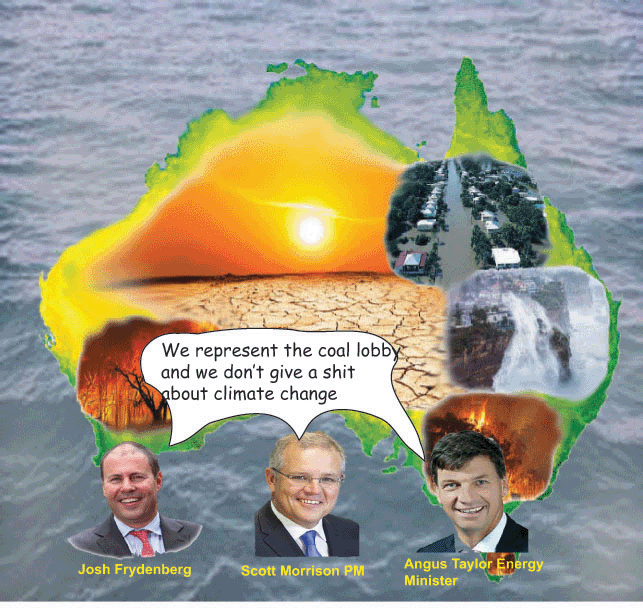 Australia’s silence during climate change debate shocks COP24 delegates, Guardian, Ben Doherty in Katowice, Poland@bendohertycorro, Mon 10 Dec 2018
Country accused of tacitly supporting oil allies’ rejection of the latest science As four of the world’s largest oil and gas producers blocked UN climate talks from “welcoming” a key scientific report on global warming, Australia’s silence during a key debate is being viewed as tacit support for the four oil allies: the US, Saudi Arabia, Russia and Kuwait.
The end of the first week of the UN climate talks – known as COP24 – in Katowice, Poland, has been mired by protracted debate over whether the conference should “welcome” or “note” a key report from the Intergovernmental Panel on Climate Change.
Negotiators spent two and a half hours trying to hammer out a compromise without success.
The apparently minor semantic debate has significant consequences, and the deadlock ensures the debate will spill into the second critical week of negotiations, with key government ministers set to arrive in Katowice.
Most of the world’s countries spoke out in fierce opposition to the oil allies’ position. The push to adopt the wording “welcome” was led by the Maldives, leader of the alliance of small island states, of which Australia’s Pacific island neighbours are members.
They were backed by a broad swathe of support, including from the EU, the bloc of 47 least developed countries, the Independent Association of Latin America and the Caribbean, African, American and European nations, and Pacific countries such as the Marshall Islands and Tuvalu.
Australia did not speak during the at-times heated debate, a silence noted by many countries on the floor of the conference, Dr Bill Hare, the managing director of Climate Analytics and a lead author on previous IPCC reports, told Guardian Australia.
“Australia’s silence in the face of this attack yesterday shocked many countries and is widely seen as de facto support for the US, Saudi Arabia, Russia and Kuwait’s refusal to welcome the IPCC report,” Hare said.
Richie Merzian, climate and energy program director at the Australia Institute, said widespread goodwill across the Katowice talks was being undermined by “a handful of countries” trying to disconnect the science and urgency from the implementation of the Paris agreement.
“It is disappointing but not surprising that Australia kept its head down during the debate … by remaining silent and not putting a position forward, Australia has tacitly supported the US, Russia and Saudi Arabia’s rejection of the latest science on climate change.”
Merzian said Australia’s regional neighbours, including New Zealand and Pacific islands, had voiced strong support for the IPCC’s report, which was a key outcome of the Paris agreement.
“A number of delegates privately shared their frustration that countries like Australia stood on the sidelines while Trump’s, Putin’s and King Salman’s representatives laid waste to the fundamental climate science.”
Hare said the interests of the fossil fuel industry were seeking to thwart the conference’s drive towards larger emissions cuts.
“The fossil fuel interest – coal, oil and gas – campaign against the IPCC 1.5 report and science continues to play out in the climate talks, but even those countries [opposing welcoming the report] are being hit by the impacts of only one degree of warming.
“The big challenge now is for the Polish presidency to set aside its obsession with coal, get out of the way and allow full acknowledgement of the IPCC 1.5C report, and its implications for increasing the ambition of all countries, in the conclusion of COP24 later this week.”
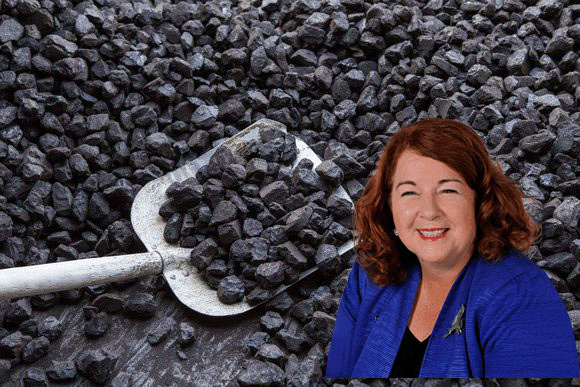 Australia’s environment minister, Melissa Price, arrived in Katowice on Sunday, with negotiations set to resume Monday morning……..
Australia’s emissions, seasonally adjusted, increased 1.3% over the past quarter. Excluding emissions from land use, land use change and forestry (for which the calculations are controversial), they are at a record high. https://www.theguardian.com/environment/2018/dec/10/australias-silence-during-climate-change-debate-shocks-cop24-delegate
Australia’s dirty tricks in Poland: getting away with no reduction in greenhouse emissions
|
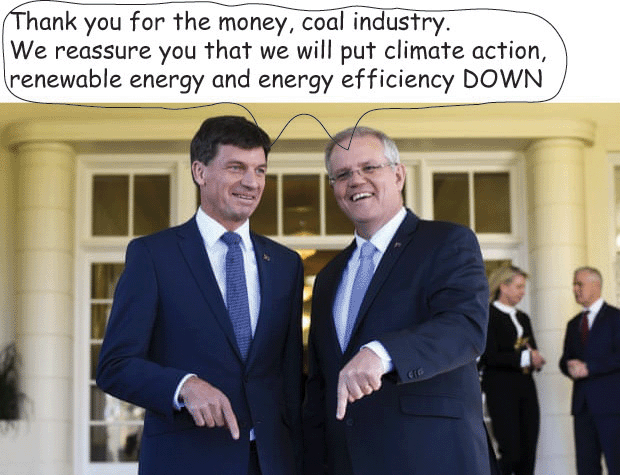
‘Fake action’: Australia’s secret path to hitting Paris climate goals, Brisbane Times, By Peter Hannam,– 10 December 2018 Australia could use a little-known loophole to help meet up to half its Paris climate commitments in a move that analysts warn could undermine the global accord. Neither Environment Minister Melissa Price nor Labor will rule out counting Australia’s expected credits from beating its 2020 goal under the soon-to-be-superseded Kyoto Protocol against its 2030 Paris pledge. The analysts say such a move by Australia would encourage other nations to follow suit. One ex-member of Australia’s negotiating team said the government had considered using the credits for some time even though it went against the spirit of the Paris accord signed in 2015. While not formally on the agenda at the current climate talks in Poland, the issue of Kyoto credits is expected to be discussed in coming days. Continue reading |
Germany: low on sunshine, high on cheap electricity from solar power
 Germany Works (accessed) 9th Dec 2018, Germany has Germany Works (accessed) 9th Dec 2018, Germany has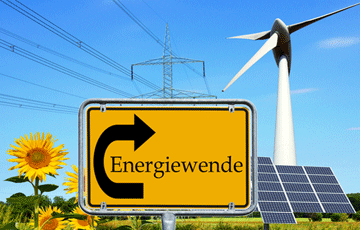 belied its status as a country with the fewest hours of sunshine in the world to become one of the planet’s largest solar power producers. belied its status as a country with the fewest hours of sunshine in the world to become one of the planet’s largest solar power producers.In 2017, Germany ranked fourth globally and accounted for about 10 per cent of the global installed capacity, according to the International Energy Agency. In 2017, Germany ranked fourth globally and accounted for about 10 per cent of the global installed capacity, according to the International Energy Agency.
This has been achieved by 1.7 million small-scale solar panel operators rather than by big, centralised power producers. These operators produced 9.6 per cent of Germany’s net energy production in the first nine months of 2018, according to research institute Fraunhofer ISE. Further, solar power has become the cheapest mode of power generation in Germany, according to Fraunhofer ISE, which says that equipment and installation costs fell by 75 per cent between 2006 and 2017.
https://germanyworks.ft.com/energy/german-solar-power-is-a-sunrise-market/ |
|
Scotland’s record electricity production in November, from wind energy
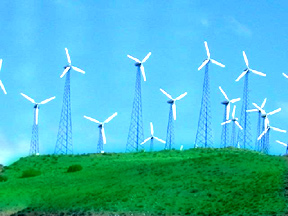
 WIND output in Scotland has broken through the 100% threshold for the first
time with 109% of total electricity demand being met from renewables, according to new data. Figures from Weather Energy, part of a wider European project, show electricity generated by wind in November was enough to power nearly 6 million homes – a new record for Scotland.
In another milestone, wind production outstripped total electricity demand on 20 out of 30 days. Gina Hanrahan, head of policy at environmental group WWF Scotland, welcomed the contribution made by wind: “Wind power breaking through the magic 100% threshold is truly momentous. For months output has flirted around the 97% mark, so it’s fantastic to reach this milestone. “It’s also worth noting that 20 out of 30 days wind production outstripped demand.
https://www.thenational.scot/news/17286749.scottish-wind-power-output-breaks-100-output-milestone/
Health risks due to high salt content in water, in a drought town
|
Health expert warns residents are at risk from high sodium in water in drought-stricken NSW town of Walgett, ABC News, By Rachel Carbonell, National Regional Reporting Team, Jessie Davies and Danielle Bonica, 10 Dec 18, Walgett has always been a river town, perched near the junction of the Barwon and the Namoi rivers.But with the drought biting hard, the water from those rivers isn’t making it to this northern New South Wales town.
With nothing to pump from the local weir, Walgett is the latest town forced to go underground for water, a move that health experts say could have potentially serious health implications. Many locals are worried the emergency supply of bore water is damaging their health. Dharriwaa Elder, Thomas Morgan, said the water was no good for drinking. “Too much salt in it,” he said. “The kids, my grandkids, they’re starting to spit it out, they don’t like it.” Continue reading |
A wave of change is coming to our planet’s water resources
 Thanks to climate change, Earth’s freshwater supplies will never be the same again, Science News for Students, BETH GEIGER, DEC 6, 2018 This is the fourth in a 10-part series about the ongoing global impacts of climate change. These stories will look at the current effects of a changing planet, what the emerging science suggests is behind those changes and what we all can do to adapt to them.
Water world Our cool blue planet is covered in water. Just 2.5 percent of that water, however, is fresh. Of that, only about one third is liquid. The rest is locked up as ice.
That isn’t much freshwater. Yet we depend on it for everything. In the United States, each person uses an average of 340 liters (90 gallons) per day at home. And that doesn’t include the water needed to grow our food or manufacture everything from clothes to cars to cell phones. It takes 3,400 liters (900 gallons) just to make one pair of jeans.
As climate changes, though, so does how much water is available. Water, climate and weather are connected in a never-ending loop called the water cycle. And like any natural system, change one part of it — whether it’s temperature, soil moisture or even how many trees are in a region — and everything else changes, too. Continue reading
Australia in midst of $20 billion wind and solar investment boom — RenewEconomy

There are $20 billion of wind, solar and storage projects currently underway in Australia, although the future looks less rosy. The post Australia in midst of $20 billion wind and solar investment boom appeared first on RenewEconomy.
via Australia in midst of $20 billion wind and solar investment boom — RenewEconomy
The technology, and new thinking, needed for 100 per cent renewable grid — RenewEconomy

We already much have the technology we need for 100 per cent renewable energy. We just need to think differently about how we produce and consume electricity. The post The technology, and new thinking, needed for 100 per cent renewable grid appeared first on RenewEconomy.
via The technology, and new thinking, needed for 100 per cent renewable grid — RenewEconomy
Gupta doubles down on green industrial plans for Whyalla, powered by cheap renewables — RenewEconomy

Steel magnate unveils more sensational details of Whyalla’s renewable powered industrial revolution, including plans for an additional steel plant – “one of world’s biggest.” The post Gupta doubles down on green industrial plans for Whyalla, powered by cheap renewables appeared first on RenewEconomy.
via Gupta doubles down on green industrial plans for Whyalla, powered by cheap renewables — RenewEconomy
Rooftop solar could supply 15% of Australian demand by 2023 — RenewEconomy

Study shows contribution to grid from Australia’s rooftop solar systems up 33% over 2018. At this rate, it could supply 14% of NEM demand within 5 years. The post Rooftop solar could supply 15% of Australian demand by 2023 appeared first on RenewEconomy.
via Rooftop solar could supply 15% of Australian demand by 2023 — RenewEconomy
Forget “Big Sticks”, more competition will lower electricity prices — RenewEconomy

Tony Abbott, my opponent for the seat of Warringah at the next federal election, thinks building new coal fired power stations will reduce power prices. He is sadly mistaken. The post Forget “Big Sticks”, more competition will lower electricity prices appeared first on RenewEconomy.
via Forget “Big Sticks”, more competition will lower electricity prices — RenewEconomy
Nuclear catastrophe – fast but avoidable. Climate change -slow, inexorable
 Former Defense Secretary Compares Climate Change To Nuclear War, Forbes, Jeff McMahon, 9 Dec 18, There are two existential catastrophes threatening the world, former Defense Secretary William Perry said. One is quick but avoidable, while the other is slowly unfolding.“Our planet today faces two existential dangers,” Perry said at Stanford University, where he now serves as a senior fellow at the Hoover Institute. “One of them is nuclear war—nuclear catastrophe—and the other is a climate catastrophe.
The nuclear catastrophe could happen next month, next year, ten years from now or if we’re lucky, never. But if it happens it happens all at once. On the other hand the climate-change catastrophe is on a slow roll. It is happening. It’s happening every month, every year. It’s getting worse…….https://www.forbes.com/sites/jeffmcmahon/2018/12/09/former-defense-secretary-compares-climate-change-to-nuclear-war/#15e849ee60bb

Climate change now brings bushfires to Australia’s Northern rainforests
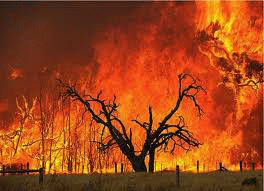 ‘Like opening a fan oven’: Australia’s rainforest threatened by bushfires, Guardian, Lisa Cox, 9 Dec 18 ‘Like opening a fan oven’: Australia’s rainforest threatened by bushfires, Guardian, Lisa Cox, 9 Dec 18Typically, rainforest should be able to self-protect during fire, with closed canopies that allow little sunlight to the forest floor and that keep the vegetation moist. But the cyclones have shredded the canopies, leaving an excess of fuel from debris on the ground, and a lack of rain meant the forest was dry. Since 22 November, more than 1m hectares has been burnt across Queensland, much of which lies in the tropics. Since the beginning of its bushfire season in August, more than 3.6m hectares have been destroyed. The most recent fires occurred on a magnitude never before seen in the state. Over a period of 12 days, the Queensland fire and emergency service said it had attended more than 1,200 fires, with help from crews from every state and territory in Australia. Andrew Piccone, a nature campaigner with the Australian Conservation Foundation, who did his studies in rainforest ecology, said that Australia would have to consider the future impact of warming conditions on a range of plant, animal and insect species in the wet tropics. “If catastrophic fire conditions are going to burn the rainforest in Queensland, what that means for the future of the wet tropics world heritage area could be quite concerning,” he said……… Philip Stewart, a fire ecologist with Queensland University’s school of earth and environmental sciences, agrees. He said governments and communities would need to become more proactive in fighting fires and that current processes were too reactive. “We do need to look at firefighting in a different light,” Stewart said. “We are a fire-prone country and more people are moving into fire-prone areas. We need to have an understanding of the danger of that and look at fighting fire with fire. He pointed to traditional burning used by Indigenous communities as a model, where prescribed burning occurs on a larger scale than hazard-reduction burns, which focus on reducing fuel in specific areas. Stewart said areas of rainforest impacted could take decades or even centuries to recover, adding that the next possible threat to those areas was mudslides as the wet season sets in. “High-intensity fire tends to create a layer within the soil that is hydrophobic and therefore water repellent causing mass soil erosion,” he said. “We are seeing this very phenomenon in the USA at Malibu where mass soil movement has taken place due to the heavy rains that followed the high-intensity and severe fires there.” https://www.theguardian.com/australia-news/2018/dec/09/australias-rainforest-under-threat-as-bushfires-rage-in-the-tropics |
|
Increased risk of bushfires in Tasmania
 Growth spurt fuels ‘normal’ bushfire riskFire danger Rapid vegetation growth during Tasmania’s recent spate of wet and warm weather could pose an added bushfire risk for property owners, the Tasmania Fire Service says….(subscribers only)
US and Russia ally with Saudi Arabia to water down climate pledge

Guardian, Jonathan Wattsand Ben Doherty, Mon 10 Dec 2018 , Move shocks delegates at UN conference as ministers fly in for final week of climate talks The US and Russia have thrown climate talks into disarray by allying with Saudi Arabia and Kuwait to water down approval of a landmark report on the need to keep global warming below 1.5C.
After a heated two-and-a-half-hour debate on Saturday night, the backwards step by the four major oil producers shocked delegates at the UN climate conference in Katowice as ministers flew in for the final week of high-level discussions.
It has also raised fears among scientists that the US president, Donald Trump, is going from passively withdrawing from climate talks to actively undermining them alongside a coalition of climate deniers.
Two months ago, representatives from the world’s governments hugged after agreeing on the 1.5C report by the UN Intergovernmental Panel on Climate Change (IPCC), commissioned to spell out the dire consequences should that level of warming be exceeded and how it can be avoided.
Reaching a global consensus was a painstaking process involving thousands of scientists sifting through years of research and diplomats working through the night to ensure the wording was acceptable to all nations.
But when it was submitted to the UN Framework Convention on Climate Change on Saturday, the four oil allies – with Saudi Arabia as the most obdurate – rejected a motion to “welcome” the study. Instead, they said it should merely be “noted”, which would make it much easier for governments to ignore. The motion has not yet been able to pass as a result of the lack of consensus.
t opened up a rift at the talks that will be hard to close in the coming five days. During the plenary, the EU, a bloc of the 47 least developed countries, as well as African and Latin and South American nations, all spoke in favour of the report. Several denounced the four countries trying to dilute its importance. ………
Scientists were also outraged. “It is troubling. Saudi Arabia has always had bad behaviour in climate talks, but it could be overruled when it was alone or just with Kuwait. That it has now been joined by the US and Russia is much more dangerous,” said Alden Meyer, the director of strategy and policy in the Union of Concerned Scientists….
Ministers have only five days to establish a rulebook for the Paris agreement. A wild card is the role of the host nation, Poland – the most coal-dependant nation in Europe – which will chair the final week of the meeting………
As well as acceptance of the report, there are several other potential fights brewing regarding transparency rules for reporting emissions and proposals for wealthy high emitters to provide financial support to poorer nations struggling to adapt. https://www.theguardian.com/environment/2018/dec/09/us-russia-ally-saudi-arabia-water-down-climate-pledges-un
1 This month.

Australians deserve the truth
about
AUKUS – https://aukuspublicinquiry.com/


PETITION – To: Prime Minister Anthony Albanese and the Australian Labor Government

of the week – Australians for War Powers Reform (AWPR)
To see nuclear-related stories in greater depth and intensity
 Antinuclear