Australia, US, UK sign nuclear transfer deal for AUKUS subs – AUSTRALIA RESPONSIBLE FOR THE SPENT FUEL WASTES
Australia would be responsible for the storage and disposal of spent nuclear fuel and radioactive waste from the nuclear power units that are transferred under the deal.
SYDNEY: Australia said on Monday (Aug 12) it had signed a deal to allow the exchange of nuclear secrets and material with the United States and Britain, a key step toward equipping its navy with nuclear-powered submarines.
It binds the three countries to security arrangements for the transfer of sensitive US and UK nuclear material and know-how as part of the tripartite 2021 AUKUS security accord.
AUKUS, which envisages building an Australian nuclear-powered submarine fleet and jointly developing advanced warfighting capabilities, is seen as a strategic answer to Chinese military ambitions in the Pacific region.
“This agreement is an important step towards Australia’s acquisition of conventionally armed nuclear-powered submarines for the Royal Australian Navy,” said Richard Marles, Australia’s defence minister and deputy prime minister.
Australia’s acquisition of a nuclear-powered submarine fleet would set the “highest non-proliferation standards”, he said, stressing that the country did not seek nuclear weapons.
The latest deal – signed in Washington last week and tabled in the Australian parliament on Monday – includes a provision for Australia to indemnify its partners against any liability for nuclear risks from material sent to the country.
Nuclear material for the future submarines’ propulsion would be transferred from the US or Britain in “complete, welded power units”, it says.
But Australia would be responsible for the storage and disposal of spent nuclear fuel and radioactive waste from the nuclear power units that are transferred under the deal.
“Submarines are an essential part of Australia’s naval capability, providing a strategic advantage in terms of surveillance and protection of our maritime approaches,” the transfer deal says.
China’s foreign minister Wang Yi warned in a visit to Australia in April that AUKUS raised “serious nuclear proliferation risks”, claiming it ran counter to a South Pacific treaty banning nuclear weapons in the region.
Canada rejects AUKUS nuclear submarine deal
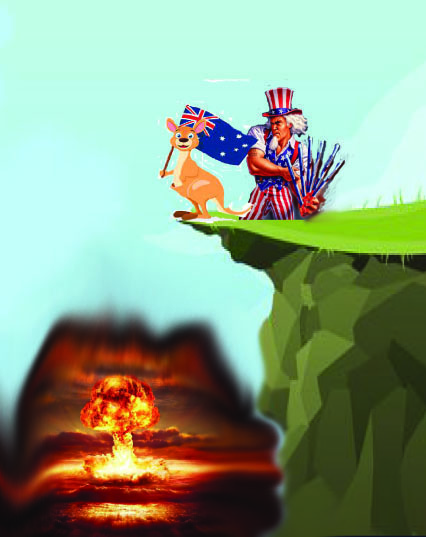
the main concern should be that this deal further locks Australia into US exceptionalism and attempted hegemony in our region. The Albanese government has repeatedly sought to reassure that our sovereignty has been preserved, but this is very difficult to accept given the extent to which our funding underwrites the US submarine-production program. Moreover, it’s likely Australia’s learning and launch activities will further integrate this country into the operational aspects of the American war machine, such that US leaders may effectively give all the instructions in terms of deployment and other activities.
John Hewson , professor at the ANU Crawford School of Public Policy and former Liberal opposition leader.
Some news this month might have given the government pause. Canada – with the longest coastline in the world and a security situation in its Arctic and north changing significantly as the region becomes more accessible, particularly with more Russian and Chinese activity – decided not to join the AUKUS arrangement and buy nuclear submarines. Instead it is considering cooperating with Germany and Norway as partners in a submarine program and will purchase 12 conventionally powered under-ice capable submarines for about $60 billion.
Compare this with the eye-watering cost of Australia’s acquisition: $368 billion for eight Virginia-class and next-generation SSN-AUKUS nuclear submarines with a vague delivery schedule.
Of course, defenders of the AUKUS deal will argue it is more than just an arrangement to buy submarines. They will claim it instead to be a broad, trilateral security arrangement for the Indo-Pacific region that also fosters technology exchanges between the three countries, and helps to build a conventionally armed nuclear-powered submarine force for Australia.
Nevertheless, the deal has been widely criticised and, given its huge cost, it’s worth asking why these criticisms haven’t resonated. One of its most vocal and effective opponents has been former prime minister Paul Keating, who has labelled it “the worst deal in history” and “the worst international decision by a Labor government since the former Labor leader Billy Hughes sought to introduce conscription”. He has slammed the deal particularly for allowing defence interests to trump diplomacy.
It has also been strongly criticised within the Labor Party and union structures: by some 50 units of the party from branches and electoral conferences, and leading unions including the Electrical Trades Union, the CFMEU and the Australian Manufacturing Workers’ Union. The Nobel Prize-winning, Australian-led International Campaign to Abolish Nuclear Weapons has also rejected it for the risks of nuclear proliferation. China’s reaction to the deal was to warn that we are “on a path of error and danger”.“The main concern should be that this deal further locks Australia into US exceptionalism and attempted hegemony in our region … Moreover, it’s likely Australia’s learning and launch activities will further integrate this country into … the American war machine…”
There has also been a host of technical concerns, including in relation to the supply of fuel to run the subs. Keating has drawn a comparison with an alternative deal proposed by the French that emerged after the Morrison government rescinded the original agreement to replace Australia’s ageing Collins-class fleet with the so-called Attack-class sub. This proposal, he says, came with a firm delivery date in 2034 at fixed prices, but was ignored by the government. Technically these French subs would have required only 5 per cent enriched uranium, instead of 95 per cent, weapons grade, for fuel. That this feature was ignored by the government should come as no surprise, as the Coalition has provided no detail about the enriched uranium fuel – neither supply nor cost – for its announced seven nuclear power plants.
However, the main concern should be that this deal further locks Australia into US exceptionalism and attempted hegemony in our region. The Albanese government has repeatedly sought to reassure that our sovereignty has been preserved, but this is very difficult to accept given the extent to which our funding underwrites the US submarine-production program. Moreover, it’s likely Australia’s learning and launch activities will further integrate this country into the operational aspects of the American war machine, such that US leaders may effectively give all the instructions in terms of deployment and other activities.
This should be an even greater concern having heard the Republican candidates for this year’s election speak at their national convention in Wisconsin. Both Donald Trump and J.D. Vance are committed to an even tougher line against China and Australia risks being used somewhat as a pawn in their response to what they like to refer to as the “China threat”. On the contrary, as I have suggested many times, the threat is not so much from the rise of China as it is related to the decline in the global standing of the US. It’s easy to imagine how Trump and Vance could only make this worse, especially by threatening tariffs on Chinese goods.
The Trump–Vance commitment to return to tariff protections flies in the face of voluminous accumulated evidence concerning the costs and disadvantages of doing so. This will certainly not restore the rust-belt states to their former glory as these candidates are promising. China’s only “sin” has been to grow its economy to rival that of the US. The US has lost any cost advantage it may once have enjoyed in manufacturing as well as its edge in technology – most recently in the production of electric vehicles. Just ask Tesla, which now bases much of its production in China.
And the halcyon days of inflation control in the ’90s were much more the result of China flooding the world with cheap manufactured goods, than any effective application of monetary policy. The US was a major beneficiary of this, which is so easily overlooked in its current cost-of-living crisis.
Surely Australia wouldn’t want to end up being pressured to park nuclear submarines along the Chinese coast as part of a US demonstration of strength? Nor should we allow ourselves to be dragged by the US into some conflict with China over Taiwan.
The Albanese government has had considerable difficulty justifying the cost of the AUKUS deal, and so it should. Governing is about priorities and, true enough, national security is a priority. It’s also true that the government has been able to deal effectively with many domestic priorities, such as providing non-inflationary cost-of-living assistance. Defence procurement has long been somewhat ring-fenced from the normal discipline applied to other departments in the Expenditure Review Committee processes, however. It’s no defence to spend so much on submarines, when so much more could have been done in other national priority areas, including education and the care sectors. This is especially so in light of the attendant risks of a deal such as AUKUS.
With the mounting tension between the US and China, world leaders should be increasingly concerned about the threat of another drift to a Cold War situation.
The need for a circuit breaker is clear. I was pleased recently to join the signatories to an open letter drafted by two former foreign affairs ministers, Gareth Evans and Bob Carr, for détente: “a genuine balance of power between the US and China, designed to avert the horror of great power conflict and to secure a lasting peace for our people, our region, and the world.”
Given the state of the world, and its pronounced geopolitical uncertainty, it is disappointing that neither the US nor China has yet responded to the proposal, and surprising that the Albanese government hasn’t embraced it as a mechanism to advance the point that Australia, as a middle-ranking power, has and can continue to punch above its weight in the global interest.
This is especially so given the benefits that Australia as a nation has reaped from the economic rise of China.
Surely a situation can’t be allowed to develop whereby the United States and China embark on trade protection and military conflict.
At the very least, there should be the imperative of a global discourse on this. Unfortunately, attitudes are hardening in Europe and the US – perhaps to the point where the outcome will be gratuitous harm?
This article was first published in the print edition of The Saturday Paper on July 27, 2024 as “Canada’s smart lead on nuclear subs”.
UK Nuclear Free Local Authorities back joint statement condemning AUKUS nuclear proliferation

The UK/Ireland Nuclear Free Local Authorities have joined environmental and peace groups around the world in endorsing a statement that will be delivered to a conference at the United Nations.
The 2024 Nuclear Non-Proliferation Treaty Preparatory Committee will meet today to begin work to make preparations for the next conference of signing to the Nuclear Non-Proliferation Treaty (or NPT).
The statement will be delivered to committee delegates by Jemila Rushton, Acting Director of the International Campaign to Abolish Nuclear Weapons Australia. The NFLAs are a member of ICAN.
Particular reference is made to the adverse impact of AUKUS, the military alliance forged between Australia, the United Kingdom, and the United States in opposition to China, on geopolitics in the Pacific.
Amongst its more controversial elements is the provision of nuclear-powered submarines by the other partners to Australia. We share the concern of other signatories that AUKUS violates in spirit both the Nuclear Non-Proliferation Treaty and the Rarotonga – South Pacific Nuclear Free Zone Treaty. The submarines will be powered by weapons-grade nuclear fuel, supplied by the other partners and will operate from Australian bases within a nuclear free zone.
Although present plans provide for these submarines to be conventionally armed, it is not inconceivable that over time they could be rearmed with nuclear weapons. The Leader of the Opposition in the Australian Parliament, Peter Dutton, is currently actively lobbying for Australia to establish a civil nuclear programme and such a programme is critical to support the development of nuclear weapons capacity.
The statement has also been endorsed by our colleagues Labrats, CND Cymru and Together against Sizewell C.
For more information please contact the NFLA Secretary Richard Outram by email to richard.outram@manchester.gov.uk
AUKUS and the pride of politicians

By Nick Deane, Jul 24, 2024 https://johnmenadue.com/aukus-and-the-pride-of-politicians/
With AUKUS, the pride of politicians has become an obstacle to reaching the best solution to the ‘national security’ conundrum. In the end, it could be that ego-driven reluctance to shift from entrenched positions results in the Australian people being delivered a disaster.
For my own purposes, I have been keeping a record of articles I have read under the topic ‘AUKUS’. There are now some 300 such items on my spreadsheet – nearly all of them finding fault of one kind or another with this extraordinary project.
The criticisms deal with a wide variety of aspects (mainly focussed on the acquisition of nuclear-powered submarines). To summarise a few, the AUKUS project:-
- Leads Australia in the direction of war;
- Has done damage to Australia’s international reputation;
- Destabilises Australia’s immediate region;
- Brings a nuclear industry with it;
- Introduces the intractable problem of nuclear waste disposal;
- Damages our relationship with our most important trading partner;
- Causes a significant loss of sovereignty;
- Is not good value for money;
- Diverts resources away from social programs;
- Will not be as effective as conventional submarines;
- Is aggressive and not defensive, and
- Will probably not come to fruition in any case.
Highly respected commentators, such as Hugh White, Paul Keating, Sam Roggeveen, Andrew Fowler, Rex Patrick and Clinton Fernandes, have all raised significant concerns. Meanwhile ‘civil society’ is also getting mobilised, with ‘anti-AUKUS’ groups springing up in all the major centres.
However, the proponents of AUKUS (and the mainstream media) appear content to ignore the valid, rational arguments being put forward against it. Indeed, industry-based conferences are going ahead as if there is nothing about to the project that needs to be questioned, and, no doubt, secret, military training programs are already well under way. Within the military-industrial establishment, the project is gathering momentum. Those in the military are excited by the prospect of controlling a new, highly lethal weapon, whilst those in the industry are attracted by the smell of the limitless funds being devoted to it.
It is disturbing to have to concede that rational argument appears to have little impact on AUKUS’s proponents. However there is an even more worrying aspect to add. That is the pride of politicians. For the longer the process continues, with all its secrecy and in the absence of meaningful debate at high levels, the harder it is for politicians to change course. Abandoning the project would already cause senior members of both major parties considerable ‘loss of face’. If it falls over (as some predict), or if opposition becomes a vote-winner at the next election, that ‘loss of face’ will be highly embarrassing. With AUKUS, the pride of politicians has thus become an obstacle to to reaching the best solution to the ‘national security’ conundrum. In the end, it could be that ego-driven reluctance to shift from entrenched positions results in the Australian people being delivered a disaster.
In an ideal, democratic society, voters and the politicians they elect appraise themselves of the ‘pros and cons’ of controversial matters and make decisions on a rational basis. If they do that in the case of AUKUS, it is surely doomed. Politicians beware!
Trusting the ‘Five Eyes’ Only
For Their Eyes Only
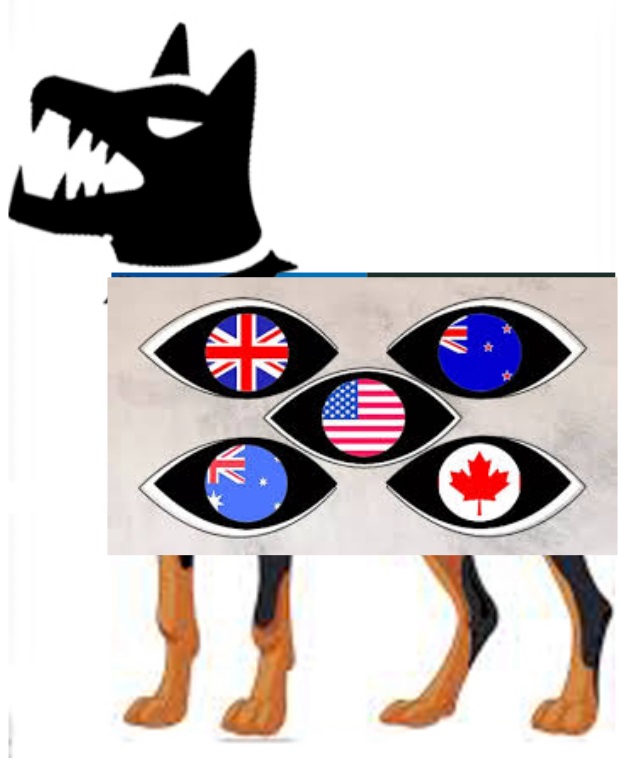
The “Five Eyes” (FVEY) is an elite club of five English-speaking countries — Australia, Canada, New Zealand, the United Kingdom, and the United States — that have agreed to cooperate in intelligence matters and share top-secret information. They all became parties to what was at first the bilateral UKUSA Agreement, a 1946 treaty for secret cooperation between the two countries in what’s called “signals intelligence” — data collected by electronic means, including by tapping phone lines or listening in on satellite communications. (The agreement was later amended to include the other three nations.) Almost all of the Five Eyes’ activities are conducted in secret, and its existence was not even disclosed until 2010. You might say that it constitutes the most secretive, powerful club of nations on the planet.
Anglo-Saxon solidarity supersedes all other relationships.
JULY 5, 2024 By Michael Klare / TomDispatch, https://scheerpost.com/2024/07/05/trusting-the-five-eyes-only/
Wherever he travels globally, President Biden has sought to project the United States as the rejuvenated leader of a broad coalition of democratic nations seeking to defend the “rules-based international order” against encroachments by hostile autocratic powers, especially China, Russia, and North Korea. “We established NATO, the greatest military alliance in the history of the world,” he told veterans of D-Day while at Normandy, France on June 6th. “Today… NATO is more united than ever and even more prepared to keep the peace, deter aggression, defend freedom all around the world.”
In other venues, Biden has repeatedly highlighted Washington’s efforts to incorporate the “Global South” — the developing nations of Africa, Asia, Latin America, and the Middle East — into just such a broad-based U.S.-led coalition. At the recent G7 summit of leading Western powers in southern Italy, for example, he backed measures supposedly designed to engage those countries “in a spirit of equitable and strategic partnership.”
But all of his soaring rhetoric on the subject scarcely conceals an inescapable reality: the United States is more isolated internationally than at any time since the Cold War ended in 1991. It has also increasingly come to rely on a tight-knit group of allies, all of whom are primarily English-speaking and are part of the Anglo-Saxon colonial diaspora. Rarely mentioned in the Western media, the Anglo-Saxonization of American foreign and military policy has become a distinctive — and provocative — feature of the Biden presidency.
America’s Growing Isolation
To get some appreciation for Washington’s isolation in international affairs, just consider the wider world’s reaction to the administration’s stance on the wars in Ukraine and Gaza.
Following Russia’s invasion of Ukraine, Joe Biden sought to portray the conflict there as a heroic struggle between the forces of democracy and the brutal fist of autocracy. But while he was generally successful in rallying the NATO powers behind Kyiv — persuading them to provide arms and training to the beleaguered Ukrainian forces, while reducing their economic links with Russia — he largely failed to win over the Global South or enlist its support in boycotting Russian oil and natural gas.
Despite what should have been a foreboding lesson, Biden returned to the same universalist rhetoric in 2023 (and this year as well) to rally global support for Israel in its drive to extinguish Hamas after that group’s devastating October 7th rampage. But for most non-European leaders, his attempt to portray support for Israel as a noble response proved wholly untenable once that country launched its full-scale invasion of Gaza and the slaughter of Palestinian civilians commenced. For many of them, Biden’s words seemed like sheer hypocrisy given Israel’s history of violating U.N. resolutions concerning the legal rights of Palestinians in the West Bank and its indiscriminate destruction of homes, hospitals, mosques, schools, and aid centers in Gaza. In response to Washington’s continued support for Israel, many leaders of the Global South have voted against the United States on Gaza-related measures at the U.N. or, in the case of South Africa, have brought suit against Israel at the World Court for perceived violations of the 1948 Genocide Convention.
In the face of such adversity, the White House has worked tirelessly to bolster its existing alliances, while trying to establish new ones wherever possible. Pity poor Secretary of State Antony Blinken, who has made seemingly endless trips to Asia, Africa, Europe, Latin America, and the Middle East trying to drum up support for Washington’s positions — with consistently meager results.
Here, then, is the reality of this anything but all-American moment: as a global power, the United States possesses a diminishing number of close, reliable allies – most of which are members of NATO, or countries that rely on the United States for nuclear protection (Japan and South Korea), or are primarily English-speaking (Australia and New Zealand). And when you come right down to it, the only countries the U.S. really trusts are the “Five Eyes.”
For Their Eyes Only
The “Five Eyes” (FVEY) is an elite club of five English-speaking countries — Australia, Canada, New Zealand, the United Kingdom, and the United States — that have agreed to cooperate in intelligence matters and share top-secret information. They all became parties to what was at first the bilateral UKUSA Agreement, a 1946 treaty for secret cooperation between the two countries in what’s called “signals intelligence” — data collected by electronic means, including by tapping phone lines or listening in on satellite communications. (The agreement was later amended to include the other three nations.) Almost all of the Five Eyes’ activities are conducted in secret, and its existence was not even disclosed until 2010. You might say that it constitutes the most secretive, powerful club of nations on the planet.
The origins of the Five Eyes can be traced back to World War II, when American and British codebreakers, including famed computer theorist Alan Turing, secretly convened at Bletchley Park, the British codebreaking establishment, to share intelligence gleaned from solving the German “Enigma” code and the Japanese “Purple” code. At first an informal arrangement, the secretive relationship was formalized in the British-US Communication Intelligence Agreement of 1943 and, after the war ended, in the UKUSA Agreement of 1946. That arrangement allowed for the exchange of signals intelligence between the National Security Agency (NSA) and its British equivalent, the Government Communications Headquarters (GCHQ) — an arrangement that persists to this day and undergirds what has come to be known as the “special relationship” between the two countries.
Then, in 1955, at the height of the Cold War, that intelligence-sharing agreement was expanded to include those other three English-speaking countries, Australia, Canada, and New Zealand. For secret information exchange, the classification “AUS/CAN/NZ/UK/US EYES ONLY” was then affixed to all the documents they shared, and from that came the “Five Eyes” label. France, Germany, Japan, and a few other countries have since sought entrance to that exclusive club, but without success.
Although largely a Cold War artifact, the Five Eyes intelligence network continued operating right into the era after the Soviet Union collapsed, spying on militant Islamic groups and government leaders in the Middle East, while eavesdropping on Chinese business, diplomatic, and military activities in Asia and elsewhere. According to former NSA contractor Edward Snowden, such efforts were conducted under specialized top-secret programs like Echelon, a system for collecting business and government data from satellite communications, and PRISM, an NSA program to collect data transmitted via the Internet.
As part of that Five Eyes endeavor, the U.S., the United Kingdom, and Australia jointly maintain a controversial, highly secret intelligence-gathering facility at Pine Gap, Australia, near the small city of Alice Springs. Known as the Joint Defence Facility Pine Gap (JDFPG), it’s largely run by the NSA, CIA, GCHQ, and the Australian Security Intelligence Organization. Its main purpose, according to Edward Snowden and other whistle-blowers, is to eavesdrop on radio, telephone, and internet communications in Asia and the Middle East and share that information with the intelligence and military arms of the Five Eyes. Since the Israeli invasion of Gaza was launched, it is also said to be gathering intelligence on Palestinian forces in Gaza and sharing that information with the Israeli Defense Forces. This, in turn, prompted a rare set of protests at the remote base when, in late 2023, dozens of pro-Palestinian activists sought to block the facility’s entry road.
Anglo-Saxon Solidarity in Asia
The Biden administration’s preference for relying on Anglophone countries in promoting its strategic objectives has been especially striking in the Asia-Pacific region. The White House has been clear that its primary goal in Asia is to construct a network of U.S.-friendly states committed to the containment of China’s rise. This was spelled out, for example, in the administration’s Indo-Pacific Strategy of the United States of 2022. Citing China’s muscle-flexing in Asia, it called for a common effort to resist that country’s “bullying of neighbors in the East and South China” and so protect the freedom of commerce. “A free and open Indo-Pacific can only be achieved if we build collective capacity for a new age,” the document stated. “We will pursue this through a latticework of strong and mutually reinforcing coalitions.”
That “latticework,” it indicated, would extend to all American allies and partners in the region, including Australia, Japan, New Zealand, the Philippines, and South Korea, as well as friendly European parties (especially Great Britain and France). Anyone willing to help contain China, the mantra seems to go, is welcome to join that U.S.-led coalition. But if you look closely, the renewed prominence of Anglo-Saxon solidarity becomes ever more evident.
Of all the military agreements signed by the Biden administration with America’s Pacific allies, none is considered more important in Washington than AUKUS, a strategic partnership agreement between Australia, the United Kingdom, and the United States. Announced by the three member states on Sept. 15, 2021, it contains two “pillars,” or areas of cooperation — the first focused on submarine technology and the second on AI, autonomous weapons, as well as other advanced technologies. As in the FVEY arrangement, both pillars involve high-level exchanges of classified data, but also include a striking degree of military and technological cooperation. And note the obvious: there is no equivalent U.S. agreement with any non-English-speaking country in Asia.
Consider, for instance, the Pillar I submarine arrangement. As the deal now stands, Australia will gradually retire its fleet of six diesel-powered submarines and purchase three to five top-of-the-line U.S.-made Los Angeles-class nuclear-powered submarines (SSNs), while it works with the United Kingdom to develop a whole new class of subs, the SSN-AUKUS, to be powered by an American-designed nuclear propulsion system. But — get this — to join, the Australians first had to scrap a $90 billion submarine deal with a French defense firm, causing a severe breach in the Franco-Australian relationship and demonstrating, once again, that Anglo-Saxon solidarity supersedes all other relationships.
Now, with the French out of the picture, the U.S. and Australia are proceeding with plans to build those Los Angeles-class SSNs — a multibillion-dollar venture that will require Australian naval officers to study nuclear propulsion in the United States. When the subs are finally launched (possibly in the early 2030s), American submariners will sail with the Australians to help them gain experience with such systems. Meanwhile, American military contractors will be working with Australia and the UK designing and constructing a next-generation sub, the SSN-AUKUS, that’s supposed to be ready in the 2040s. The three AUKUS partners will also establish a joint submarine base near Perth in Western Australia.
Pillar II of AUKUS has received far less media attention but is no less important. It calls for American, British, Australian scientific and technical cooperation in advanced technologies, including AI, robotics, and hypersonics, aimed at enhancing the future military capabilities of all three, including through the development of robot submarines that could be used to spy on or attack Chinese ships and subs.
Aside from the extraordinary degree of cooperation on sensitive military technologies — far greater than the U.S. has with any other countries — the three-way partnership also represents a significant threat to China. The substitution of nuclear-powered subs for diesel-powered ones in Australia’s fleet and the establishment of a joint submarine base at Perth will enable the three AUKUS partners to conduct significantly longer undersea patrols in the Pacific and, were a war to break out, attack Chinese ships, ports, and submarines across the region. I’m sure you won’t be surprised to learn that the Chinese have repeatedly denounced the arrangement, which represents a potentially mortal threat to them.
Unintended Consequences
It’s hardly a surprise that the Biden administration, facing growing hostility and isolation in the global arena, has chosen to bolster its ties further with other Anglophone countries rather than make the policy changes needed to improve relations with the rest of the world. The administration knows exactly what it would have to do to begin to achieve that objective: discontinue arms deliveries to Israel until the fighting stops in Gaza; help reduce the burdensome debt load of so many developing nations; and promote food, water security, and other life-enhancing measures in the Global South. Yet, despite promises to take just such steps, President Biden and his top foreign policy officials have focused on other priorities — the encirclement of China above all else — while the inclination to lean on Anglo-Saxon solidarity has only grown.
However, by reserving Washington’s warmest embraces for its anglophone allies, the administration has actually been creating fresh threats to U.S. security. Many countries in contested zones on the emerging geopolitical chessboard, especially in Africa, the Middle East, and Southeast Asia, were once under British colonial rule and so anything resembling a potential Washington-London neocolonial restoration is bound to prove infuriating to them. Add to that the inevitable propaganda from China, Iran, and Russia about a developing Anglo-Saxon imperial nexus and you have an obvious recipe for widespread global discontent.
It’s undoubtedly convenient to use the same language when sharing secrets with your closest allies, but that should hardly be the deciding factor in shaping this nation’s foreign policy. If the United States is to prosper in an increasingly diverse, multicultural world, it will have learn to think and act in a far more multicultural fashion — and that should include eliminating any vestiges of an exclusive Anglo-Saxon global power alliance.
There is no shortage of Coalition U-turns on nuclear. But this Aukus example might be the most remarkable
So the Coalition is going all-in, no longer responsible for upholding the guarantees of government nor at the same risk of sparking proliferation speculation that might arise if it did so while in office.
Karen Middleton, Sat 22 Jun 2024 https://www.theguardian.com/environment/article/2024/jun/22/there-is-no-shortage-of-coalition-u-turns-on-nuclear-but-this-aukus-example-might-be-the-most-remarkable
From the nuclear submarine pact to community vetoes, Peter Dutton has abandoned pledges the Coalition made in government with his latest announcement.
When he unveiled preliminary details of his nuclear power plan this week, Peter Dutton was not asked any questions about the relevance of the Aukus agreement.
His energy spokesperson, Ted O’Brien, mentioned the nuclear-powered submarine pact in his opening remarks at Wednesday’s joint news conference, called to name seven sites for possible future nuclear reactors.
O’Brien’s reference was in the context of safety – that nuclear technology was already in use in Australia medically and anticipated for the military.
Journalists were more concerned about interrogating the absence of details on cost, reactor type, volume of power generated and the like, than exploring what relevance Aukus might have.
But there’s an Aukus-related back story to this week’s nuclear announcement that sheds some new light on how we got here. Or, more precisely, why we didn’t get here sooner.
When Scott Morrison was prime minister, the Coalition thought about having a second go at a nuclear power policy. It had been part of John Howard’s bid to engage with climate change in late 2006 as the Kevin ’07 juggernaut advanced.
Twelve years later, contemplating the 2022 election, Morrison considered having another go. The climate debate had shifted and embracing coal was no longer going to cut it. Nuclear energy offered a possible low-emissions course.
But polling on the proposal came back negative and Morrison quietly shelved the idea immediately, despite the urgings of some who thought a case could be made.
Then came the Aukus negotiations and the extraordinary announcement in September 2021 that Australia had ditched its contract with France to buy conventional submarines, securing a nuclear-powered option instead.
With a Coalition government in power, it seemed logical this might reopen the nuclear energy debate in Australia. But any thoughts of that were banished before they had time to form.
“Australia is not seeking to acquire nuclear weapons or establish a civil nuclear capability,” Morrison declared at the surprise announcement via satellite with the United States president and British prime minister. “And we will continue to meet all our nuclear non-proliferation obligations.”
Turns out, this wasn’t just a definitive Morrison statement. It was a condition of the Americans agreeing to go ahead.
As the Aukus deal reached its crucial end point, the US made it plain to senior members of the Morrison government that if there was any suggestion the submarine deal could precipitate any broader policy change in Australia – anything at all that could generate speculation about acquiring nuclear weapons, no matter how fanciful – the deal was off. It must not, under any circumstances, give rise to any extraneous suggestion that the US was bending non-proliferation rules.
That included any talk of establishing a civil nuclear industry.
At the announcement, all three leaders – Morrison, Boris Johnson and Joe Biden – emphasised that the agreement did not and would not breach the nuclear non-proliferation treaty.
“I want to be exceedingly clear about this: we’re not talking about nuclear-armed submarines,” Biden said at the time, throwing in a shout-out to snubbed and furious France, a “key partner and ally”. “These are conventionally armed submarines that are powered by nuclear reactors. This technology is proven. It’s safe. And the United States and the UK have been operating nuclear-powered submarines for decades.”
Peter Dutton was defence minister at the time. But three years later and now in opposition, his circumstances have changed. Aukus has become a Labor government project. Domestically, the historical public animosity towards nuclear power also appears to have softened – at least in principle
So the Coalition is going all-in, no longer responsible for upholding the guarantees of government nor at the same risk of sparking proliferation speculation that might arise if it did so while in office.
And now Aukus isn’t a handbrake but its own nuclear weapon against Anthony Albanese and his Labor colleagues who are now the agreement’s custodians.
On Wednesday, the fact that journalists gave him no direct opportunity to enlist Aukus to counter inevitable nuclear safety scares did not stop Dutton from doing it.
“There will be a reactor there where submariners, in Australian uniforms, will be sleeping in a submarine alongside the reactor in a safe way,” Dutton said, in a lengthy response to a question that was actually about whether he could convince the Senate to overturn a nuclear ban.
To a question about the viability of getting reactors up and running within 10 years, he said: “I mean, this is a good question to the government in terms of Aukus. The Aukus submarines will arrive in 2040 and that’s a decision that we’ve taken now, with a lead time.”
A question about convincing Australians that nuclear technology is safe allowed him to talk about it again.
“Would a prime minister sign up to an Aukus deal using this nuclear technology to propel submarines, and to have our members of the Australian Navy on those submarines 24/7, if he thought, or she thought that that technology was unsafe?” he asked. “No.”
And there was one final opportunity, when a question came about where nuclear waste should be stored. Dutton said the waste should be stored onsite until the end of the reactor’s life and then moved to a permanent disposal site.
“That should be where the government decides for the waste from the submarines to be stored,” he said.
So Aukus has gone from being the reason Australia couldn’t have a nuclear energy industry to the Coalition’s handiest argument in favour.
It’s not the only aspect of this policy that involves a 180-degree swivel.
The seven sites the Coalition has chosen for nuclear reactors – sites that host coal-fired power stations now – are not negotiable. There was a brief suggestion late on Wednesday from Nationals’ deputy leader Perin Davey that unhappy locals would have a veto.
“If the community is absolutely adamant, we will not proceed,” Davey told Sky News.
Littleproud and Dutton said she was wrong.
But in late 2019, back when the Morrison government was briefly entertaining the idea of nuclear power again, it was the Davey – not the Dutton – view prevailing.
In December that year, the House of Representatives Standing Committee on the Environment and Energy published a report entitled Not Without Your Approval: a Way Forward for Nuclear Technology in Australia. The chair of its inquiry into the pre-requisites for nuclear energy in Australia was Ted O’Brien.
Its terms of reference noted Australia had a bipartisan moratorium on nuclear energy and declared it would “remain in place”. Nonetheless, it was commissioned to look at “the circumstances and prerequisites necessary for any future government’s consideration of nuclear energy generation”.
O’Brien wrote a foreword, which included a final note headed “Honouring the will of the people”.
“The Committee believes the will of the people should be honoured by requiring broad community consent before any nuclear facility is built,” O’Brien wrote. “That is, nuclear power plants or waste facilities should not be imposed upon local communities that are opposed to proposals relating to nuclear facilities presented to them.”
But that was then and this is now.
Whether to the US government or the federal parliament, it seems nuclear undertakings given in government no longer apply.
Submarine boss refuses to answer questions over multi-billion-dollar AUKUS payments
By defence correspondent Andrew Greene, https://www.abc.net.au/news/2024-06-07/submarine-bossmulti-billion-aukus-payments/103952528
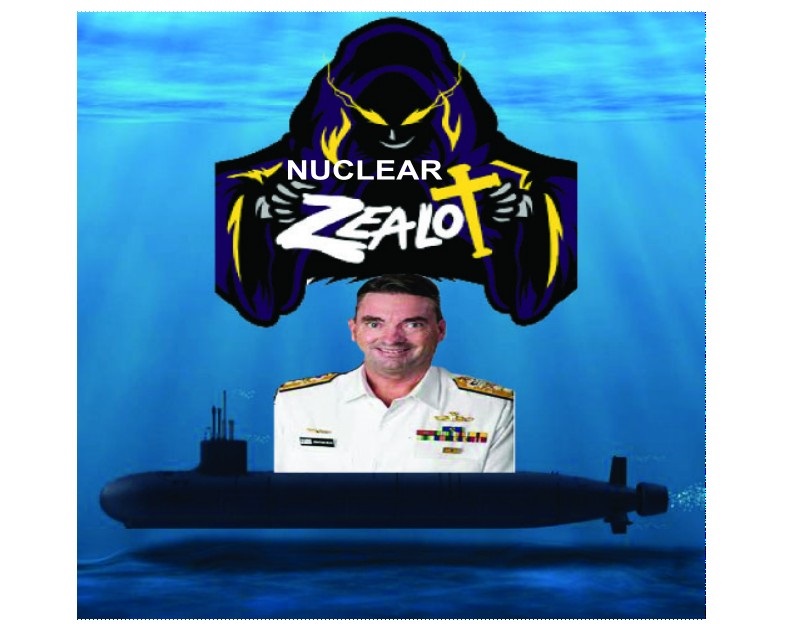
The head of the AUKUS submarine program has refused to say whether an almost $5 billion government payment to the United States will be refunded if no nuclear-powered boats are delivered to Australia.
Under the tri-nation agreement, Australia is providing multi-billion-dollar contributions to the United States and United Kingdom to help expand their submarine industrial bases, but for months officials have declined to discuss details of the transfers.
During a Senate estimates hearing, Greens senator David Shoebridge attempted to extract details of the impending $4.7 billion payment to the US from the head of the Australian Submarine Agency, Vice Admiral Jonathan Mead.
Under questioning late on Thursday, the ASA boss repeatedly refused to say if a refund clause was included with Australia’s payment in case the United States fails to transfer Virginia class submarines in the 2030s.
“I just go back to the original statement — the US has committed to providing two US submarines from its submarine industrial base in the early 2030s and a third one on procurement,” the vice admiral told the committee.
What if the United States determines not to give us a nuclear submarine? Is there a clawback provision in the agreement?” Senator Shoebridge then demanded to know.
“That’s a hypothetical and I’m not going to entertain … The US has committed to transferring two nuclear-powered submarines to Australia,” the ASA boss asserted.
“It may be embarrassing that you have entered into an agreement that sees Australian taxpayers shelling out $4.7 billion — which we don’t get back if we don’t get our nuclear submarines,” Senator Shoebridge responded.
Under the final stage of AUKUS the United Kingdom will help develop a new class of nuclear-powered submarine to be known as SSN-AUKUS, with Australia’s boats to be built locally in Adelaide.
Ahead of the ambitious venture, Australia will hand almost $5 billion to British industry over the next decade for design work and to expand production of nuclear reactors that will eventually be installed on AUKUS submarines
Navy apologises to traditional land owners over nuclear expansion
Defence has apologised to traditional land owners in Western Australia who live around the Garden Island naval base for not consulting them about upgrades being made to accommodate visiting nuclear-powered submarines.
During Senate estimates, Greens senator Dorinda Cox, who is a Yamatji-Noongar woman, expressed concerns on behalf of her community about the AUKUS work that will soon occur at HMAS Stirling.
Chief of Navy Vice Admiral Mark Hammond told the Senator he wanted to discuss the matter on his next visit, an offer she accepted.
“I’m just surprised that this has been such an oversight for an extended period of time, I do apologise, I’m in Western Australia in a couple of weeks’ time and again in July. I’d like to formally engage with your concurrence.”
A Detectable Subservience – Australia’s ill-fated nuclear submarine deal?

All of this leaves one wondering about just what due diligence was done before Morrison, and the 24-hour copycat decision-maker Albanese, committed us to the folly of paying $A368 billion to purchase a subservient position embedded within the US war machine by means of a soon-to-be fully detectable and therefore likely to be destroyed fleet of nuclear-powered submarines.
June 6, 2024 by: The AIM Network, By Michael Willis, https://theaimn.com/a-detectable-subservience/
The first operational outcome of the Pillar 2 AUKUS arrangement between the US, UK and Australia has just been announced.
The three countries will share data from their submarine-hunting PA-8 Poseidon aircraft, manufactured by the troubled Boeing Corporation.
This was announced on May 29 in an “exclusive interview” given to US online website Breaking Defense by Michael Horowitz, whose office serves as the Pentagon’s day-to-day lead on AUKUS issues.
(In a deliciously ironic slip, the website referred to the United Kingdom as the “Untied Kingdom”, true of the political cohesion of both the UK and the US at this time.)
All three AUKUS nations:
“… operate the Boeing-made maritime surveillance aircraft; the US operates 120, Australia 12, and the United Kingdom nine. A key part of the P-8 is its collection of sonobuoys, which are dropped into the water to hunt down submarines. (“Sonobuoys” is the preferred US-spelling of the English language “sonar buoys”.)
According to Horowitz, the Pentagon’s Deputy Assistant Secretary of Defense for Force Development and Emerging Capabilities, a new “trilateral algorithm” will allow them to share information from P-8 sonar buoys between each other.
According to Breaking Defense, the trilateral algorithm requires a high level of trust between the three countries.
“Even among Five Eyes partners,” it says, “sonobuoy information is highly sensitive, as sharing that data not only makes clear what each country has the ability to gather and where those buoys are deployed, but because it clearly reveals what and where each country is tracking.”
Pillar 2 arrangements build on those of Pillar 1 which are solely concerned with Australia’s acquisition of the hugely expensive nuclear-powered submarines.
At a cost averaged out at $A33 million a day over 35 years, we are promised a fleet of 8 submarines with the apparent advantages of extended range and endurance, higher speed, increased payload capacity, and reduced refuelling needs.
But given our own use of sonar buoys and knowing that our own all-but-at-war with “enemy”, China, has the same or superior detection technologies, it is the claim that SSNs (nuclear-powered submarines) have greater stealth and reduced detectability that is the major sales pitch justifying our $368 billion spend.
SSNs are claimed to have reduced noise and to be able to operate at greater depths, thus making them harder to detect.
Reduced noise will affect passive sonar buoys which listen for sounds generated by submarines. These sounds can include engine noise, propeller cavitation, or other mechanical noises.
Greater depth will affect active sonar buoys, those that send out a sound wave which then bounces off the submarine, allowing the buoy to detect the “ping” that travels back to the buoy. That ping is weaker the greater distance it has to travel.
Former Senator and submariner Rex Patrick was critical of the AUKUS decision for Australia to begin its SSN acquisition with the purchase of three second-hand Virginia Class SSNs from the US.
“The first highly noticeable issue with the Virginia class is a problem that has surfaced with the submarine’s acoustic coating that’s designed to reduce the ‘target strength’ of the submarine (how much sound energy from an enemy active sonar bounces off the submarine, back to the enemy),” he said.
“The coating is prone to peeling off at high-speed leaving loose cladding that slaps against the hull, making dangerous noise, and causes turbulent water flow, which also causes dangerous hull resonance (where the hull sings at its resonant frequency, like a tuning fork) and extra propulsion noise. I know a bit about this as a former underwater acoustics specialist.”
Magnetic Anomaly Detection (MAD) is another method of detection. MAD detects disturbances in the Earth’s magnetic field caused by the metal hull of a submarine. MAD sensors are typically deployed on aircraft and can detect submarines at relatively close ranges. The signals weaken with distance.
However, the Chinese are developing the ability to detect extremely low frequency (ELF) electromagnetic signal produced by speeding subs.
Researchers from the Chinese Academy of Sciences’ Fujian Institute of Research on the Structure of Matter found an ultra-sensitive magnetic detector could pick up traces of the most advanced submarine from long distances away.
The researchers calculated that the extremely low frequency (ELF) signal produced by a submarine’s bubbles could be stronger than the sensitivities of advanced magnetic anomaly detectors by three to six orders of magnitude.
The bubbles are an inevitable consequence of the submarine’s cruising speed, which causes the water flowing around the hull to move faster as its kinetic energy increases and its potential energy – expressed as pressure – decreases. When the pressure decreases sufficiently, small bubbles form on the surface of the hull as some of the water vaporises. This process causes turbulence and can produce an electromagnetic signature, in a phenomenon known as the magnetohydrodynamic (MHD) effect.
Though faint, ELF signals can travel great distances, thanks to their ability to penetrate the water and reach the ionosphere, where they are reflected back to the Earth’s surface.
Detection by ELF turns the advantage of an SSNs higher speed into its opposite, namely the disadvantage of higher detectability.
This ability of science to increase the detection of SSNs led even the pro-US Australian Strategic Policy Institute (ASPI) to publish a warning that “the oceans of tomorrow may become ‘transparent’. The submarine era could follow the battleship era and fade into history.”
It titled its article on a study of submarine detection by Australian scientists and academics “Advances in detection technology could render AUKUS submarines useless by 2050.”
According to the authors:
“The results should ring alarm bells for the AUKUS program to equip Australia with nuclear-powered submarines. Our assessment suggests that there will only be a brief window of time between the deployment of the first SSN AUKUS boats and the onset of transparent oceans.”
However, it is the expanding frontier of quantum computing that may be the ultimate nail in the AUKUS submarines coffin.
Quantum computing is the sexy new kid on the block – witness the Australian government’s investment of almost a billion dollars in a bid to build the world’s first commercially useful quantum computer in Brisbane. It’s bound to make the shareholders of US company PsiQuantum very happy, including notorious corporate investors such as Black Rock.
In July 2016, the Australia government awarded a contract to local company Q-CTRL to develop a quantum navigation system can use the motions of a single atom to precisely determine the course and position of a submarine and maintain accuracy to a remarkable degree. This overcomes two disadvantages of navigation by GPS: GPS is vulnerable to jamming by an adversary, and its signals cannot penetrate sea water to any appreciable depth.
That’s the good news story.
The bad news is that China has already funded its multi-billion-dollar National Quantum Laboratories to develop quantum-based technology applications for “immediate use to the Chinese armed forces”, possibly including targeting stealthy submarines.
According to Zhu Jin in The Conversation:
“New quantum sensing systems offer more sensitive detection and measurement of the physical environment. Existing stealth systems, including the latest generation of warplanes and ultra-quiet nuclear submarines, may no longer be so hard to spot.”
Using devices that measure and analyse the gravitational pull exercised by the mass of a submarine on the movement of sub-atomic particles in a sensor would overcome the disadvantages of sonar buoys and magnetometers, rendering any otherwise undetectable object with mass detectable.
The other area in which China is more advanced than its competitors is the use of quantum computing for encryption and decryption of communications.
In a 2022 paper on Quantum Computing and Cryptography, the authors that:
“China has set the pace for creating secure quantum communications that cannot be intercepted or manipulated. Further advances in Chinese quantum communication networks, especially networks designed for military use, will put the Navy at increased risk when deployed to the Indo-Pacific. If Chinese communications are virtually unbreakable and U.S. Navy communications can be exploited by Chinese quantum code-breaking technology, it will quickly lose its ability to safely operate among PLAN forces.”
All of this leaves one wondering about just what due diligence was done before Morrison, and the 24-hour copycat decision-maker Albanese, committed us to the folly of paying $A368 billion to purchase a subservient position embedded within the US war machine by means of a soon-to-be fully detectable and therefore likely to be destroyed fleet of nuclear-powered submarines.
Michael Williss is a member of the Australian Anti-AUKUS Coalition (AAAC) and the Independent and Peaceful Australia Network (IPAN).
Lidia Thorpe warns new laws will turn Australia into “the world’s nuclear waste dump”

Giovanni Torre – May 13, 2024, https://nit.com.au/13-05-2024/11377/lidia-thorpe-warns-new-laws-will-turn-australia-into-the-worlds-nuclear-waste-dump?mc_cid=a41a81cd8c&mc_eid=261607298d
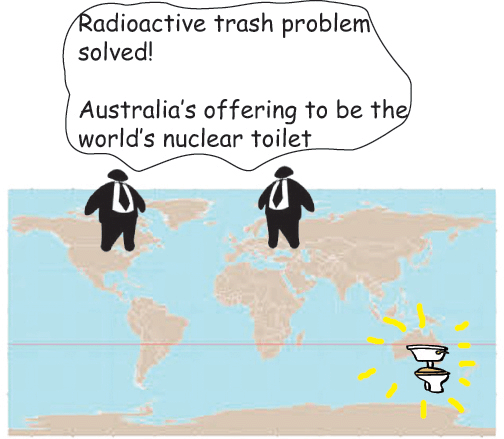
Senator Lidia Thorpe has warned new legislation to regulate nuclear safety of activities relating to AUKUS submarines has left Australia open to becoming “the world’s nuclear waste dump”.
Under the AUKUS deal, the federal government agreed to manage nuclear waste from Australian submarines, but under legislation to be introduced in June, Australia could be set to take nuclear waste from UK and US submarines also, Senator Thorpe warned.
The Gunnai, Gunditjmara and Djab Wurrung independent senator for Victoria called on the government to urgently amend the bill to prohibit high-level nuclear waste from being stored in Australia, a call she said is backed by experts in the field and addresses one of the major concerns raised during the inquiry into the bill.
“This legislation should be setting off alarm bells, it could mean that Australia becomes the world’s nuclear waste dump,” Senator Thorpe said on Monday.
“The government claims it has no intention to take AUKUS nuclear waste beyond that of Australian submarines, so they should have no reason not to close this loophole.
“Unless they amend this bill, how can we know they’re being honest? They also need to stop future governments from deciding otherwise. We can’t risk our future generations with this.”
In March, Senator Thorpe questioned Foreign Affairs Minister Penny Wong about the long-term cost from storage of nuclear waste, and whether Australia would take on foreign nuclear waste under the AUKUS deal. The minister responded that this cost is not included in the current $368 billion estimated for AUKUS, and she could not confirm that foreign waste would not be stored in Australia.
Senator Thorpe noted that the US Environmental Protection Agency warns high-level nuclear waste remains dangerous for at least 10,000 years; managing the risk posed by the decommissioned fuel rods from the AUKUS submarines would require storage and management that is future-proof, something that has proven challenging even in countries with advanced nuclear industries.
She also pointed out on Monday that the bill has also been criticised for lack of transparency and accountability; and allows the Minister of Defense to bypass public consultation and override federal and state laws to determine sites for the construction and operation of nuclear submarines, and the disposal of submarine nuclear waste.
Senator Thorpe said there are serious concerns about a lack of community consultation and the risk of violating First Peoples right to Free, Prior and Informed Consent.
Historically, governments have tried to push the storage of radioactive waste on remote First Nations communities, with successful campaigns in Coober Pedy, Woomera, Muckaty, Yappala in the Flinders Ranges and Kimba fighting off these attempts.
“We’ve seen how far the major parties will go to ingratiate themselves with the US. Labor must amend this bill to prove they’re putting the interests of our country first,” Senator Thorpe said.
“And they need to change the powers that allow the Minister and the Department to choose any place they like for nuclear waste facilities with no oversight or community consultation.
“That’s complete overreach and will undermine First Peoples rights for Free, Prior and Informed Consent under the United Declaration on the Rights of Indigenous Peoples.”
The senator said “time and again” governments have attempted to turn remote communities into nuclear waste dumps, with the risks from nuclear waste always being put on First Peoples.
“I’m concerned that this time it will be no different,” she said.
“The Bill allows the government to contract out liability for nuclear safety compliance, includes no emergency preparedness or response mechanisms, no consideration of nuclear safety guidelines from the Australian Radiation Protection and Nuclear Safety Agency and leaves many other questions on nuclear safety unanswered.”
“This Bill fails to set out a nuclear safety framework for the AUKUS submarines and instead focuses on defence objectives, while sidestepping safety, transparency and accountability. It’s a negligent and reckless bill that should not pass the Senate.”
Australia risks being ‘world’s nuclear waste dump’ unless Aukus laws changed, critics say
Labor-chaired inquiry calls for legislation to rule out accepting high-level nuclear waste from US and UK submarines among other recommendations
Daniel Hurst Foreign affairs and defence correspondent, https://www.theguardian.com/world/article/2024/may/13/australia-aukus-deal-submarines-critics-nuclear-waste
Australia risks becoming the “world’s nuclear waste dump” unless the Albanese government moves to rewrite its proposed Aukus laws, critics say.
A Labor-chaired inquiry has called for the legislative safeguard to specifically rule out accepting high-level nuclear waste from the US and the UK. One of the members of a Senate committee that reviewed the draft laws, independent senator Lidia Thorpe, said the legislation “should be setting off alarm bells” because “it could mean that Australia becomes the world’s nuclear waste dump”.
The government’s bill for regulating nuclear safety talks about “managing, storing or disposing of radioactive waste from an Aukus submarine”, which it defines broadly as Australia, UK or US submarines.
In a report published on Monday, the Senate’s foreign affairs, defence and trade legislation committee said this wording did not reflect the government’s promise not to accept high-level nuclear waste.
It recommended that the government consider “amending the bill so that a distinction is made between Australia’s acceptance of low-level nuclear waste from Aukus partners, but non-acceptance of high-level nuclear waste”.
The government has left the door open to accepting low-level waste from US and UK nuclear-powered submarines when they conduct rotational visits to Western Australia in the first phase of the Aukus plan. Low-level waste contains small amounts of radioactivity and include items such as personal protective equipment, gloves and wipes.
“According to the Australian Submarine Agency, nuclear-powered submarines only generate around a ‘small skip bin’ of low-level naval nuclear waste per submarine per year and that intermediate- and high-level waste will not become a concern until the first naval nuclear reactor requires disposal in the mid-2050s,” the Senate committee report said.
The government has yet to decide on the location for the disposal of radioactive waste from the submarines.
But infrastructure works proposed for HMAS Stirling – the naval base in Western Australia – to support the increased rotational visits are expected to include an operational waste storage facility for low-level radioactive waste.
The Department of Defence has argued any changes to the definitions should not prevent “regulatory control of the management of low-level radioactive waste from UK or US submarines” as part of those rotational visits.
Thorpe, an independent senator, said the call to prohibit high-level nuclear waste from being stored in Australia was “backed by experts in the field and was one of the major concerns raised during the inquiry into the bill”.
“The government claims it has no intention to take Aukus nuclear waste beyond that of Australian submarines, so they should have no reason not to close this loophole,” Thorpe said.
“They also need to stop future governments from deciding otherwise. We can’t risk our future generations with this.”
The government’s proposed legislation would set up an Australian naval nuclear power safety regulator to oversee the safety of the nuclear-powered submarines.
The committee made eight recommendations, including setting “a suitable minimum period of separation” to prevent a revolving door from the Australian Defence Force or Department of Defence to the new regulator.
The main committee report acknowledged concerns in the community that Australia might become a “dumping ground” for the Aukus countries, but it said the term was “not helpful in discussing the very serious question of national responsibility for nuclear waste”.
It also said the bill should be amended to ensure the regulator was transparent about “any accidents or incidents” with the soon-to-be-established parliamentary oversight committee on defence.
The Labor chair of the committee, Raff Ciccone, said the recommendations would “further strengthen the bill” and help “ensure Australia maintains the highest standards of nuclear safety”.
In a dissenting report, the Greens senator David Shoebridge said the legislation was “deeply flawed”, including because the regulator would report to the defence minister.
“The proposed regulator lacks genuine independence, the process for dealing with nuclear waste is recklessly indifferent to community or First Nations interests and the level of secrecy is a threat to both the environment and the public interest,” Shoebridge said.
The defence minister, Richard Marles, was contacted for comment.
Australian Conservation Foundation is seriously concerned about the AUKUS nuclear submarine project, its costs and consequences and the way this initiative is being advanced.

Submission to the Senate Foreign Affairs, Defence and Trade Legislation Committee – Inquiry into the Australian Naval Nuclear Power Safety Bill 2023
ACF and AUKUS
ACF holds serious concerns around the AUKUS nuclear submarine project, its costs and consequences and the way this initiative is being advanced…..
ACF’s focus in this submission is on the environmental ramifications of AUKUS in Australia. The submission starts from the premise a regulatory system of some kind related to AUKUS in Australia will be adopted by Federal Parliament. The submission identifies gaps in the regime and issues that require further consideration and provides practical recommendations for improvement
Summary
– ACF’s is deeply concerned with the Bill’s potential for approval to be granted for the storage in Australia of high-level radioactive waste from submarines operated by other countries.
– The safety of the Australian public should be the paramount concern here. The Bill’s proposed objects do not adequately reflect this. The objects need to be expanded.
– The current drafting does not provide for any meaningful community information, consultation or reporting. The principles of open government and accountability would suggest that the default position ought to be that information will be available but permit exceptions based on regulations or ministerial discretion.
– The current drafting permits abrogation of responsibility by Commonwealth entities. Non-government third parties (e.g. contractors) could be solely responsible for compliance with the relevant duties. This could include organisations based outside Australia. Given the nature of the risk, Commonwealth entities should be subject to ongoing responsibility, regardless of contractual arrangements.
– The Bill proposes a compliance regime which would make enforcement of the nuclear safety duty problematic. The use of “as far as reasonably practicable” is rare in the criminal offence context and should not be used in the context of nuclear safety.
– Licences ought only to be issued to entities that have demonstrated capability and record and reputation for meeting their regulatory obligations. A requirement that licences only be issued to entities that are a fit and proper person should be included.
Other issues addressed in this submission are:
– Consent considerations and the UN Declaration on the Rights of Indigenous Peoples
– Nuclear Non-Proliferation Treaty
– A Nuclear Industry by Stealth?
– Disregard of advice from ARPANSA’s Radiation Health and Safety Advisory Council
– Clarification on Relationship of New Regulator with Existing Agencies
Summary of Recommendations
1. The Bill be amended to ensure that it only provides for the licencing of radioactive waste storage facilities for HLW from Australian submarines.
2. The Federal Government develop an open approach to future HLW management in Australia that is informed by the wider consideration of domestic ILW (intermediate-level waste) management.
3. That the objects of the Bill be redrafted to address protection of a range of people and the environment, and transparency of information and decision-making and accountability of the Government.
4. That the Bill be amended to improve transparency by requiring, subject to national security exceptions, public notification of applications and decisions, a public register of key applications and decisions and mandatory reporting requirements. The Committee should consider principles of open government and comparable regulatory regimes in developing its detailed recommendations to improve transparency.
5. That the Bill be amended to establish a clear-cut obligation to ensure nuclear safety and then provide a defence if the defendant can demonstrate that they exercised due diligence and took all reasonably practicable precautions.
6. That the Bill be amended to recognise and reflect the foundational management principle of free, prior and informed consent (FPIC).
7. That the Bill be amended to ensure the Commonwealth cannot contract out of liability in relation to compliance with the duties on licence holders created by the Bill. A mechanism should be included to ensure the Commonwealth bears responsibility in relation to nuclear safety for the actions of a contractor who holds a licence.
8. That the Bill be amended to ensure the definition of Commonwealth Contractor does not include sub-contractors to a Commonwealth sub-contractor.
9. That the Bill be amended such that the responsibility of each person in the supply chain or logistics chain is expressed, including in terms of the duties and incident reporting, in a manner similar to the National Heavy Vehicle Laws and Work Health and Safety Laws
10. That the Bill be amended to include a requirement that licences only be issued to entities that are a fit and proper persons similar to the Protection from Harmful Radiation Act 1990 (NSW) or Protection of the Environment (Operations) Act 1997 (NSW).
11. That the Committee request ARPANSA’s Radiation Health and Safety Advisory Council give evidence and consider the divergence of the Bill from the Council’s 2022 advice to the ARPANSA CEO.
12. The Committee recommend the ARPANS Act exclusion be modified or removed.
13. The Committee take evidence from the Department on, and consider, the interaction between the new regulatory regime, ARPANSA and potentially relevant state and territory regulatory controls.
14. The Committee consider amendments to provide for a formal means of contact between ARPANSA and the new regulator. This could include a formal position with the new regulator of the requirement to consider ARPANSA guidance materials.
High-Level Radioactive Waste from Other Countries
The AUKUS initiative brings a profound elevation in the cost, complexity and challenges of radioactive waste management in Australia through the introduction of High-Level Waste (HLW)0F1. This material needs to be securely isolated from people and the wider environment for periods of up to 100,000 years.1F2
The AUKUS initiative brings a profound elevation in the cost, complexity and challenges of radioactive waste management in Australia through the introduction of High-Level Waste (HLW)0F1. This material needs to be securely isolated from people and the wider environment for periods of up to 100,000 years.1F2
Speaking on the ABC in March 2023 Defence Minister Marles stated:
We are making a commitment that we will dispose of the nuclear reactor. That is a significant commitment to make. This is going to require a facility to be built in order to do that disposal, obviously that facility will be remote from populations, and today we are announcing that that facility will be on Defence land, current or future.
Part of the AUKUS deal is that Australia must manage all radioactive waste generated by the submarines on Australian soil. Minister Richard Marles said this was a pre-condition for the whole program.
The ABC also reported that while the sole responsibility of the submarine nuclear waste disposal lies with Australia, the White House has promised the US and UK will help, quoting a White House representative:
The United Kingdom and the United States will assist Australia in developing this capability, leveraging Australia’s decades of safely and securely managing radioactive waste domestically.
At no point has a compelling case been made for why Australia should take responsibility for the management of this waste, especially in relation to waste arising from purchased secondhand US Virginia class submarines.
This lack of rationale was highlighted in an article by Kym Bergmann titled the Nightmare of Nuclear-powered Submarine Disposal in the July-August, 2023edition of the Asia-Pacific Defence Reporter (APDR):
Why Australia has committed to this expensive process, hazardous to human life is unknown. In summary form, we will need to put in place facilities for the following:
• To remove the fuel from the sub.
• To store the recently removed fuel in pools of water.
• To transfer the fuel from the pools to dry casks.
• To store the dry casks on an interim basis.
• To permanently dispose of the spent fuel deep underground.
• To permanently dispose of the rest of the reactor (excluding the fuel).
It is unknown whether the estimated project cost of $368 billion covers this. It is unknown where the facilities will be built. It is unknown whether the decommissioning of submarines
will occur at their east coast base. In addition, the U235 will have to be in a secure location and then guarded forever to prevent its theft for conversion into weapons.
APDR went on to ask:
One of the many mysteries around the AUKUS deal is why Australia has agreed to disposing of the Virginia class submarines here. Surely the logical thing would be to have an agreement where the US took them back at the end of their lives and decommissioned them using their well established procedures.
Who benefits from compelling Australia to develop our own waste disposal industry? Why not lease the used Virginia class subs rather than purchase them outright?
To this can be added the mystery of why agree to second hand submarines at all?………………………………………………………………………………………………………………………………………………………………….
1 This month

of the week – Australians for War Powers Reform (AWPR)
To see nuclear-related stories in greater depth and intensity
 Antinuclear