Canada rejects AUKUS nuclear submarine deal
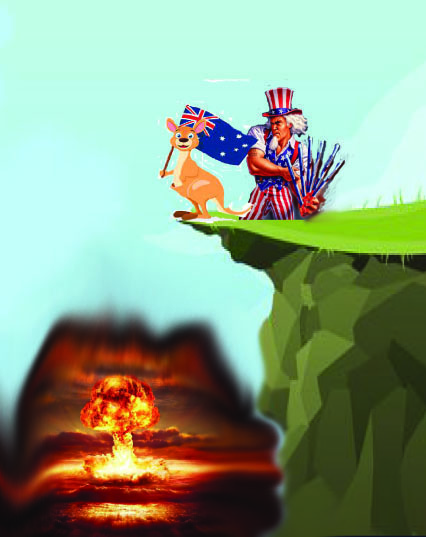
the main concern should be that this deal further locks Australia into US exceptionalism and attempted hegemony in our region. The Albanese government has repeatedly sought to reassure that our sovereignty has been preserved, but this is very difficult to accept given the extent to which our funding underwrites the US submarine-production program. Moreover, it’s likely Australia’s learning and launch activities will further integrate this country into the operational aspects of the American war machine, such that US leaders may effectively give all the instructions in terms of deployment and other activities.
John Hewson , professor at the ANU Crawford School of Public Policy and former Liberal opposition leader.
Some news this month might have given the government pause. Canada – with the longest coastline in the world and a security situation in its Arctic and north changing significantly as the region becomes more accessible, particularly with more Russian and Chinese activity – decided not to join the AUKUS arrangement and buy nuclear submarines. Instead it is considering cooperating with Germany and Norway as partners in a submarine program and will purchase 12 conventionally powered under-ice capable submarines for about $60 billion.
Compare this with the eye-watering cost of Australia’s acquisition: $368 billion for eight Virginia-class and next-generation SSN-AUKUS nuclear submarines with a vague delivery schedule.
Of course, defenders of the AUKUS deal will argue it is more than just an arrangement to buy submarines. They will claim it instead to be a broad, trilateral security arrangement for the Indo-Pacific region that also fosters technology exchanges between the three countries, and helps to build a conventionally armed nuclear-powered submarine force for Australia.
Nevertheless, the deal has been widely criticised and, given its huge cost, it’s worth asking why these criticisms haven’t resonated. One of its most vocal and effective opponents has been former prime minister Paul Keating, who has labelled it “the worst deal in history” and “the worst international decision by a Labor government since the former Labor leader Billy Hughes sought to introduce conscription”. He has slammed the deal particularly for allowing defence interests to trump diplomacy.
It has also been strongly criticised within the Labor Party and union structures: by some 50 units of the party from branches and electoral conferences, and leading unions including the Electrical Trades Union, the CFMEU and the Australian Manufacturing Workers’ Union. The Nobel Prize-winning, Australian-led International Campaign to Abolish Nuclear Weapons has also rejected it for the risks of nuclear proliferation. China’s reaction to the deal was to warn that we are “on a path of error and danger”.“The main concern should be that this deal further locks Australia into US exceptionalism and attempted hegemony in our region … Moreover, it’s likely Australia’s learning and launch activities will further integrate this country into … the American war machine…”
There has also been a host of technical concerns, including in relation to the supply of fuel to run the subs. Keating has drawn a comparison with an alternative deal proposed by the French that emerged after the Morrison government rescinded the original agreement to replace Australia’s ageing Collins-class fleet with the so-called Attack-class sub. This proposal, he says, came with a firm delivery date in 2034 at fixed prices, but was ignored by the government. Technically these French subs would have required only 5 per cent enriched uranium, instead of 95 per cent, weapons grade, for fuel. That this feature was ignored by the government should come as no surprise, as the Coalition has provided no detail about the enriched uranium fuel – neither supply nor cost – for its announced seven nuclear power plants.
However, the main concern should be that this deal further locks Australia into US exceptionalism and attempted hegemony in our region. The Albanese government has repeatedly sought to reassure that our sovereignty has been preserved, but this is very difficult to accept given the extent to which our funding underwrites the US submarine-production program. Moreover, it’s likely Australia’s learning and launch activities will further integrate this country into the operational aspects of the American war machine, such that US leaders may effectively give all the instructions in terms of deployment and other activities.
This should be an even greater concern having heard the Republican candidates for this year’s election speak at their national convention in Wisconsin. Both Donald Trump and J.D. Vance are committed to an even tougher line against China and Australia risks being used somewhat as a pawn in their response to what they like to refer to as the “China threat”. On the contrary, as I have suggested many times, the threat is not so much from the rise of China as it is related to the decline in the global standing of the US. It’s easy to imagine how Trump and Vance could only make this worse, especially by threatening tariffs on Chinese goods.
The Trump–Vance commitment to return to tariff protections flies in the face of voluminous accumulated evidence concerning the costs and disadvantages of doing so. This will certainly not restore the rust-belt states to their former glory as these candidates are promising. China’s only “sin” has been to grow its economy to rival that of the US. The US has lost any cost advantage it may once have enjoyed in manufacturing as well as its edge in technology – most recently in the production of electric vehicles. Just ask Tesla, which now bases much of its production in China.
And the halcyon days of inflation control in the ’90s were much more the result of China flooding the world with cheap manufactured goods, than any effective application of monetary policy. The US was a major beneficiary of this, which is so easily overlooked in its current cost-of-living crisis.
Surely Australia wouldn’t want to end up being pressured to park nuclear submarines along the Chinese coast as part of a US demonstration of strength? Nor should we allow ourselves to be dragged by the US into some conflict with China over Taiwan.
The Albanese government has had considerable difficulty justifying the cost of the AUKUS deal, and so it should. Governing is about priorities and, true enough, national security is a priority. It’s also true that the government has been able to deal effectively with many domestic priorities, such as providing non-inflationary cost-of-living assistance. Defence procurement has long been somewhat ring-fenced from the normal discipline applied to other departments in the Expenditure Review Committee processes, however. It’s no defence to spend so much on submarines, when so much more could have been done in other national priority areas, including education and the care sectors. This is especially so in light of the attendant risks of a deal such as AUKUS.
With the mounting tension between the US and China, world leaders should be increasingly concerned about the threat of another drift to a Cold War situation.
The need for a circuit breaker is clear. I was pleased recently to join the signatories to an open letter drafted by two former foreign affairs ministers, Gareth Evans and Bob Carr, for détente: “a genuine balance of power between the US and China, designed to avert the horror of great power conflict and to secure a lasting peace for our people, our region, and the world.”
Given the state of the world, and its pronounced geopolitical uncertainty, it is disappointing that neither the US nor China has yet responded to the proposal, and surprising that the Albanese government hasn’t embraced it as a mechanism to advance the point that Australia, as a middle-ranking power, has and can continue to punch above its weight in the global interest.
This is especially so given the benefits that Australia as a nation has reaped from the economic rise of China.
Surely a situation can’t be allowed to develop whereby the United States and China embark on trade protection and military conflict.
At the very least, there should be the imperative of a global discourse on this. Unfortunately, attitudes are hardening in Europe and the US – perhaps to the point where the outcome will be gratuitous harm?
This article was first published in the print edition of The Saturday Paper on July 27, 2024 as “Canada’s smart lead on nuclear subs”.
AUKUS and the pride of politicians

By Nick Deane, Jul 24, 2024 https://johnmenadue.com/aukus-and-the-pride-of-politicians/
With AUKUS, the pride of politicians has become an obstacle to reaching the best solution to the ‘national security’ conundrum. In the end, it could be that ego-driven reluctance to shift from entrenched positions results in the Australian people being delivered a disaster.
For my own purposes, I have been keeping a record of articles I have read under the topic ‘AUKUS’. There are now some 300 such items on my spreadsheet – nearly all of them finding fault of one kind or another with this extraordinary project.
The criticisms deal with a wide variety of aspects (mainly focussed on the acquisition of nuclear-powered submarines). To summarise a few, the AUKUS project:-
- Leads Australia in the direction of war;
- Has done damage to Australia’s international reputation;
- Destabilises Australia’s immediate region;
- Brings a nuclear industry with it;
- Introduces the intractable problem of nuclear waste disposal;
- Damages our relationship with our most important trading partner;
- Causes a significant loss of sovereignty;
- Is not good value for money;
- Diverts resources away from social programs;
- Will not be as effective as conventional submarines;
- Is aggressive and not defensive, and
- Will probably not come to fruition in any case.
Highly respected commentators, such as Hugh White, Paul Keating, Sam Roggeveen, Andrew Fowler, Rex Patrick and Clinton Fernandes, have all raised significant concerns. Meanwhile ‘civil society’ is also getting mobilised, with ‘anti-AUKUS’ groups springing up in all the major centres.
However, the proponents of AUKUS (and the mainstream media) appear content to ignore the valid, rational arguments being put forward against it. Indeed, industry-based conferences are going ahead as if there is nothing about to the project that needs to be questioned, and, no doubt, secret, military training programs are already well under way. Within the military-industrial establishment, the project is gathering momentum. Those in the military are excited by the prospect of controlling a new, highly lethal weapon, whilst those in the industry are attracted by the smell of the limitless funds being devoted to it.
It is disturbing to have to concede that rational argument appears to have little impact on AUKUS’s proponents. However there is an even more worrying aspect to add. That is the pride of politicians. For the longer the process continues, with all its secrecy and in the absence of meaningful debate at high levels, the harder it is for politicians to change course. Abandoning the project would already cause senior members of both major parties considerable ‘loss of face’. If it falls over (as some predict), or if opposition becomes a vote-winner at the next election, that ‘loss of face’ will be highly embarrassing. With AUKUS, the pride of politicians has thus become an obstacle to to reaching the best solution to the ‘national security’ conundrum. In the end, it could be that ego-driven reluctance to shift from entrenched positions results in the Australian people being delivered a disaster.
In an ideal, democratic society, voters and the politicians they elect appraise themselves of the ‘pros and cons’ of controversial matters and make decisions on a rational basis. If they do that in the case of AUKUS, it is surely doomed. Politicians beware!
Trusting the ‘Five Eyes’ Only
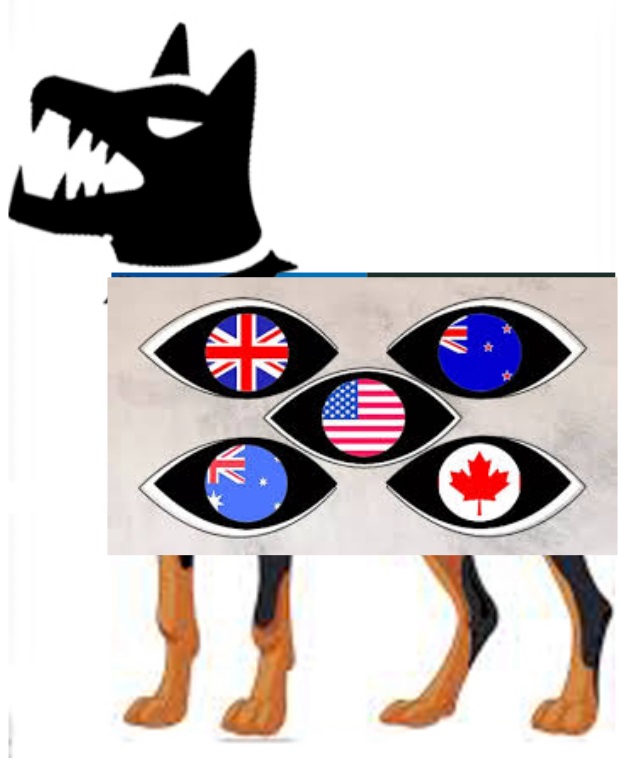
For Their Eyes Only
The “Five Eyes” (FVEY) is an elite club of five English-speaking countries — Australia, Canada, New Zealand, the United Kingdom, and the United States — that have agreed to cooperate in intelligence matters and share top-secret information. They all became parties to what was at first the bilateral UKUSA Agreement, a 1946 treaty for secret cooperation between the two countries in what’s called “signals intelligence” — data collected by electronic means, including by tapping phone lines or listening in on satellite communications. (The agreement was later amended to include the other three nations.) Almost all of the Five Eyes’ activities are conducted in secret, and its existence was not even disclosed until 2010. You might say that it constitutes the most secretive, powerful club of nations on the planet.
Anglo-Saxon solidarity supersedes all other relationships.
JULY 5, 2024 By Michael Klare / TomDispatch, https://scheerpost.com/2024/07/05/trusting-the-five-eyes-only/
Wherever he travels globally, President Biden has sought to project the United States as the rejuvenated leader of a broad coalition of democratic nations seeking to defend the “rules-based international order” against encroachments by hostile autocratic powers, especially China, Russia, and North Korea. “We established NATO, the greatest military alliance in the history of the world,” he told veterans of D-Day while at Normandy, France on June 6th. “Today… NATO is more united than ever and even more prepared to keep the peace, deter aggression, defend freedom all around the world.”
In other venues, Biden has repeatedly highlighted Washington’s efforts to incorporate the “Global South” — the developing nations of Africa, Asia, Latin America, and the Middle East — into just such a broad-based U.S.-led coalition. At the recent G7 summit of leading Western powers in southern Italy, for example, he backed measures supposedly designed to engage those countries “in a spirit of equitable and strategic partnership.”
But all of his soaring rhetoric on the subject scarcely conceals an inescapable reality: the United States is more isolated internationally than at any time since the Cold War ended in 1991. It has also increasingly come to rely on a tight-knit group of allies, all of whom are primarily English-speaking and are part of the Anglo-Saxon colonial diaspora. Rarely mentioned in the Western media, the Anglo-Saxonization of American foreign and military policy has become a distinctive — and provocative — feature of the Biden presidency.
America’s Growing Isolation
To get some appreciation for Washington’s isolation in international affairs, just consider the wider world’s reaction to the administration’s stance on the wars in Ukraine and Gaza.
Following Russia’s invasion of Ukraine, Joe Biden sought to portray the conflict there as a heroic struggle between the forces of democracy and the brutal fist of autocracy. But while he was generally successful in rallying the NATO powers behind Kyiv — persuading them to provide arms and training to the beleaguered Ukrainian forces, while reducing their economic links with Russia — he largely failed to win over the Global South or enlist its support in boycotting Russian oil and natural gas.
Despite what should have been a foreboding lesson, Biden returned to the same universalist rhetoric in 2023 (and this year as well) to rally global support for Israel in its drive to extinguish Hamas after that group’s devastating October 7th rampage. But for most non-European leaders, his attempt to portray support for Israel as a noble response proved wholly untenable once that country launched its full-scale invasion of Gaza and the slaughter of Palestinian civilians commenced. For many of them, Biden’s words seemed like sheer hypocrisy given Israel’s history of violating U.N. resolutions concerning the legal rights of Palestinians in the West Bank and its indiscriminate destruction of homes, hospitals, mosques, schools, and aid centers in Gaza. In response to Washington’s continued support for Israel, many leaders of the Global South have voted against the United States on Gaza-related measures at the U.N. or, in the case of South Africa, have brought suit against Israel at the World Court for perceived violations of the 1948 Genocide Convention.
In the face of such adversity, the White House has worked tirelessly to bolster its existing alliances, while trying to establish new ones wherever possible. Pity poor Secretary of State Antony Blinken, who has made seemingly endless trips to Asia, Africa, Europe, Latin America, and the Middle East trying to drum up support for Washington’s positions — with consistently meager results.
Here, then, is the reality of this anything but all-American moment: as a global power, the United States possesses a diminishing number of close, reliable allies – most of which are members of NATO, or countries that rely on the United States for nuclear protection (Japan and South Korea), or are primarily English-speaking (Australia and New Zealand). And when you come right down to it, the only countries the U.S. really trusts are the “Five Eyes.”
For Their Eyes Only
The “Five Eyes” (FVEY) is an elite club of five English-speaking countries — Australia, Canada, New Zealand, the United Kingdom, and the United States — that have agreed to cooperate in intelligence matters and share top-secret information. They all became parties to what was at first the bilateral UKUSA Agreement, a 1946 treaty for secret cooperation between the two countries in what’s called “signals intelligence” — data collected by electronic means, including by tapping phone lines or listening in on satellite communications. (The agreement was later amended to include the other three nations.) Almost all of the Five Eyes’ activities are conducted in secret, and its existence was not even disclosed until 2010. You might say that it constitutes the most secretive, powerful club of nations on the planet.
The origins of the Five Eyes can be traced back to World War II, when American and British codebreakers, including famed computer theorist Alan Turing, secretly convened at Bletchley Park, the British codebreaking establishment, to share intelligence gleaned from solving the German “Enigma” code and the Japanese “Purple” code. At first an informal arrangement, the secretive relationship was formalized in the British-US Communication Intelligence Agreement of 1943 and, after the war ended, in the UKUSA Agreement of 1946. That arrangement allowed for the exchange of signals intelligence between the National Security Agency (NSA) and its British equivalent, the Government Communications Headquarters (GCHQ) — an arrangement that persists to this day and undergirds what has come to be known as the “special relationship” between the two countries.
Then, in 1955, at the height of the Cold War, that intelligence-sharing agreement was expanded to include those other three English-speaking countries, Australia, Canada, and New Zealand. For secret information exchange, the classification “AUS/CAN/NZ/UK/US EYES ONLY” was then affixed to all the documents they shared, and from that came the “Five Eyes” label. France, Germany, Japan, and a few other countries have since sought entrance to that exclusive club, but without success.
Although largely a Cold War artifact, the Five Eyes intelligence network continued operating right into the era after the Soviet Union collapsed, spying on militant Islamic groups and government leaders in the Middle East, while eavesdropping on Chinese business, diplomatic, and military activities in Asia and elsewhere. According to former NSA contractor Edward Snowden, such efforts were conducted under specialized top-secret programs like Echelon, a system for collecting business and government data from satellite communications, and PRISM, an NSA program to collect data transmitted via the Internet.
As part of that Five Eyes endeavor, the U.S., the United Kingdom, and Australia jointly maintain a controversial, highly secret intelligence-gathering facility at Pine Gap, Australia, near the small city of Alice Springs. Known as the Joint Defence Facility Pine Gap (JDFPG), it’s largely run by the NSA, CIA, GCHQ, and the Australian Security Intelligence Organization. Its main purpose, according to Edward Snowden and other whistle-blowers, is to eavesdrop on radio, telephone, and internet communications in Asia and the Middle East and share that information with the intelligence and military arms of the Five Eyes. Since the Israeli invasion of Gaza was launched, it is also said to be gathering intelligence on Palestinian forces in Gaza and sharing that information with the Israeli Defense Forces. This, in turn, prompted a rare set of protests at the remote base when, in late 2023, dozens of pro-Palestinian activists sought to block the facility’s entry road.
Anglo-Saxon Solidarity in Asia
The Biden administration’s preference for relying on Anglophone countries in promoting its strategic objectives has been especially striking in the Asia-Pacific region. The White House has been clear that its primary goal in Asia is to construct a network of U.S.-friendly states committed to the containment of China’s rise. This was spelled out, for example, in the administration’s Indo-Pacific Strategy of the United States of 2022. Citing China’s muscle-flexing in Asia, it called for a common effort to resist that country’s “bullying of neighbors in the East and South China” and so protect the freedom of commerce. “A free and open Indo-Pacific can only be achieved if we build collective capacity for a new age,” the document stated. “We will pursue this through a latticework of strong and mutually reinforcing coalitions.”
That “latticework,” it indicated, would extend to all American allies and partners in the region, including Australia, Japan, New Zealand, the Philippines, and South Korea, as well as friendly European parties (especially Great Britain and France). Anyone willing to help contain China, the mantra seems to go, is welcome to join that U.S.-led coalition. But if you look closely, the renewed prominence of Anglo-Saxon solidarity becomes ever more evident.
Of all the military agreements signed by the Biden administration with America’s Pacific allies, none is considered more important in Washington than AUKUS, a strategic partnership agreement between Australia, the United Kingdom, and the United States. Announced by the three member states on Sept. 15, 2021, it contains two “pillars,” or areas of cooperation — the first focused on submarine technology and the second on AI, autonomous weapons, as well as other advanced technologies. As in the FVEY arrangement, both pillars involve high-level exchanges of classified data, but also include a striking degree of military and technological cooperation. And note the obvious: there is no equivalent U.S. agreement with any non-English-speaking country in Asia.
Consider, for instance, the Pillar I submarine arrangement. As the deal now stands, Australia will gradually retire its fleet of six diesel-powered submarines and purchase three to five top-of-the-line U.S.-made Los Angeles-class nuclear-powered submarines (SSNs), while it works with the United Kingdom to develop a whole new class of subs, the SSN-AUKUS, to be powered by an American-designed nuclear propulsion system. But — get this — to join, the Australians first had to scrap a $90 billion submarine deal with a French defense firm, causing a severe breach in the Franco-Australian relationship and demonstrating, once again, that Anglo-Saxon solidarity supersedes all other relationships.
Now, with the French out of the picture, the U.S. and Australia are proceeding with plans to build those Los Angeles-class SSNs — a multibillion-dollar venture that will require Australian naval officers to study nuclear propulsion in the United States. When the subs are finally launched (possibly in the early 2030s), American submariners will sail with the Australians to help them gain experience with such systems. Meanwhile, American military contractors will be working with Australia and the UK designing and constructing a next-generation sub, the SSN-AUKUS, that’s supposed to be ready in the 2040s. The three AUKUS partners will also establish a joint submarine base near Perth in Western Australia.
Pillar II of AUKUS has received far less media attention but is no less important. It calls for American, British, Australian scientific and technical cooperation in advanced technologies, including AI, robotics, and hypersonics, aimed at enhancing the future military capabilities of all three, including through the development of robot submarines that could be used to spy on or attack Chinese ships and subs.
Aside from the extraordinary degree of cooperation on sensitive military technologies — far greater than the U.S. has with any other countries — the three-way partnership also represents a significant threat to China. The substitution of nuclear-powered subs for diesel-powered ones in Australia’s fleet and the establishment of a joint submarine base at Perth will enable the three AUKUS partners to conduct significantly longer undersea patrols in the Pacific and, were a war to break out, attack Chinese ships, ports, and submarines across the region. I’m sure you won’t be surprised to learn that the Chinese have repeatedly denounced the arrangement, which represents a potentially mortal threat to them.
Unintended Consequences
It’s hardly a surprise that the Biden administration, facing growing hostility and isolation in the global arena, has chosen to bolster its ties further with other Anglophone countries rather than make the policy changes needed to improve relations with the rest of the world. The administration knows exactly what it would have to do to begin to achieve that objective: discontinue arms deliveries to Israel until the fighting stops in Gaza; help reduce the burdensome debt load of so many developing nations; and promote food, water security, and other life-enhancing measures in the Global South. Yet, despite promises to take just such steps, President Biden and his top foreign policy officials have focused on other priorities — the encirclement of China above all else — while the inclination to lean on Anglo-Saxon solidarity has only grown.
However, by reserving Washington’s warmest embraces for its anglophone allies, the administration has actually been creating fresh threats to U.S. security. Many countries in contested zones on the emerging geopolitical chessboard, especially in Africa, the Middle East, and Southeast Asia, were once under British colonial rule and so anything resembling a potential Washington-London neocolonial restoration is bound to prove infuriating to them. Add to that the inevitable propaganda from China, Iran, and Russia about a developing Anglo-Saxon imperial nexus and you have an obvious recipe for widespread global discontent.
It’s undoubtedly convenient to use the same language when sharing secrets with your closest allies, but that should hardly be the deciding factor in shaping this nation’s foreign policy. If the United States is to prosper in an increasingly diverse, multicultural world, it will have learn to think and act in a far more multicultural fashion — and that should include eliminating any vestiges of an exclusive Anglo-Saxon global power alliance.
Nuclear misinformation in Australia is Hail Mary policy by the Opposition
The Fifth Estate, DARRIN DURANT, Dr Darrin Durant is Senior Lecturer in Science and Technology Studies at the University of Melbourne.17 JUNE 2024
Having promised a nuclear power policy for several years, the Australian Liberal-National Party finally announced one: no reactors before 2040 and approving new gas and coal projects instead. At the same time, it is abandoning the emissions reduction target for 2030 (a 43 per cent cut compared with 2005 levels) and refusing to commit to details about nuclear projects until after the May 2025 election.
This is a Nuclear Hail Mary Policy: reduce emissions aspirations and hope a final play two decades from now will work out.
Most commentary has focused on what this nuclear Hail Mary implies for Australia’s commitment to the Paris Agreement. Some suggest the LNP plans to “rip up” the agreement. Others that the LNP plans to “breach the text and spirit” of the agreement.
Closest to the mark, I suggest, is that LNP is internally fractured and confused about both what its nuclear and emissions policy should be and how it should conduct itself regarding international agreements.
Opposition Leader Peter Dutton’s climate backtracking on Saturday, 8 May 2024, pushed from the news cycle a clear marker of the LNP’s policy vacuum on nuclear power, climate emissions and international. On 7 June, the LNP engaged in disinformation about regional cooperation on decarbonization.
The occasion for the LNP’s disinformation campaign was the signing by the Albanese Labor government of the Indo-Pacific Economic Framework (IPEF) Clean Economy Agreement. The IPEF was signed by Australia and 13 other nations on 6 June 2024.
Ted O’Brien MP (Shadow Minister for Climate Change and Energy in the LNP) claimed the ALP signing of the IPEF “exposes rank hypocrisy”, demonstrates a “lack of integrity”, and amounts to “treating Australians like mugs”.
None of the claims by O’Brien and the LNP are true. It is the LNP nuclear disinformation campaign that displays hypocrisy and duplicity and treats Australians like mugs.
The IPEF Clean Economy Agreement
The IPEF agreement aims to build regional economic cooperation across four pillars: trade, supply chains, clean energy, and tax. Australia joined IPEF on 23 May 2022, after the 21 May 2022 election in which Labor swept the LNP from power. Since then, eight rounds of negotiations between the member nations have taken place…………………………………………………………………………………………………..
Australian nuclear misinformation goes walkabout
Thus far, Coalition claims about nuclear prospects have been domestic doomsday claims about Australia’s fate if it does not “go nuclear”.
Yet the Coalition’s claims routinely hinge on misinformation: inflating estimations of transmission projects, over-playing the risk of load shedding, over-estimating G20 reliance on nuclear, exaggerating renewables-related land use, and inventing risks from windfarms (on and offshore).
While the international nuclear renaissance has been a farcical (short) history of massive cost and construction blowouts, the Coalition has sidelined those facts at home, leading to claims that Coalition nuclear plans are a delay tactic to perpetuate coal and gas………..
The IPEF stipulates that the Parties should:
“promote transparent licensing, siting, and permitting for clean energy and related generation, transmission, distribution, and storage projects in the electricity sector” (Sect 4, Point 2b)
Furthermore, for those parties supportive of nuclear, they should:
“ensure that sound policy and regulatory frameworks in nuclear safety and waste management are in place when considering the adoption of nuclear energy technologies” (Sect. 4, Point 7a).
The LNP has spent years spruiking nuclear power, yet the Australian public remains in the dark about those two important clauses in the IPEF agreement.
The LNP cannot be ‘transparent’ if it has provided no detail to the Australian public about licensing, siting and permitting. The LNP claims to be considering nuclear, yet where are any serious policy proposals regarding the regulatory frameworks for nuclear safety and nuclear waste?
Instead, the LNP treats citizens as incapable of spotting fabrications and omissions.
For instance, the O’Brien’s/LNP press release tells citizens they will find the IPEF “supporting small modular reactors (SMRs) in the Indo Pacific”. This is a fabrication: the negotiated text of the agreement never mentions SMRs. Similarly, the Coalition omits that the IPEF agreement strongly supports windfarms and energy efficiency, two key elements of the ALP’s Rewiring the Nation plan………….
Treating citizens like mugs
……………………………To be a mug is to be easily deceived. The LNP must assume citizens are mugs if it thinks Australian voters cannot spot the LNP’s misrepresentation of the IPEF agreement. No, Labor is not in contradiction for opposing domestic nuclear and signing the IPEF, because the IPEF favours clean energy in general and advocates for member nations to pursue their own pathway (which may or may not include nuclear power)
Yet even if tempted by the Coalition logic, just remember, the Coalition opposes most of what is supported in the IPEF agreement. The Coalition is not talking straight about either energy policy or international agreements, and voters should keep this in mind as the Coalition obfuscates important international agreements like the Paris Agreement. https://thefifthestate.com.au/columns/spinifex/nuclear-misinformation-in-australia-is-hail-mary-policy-by-the-opposition
Why bet on a loser? Australia’s dangerous gamble on the USA
June 15, 2024, by: The AIM Network, By Michael Williss, https://theaimn.com/why-bet-on-a-loser-australias-dangerous-gamble-on-the-us/
A fresh warning that the US will lose a war with China has just been made by a US data analytics and military software company with US Department of Defense contracts.
It seems no-one is prepared to back the US to win a war with China, so why is Australia going all-out to align itself with provocative moves and hostility from the US directed at China?
Govini released its latest study of US capacity to fight China in June. Its annual reports measure the performance of the US federal government, looking at 12 top critical national security technologies through the lens of acquisition, procurement, supply chain, foreign influence and adversarial capital and science and technology.
It concluded that it is nearly impossible for the US to win a war against the PLA if a conflict were to break out between the two global superpowers.
The report also found that China has more patents than the US in 13 of 15 critical technology areas, further demonstrating how the US is falling behind in AI development.
“This year’s report also highlighted another reason a US conflict with China could be unwinnable: the very real possibility of parts scarcity.”
It identified serious risks within seven major DoD programs, including the cornerstone of AUKUS, namely the Virginia-class submarines. Not that this will worry the cargo-culters in Canberra who keep throwing billions at the fraught arrangement.
Another factor was China’s lead in the global supply chains.
-ADVERTISEMENT-
Govini CEO Tara Murphy Dougherty said:
”China still has a dangerously high presence in US government supply chains. The Departments of the Navy and Army showed a decreasing reliance on Chinese suppliers over the past year, however, the Department of the Air Force showed a 68.8 percent increase in the usage of Chinese suppliers.”
Govini’s report adds to a number of similar scenarios in recent years, starting with the headlined warning by The Times on May 16, 2020 “US ‘would lose any war’ fought in the Pacific with China.”
In the New Atlanticist, Lieutenant Colonel Brian Kerg, an active-duty US Marine Corps operational planner, critiqued biases in modern US war games, in which military planners command opposing armed forces in simulated warfare. He writes that instead of a short, sharp war over Taiwan with a win for the US, as predicted by war games, the greater likelihood is one of a years-long war with China with uncertain outcomes. One of those, too terrible to contemplate, must be the likelihood of Chinese retaliation against Australia for joining the US, for being fully interoperable with its military, and the consequent rubbleisation of Australian cities and attacks on US military bases here.
Retired US Army Colonel Dr John Mauk agrees that any conflict over Taiwan will almost certainly be a prolonged war, and he says that it would be one that favours China. He writes:
“U.S. military forces are too small, their supply lines are too vulnerable, and America’s defense industrial capacity is far too eroded to keep up with the materiel demands of a high-intensity conflict. Another critical factor undermining U.S. capacity to sustain a war is that Americans lack the resilience to fight a sustained, brutal conflict.”
By contrast, China is well-postured to sustain a protracted high intensity war of attrition.
He says that the current political divide in the US impedes its ability to respond to national security crises, and that:
“Americans in general are unprepared for, unwilling, or incapable to perform military service. Short of reinstituting a draft, U.S. military services cannot attract or retain enough manpower quickly enough to sustain a fight with China.”
Former US assistant secretary of state for Europe and Eurasia, A. Wess Mitchell, believes that “United States is a heartbeat away from a world war that it could lose.” He writes that:
“… today’s U.S. military is not designed to fight wars against two major rivals simultaneously. In the event of a Chinese attack on Taiwan, the United States would be hard-pressed to rebuff the attack while keeping up the flow of support to Ukraine and Israel.”
Comparing US and Chinese naval growths, Mitchell says that the US is no longer able to “outproduce its opponents”. With US debt already in excess of 100% of GDP, he says that the debt loads incurred through war with China would risk catastrophic consequences for the U.S. economy and financial system.
He raises the possibility of a Chinese fire-sale of US debt:
“China is a major holder of U.S. debt, and a sustained sell-off by Beijing could drive up yields in U.S. bonds and place further strains on the economy.”
Hillary Clinton raised this quandary facing the US with then PM Kevin Rudd in 2010 when she asked him “How do you deal toughly with your banker?” It is a question that the US has yet to find an answer to.
And questions there are. Harlan Ullman, a senior adviser at the Atlantic Council, opens a January 2024 article with the observation that:
“Since World War II ended, America has lost every war it started. Yes, America has lost every war it started – Vietnam, Afghanistan and the second Iraq War.”
He sounds a warning:
“… given likely weapons expenditure rates should a war with China erupt, the U.S. has the capacity for about a month before, as in Ukraine, it runs out of inventory,” before asking his questions: “War with China would be a strategic catastrophe. The U.S. has not explained how such a war could be fought and won. The economic consequences would be disastrous. And how would such a war end? Can anyone answer these questions?”
China is quite adept at utilising sentiments such as these. Major Franz J. Gayl, a retired Marine Corps infantry officer has regularly written for Chinese online news outlet Global Times. Last year, a number of his contributed articles to GT were published as a book, “The United States Will Lose the Coming War with China” which is available on Amazon.
Australia’s Liberal-Labor pro-US coalition has placed a $368 billion bet on the ability of the US to prevent the expansion of Chinese influence in the South Pacific or its recovery of the island province of Taiwan.
It is an expensive way to be taught the African proverb that when the elephants dance, it is the grass that suffers.
Submarine boss refuses to answer questions over multi-billion-dollar AUKUS payments
By defence correspondent Andrew Greene, https://www.abc.net.au/news/2024-06-07/submarine-bossmulti-billion-aukus-payments/103952528
The head of the AUKUS submarine program has refused to say whether an almost $5 billion government payment to the United States will be refunded if no nuclear-powered boats are delivered to Australia.
Under the tri-nation agreement, Australia is providing multi-billion-dollar contributions to the United States and United Kingdom to help expand their submarine industrial bases, but for months officials have declined to discuss details of the transfers.
During a Senate estimates hearing, Greens senator David Shoebridge attempted to extract details of the impending $4.7 billion payment to the US from the head of the Australian Submarine Agency, Vice Admiral Jonathan Mead.
Under questioning late on Thursday, the ASA boss repeatedly refused to say if a refund clause was included with Australia’s payment in case the United States fails to transfer Virginia class submarines in the 2030s.
“I just go back to the original statement — the US has committed to providing two US submarines from its submarine industrial base in the early 2030s and a third one on procurement,” the vice admiral told the committee.
What if the United States determines not to give us a nuclear submarine? Is there a clawback provision in the agreement?” Senator Shoebridge then demanded to know.
“That’s a hypothetical and I’m not going to entertain … The US has committed to transferring two nuclear-powered submarines to Australia,” the ASA boss asserted.
“It may be embarrassing that you have entered into an agreement that sees Australian taxpayers shelling out $4.7 billion — which we don’t get back if we don’t get our nuclear submarines,” Senator Shoebridge responded.
Under the final stage of AUKUS the United Kingdom will help develop a new class of nuclear-powered submarine to be known as SSN-AUKUS, with Australia’s boats to be built locally in Adelaide.
Ahead of the ambitious venture, Australia will hand almost $5 billion to British industry over the next decade for design work and to expand production of nuclear reactors that will eventually be installed on AUKUS submarines
Navy apologises to traditional land owners over nuclear expansion
Defence has apologised to traditional land owners in Western Australia who live around the Garden Island naval base for not consulting them about upgrades being made to accommodate visiting nuclear-powered submarines.
During Senate estimates, Greens senator Dorinda Cox, who is a Yamatji-Noongar woman, expressed concerns on behalf of her community about the AUKUS work that will soon occur at HMAS Stirling.
Chief of Navy Vice Admiral Mark Hammond told the Senator he wanted to discuss the matter on his next visit, an offer she accepted.
“I’m just surprised that this has been such an oversight for an extended period of time, I do apologise, I’m in Western Australia in a couple of weeks’ time and again in July. I’d like to formally engage with your concurrence.”
A Detectable Subservience – Australia’s ill-fated nuclear submarine deal?

All of this leaves one wondering about just what due diligence was done before Morrison, and the 24-hour copycat decision-maker Albanese, committed us to the folly of paying $A368 billion to purchase a subservient position embedded within the US war machine by means of a soon-to-be fully detectable and therefore likely to be destroyed fleet of nuclear-powered submarines.
June 6, 2024 by: The AIM Network, By Michael Willis, https://theaimn.com/a-detectable-subservience/
The first operational outcome of the Pillar 2 AUKUS arrangement between the US, UK and Australia has just been announced.
The three countries will share data from their submarine-hunting PA-8 Poseidon aircraft, manufactured by the troubled Boeing Corporation.
This was announced on May 29 in an “exclusive interview” given to US online website Breaking Defense by Michael Horowitz, whose office serves as the Pentagon’s day-to-day lead on AUKUS issues.
(In a deliciously ironic slip, the website referred to the United Kingdom as the “Untied Kingdom”, true of the political cohesion of both the UK and the US at this time.)
All three AUKUS nations:
“… operate the Boeing-made maritime surveillance aircraft; the US operates 120, Australia 12, and the United Kingdom nine. A key part of the P-8 is its collection of sonobuoys, which are dropped into the water to hunt down submarines. (“Sonobuoys” is the preferred US-spelling of the English language “sonar buoys”.)
According to Horowitz, the Pentagon’s Deputy Assistant Secretary of Defense for Force Development and Emerging Capabilities, a new “trilateral algorithm” will allow them to share information from P-8 sonar buoys between each other.
According to Breaking Defense, the trilateral algorithm requires a high level of trust between the three countries.
“Even among Five Eyes partners,” it says, “sonobuoy information is highly sensitive, as sharing that data not only makes clear what each country has the ability to gather and where those buoys are deployed, but because it clearly reveals what and where each country is tracking.”
Pillar 2 arrangements build on those of Pillar 1 which are solely concerned with Australia’s acquisition of the hugely expensive nuclear-powered submarines.
At a cost averaged out at $A33 million a day over 35 years, we are promised a fleet of 8 submarines with the apparent advantages of extended range and endurance, higher speed, increased payload capacity, and reduced refuelling needs.
But given our own use of sonar buoys and knowing that our own all-but-at-war with “enemy”, China, has the same or superior detection technologies, it is the claim that SSNs (nuclear-powered submarines) have greater stealth and reduced detectability that is the major sales pitch justifying our $368 billion spend.
SSNs are claimed to have reduced noise and to be able to operate at greater depths, thus making them harder to detect.
Reduced noise will affect passive sonar buoys which listen for sounds generated by submarines. These sounds can include engine noise, propeller cavitation, or other mechanical noises.
Greater depth will affect active sonar buoys, those that send out a sound wave which then bounces off the submarine, allowing the buoy to detect the “ping” that travels back to the buoy. That ping is weaker the greater distance it has to travel.
Former Senator and submariner Rex Patrick was critical of the AUKUS decision for Australia to begin its SSN acquisition with the purchase of three second-hand Virginia Class SSNs from the US.
“The first highly noticeable issue with the Virginia class is a problem that has surfaced with the submarine’s acoustic coating that’s designed to reduce the ‘target strength’ of the submarine (how much sound energy from an enemy active sonar bounces off the submarine, back to the enemy),” he said.
“The coating is prone to peeling off at high-speed leaving loose cladding that slaps against the hull, making dangerous noise, and causes turbulent water flow, which also causes dangerous hull resonance (where the hull sings at its resonant frequency, like a tuning fork) and extra propulsion noise. I know a bit about this as a former underwater acoustics specialist.”
Magnetic Anomaly Detection (MAD) is another method of detection. MAD detects disturbances in the Earth’s magnetic field caused by the metal hull of a submarine. MAD sensors are typically deployed on aircraft and can detect submarines at relatively close ranges. The signals weaken with distance.
However, the Chinese are developing the ability to detect extremely low frequency (ELF) electromagnetic signal produced by speeding subs.
Researchers from the Chinese Academy of Sciences’ Fujian Institute of Research on the Structure of Matter found an ultra-sensitive magnetic detector could pick up traces of the most advanced submarine from long distances away.
The researchers calculated that the extremely low frequency (ELF) signal produced by a submarine’s bubbles could be stronger than the sensitivities of advanced magnetic anomaly detectors by three to six orders of magnitude.
The bubbles are an inevitable consequence of the submarine’s cruising speed, which causes the water flowing around the hull to move faster as its kinetic energy increases and its potential energy – expressed as pressure – decreases. When the pressure decreases sufficiently, small bubbles form on the surface of the hull as some of the water vaporises. This process causes turbulence and can produce an electromagnetic signature, in a phenomenon known as the magnetohydrodynamic (MHD) effect.
Though faint, ELF signals can travel great distances, thanks to their ability to penetrate the water and reach the ionosphere, where they are reflected back to the Earth’s surface.
Detection by ELF turns the advantage of an SSNs higher speed into its opposite, namely the disadvantage of higher detectability.
This ability of science to increase the detection of SSNs led even the pro-US Australian Strategic Policy Institute (ASPI) to publish a warning that “the oceans of tomorrow may become ‘transparent’. The submarine era could follow the battleship era and fade into history.”
It titled its article on a study of submarine detection by Australian scientists and academics “Advances in detection technology could render AUKUS submarines useless by 2050.”
According to the authors:
“The results should ring alarm bells for the AUKUS program to equip Australia with nuclear-powered submarines. Our assessment suggests that there will only be a brief window of time between the deployment of the first SSN AUKUS boats and the onset of transparent oceans.”
However, it is the expanding frontier of quantum computing that may be the ultimate nail in the AUKUS submarines coffin.
Quantum computing is the sexy new kid on the block – witness the Australian government’s investment of almost a billion dollars in a bid to build the world’s first commercially useful quantum computer in Brisbane. It’s bound to make the shareholders of US company PsiQuantum very happy, including notorious corporate investors such as Black Rock.
In July 2016, the Australia government awarded a contract to local company Q-CTRL to develop a quantum navigation system can use the motions of a single atom to precisely determine the course and position of a submarine and maintain accuracy to a remarkable degree. This overcomes two disadvantages of navigation by GPS: GPS is vulnerable to jamming by an adversary, and its signals cannot penetrate sea water to any appreciable depth.
That’s the good news story.
The bad news is that China has already funded its multi-billion-dollar National Quantum Laboratories to develop quantum-based technology applications for “immediate use to the Chinese armed forces”, possibly including targeting stealthy submarines.
According to Zhu Jin in The Conversation:
“New quantum sensing systems offer more sensitive detection and measurement of the physical environment. Existing stealth systems, including the latest generation of warplanes and ultra-quiet nuclear submarines, may no longer be so hard to spot.”
Using devices that measure and analyse the gravitational pull exercised by the mass of a submarine on the movement of sub-atomic particles in a sensor would overcome the disadvantages of sonar buoys and magnetometers, rendering any otherwise undetectable object with mass detectable.
The other area in which China is more advanced than its competitors is the use of quantum computing for encryption and decryption of communications.
In a 2022 paper on Quantum Computing and Cryptography, the authors that:
“China has set the pace for creating secure quantum communications that cannot be intercepted or manipulated. Further advances in Chinese quantum communication networks, especially networks designed for military use, will put the Navy at increased risk when deployed to the Indo-Pacific. If Chinese communications are virtually unbreakable and U.S. Navy communications can be exploited by Chinese quantum code-breaking technology, it will quickly lose its ability to safely operate among PLAN forces.”
All of this leaves one wondering about just what due diligence was done before Morrison, and the 24-hour copycat decision-maker Albanese, committed us to the folly of paying $A368 billion to purchase a subservient position embedded within the US war machine by means of a soon-to-be fully detectable and therefore likely to be destroyed fleet of nuclear-powered submarines.
Michael Williss is a member of the Australian Anti-AUKUS Coalition (AAAC) and the Independent and Peaceful Australia Network (IPAN).
Not enough war on the ground, the US is taking it to space

The military industrial complex is suiting up for a new arms race, far beyond the stratosphere
STAVROULA PABST, APR 05, 2024, https://responsiblestatecraft.org/u-s-space-race/
Elon Musk’s space company SpaceX recently secured a classified contract to build an extensive network of “spy satellites” for an undisclosed U.S. intelligence agency, with one source telling Reuters that “no one can hide” under the prospective network’s reach.
While the deal suggests the space company, which currently operates over half the active satellites orbiting Earth, has warmed to U.S. national security agencies, it’s not the first Washington investment in conflict-forward space machinery. Rather, the U.S. is funding or otherwise supporting a range of defense contractors and startups working to create a new generation of space-bound weapons, surveillance systems, and adjacent technologies.
In other words, America is hell-bent on a new arms race — in space.
Space arms, then and now
Attempts to regulate weapons’ presence and use in space span decades. Responding to an intense, Cold War-era arms race between the U.S. and Soviet Union, the 1967 Outer Space Treaty established that space, while free for all countries to explore and use, was limited to peaceful endeavors. Almost 60 years later, the Outer Space Treaty’s vague language regarding military limitations in space, as space policy experts Michelle L.D. Hanlon and Greg Autry highlight, “leave more than enough room for interpretation to result in conflict.”
Stonewalling subsequent international efforts to limit the militarization of space (though the U.S. is participating in a new U.N. working group on the subject), Washington’s interest in space exploration and adjacent weapons technologies also goes back decades. Many may recall President Ronald Reagan’s 1983 Strategic Defense Initiative (SDI), which was established to develop land-, air-, and space-based missile defense systems to deter missile or nuclear weapons attacks against the U.S. Cynically referred to by critics as the “Star Wars” program, many SDI initiatives were ultimately canned due to prohibitive costs and technological limitations.
And while the Pentagon established Space Command in 1985, the Space Force, an entirely new branch of the military “focused solely on pursuing superiority in the space domain,” was launched in 2019, signaling renewed emphasis on space militarization as U.S. policy.
Weapons contractors cash in

Long-term American interest in space war tech now manifests in ambitious projects, where defense companies and startups are lining up for military contracts to create a new generation of space weaponry and adjacent tech, including space vehicles, hypersonic rockets, and extensive surveillance and communications projects.
For starters, Space Force’s Space Development Agency recently granted defense contractors L3Harris and Lockheed Martin and space company Sierra Space contracts worth $2.5 billion to build satellites for the U.S. military’s Proliferated Warfighter Space Architecture (PWSA), a constellation of hundreds of satellites, built out on tranches, that provide various warfighting capabilities, including the collection and transmission of critical wartime communications, into low-Earth orbit.
The PWSA will serve as the backbone of the Pentagon’s Joint All-Domain Command and Control project, an effort to bolster warfighting capacities and decision-making processes by facilitating “information advantage at the speed of relevance.”
Other efforts are just as sci-fi-esque. Zoning in on hypersonic weapons systems and parts, for example, RTX (formerly Raytheon) and Northrop Grumman have collaborated to secure a DARPA contract for a Hypersonic Air-breathing Weapons Concept, where scramjet-powered missiles can travel at hypersonic speeds (Mach 5 or faster) for offensive purposes.
And Aerospace startup True Anomaly, which was founded by military officers and has received funding from the U.S. Space Force to the tune of over $17 million, is developing space weapons and adjacent conflict-forward tools. An example is True Anomaly’s Jackal Autonomous Orbital Vehicle, an imaging satellite able to take on, according to True Anomaly CEO Even Rogers, “rendezvous and proximity operations missions” with “uncooperative” targets.
As True Anomaly finds fiscal success, accruing over $100 million in a December 2023 series B fundraising round from venture capitalists including Eclipse Ventures and ACME Capital, other aerospace start-ups are flooding the market with the assistance of the U.S. government, both in funding and other critical partnerships.
Take how Firehawk Aerospace — which wants to “create the rocket system of the future” to “enab[le] the next generation of aerospace and defense systems” — partnered with NASA in 2021 to test rocket engines at NASA’s Stennis Space Center in Mississippi. It recently secured Army Applications Laboratory and U.S. Air Force Small Business Innovation Research Awards to advance developments in its rocket motors and engines.
And data and satellite-focused American space tech company Capella Space, a contractor for federal agencies including the Air and Space Forces, specializes in reconnaissance and powerful surveillance tools, including geospatial intelligence and Synthetic Aperture Radar monitoring that help national security officials identify myriad security risks. In early 2023, Capella Space even formed a subsidiary, Capella Federal, to provide federal clients with additional access to Synthetic Aperture Radar imagery services.
We need diplomacy, not space superiority
The funding of expensive, futuristic space surveillance and weapons projects indicates the U.S.’s eagerness to maintain superiority, where military personnel posit such advancements are critical within the context of both a “space race” and an increasingly tumultuous geopolitical climate, if not the possibility of war in space outright.
As Space Force General Chance Saltzman declared at the recent Mitchell Institute Spacepower Security Forum: “if we do not have space, we lose.” Testifying before the Senate Armed Services Committee in late February, U.S. Space Force General Stephen N. Whiting explained that the U.S. Space Command must bolster its military capacities through increased personnel training and investments in relevant technologies so that the U.S. is “ready if deterrence fails.”
While upping its own military capacities, however, Washington is simultaneously pushing against other countries’ anti-satellite weapons testing, a capability the U.S. already has.
In any case, such pointing fingers, when coupled with ongoing space deterrence and weapons proliferation efforts, does little to advance genuine diplomacy, where states could instead discuss, on equal terms, how space should be used and shared amongst nations.
Ultimately, weapons and aerospace companies’ efforts have launched a new generation of weaponry and adjacent tech — buoyed by consistent support from a “deterrence”-focused U.S. As a result, the military industrial complex has further expanded into the domain of space, where defense companies have new opportunities to score lucrative weapons contracts and theoretically even push for more conflict.
Fatal Flaws Undermine America’s Defense Industrial Base
Many elements of the traditional DIB have yet to adopt advanced manufacturing technologies, as they struggle to develop business cases for needed capital investment.
In other words, while adopting advanced manufacturing technologies would fulfill the purpose of the US Department of Defense, it is not profitable for private industry to do so.
Despite virtually all the problems the report identifies stemming from private industry’s disproportionate influence over the US DIB, the report never identifies private industry itself as a problem.
If private industry and its prioritization of profits is the central problem inhibiting the DIB from fulfilling its purpose, the obvious solution is nationalizing the DIB by replacing private industry with state-owned enterprises. This allows the government to prioritize purpose over profits. Yet in the United States and across Europe, the so-called “military industrial complex” has grown to such proportions that it is no longer subordinated to the government and national interests, but rather the government and national interests are subordinated to it.
US defense industrial strategy built on a flawed premise
Beyond private industry’s hold on the US DIB, the very premise the NDIS is built on is fundamentally flawed, deeply rooted in private industry’s profit-driven prioritization.
The report claims:
The purpose of this National Defense Industrial Strategy is to drive development of an industrial ecosystem that provides a sustained competitive advantage to the United States over its adversaries.
The notion of the United States perpetually expanding its wealth and power across the globe, unrivaled by its so-called “adversaries” is unrealistic.
China alone has a population 4-5 times greater than the US. China’s population is, in fact, larger than that of the G7 combined. China has a larger industrial base, economy, and education system than the US. China’s education system not only produces millions more graduates each year in essential fields like science, technology, and engineering than the US, the proportion of such graduates is higher in China than in the US.
China alone possesses the means to maintain a competitive advantage over the United States now and well into the foreseeable future. The US, attempting to draw up a strategy to maintain an advantage over China (not to mention over the rest of the world) regardless of these realities, borders on delusion.
Yet for 60 pages, US policymakers attempt to lay out a strategy to do just that.
Not just China, but also Russia
While China is repeatedly mentioned as America’s “pacing challenge,” the ongoing conflict in Ukraine is perhaps the most acute example of a shifting balance of global power.
Despite a combined population, GDP, and military budget many times greater than Russia’s, the collective West is incapable of matching Russian production of even relatively simple munitions like artillery shells, let alone more complex systems like tanks, aircraft, and precision-guided missiles.
While the US and its allies appear to have every conceivable advantage over Russia on paper, the collective West has organized itself as a profit-driven rather than purpose-driven society.
In Russia, the defense industry exists to serve national security. While one might believe this goes without saying, across the collective West, the defense industry, like all other industries in the West, exists solely to maximize profits.
To best serve national security, the defense industry is required to maintain substantial surge capacity – meaning additional, unused factory space, machines, and labor on standby if and when large surges in production are required in relatively short periods of time. Across the West, in order to maximize profits, surge capacity has been ruthlessly slashed, deemed economically inefficient. Only rare exceptions exist, such as US 155 mm artillery shell production.
While the West’s defense industry remains the most profitable on Earth, its ability to actually churn out arms and ammunition in the quantities and quality required for large-scale conflict is clearly compromised by its maximization of profits.
The result is evident today as the West struggles to expand production of arms and ammunition for its Ukrainian proxies.
The NDIS report would note:
Prior to the invasion, weapon procurements for some of the in-demand systems were driven by annual training requirements and ongoing combat operations. This modest demand, along with recent market dynamics, drove companies to divest excess capacity due to cost. This meant that any increased production requirements would require an increase in workforce hours in existing facilities—commonly referred to as “surge” capacity. These, in turn, were limited further by similar down-stream considerations of workforce, facility, and supply chain limitations.
Costs are most certainly a consideration across any defense industry, but costs cannot be the primary consideration.
A central element of Russia’s defense industry is Rostec, a massive state-owned enterprise under which hundreds of companies related to national industrial needs including defense are organized. Rostec is profitable. However, the industrial concerns organized under Rostec serve purposes related to Russia’s national interests first and foremost, be it national health, infrastructure or security.
Because Russia’s defense industry is purpose-driven, it produced military equipment because it was necessary, not because it was profitable. As a result, Russia possessed huge stockpiles of ammunition and equipment ahead of the Special Military Operation (SMO) in February 2022. In addition to this, Russia maintained large amounts of surge capacity enabling production rates of everything from artillery shells to armored vehicles to expand quickly over the past 2 years.
Only relatively recently have Western analysts acknowledged this.
Continue reading

“military industrial complex” has grown to such proportions that it is no longer subordinated to the government and national interests, but rather the government and national interests are subordinated to it.
the collective West has organized itself as a profit-driven rather than purpose-driven society………………………………across the collective West, the defense industry, like all other industries in the West, exists solely to maximize profits.
By Brian Berletic, Orinoco Tribune. February 24, 2024 https://popularresistance.org/fatal-flaws-undermine-americas-defense-industrial-base/
The first-ever US Department of Defense National Defense Industrial Strategy (NDIS) confirms what many analysts have concluded in regard to the unsustainable nature of Washington’s global-spanning foreign policy objectives and its defense industrial base’s (DIB) inability to achieve them.
The report lays out a multitude of problems plaguing the US DIB including a lack of surge capacity, inadequate workforce, off-shore downstream suppliers, as well as insufficient “demand signals” to motivate private industry partners to produce what’s needed, in the quantities needed, when it is needed.
In fact, the majority of the problems identified by the report involved private industry and its unwillingness to meet national security requirements because they were not profitable.
For example, the report attempts to explain why many companies across the US DIB lack advanced manufacturing capabilities, claiming:
Many elements of the traditional DIB have yet to adopt advanced manufacturing technologies, as they struggle to develop business cases for needed capital investment.
In other words, while adopting advanced manufacturing technologies would fulfill the purpose of the US Department of Defense, it is not profitable for private industry to do so.
Despite virtually all the problems the report identifies stemming from private industry’s disproportionate influence over the US DIB, the report never identifies private industry itself as a problem.
If private industry and its prioritization of profits is the central problem inhibiting the DIB from fulfilling its purpose, the obvious solution is nationalizing the DIB by replacing private industry with state-owned enterprises. This allows the government to prioritize purpose over profits. Yet in the United States and across Europe, the so-called “military industrial complex” has grown to such proportions that it is no longer subordinated to the government and national interests, but rather the government and national interests are subordinated to it.
US defense industrial strategy built on a flawed premise
Beyond private industry’s hold on the US DIB, the very premise the NDIS is built on is fundamentally flawed, deeply rooted in private industry’s profit-driven prioritization.
The report claims:
The purpose of this National Defense Industrial Strategy is to drive development of an industrial ecosystem that provides a sustained competitive advantage to the United States over its adversaries.
The notion of the United States perpetually expanding its wealth and power across the globe, unrivaled by its so-called “adversaries” is unrealistic.
China alone has a population 4-5 times greater than the US. China’s population is, in fact, larger than that of the G7 combined. China has a larger industrial base, economy, and education system than the US. China’s education system not only produces millions more graduates each year in essential fields like science, technology, and engineering than the US, the proportion of such graduates is higher in China than in the US.
China alone possesses the means to maintain a competitive advantage over the United States now and well into the foreseeable future. The US, attempting to draw up a strategy to maintain an advantage over China (not to mention over the rest of the world) regardless of these realities, borders on delusion.
Yet for 60 pages, US policymakers attempt to lay out a strategy to do just that.
Not just China, but also Russia
While China is repeatedly mentioned as America’s “pacing challenge,” the ongoing conflict in Ukraine is perhaps the most acute example of a shifting balance of global power.
Despite a combined population, GDP, and military budget many times greater than Russia’s, the collective West is incapable of matching Russian production of even relatively simple munitions like artillery shells, let alone more complex systems like tanks, aircraft, and precision-guided missiles.
While the US and its allies appear to have every conceivable advantage over Russia on paper, the collective West has organized itself as a profit-driven rather than purpose-driven society.
In Russia, the defense industry exists to serve national security. While one might believe this goes without saying, across the collective West, the defense industry, like all other industries in the West, exists solely to maximize profits.
To best serve national security, the defense industry is required to maintain substantial surge capacity – meaning additional, unused factory space, machines, and labor on standby if and when large surges in production are required in relatively short periods of time. Across the West, in order to maximize profits, surge capacity has been ruthlessly slashed, deemed economically inefficient. Only rare exceptions exist, such as US 155 mm artillery shell production.
While the West’s defense industry remains the most profitable on Earth, its ability to actually churn out arms and ammunition in the quantities and quality required for large-scale conflict is clearly compromised by its maximization of profits.
The result is evident today as the West struggles to expand production of arms and ammunition for its Ukrainian proxies.
The NDIS report would note:
Prior to the invasion, weapon procurements for some of the in-demand systems were driven by annual training requirements and ongoing combat operations. This modest demand, along with recent market dynamics, drove companies to divest excess capacity due to cost. This meant that any increased production requirements would require an increase in workforce hours in existing facilities—commonly referred to as “surge” capacity. These, in turn, were limited further by similar down-stream considerations of workforce, facility, and supply chain limitations.
Costs are most certainly a consideration across any defense industry, but costs cannot be the primary consideration.
A central element of Russia’s defense industry is Rostec, a massive state-owned enterprise under which hundreds of companies related to national industrial needs including defense are organized. Rostec is profitable. However, the industrial concerns organized under Rostec serve purposes related to Russia’s national interests first and foremost, be it national health, infrastructure or security.
Because Russia’s defense industry is purpose-driven, it produced military equipment because it was necessary, not because it was profitable. As a result, Russia possessed huge stockpiles of ammunition and equipment ahead of the Special Military Operation (SMO) in February 2022. In addition to this, Russia maintained large amounts of surge capacity enabling production rates of everything from artillery shells to armored vehicles to expand quickly over the past 2 years.
Only relatively recently have Western analysts acknowledged this.
Continue reading
The “Rules-Based International Order”

CAITLIN JOHNSTONE, JAN 16, 2024 https://www.caitlinjohnst.one/p/the-rules-based-international-order?utm_source=post-email-title&publication_id=82124&post_id=140721447&utm_campaign=email-post-title&isFreemail=true&r=1ise1&utm_medium=email
The “rules-based international order” has allowed the incineration of Gaza, and the bombing of Yemeni forces who are trying to stop it.
The “rules-based international order” allowed hundreds of thousands of people to be killed by western-backed Saudi atrocities in Yemen.
The “rules-based international order” allowed NATO powers to knowingly provoke a world-threatening proxy war in Ukraine.
The “rules-based international order” allowed western powers and their regional partners to plunge Syria into a horrific civil war by flooding the nation with heavily armed fascistic extremist factions.
The “rules-based international order” has allowed the US to invade and occupy a vast stretch of Syrian territory in order to control the nation’s natural resources and prevent reconstruction.
The “rules-based international order” allowed Libya to be turned into a chaotic hellscape after western-backed forces killed Gaddafi following a long-desired western regime change operation disguised as “humanitarian intervention”.
The “rules-based international order” allowed the invasion of Iraq to destabilize an entire region resulting in millions of deaths following a campaign of deliberate lies and propaganda.
The “rules-based international order” allowed the invasion of Afghanistan and a decades-long occupation sustained by lies and corruption.
The “rules-based international order” allowed the imprisonment of Julian Assange for journalistic activities exposing US war crimes.
The “rules-based international order” has allowed the planet to be circled by hundreds of US military bases, including in places where the people who live there vehemently oppose their presence like Okinawa, Iraq and Syria.
The “rules-based international order” has allowed the US and its allies to kill huge numbers of civilians with siege warfare tactics in nations like Yemen, Iraq and Venezuela.
The “rules-based international order” has allowed the US to interfere in scores of elections around the world at will and forcibly topple inconvenient governments whenever it wants to.
The “rules-based international order” has allowed China to be surrounded by a rapidly increasing amount of US military bases and war machinery in preparation for a future conflict of unimaginable horror.
The “rules-based international order” has allowed the US to plunge the world into a new cold war with rapidly-escalating brinkmanship against nuclear-armed Russia and China.
The “rules-based international order” has allowed our civilization to be controlled by the most powerful propaganda system ever devised, creating a mind-controlled dystopia of brainwashed gear-turners who are deceived into believing they are free.
The “rules-based international order” has allowed unfathomable amounts of government malfeasance to be hidden behind an increasingly opaque wall of government secrecy.
The “rules-based international order” has allowed the interests of ordinary human beings to be subordinated and subjected to the interests of billionaire corporations and sociopathic government agencies.
The “rules-based international order” has allowed the destruction of our ecosystem for the enrichment of powerful plutocrats.
The “rules-based international order” has allowed our planet to be dominated by an empire of extreme murderousness and depravity at the cost of nonstop bloodshed and ever-increasing tyranny.
If the “rules-based international order” has allowed all these things to happen, what kind of “rules” are we talking about exactly? And what kind of “order” do they sustain?
If this is what the “rules-based international order” looks like, would we not, perhaps, be better off without it?
1 This month

of the week – Australians for War Powers Reform (AWPR)
To see nuclear-related stories in greater depth and intensity
 Antinuclear