Going nuclear on power and wages may not be the election winner Peter Dutton thinks it is

Guardian, Paul Karp, 20 May 24
Opposition leader has laid fertile ground for progressive attack ads to grow in policy-lite budget reply
Peter Dutton’s budget reply sets the Coalition up for an election campaign focused on migration and law and order. At least, that’s the election he wants because it’s one he thinks he could win.
But Dutton’s policy-lite speech contains the seeds of campaigns that will inevitably be deployed by the progressive side of politics: on nuclear and wages.
The nuclear debate has been a train wreck in slow motion for months now.
So many front page stories in the Australian promised the policy before the budget with such juicy details as the type of technology, the number of reactors, their putative location.
Then, a deferral. All in good time.
In Thursday’s speech, Dutton made the case that nuclear is popular. Bob Hawke supported it, so does John Howard, the Australian Workers Union and “65% of Australians aged 18 to 34 years of age”.
One couldn’t help but wonder: if it’s so popular, why not make it the centrepiece of the speech and actually announce the policy?
Perhaps because it’s so expensive that it completely fails the Coalition’s new test for Future Made in Australia projects – that they must be commercially viable without taxpayer support. Perhaps because the friendlier-sounding small modular reactors are not commercially available.
Or perhaps because it is not, in fact, that popular.
Labor are increasingly cocky that the nuclear thought-bubble is an exploding cigar for the opposition. On Thursday the energy minister, Chris Bowen, gleefully cited choice anonymous quotes from Coalition backbenchers in question time that the policy is “madness on steroids” and within the ranks there is “a sudden sense of bewilderment” about the idea.
A few months ago I wrote a slightly trolling column about the possibility of a plebiscite on nuclear power to accompany the next election. Labor see Dutton doing everything in his power to turn the next election into a straw poll on his big bad idea anyway.
The attack ads write themselves. I can see the bunting wrapped around schools on election day already, with nuclear cooling towers, yellowcake, plutonium rods and Dutton’s face.
In his post budget reply press conference the education minister, Jason Clare, said simply: “If he won’t tell you where he’s going to put all the nuclear reactors, why would you vote for him?”
This is the obvious scare campaign. Let’s also look at the slower burn issue: wages.
An easy win – but not for him
In his speech Dutton promised to “remove the complexity and hostility of Labor’s industrial relations agenda, which is putting unreasonable burdens on businesses”…………………
It’s absolutely fine for Dutton to create some policy differentiation with Labor, but if he doesn’t set out chapter and verse what’s in and what’s out, the unions will paint him as against all of it………………………………………………………………
The minor themes of the speech have the greatest potential to develop into major problems for him https://www.theguardian.com/australia-news/article/2024/may/20/going-nuclear-on-power-and-wages-may-not-be-the-election-winner-peter-dutton-thinks-it-is
The president of the ACTU, Michele O’Neil, said: “Dutton committed to getting rid of the workplace laws that are finally seeing real wages grow, after 10 years of wage stagnation by the last Coalition government.”
Dutton “told workers that if he is elected, he will again commit the Coalition to running an economy based on low wages” and “turn secure jobs into casual jobs”.
Nuclear option costs ‘six times more’ than renewables
By Marion Rae, May 18 2024, https://www.canberratimes.com.au/story/8632826/nuclear-option-costs-six-times-more-than-renewables/—
The high upfront costs and burden on consumers of adding nuclear to Australia’s energy mix have been confirmed in an independent review.
Building nuclear reactors would cost six times more than wind and solar power firmed up with batteries, according to the independent report released on Saturday by the Clean Energy Council.
“We support a clear-eyed view of the costs and time required to decarbonise Australia and right now, nuclear simply doesn’t stack up,” the industry body’s chief executive Kane Thornton said.
Taxpayers needed to understand the decades of costs if they were forced to foot the bill for building a nuclear industry from scratch, Mr Thornton warned.
The analysis prepared by construction and engineering experts Egis also found nuclear energy had poor economic viability in a grid dominated by renewable energy.
Renewable energy will provide 82 per cent of the national electricity market under current targets for 2030, which is at least a decade before any nuclear could theoretically be operational.
Further, nuclear power stations are not designed to ramp up and down to align with renewable energy generation.
Adding to the cost challenges, Australia has no nuclear energy industry because it is prohibited under commonwealth and state laws, which would all need to be changed.
Mr Thornton said the analysis confirmed that building nuclear power stations instead of renewables would cause power prices to “explode”.
The analysis was based on the CSIRO’s GenCost 2023-24 consultation draft, the Mineral Council of Australia’s Small Modular Reactors study and the industry benchmark Lazard Levelized Cost of Energy Report.
These reports did not include waste management and decommissioning of a nuclear plant in cost calculations, which meant the true cost could be even higher, Mr Thornton said.
Australia risks being ‘world’s nuclear waste dump’ unless Aukus laws changed, critics say
Labor-chaired inquiry calls for legislation to rule out accepting high-level nuclear waste from US and UK submarines among other recommendations
Daniel Hurst Foreign affairs and defence correspondent, https://www.theguardian.com/world/article/2024/may/13/australia-aukus-deal-submarines-critics-nuclear-waste
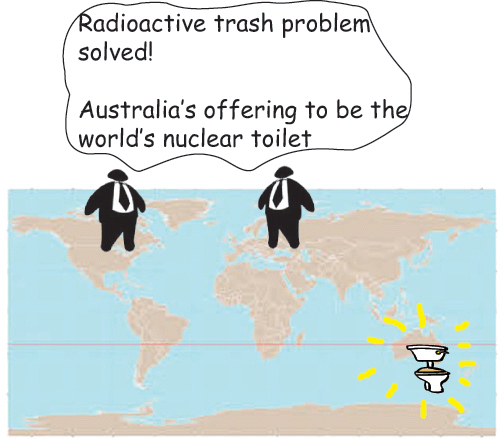
Australia risks becoming the “world’s nuclear waste dump” unless the Albanese government moves to rewrite its proposed Aukus laws, critics say.
A Labor-chaired inquiry has called for the legislative safeguard to specifically rule out accepting high-level nuclear waste from the US and the UK. One of the members of a Senate committee that reviewed the draft laws, independent senator Lidia Thorpe, said the legislation “should be setting off alarm bells” because “it could mean that Australia becomes the world’s nuclear waste dump”.
The government’s bill for regulating nuclear safety talks about “managing, storing or disposing of radioactive waste from an Aukus submarine”, which it defines broadly as Australia, UK or US submarines.
In a report published on Monday, the Senate’s foreign affairs, defence and trade legislation committee said this wording did not reflect the government’s promise not to accept high-level nuclear waste.
It recommended that the government consider “amending the bill so that a distinction is made between Australia’s acceptance of low-level nuclear waste from Aukus partners, but non-acceptance of high-level nuclear waste”.
The government has left the door open to accepting low-level waste from US and UK nuclear-powered submarines when they conduct rotational visits to Western Australia in the first phase of the Aukus plan. Low-level waste contains small amounts of radioactivity and include items such as personal protective equipment, gloves and wipes.
“According to the Australian Submarine Agency, nuclear-powered submarines only generate around a ‘small skip bin’ of low-level naval nuclear waste per submarine per year and that intermediate- and high-level waste will not become a concern until the first naval nuclear reactor requires disposal in the mid-2050s,” the Senate committee report said.
The government has yet to decide on the location for the disposal of radioactive waste from the submarines.
But infrastructure works proposed for HMAS Stirling – the naval base in Western Australia – to support the increased rotational visits are expected to include an operational waste storage facility for low-level radioactive waste.
The Department of Defence has argued any changes to the definitions should not prevent “regulatory control of the management of low-level radioactive waste from UK or US submarines” as part of those rotational visits.
Thorpe, an independent senator, said the call to prohibit high-level nuclear waste from being stored in Australia was “backed by experts in the field and was one of the major concerns raised during the inquiry into the bill”.
“The government claims it has no intention to take Aukus nuclear waste beyond that of Australian submarines, so they should have no reason not to close this loophole,” Thorpe said.
“They also need to stop future governments from deciding otherwise. We can’t risk our future generations with this.”
The government’s proposed legislation would set up an Australian naval nuclear power safety regulator to oversee the safety of the nuclear-powered submarines.
The committee made eight recommendations, including setting “a suitable minimum period of separation” to prevent a revolving door from the Australian Defence Force or Department of Defence to the new regulator.
The main committee report acknowledged concerns in the community that Australia might become a “dumping ground” for the Aukus countries, but it said the term was “not helpful in discussing the very serious question of national responsibility for nuclear waste”.
It also said the bill should be amended to ensure the regulator was transparent about “any accidents or incidents” with the soon-to-be-established parliamentary oversight committee on defence.
The Labor chair of the committee, Raff Ciccone, said the recommendations would “further strengthen the bill” and help “ensure Australia maintains the highest standards of nuclear safety”.
In a dissenting report, the Greens senator David Shoebridge said the legislation was “deeply flawed”, including because the regulator would report to the defence minister.
“The proposed regulator lacks genuine independence, the process for dealing with nuclear waste is recklessly indifferent to community or First Nations interests and the level of secrecy is a threat to both the environment and the public interest,” Shoebridge said.
The defence minister, Richard Marles, was contacted for comment.
This week’s Climate Military-Industrial-nuclear-media -complex news

Some bits of good news. Opposing The War Machine Is Cool Again – https://www.youtube.com/watch?v=Us1r9Wsvjts Hake Fisheries’ Remarkable Recovery Is a Sign of Hope for Our Oceans.
TOP STORIES. `
We’ve barely scratched the surface of how energy efficiency can help the energy transition.
The End of the World as We Know It. United States nuclear weapons, 2024 – (long) extracts at- https://nuclear-news.net/2024/05/10/2-a-united-states-nuclear-weapons-2024/ Don’t Believe the Washington War Machine: Putin Is Not Going to Invade Another NATO Ally.
China and the U.S. Are Numb to the Real Risk of War – ALSO AT https://nuclear-news.net/2024/05/12/1a-china-and-the-u-s-are-numb-to-the-real-risk-of-war/ Fusion reactor could create ingredients for a nuclear weapon in weeks.
Climate. ‘The stakes could not be higher’: world is on edge of climate abyss, UN warns. Floods in Brazil, Kenya, and Texas USA. Venezuela loses its last glacier as it shrinks down to an ice field. World’s oceans suffer from record-breaking year of heat. Afghanistan flash floods kill more than 300 as torrents of water and mud crash through villages.
Ghent students occupy university building in climate and Gaza protest.
Noel’s notes. Time to rise above the tit-for-tat mentality – “Turning Point: the Bomb and the Cold War” (and this is not an ad) https://www.youtube.com/watch?v=qHuuLo-CSRo&t=4s. What is special about “Turning Point -The Bomb and Cold War”?. “The empire” – an exaggerated, emotive, term?
**********************************************************
AUSTRALIA.
- Federal election 2025: Peter Dutton’s nuclear plans worry voters in Nationals-held seat of Gippsland. Australia doesn’t need nukes: International Energy Agency boss. Coalition MPs dismiss International Energy Agency advice to ditch nuclear plans.
- Radiation Protection Agency to Decide on Nuclear Waste Facility Licence Soon.
- Were Australian weapons used in mass killings by Saudi Arabia?
- Australia votes ‘yes’ at United Nations as Palestinian push for full membership gathers momentum.
- Bungled design blamed for cracks in the lining of ANSTO’s new nuclear waste plant – ALSO AT https://antinuclear.net/2024/05/12/bungled-design-blamed-for-cracks-in-the-lining-of-anstos-new-nuclear-waste-plant/
- Koonibba looks to the future as a rocket launch site, but one elder is concerned about impact on sacred sites.
NUCLEAR ISSUES.
CLIMATE. Fixation on UK nuclear power may not help to solve climate crisis.
ECONOMICS
How long does it take to build a nuclear reactor? We ask France. NuScale, maker of small nuclear reactors, reported revenue of $1.4 million and net loss of $48.1 million for the three-month period ended March 31, 2024. Sizewell C nuclear station ‘absolutely not inevitable‘ says campaigner – Can investors be found?
Sam Altman’s nuclear energy company Oklo plunges 54% in New York Stock Exchange debut. Sam Altman-backed nuclear start-up crashes after Wall Street debut. NuScale Power Corporation (SMR) Reports Q1 Loss, Misses Revenue Estimates.
| EDUCATION. Nuclear lobby infiltrates West Lakes Academy and the Energy Coast University Technical College . | ENERGY. Energy Revolutions – time for a change. Constellation Energy looks to small nuclear reactors for the gross, ever-increasing, energy needs of great steel data containers. | ENVIRONMENT. Hinkley Point C: New public inquiry planned over environmental impact. UK Environment Agency ponders on its concerns over Hinkley Point C nuclear effects on fish and the marine habitat.Inside abandoned ghost town at Fukushima after nuclear power plant meltdown. |
| ETHICS and RELIGION. Let Israel’s Leaders Get Arrested for War Crimes. | LEGAL. The mad waste of public money by UK’s leading nuclear giants to pursue costs against a whistleblower at your expense. Forces of Impunity: The US Threatens the International Criminal Court. | MEDIA. Biden’s war on Gaza is now a war on truth and the right to protest. Israel Bans Al Jazeera Journalists, Network, Joining Syria and Iran as Repressive Regime.New Lines: How Washington is Weaponizing Media. |
| POLITICS.USA politicians threaten to invade International Criminal Court if Israel faces war crimes charges. The Summer of Student Activist Protests.UK’s Nuclear roadmap is a massive detour. UK Taxpayers to fund fast-tracked nuclear fusion reactors.Kremlin says nuclear weapon drills are Russia’s response to West’s statements.Polish industry minister announces massive delay in nuclear power plant project. Canada: Nuclear Waste Petition Tabled in Parliament. | POLITICS INTERNATIONAL AND DIPLOMACYIran warns it will change nuclear doctrine if ‘existence threatened’.France’s mini nuclear reactor plan – Nuward, gets another financial handout from the European Commission.Nuclear Energy: The New Geopolitical Battleground.South Korean state energy monopoly in talks to build new UK nuclear plant– ALSO AT https://nuclear-news.net/2024/05/12/1-b1-south-korean-state-energy-monopoly-in-talks-to-build-new-uk-nuclear-plant/Biden’s Shifting ‘Red Line’ Lets Israel Get Away With Murder. |
| RADIATION. Canada’s federal budget -calls nuclear energy “clean” – the height of absurdity! | SAFETY. Sizewell C in Suffolk granted nuclear site licence. |
| SPACE. EXPLORATION, WEAPONS. The detonation of even a single nuclear weapon in space could destroy a significant proportion of satellites in orbit around Earth: UK statement at the UN General Assembly.Astronomers in court against Federal Communications Commission and SpaceX. Russia, China plan nuclear power plant on Moon. | TECHNOLOGY. Warren Buffett compares AI to nuclear weapons in stark warning. The UK makes licensing for nuclear fusion easier: developers can lead site selection. Nano Nuclear wants to reinvent the nuclear power business—but it could take a while. Microsoft reportedly planning “Stargate”, a $100billion supercomputer to be powered by several nuclear plants |
| URANIUM. US Congress Restricts Russian Uranium Imports, Unlocks $2.7 Billion for Domestic Fuel.US nuclear industry clamors for waiver process details as Russian uranium ban looms. | WASTES. Nuclear waste at center of testy Nevada Senate race. Japan’s government asks Genkai mayor to accept site survey to host nuclear waste. |
| WAR and CONFLICT. Israeli Invasion of Rafah Appears Imminent After Evacuation Order. Ending the Logic of War. Rafah residents call on the world to act. NATO escalation in Ukraine threatens nuclear war with Russia. Moscow threatens to strike British military facilities following Cameron’s remarks. Medvedev says aim of nuclear exercises is to work out response to attacks on Russian soil. Exactly what happens in the seconds after a nuclear bomb is launched – https://www.youtube.com/watch?v=–dDjjOkY9A | WEAPONS and WEAPONS SALES.France wants to extend its nuclear umbrella to Europe.US Defenseless Against Russian Hypersonic Missiles and Iranian Drones – Explosive Defence Department Testimony.Military interests are pushing new nuclear power.Students Demanding Divestment: You’re on the Right Side of History.Token gesture: Biden puts hold on approved shipments of ammo to Israel. Hamas will not be defeated for another two to three years: Israeli military sources.Putin orders tactical nuclear weapons drills. Pentagon sees no change in Russia’s strategic nuclear force posture.The Great Ukraine Robbery Is Not Over Yet. The United States Is Expected to Announce a New $400 Million Package of Weapons for Ukraine. |
TODAY. Small modular reactors – yes -the nuclear lobby will keep hyping them – no matter what!

Well, we all do know why. The small nuclear reactor (SMR)power industry – moribund though it is, is essential for the nuclear weapons industry – for a number of reasons, but importantly – to put a sweet gloss on that murderous industry.
Never mind that USA’s NuScale’s SMRs were a resounding flop – NuScale is still being touted, along with all the other little nuclear unicorns manouvreing to get tax-payer funding.
The facts remain, and apparently just need to be hammered again and again:
SMRs are not cheap, not safe, do not reduce wastes, are not reliable for off-grid power, are not more efficient fuel users than are large reactors.
The latest hyped -up push for SMRs is in Canada – with the boast that they will benefit indigenous communities . Successful bribery of indigenous people would give a huge boost to the global nuclear lobby, – as indigenous people have historically been the most distrustful of uranium mining and of the whole nuclear fuel chain.

The gimmicks this time are floating nuclear power plants – barges carrying Westinghouse’s eVinci microreactors. These would take over from the current deisal power plants serving remote communities. There are already some solar, wind and battery projects – frowned upon by the nuclear lobby, of course.
These projects are being strongly promoted, but poorly explained to indigenous communities, would bring radiological hazards along Canada’s Northern shoreline
And what really are the chances that these little nuclear power sources would be effective anyway? Recent reports by the International Atomic Energy Agency (IAEA) reveal that while 83 small nuclear reactors are “in development”, but there are only 2 in operation.
In both cases, the development of the reactors was a very lengthy and expensive process.
The Chinese SMR HTR-PM- “Between January and December 2022, the reactors operated for only 27 hours out of a possible maximum of 8,760 hours. In the subsequent three months, they seem to have operated at a load factor of around 10 percent.”
For the Russian SMR – “The operating records of the two KLT-40S reactors have been quite poor. According to the IAEA’s PRIS [Power Reactor Information System] database, the two reactors had load factors of just 26.4 and 30.5 percent respectively in 2022, and lifetime load factors of just 34 and 22.4 percent.”
Will Canada’s remote indigenous communitites buy the duplicitous nuclear lobby’s propaganda on SMRs ? And then, subsequently, will the rest of us buy it, despite the facts. I guess that the corporate media will help, – if lies are repeated often enough, people come to believe them.
Can floating nuclear power plants help solve Northern Canada’s energy woes?

tangible details on how nuclear technology might be deployed for the benefit of Indigenous peoples were almost entirely absent.
being saddled with a floating radiological hazard on its shoreline could be a worst-case scenario for a Northern community – around the world, there’s a long history of derelict vessels abandoned and left for others to deal with.
Diesel is the only way to keep the lights on in many remote Arctic towns. A new project wants to offer a greener [?] option – but first it has to assuage safety and cost concerns and compete with other renewables
The Globe and Mail MATTHEW MCCLEARN 3 May 24
The nuclear industry is seeking to establish a beachhead in Canada’s North – literally – with a proposed floating nuclear power plant to serve remote Indigenous communities.
Westinghouse, a U.S.-based reactor vendor, has partnered with Prodigy Clean Energy, a Montreal-based company, to develop a transportable nuclear power plant. Essentially a barge housing one or more of Westinghouse’s eVinci microreactors, it would be built in a shipyard and moved thousands of kilometres by a heavy-lift carrier to its destination in the Far North. There it could be moored within a protected harbour, or installed on land near the shore.
Prodigy, which spent the past eight years developing the barge, markets it as a solution for delivering small modular reactors (SMRs) for coastal applications. To serve markets with larger energy appetites, Prodigy has partnered with another American vendor, NuScale, whose reactor produces far more electricity than the eVinci.
While both the eVinci and barge are still works in progress, the partners vow to have their first transportable nuclear plant operating by the end of this decade. “We are talking here about really starting a new industry,” said chief executive Mathias Trojer. “Prodigy solves the SMR deployment problem.”
Prodigy markets its product as an alternative to diesel-fired power plants, which power nearly all Northern remote communities. Diesel is unpopular because of its high emissions and the considerable logistical challenges and costs associated with shipping it to far-flung places.
Prodigy’s message dovetails with broader marketing efforts by the federal government and the nuclear industry to promote SMRs: The word “Indigenous” appeared in the government’s 80-page “SMR road map” more than 100 times, mostly in relation to how communities should be engaged with well in advance of specific project proposals. Yet tangible details on how nuclear technology might be deployed for the benefit of Indigenous peoples were almost entirely absent.
With Prodigy’s transportable plant, a more coherent vision is beginning to emerge. In March, Prodigy announced it had reached an agreement with Des Nëdhé Group, a development corporation of the English River First Nation in northern Saskatchewan. Des Nëdhé’s task will be to engage with First Nations, Inuit and Métis across Canada on potential installations.
“You have Indigenous people that want to be part of this process, that want to include other Indigenous people and treat them like value-added partners,” said Sean Willy, Des Nëdhé’s president and CEO. “Having Indigenous people talk to Indigenous people seems to work a lot better than bringing in a bunch of outside consultants and highly technical people. That’s why we’re part of this project.”
Floating reactors are marketed for other purposes, too. At a conference the International Atomic Energy Agency held late last year that focused on them, possibilities discussed included supplying power to offshore oil and gas platforms, island nations, desalination plants and ports.
But as the partners race to commercialize their transportable nuclear plant, a few Northern communities are already using renewables such as wind and solar to reduce diesel consumption. Will floating nuclear power plants be ready in time and at an affordable price?
Diesel dissatisfaction
Gjoa Haven, Sachs Harbour, Puvirnituq, Arviat: They’re four of the roughly 200 remote communities across Canada lacking a connection to North America’s continental electricity grid and natural gas pipelines. For many decades, diesel-fired plants were the only option.
Their ubiquity stems in part from low upfront capital costs, and they’re relatively straightforward to maintain. They can respond rapidly to shifting demand – a quality that is particularly important for small communities. They have proved dependable in harsh environments.
Diesel “can be installed almost anywhere,” said Michael Ross, a professor at Yukon University who studies Northern energy needs. “It’s been around for many, many years, and we know how it works.”
And yet it’s woefully unpopular. According to one estimate, Northern communities consume an average of 680 million litres of diesel every year. Severe conditions in the North leave a short delivery window each summer; shipments may arrive only once or twice a year. (Nunavut alone consumes approximately 15 million litres of diesel annually.) To ensure those supplies last, communities often maintain large excess reserves, which are expensive. Operating costs are high. A 2015 Senate committee report found that many of the North’s diesel plants were built in the 1950s and 60s and had already surpassed their expected service lives, driving costs higher still.
These and other factors drive up Northerners’ power bills to levels that would incite outrage elsewhere. Yet were it not for heavy government subsidies, they’d pay between 10 and 30 times today’s rates, according to the Pembina Institute, a clean energy think-tank. It estimates direct subsidies at between $300-million and $400-million annually.
Environmental effects are also considerable. Diesel-fired plants emit sulphur dioxide, nitrogen oxides and particulate matter, impairing local air quality, along with greenhouse gases. Leaks and accidental spills occur frequently. Even so, as recently as a few years ago, the consensus was that there were no alternatives. ………………………………………………….
The 2021 mandate letter for Minister of Natural Resources Jonathan Wilkinson ordered him to work with Indigenous partners to help replace diesel-fuelled power with renewables by 2030. Though nuclear technology is not renewable and was not mentioned, Mr. Wilkinson is an ardent supporter, and his government has funded SMR vendors. The federal government has already contributed $27.2-million to support the eVinci’s development.
Barging in
The underlying technology for floating nuclear power plants has a long history. The first nuclear-powered submarine entered service in the 1950s. Since then, reactors have powered American, British and Russian submarines as well as aircraft carriers and icebreakers……………………………………………….
In Siberia, the four-reactor Bilibino nuclear plant was constructed during the 1970s and supplied electricity to the port of Pevek, hundreds of kilometres away. Its output was recently replaced by the Akademik Lomonosov, which is sometimes described not only as the world’s lone floating nuclear power plant, but also the only true functioning SMRs. (According to reports, more floating SMRs are being constructed to supply electricity to mines near Pevek, and there are proposals to deploy Chinese-built floating nukes in the South China Sea.)
The Akademik Lomonosov’s history, though, is not entirely encouraging. According to Mycle Schneider, a nuclear energy analyst and consultant who produces annual reports on the state of the industry, the original plan was to build the plant in less than four years and commission it in 2010; it was delivered a full decade late, and far over budget…………………………………………………..
Even ballpark pricing for a five-megawatt transportable plant is unavailable. Cost is no small consideration here: Nuclear has traditionally been regarded as among the most expensive options for generating power. And according to the Pembina Institute, Indigenous communities and businesses have difficulty accessing capital.
Qulliq Energy, Nunavut’s sole electricity provider, generates nearly all the electricity for its approximately 15,000 customers using 25 diesel plants. It has demonstrated a willingness to consider nuclear power, but admits it can’t afford to pay for any alternatives. A 2020 report said the utility “will not be able to incorporate alternative energy sources into its generation supply mix unless significant funding becomes available.” It looked to the federal government to pay.
Qulliq’s media relations department did not respond to inquiries. Michael MacDonald, a spokesperson for the federal Natural Resources Department, said his department hadn’t provided funding to Qulliq for SMRs or for any other nuclear project. It did provide Qulliq with funding for a solar project in Kugluktuk
Mr. Trojer insisted a floating eVinci’s power would be “very significantly more affordable” than diesel. M.V. Ramana, a professor at the University of British Columbia who specializes in nuclear issues and has studied the economic attractiveness of SMRs in remote applications, disagrees. He estimates costs for SMRs could be as much as 10 times higher than diesel.
“If you really are interested in lowering their costs, I think one would first try out a lot more renewable options, and seek to reduce the demand for diesel before you even think about nuclear,” he said.
Racing against alternatives
The earliest Northern communities to reduce their dependence on diesel have done precisely that – they’ve pursued renewables.
The White River First Nation’s Beaver Creek Solar Project, in Yukon, featured 1.9 megawatts of solar panels and 3.5 megawatt hours of battery storage capacity, and is expected to reduce diesel consumption by more than half. The Sree Vyàa solar project, in Old Crow, Yukon, aimed to reduce that community’s diesel consumption by 190,000 litres.
“Wind and solar seem to be the most sought-after solutions, in partnership with batteries,” said Prof. Ross, who has work on 11 Northern renewable energy projects……………………………………
SMRs are often marketed as producers of “clean” energy, but this overlooks their radioactive wastes. In Southern Canada, the longstanding practice has been to store spent fuel in special facilities at nuclear power plants. But being saddled with a floating radiological hazard on its shoreline could be a worst-case scenario for a Northern community – around the world, there’s a long history of derelict vessels abandoned and left for others to deal with.
…………………………………………………………………………………………….. The Nuclear Waste Management Organization is responsible for long-term storage of spent fuel, and proposes to construct an underground disposal site known as a Deep Geological Repository to permanently store it. It says the repository would be able “to accommodate changes in technology,” but is currently focused on reactors already in the licensing process.
“We are aware of and actively monitoring additional technologies, including the eVinci, however these are still at a preliminary stage,” it said in a statement……………………………………………….
Other issues must be ironed out as well. All of Canada’s existing nuclear plants are large industrial facilities – the largest have thousands of employees and multiple parking lots. It’s not clear yet how many people would be required to operate a transportable nuclear plant equipped with an eVinci. Enticing highly skilled workers to tiny remote communities – and retaining them – could be a challenge.
Canada’s existing nuclear plants are patrolled by security teams. How many individuals with automatic weapons would be needed to patrol a transportable plant? This also has yet to be determined.
Citing waste concerns, the Assembly of First Nations, a national advocacy group, adopted a resolution in 2018 opposing construction and operation of SMRs anywhere in Canada. In March, Biigtigong Nishnaabeg First Nation (Ontario), Kabaowek First Nation (Quebec) and the Passamaquoddy Recognition Group (New Brunswick) were among hundreds of civil society groups who signed a declaration in Brussels against the backdrop of an international nuclear summit.
“Time is precious,” the declaration read, “and too many governments are wasting it with nuclear energy fairy tales.”
……………………………………………….. Whether Ottawa’s ready or not, Prodigy is pushing forward. Mr. Trojer said his company has ensured all elements of the transportable nuclear power plant can be licensed under existing rules and regulations. And Prodigy has closely co-ordinated with delivery dates promised by partners like Westinghouse. It’s now speaking with Canadian shipyards in hopes of finding one to build the transportable nuclear power plant.
The 2030 target, he vowed, will be met. “Prodigy absolutely will meet this timeline.” https://www.theglobeandmail.com/business/article-can-floating-nuclear-power-plants-help-solve-northern-canadas-energy
Small modular reactors aren’t the energy answer for Canada’s remote communities and mines
The energy costs associated with small modular reactors exceed those of diesel-based electricity. Policy-makers should focus on renewables.
by Sarah Froese, Nadja Kunz, M. V. Ramana August 26, 2020 https://policyoptions.irpp.org/magazines/august-2020/small-modular-reactors-arent-the-energy-answer-for-remote-communities-and-mines/
A new type of theoretical nuclear power plant design called small modular reactors (SMRs) has been in the news of late. Earlier this year, at the 2020 Canadian Nuclear Association conference, Minister of Natural Resources Seamus O’Regan announced that the federal government will release an SMR Action Plan this fall. Ontario, New Brunswick and Saskatchewan have announced their backing and possibly some financial support for the development of these reactors.
Promoters suggest that remote communities and off-grid mining operations are promising markets for SMRs in Canada. These communities and mines pay a lot for electricity because they are reliant on diesel generators, and transporting and storing diesel to these locations can be very expensive. Thus, supporters hope, SMRs might be a way to lower electricity costs and carbon dioxide emissions.
We examined this proposition in detail in a recently published paper and concluded that this argument has two problems. First, the electricity that SMRs produce is far more expensive than diesel-based electricity. Second, even ignoring this problem, the total demand for electricity at these proposed markets is insufficient to justify investing in a factory to manufacture the SMRs.
SMRs have been proposed as a way to deal with many problems associated with large nuclear power plants, in particular the high costs of construction, running to tens of billions of dollars. SMR designs have much in common with large nuclear reactors, including, most basically, their reliance on nuclear fission reactions to produce electricity. But they also differ from large nuclear reactors in two ways. First, they have electricity outputs of less than 300 megawatts (MW) and sometimes as low as a few MW, considerably lower than the outputs of 700 to 1500 MW typical of large nuclear reactors. Second, SMR designs use modular means of manufacturing, so that they need only be assembled, rather than fully constructed, at the plant site. While large reactors that have been constructed in recent years have also adopted modular construction, SMR designers hope to rely more substantially on these techniques.
A standard metric used to evaluate the economics of different energy choices is called the levelized cost of energy (LCOE). We calculated that the LCOE for SMRs could be over ten times greater than the LCOE for diesel-based electricity. The cheapest options are hybrid generation systems, with wind or solar meeting a part of the electricity demand and diesel contributing the rest.
Why this high cost? The primary problem is that the small outputs from SMRs run counter to the logic of economies of scale. Larger reactors are more cost-efficient because they produce more electricity for each unit of material (such as concrete and steel) they use and for the number of operators they employ. SMR proponents argue that they can make up for this through the savings from mass manufacture at factories and the learning that comes with manufacturing many reactors. The problem is that building a factory requires a sizable market, sometimes referred to as an order book. Without a large number of orders, the investment needed to build the factory will not be justified.
We estimated the potential market for SMRs at remote mines and communities in Canada. We drew primarily upon two databases produced by Natural Resources Canada regarding mining areas and remote communities. As of 2018, there were 24 remote mining projects that could be candidates for SMR deployment within the next decade. Currently, these projects use diesel generators with a total installed capacity of 617 MW. For remote communities, we calculated a fossil fuel (primarily diesel) generation capacity of 506 MW. But many of these communities had demands that were too low for even the smallest-output SMR under review at the Canadian Nuclear Safety Commission.
Even if all these potential buyers want to adopt SMRs for electricity supply, without regard to the economic or noneconomic factors weighing against the construction of nuclear reactors, the combined demand would likely be much less than 1000 MW. The minimum demand required to justify the cost of producing SMRs would be three to seven times higher.
Furthermore, we concluded that the economics of SMRs don’t compete when compared with other alternatives. The cost of electricity from SMRs was found to be much higher than the cost of wind or solar, or even of the diesel supply currently used in the majority of these mines and communities.
Of course, our estimates for the LCOEs of different sources are dependent on various assumptions. We tried varying these assumptions within reasonable limits and found that the main result — that electricity from SMRs is far more expensive than the corresponding costs of generating electricity using diesel, wind, solar or some combination thereof — remains valid. All else being equal, the assumed capital cost of constructing a SMR would have to decline by over 95 percent to be competitive with a wind-diesel hybrid system. The limited experience with SMRs that are being built around the world suggests that construction costs will be higher, not lower, than advocates promise.
Meanwhile, renewables and storage technologies have seen substantial cost declines over the past decades. Recent estimates place wind, solar and hybrid systems at costs competitive with diesel power. Successful demonstrations suggest that renewable hybrid applications are becoming increasingly feasible for heavy industry, and the implementation of numerous numerous projects in northern communities suggests a high level of social acceptance. Many northern and, in particular, Indigenous communities have an interest in self-determined decision-making and maintaining a good relationship with the land. In June 2019, for example, the Anishinabek Chiefs-in-Assembly, representing 40 First Nations across Ontario, unanimously expressed opposition to SMRs. Grand Council Chief Glen Hare announced that the Anishinabek Nation is “vehemently opposed to any effort to situate SMRs within our territory.”
Instead of focusing on SMRs, policy-makers should bolster support for other renewable generation technologies as key mechanisms to reduce carbon emissions and align with community values.
Five Things the “Nuclear Bros” Don’t Want You to Know About Small Modular Reactors

1. SMRs are not more economical than large reactors.
2. SMRs are not generally safer or more secure than large light-water reactors.
3. SMRs will not reduce the problem of what to do with radioactive waste.
4. SMRs cannot be counted on to provide reliable and resilient off-the-grid power for facilities, such as data centers, bitcoin mining, hydrogen or petrochemical production.
5. SMRs do not use fuel more efficiently than large reactors.
Ed Lyman, April 30, 2024 https://blog.ucsusa.org/edwin-lyman/five-things-the-nuclear-bros-dont-want-you-to-know-about-small-modular-reactors/
Even casual followers of energy and climate issues have probably heard about the alleged wonders of small modular nuclear reactors (SMRs). This is due in no small part to the “nuclear bros”: an active and seemingly tireless group of nuclear power advocates who dominate social media discussions on energy by promoting SMRs and other “advanced” nuclear technologies as the only real solution for the climate crisis. But as I showed in my 2013 and 2021 reports, the hype surrounding SMRs is way overblown, and my conclusions remain valid today.
Unfortunately, much of this SMR happy talk is rooted in misinformation, which always brings me back to the same question: If the nuclear bros have such a great SMR story to tell, why do they have to exaggerate so much?
What are SMRs?
SMRs are nuclear reactors that are “small” (defined as 300 megawatts of electrical power or less), can be largely assembled in a centralized facility, and would be installed in a modular fashion at power generation sites. Some proposed SMRs are so tiny (20 megawatts or less) that they are called “micro” reactors. SMRs are distinct from today’s conventional nuclear plants, which are typically around 1,000 megawatts and were largely custom-built. Some SMR designs, such as NuScale, are modified versions of operating water-cooled reactors, while others are radically different designs that use coolants other than water, such as liquid sodium, helium gas, or even molten salts.
To date, however, theoretical interest in SMRs has not translated into many actual reactor orders. The only SMR currently under construction is in China. And in the United States, only one company—TerraPower, founded by Microsoft’s Bill Gates—has applied to the Nuclear Regulatory Commission (NRC) for a permit to build a power reactor (but at 345 megawatts, it technically isn’t even an SMR).
The nuclear industry has pinned its hopes on SMRs primarily because some recent large reactor projects, including Vogtle units 3 and 4 in the state of Georgia, have taken far longer to build and cost far more than originally projected. The failure of these projects to come in on time and under budget undermines arguments that modern nuclear power plants can overcome the problems that have plagued the nuclear industry in the past.
Developers in the industry and the US Department of Energy say that SMRs can be less costly and quicker to build than large reactors and that their modular nature makes it easier to balance power supply and demand. They also argue that reactors in a variety of sizes would be useful for a range of applications beyond grid-scale electrical power, including providing process heat to industrial plants and power to data centers, cryptocurrency mining operations, petrochemical production, and even electrical vehicle charging stations.
Here are five facts about SMRs that the nuclear industry and the “nuclear bros” who push its message don’t want you, the public, to know.
Continue readingNuclear: In Flamanville, the EPR farce continues
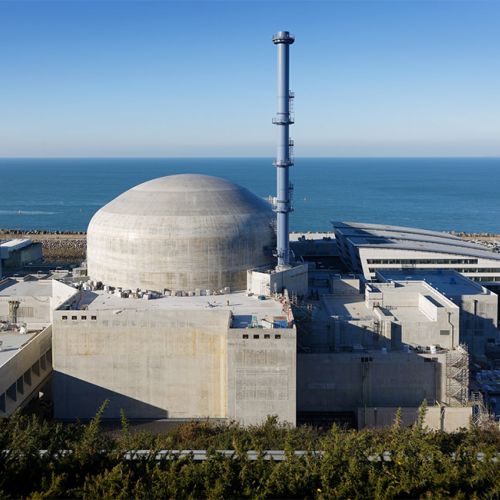
During a meeting of the local information commission on April 12, the Nuclear Safety Authority (ASN) assured that it could give the green light to the start-up of the reactor by the beginning of May. However, not all technical problems are resolved. And now a new one – of vibrations – appeared at the end of last year on the primary circuit. Revelations.
Blast, Thierry Gadault , 22 Apr 24
A few kilometers from the Flamanville nuclear power plant, Les Pieux (Manche) is typical of the many nuclear communities that we cross along the Rhône and Loire valleys: stone facades scrubbed with a toothbrush, paved sidewalks shiny as a new penny, innumerable municipal facilities that a town of some 3,500 inhabitants could never hope to afford, even in its wildest dreams, if it were not for the millions poured every year by EDF into the Department………………………..
Dialogue of the deaf in the basement
Behind the town hall, an old mansion which dominates the village, is the Pieux proximity center. In the basement of the building, which houses part of the municipal services, an auditorium with around fifty seats hosts the meetings of the Local Information Commission (CLI), a consultative body bringing together EDF, the Nuclear Safety Authority (ASN), local elected officials, the State and association representatives.
April 12, 2024, there was a crowd for the extraordinary meeting of the CLI. The menu was potentially copious: it was a question of taking stock of the EPR, before the ASN gave the green light to EDF to install the nuclear fuel in the vessel. While the independent authority was in full public consultation (it ended on April 17), an essential prerequisite for its decision-making, the associations had obtained this appointment in the form of a last-chance meeting, to try to derail the process.
But neither the ASN representative, Gaëtan Lafforge, the head of the Caen division, nor that of EDF, Alain Morvan, the director of the Flamanville EPR project, had the intention of revealing the reality of the numerous problems which still affect the reactor. And it was a dialogue of the deaf that the participants engaged in.
On the ASN and EDF side, the speech can easily be summarized: officially, everything is in order and the objective is now to gradually bring the reactor to operate at full power, at the end of the year. The authority also specified that the green light will be given by the beginning of May. Alain Morvan, with slides reduced to the strict minimum, simply outlined the process of starting up the new reactor.
On April 12, questioned on this subject by Yannick Rousselet, nuclear safety consultant at Greenpeace, the ASN representative had the greatest difficulty in answering the question clearly. “I can’t tell you that there won’t be anything left, there could be possible deviations during the tests,” stammered Gaëtan Lafforge. This then led to a short lunar exchange with the anti-nuclear activist, which triggered laughter from the audience.
On the anti-nuclear activist side, the troops left after two hours with their questions. In particular, lo and behold, a new vibration problem on the primary circuit detected last year.
The information was given to Blast by Julien Collet, the deputy director general of ASN, during the authority’s annual press conference organized at the end of last January. The DGA then told us that EDF was in the process of investigating this umpteenth glitch on the EPR.
On April 12, questioned on this subject by Yannick Rousselet, nuclear safety consultant at Greenpeace, the ASN representative had the greatest difficulty in answering the question clearly. “I can’t tell you that there won’t be anything left, there could be possible deviations during the tests,” stammered Gaëtan Lafforge. This then led to a short lunar exchange with the anti-nuclear activist, which triggered laughter from the audience.
Strangely, Alain Morvan, who could have provided technical details, remained silent. And no one thought to give him the floor. Especially since the president of the CLI, perhaps impatient to go to lunch, hastened to close the session. Questioned by Blast after the meeting, the director of the EPR project, cornered by a member of EDF communications, refused to answer us.
Hardly any more luck with the Parisian communications department, a few moments later. “The vibrational issues have been dealt with and technical solutions put in place,” she simply responded in the usual wooden language. In short, move around, there is nothing to see.
Yes, but here it is: questioned by a journalist from Presse de la Manche, the local daily which covered the event, EDF gave another answer : “There is no new vibration subject,” said the electrician. to our colleague. Um… we should know: has the subject been covered or does it not exist?
It’s not me, it’s him !
To try to see things clearly, Blast turned to the Institute of Radiation Protection and Nuclear Safety (IRSN), the public research establishment which provides technical advice to the ASN.
Perhaps concerned about its future – following the merger with the ASN imposed by the government and ratified by the National Assembly and the Senate – the establishment informed us through its press manager that the subject was not his responsibility. And to send us back to the ASN…
Unfortunately, ASN did not answer our questions. As Martine Aubry, the mayor of Lille and former candidate defeated in the 2011 socialist primary, said about François Hollande, “when it’s vague, there’s a wolf…”
The lid saga
This new problem… sorry “subject” vibration is therefore added to the numerous unresolved technical files that EDF has decided to leave as is, with the agreement of the ASN, to provide a response only after the commissioning of the reactor – it is unusual, we will agree. Starting obviously with the lid of the tank, weakened by a manufacturing defect (positive carbon segregation also present in the bottom of the tank). When the authority finally authorized the use of the tank and its lid in 2018, when it was no longer possible to exclude the risk of rupture but only to prevent it (which does not have the same meaning), she had asked EDF to change the cover no later than December 2024.
……………………………………..Questioned by activists to know why the company was not waiting for this new cover, Alain Morvan got confused in his explanations. He first suggested that it was not finished, and that it would therefore not be installed before the summer of 2025, before contradicting himself to finally assure that it would be delivered to the nuclear power plant at the end of the year…
In fact, the public group has nothing to do with it: in 2023, Framatome obtained from the ASN to postpone the replacement of the cover by one year, without giving any justification for such a postponement. According to the order issued by the authority last year, it must now be replaced during the first full inspection of the installation, after its start-up.
While it was possible to change this part in complete safety for the health of workers, if the new one had been installed before start-up, this postponement changes everything. The current cover will be irradiated and it will in fact become nuclear waste. In other words, an object that cannot be handled like that.
Apart from the fact that this unnecessarily exposes workers to taking doses during operations to replace it, this poses another problem. This question has not been resolved to date by EDF: that of the storage of this contaminated part, when it is removed. ASN asked the EDF group to construct a building for this purpose which would allow it to be stored safely on the power plant site. Which still doesn’t seem to be done…
Radioactivity, haphazardly
Emblematic, the tank cover file is not the only one which demonstrates EDF’s lack of consideration for nuclear employees, whether they are in-house agents or subcontracting employees. A second major project, also planned after the start-up of the reactor, will expose those involved to radioactive risks. Here again, this intervention could have been carried out in complete safety before the installation was started: the modification of the cooling system of the reactor auxiliary networks (RRI) and rescued raw water (SEC). Essential elements, particularly during reactor shutdown…………………………………………………………………………………………………………………….
Later, again
Still in the same logic, EDF has postponed the modification of the tank internals until later, more precisely the lower plenum which directs the distribution of the hydraulic flow in the tank. Since the incident that occurred on one of the two EPRs at Taishan in China, in 2021, we have had some feedback: it has been established that this equipment generates poor distribution of hydraulic flow which causes greater fluctuations. greater than expected in the neutron flux, which could lead to difficulties in controlling the nuclear reaction. Although ASN asked EDF to modify the lower plenum, the studies are still in progress………………………………………………………….
In China, to avoid major problems while waiting for the modification of the lower plenum, the power of the reactors (officially 1,750 MW) would have been limited to 1,500 MW. Will this also be the case for the Flamanville EPR? Questioned during the CLI meeting on April 12 by Yannick Rousselet, neither ASN nor EDF deigned to respond.
Let’s cross our fingers, hoping that there will be no runaway nuclear reaction in the Flamanville EPR tank. Especially since Libération revealed in July 2022, two systems of probes and sensors essential for operating the reactor, installed either in the tank or outside, are malfunctioning.
The EPR, political totem
“It would have been smarter to do all this work before the reactor was started,” exasperates Gilles Reynaud, the president of Ma Zone Contrôlée , which brings together nuclear subcontracting employees. But EDF wants to put the EPR into production to say: “that’s it, it works.” Doing all this work afterwards, I don’t find it very respectful for the workers and the population. »
No matter the cost
“We are starting at all costs for purely political reasons,” judge Yannick Rousselet, interviewed by Blast at the end of the CLI on April 12. As President Macron announced the relaunch of nuclear power with the construction of new EPRs, they want to send the message that we are out of the rut. » For Rousselet, this is a very short-term vision: “Even if this reactor shuts down in a few months for a long period, no one cares. We must be able to say: “That’s it, the Flamanville EPR is loaded. He started.” This is what is most dangerous. We don’t try to solve the problems first. »
The secrets of an engineer
And then, potentially, there is another problem in the medium term. Recently, an engineer, Thierry C, contacted Blast to tell us about his short experience in nuclear power.
………………………………. “When I took the file, I quickly realized that most of the valves that had to be installed could not meet the temperature and pressure conditions planned during these requalification tests,” he explains to Blast. Of the approximately 650 pipes equipped with valves, there were approximately 450 that had to be cut to remove the equipment and replace it with a temporary device to block the pipes. » A not really reassuring observation. “I spoke about it to my superiors who asked me to keep quiet and not talk to EDF about it. »
The documents and plans consulted by Blast seem to confirm these remarks. Which poses a problem: the requalification tests must be carried out with the valves to be validated. However, this analysis work was carried out in 2008-2009, when the EPR construction site, which had just started, was still in the civil engineering stage. Thierry C. left the group shortly after carrying out this study. What has happened since then? Has the error made by Alstom on the technical characteristics of the valves been corrected? Impossible to know: neither EDF, nor ASN, nor IRSN wanted to answer us.
Overall, given these unresolved problems and the lack of transparency from EDF and ASN regarding the technical setbacks of the installation, within the Flamanville CLI but also vis-à-vis the press, the long nightmare of the EPR construction site may not be over. This bad dream led to its bill exploding – which reached some 19.1 billion euros . A farce that could end up boring and no longer make anyone laugh. https://www.blast-info.fr/articles/2024/nucleaire-a-flamanville-la-farce-de-lepr-se-poursuit-G9PeKawaRwmShmxp6sJL3g
Civil and military nuclear mutuality

‘The UK government is pursuing an uneconomic nuclear programme in large part so as to maintain & renew military nuclear capabilities’.
Rishi Sunak backs both civil and military nuclear: ‘Safeguarding the future of our nuclear deterrent and nuclear energy industry is a critical national endeavour’. French president Emmanuel Macron is even more upfront about it all: ‘Without civil nuclear power, no military nuclear power, without military nuclear, no civil nuclear.’ With the USA, China and Russia also evidently locked into similar paths, the global future doesn’t look too good.
‘The UK government is pursuing an uneconomic nuclear programme in large part so as to maintain & renew military nuclear capabilities’.
backs both civil and military nuclear: ‘Safeguarding the future of our nuclear deterrent and nuclear energy industry is a critical national endeavour’. French president Emmanuel Macron is even more upfront about it all: ‘Without civil nuclear power, no military nuclear power, without military nuclear, no civil nuclear.’ With the USA, China and Russia also evidently locked into similar paths, the global future doesn’t look too good.
Renew Extra Weekly, 13 Apr 24
Until recently, the UK government has always said that civil and military nuclear technologies were separate things, for example in response to claims that expansion of civil nuclear power capacity could lead to proliferation of nuclear weapons making capacity. But, as researchers at the University of Sussex have relentlessly catalogued, there seems to have been a change of view underway, culminating formally in March in a new policy document from No. 10 Downing Street. Entitled ‘Building the Nuclear Workforce of Tomorrow’ it claims that ‘domestic [civil] nuclear capability is vital to our national defence and energy security, underpinning our nuclear deterrent and securing cheaper, more reliable energy for UK consumers’. So they are intertwined and mutually beneficial- we need both!
UK Prime Minister Sunak says that ‘in a more dangerous and contested world, the UK’s continuous at-sea nuclear deterrent is more vital than ever’ and that civil nuclear power is the ‘perfect antidote to the energy challenges facing Britain- it’s green, cheaper in the long term and will ensure the UK’s energy security for the long term’.
There are many issues raised by these claims. Leaving aside all the major moral and political issues associated with nuclear weapons, it is not at all clear that new nuclear reactors will be as costs effective as renewables. Indeed, the cost of renewables has fallen dramatically in recent years while the cost of nuclear projects has continued to escalate. It could be that, recognising this imbalance in cost, what we are now seeing is the government trying to provide a compensating justification for new civil nuclear- it will aid defence. Even if, arguably, it makes little economic sense as Business Green argued: ‘The UK government is pursuing an uneconomic nuclear programme in large part so as to maintain & renew military nuclear capabilities’.
Basically, as the Sussex University researchers have argued, it does seem that the government is just responding to military pressures. More specifically though, it’s a matter of rapidly expanding skill requirements- and shortages. Matthew Lay, Head of EDF Nuclear Skills Alliance, says that ‘the UK Government’s commitment to nuclear power must be seen in the context of a steady increase of nuclear capacity worldwide as well as growth in defence expenditure,’ and especially the growth in the ‘defence industry’s demand for nuclear skills, to deliver established and new nuclear submarine programmes’. So it’s about expanding nuclear skills for building nuclear sub power plants and civil reactors, including possibly Small Modular Reactors (SMRs), which have some similarities. Presumably also about making fuels for them both too.
Some may be happy about civil-military skill sharing, but it’s a long way from the old rhetoric about ‘atoms for peace’. In 1953 President Eisenhower called for nuclear bomb technology to be turned to peaceful ends around the world, with US help e.g. in transferring nuclear plant technology to developing countries. That had floundered due, in part, to the high cost of nuclear plants. According to a review by Drogan, a State Department Intelligence Report, circulated in January 1954, ‘Economic Implications of Nuclear Power in Foreign Countries’, noted that ‘nuclear power plants may cost twice as much to operate and as much as 50 percent more to build and equip than conventional thermal plants’. So it warned that the introduction of nuclear power would ‘not usher in a new era of plenty and rapid economic development as is commonly believed’. You could say that we are still waiting!
There were also potential conflicts between the ‘atoms for peace’ idea and proliferation issues. Indeed that is now even more of a problem, with some newly developing countries, following the UAE’s lead, looking to have nuclear plants, which, in theory, could give them the ability to make bombs. And (the Nuclear Proliferation Treaty apart!) why not, if nuclear weapons states like the UK are seen as no longer maintaining a clear separation between civil and military nuclear technology? Except of course the high cost of civil nuclear may make renewables a much better deal- especially solar, of which many countries (in the Middle East and Africa for example) have plenty. ……………………………………………………………………………..
Clearly UK Prime Minister Sunak doesn’t see it this way- he backs both civil and military nuclear: ‘Safeguarding the future of our nuclear deterrent and nuclear energy industry is a critical national endeavour’. French president Emmanuel Macron is even more upfront about it all: ‘Without civil nuclear power, no military nuclear power, without military nuclear, no civil nuclear.’ With the USA, China and Russia also evidently locked into similar paths, the global future doesn’t look too good.
Do we really have to continue with all this? In 1995, Sir Michael Atiyah, then retiring as President of the Royal Society, said ‘I believe history will show that insistence on a UK nuclear capability [weapons and energy] was fundamentally misguided, a total waste of resources and a significant factor in our relative economic decline over the past 50 years’. He may have been right. https://renewextraweekly.blogspot.com/2024/04/civil-and-military-nuclear-mutuality.html
Is Nuclear Fusion Really The Ultimate Solution to AI’s Crazy Power Use?

By Alex Kimani – Mar 29, 2024, https://oilprice.com/Energy/Energy-General/Is-Nuclear-Fusion-Really-The-Ultimate-Solution-to-AIs-Crazy-Power-Use.html
- A Boston Consulting Group analysis has predicted that data center electricity consumption will triple by 2030.
- Past trends in technology advances suggest that AI cons are very likely to outweigh the pros as far as power demand is concerned.
- OpenAI’s Altman: nuclear fusion is the ultimate solution to the AI energy puzzle
Two weeks ago, we reported how Artificial Intelligence (AI), cryptocurrency mining and clean energy manufacturing are powering the Fourth Industrial Revolution, or simply 4R, and driving disruptive trends including the rise of data and connectivity, analytics, human-machine interaction, and improvements in robotics. Unfortunately, these secular megatrends are pushing the U.S. power grid to its limits.

According to Sreedhar Sistu, vice president of artificial intelligence at Schneider Electric (OTCPK:SBGSF), excluding China, AI represents 4.3 GW of global power demand, and could grow almost five-fold by 2028. Another analysis has predicted that demand from AI will grow exponentially, increasing at least 10x between 2023 and 2026.

AI tasks typically demand more powerful hardware than traditional computing tasks. Meanwhile, bitcoin mining shows no signs of slowing down, with mining rates hitting 565 exahashes per second (EH/s) currently, a five-fold increase from three years ago.
Bitcoin mining consumes 148.63 TWh of electricity per year and emits 82.90 Mt CO2 per year, comparable to the power consumption of Malaysia. And, data center demand is not helping matters at all. Data center storage capacity is expected to grow from 10.1 zettabytes (ZB) in 2023 to 21.0 ZB in 2027, good for a 18.5% CAGR.

A Boston Consulting Group analysis has predicted that data center electricity consumption will triple by 2030, enough electricity to power 40 million U.S. homes.
The situation is already getting out of hand: U.S. power demand has started rising for the first time ever in 15 years. “We as a country are running out of energy,” Michael Khoo, climate disinformation program director at Friends of the Earth and co-author of a report on AI and climate, has told CNN.
To be fair, AI has been touted as one of the key technologies that will help tackle climate change. The revolutionary technology is already being used to track pollution, predict weather, monitor melting ice and map deforestation. A recent report commissioned by Google and published by the Boston Consulting Group claimed AI could help mitigate up to 10% of planet-heating pollution.
Unfortunately, past trends in technology advances suggest that AI cons are very likely to outweigh the pros as far as power demand is concerned.
“Efficiency gains have never reduced the energy consumption of cryptocurrency mining. When we make certain goods and services more efficient, we see increases in demand,” Alex de Vries, a data scientist and researcher at Vrije Universiteit Amsterdam, has pointed out.
At this point, nearly everybody agrees that we are incapable of developing renewable energy plants fast enough to meet this skyrocketing power demand. So, what other recourse do we have, short of saying let’s just build more natural gas and fossil fuel power plants?
Enter nuclear fusion, long regarded by scientists as the Holy Grail of clean and almost limitless energy. Sam Altman, head of ChatGPT creator OpenAI, says nuclear fusion is the ultimate solution to the AI energy puzzle, “There’s no way to get there without a breakthrough, we need fusion,” Altman said in a January interview. Altman reiterated this view a few weeks ago when podcaster and computer scientist Lex Fridman asked him about the AI energy conundrum.
Blue Sky Thinking

Unfortunately, Altman’s proposal is likely another case of overly optimistic blue-sky thinking, and we might not be any closer to building a commercial nuclear fusion reactor than we are to harvesting energy from blackholes.
For decades, nuclear fusion has been considered the “Holy Grail” of clean energy. If we were able to harness its power it would mean endless clean and sustainable energy. It’s what powers stars, and the theory is that it could be successfully applied to nuclear reactors–without the risk of a catastrophic meltdown disaster.
Scientists have been working on a viable nuclear fusion reactor since the 1950s–ever hopeful that a breakthrough is just around the corner. Unfortunately, the running joke has become that a practical nuclear fusion power plant could be decades or even centuries away, with milestone after milestone having fallen time and again
To be fair again, there’s been some promising glimpses into the possibilities here. Last year, a nuclear fusion reactor in California produced 3.15 megajoules of energy using only 2.05 megajoules of energy input, a rare instance where a fusion experiment produced more energy than it consumed. The vast majority of fusion experiments are energy negative, taking in more energy than they generate thus making them useless as a form of electricity generation. Despite growing hopes that fusion could soon play a part in climate change mitigation by providing vast amounts of clean power for energy-hungry technologies like AI, the world is “still a way off commercial fusion and it cannot help us with the climate crisis now”, Aneeqa Khan, research fellow in nuclear fusion at Manchester University, told the Guardian just after the initial December breakthrough.
You don’t have to look very far to get a healthy dose of reality check.
For decades, 35 countries have collaborated on the largest and most ambitious scientific experiments ever conceived: the International Thermonuclear Experimental Reactor (ITER), the biggest-ever fusion power machine. ITER plans to generate plasma at temperatures 10x higher than that of the sun’s core, and generate net energy for seconds at a time. As is usually the case with many nuclear power projects, ITER is already facing massive cost overruns that puts its future viability in question. W
When the ITER project formally commenced operations in 2006, its international partners agreed to fund an estimated €5 billion (then $6.3 billion) for a 10-year plan that would have seen the reactor come online in 2016. Charles Seife, director of the Arthur L. Carter Institute of Journalism at New York University, has sued ITER for lack of transparency on cost and incessant delays. According to him, the project’s latest official cost estimate now stands at more than €20 billion ($22 billion), with the project nowhere near achieving its key objectives. To make matters worse, none of ITER’s key players, including the U.S. Department of Energy, has been able to provide concrete answers of whether the team can overcome the technical challenges or estimates of the additional delays, much less the extra expenses.
Seife notes that whereas the Notre Dame took a century to complete, it eventually was used for its intended purpose less than a generation after construction began. However, he concludes by saying that the same can hardly be said about ITER, which looks less and less like a cathedral–and more like a mausoleum.
“Nuclear comes last”

the tail-between-legs exit of the Nuclear Summit conferees declared in a headline: “Taxpayers are needed to foot the bill to achieve 2050 targets.”
Banks reject nuclear funding, stocks nosedive and the industry says it should, believe it or not, slow down
By Linda Pentz Gunter https://beyondnuclearinternational.org/2024/03/31/nuclear-comes-last/

NuScale, the company whose small modular reactor project collapsed so spectacularly last November, is “burning cash at the rate of $185 million per year”. On March 22, the company’s CEO, John Hopkins, sold 59,768 of his shares in the company. This is the same CEO who declared NuScale’s SMR project, aptly named VOYGR, “a dead horse.” It’s clearly on a journey to nowhere.

Wells Fargo, with an eye on prudent investments, has declared, “We think investor enthusiasm for SMR is misguided”. As The Motley Fool reported, “NuScale’s VOYGR nuclear power product has ‘no secure customers’ and is ‘not cost competitive’ says the analyst.”
The splashy cheerleading Nuclear Energy Summit organized by the International Atomic Energy Agency in Brussels on March 21 proved to be just that. The participants arrived floating on the hot air of their misplaced enthusiasm but “left humbled by the tepid reaction of bankers assessing the price tag of their ambitions”.
European Investment Bank Vice President Thomas Ostros, told Summit attendees to their face that “The project risks, as we have seen in reality, seem to be very high”. Representatives from the European and Latin American banking worlds said that “their lending priorities lean toward renewables and transmission grids” and that “nuclear comes last”.

Even the US Nuclear Regulatory Commission couldn’t quite bring itself to slam down its rubber stamp on Oklo’s chalet-in-the-woods micro reactor, the Aurora, which remains about as real as its namesake fairy tale princess.
In January 2022, the NRC denied Oklo’s license application outright because it “continues to contain significant information gaps in its description of Aurora’s potential accidents as well as its classification of safety systems and components,” wrote the NRC.
Oklo reapplied nine months later but according to the NRC docket there is “no further action”.
Nevertheless, Oklo brags on its website that it “made history” simply by developing “the first advanced fission combined license application to the U.S. Nuclear Regulatory Commission”, which sums up the second nuclear “renaissance” perfectly: Make a drawing. Hit ‘send’.
Meanwhile, the US military canceled its contract for an Aurora reactor originally intended for the Eielson Air Force Base near Fairbanks, Alaska.
And finally, an executive from the industry that has consistently delivered its latest new reactors decades late and billions over the original budget — in one case $20 billion over — suggested they should all just slow down. Said Ian Edwards, chief executive of Canadian reactor producer, Atkins Realis, “we all become too optimistic. We have this optimism bias towards being able to deliver faster. Really we should probably slow things down a little bit.”
But nuclear power is the answer to our current climate crisis! Ya think?
It’s tempting to ask whether things can get any worse for the nuclear power industry, but they almost certainly will. Unless we end up paying for it all. As the Bloomberg article that related the tail-between-legs exit of the Nuclear Summit conferees declared in a headline: “Taxpayers are needed to foot the bill to achieve 2050 targets.”
At the moment, a majority in the US Congress seem intent on making sure that is exactly what will happen. Because after all, why should multi-billionaire, Bill Gates, be forced to pay for his own nuclear toys when he can milk (read ‘bilk’) US taxpayers instead?

The US government has already pledged $2 billion of our money to Gates for his proliferation-friendly liquid sodium-cooled molten salt fast reactor produced by his company, TerraPower (more properly, TerrorPower). Gates can’t wait to export it the United Arab Emirates. Nuclear weapons anyone?
The strokey-white-beard-named ADVANCE Act, has been passed by the US House with 365 voting in favor and only 36 Democrats-with-a-conscience voting against it. By its own description, the ADVANCE ACT aims to “advance the benefits of nuclear energy by enabling efficient, timely, and predictable licensing, regulation, and deployment of nuclear energy technologies.” In other words, do away with burdensome — and expensive — safety regulations.
Indeed, New Mexico Democrat, Senator Martin Heinrich, told E&E News in January that “These regulatory timelines do not lend themselves to fighting the climate crisis.” Oh those wascally wegulations!
Meanwhile, Democratic senator Joe Manchin of West Virginia doesn’t want to seat any new NRC commissioners who might be “too focused on safety.”
The NRC’s motto is “protecting people and the environment,” a mandate it demonstrably endeavors to avoid already, but even some vestige of interest in safety is probably better than none. Not that safety oversight will be needed of course because, hey, SMRs are “walkaway safe” and “meltdown proof” and any new light water reactors are too “advanced” to be a safety risk.

This makes the insistence by SMR manufacturers that they must be covered by the Price-Anderson Act (PAA) all the more curious. Price-Anderson, due to expire in 2025, was culled out of the ADVANCE ACT, now moving out of Senate committee and working its way through the reconciliation process, and handled separately. The Senate adopted the House version of the PAA, giving it a 40-year extension to 2026, and expanded limited liability for a major accident to just over $16 billion per reactor.
President Biden duly signed it into law, marking another misstep on what is becoming an increasingly problematic presidency.
Ed Lyman, Nuclear Power Safety Director at the Union of Concerned Scientists, told Nuclear Intelligence Weekly that “The nuclear industry’s push for a 40-year Price-Anderson Act extension is a sure sign that it doesn’t believe its own messaging about how safe the next generation of nuclear reactors is going to be.”
But in a joint statement, Senator Shelley Moore Capito (R-W.Va.) and Senator Tom Carper (D-Del.) declared that “The extension of the Price-Anderson Act in the minibus sends a clear message that we are committed to the advancement of this safe and reliable power source.”
The “clear message” this actually sends is that, in the event of a major nuclear accident, US taxpayers will be thrown under that minibus. The $16 billion coverage will be chicken feed and we will all be stuck with the bill. Let’s remember that the Chornobyl and Fukushima nuclear disasters are each racking up costs in the hundreds of billions of dollars and counting. We have been warned.
But a bi-partisan group of Representatives and Senators think it’s perfectly fine for all of us to pay for such an eventuality. Meanwhile, if you own a home and are forced to abandon it in the path of a nuclear accident, you cannot claim a dime off your homeowner’s insurance. It will just be a total loss. Think about that for a moment.
Are we outraged yet?
Linda Pentz Gunter is the international specialist at Beyond Nuclear
Nuclear news for the last week of March

Some bits of good news. More Teens Than You Think Understand the Positive and Negative Aspects of Smartphones–Survey. India makes significant progress on malaria. Renewables blew gas away in the UK.
TOP STORIES
UK Court Gives Biden Chance to Dodge Assange Appeal by “Assuring” His Rights .
Spending Unlimited – The Pentagon’s Budget Follies Come at a High Price.
Air attacks on Ukraine have again put the Zaporizhzhia nuclear power plant(ZNPP), under Russian control, in danger. ALSO AT ………
Nuclear waste clean-up company to be prosecuted over alleged cyber blunders, lax security.
THE R.A.F’S NUCLEAR FLIGHTS OVER BRITAIN AND THE ATLANTIC.
Is Nuclear Fusion Really The Ultimate Solution to AI’s Crazy Power Use?
Climate. Oil company chief urges investment in fossil fuels, as world heats at a record pace. Antarctic sea ice ‘behaving strangely’ as Arctic reaches ‘below-average’ winter peak. Copernicus online portal offers a terrifying view of climate emergency.
Noel’s notes. Sellafield scandals – a case study in why the nuclear industry must be shut down. A world run by 11 year-old boys? The tiresome spin of the nuclear lobby in Australia.
******************************************************************
AUSTRALIA.
- Australian government seeks top quality PR team to persuade Aborigines that a nuclear waste dump is a good thing.
- The AUKUS Cash Cow: Robbing the Australian Taxpayer. Australia’s move on nuclear submarines raises concern.
- Nuclear ranks last on list of good investments by big institutions. IFM Investors steers clear of nuclear projects.
- Liberal Coalition twisting itself into knots over nuclear policy. Opposition’s nuclear policy must be based on facts. ‘They don’t have a plan’: Chris Bowen slams Opposition push for nuclear.
- UN Security Council ceasefire resolution a turning point in Gaza war.
NUCLEAR ISSUES
ART and CULTURE. Decades of Dissent: Anti-Nuclear movement explored in LSE Library exhibition, London.
CIVIL LIBERTIES. The Empire Slowly Suffocates Assange Like It Slowly Suffocates All Its Enemies.
Arrested for peaceful protest against Israeli-owned military technology company.
ECONOMICS.
- UK’s ever more expensive nuclear submarines will torpedo spending plans for years to come.
- ‘Nuclear Dinosaurs’ Roam New Brunswick, Ontario as ‘Jurassic’ Partnership Looms.
- Nuclear energy everywhere costs an arm and a leg.
- EDF Names New Head of Nuclear Plant Projects Amid Cost Overruns.
- United Arab Emirates signals interest in European nuclear energy investments.
- Famous UK seaside town ‘decimated’ by £46bn nuclear power station and huge Pontins change.
| EDUCATION. Nuclear and weapons industry propaganda to schools. Missing Links in Textbook History: War | EMPLOYMENT. Sellafield’s head of information security to step down. | ETHICS and RELIGION. A Genocide Foretold. |
EVENTS. The First Annual Plutonium Trail Caravan is on Saturday April 6th – Join Us!
| LEGAL. Assange Extradition Delayed Unless US Provides ‘Assurances’ He Won’t Be Executed for Revealing the Truth. Chris Hedges: The Crucifixion of Julian Assange. Purgatorial Torments: Assange and the UK High Court. Now there are three court challenges against Ontario nuclear waste disposal facility. The Decision That Wasn’t A Decision. The Office for Nuclear Regulation (ONR) will prosecute Sellafield Ltd on charges of security offences. British nuclear site Sellafield to be prosecuted for cybersecurity failures. Court Allows Ageing Japanese Nuclear Plants to Continue Operations. | MEDIA. This is how nuclear war would begin – in terrifying detail. ‘My jaw dropped’: Annie Jacobsen on her scenario for nuclear war. Review: Annie Jacobsen’s ‘Nuclear War: A Scenario’ Will Make You Start Worrying And Hate The Bomb. The Rising Nuclear Threat: Readers respond to the “At the Brink” series of Opinion articles Einstein’s vision for peace. Oppenheimer: Monaghan man, Daniel A. McGovern, who captured nuclear devastation. |
| OPPOSITION to NUCLEAR . Scotland’s National Party attacks £200m extra for nuclear deterrent and industry. | POLITICS. Whaat! Romania’s state-owned Nuclearelectrica to partner with NuScale to build small nuclear reactors- U.S, government to give $1.52 billion loan guarantee to Holtec to resuscitate Palisades Nuclear Plant. IAEA Warns Of Iraq-Like Scenario For Iran Without Transparency |
| POLITICS INTERNATIONAL and DIPLOMACY. New NATO member Finland admits US pact ‘restricts sovereignty’. Biden claims binding UN Security Council Gaza ceasefire resolution is ‘non-binding.’ | PUBLIC OPINION. Most Americans now disapprove of Israel’s military action in Gaza new poll reveals as tensions rise between allies. | SAFETY. Atomic blackmail – Russia-Ukraine war and Ramberg’s theory of vulnerability. NRC admits San Onofre Holtec nuclear waste canisters are all damaged. Special nuclear flights between the US and UK: the dangers involved. Security concerns as UAE Eyeing Investments in Europe’s Nuclear Energy Sector. |
| SECRETS and LIES. IAEA Unaware Of Secret Iranian Nuclear Site Targeted By Israel. | SPINBUSTER.ChatGPT’s boss claims nuclear fusion is the answer to AI’s soaring energy needs. Not so fast, experts say. Cancer “epidemic” in the Young as Radioactive Wastes are Increasingly Dispersed to the Environment meanwhile Nuclear given “green” status in Brussels.. | TECHNOLOGY. Weaponizing Reality: The Dawn of Neurowarfare. New nuclear reactor types will not solve waste and safety issues. |
| WASTES. UK nuclear watchdog takes Sellafield nuclear waste operator to court over alleged IT breaches. Experts from Japan and China held talks on treated radioactive wastewater. Decommissioning. How much will extra decades of nuclear decommissioning work at Dounreay cost? Dounreay decommissioning date ‘never achievable’ says Caithness councillor Also at https://nuclear-news.net/2024/04/01/1-b1-dounreay-decommissioning-date-never-achievable-says-caithness-councillor/. | WAR and CONFLICT. Putin says Russia will not attack NATO, but F-16s will be shot down in Ukraine. Atrocities. Israel Remains Intent on Genocide Despite World Court Orders. Michigan Republican congressman says Gaza should be destroyed with nuclear bomb ‘like Nagasaki and Hiroshima’, as he slams US for sending humanitarian aid. | WEAPONS and WEAPONS SALES.Biden Is Quietly Funding Nuclear Weapons Upgrades That Could Imperil the Planet. The Nuclear Explosion That Makes US Aid to Israel Illegal. US secretly sending more bombs to Israel – Washington Post.. U.S., Germany Supplied 99% of Israel Weapons Import Despite Pressure: Data.France will help Brazil develop nuclear-powered submarines, Macron says.Nabbed Australian Protestors Stopping Military Shipment to Israel.UK to test new ‘Astraea’ nuclear warheads without detonation. |
Nuclear energy everywhere costs an arm and a leg

By Jean-François Julliard, Mar 30, 2024, https://johnmenadue.com/nuclear-energy-everywhere-costs-an-arm-and-a-leg/
The contribution of nuclear power to electricity generation is the lowest for thirty years and its price twice that of renewables.
It crackles like a Geiger counter in a uranium mine: in 2023, Emmanuel Macron announced plans for six additional EPR [European Pressurised Reactor] nuclear power plants. Hang on, no, perhaps fourteen in the long term.
In reviving nuclear in the name of the struggle against global warming, the European Union has followed suit. Japan is promising new developments on the nuclear front. The US is experimenting with miniature reactors. China is building with gusto … All these ‘ionising’ projects seem to indicate that fission-based nuclear power is in full swing.
In fact, it is to the contrary. A report of experts published in December 2023, the World Nuclear Industry Status Report 2023 [549pp!], using data supplied by the International Atomic Energy Agency and national states, provides the evidence. The part of electricity generation due to nuclear power is the lowest in 30 years (9.2 percent), compared to near double that figure in the 1990s.
Over twenty years, the cost of a nuclear kilowatt hour has increased slightly, whereas the cost of solar and wind has plummeted (‘melted’), these days coming in at roughly half that of nuclear. In 2022, the report highlights, €35 billion has been invested in nuclear globally, compared to … €455 billion in renewables.
France is still trying to recover from an annus horribilis in 2022. In addition to higher costs associated with the war in Ukraine, reactor shutdowns have multiplied. In August 2023, 60 % of France’s 56 reactors were dysfunctional. During 2023, production has augmented, but it has stayed at the level of … 1995.
Showcases of French savoir-faire, the EPR reactors are not ‘making sparks’, accumulating shutdowns, delays (twelve years for Flamanville, on the English Channel, and thirteen years for Olkiluoto, in Finland) as well as cost blowouts (the bill multiplied by 1.7 [for now] at Hinkley Point, in Great Britain, by 3 at Olkiluoto and by 6 at Flamanville!).
During this time, plutonium (for which every gram is of fearsome toxicity), an essential fuel for these ‘toys’, piles up. The accumulated stock for France has reached an unprecedented level of 92 tonnes.
Small problem: how can EDF [Électricité de France], which has acquired a debt of €65 billion, finance the announced projects? This question doesn’t stop Brussels from supporting them – in spite of the industrial disaster on course. No matter that, for several years, within the EU, renewable energy (hydraulic, wind and solar) has generated the most electricity, ahead of nuclear, followed by gas and coal.
South Korea was formerly one of the principal international competitors of EDF for conquering foreign markets. These days South Korea shows itself more reluctant, especially after a calamitous 2022. Kepco, the national electrician, has lost more than €22 billion, adding to a debt of €131 billion – a record. Nuclear contributes 29.6 % to production, currently less than coal. But the promises – within ten years coal’s contribution is supposed to be cut in half and that of renewables tripled. As for nuclear, it will grow by … 5 %.
Japan only starts to pick up with the atom after the closure of several reactors following Fukushima. To the subsequent shortage of electricity add the financial dimension of the catastrophe: in 2021, the government estimated it at more than €200 billion. Thirteen years after the event, the Prime Minister, Fumio Kishida, wants to rekindle nuclear (‘accelerate the particles’) but furnishes no details on new reactors.
Last year, production in Japan was at its lowest level (equivalent to that of the 1970s), and only 6 % of electricity was of nuclear origin. In spite of announcements, distrust persists, especially since the discovery of misrepresentations (modification of results of chemical analyses, falsification of measures of resistance of materials) of Japan Steel Works, manufacturer of components for reactors, selling them worldwide and notably to France.
China is the country the most committed to the atom. On 58 reactors currently under construction globally, 23 (40 %) are in the Middle Kingdom. However, if nuclear trots, renewables gallop, flat out. Nuclear represents 5 % of electricity, whereas wind and solar furnish 15 %, progressing more quickly than coal, which remains far and away the main ‘source of the juice’. Other vexation: Beijing exports little of its savoir-faire. This because the US, among others, which have blacklisted Chinese enterprises, accused of having siphoned American technology for its military ambitions. Slanderous!
The United States remains the champion of nuclear energy but its brainpower has not kept pace (‘their neutrons are not very quick’). In 2022, the contribution of nuclear to electricity generation has fallen to 18.2 % – the lowest rate since 1987 – less than coal and renewables, the latter passed for the first time to pole position. American reactors are on average the oldest in the world (42 years), and only two reactors have been brought into service in the last twenty-five years.
And what a debut! The AP1000 (variation of the EPR) of Vogtle (Georgia) began operation in March 2023, eight years later than planned and, above all, at an estimated cost of €28.5 billion, more than double the initial estimate. Les Echos [French business newspaper] (25/1/22) has kindly described the feat as a local ‘Flamanville’. This financial debacle has much contributed to the failure of Westinghouse, giant of nuclear reactor manufacture. The event has also provoked the shutdown of the construction site (nine years work) of two other AP1000s in South Carolina. Living fossils!
As a consequence, the US is paying more attention to mini reactors, or SMR [small modular reactors]. Save that NuScale, the champion of the type, last November, cancelled a vast construction program of six of these miniatures, for which the budget had almost tripled …
Russia is the veritable world champion of the ‘civil atom’. That said, however, it produces only 20 % of the country’s electricity. Rosatom, the Russian EDF, foreshadows a small increase to 25 %, but in … 2045. It is overseas where business is booming. Russia, a nation at war, is building reactors in countries as peaceful as Iran, Egypt, India or Turkey. Without forgetting China, one of Russia’s best customers.
Russia’s commercial secret? Its discounted prices, its turnkey packages and, above all, its control of the indispensable enriched uranium. Russia furnishes much of the latter to Europe but also to the US, 31 % of its supplies coming from Russia. All this while imposing sanctions on Putin’s country, which toys with the nuclear threat, going so far as to bomb the vicinity of Ukraine’s nuclear reactor at Zaporizhzhia – the largest such in Europe.
ChatGPT’s boss claims nuclear fusion is the answer to AI’s soaring energy needs. Not so fast, experts say

CNN, 26 Mar 24,
Artificial intelligence is energy-hungry and as companies race to make it bigger, smarter and more complex, its thirst for electricity will increase even further. This sets up a thorny problem for an industry pitching itself as a powerful tool to save the planet: a huge carbon footprint.
Yet according to Sam Altman, head of ChatGPT creator OpenAI, there is a clear solution to this tricky dilemma: nuclear fusion.
Altman himself has invested hundreds of millions in fusion and in recent interviews has suggested the futuristic technology, widely seen as the holy grail of clean energy, will eventually provide the enormous amounts of power demanded by next-gen AI.
“There’s no way to get there without a breakthrough, we need fusion,” alongside scaling up other renewable energy sources, Altman said in a January interview. Then in March, when podcaster and computer scientist Lex Fridman asked how to solve AI’s “energy puzzle,” Altman again pointed to fusion.
Nuclear fusion — the process that powers the sun and other stars — is likely still decades away from being mastered and commercialized on Earth. For some experts, Altman’s emphasis on a future energy breakthrough is illustrative of a wider failure of the AI industry to answer the question of how they are going to satiate AI’s soaring energy needs in the near-term.
It chimes with a general tendency toward “wishful thinking” when it comes to climate action, said Alex de Vries, a data scientist and researcher at Vrije Universiteit Amsterdam. “It would be a lot more sensible to focus on what we have at the moment, and what we can do at the moment, rather than hoping for something that might happen,” he told CNN.
A spokesperson for OpenAI did not respond to specific questions sent by CNN, only referring to Altman’s comments in January and on Fridman’s podcast.
The appeal of nuclear fusion for the AI industry is clear. Fusion involves smashing two or more atoms together to form a denser one, in a process that releases huge amounts of energy.
It doesn’t pump carbon pollution into the atmosphere and leaves no legacy of long-lived nuclear waste, offering a tantalizing vision of a clean, safe, abundant energy source.
But “recreating the conditions in the center of the sun on Earth is a huge challenge” and the technology is not likely to be ready until the latter half of the century, said Aneeqa Khan, a research fellow in nuclear fusion at the University of Manchester in the UK.
“Fusion is already too late to deal with the climate crisis,” Khan told CNN…………………………………
As well as the energy required to make chips and other hardware, AI requires large amounts of computing power to “train” models — feeding them enormous datasets —and then again to use its training to generate a response to a user query.
As the technology develops, companies are rushing to integrate it into apps and online searches, ramping up computing power requirements. An online search using AI could require at least 10 times more energy than a standard search, de Vries calculated in a recent report on AI’s energy footprint.
The dynamic is one of “bigger is better when it comes to AI,” de Vries said, pushing companies toward huge, energy-hungry models. “That is the key problem with AI, because bigger is better is just fundamentally incompatible with sustainability,” he added.
The situation is particularly stark in the US, where energy demand is shooting upward for the first time in around 15 years, said Michael Khoo, climate disinformation program director at Friends of the Earth and co-author of a report on AI and climate. “We as a country are running out of energy,” he told CNN.
In part, demand is being driven by a surge in data centers. Data center electricity consumption is expected to triple by 2030, equivalent to the amount needed to power around 40 million US homes, according to a Boston Consulting Group analysis.
“We’re going to have to make hard decisions” about who gets the energy, said Khoo, whether that’s thousands of homes, or a data center powering next-gen AI. “It can’t simply be the richest people who get the energy first,” he added…………………………………………………………………..
There has been a “tremendous” increase in AI’s efficiency, de Vries said. But, he cautioned, this doesn’t necessarily mean AI’s electricity demand will fall.
In fact, the history of technology and automation suggests it could well be the opposite, de Vries added. He pointed to cryptocurrency. “Efficiency gains have never reduced the energy consumption of cryptocurrency mining,” he said. “When we make certain goods and services more efficient, we see increases in demand.”
In the US, there is some political push to scrutinize the climate consequences of AI more closely. In February, Sen. Ed Markey introduced legislation aimed at requiring AI companies to be more transparent about their environmental impacts, including soaring data center electricity demand.
“The development of the next generation of AI tools cannot come at the expense of the health of our planet,” Markey said in a statement at the time. But few expect the bill would get the bipartisan support needed to become law…………https://edition.cnn.com/2024/03/26/climate/ai-energy-nuclear-fusion-climate-intl/index.html
1 This month

of the week – Australians for War Powers Reform (AWPR)
To see nuclear-related stories in greater depth and intensity
 Antinuclear