TODAY. The cover-up of the danger of nuclear radiation and health, but who is speaking for our grandchildren?
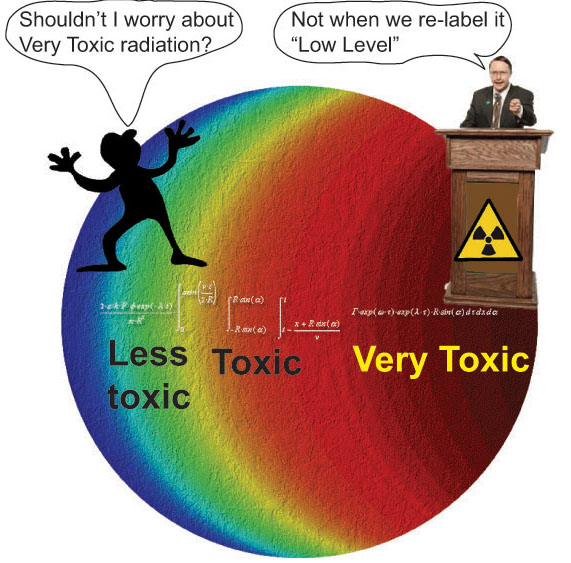
From the earliest days of Marie and Pierre Curie, the harm from ionising radiation was observed, but not fully acknowledged. And before long, it was enthusiastically used in medicine, as x-rays, and in the general world, in various forms, as an aid to health and beauty. When the “radium girls” who painted watch dials with the glow-in-the-dark, radium-based paint, became ill, they were diagnosed by company doctors as having poor diet, neuroses or even syphilis.
Accidents during the Manhattan Project showed the horror effects of high doses of radiation, – but with some military propaganda sleight-of-hand this seemed to be taken to show that “low level” radiation is fine.
Doctors and scientists of integrity, who researched the harm of nuclear radiation were harassed, ridiculed, and sidelined. Integrity was a career killer for DrJohn Gofman, Arthur Tamblin, Harold Knapp, Linus Pauling, Alice Stewart, Ernest Sternglass and Hermann Muller.
Despite the scientific report in 2007 – Biological Effects of Ionizing Radiation (BEIR) stating the danger, the nuclear lobby has been successful in obscuring the truth, and putting across a general acceptance that low dose radiation is well, OK, really.
Dr. Alice Stewart and , Dr. Rosalie Bertell showed the link between x-rays in the mothers and leukemia in their children – their results were similarly rubbished, (but medical authorities quietly curtailed the widespread use of x-rays)
Epidemiology and Statistics are boring stuff, I know. But population statistics of infant deaths and child cancers have shown the increased danger to embryos, infants and children living near nuclear facilities.
Sadly, health authorities have colluded in this cover-up. Public anxiety about ionising radiation is a threat to the thriving nuclear medicine industry. How much of nuclear medicine is absolutely necessary? How many CT scans and other radiological examinations are not really called for? It’s easier for medical professionals to just go along with the view that low level radiation is OK.
After all, amongst many thousands, if only a few thousand children die as a result of exposure to low level radiation – from nuclear reactors and other nuclear facilities, that’s OK isn’t it?
As world leaders enthuse over more nuclear power, and more nuclear “deterrents” , Dr. Gordon Edwards asks the question “Who is speaking for our grandchildren?”
(My inspiration for this short article came from Dr Dale Dewar’s Ionizing Radiation and Human Health .)
Nuclear industry workers face significant, inevitable and unavoidable radiation health risks
By Tony Webb, 24 June 24, https://johnmenadue.com/nuclear-industry-workers-face-significant-inevitable-and-unavoidable-radiation-health-risks/
Nuclear industry workers face significant, inevitable and largely unavoidable radiation health risks which have so far not been addressed in the debate about Australia possibly buying into this industry.
In addition to the important arguments against the coalition policy that currently proposes building seven nuclear power plants to replace closing coal fired generators, notably that such:
will be likely cost about twice that of firmed renewable generation and take at least 15 years to build – and this in the context where most nuclear plant construction worldwide appears to routinely involve a doubling of both cost and time to build
– and so are dangerously irrelevant to meeting the existential challenge to reduce carbon and methane emissions that are driving climate change;
will require legislative changes at state and federal levels that are to say the least unlikely to be achieved;ignores the challenge of developing workforce skills to manage this technology;
ignores the as yet intractable if not insoluble problem of managing long lived nuclear wastes;
and poses significant risks to the public in the event of nuclear accidents as witnessed in the USA, Ukraine/former USSR, and Japan;
There is also an inevitable and unavoidable risk to workers in the industry and public ‘downwind’ from such reactors from routine exposure to ionising radiation.
This last has to date received little attention and whenever raised results in dismissive but misleading arguments from the nuclear industry advocates, notably that any such exposures to individuals are small and pose little, indeed ‘acceptable’ health risks compared to other risks faced in day to day living and working. Tackling this misinformation as part of the campaign has much to offer in convincing the nuclear target communities and the workers in these that might be seduced by prospects of employment in these facilities that the risks they face are far from insignificant – that, as a community they will face an increase in the incidence of fatal and ‘treatable / curable’ cancers, an increase in other, notably cardio vascular diseases and increased risk of genetic damage affecting children and future generations.
Allow me to introduce myself. I have been an active campaigner on the health effects of ionising radiation since the late 1970s. With two colleagues in 1978 I founded the UK based Radiation and Health Information Service that highlighted the evidence showing the risk estimates from radiation exposure, on which the national and international occupational and public exposure limits were based, grossly under-represented the actual risk.
This radiation-health argument was developed as part of a national campaign that resulted in a significant change of the, until then, pro-nuclear policies of UK unions with members in the industry and a review of Trade Union Congress policy in 1979. It was also an integral part of the union-led national Anti-Nuclear Campaign opposing the Thatcher government’s nuclear expansion – revealed in leaked cabinet minutes as part of the government strategy for undermining the power of the unions, particularly the National Union of Mineworkers (NUM), the Transport and General Workers Union, (T&GWU) and the General and Municipal, Boilermakers’ and Allied Trades union (GMBATU). In late 1980 I took this work on Occupational Radiation risks to the USA establishing the US Radiation and Health Labor Project, auspiced by the Foundation for National Progress / Mother Jones Magazine, that built union support across the country for AFL-CIO policy calling for a reduction in the occupational exposure limit.
Subsequently I worked as a consultant to the Canadian union (CPSU – local 2000) representing workers in the nuclear power industry and built a Canadian coalition of five Unions representing workers exposed to radiation on the job. Linking these North American union demands with those of UK and European unions (also similar concerns from unions in Australia following a 1988 organising tour) reinforced pressures from within the scientific community – notably the US Biological Effects of Ionising Radiation (BEIR) committee.
These sustained pressures led eventually to the International Commission on Radiological Protection (ICRP) reducing the recommended limits for permissible occupational (and public) exposures in 1991. Despite evidence that would have justified a ten-fold reduction (from the 50 mSv annual occupational limit to a limit of 5 mSv) the ICRP limit was only reduced by 40% (to 20 mSv a year but with individual exposures still permitted to 50 mSv in any year so long as the average over 5 years was no higher than 20 mSv).
Since then, a large-scale study of UK, EU, and US nuclear industry workers has shown radiation-induced cancer risks to be on average 2.6 times higher than the estimates used to set the ICRP limits. To put it in simple if statistical terms, the lifetime cancer risk for a worker exposed to the permissible annual dose of radiation over say a 25-year career would be of the order of 6.5% higher than normal. To this should be added the significant health effects of non-fatal cancers, an approximate doubling of the normal rate of cardio-vascular disease and a not insignificant increase in genetic damage to workers children and future generations. Nuclear industry workers face significant, inevitable and largely unavoidable radiation health risks which have so far not been addressed in the debate about Australia possibly buying into this industry.
What needs to be more clearly understood however is that the concern is not just in relation to risks faced by individuals exposed on the job, or from relatively small amounts of radiation released from routine operations of nuclear plants. What is of far greater public concern is the impact of the collective exposure. What is not fully appreciated is that there is simply no safe level of exposure – any dose however small may be the one that causes damage at cellular level in the human body that may show up years later as cancer, genetic damage or some other health effect. it is the total/collective dose that will determine the number of such health effects. Spreading the dose over a larger population will reduce the risk to any individual but not the total health effects. Indeed, it may increase it. An individual affected by cancer can only die once.
These arguments carry weight. They formed a significant part if the discussions within the 2016 South Australian government’s ‘Citizens Jury’ convened to consider proposals to import and store around a third of the world’s nuclear wastes. The concern about radiation and health received special note in the report of this jury to the SA Premier that a two-thirds majority said ‘no – under any circumstances’ to the radioactive waste proposal. The issues can also form the basis for increased collaboration between the trade union, environment, medical reform and public health movements as was the case in the mid 1990s when UK, Labour MP Frank Cook convened a Radiation Roundtable that brought together representatives of these constituencies.
So, within the current debate about a possible Australian Nuclear Power program – alongside the arguments already made about its excessive cost, extended construction time frame, ill-fit within an essential decentralised renewable energy program, risks of major accidents, and the intractable problems of multi-generation waste management, can we please add this concern over health effects that will inevitably result from occupational and public exposures to radiation. Can we particularly focus the attention of trade unions and their members in the seven former coal-fired generation-dependent communities on the effect of these exposures on health of workers who might seek to be employed in operating these facilities and on the health of their families, neighbours, and future generations.
A key demand from unions should be that the occupational limit for annual radiation exposures cbe reduced from the current ICRP level of 20 mSv to a maximum of 5 mSv a year with a lifetime limit of 50 mSV. This revision of standards would put real pressure on the nuclear industry – the current uranium mining and any future enrichment, fuel fabrication, nuclear generation, fuel reprocessing, and waste management – to keep such exposures as low as possible. In the unlikely event of any of the reactor proposals getting the go-ahead there should be baseline monitoring of the health of the community and any workers employed so that any detrimental increase in health effects can be detected early and possibly remediated in the future.
New Book – The Scientists Who Alerted Us to the Dangers of Radiation.
Jim Green, 2 May 24, A new book on radiation risks recently published by The Ethics Press International “The Scientists Who Alerted us to Radiation’s Dangers”. The book was written by myself and a US campaigner Cindy Folkers.
Recent epidemiology evidence clearly shows that radiation risks have increased and that previous denials on radiation risks by successive governments and their nuclear establishment on both sides of the Atlantic were and are wrong. Radiation is considerably more dangerous than official reports indicate, both in terms of the numerical magnitudes of cancer risks, and also in terms of new diseases, apart from cancer, ow shown to be radiogenic.
This is an up-to-date reference book for academics on the dangers and risks of radiation and radioactivity. The book also serves to help journalists and students counter the misrepresentations, incorrect assertions, wrong assumptions, and untruths about radiation risks often disseminated by the nuclear (power and weapons) establishments on both sides of the Atlantic. All scientific statements are backed by evidence via hundreds of references, 14 Appendices, 6 Annexes, a glossary and an extensive bibliography.
At present the book is only available in hardback from the Ethics Press. This is expensive but a 33% discount is available at
In addition, a paperback (~£30) version will be available in November 2024.https://www.amazon.co.uk/Scientists-Who-Alerted-Dangers-Radiation/dp/1804414468
In the meantime, the book’s first three chapters may be sampled at
1 This month

of the week – Australians for War Powers Reform (AWPR)
To see nuclear-related stories in greater depth and intensity
 Antinuclear