Lockheed Martin, Australian Government: joined at the hip
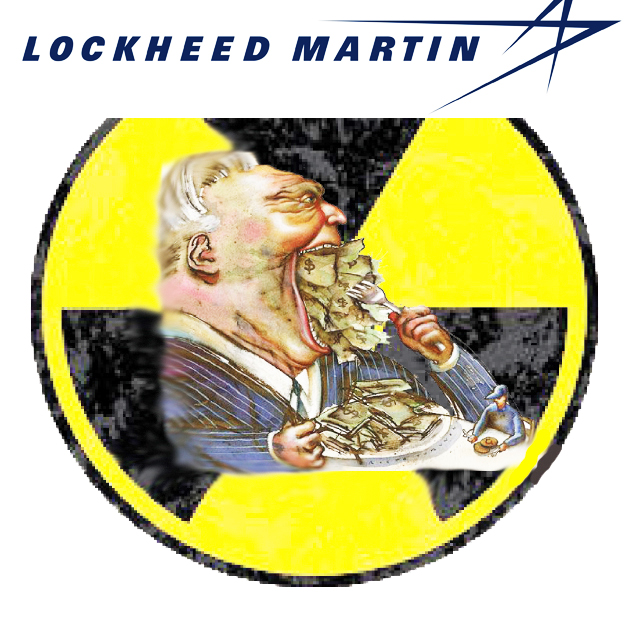
There is a remarkable “revolving door” of top people between Australian government and Defence Department roles and the world’s no 1 weapons-maker
MICHELLE FAHY, JUN 19, 2024
Global weapons giant Lockheed Martin – which has deleted from its website details about Australia’s key role in building F-35 fighter jets – has long had deep ties to the Australian government, investigations show.
Analysis shows a remarkable “revolving door” of people between top government and Defence Department roles and the world’s largest weapons-maker, whose F-35 fighter jets Israel is using to bomb Gaza.
The revolving door between government and corporations is well documented as a factor helping to undermine democracy.
In 2022, Lockheed Martin’s total global revenue was US$66 billion, with 90 per cent of it (US$59.4 billion) from the sale of arms.
Some of Australia’s most senior government officials, military officers, and Defence Department staff have been appointed to Lockheed Martin Australia’s board or have served as its chief executive or in other positions in recent years.
Constantly revolving door
Lockheed’s current CEO for Australia and New Zealand, retired Air Marshal Warren McDonald, officially joined the weapons maker’s ANZ leadership team as chief executive elect on July 1, 2021 having exited his 41-year career in the Royal Australian Air Force (RAAF) just seven months earlier. McDonald formally commenced as Lockheed’s local CEO in November 2021.
McDonald was deputy chief of the RAAF until mid-2017 when he was promoted into a new role as the Defence Force’s inaugural Chief of Joint Capabilities, a group comprising space, cyber and the defence networks tasked with preparing space and cyber power, and logistics capabilities, to serve the modern integrated defence force.
When later asked what had interested him about joining Lockheed Martin, McDonald said: “From all domains – space to the sea floor – Lockheed Martin has in its hands the combat capability of the Defence Force”…………………………………………………………………………more https://undueinfluence.substack.com/p/lockheed-martin-australian-government?utm_source=post-email-title&publication_id=297295&post_id=145632377&utm_campaign=email-post-title&isFreemail=true&r=ln98x&triedRedirect=true&utm_medium=email
Lockheed Martin deletes Australian F-35 ties
The world’s biggest weapons manufacturer, Lockheed Martin, has deleted from its website details about Australia’s key role in building F-35 fighter jets, which Israel is using to bomb Gaza.
MICHELLE FAHY, JUN 05, 2024 https://theklaxon.com.au/lockheed-martin-australian-government-joined-at-the-hip/
Among the details quietly scrubbed from Lockheed Martin’s website are that Australian businesses are supplying components ‘for the entire F-35 fleet’ and that, ‘Every F-35 built contains some Australian parts and components’.
The material was included in the section ‘Industrial Partnerships’, which was deleted entirely between March 15 and April 7 this year.
Around that time, Lockheed Martin and the Albanese Government were under heavy scrutiny following a February Senate hearing in which the supply of ‘weapons’ to Israel was hotly contested, specifically F-35 parts and components.
The deleted ‘Industrial Partnerships’ section of the Lockheed Martin site states: ‘As a programme partner, Australian businesses are supplying components for the entire F-35 fleet, not just Australian aircraft.’
It continues: ‘In total, more than 70 Australian companies have been awarded export contracts valued at AU$4.13 billion.’
Web archive Wayback Machine, which sporadically screenshots webpages, shows the ‘Industrial Partnerships’ section was on Lockheed Martin’s site until March 15, but had been deleted by April 7, the next time it screenshot the page.
Also deleted from the site is a profile of Melbourne F-35 parts manufacturer Marand Precision Engineering, which supplies the F-35 ‘global fleet’ with an ‘engine removal and installation mobility trailer’ comprised of ‘around 12,000 individual parts’.
The Marand article was on the Lockheed site when the Wayback Machine took a screenshot of the page on March 28, but it had been deleted by the time of the next screenshot taken on May 9.
Lockheed Martin’s Australian F-35 page now contains only information relating to the Australian Defence Force’s F-35 program.
On March 25, Greens Senator David Shoebridge tried (and failed) to move a motion in the Senate that accused the Federal Government of being ‘content to send weapons and weapons parts to Israel to literally fuel the genocide’.
On February 14, participating in a Senate committee, Shoebridge asked Hugh Jeffrey, a Department of Defence deputy secretary: ‘Do you consider parts of an F-35 fighter jet, such as the parts manufactured in Australia and used on Israeli Defence Force fighter jets to open the bomb bay doors, to be weapons?’
Jeffrey responded: ‘A pencil is used for writing. It’s not designed in and of itself to be a weapon, but it can be, if you want to use it as a weapon.’
Shoebridge said: ‘Bomb bay doors are generally used to release bombs.’
Jeffrey said that under the UN definition, ‘weapons are defined as whole systems’, such as ‘armoured vehicles’, ‘tanks’ and ‘combat helicopters’.
The Albanese government has repeatedly said that no ‘weapons’ have been sent to Israel for at least the past five years.
Focusing on the word ‘weapons’ enables the government to ignore exports of ‘ammunition/munitions’ and ‘parts and components’, all of which are covered by the 2014 Arms Trade Treaty, which Australia championed at the United Nations and ratified in 2014.
The Albanese government is coming under increasing pressure, with concerns mounting that Australia will be found to be complicit in genocide because it has not ceased military exports to Israel.
More than 800 public servants last week released a signed open letter calling on the government to immediately stop all military exports to Israel.
The Department of Defence has admitted it approved two new export permits to Israel after the October 7 attack.
In a Senate estimates hearing on February 14, the Defence Department‘s Hugh Jeffrey said: ‘Two export permits have been granted since the time of the last estimates’, the date of which was 25 October 2023. The permits were approved between October 25 and October 31. Mr Jeffrey refused to say what items the new permits covered.
The Defence Department and DFAT have also refused to answer questions about whether approved military export permits that were in place before the Hamas attacks have been suspended.
Australia’s key role in the F-35 fighter jet program
More than 70 Australian companies supply parts and components into the global supply chain of the F-35.
Several of the companies are the sole source of the parts they produce. Without them, new F-35 jets cannot be built, nor can parts be replaced.
In December last year a US Congressional hearing revealed that the F-35 joint program office had been moving ‘at a breakneck speed to support … Israel … by increasing spare part supply rates’. (Emphasis added.)
On October 30, the Defence Department issued a media release trumpeting the important role played by Australian industry in the production and maintenance of the global F-35 fleet. The release announced that Melbourne company Rosebank Engineering had established an important repair depot under the F-35 global support solution for aircraft operating in or deployed to the Indo-Pacific region. Rosebank Engineering and the Defence Department had partnered with the US F-35 joint program office and Lockheed Martin to establish the new facility.
Rosebank has been part of the F-35 supply chain since 2004 and now manufactures more than 150 components for the landing gear and weapons bay systems on the F-35, including the components that enable the bombs to be dropped on Gaza. Rosebank (formerly RUAG Australia) is the sole source global supplier of the F-35’s ‘uplock actuators’ that open and close the F-35’s weapons bay doors.
Sydney-based Quickstep Holdings is another long-term supplier to the F-35 program. In December 2020, it announced it had produced its 10,000th component – just 20% of its commitment to the program. Quickstep manufactures more than 50 components and assemblies, worth about $440,000 in each F-35, it says.
Lockheed Martin also acknowledged Queensland’s Ferra Engineering in providing products for the F-35 since 2004 and said it remained a vital partner.
Rosebank Engineering, Quickstep Holdings and Ferra Engineering have all supplied parts and components into the F-35’s supply chain during the past five years.
Bankers upgrade Lockheed stock after Iran strikes at Israel

defense contractors are actively shaping U.S. foreign policy through lobbying and campaign contributions, among other tactics.
The American company has played an outsized role in Tel Aviv’s bombing and invasion of Gaza since Oct. 7
NICK CLEVELAND-STOUT, APR 17, 2024 https://responsiblestatecraft.org/lockheed-martin-israel-war/
Over the weekend, Iran launched over 300 missiles at Nevatim Air Base, a base in southern Israel that houses U.S.-made F-35 fighter jets. Israeli Prime Minister Benjamin Netanyahu, who oversaw a strike on an Iranian consulate in Syria just a few weeks ago, has already promised to retaliate. Observers viewed these brewing tensions with concern, ringing the alarm bells of the breakout of a wider war.
Not JP Morgan analyst Seth Seifman. On Monday morning, Seifman upgraded JPMorgan’s outlook from “hold” to “buy” for Lockheed Martin, the manufacturer of Israel’s F-35s, and set a higher price target for the stock.
Seifman says the change was pre-planned, but noted that these developments could be good for business. “What we can say is that it’s a dangerous world and while that is not a sufficient condition for defense stocks to outperform,” he said, “it is a potential source of support, especially when they are under-owned.” JP Morgan owns $355 million worth of Lockheed Martin stock, about a third of which was bought in the last quarter of 2023.
UK investment bank Liberum Capital was similarly bullish on defense stocks, so long as a wider war does not break out. “In our base case scenario of Israel retaliating but in a limited way that keeps the conflict from escalating further, this could lead to a 5-10% correction in the stock market together with further strength in the U.S. dollar,” Liberium told investors. “The obvious short-term winners will be oil & gas stocks as well as defense contractors.”
As finance journalist Jacob Wolisnky put it in a recent preview of defense stock picks, “Where there’s war, there’s money to be made.” At least one member of Congress agrees. Yesterday, Rep. Kevin Hern (R-Okla.) disclosed that he bought Lockheed Martin stock on March 29.
Lockheed Martin has played a large role in Israel’s bombing and invasion of Gaza, manufacturing Hellfire missiles, providing transport planes, and supplying F-16 and F-35 fighter jets. A missile that hit journalists on November 9 of last year in Gaza City was reportedly manufactured by Lockheed Martin. “Their core business model has no respect for human rights,” said Jilianne Lyon, who leads shareholder advocacy campaigns at Investor Advocates for Social Justice.
While privately acknowledging conflict is good for business, the defense industry and its financiers publicly claim they are simply doing America’s bidding. As Lockheed Martin CEO James Taiclet once said, “It’s only up to us to step to what we’ve been asked to do and we’re just trying to do that in a more effective way, and that’s our role.” After all, it was the U.S. government — not Lockheed Martin — that came to Israel’s defense and intercepted the majority of Iran’s missiles.
But this “we just do what we’re told” defense doesn’t quite work given that defense contractors are actively shaping U.S. foreign policy through lobbying and campaign contributions, among other tactics. Aaron Acosta, program director at Investor Advocates for Social Justice, told Responsible Statecraft that defense contractors “are often the ones creating demand by lobbying the U.S. government and pushing for sales of these weapons.”
In 2023, Lockheed Martin spent over $14 million lobbying Congress. The three companies that lobbied the House’s version of the annual defense policy bill the most were RTX (formerly known as Raytheon), Lockheed Martin, and General Dynamics. During the 2022 election cycle, Lockheed Martin contributed nearly $4 million to political candidates. So far, 2024 promises similar results. In its 2023 annual report, Lockheed Martin wrote that, “Changes in the U.S. Government’s priorities, or delays or reductions in spending could have a material adverse effect on our business.”
Sure, 84% of voters might be concerned about the U.S. being drawn into conflict in the Middle East. But as far as defense companies and their shareholders are concerned, business is booming.
1 This month

of the week – Australians for War Powers Reform (AWPR)
To see nuclear-related stories in greater depth and intensity
 Antinuclear