As a secular Jew raised in a fiercely anti-Zionist family, I grew up viewing the State of Israel as an unfortunate fait accompli and accepting that the two-state solution was probably the best that could be hoped for.
Since then, I have come to the conclusion that the creation of a Jewish state was a catastrophic mistake and that Zionist Israel has relinquished its right to exist.
What good could possibly have come from a project that handed a group of Jewish Europeans a land that for countless centuries was inhabited by Arab Palestinians?
Not only did Palestinians have no say in the creation of a Jewish state on their homeland, but just at the time when other developing countries around the world were finally breaking free from the yoke of colonial rule Palestinians, like Native Americans and Australia’s First Nations people before them, became the victims of European settler colonialism — this time endorsed by a U.N. resolution that neither the Palestinians nor any of the Arab states agreed to or voted for.
The driving force behind both the 1917 Balfour Declaration that called for a Jewish homeland in the British Mandate of Palestine and the 1948 U.N. Partition Plan that established a Jewish State, was Zionism, a religious, political and cultural movement that began in the late 19th century to claim Palestine as the God-given homeland of the Jewish people.
Contrary to official mythology, however, the Zionist fervour was not shared by the majority of Jews.
The socialist Jewish Labour Bund in Eastern Europe, for instance, believed that Jewish culture should be preserved right at home in the shtetls (villages) as opposed to running off to Palestine and thought that the notion of Jews colonising Palestine was farcical. They even wrote a mocking Yiddish song for the Zionists – “Oy, Ir Narishe Tsionistn” (“You Foolish Little Zionist”).
Meanwhile Jews, Christians and Muslims had been living aside each other in historic Palestine in relative peace for centuries. It was only after the rapid influx of European Jewish refugees fleeing the pogroms in Eastern Europe following World War I, and in the wake of the Holocaust, that the conflicts in Palestine escalated and the bloodshed on both sides began.
By the time of the U.N. partition plan, Israeli Defence Force brigades had already launched a bloody campaign of burning villages and killing men, women and children to drive Palestinians off their land. In all, 750,000 Palestinians were expelled into refugee camps in neighbouring Arab countries.
This was the beginning of the Nakba (the catastrophe) that continues today – most strikingly in Gaza — as Zionist zealots insist Israel has a rightful claim to all the land between the Jordan River and the Mediterranean Sea.
In their view, all of Palestine belongs to Jews because in the words of Likud Party Knesset Member Danny Danon, the Bible is “our deed to the land.”
For Zionists like Danon, expelling Palestinians is an existential necessity, a view that echoed in 1956 by Moshe Dayan, military commander of the Jerusalem Front in 1948, who proclaimed:
“We are a generation of settlers, and without the steel helmet and the cannon we cannot plant a tree and build a home… This is the fate of our generation, and the choice of our life – to be prepared and armed, strong and tough – or otherwise, the sword will slip from our fist, and our life will be snuffed out.
What cause have we to complain about their fierce hatred to us? For eight years now, they sit in their refugee camps in Gaza, and before their eyes we turn into our homestead the land and villages in which they and their forefathers have lived.
Let us not be afraid to see the hatred that accompanies and consumes the lives of hundreds of thousands of Arabs who sit all around us and wait for the moment when their hands will be able to reach our blood.”
Next Uprising Would Dwarf Oct.7
As Dayan knew then, Israel would never be safe. In Gaza now, Israel is creating the next generation of Palestinian resistance fighters who have witnessed their families slaughtered, guaranteeing that the next uprising will dwarf the Hamas invasion of Oct. 7.
Whatever legitimacy Israel might have claimed as a haven for Jewish refugees who were abandoned in the West after the Holocaust, their right to a state of their own has long since been forfeited.
Both the 1917 Balfour Declaration that promised Jews a homeland in the British Mandate of Palestine and the 1948 U.N. partition plan creating the State of Israel stipulated that the rights of Palestinians had to be safeguarded and, following the expulsion of hundreds of thousands of Palestinians in 1948, U.N. General Assembly Resolution 194 of that year specifically said the refugees’ had the right to return “at the earliest practicable date.”
On all counts, Israel has completely failed to live up to its obligations to protect the most basic rights of the Palestinian people.
Today, Palestinians living inside Israel remain second-class citizens without equal rights to own property or even use their own language. On the West Bank, Palestinians are dispossessed and murdered daily by Jewish settlers with the backing of the IDF.
In Gaza, even before Israel’s invasion following Oct. 7, Palestinians have lived under a brutal state of siege in an open air prison. The millions of Palestinians who were exiled into refugee camps in neighbouring Arab states are still denied the right to return.
Indeed, the Zionists have brought to Palestine the very scourge they fled in Europe — murdering, expelling and ethnically cleansing an entire population, mirroring the behaviour of their Nazi oppressors.
In the documentary film Tantura about the 1948 massacre of almost 300 Palestinians in the Palestinian village of Tantura, former Israeli soldiers, now in their 90s, retell the story of the slaughter unashamedly.
One brigade member laughs as he recalls, “Of course we killed them, without remorse… If you killed, you did a good thing.” An old woman says matter-of-factly, “Let them remember (what we did to them) like we remember what happened in Europe (the Holocaust). If they did it, we can also.”
Yet, despite the evidence of Israeli war crimes, Zionists have continued to deny Israel’s atrocities while claiming their own superiority. Professor emeritus at Haifa University, Ilan Pappe, says of the mindset:
“I think the self-image of Israel as a moral society is something I haven’t seen anywhere else in the world. We are the ‘Chosen People’ (in the Old Testament Jews were chosen by God as his special people). This is part of the Israeli self-identification…(But) basically, the project of Zionism has a problem… You cannot create a safe haven by creating a catastrophe for other people.”
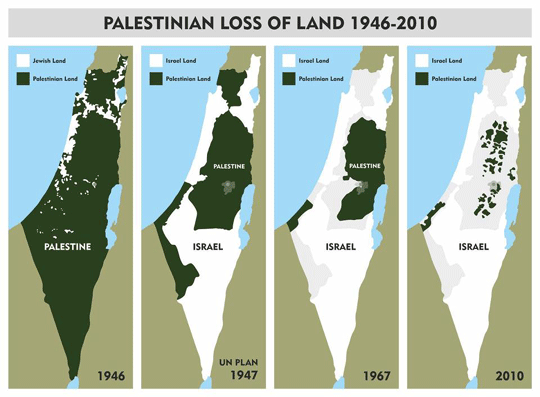
Today, complicit Western leaders and their media proxies wring their hands about the regrettable loss of civilian lives in Gaza while hypocritically calling for a two-state solution they know is virtually impossible since Israel has reduced the amount of Palestinian land from 45 percent at the time of partition to 15 percent today.
Craig Mokhiber, who recently resigned as New York director for the U.N. High Commissioner for Human Rights over the U.N.’s failure to act on war crimes in Gaza, said in his resignation letter:
“The mantra of the ‘two-state solution’ has become an open joke in the corridors of the U.N., both for its utter impossibility in fact, and for its total failure to account for the inalienable human rights of the Palestinian people.”
Writing On Wall For Two-State Solution
After 75 years of Israel’s colonial oppression of the Palestinian people, it has become glaringly obvious that any notion of a two-state solution has become little more than a fig leaf for Israel’s apartheid regime and the only way forward is one secular democratic state that safeguards the fundamental rights and equality for all of its citizens.
Obviously, it won’t happen overnight or without conflict – Israel will aggressively defend its perceived right to exist as a Jewish state with the massive backing of the Western powers. Palestinians will never abandon their yearning for a homeland as it was before the arrival of European Jewish settlers — but the writing is on the wall.
Almost two decades ago the late Palestinian-American academic Edward Said wrote that:
“The beginning (of one democratic state) is to develop something entirely missing from both Israeli and Palestinian realities today: the idea and practice of citizenship, not of ethnic or racial community, as the main vehicle of coexistence.”
More recently, Palestinian academic and physician Ghada Karmi has cautioned:
“The U.N. that made Israel and must now unmake it, not by expulsion and displacement as in 1948, but by converting its bleak legacy into a future of hope for both peoples in one state.”
But if the U.N. fails to act, Karmi sees a more apocalyptic path to the end of the Zionist state. In her recent book One State: The Only Democratic Future for Palestine, she writes:
“Israel will fiercely reject the shared state, but will be powerless to prevent it from happening. … It will not happen solely as a result of a one-state campaign and solidarity movements. … but rather through people’s natural resistance to relentless oppression leading to the ultimate overthrow of the oppressors.”
If that can happen without cataclysmic global repercussions, possibly bringing the U.S. and Europe to the brink of the next world war, perhaps a new secular democratic state for both Jews and Palestinians will evolve from the struggle.
In any event, it is time to acknowledge that the Zionist project has been a spectacular failure and the status quo can no longer be maintained. Israel has become a pariah state in the eyes of most of the world and the winds of change are now howling across the region.
Stefan Moore is an American-Australian documentary filmmaker. His documentaries have received four Emmys and other awards. In the U.S., he was co-director of TVG Productions in New York, a series producer at WNET and a producer for the prime time CBS News magazine program 48 HOURS. In the U.K. he worked as a series producer at the BBC, and in Australia he was an executive producer for Film Australia and the ABC.
Ethnic cleansing or “transfer” is an intrinsic part of Zionism’s early history, and has remained an essential feature of Israeli political life. More recently, “transfer” has been mainstreamed by billing it as encouraging “voluntary emigration.”
SCHEERPOST, By Mouin Rabbani / Mondoweiss, December 29, 2023
Senior Israeli leaders, including Prime Minister Binyamin Netanyahu, are again publicly advocating the ethnic cleansing of the Gaza Strip. Their proposals are being presented as voluntary emigration schemes, in which Israel is merely playing the role of Good Samaritan, selflessly mediating with foreign governments to find new homes for destitute and desperate Palestinians. But it is ethnic cleansing all the same.
Alarm bells should have started ringing in early November when U.S. Secretary of State Antony Blinken and other Western politicians began insisting there could be “no forcible displacement of Palestinians from Gaza.” Rather than rejecting any mass removal of Palestinians, Blinken and colleagues objected only to optically challenging expulsions at gunpoint. The option of “voluntary” displacement by leaving residents of the Gaza Strip with no choice but departure was pointedly left open.
Ethnic cleansing, or “transfer” as it is known in Israeli parlance, has a long pedigree that goes back to the late-nineteenth-century beginnings of the Zionist movement. While the early Zionists adopted the slogan, “A Land Without a People for a People Without a Land,” the evidence demonstrates that, from the very outset, their leaders knew better. More to the point, they clearly understood that the Palestinians formed the main obstacle to the establishment of a Jewish state in Palestine. This is for the simple reason that, to them, a “Jewish state” denotes one in which its Jewish population acquires and maintains unchallenged demographic, territorial, and political supremacy.
Enter “transfer.” As early as 1895, Theodor Herzl, the founder of the contemporary Zionist movement, identified the necessity of removing the inhabitants of Palestine in the following terms: “We shall try to spirit the penniless population across the border by procuring employment for it in the transit countries, while denying it any employment in our own country … expropriation and the removal of the poor must be carried out discreetly and circumspectly.” David Ben-Gurion (née Grün), Chairman of the Executive Committee of the Jewish Agency for Palestine, and later Israel’s first prime minister, was more blunt. In a 1937 letter to his son, he wrote: “We must expel the Arabs and take their place.”
Writing in his diary in 1940, Yosef Weitz, a senior Jewish National Fund official who chaired the influential Transfer Committee before and during the Nakba (“Catastrophe”), and became known as the Architect of Transfer, put it thus: “The only solution is a Land of Israel devoid of Arabs. There is no room here for compromise. They must all be moved. Not one village, not one tribe, can remain. Only through this transfer of the Arabs living in the Land of Israel will redemption come.” His diaries are littered with similar sentiments.
The point of the above is not to demonstrate that individual Zionist leaders held such views, but that the senior leadership of the Zionist movement consistently considered the ethnic cleansing of Palestine an objective and priority. Initiatives such as the Transfer Committee, and Plan Dalet, initially formulated in 1944 and described by the pre-eminent Palestinian historian Walid Khalidi as the “Master Plan for the Conquest of Palestine,” additionally demonstrate that the Zionist movement actively planned for it.
The 1948 Nakba, during which more than four-fifths of Palestinians residing in territory that came under Israeli rule were ethnically cleansed, should, therefore, be seen as the fulfillment of a longstanding ambition and implementation of a key policy. A product of design, not of war (historical Christmas footnote: the Palestinian town of Nazareth was spared a similar fate only because the commander of Israeli forces that seized the city, a Canadian Jew named Ben Dunkelman, disobeyed orders to expel the population, and was relieved of his command the following day).
That the Nakba was a product of design is further substantiated by the Transfer Committee’s terms of reference. These comprised not only proposals for the expulsion of the Palestinians but, just as importantly, active measures to prevent their return, destroy their homes and villages, expropriate their property, and resettle those territories with Jewish immigrants. Weitz, together with fellow Committee members Eliahu Sassoon and Ezra Danin, on June 5, 1948, presented a three-page blueprint, entitled “Scheme for the Solution of the Arab Problem in the State of Israel,” to Prime Minister Ben-Gurion to achieve these goals. According to leading Israeli historian Benny Morris, “there is no doubt Ben-Gurion agreed to Weitz’s scheme,” which included “what amounted to an enormous project of destruction” that saw more than 450 Palestinian villages razed to the ground.
The understandable focus on the expulsions of 1948 often overlooks the fact that ethnic cleansing remains incomplete unless its victims are barred from returning to their homes by a combination of armed force and legislation, and thereafter replaced by others. It is Israel’s determination to make Palestinian dispossession permanent that distinguishes Palestinian refugees from many other war refugees.
After 1948, Israel put out a whole series of fabrications to shift responsibility for the transformation of the Palestinians into dispossessed and stateless refugees onto the Arab states and the refugees themselves. These included claims that the refugees voluntarily left (they were either expelled or fled in justified terror); that Arab radio broadcasts ordered the Palestinians to flee (in fact, they were encouraged to stay put); that Israel conducted a population exchange with Arab states (there was nothing of the sort); and the bizarre argument that because they’re Arabs, Palestinians had numerous other states while Jews have only Israel (by the same logic, Sikhs would be entitled to seize British Columbia and deport its population to either the rest of Canada or the United States). More importantly, even if uniformly substantiated, none of these pretexts entitles Israel to prohibit the right of Palestinian refugees to return to their homes at the conclusion of hostilities. It is, furthermore, a right that was consecrated in United Nations General Assembly resolution 194 of December 11, 1948, which has been reaffirmed repeatedly since.
Ethnic cleansing after 1967
In 1967, Israel seized the remaining 22 percent of Mandatory Palestine — the West Bank (including East Jerusalem) and the Gaza Strip. Depopulation in these territories operated differently than in 1948. Most importantly, Israel, in addition to prohibiting the return of Palestinians who fled hostilities during the 1967 June War, and encouraging others to leave (by, for example, providing a daily bus service from Gaza City to the Allenby Bridge connecting the West Bank to Jordan), conducted a census during the summer of 1967 . Any resident who was not present during the census was ineligible for an Israeli identity document and automatically lost their right of residency.
As a result, the population of these territories declined by more than twenty percent overnight. Many of those thus displaced were already refugees from 1948. Aqbat Jabr Refugee Camp near Jericho, for example — until 1967, the West Bank’s largest — became a virtual ghost town after almost all its inhabitants became refugees once again in Jordan. So many Palestinians from the Gaza Strip ended up in Jordan that a new refugee camp, Gaza Camp, was established on the outskirts of Jerash. The occupied Palestinian territories would not recover their 1967 population levels until the early 1980s.
Within the West Bank, there were also cases of mass expulsion………………………………………………….
Depopulation through administrative rule
In subsequent years, Israel employed all kinds of administrative shenanigans to further reduce the Palestinian population of the West Bank and Gaza Strip. Until the 1993 Oslo Accords, for example, an exit permit from Israel’s military government was required to leave the occupied territory. It was valid for only three years and thereafter renewable annually for a maximum of three additional years (for a fee) at an Israeli consulate. If a Palestinian lost an exit permit or failed to renew an exit permit prior to its expiration for any reason (including bureaucratic foot-dragging), or couldn’t pay the renewal fee, or failed to return to Palestine prior to its expiration, that Palestinian automatically lost residency rights………………………………………………..
………………………………………. the mass expulsion was, as always in such matters, approved by Israel’s High Court of Justice after minor modifications. It ruled, among other things, that this was not a collective deportation but rather a collection of individual deportations……………………………………………….
Israel’s strategies to ‘thin’ Gaza’s population
With the focus in recent years on the intensified campaigns of ethnic cleansing in the West Bank, it is often forgotten that, for decades, the primary target for depopulation was the Gaza Strip, particularly its refugee population, which accounts for approximately three-quarters of the territory’s residents. Even before it occupied Gaza in 1967, Israel regularly promoted initiatives to achieve the “thinning” of its refugee population, with destinations as far afield as Libya and Iraq………………………………………………………………………………….
‘Transfer’ and Gaza today
In the decades since, “transfer,” often presented as the encouragement of voluntary emigration either by providing material incentives or making the conditions of life impossible, has become increasingly mainstreamed in Israeli political life. In 2019, for example, a “senior government official,” quoted in the Israeli newspaper Ha’aretz, expressed a willingness to help Palestinians emigrate from the Gaza Strip.
Mass expulsion has been gaining its share of adherents as well, and it is a position that is today represented within Israel’s coalition government. As has the idea that “transfer” should include Palestinian citizens of Israel — Avigdor Lieberman, for example, who was Israel’s Minister of Defense several years ago, is an advocate of not only emptying the West Bank and Gaza Strip of Palestinians but of getting rid of Palestinian citizens of Israel as well. As one might expect from a minister who was in charge of the Israeli military, he is also an advocate of “beheading” disloyal Palestinian citizens of Israel with “an axe.”
Against this background, Israel saw the attacks of October 7 as not only a threat but also as an opportunity. Fortified with unconditional U.S. and European support, Israeli political and military leaders immediately began promoting the transfer of Gaza’s Palestinian population to the Sinai desert.
The proposal was enthusiastically embraced by the United States and by Secretary of State Antony Blinken in particular. As ever hopelessly out of his depth when it comes to the Middle East, he appears to have genuinely believed he could recruit or pressure Washington’s Arab client regimes to make Israel’s wish a reality. Given Egyptian strongman Abdel-Fatah al-Sisi’s economic troubles, the fallout of the Menendez scandal, and the looming Egyptian presidential elections, it was suggested to him by the Washington echo chamber that it would take only an IMF loan, debt relief, and a promise to file away Menendez to bring Cairo on board. As so often when it comes to the Middle East, Blinken, armed only with Israel’s latest wish list, didn’t have a clue his indecent proposal would be categorically rejected, first and foremost by Egypt.
‘Transfer’ as ‘voluntary immigration’
The fallback position is opposition to “forcible displacement” at the point of a gun, while anything else is fair game. This includes reducing the Gaza Strip to rubble in what may well be the most intensive bombing campaign in history; a genocidal assault on an entire society that has killed civilians at an unprecedentedly rapid pace; the deliberate destruction of an entire civilian infrastructure, including the targeted obliteration of its health and education sectors; the highest proportion of households in hunger crisis ever recorded globally and the real prospect of pre-meditated famine; severance of the water and electricity supply leading to acute thirst, widespread consumption of non-potable water, and termination of sewage treatment; and promotion of a sharp rise in infectious disease. …………………………………………………..
In other words, if desperate Palestinians seek to flee this seventh circle of hell to save their skins, that’s considered voluntary emigration — their choice……………………………………………………………….
As an editorial in the Israeli newspaper Ha’aretz put it on December 27: “Israeli lawmakers keep pushing for transfer under the guise of humanitarian aid.”………………………………………………
Not individual Gazans, but “the people of Gaza.” Notably, such proposals consistently take it as a given that those departing will never return. ………………………………………….
While ethnic cleansing has been intrinsic to Zionist/Israeli ideology and practice from the very outset, it also has a flip side: the 1948 expulsion of the Palestinians expanded what had been a conflict between the Zionist movement and the Palestinians into a regional, Arab-Israeli one. The second Nakba Israel is currently inflicting on the Gaza Strip similarly appears well on its way to instigating the renewal of hostilities across the Middle East.



 Antinuclear