Coalition nuclear policy leaves traditional owners of Kakadu uranium mine worried

ABC News, By Jane Bardon, 3 July 24
In short:
Kakadu traditional owners are worried the Coalition’s nuclear policy will drive demand for uranium mining on their land at Jabiluka.
Energy Resources of Australia (ERA) and traditional owners have asked the NT and federal governments to decide whether to extend the Jabiluka uranium mining lease.
What’s next?
ERA’s majority shareholder Rio Tinto is worried the Jabiluka lease stoush could drive up the costs of rehabilitating its closed Ranger Uranium Mine.
Mirarr traditional owner Corben Mudjandi is desperate for his spectacular land at Jabiluka to be incorporated into Kakadu National Park, which surrounds it, rather than mined for its uranium.
“Its sacred to us, and it’s a piece of human history, 65,000 years, we want Jabiluka not mined; we want to show people the beauty of nature, and what we call home,” he said.
Mr Mudjandi is worried the federal Coalition’s plan to open nuclear plants if it wins government could drive demand for Jabiluka’s uranium.
The Mirarr are also concerned that almost a year after Energy Resources of Australia (ERA) applied to extend its uranium mining lease over Jabiluka for another decade, the Northern Territory and federal governments have not yet decided whether to reject or approve it.
ERA’s current lease expires on August 11.
“The government are following process, but of course we hope they don’t support the application extension,” Mr Mudjandi said.
Senior Mirarr traditional owner Yvonne Margarula said she was worried that although ERA’s Jabiluka lease agreement enabled traditional owners to veto mining, they felt under constant pressure to change their minds.
“The mining companies might come back asking again and again, it’s annoying them asking more, enough is enough, so I hope the government is going to help us,” she said………………………………..
……………………….Professor of Archaeology at Griffith University Lynley Wallis said the Mirarr had a strong case for Jabiluka to be incorporated into Kakadu instead of mined, because of its 65,000 year-old-evidence of occupation.
“Archaeologically the escarpment that’s encapsulated within the Jabiluka mineral lease is unparalleled,” she said.
“There are hundreds of rock shelter sites, almost all of which have paintings in them, of which are incredibly well preserved, and then there are amazing objects that have been cached in those rock shelters, ceremonial wooden objects, grinding stones, spear points and scrapers.
………. the lease agreement includes a traditional owner right to veto mining……………
Lynley Wallis said the Jabiluka mining lease did not provide adequate protection.
“While a company holds a mineral lease over Jabiluka it is possible for them to apply to develop the resources in that land, and any development would pose imminent threat to the cultural sites that are within the lease,” she said.
While some of ERA’s minority shareholders want to keep the Jabiluka lease, which they estimate is worth $50 billion, its majority shareholder Rio Tinto does not.
Jabiluka is ERA’s only potentially valuable asset, but Rio Tinto estimates the rehabilitation costs would be much more than potential profits.
The cost of ERA’s rehabilitation of its neighbouring closed Ranger Uranium Mine on the Mirarr’s land has now blown out to more than $2.5 billion.
ERA is expected to run out of funds by September, and Rio Tinto has promised to fund Ranger’s rehabilitation.
But the ABC understands Rio Tinto is concerned ERA’s application to extend the Jabiluka lease is worrying Mirarr traditional owners so much, that they could delay further agreements needed on how the Ranger mine rehabilitation continues, adding to the project’s soaring costs.
Dave Sweeney, the Australian Conversation Foundation’s nuclear policy spokesman, has called on both governments to end the prospect of mining at Jabiluka.
“ERA are not making any money,” he said.
“They should be focused on getting the assured financial capacity on delivering on their legal obligations rather than appeasing minority shareholders in a fanciful push for a project that will never happen, but increases pressure on traditional owners who’ve had too much for too long.”
A spokesman for the federal Resources Minister Madeleine King said it was up to the NT government whether to renew ERA’s lease.
The spokesman said when Ms King provides her advice to NT government, she would “consider information about Jabiluka in good faith and with appropriate consultation”.
The NT Mining Minister Mark Monaghan would not explain why his government had not made a decision on the lease.
“We’re not delaying the decision, the decision is going through what is a process,” he said.
NT Opposition leader Lia Finocchiaro has backed ERA’s argument on why the lease should continue.
“Importantly that maintains the veto rights for the Mirarr people which we believe continues to be a very important right for them to have,” she said. worried
The Release of Julian Assange: Plea Deals and Dark Legacies
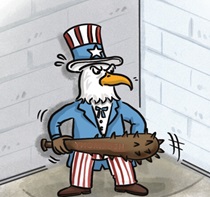
It ultimately goes to the brutal exercise of US extraterritorial power against any publisher, irrespective of outlet and irrespective of nationality…………….. the measure extracts a pound of flesh from the fourth estate. It signals that the United States can and will seek out those who obtain and publish national security information that they would rather keep under wraps under spurious notions of “harm”.
June 27, 2024, by: Dr Binoy Kampmark https://theaimn.com/the-release-of-julian-assange-plea-deals-and-dark-legacies-2/
One of the longest sagas of political persecution is coming to its terminus. That is, if you believe in final chapters. Nothing about the fate of Julian Assange seems determinative. His accusers and inquisitors will draw some delight at the plea deal reached between the WikiLeaks founder’s legal team and the US Department of Justice. Others, such as former US Vice President, Mike Pence, thought it unjustifiably lenient.
Alleged to have committed 18 offences, 17 novelly linked to the odious Espionage Act, the June 2020 superseding indictment against Assange was a frontal assault on the freedoms of publishing and discussing classified government information. At this writing, Assange has arrived in Saipan, located in the US commonwealth territory of Northern Mariana Islands in the Western Pacific, to face a fresh indictment. It was one of Assange’s conditions that he would not present himself in any court in the United States proper, where, with understandable suspicion, he might legally vanish.
As correspondence between the US Department of Justice and US District Court Chief Judge Ramona V. Manglona reveals, the “proximity of this federal US District Court to the defendant’s country of citizenship, Australia, to which we expect he will return at the conclusion of proceedings” was also a factor.
Before the US District Court for the Northern Mariana Islands, he will plead guilty to one count of conspiracy to obtain and disclose national defence information under the Espionage Act of 1917, or section 793(g) (Title 18, USC). The felony carries a fine up to $10,000 and/or up to 10 years in prison, though Assange’s time in Belmarsh Prison, spent on remand for some 62 months, will meet the bar.
The felony charge sheet alleges that Assange knowingly and unlawfully conspired with US Army intelligence analyst Chelsea Manning, then based at Operating Base Hammer in Iraq, to receive and obtain documents, writings and notes, including those of a secret nature, relating to national defence, wilfully communicated those documents from persons with lawful possession of or access to them to those not entitled to receive them, and do the same from persons unauthorised to possess such documents.
Before turning to the grave implications of this single count and the plea deal, supporters of Assange, including his immediate family, associates and those who had worked with him and drunk from the same well of publishing, had every reason to feel a surreal sense of intoxication. WikiLeaks announced Assange’s departure from London’s Belmarsh Prison on the morning of June 24 after a 1,901 day stint, his grant of bail by the High Court in London, and his release at Stansted Airport. Wife Stella regularly updated followers about the course of flight VJ199. In coverage posted of his arrival at the federal court house in Saipan, she pondered “how overloaded his senses must be, walking through the press scrum after years of sensory depravation and the four walls” of his Belmarsh cell.
As for the plea deal itself, it is hard to fault it from the emotional and personal perspective of Assange and his family. He was ailing and being subjected to a slow execution by judicial process. It was also the one hook upon which the DOJ, and the Biden administration, might move on. This being an election year in the US, the last thing President Biden wanted was a haunting reminder of this nasty saga of political persecution hovering over freedom land’s virtues.
There was another, rather more sordid angle, and one that the DOJ had to have kept in mind in thinning the charge sheet: a proper Assange trial would have seen the murderous fantasies of the CIA regarding the publisher subject to scrutiny. These included various possible measures: abduction, rendition, even assassination, points thoroughly explored in a Yahoo News contribution in September 2021.
One of the authors of the piece, Zach Dorfman, posted a salient reminder as news of the plea deal filtered through that many officials during the Trump administration, even harsh critics of Assange, “thought [CIA Director Mike] Pompeo’s extraordinary rendition plots foolhardy in the extreme, and probably illegal. They also – critically – thought it might harm Assange’s prosecution.” Were Pompeo’s stratagems to come to light, “it would make the discovery process nightmarish for the prosecution, should Assange ever see trial.”
From the perspective of publishers, journalists and scribblers keen to keep the powerful accountable, the plea must be seen as enormously troubling. It ultimately goes to the brutal exercise of US extraterritorial power against any publisher, irrespective of outlet and irrespective of nationality. While the legal freight and prosecutorial heaviness of the charges was reduced dramatically (62 months seems sweetly less imposing than 175 years), the measure extracts a pound of flesh from the fourth estate. It signals that the United States can and will seek out those who obtain and publish national security information that they would rather keep under wraps under spurious notions of “harm”.
Assange’s conviction also shores up the crude narrative adopted from the moment WikiLeaks began publishing US national security and diplomatic files: such activities could not be seen as journalistic, despite their role in informing press commentary or exposing the venal side of power through leaks.
From the lead prosecuting attorney Gordon Kromberg to such British judges as Vanessa Baraitser; from the national security commentariat lodged in the media stable to any number of politicians, including the late California Democrat Dianne Feinstein to the current President Joe Biden, Assange was not of the fourth estate and deserved his mobbing. He gave the game away. He pilfered and stole the secrets of empire.
To that end, the plea deal makes a mockery of arguments and effusive declarations that the arrangement is somehow a victory for press freedom. It suggests the opposite: that anyone publishing US national security information by a leaker or whistleblower is imperilled. While the point was never tested in court, non-US publishers may be unable to avail themselves of the free speech protections of the First Amendment. The Espionage Act, for the first time in history, has been given a global, tentacular reach, made a weapon against publishers outside the United States, paving the way for future prosecutions.
Julian Assange is free, but curly legal questions about his case remain

National Tribune, 26 Jun 2024, Holly Cullen, Adjunct Professor in Law, The University of Western Australia
Today Julian Assange walked out of the Federal Court Building in Saipan, North Marianas Islands, a free man. He pleaded guilty to one count of breaching the US Espionage Act.
With the court accepting his 62 months already spent in Belmarsh Prison as a sufficient sentence, he has no more case to answer, and no more sentence to serve.
However, this case leaves behind it a trail of unanswered legal questions and unresolved controversies. In particular, there are questions of fundamental human rights that can only now be addressed in future cases, if ever.
Can freedom of speech concerns stop extradition?
Once Assange had formally pleaded guilty, the US government’s lawyers announced they would immediately withdraw the request to extradite Assange from the UK.
That means the appeal that would have been heard later this year will not go ahead.
To recap, in May the UK High Court gave Assange the right to appeal the UK Home Secretary’s order for his extradition. This was granted on two grounds, both related to free speech.
The first ground of appeal accepted by the court was that extradition would be incompatible with Assange’s right to freedom of expression, as guaranteed in the European Convention on Human Rights.
The second ground, related to the first, is that he would be discriminated against on the basis of his nationality because he could, as a non-citizen of the US, be unable to rely on First Amendment freedom of speech rights.
But as this appeal is no longer proceeding, the issue of whether a threat to the accused’s freedom of expression can stop extradition will therefore not be argued or decided. The European Court of Human Rights and other human rights bodies have never addressed this point. It’s unlikely to arise again soon.
An espionage precedent?
Also on freedom of expression, the relationship between the US Espionage Act and the First Amendment of the US Constitution remains an open question.
In today’s pleadings, Assange and the US government took different views on whether the exercise of freedom of expression should constitute an exception to the offences under the Espionage Act. Nonetheless, Assange accepted that no existing US case law established such an exception.
This leads to the question of whether today’s guilty plea establishes a precedent for prosecuting journalists for espionage.
In the strict legal meaning of precedent in common law, which refers to a binding judicial interpretation, it does not.
The judge made no determination on whether Assange or the US government was legally correct. However, the US government can now point to this case as an example of securing a conviction against a journalist under the Espionage Act.
The question of how much a non-national of the US can rely on the First Amendment likewise continues to be on the table. This issue would also have been addressed in the extradition appeal, as a question of whether Assange would be discriminated against on the basis of his nationality.
Detention or confinement?
Finally, today’s hearing revived the question of whether the time Assange spent in the Ecuadorian embassy between 2012 and 2019 counts as detention.
As the judge moved to determine whether the sentence of “time served” was a sufficient penalty for his offence, the US government insisted the judge could only consider the 62 months in Belmarsh……………………………………………………
Today, the main story is that Assange no longer faces prosecution for espionage and is now free to return to his family. However, some of the legal issues emerging from this case remain tantalisingly unresolved. https://www.nationaltribune.com.au/julian-assange-is-free-but-curly-legal-questions-about-his-case-remain/
Small Modular Nuclear Reactors cost concerns challenge industry optimism
Reuters, Paul Day, Jun 27, 2024
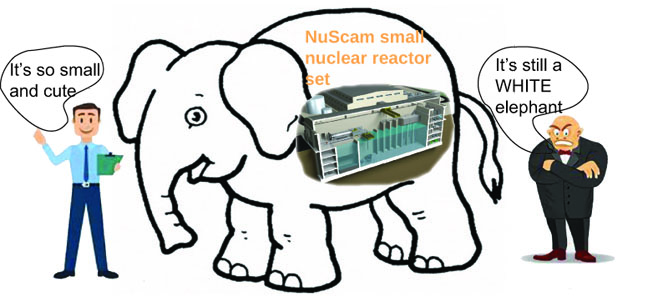
Concerns over the potential cost of small modular reactors (SMRs) and the electricity they produce continue to cast a shadow over growing optimism for new nuclear.
Proponents say that the recent faltering history of large nuclear projects missing schedules and running over budget are just teething problems for a new industry in the midst of a difficult economic climate.
However, critics claim it as proof that nuclear is not economically viable at all, and it will take too long faced with pressing climate issues.
There is little doubt that new nuclear will, at least initially, be more expensive to develop, build, and run than many are hoping.
New Generation IV reactors, such as SMRs, are likely to produce hidden costs inherent in the development of first-of-a-kind technology, while high commodity and building material prices, stubbornly high inflation, and interest rates at levels not seen for decades are adding to mounting expenses for the new developers.
NuScale’s cancelled deal to supply its SMRs to a consortium of electricity cooperatives due to rising power price estimates prompted The Breakthrough Institute’s Director for Nuclear Energy Innovation Adam Stein to write that advanced nuclear energy was in trouble.

Speaking during an event at the American Nuclear Society (ANS) 2024 Annual Conference in June, Stein said nothing had changed to fix the fundamental challenges nuclear faces since he wrote that in November, but there was a greater sense of urgency.
“Commodity prices have come down slightly, though interest rates are largely still the same and those are risks, or uncertainties, that are outside of the developer’s control,” Stein said during an event at the American Nuclear Society (ANS) 2024 Annual Conference.
“Until those can be considered a project risk, instead of unknown uncertainties, they are not going to be controlled at all and can drastically swing the price of any single project.”
Enthusiastic hype
These criticisms clash with growing enthusiasm (critics say ‘hype’) surrounding the new technology.
Twenty two countries and 120 companies at the COP28 conference in November vowed to triple global nuclear capacity by 2050, and developers are making sweeping promises about the capabilities and affordability of their latest creations, many of which will not be commercially available in North America or Europe until the early 2030s.
SMRs, defined as reactors that generate 300 MW or less, cost too much, and deployment is too far out for them to be a useful tool to transition from fossil fuels in the coming 10-15 years, according to a recent study by the Institute for Energy Economics and Financial Analysis (IEEFA).
“SMRs are not going to be helpful in the transition. They’re not going to be here quick enough. They’re not going to be economic enough. And we really don’t have time to wait,” says co-author of the study Dennis Wamsted.
Existing SMRs in China (Shidao Bay), Russia (floating SMR such as the Akademik Lomonosov), and in Argentina (the still under-construction CAREM) have all cost significantly more than originally planned, the IEEFA says in the study ‘Small Modular Reactors: Still too expensive, too slow, and too risky.’
Construction work on the cutting-edge CAREM project has been stalled since May due to cost-cutting measures by Argentina’s President Javier Milei, the head of National Atomic Energy Commission (CNEA) told Reuters.
The billions of dollars the U.S. and Canadian governments are pouring into nuclear power through subsidies, tax credits, and federally funded research, would be better spent on extra renewables, Wamsted says.
Some 260,000 MW of renewable energy generation, mostly solar, is expected to be added to the U.S. grid just through to 2028, the study says citing the American Clean Power Association, way before any new nuclear is expected to be plugged in.
“Federal funds to nuclear is, in our opinion, a waste of time and money,” says Wamsted.
High uncertainty…………………………………………….
https://www.reutersevents.com/nuclear/smr-cost-concerns-challenge-industry-optimism
Scary truths on civilian nuclear power are coming to the fore
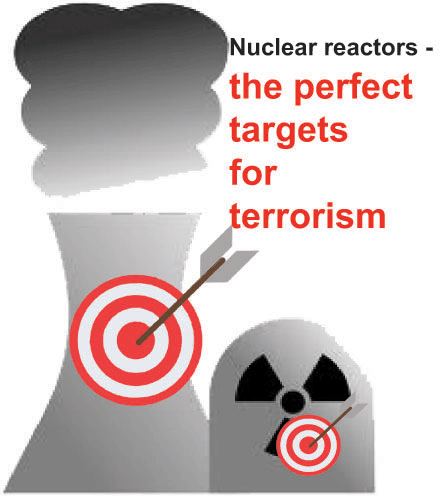
Firstly, everyone agrees that climate breakdown will flip heretofore stable regions into unstable. Adding the reasons mentioned above, a proliferation of civilian nuclear power stations will give potential non-nuclear conflicts a new nuclear dimension. Add to that the cheaper, supposedly even sometimes mobile, small nuclear reactors that are seen as “dirtier” than existing NPPs.
It’s no surprise therefore that the civil nuclear lobby would rather not talk about it.
Bill Ramsay, The National 24 June 24
IT’S entirely natural that the UK civilian nuclear power lobby pitch is behind Labour.
Probably some who support Scottish independence think that the stance of the SNP on nuclear power is a marginal vote-loser. However, if looked at properly through a national security lens, it’s actually a vote-winner.
Occasionally, the threat of some limited non-state terrorist attack on a civilian nuclear facility gets an airing. The more important issue of the implication of the presence of civilian nuclear power stations in a war zone rarely does.
………………………………. the lack of discussion – in the public domain at least – of the implications of the presence of a civilian nuclear power station in a so-called non-nuclear conventional battlefield.
I did nothing more on the issue until my sort-of retirement from education as a senior official of the EIS aligned with the Russian invasion of Ukraine. Ukraine hosts Europe’s largest nuclear power station and some others. More than half of Ukraine’s electricity is generated by its nuclear power stations.
My first attempt at a paper was rather “undercooked” – as the rejection from the Royal United Services Institute (RUSI) rightly pointed out – but the final effort – after helpful further consultation with Paul Rodgers, emeritus professor of peace studies at Bradford University – is now available on the Scottish CND website.
In Castle Zaporizhzhia: War Fighting Implications Linked To The Proliferation Of Nuclear Power As Part Solution To Climate Chaos, I unpack the dangers that the nuclear lobby would rather not discuss.
I argue that from a purely military perspective, the occupying Russian forces – whose current, if not future, capabilities are far from overwhelming – will militarily milk the Zaporizhzhia NPP for all its worth and more.
Militarily, the intimidatory potential of the Zaporizhzhia NPP of today and future Zaporizhzhias are huge. Zaporizhzhia NPP performs a similar role for the Russian invaders of Ukraine that the motte-and-bailey castle did for the Norman invaders of England after 1066. These castles of wood then stone were designed to intimidate the Saxon natives.
Zaporizhzhia NPP does the same. Russia can use it as a base of operations from which it can project its power in the full knowledge that the Ukrainians cannot attack it without the risk of another Chornobyl nuclear disaster.
If they wished, the Russians could fire long-range ordnance from it, in the full knowledge the Ukrainians dare not fire back. Indeed, although Zaporizhzhia NPP was discussed at the Ukrainian summit held in Switzerland a few days ago, the bigger global security risks associated with civilian nuclear power production was not. Why? Because the civil nuclear lobby sees nuclear power as a clean alternative to fossil fuels.
In my view, civil nuclear power as a climate chaos mitigator is triply flawed.
Firstly, everyone agrees that climate breakdown will flip heretofore stable regions into unstable. Adding the reasons mentioned above, a proliferation of civilian nuclear power stations will give potential non-nuclear conflicts a new nuclear dimension. Add to that the cheaper, supposedly even sometimes mobile, small nuclear reactors that are seen as “dirtier” than existing NPPs.
It’s no surprise therefore that the civil nuclear lobby would rather not talk about it. Though, to be fair to RUSI, soon after the publication of my report by Scottish CND, RUSI published another which was followed up by a seminar and more recently it has established an ongoing project on strategic and security aspects of civil nuclear power.
Despite all this, the security aspects of civil nuclear power remain very much an elite issue with very little reportage in the mainstream media.
It’s a similar strategy to that employed by John Cleese’s hotelier character Basil Fawlty when faced by an influx of a coach-load of elderly German tourists to his establishment. Paranoid that his staff would make reference to the Second World War, he threatened them with dismissal if they did.
We would all like the war in Ukraine to end, not least because of the death and destruction. The nuclear lobby’s motives are rather less altruistic as the longer the war goes on, the more likely their so-called solution to climate chaos will be exposed to a more searching critique. https://www.thenational.scot/politics/24405095.scary-truths-civilian-nuclear-power-coming-fore/
‘Julian Assange Is Free’: WikiLeaks Founder Strikes Plea Deal With US
“We thank all who stood by us, fought for us, and remained utterly committed in the fight for his freedom,” said WikiLeaks. “Julian’s freedom is our freedom.”
COMMON DREAMS STAFF, Jun 24, 2024, https://www.commondreams.org/news/julian-assange-plea-deal
WikiLeaks founder Julian Assange on Monday reached a deal with the U.S. government, agreeing to plead guilty to one felony related to the disclosure of national security information in exchange for his release from Belmarsh Prison in the United Kingdom.
A related document was filed in federal court in the Northern Mariana Islands, a U.S. commonwealth. Under the plea agreement, which must still be approved by a judge, the Department of Justice will seek a 62-month sentence, equal to the time that the 52-year-old Australian has served in the U.K. prison while battling his extradition to the United States.
Assange faced the risk of spending the rest of his life in U.S. prison if convicted of Espionage Act and Computer Fraud and Abuse Act charges for publishing classified material including the “Collateral Murder” video and the Afghan and Iraq war logs. Before Belmarsh, he spent seven years in the Ecuadorian Embassy in London with asylum protections.
“Julian Assange is free,” WikiLeaks declared on the social media platform X, confirming that he left Belmarsh Friday “after having spent 1,901 days there,” locked in a small cell for 23 hours a day.
He was granted bail by the High Court in London and was released at Stanstead Airport during the afternoon, where he boarded a plane and departed the U.K.,” WikiLeaks said. “This is the result of a global campaign that spanned grassroots organizers, press freedom campaigners, legislators, and leaders from across the political spectrum, all the way to the United Nations.”
“He will soon reunite with his wife Stella Assange, and their children, who have only known their father from behind bars,” the group continued. “WikiLeaks published groundbreaking stories of government corruption and human rights abuses, holding the powerful accountable for their actions. As editor-in-chief, Julian paid severely for these principles, and for the people’s right to know. As he returns to Australia.”
The news of Assange’s release was celebrated by people around the world, who also blasted the U.S. for continuing to pursue charges against him and the U.K. for going along with it.
“Takeaway from the 12 years of Assange persecution: We need a world where independent journalists work in freedom and top war criminals go to prison—not the other way around,” the progressive advocacy group and longtime Assange supporter RootsAction said on social media.
Leftist Colombian President Gustavo Petro said in a statement: “I congratulate Julian Assange on his freedom. Assange’s eternal imprisonment and torture was an attack on press freedom on a global scale. Denouncing the massacre of civilians in Iraq by the U.S. war machine was his “crime”; now the massacre is repeated in Gaza I invite Julian and his wife Stella to visit Colombia and let’s take action for true freedom.”
Australian Greens leader Adam Bandt, who represents Melbourne in Parliament, said on social media that “Julian Assange will finally be free. While great news, this has been over a decade of his life wasted by U.S. overreach.”
“Journalism is not a crime,” Bandt added. “Pursuing Assange was anti-democratic, anti-press freedom, and the charges should have been dropped.”
The women-led peace group CodePink said in a statement:
Without Julian Assange’s critical journalism, the world would know a lot less about war crimes committed by the United States and its allies. He is the reason so many anti-war organizations like ours have the proof we need to fight the war machine in the belly of the beast. CodePink celebrates Julian’s release and commends his brave journalism.
One of the most horrific videos published by WikiLeaks was called “Collateral Murder,” footage of the U.S. military opening fire on a group of unarmed civilians–including Reuters journalists–in Baghdad. While Julian has been in captivity for the past 14 years, the war criminals that destroyed Iraq walked free. Many are still in government positions today or living off the profits of weapons contracts.
While Julian pleads guilty to espionage—we uphold him as a giant of journalistic integrity.
Vahid Razavi, founder of Ethics in Tech and host of multiple NSA Comedy Nights focusing on government mass surveillance, told Common Dreams that “they took a hero and turned him into a criminal.”
“Meanwhile, all of the war criminals in the files exposed by WikiLeaks via Chelsea Manning are free and never faced any punishment or even their day in court,” he added. “You can kill journalists with impunity, just like Israel is doing right now in Gaza.”
British journalist Afshin Rattansi said, “Let no one think that any of us will ever forget what the British state did to the most famous journalist of his generation.”
“They tortured him—according to the United Nations special rapporteur on torture—at the behest of the United States,” Rattansi noted.
Andrew Kennis, a professor of journalism and social media at Rutgers University, told Common Dreams that “Julian Assange is nothing less than the Daniel Ellsberg of our time.”
Keep up to date on Australia’s media quagmire on nuclear power
This is still the most interesting article of all
Patricia Karvelas: Peter Dutton’s nuclear energy plan breaks all the rules of policy making. Is it genius or career self-destruction?
Below is a list of news articles. Now I have not here included the pro nuclear propaganda ones, nor the ravings of the very right-wing shock jocks of commercial radio – such as Melbourne’s 3AW. But you can find all that stuff on mainstream, mainly Murdoch media. The ABC is doing its best to stay afloat and actually give the facts. I am sure that those brave female TV and radio voices are now under quite vicious attack – Patricia Karvelas, Sarah Ferguson and Laura Tingle
I will try to keep this list up-to date – it is a daunting task –
National politics Dutton’s plan to nuke Australia’s renewable energy transition explained in full . No costing, no clear timelines, no easy legal path: deep scepticism over Dutton’s nuclear plan is warranted Nuclear plan is fiscal irresponsibility on an epic scale and rank political opportunism. Dutton’s nuclear lights are out and no one’s home. Peter Dutton launches highly personal attack on Anthony Albanese, calling him ‘a child in a man’s body’ while spruiking his new nuclear direction. Peter Dutton vows to override state nuclear bans as he steps up attack on PM. Peter Dutton is seated aloft the nuclear tiger, hoping not to get eaten.
Local politics. Nuclear thuggery: Coalition will not take no for an answer from local communities or site owners.
Climate change policy. Here’s how bad the climate crisis will get before Dutton builds his first nuclear reactor. Labor’s new climate chief Matt Kean says nuclear not viable. Peter Dutton’s flimsy charade is first and foremost a gas plan not a nuclear power plan. Coalition’s climate and energy policy in disarray as opposition splits over nuclear and renewables.
Economics Peter Dutton’s nuclear plan could cost as much as $600bn and supply just 3.7% of Australia’s energy by 2050, experts say . The insane amount it could cost to turn Australia nuclear – as new detail in Peter Dutton’s bold plan is revealed. Nuclear engineer dismisses Peter Dutton’s claim that small modular reactors could be commercially viable soon. Wrong reaction: Coalition’s nuclear dream offers no clarity on technology, cost, timing, or wastes. ‘Peter Dutton’s nuclear plan is an economic disaster that would leave Australians paying more for electrici.ty’. Dutton’s nuclear thought bubble floats in a fantasy world of cheap infrastructure. UK’s nuclear plant will cost nearly three times what was estimated.
Energy, Coalition won’t say how much nuclear power its plan will generate until after an election. Is rooftop solar a fatal flaw in the Coalition’s grand nuclear plans? Nuclear lobby concedes rooftop solar will have to make way for reactors.
Health Nuclear industry workers face significant, inevitable and unavoidable radiation health risks
Indigenous issues, How a British nuclear testing program ‘forced poison’ onto Maralinga Traditional Owners.
Technology. Dutton’s plan to build nuclear plants on former coal sites not as easy as it seems Over budget and plagued with delays: UK nuclear lessons for Australia.
Sabotaging renewables. There’s one real Coalition energy policy now: sabotaging renewables.
Secrecy. Port Augusta mayor and local MP kept in the dark about Liberal Coalition’s plant to site nuclear reactors there.
Site locations for reactors. Peter Dutton reveals seven sites for proposed nuclear power plants. Coalition set to announce long-awaited nuclear details.
Safety. Nuclear debate is getting heated, but whose energy plan stacks up? Some of the Coalition’s proposed nuclear locations are near fault lines — is that a problem?
Spinbuster. It’s time to go nuclear on the Coalition’s stupidity. Ziggy Switkowski and another big nuclear back-flip . Does the Coalition’s case for nuclear power stack up? We factcheck seven key claims. A Coalition pie-in-the-sky nuclear nightmare.
Peter Dutton vows to override state nuclear bans as he steps up attack on PM
Opposition leader tells Liberal party officials that state premiers ‘won’t stop us’ and labels Anthony Albanese a ‘child in a man’s body’
Guardian, Jordyn Beazley, Sat 22 Jun 2024
Peter Dutton has vowed a Coalition government would override the states’ legislated ban on nuclear power, telling party officials on Saturday that state premiers “won’t stop us”.
The opposition leader made the comments in an address to the federal Liberal party council in Sydney, where he escalated his attacks on Anthony Albanese. He called the prime minister a “fraud” and a “child in a man’s body” that is “still captured in his university years”.
On Wednesday, the Coalition unveiled its controversial nuclear energy plan in the event it wins government, including seven proposed sites for nuclear reactors across five states. The nuclear pledge drew unanimous blowback from state premiers.
In question time this week, the New South Wales premier, Chris Minns, said he wanted to “make it clear” that his government would not be repealing the ban on nuclear energy in the state. The premiers of Victoria and Queensland said the same.
In responding to the criticism, Dutton said he would work “respectfully and collaboratively” with state premiers, “but I don’t answer to them”.
“The decisions I make will be in our national interest to the benefit of the Australian people,” he said on Saturday.
“Commonwealth laws override state laws even to the level of the inconsistency. So support or opposition at a state level won’t stop us rolling out our new energy system,” he said to a round of applause erupting from the room.
Some state opposition leaders have also opposed the Coalition’s nuclear pledge, with Victoria’s opposition leader, John Pesutto, saying his party had “no plans for nuclear” and Queensland’s opposition leader, David Crisafulli, also saying it was not part of the party’s plan and would remain that way.
In his address, Dutton said Crisafulli had taken “a perfectly understandable position on nuclear power” and was “getting a hard time from the worst premier in Australia, Steven Miles”.
Dutton said Australians would decide their energy future, saying the “the next election will not only define the next political term, it will define the future and fate of this nation”.
During his speech, Dutton slammed Albanese as being out of “his depth”, later adding “visionary Labor leaders – like the late, great Bob Hawke – knew that zero emissions nuclear energy was a good thing”.
“But Labor’s current crop of leaders have been reduced to posting juvenile social media memes of three-eyed fish and koalas.
“Frankly, their behaviour is an affront to the intelligence of the voters whom they seek to represent,” he said.
He then diverged from his scripted remarks to say “our prime minister is a man with his mind still captured in his university years, he’s as a child in a man’s body.
“[Albanese’s] more interested in appeasing the international climate lobby than sticking up for the interests of everyday Australians,” he said………………………………….
Prof Anne Twomey, a constitutional law expert at the University of Sydney, said the commonwealth can override state laws, but there were a number of hurdles the government would face.
The first would be enacting legislation that overrides any inconsistent state laws and passing that through the Senate, while ensuring government decision-making processes around the laws were done fairly.
“If you get through both of those, then … so long as the commonwealth enacts laws that are valid, that are supported by the Constitution, then those laws will override state laws that are inconsistent.”
Victoria’s premier, Jacinta Allan, said in a statement after Dutton’s remarks: “There is no plan that sits behind Peter Dutton and his Liberal National colleagues’ announcement to bring a nuclear power plant to Victoria – and no detail about how much it would cost, how long it would take, where the waste would go, the impact on water supply and the water security for the Gippsland community.
“When you look at all that uncertainty, it makes no sense when you have an alternative. We’ll continue to stand with the Gippsland community and stand against this toxic, risky, uncertain pathway that Peter Dutton wants to go down. https://www.theguardian.com/australia-news/article/2024/jun/22/peter-dutton-nuclear-power-energy-state-bans-attacks-pm
No costing, no clear timelines, no easy legal path: deep scepticism over Dutton’s nuclear plan is warranted
Ian Lowe, Emeritus Professor, School of Environment and Science, Griffith University June 20, 2024 https://theconversation.com/no-costing-no-clear-timelines-no-easy-legal-path-deep-scepticism-over-duttons-nuclear-plan-is-warranted-232822
It is very difficult to take Opposition Leader Peter Dutton’s nuclear announcement seriously. His proposal for seven nuclear power stations is, at present, legally impossible, technically improbable, economically irrational and environmentally irresponsible.
Given the repeated community objections to much more modest nuclear proposals, such as storage of low-level radioactive waste, there is almost certainly no social licence for nuclear power stations.
Dutton promises that, if elected, he would make nuclear power a reality within a little over ten years. Given the enormous obstacles even to turn the first sod, this seems like a pipe dream.
Here’s why.
Legal status: seemingly impossible
Some 25 years ago, the Howard Coalition government legislated a ban on nuclear energy in its environment laws. Coalition governments have been in power federally for most of the time since, but have made no attempt to repeal the ban.
Even a sweeping victory in the forthcoming federal election would not give the Coalition the Senate majority necessary to change the ban in the next term of parliament. As is usually the case, only half the Senate will be elected, so simple arithmetic shows no prospect of a Coalition majority. The only possibility would be negotiating with the crossbench.
Of the seven nuclear power stations Dutton is proposing to build on the site of old coal stations, five would be in the eastern states: two in Queensland at Tarong and Callide, two in New South Wales at Mount Piper and Liddell, and one in Victoria at Loy Yang.
Each of these states have their own laws banning nuclear power. The eastern premiers have made clear they will not change their laws. Even Dutton’s Queensland Liberal National Party colleagues, who face a state election in October, do not support the plan.
So the proposal does not satisfy current laws and there is no realistic possibility of these changing in the timeframe Dutton would need to get the first reactors built (he says the first would be operating by the mid-2030s).
Dutton could try to bypass the states by building on Commonwealth land. But this would mean missing the supposed benefit of locating reactors next to existing transmission lines at old coal plant sites.
Cost: astronomical
Cost is a huge problem. Dutton has promised nuclear will deliver cheap power. But CSIRO’s latest GenCost study on the cost of different power generation technologies shows there is no economic case for nuclear power in Australia. Nuclear power would cost at least 50% more than power produced by renewables and firmed with storage.
This estimate is conservative – in reality nuclear would likely cost even more, as GenCost relies on the nuclear industry’s cost estimates. All recent projects have gone way over budget.
The three nuclear power stations being built in western Europe are all costing two to four times the original budget estimate.
It is true a renewables-dominated grid will require more storage, which means building more grid batteries and pumped hydro schemes. It is also true we’ll need to expand our existing 40,000 kilometres of transmission lines by 25% to get renewable electricity to consumers.
But even when we add these extra costs, and even when we accept industry figures, nuclear still cannot compete with solar farms or wind turbines. CSIRO costs nuclear at between A$8 and $17 billion for a large-scale reactor.
There are no private investors lining up to build nuclear. Overseas, nuclear has always been heavily bankrolled by the taxpayer. Dutton’s plan would either require a huge spend of public money or a major increase to power bills. In the United Kingdom, for example, the government has assured the developer of its Hinckley Point C reactor they will be able to recoup the cost by charging higher rates for the power.
While Dutton is promoting nuclear as a way to avoid building expensive and often unpopular new transmission lines, this is not true. Several proposed reactors would need their own lines built, as coal transmission capacity is rapidly being taken up by renewables, as South Australia’s energy minister Tom Koutsantonis has pointed out.
Time: we’re out of it
Building a nuclear reactor takes years or even decades. Dutton has promised Australia would have its first nuclear power station operational in a decade, assuming his party is elected and their scheme implemented without delay in 2025.
This claim is wholly without merit. In 2006, the Coalition government commissioned a study on whether nuclear power was viable in Australia, which found it would likely take 15 years to build a reactor here. The timeframe today would be similar, because we don’t have a workforce with experience of building large nuclear reactors. We also don’t have the regulatory framework needed to give the community confidence nuclear power stations could be built and operated safely.
Even in the United States, the UK and France – three countries with long experience with nuclear – no recent project has been completed within ten years.
It defies logic to suggest we could start with a blank sheet of paper and build complex systems faster than countries with long-established industries and regulatory regimes.
Nuclear backers often point to examples in China and the United Arab Emirates, which have both built reactors within about a decade. But these countries do not tolerate the community objections which would be inevitable. In Australia, consultation, legal challenges and protests often delay far less controversial projects.
Why does this matter? Dutton’s push for nuclear isn’t happening in a vacuum. This is the crucial decade for action on climate change. As Australian climate scientist Joëlle Gergis has written, we are now paying the cost of long inaction on climate change in damage from more severe bushfires, floods and drought.
Let’s say the Coalition is elected and sets about making this plan a reality. In practice, this would commit us to decades more of coal and gas, while we wait for nuclear to arrive. We would break our Paris Agreement undertaking to make deep cuts to emissions, and keep making climate change worse.
A Coalition pie-in-the-sky nuclear nightmare

(Cartoon by Mark David / @MDavidCartoons)
By Belinda Jones | 22 June 2024, Independent Australia
Having reignited the “climate wars” with pie-in-the-sky nuclear energy plans, if the plans fail, Dutton and Littleproud will face the wrath of a climate-war-weary Australian people at the ballot box, writes Belinda Jones.
AUSTRALIANS finally caught a glimpse of the Coalition’s nuclear energy plan this week. And, we mean “glimpse” — a one-page media release identifying seven proposed locations for nuclear power plants and not much more detail than that.
Nationals’ Leader David Littleproud called for Australia to have “a conversation about nuclear”, which culminated in this week’s long-awaited announcement from Littleproud and Opposition Leader Peter Dutton.
It has taken two years to create a one-page media release. By any standard, that is poor form.
As Betoota Advocate editor Clancy Overell so eloquently summed it up this week,
“Man who was paralysed with fear over lack of details about Indigenous Voice provides a one-page media release for his half a trillion dollar nuclear plan.”
In fact, the Coalition press conference on nuclear energy inspired far more questions than answers, despite Dutton claiming the Coalition has done “an enormous amount of work”.
Obviously, for Australians, the most pressing concerns for nuclear energy are cost and the time it’ll take to build seven nuclear reactors, as well as safety concerns.
As a policy, it’s not off to a good start. State premiers have rejected the idea and their support is crucial to the success of nuclear energy, due to the fact state legislation would have to be amended to allow any nuclear energy plan even to exist…………………………………………………………………..
However, the states’ consensus on nuclear energy may not be a major hurdle for the Coalition’s nuclear plans. Constitutional law expert, Professor Emerita Anne Twomey, suggested “state bans on nuclear could be overridden by a federal law, as outlined in section 109 of the Constitution”.
Section 109 of the Australian Constitution states:
‘When a law of a State is inconsistent with a law of the Commonwealth, the latter shall prevail, and the former shall, to the extent of the inconsistency, be invalid.’
Perhaps, similar to the Coalition’s plan to announce first where they plan to build nuclear reactors, then consult with the local communities affected after the fact, their plan is to bulldoze their way past state laws irrespective of the wishes of constituents, state governments or any other objectors to their nuclear plans — which is hardly a democratic process.
One supporter of the current Coalition’s nuclear energy policy is nuclear physicist Dr Ziggy Switkowski, the former Howard Government advisor on nuclear. This is despite Switkowski telling a Federal Parliamentary Inquiry in 2019 of the risk of “catastrophic failure” and that the “window for ‘large nuclear generation’ had closed for Australia”. At the time, Switkowski cited the “emerging technology of small nuclear reactors [as] the viable option on the table”.
That prediction has been proven to be premature with no small nuclear reactors at a viable or commercial stage in 2024. The USA’s first small modular reactor was cancelled by developer NuScale last year due to cost blowouts.
Switkowski also told the 2019 Inquiry:
“It was unlikely the industry could establish enough support to gain a social licence to operate.”
This week, Switkowski weighed in on the scepticism his work in previous years had helped to foment within Australia saying, “The strong positions some critics have taken in the last 24 hours are ridiculous”.
Australia’s wealthiest woman and enthusiastic Coalition supporter Gina Rinehart has long been demanding nuclear energy be part of Australia’s energy mix — a view that may emanate from her business interests around uranium exploration and mining.
Rinehart is no fan of renewables, claiming they’ll force food prices up and send farmers broke. This is despite the fact that they produce alternative sources of income for farmers and provide reliable energy solutions where “there’s no mains just to switch on” in isolated, rural communities.
The Coalition’s proposed seven nuclear reactors would not provide any benefit to those rural communities to which Rinehart refers that are not connected to mains power, whereas a combination of solar or wind and battery power would.
So, the electorally embattled Dutton and Littleproud face an uphill battle to get their nuclear policy off the ground in the face of overwhelming opposition to their plans. And though their scant plans offer nothing substantial on the issue of Coalition nuclear policy, they have managed to “reignite the climate wars”, which may in fact be the method in their madness.
Rather than bring the nation together, divide and conquer on any issue seems to be their modus operandi.
For a nation exhausted by over a decade of “climate wars” that it hoped were well and truly over, the Coalition has taken a huge risk to bring expensive, pie-in-the-sky nuclear to the table and reignite those wars. If it fails and it likely will, based purely on economics, then both Dutton and Littleproud will face the wrath of a climate-war-weary Australian people at the ballot box and, ultimately, their own political parties.
Dutton and Littleproud have both nailed their colours to the mast, demanding a conversation on nuclear energy with no intention of taking no for an answer. Like their failure to consult with communities before announcing their plans, they may have put the cart before the horse. Time will tell. https://independentaustralia.net/politics/politics-display/a-coalition-pie-in-the-sky-nuclearnightmare,18704
There is no shortage of Coalition U-turns on nuclear. But this Aukus example might be the most remarkable

So the Coalition is going all-in, no longer responsible for upholding the guarantees of government nor at the same risk of sparking proliferation speculation that might arise if it did so while in office.
Karen Middleton, Sat 22 Jun 2024 https://www.theguardian.com/environment/article/2024/jun/22/there-is-no-shortage-of-coalition-u-turns-on-nuclear-but-this-aukus-example-might-be-the-most-remarkable
From the nuclear submarine pact to community vetoes, Peter Dutton has abandoned pledges the Coalition made in government with his latest announcement.
When he unveiled preliminary details of his nuclear power plan this week, Peter Dutton was not asked any questions about the relevance of the Aukus agreement.
His energy spokesperson, Ted O’Brien, mentioned the nuclear-powered submarine pact in his opening remarks at Wednesday’s joint news conference, called to name seven sites for possible future nuclear reactors.
O’Brien’s reference was in the context of safety – that nuclear technology was already in use in Australia medically and anticipated for the military.
Journalists were more concerned about interrogating the absence of details on cost, reactor type, volume of power generated and the like, than exploring what relevance Aukus might have.
But there’s an Aukus-related back story to this week’s nuclear announcement that sheds some new light on how we got here. Or, more precisely, why we didn’t get here sooner.
When Scott Morrison was prime minister, the Coalition thought about having a second go at a nuclear power policy. It had been part of John Howard’s bid to engage with climate change in late 2006 as the Kevin ’07 juggernaut advanced.
Twelve years later, contemplating the 2022 election, Morrison considered having another go. The climate debate had shifted and embracing coal was no longer going to cut it. Nuclear energy offered a possible low-emissions course.
But polling on the proposal came back negative and Morrison quietly shelved the idea immediately, despite the urgings of some who thought a case could be made.
Then came the Aukus negotiations and the extraordinary announcement in September 2021 that Australia had ditched its contract with France to buy conventional submarines, securing a nuclear-powered option instead.
With a Coalition government in power, it seemed logical this might reopen the nuclear energy debate in Australia. But any thoughts of that were banished before they had time to form.
“Australia is not seeking to acquire nuclear weapons or establish a civil nuclear capability,” Morrison declared at the surprise announcement via satellite with the United States president and British prime minister. “And we will continue to meet all our nuclear non-proliferation obligations.”
Turns out, this wasn’t just a definitive Morrison statement. It was a condition of the Americans agreeing to go ahead.
As the Aukus deal reached its crucial end point, the US made it plain to senior members of the Morrison government that if there was any suggestion the submarine deal could precipitate any broader policy change in Australia – anything at all that could generate speculation about acquiring nuclear weapons, no matter how fanciful – the deal was off. It must not, under any circumstances, give rise to any extraneous suggestion that the US was bending non-proliferation rules.
That included any talk of establishing a civil nuclear industry.
At the announcement, all three leaders – Morrison, Boris Johnson and Joe Biden – emphasised that the agreement did not and would not breach the nuclear non-proliferation treaty.
“I want to be exceedingly clear about this: we’re not talking about nuclear-armed submarines,” Biden said at the time, throwing in a shout-out to snubbed and furious France, a “key partner and ally”. “These are conventionally armed submarines that are powered by nuclear reactors. This technology is proven. It’s safe. And the United States and the UK have been operating nuclear-powered submarines for decades.”
Peter Dutton was defence minister at the time. But three years later and now in opposition, his circumstances have changed. Aukus has become a Labor government project. Domestically, the historical public animosity towards nuclear power also appears to have softened – at least in principle
So the Coalition is going all-in, no longer responsible for upholding the guarantees of government nor at the same risk of sparking proliferation speculation that might arise if it did so while in office.
And now Aukus isn’t a handbrake but its own nuclear weapon against Anthony Albanese and his Labor colleagues who are now the agreement’s custodians.
On Wednesday, the fact that journalists gave him no direct opportunity to enlist Aukus to counter inevitable nuclear safety scares did not stop Dutton from doing it.
“There will be a reactor there where submariners, in Australian uniforms, will be sleeping in a submarine alongside the reactor in a safe way,” Dutton said, in a lengthy response to a question that was actually about whether he could convince the Senate to overturn a nuclear ban.
To a question about the viability of getting reactors up and running within 10 years, he said: “I mean, this is a good question to the government in terms of Aukus. The Aukus submarines will arrive in 2040 and that’s a decision that we’ve taken now, with a lead time.”
A question about convincing Australians that nuclear technology is safe allowed him to talk about it again.
“Would a prime minister sign up to an Aukus deal using this nuclear technology to propel submarines, and to have our members of the Australian Navy on those submarines 24/7, if he thought, or she thought that that technology was unsafe?” he asked. “No.”
And there was one final opportunity, when a question came about where nuclear waste should be stored. Dutton said the waste should be stored onsite until the end of the reactor’s life and then moved to a permanent disposal site.
“That should be where the government decides for the waste from the submarines to be stored,” he said.
So Aukus has gone from being the reason Australia couldn’t have a nuclear energy industry to the Coalition’s handiest argument in favour.
It’s not the only aspect of this policy that involves a 180-degree swivel.
The seven sites the Coalition has chosen for nuclear reactors – sites that host coal-fired power stations now – are not negotiable. There was a brief suggestion late on Wednesday from Nationals’ deputy leader Perin Davey that unhappy locals would have a veto.
“If the community is absolutely adamant, we will not proceed,” Davey told Sky News.
Littleproud and Dutton said she was wrong.
But in late 2019, back when the Morrison government was briefly entertaining the idea of nuclear power again, it was the Davey – not the Dutton – view prevailing.
In December that year, the House of Representatives Standing Committee on the Environment and Energy published a report entitled Not Without Your Approval: a Way Forward for Nuclear Technology in Australia. The chair of its inquiry into the pre-requisites for nuclear energy in Australia was Ted O’Brien.
Its terms of reference noted Australia had a bipartisan moratorium on nuclear energy and declared it would “remain in place”. Nonetheless, it was commissioned to look at “the circumstances and prerequisites necessary for any future government’s consideration of nuclear energy generation”.
O’Brien wrote a foreword, which included a final note headed “Honouring the will of the people”.
“The Committee believes the will of the people should be honoured by requiring broad community consent before any nuclear facility is built,” O’Brien wrote. “That is, nuclear power plants or waste facilities should not be imposed upon local communities that are opposed to proposals relating to nuclear facilities presented to them.”
But that was then and this is now.
Whether to the US government or the federal parliament, it seems nuclear undertakings given in government no longer apply.
Australia’s media on nuclear power – wading through the quagmire

First of all, I’d like to commend a top article, which analyses the political significance for Peter Dutton, of his extraordinary policy :
Patricia Karvelas: Peter Dutton’s nuclear energy plan breaks all the rules of policy making. Is it genius or career self-destruction?
More recent articles at https://antinuclear.net/2024/06/24/from-25th-june-the-most-recent-australian-nuclear-news/
Below is a list of news articles. Now I have not here included the pro nuclear propaganda ones, nor the ravings of the very right-wing shock jocks of commercial radio – such as Melbourne’s 3AW. But you can find all that stuff on mainstream, mainly Murdoch media. The ABC is doing its best to stay afloat and actually give the facts. I am sure that those brave female TV and radio voices are now under quite vicious attack – Patricia Karvelas, Sarah Ferguson and Laura Tingle
I will try to keep this list up-to date – but that is going to be a daunting task –
National politics Dutton’s plan to nuke Australia’s renewable energy transition explained in full . No costing, no clear timelines, no easy legal path: deep scepticism over Dutton’s nuclear plan is warranted Nuclear plan is fiscal irresponsibility on an epic scale and rank political opportunism. Dutton’s nuclear lights are out and no one’s home. Peter Dutton launches highly personal attack on Anthony Albanese, calling him ‘a child in a man’s body’ while spruiking his new nuclear direction. Peter Dutton vows to override state nuclear bans as he steps up attack on PM. Peter Dutton is seated aloft the nuclear tiger, hoping not to get eaten.
Local politics. Nuclear thuggery: Coalition will not take no for an answer from local communities or site owners.
Climate change policy. Peter Dutton’s flimsy charade is first and foremost a gas plan not a nuclear power plan. Coalition’s climate and energy policy in disarray as opposition splits over nuclear and renewables.
Economics Peter Dutton’s nuclear plan could cost as much as $600bn and supply just 3.7% of Australia’s energy by 2050, experts say . The insane amount it could cost to turn Australia nuclear – as new detail in Peter Dutton’s bold plan is revealed. Nuclear engineer dismisses Peter Dutton’s claim that small modular reactors could be commercially viable soon. Wrong reaction: Coalition’s nuclear dream offers no clarity on technology, cost, timing, or wastes. ‘Peter Dutton’s nuclear plan is an economic disaster that would leave Australians paying more for electrici.ty’. Dutton’s nuclear thought bubble floats in a fantasy world of cheap infrastructure. UK’s nuclear plant will cost nearly three times what was estimated.
Energy, Coalition won’t say how much nuclear power its plan will generate until after an election
Health Nuclear industry workers face significant, inevitable and unavoidable radiation health risks
Indigenous issues, How a British nuclear testing program ‘forced poison’ onto Maralinga Traditional Owners.
Technology. Dutton’s plan to build nuclear plants on former coal sites not as easy as it seems Over budget and plagued with delays: UK nuclear lessons for Australia.
Sabotaging renewables. There’s one real Coalition energy policy now: sabotaging renewables.
Secrecy. Port Augusta mayor and local MP kept in the dark about Liberal Coalition’s plant to site nuclear reactors there.
Site locations for reactors. Peter Dutton reveals seven sites for proposed nuclear power plants. Coalition set to announce long-awaited nuclear details.
Safety. Some of the Coalition’s proposed nuclear locations are near fault lines — is that a problem?
Spinbuster. It’s time to go nuclear on the Coalition’s stupidity. Ziggy Switkowski and another big nuclear back-flip . Does the Coalition’s case for nuclear power stack up? We factcheck seven key claims. A Coalition pie-in-the-sky nuclear nightmare.
Gina Rinehart and co are not the slightest interested in nuclear power plants. Goal is just – dig baby dig – coal, gas, uranium – forever. They can just keep mining forever, and funding the Liberal Coalition’s pointless nuclear mirage. Nobody’s really interested in super-expensive nuclear power plants, big or small. But while Australia is conned into believing that this nuclear power plan is actually real, well – it’ll keep on being dig baby dig. As Helen Caldicott once suggested – if these grasping oligarchs could put a blanket around the sun and sell holes – then they’d be interested in solar power,
Australian news media swamped with Peter Dutton’s pro nuclear gamble.

It’s pretty lacklustre journalism. Everyone crapping on about financial costs – apparently Australians are supposed to think that is the only thing that matters. Even then, the cost of nuclear wastes is ignored.
Never mind about about worker safety, ionising radiation, terrorism risks, weapons proliferation.
And here’s Australia, right now poised to become the global leader in genuinely clean energy!
Patricia Karvelas: Peter Dutton’s nuclear energy plan breaks all the rules of policy making. Is it genius or career self-destruction?

By Q+A and RN Breakfast host Patricia Karvelas, https://www.abc.net.au/news/2024-06-20/nuclear-dutton-coalition-unanswered-questions-beak-rules/104000664
Peter Dutton has broken every single rule when it comes to unveiling radical policy as opposition leader, tearing up the script and gambling with his party’s chances at the next election with his nuclear policy.
If he can pull it off and convince enough voters that his blueprint for an Australian nuclear future is feasible and preferable, it will be the most unorthodox approach we’ve seen from an opposition leader in recent memory. It will rewrite our understanding of how modern politics works and reshape Australia.
Dutton has just placed a target on his back — and many of his state and even federal colleagues are scratching their heads trying to work out what the larger strategy here is. Is it cunning genius or the longest political self-destruction?
But what will it cost?
For months, journalists have been inquiring about when and why the nuclear policy announcement was being delayed. Senior Coalition figures informed me that the opposition — knowing full well that Labor and others would throw everything at pulling it apart — were doing their most comprehensive piece of work to deliver a “bulletproof” policy that could withstand dissection and sustained attack.
Yet when Dutton and his colleagues stood up before the media yesterday, they outlined a policy with many questions unanswered — including, most crucially, the actual cost of their nuclear rollout. The Coalition says it will reveal the cost down the track. But to leave unanswered such a crucial detail when the entire debate is centred around the cost of energy leaves the policy vulnerable and impossible to critically assess.
It is stunning and unheard-of for a mainstream political party to put forward such a significant and consequential policy blueprint without the numbers attached.
One senior Liberal suggested the delay in releasing the figures was to rob Labor of the ability to question the economic basis of the policy — you can’t pull and pick apart numbers that haven’t been provided. Conventional politics would involve the unveiling of modelling and robust independent accounting to explain the cost for taxpayers.
Tony Barry, the director of political research organisation RedBridge Research and a former Liberal Party strategist, says the way the policy had been announced makes the Coalition vulnerable to criticism.
“It isn’t so much ‘bulletproof’ but rather wearing a high-vis vest with a bullseye on it,” Barry told me. “The Coalition has to try and sell its product while Labor only has to convince people not to buy it, and in that scenario, Labor has the easier job.”
There are hurdles to jump
Among the many hurdles for the Coalition to jump before it can even develop a nuclear site will be the state premiers, who have lined up against this blueprint to establish nuclear power plants at seven locations across the country. Peter Dutton says the states’ concerns were easy to deal with.
“Somebody famously said, ‘I would not stand between the premier and a bucket of money’, and we’ve seen the premiers in different debates before where they’ve been able to negotiate with the Commonwealth and will be able to address those issues,” he says.
A Coalition government would also have to convince federal parliament — the Senate too — to lift restrictions on nuclear power and find a solution for nuclear waste. It would also have to build a nuclear workforce from scratch.
Is it achievable? It would be a big departure from the usual way Australia does business.
And then there’s the question of social license. Communities would need to get on board and provide support to build nuclear facilities in their neighbourhood. The Coalition says polling in some of these seats shows that there is support — even if it’s tight.
A poll released by the Lowy Institute earlier this month of 2,000 voters showed 61 per cent said they supported Australia including nuclear generation in its energy mix. Public opinion towards nuclear power in Australia has shifted over time. A significant minority (37 per cent) “somewhat” or “strongly” oppose it. Those who “strongly support” nuclear power generation (27 per cent) outnumber those who “strongly oppose” it (17 per cent).
But on the question of the rights of communities to raise objections, the Nationals were at odds yesterday.
Nationals leader David Littleproud contradicted his deputy, Perin Davey, who said that, “if a community is absolutely adamant, then we will not proceed”. But the Nationals leader later said Davey’s claim was “not correct”.
“Peter Dutton and David Littleproud, as part of a Coalition government, are prepared to make the tough decisions in the national interest. We will consult, and we will give plenty of notice.”
More unanswered questions
Part of the motivation for this massive climate pivot is the opposition to the rollout of renewables. Given the controversy on poles and wires and their rollout on the basis that some communities don’t want them, it seems a stretch that other communities would be pushed to accept nuclear.
The Coalition is right to observe some questioning of the pace and cost of the renewables rollout. But it’s a big leap to go from detecting softening support for renewables to assuming there will be full-blown support for nuclear in the community.
If we accept that community opposition to the idea of nuclear is softening — although we can’t be sure of how much — then the fight shifts to cost.
Will the Coalition be able to convince the public that nuclear will really give them cheaper bills? On this pivotal question, the evidence has not been provided.
The real reason Peter Dutton wants nuclear power
SMH, JUNE 20, 2024
There is no Coalition nuclear plan, except to get re-elected (“Dutton hits the nuclear button”, June 20). No nuclear power plants will ever be built here. Avoiding questions about the exorbitant costs, electorate opposition, absence of technology and radioactive waste, Dutton is exploiting those worried about climate change and energy costs who haven’t the time or ability to question his remedy.
Unfortunately, this will then be followed by countless committees to look into the best way to implement such a “ground-breaking” and “important” policy for another election cycle or two until, finally, some election strategist decides that changes in policy may be needed. Ten years later Australia is left penniless, without enough energy, and polluting the world with the scraps of fossil fuels it is desperately burning to keep the lights on. Andrew Scott, Pymble
Canada, a country similar to Australia, has five nuclear plants containing 22 reactors, built 40 to 60 years ago. They produce only 15 per cent of that nation’s electricity requirements. This raises two issues: Firstly, if we could manage to build two reactors by 2037, as Dutton claims, Australia would still need to source more than 90 per cent of our electricity from fossil fuels or renewables. Secondly, the Canadian Nuclear Safety Commission states on its website that each 600MW reactor produces 90 tonnes of high-level radioactive waste per year which has to be stored on-site in water-filled bays for six to 10 years until cooled enough to be moved to reinforced concrete canisters also on site. John Keene, Glebe
David Crowe (“Seven sites and two black holes: voters deserve better”, June 20) highlights the lack of detail in Dutton’s plan for nuclear power. However, we should allow for the possibility that Dutton thinks that nuclear power will probably never happen in Australia. His only plan is likely to be that of winning the next election by whatever means he can. As in the lead-up to the Voice vote, the aim will be to dominate the framing of the debate and spread division and strengthen tribal partisanship. We may expect a drip feed of bits of the nuclear plan over the coming months, each morsel lacking details. But that won’t matter to Dutton as long as disinformation and division dominate the news cycle. Peter Thompson, Grenfell
Dutton doesn’t care about nuclear. It’s all theatre. What he does care about is causing division with the aim of winning power because the Coalition can’t bear its current irrelevance. He does this via fear, obfuscation and a claim to care about “battlers”. If we voters can’t see through this then all Dutton’s theatrics will pay off. Judy Hungerford, Kew (Vic)
One of the issues in centralising baseload power is national defence planning. Jump forward to 2050, any country threatening us needs just seven intercontinental ballistic missiles to cripple industry and transport over the entire country, never mind the spread of nuclear waste over land and water. Smaller countries could disable the plants effectively with a few drones. Mad Max is real! Keith Smith, Lane Cove
So let me get this right. The political party that claims to be the superior economic manager is offering us an uncosted, unplanned, unsafe, unsure energy efficiency power source on land that they have yet to acquire in communities that it has yet to consult to be constructed decades into the future to address today’s cost of living crisis. Got it! Barry Ffrench, Cronulla
Several years ago I bought a solar array and a battery for my house. The battery was very expensive at $1000 per kW of storage although the costs for gel-ion batteries (developed in Australia) are even less. Our storage carries our household of five through the afternoon/evening peak and most often overnight. We also have a battery-run circuit dedicated to running some lights, the fridge, oven and microwave should there be a blackout in which case we are automatically disconnected from the grid. If the federal Coalition were to spend a portion of the cost of nuclear power stations, say a mere $20 billion, on solar batteries they could currently buy one million 20kW lithium-ion batteries. If the state governments chipped in the same amount, there’d be two million batteries. If the combined governments provided the money as a 50 per cent subsidy, with home and business owners contributing the remaining 50 per cent, there’d be 4 million batteries; eight million if each battery had only 10kW capacity. Even more batteries if gel-ion production was ramped up. Personal storage is one of the best ways to reduce electricity costs. Our worst quarterly bill in three years, for a cloudy, wet autumn was $127 and that included $90 for being connected to the grid. Over a year, we are in credit, so I don’t understand the Coalition’s antipathy to renewables and either state-run or private battery storage. In the face of buying or subsidising battery use, going nuclear would be a mind-boggling silly use … of our taxpayer money. Peter Butler, Wyongah
While visiting a friend in Switzerland recently, she received a package of iodine tablets in the mail. These were issued free by the government, replacing the ones they sent previously which were deemed past their use-by date. Why? Because she lives within 50km of a nuclear power plant … just in case. Julie Wilson, Dubbo
Peter Dutton’s faith in future Coalition leaders is bemusing. I wonder how keen they will be after his maybe six years, to continue with his extraordinarily expensive dream. Where will the costing cuts be made to pay for this? You can bet your life it won’t be negative gearing, franking credits or tax cuts to big business. Watch out you “battlers” facing the cost of living crisis and the need for essential services. Mary Billing, Allambie Heights
Peter Dutton talks of many countries having nuclear power plants, but nearly all of these were built in the past when there were limited other options. Some of the countries are decommissioning functioning plants because of the danger they pose. Very few are building new nuclear plants because there are many better, cheaper, cleaner options. Nuclear is old technology. Peggy Fisher, Manly
Is it too late to nominate the upper north shore for a nuclear plant? With all of our overachieving private schools, there’s no shortage of young people involved in STEM. We’ve also got lots of lawyers and consultants, so the contracts are sorted. As for builders, have you seen the place? Every tradie in Sydney is working on a new six-bedroom, 10-bathroom mansion. We’ve already got lots of trees, so the climate’s covered. As for space, take your pick of the hundreds of parks and ovals ready for development. The upper north shore is ready for a bit of radioactive action. What could go wrong? Chris Andrew, Turramurra
Kudos to John Shakespeare on the brilliant cartoon depicting Peter DOH!tton as Homer Simpson. I expect John Howard will be rolled out soon in desperation as usual by the Libs to play the part of Montgomery Burns. Paul McShane, Burradoo……………………………………………………………………………………………. more https://www.smh.com.au/national/nsw/the-real-reason-peter-dutton-wants-nuclear-power-20240620-p5jna2.html
1 This month

of the week – Australians for War Powers Reform (AWPR)
To see nuclear-related stories in greater depth and intensity
 Antinuclear