TODAY. Small modular reactors – yes -the nuclear lobby will keep hyping them – no matter what!

Well, we all do know why. The small nuclear reactor (SMR)power industry – moribund though it is, is essential for the nuclear weapons industry – for a number of reasons, but importantly – to put a sweet gloss on that murderous industry.
Never mind that USA’s NuScale’s SMRs were a resounding flop – NuScale is still being touted, along with all the other little nuclear unicorns manouvreing to get tax-payer funding.
The facts remain, and apparently just need to be hammered again and again:
SMRs are not cheap, not safe, do not reduce wastes, are not reliable for off-grid power, are not more efficient fuel users than are large reactors.
The latest hyped -up push for SMRs is in Canada – with the boast that they will benefit indigenous communities . Successful bribery of indigenous people would give a huge boost to the global nuclear lobby, – as indigenous people have historically been the most distrustful of uranium mining and of the whole nuclear fuel chain.

The gimmicks this time are floating nuclear power plants – barges carrying Westinghouse’s eVinci microreactors. These would take over from the current deisal power plants serving remote communities. There are already some solar, wind and battery projects – frowned upon by the nuclear lobby, of course.
These projects are being strongly promoted, but poorly explained to indigenous communities, would bring radiological hazards along Canada’s Northern shoreline
And what really are the chances that these little nuclear power sources would be effective anyway? Recent reports by the International Atomic Energy Agency (IAEA) reveal that while 83 small nuclear reactors are “in development”, but there are only 2 in operation.
In both cases, the development of the reactors was a very lengthy and expensive process.
The Chinese SMR HTR-PM- “Between January and December 2022, the reactors operated for only 27 hours out of a possible maximum of 8,760 hours. In the subsequent three months, they seem to have operated at a load factor of around 10 percent.”
For the Russian SMR – “The operating records of the two KLT-40S reactors have been quite poor. According to the IAEA’s PRIS [Power Reactor Information System] database, the two reactors had load factors of just 26.4 and 30.5 percent respectively in 2022, and lifetime load factors of just 34 and 22.4 percent.”
Will Canada’s remote indigenous communitites buy the duplicitous nuclear lobby’s propaganda on SMRs ? And then, subsequently, will the rest of us buy it, despite the facts. I guess that the corporate media will help, – if lies are repeated often enough, people come to believe them.
Can floating nuclear power plants help solve Northern Canada’s energy woes?

tangible details on how nuclear technology might be deployed for the benefit of Indigenous peoples were almost entirely absent.
being saddled with a floating radiological hazard on its shoreline could be a worst-case scenario for a Northern community – around the world, there’s a long history of derelict vessels abandoned and left for others to deal with.
Diesel is the only way to keep the lights on in many remote Arctic towns. A new project wants to offer a greener [?] option – but first it has to assuage safety and cost concerns and compete with other renewables
The Globe and Mail MATTHEW MCCLEARN 3 May 24
The nuclear industry is seeking to establish a beachhead in Canada’s North – literally – with a proposed floating nuclear power plant to serve remote Indigenous communities.
Westinghouse, a U.S.-based reactor vendor, has partnered with Prodigy Clean Energy, a Montreal-based company, to develop a transportable nuclear power plant. Essentially a barge housing one or more of Westinghouse’s eVinci microreactors, it would be built in a shipyard and moved thousands of kilometres by a heavy-lift carrier to its destination in the Far North. There it could be moored within a protected harbour, or installed on land near the shore.
Prodigy, which spent the past eight years developing the barge, markets it as a solution for delivering small modular reactors (SMRs) for coastal applications. To serve markets with larger energy appetites, Prodigy has partnered with another American vendor, NuScale, whose reactor produces far more electricity than the eVinci.
While both the eVinci and barge are still works in progress, the partners vow to have their first transportable nuclear plant operating by the end of this decade. “We are talking here about really starting a new industry,” said chief executive Mathias Trojer. “Prodigy solves the SMR deployment problem.”
Prodigy markets its product as an alternative to diesel-fired power plants, which power nearly all Northern remote communities. Diesel is unpopular because of its high emissions and the considerable logistical challenges and costs associated with shipping it to far-flung places.
Prodigy’s message dovetails with broader marketing efforts by the federal government and the nuclear industry to promote SMRs: The word “Indigenous” appeared in the government’s 80-page “SMR road map” more than 100 times, mostly in relation to how communities should be engaged with well in advance of specific project proposals. Yet tangible details on how nuclear technology might be deployed for the benefit of Indigenous peoples were almost entirely absent.
With Prodigy’s transportable plant, a more coherent vision is beginning to emerge. In March, Prodigy announced it had reached an agreement with Des Nëdhé Group, a development corporation of the English River First Nation in northern Saskatchewan. Des Nëdhé’s task will be to engage with First Nations, Inuit and Métis across Canada on potential installations.
“You have Indigenous people that want to be part of this process, that want to include other Indigenous people and treat them like value-added partners,” said Sean Willy, Des Nëdhé’s president and CEO. “Having Indigenous people talk to Indigenous people seems to work a lot better than bringing in a bunch of outside consultants and highly technical people. That’s why we’re part of this project.”
Floating reactors are marketed for other purposes, too. At a conference the International Atomic Energy Agency held late last year that focused on them, possibilities discussed included supplying power to offshore oil and gas platforms, island nations, desalination plants and ports.
But as the partners race to commercialize their transportable nuclear plant, a few Northern communities are already using renewables such as wind and solar to reduce diesel consumption. Will floating nuclear power plants be ready in time and at an affordable price?
Diesel dissatisfaction
Gjoa Haven, Sachs Harbour, Puvirnituq, Arviat: They’re four of the roughly 200 remote communities across Canada lacking a connection to North America’s continental electricity grid and natural gas pipelines. For many decades, diesel-fired plants were the only option.
Their ubiquity stems in part from low upfront capital costs, and they’re relatively straightforward to maintain. They can respond rapidly to shifting demand – a quality that is particularly important for small communities. They have proved dependable in harsh environments.
Diesel “can be installed almost anywhere,” said Michael Ross, a professor at Yukon University who studies Northern energy needs. “It’s been around for many, many years, and we know how it works.”
And yet it’s woefully unpopular. According to one estimate, Northern communities consume an average of 680 million litres of diesel every year. Severe conditions in the North leave a short delivery window each summer; shipments may arrive only once or twice a year. (Nunavut alone consumes approximately 15 million litres of diesel annually.) To ensure those supplies last, communities often maintain large excess reserves, which are expensive. Operating costs are high. A 2015 Senate committee report found that many of the North’s diesel plants were built in the 1950s and 60s and had already surpassed their expected service lives, driving costs higher still.
These and other factors drive up Northerners’ power bills to levels that would incite outrage elsewhere. Yet were it not for heavy government subsidies, they’d pay between 10 and 30 times today’s rates, according to the Pembina Institute, a clean energy think-tank. It estimates direct subsidies at between $300-million and $400-million annually.
Environmental effects are also considerable. Diesel-fired plants emit sulphur dioxide, nitrogen oxides and particulate matter, impairing local air quality, along with greenhouse gases. Leaks and accidental spills occur frequently. Even so, as recently as a few years ago, the consensus was that there were no alternatives. ………………………………………………….
The 2021 mandate letter for Minister of Natural Resources Jonathan Wilkinson ordered him to work with Indigenous partners to help replace diesel-fuelled power with renewables by 2030. Though nuclear technology is not renewable and was not mentioned, Mr. Wilkinson is an ardent supporter, and his government has funded SMR vendors. The federal government has already contributed $27.2-million to support the eVinci’s development.
Barging in
The underlying technology for floating nuclear power plants has a long history. The first nuclear-powered submarine entered service in the 1950s. Since then, reactors have powered American, British and Russian submarines as well as aircraft carriers and icebreakers……………………………………………….
In Siberia, the four-reactor Bilibino nuclear plant was constructed during the 1970s and supplied electricity to the port of Pevek, hundreds of kilometres away. Its output was recently replaced by the Akademik Lomonosov, which is sometimes described not only as the world’s lone floating nuclear power plant, but also the only true functioning SMRs. (According to reports, more floating SMRs are being constructed to supply electricity to mines near Pevek, and there are proposals to deploy Chinese-built floating nukes in the South China Sea.)
The Akademik Lomonosov’s history, though, is not entirely encouraging. According to Mycle Schneider, a nuclear energy analyst and consultant who produces annual reports on the state of the industry, the original plan was to build the plant in less than four years and commission it in 2010; it was delivered a full decade late, and far over budget…………………………………………………..
Even ballpark pricing for a five-megawatt transportable plant is unavailable. Cost is no small consideration here: Nuclear has traditionally been regarded as among the most expensive options for generating power. And according to the Pembina Institute, Indigenous communities and businesses have difficulty accessing capital.
Qulliq Energy, Nunavut’s sole electricity provider, generates nearly all the electricity for its approximately 15,000 customers using 25 diesel plants. It has demonstrated a willingness to consider nuclear power, but admits it can’t afford to pay for any alternatives. A 2020 report said the utility “will not be able to incorporate alternative energy sources into its generation supply mix unless significant funding becomes available.” It looked to the federal government to pay.
Qulliq’s media relations department did not respond to inquiries. Michael MacDonald, a spokesperson for the federal Natural Resources Department, said his department hadn’t provided funding to Qulliq for SMRs or for any other nuclear project. It did provide Qulliq with funding for a solar project in Kugluktuk
Mr. Trojer insisted a floating eVinci’s power would be “very significantly more affordable” than diesel. M.V. Ramana, a professor at the University of British Columbia who specializes in nuclear issues and has studied the economic attractiveness of SMRs in remote applications, disagrees. He estimates costs for SMRs could be as much as 10 times higher than diesel.
“If you really are interested in lowering their costs, I think one would first try out a lot more renewable options, and seek to reduce the demand for diesel before you even think about nuclear,” he said.
Racing against alternatives
The earliest Northern communities to reduce their dependence on diesel have done precisely that – they’ve pursued renewables.
The White River First Nation’s Beaver Creek Solar Project, in Yukon, featured 1.9 megawatts of solar panels and 3.5 megawatt hours of battery storage capacity, and is expected to reduce diesel consumption by more than half. The Sree Vyàa solar project, in Old Crow, Yukon, aimed to reduce that community’s diesel consumption by 190,000 litres.
“Wind and solar seem to be the most sought-after solutions, in partnership with batteries,” said Prof. Ross, who has work on 11 Northern renewable energy projects……………………………………
SMRs are often marketed as producers of “clean” energy, but this overlooks their radioactive wastes. In Southern Canada, the longstanding practice has been to store spent fuel in special facilities at nuclear power plants. But being saddled with a floating radiological hazard on its shoreline could be a worst-case scenario for a Northern community – around the world, there’s a long history of derelict vessels abandoned and left for others to deal with.
…………………………………………………………………………………………….. The Nuclear Waste Management Organization is responsible for long-term storage of spent fuel, and proposes to construct an underground disposal site known as a Deep Geological Repository to permanently store it. It says the repository would be able “to accommodate changes in technology,” but is currently focused on reactors already in the licensing process.
“We are aware of and actively monitoring additional technologies, including the eVinci, however these are still at a preliminary stage,” it said in a statement……………………………………………….
Other issues must be ironed out as well. All of Canada’s existing nuclear plants are large industrial facilities – the largest have thousands of employees and multiple parking lots. It’s not clear yet how many people would be required to operate a transportable nuclear plant equipped with an eVinci. Enticing highly skilled workers to tiny remote communities – and retaining them – could be a challenge.
Canada’s existing nuclear plants are patrolled by security teams. How many individuals with automatic weapons would be needed to patrol a transportable plant? This also has yet to be determined.
Citing waste concerns, the Assembly of First Nations, a national advocacy group, adopted a resolution in 2018 opposing construction and operation of SMRs anywhere in Canada. In March, Biigtigong Nishnaabeg First Nation (Ontario), Kabaowek First Nation (Quebec) and the Passamaquoddy Recognition Group (New Brunswick) were among hundreds of civil society groups who signed a declaration in Brussels against the backdrop of an international nuclear summit.
“Time is precious,” the declaration read, “and too many governments are wasting it with nuclear energy fairy tales.”
……………………………………………….. Whether Ottawa’s ready or not, Prodigy is pushing forward. Mr. Trojer said his company has ensured all elements of the transportable nuclear power plant can be licensed under existing rules and regulations. And Prodigy has closely co-ordinated with delivery dates promised by partners like Westinghouse. It’s now speaking with Canadian shipyards in hopes of finding one to build the transportable nuclear power plant.
The 2030 target, he vowed, will be met. “Prodigy absolutely will meet this timeline.” https://www.theglobeandmail.com/business/article-can-floating-nuclear-power-plants-help-solve-northern-canadas-energy

Small modular reactors aren’t the energy answer for Canada’s remote communities and mines
The energy costs associated with small modular reactors exceed those of diesel-based electricity. Policy-makers should focus on renewables.
by Sarah Froese, Nadja Kunz, M. V. Ramana August 26, 2020 https://policyoptions.irpp.org/magazines/august-2020/small-modular-reactors-arent-the-energy-answer-for-remote-communities-and-mines/
A new type of theoretical nuclear power plant design called small modular reactors (SMRs) has been in the news of late. Earlier this year, at the 2020 Canadian Nuclear Association conference, Minister of Natural Resources Seamus O’Regan announced that the federal government will release an SMR Action Plan this fall. Ontario, New Brunswick and Saskatchewan have announced their backing and possibly some financial support for the development of these reactors.
Promoters suggest that remote communities and off-grid mining operations are promising markets for SMRs in Canada. These communities and mines pay a lot for electricity because they are reliant on diesel generators, and transporting and storing diesel to these locations can be very expensive. Thus, supporters hope, SMRs might be a way to lower electricity costs and carbon dioxide emissions.
We examined this proposition in detail in a recently published paper and concluded that this argument has two problems. First, the electricity that SMRs produce is far more expensive than diesel-based electricity. Second, even ignoring this problem, the total demand for electricity at these proposed markets is insufficient to justify investing in a factory to manufacture the SMRs.
SMRs have been proposed as a way to deal with many problems associated with large nuclear power plants, in particular the high costs of construction, running to tens of billions of dollars. SMR designs have much in common with large nuclear reactors, including, most basically, their reliance on nuclear fission reactions to produce electricity. But they also differ from large nuclear reactors in two ways. First, they have electricity outputs of less than 300 megawatts (MW) and sometimes as low as a few MW, considerably lower than the outputs of 700 to 1500 MW typical of large nuclear reactors. Second, SMR designs use modular means of manufacturing, so that they need only be assembled, rather than fully constructed, at the plant site. While large reactors that have been constructed in recent years have also adopted modular construction, SMR designers hope to rely more substantially on these techniques.
A standard metric used to evaluate the economics of different energy choices is called the levelized cost of energy (LCOE). We calculated that the LCOE for SMRs could be over ten times greater than the LCOE for diesel-based electricity. The cheapest options are hybrid generation systems, with wind or solar meeting a part of the electricity demand and diesel contributing the rest.
Why this high cost? The primary problem is that the small outputs from SMRs run counter to the logic of economies of scale. Larger reactors are more cost-efficient because they produce more electricity for each unit of material (such as concrete and steel) they use and for the number of operators they employ. SMR proponents argue that they can make up for this through the savings from mass manufacture at factories and the learning that comes with manufacturing many reactors. The problem is that building a factory requires a sizable market, sometimes referred to as an order book. Without a large number of orders, the investment needed to build the factory will not be justified.
We estimated the potential market for SMRs at remote mines and communities in Canada. We drew primarily upon two databases produced by Natural Resources Canada regarding mining areas and remote communities. As of 2018, there were 24 remote mining projects that could be candidates for SMR deployment within the next decade. Currently, these projects use diesel generators with a total installed capacity of 617 MW. For remote communities, we calculated a fossil fuel (primarily diesel) generation capacity of 506 MW. But many of these communities had demands that were too low for even the smallest-output SMR under review at the Canadian Nuclear Safety Commission.
Even if all these potential buyers want to adopt SMRs for electricity supply, without regard to the economic or noneconomic factors weighing against the construction of nuclear reactors, the combined demand would likely be much less than 1000 MW. The minimum demand required to justify the cost of producing SMRs would be three to seven times higher.
Furthermore, we concluded that the economics of SMRs don’t compete when compared with other alternatives. The cost of electricity from SMRs was found to be much higher than the cost of wind or solar, or even of the diesel supply currently used in the majority of these mines and communities.
Of course, our estimates for the LCOEs of different sources are dependent on various assumptions. We tried varying these assumptions within reasonable limits and found that the main result — that electricity from SMRs is far more expensive than the corresponding costs of generating electricity using diesel, wind, solar or some combination thereof — remains valid. All else being equal, the assumed capital cost of constructing a SMR would have to decline by over 95 percent to be competitive with a wind-diesel hybrid system. The limited experience with SMRs that are being built around the world suggests that construction costs will be higher, not lower, than advocates promise.
Meanwhile, renewables and storage technologies have seen substantial cost declines over the past decades. Recent estimates place wind, solar and hybrid systems at costs competitive with diesel power. Successful demonstrations suggest that renewable hybrid applications are becoming increasingly feasible for heavy industry, and the implementation of numerous numerous projects in northern communities suggests a high level of social acceptance. Many northern and, in particular, Indigenous communities have an interest in self-determined decision-making and maintaining a good relationship with the land. In June 2019, for example, the Anishinabek Chiefs-in-Assembly, representing 40 First Nations across Ontario, unanimously expressed opposition to SMRs. Grand Council Chief Glen Hare announced that the Anishinabek Nation is “vehemently opposed to any effort to situate SMRs within our territory.”
Instead of focusing on SMRs, policy-makers should bolster support for other renewable generation technologies as key mechanisms to reduce carbon emissions and align with community values.
Gaza Journalists Killed by Israel Honored on World Press Freedom Day
“To claim these deaths are accidental is not only incredulous, it is insulting to the memory of professionals who lived their lives in service of truth and accuracy,” said one expert.
Common dreams JESSICA CORBETT, May 03, 2024
As the international community marked World Press Freedom Day on Friday, journalists and advocates across the globe mourned and celebrated those killed in Israel’s ongoing assault on the Gaza Strip.
The U.S.-based Committee to Protect Journalists (CPJ) has publicly identified at least 97 media workers killed since Israel launched its retaliatory war on October 7: 92 Palestinian, three Lebanese, and two Israeli reporters.
Since the Israel-Gaza war began, journalists have been paying the highest price—their lives—to defend our right to the truth. Each time a journalist dies or is injured, we lose a fragment of that truth,” said CPJ program director Carlos Martínez de la Serna in a Friday statement. “Journalists are civilians who are protected by international humanitarian law in times of conflict. Those responsible for their deaths face dual trials: one under international law and another before history’s unforgiving gaze.”
Reporters Sans Frontières (RSF)—or Reporters Without Borders—puts the journalist death toll in Gaza above 100. Middle East Monitorreports at least 144 members of the press are among the 34,622 Palestinians that Israeli forces have killed in less than seven months in what the International Court of Justice has called a plausibly genocidal campaign.
RSF on Friday released its annual Press Freedom Index. In its section on the Middle East, the group states:
Palestine (157th), the most dangerous country for reporters, is paying a high price. The Israel Defense Forces (IDF) have so far killed more than 100 journalists in Gaza, including at least 22 in the course of their work. Since the start of the war, Israel (101st) has been trying to suppress the reporting coming out of the besieged enclave while disinformation infiltrates its own media ecosystem……………………………………………………..
The Paris-based group nominated Palestinian journalists covering Gaza for an annual award from the United Nations Educational, Scientific, and Cultural Organization (UNESCO)—an honor they received during a ceremony on Thursday.
“Each year, the UNESCO/Guillermo Cano Prize pays tribute to the courage of journalists facing difficult and dangerous circumstances,” said Audrey Azoulay, the U.N. organization’s director-general. “Once again this year, the prize reminds us of the importance of collective action to ensure that journalists around the world can continue to carry out their essential work to inform and investigate.”…………………………………….
While Israel has repeatedly claimed—as it did to CNN on Friday—that “the IDF has never, and will never, deliberately target journalists,” members of the press and others have cast doubt on such comments.
“For far too long Israel has been able to operate with impunity in the occupied Palestinian territory, and this has included occasionally killing reporters, like the Palestinian-American journalist Shireen Abu Akleh, in 2022,” Simon Adams, president of the Center for Victims of Torture, told the Inter Press Service.
Given the number of journalists killed in Gaza since October, he said, “to claim these deaths are accidental is not only incredulous, it is insulting to the memory of professionals who lived their lives in service of truth and accuracy.”…………………………… more https://www.commondreams.org/news/gaza-journalists
Five Things the “Nuclear Bros” Don’t Want You to Know About Small Modular Reactors

1. SMRs are not more economical than large reactors.
2. SMRs are not generally safer or more secure than large light-water reactors.
3. SMRs will not reduce the problem of what to do with radioactive waste.
4. SMRs cannot be counted on to provide reliable and resilient off-the-grid power for facilities, such as data centers, bitcoin mining, hydrogen or petrochemical production.
5. SMRs do not use fuel more efficiently than large reactors.
Ed Lyman, April 30, 2024 https://blog.ucsusa.org/edwin-lyman/five-things-the-nuclear-bros-dont-want-you-to-know-about-small-modular-reactors/
Even casual followers of energy and climate issues have probably heard about the alleged wonders of small modular nuclear reactors (SMRs). This is due in no small part to the “nuclear bros”: an active and seemingly tireless group of nuclear power advocates who dominate social media discussions on energy by promoting SMRs and other “advanced” nuclear technologies as the only real solution for the climate crisis. But as I showed in my 2013 and 2021 reports, the hype surrounding SMRs is way overblown, and my conclusions remain valid today.
Unfortunately, much of this SMR happy talk is rooted in misinformation, which always brings me back to the same question: If the nuclear bros have such a great SMR story to tell, why do they have to exaggerate so much?
What are SMRs?
SMRs are nuclear reactors that are “small” (defined as 300 megawatts of electrical power or less), can be largely assembled in a centralized facility, and would be installed in a modular fashion at power generation sites. Some proposed SMRs are so tiny (20 megawatts or less) that they are called “micro” reactors. SMRs are distinct from today’s conventional nuclear plants, which are typically around 1,000 megawatts and were largely custom-built. Some SMR designs, such as NuScale, are modified versions of operating water-cooled reactors, while others are radically different designs that use coolants other than water, such as liquid sodium, helium gas, or even molten salts.
To date, however, theoretical interest in SMRs has not translated into many actual reactor orders. The only SMR currently under construction is in China. And in the United States, only one company—TerraPower, founded by Microsoft’s Bill Gates—has applied to the Nuclear Regulatory Commission (NRC) for a permit to build a power reactor (but at 345 megawatts, it technically isn’t even an SMR).
The nuclear industry has pinned its hopes on SMRs primarily because some recent large reactor projects, including Vogtle units 3 and 4 in the state of Georgia, have taken far longer to build and cost far more than originally projected. The failure of these projects to come in on time and under budget undermines arguments that modern nuclear power plants can overcome the problems that have plagued the nuclear industry in the past.
Developers in the industry and the US Department of Energy say that SMRs can be less costly and quicker to build than large reactors and that their modular nature makes it easier to balance power supply and demand. They also argue that reactors in a variety of sizes would be useful for a range of applications beyond grid-scale electrical power, including providing process heat to industrial plants and power to data centers, cryptocurrency mining operations, petrochemical production, and even electrical vehicle charging stations.
Here are five facts about SMRs that the nuclear industry and the “nuclear bros” who push its message don’t want you, the public, to know.
Continue readingNew Book – The Scientists Who Alerted Us to the Dangers of Radiation.

Jim Green, 2 May 24, A new book on radiation risks recently published by The Ethics Press International “The Scientists Who Alerted us to Radiation’s Dangers”. The book was written by myself and a US campaigner Cindy Folkers.
Recent epidemiology evidence clearly shows that radiation risks have increased and that previous denials on radiation risks by successive governments and their nuclear establishment on both sides of the Atlantic were and are wrong. Radiation is considerably more dangerous than official reports indicate, both in terms of the numerical magnitudes of cancer risks, and also in terms of new diseases, apart from cancer, ow shown to be radiogenic.
This is an up-to-date reference book for academics on the dangers and risks of radiation and radioactivity. The book also serves to help journalists and students counter the misrepresentations, incorrect assertions, wrong assumptions, and untruths about radiation risks often disseminated by the nuclear (power and weapons) establishments on both sides of the Atlantic. All scientific statements are backed by evidence via hundreds of references, 14 Appendices, 6 Annexes, a glossary and an extensive bibliography.
At present the book is only available in hardback from the Ethics Press. This is expensive but a 33% discount is available at
In addition, a paperback (~£30) version will be available in November 2024.https://www.amazon.co.uk/Scientists-Who-Alerted-Dangers-Radiation/dp/1804414468
In the meantime, the book’s first three chapters may be sampled at
University Investments: Divesting from the Military-Industrial Complex

The salient warning that universities were at risk of being snared by government interests and, it followed, government objectives, was well noted by President Dwight D. Eisenhower in his heralded 1961 farewell address, one which publicly outed the “military-industrial complex” as a sinister threat.

The nature of this complex stretches into the extremities of the education process, including the grooming and encouragement of Stem (science, technology, engineering and mathematics) students.
Lockheed Martin Day, part of a sweeping national effort to establish defense industry recruitment pipelines in college STEM.”
May 1, 2024, by: Dr Binoy Kampmark, https://theaimn.com/university-investments-divesting-from-the-military-industrial-complex/
The rage and protest against Israel’s campaign in Gaza, ongoing since the October 7 attacks by Hamas, has stirred student activity across a number of US university campuses and beyond. Echoes of the Vietnam anti-war protests are being cited. The docile consumers of education are being prodded and found interested. University administrators and managers are, as they always tend to, doing the bidding of their donors and funders in trying to restore order, punish the protesting students where necessary and restrict various forms of protest. Finally, those in the classrooms have something to talk about.
A key aspect of the protest centres on university divestment from US military companies linked and supplying the Israeli industrial war machine. (The pattern is also repeating itself in other countries, including Canada and Australia.) The response from university officialdom has been to formulate a more vigorous antisemitism policy – whatever that means – buttressed, as was the case in Columbia University, by the muscular use of police to remove protesting students for trespassing and disruption. On April 18, in what she described as a necessary if “extraordinary step”, Columbia President Minouche Shafik summoned officers from the New York Police Department, outfitted in riot gear, to remove 108 demonstrators occupying Columbia’s South Lawn. Charges have been issued; suspensions levelled.
Students from other institutions are also falling in, with similar results. An encampment was made at New York University, with the now predictable police response. At Yale, 45 protestors were arrested and charged with misdemeanour trespassing. Much was made of the fact that tents had been set up on Beinecke Plaza. A tent encampment was also set up at MIT’s Cambridge campus.
The US House Committee on Education and the Workforce has also been pressuring university heads to put the boot in, well illustrating the fact that freedom of speech is a mighty fine thing till it aggrieves, offends and upsets various factional groups who wish to reserve it for themselves. Paradoxically enough, one can burn the US flag one owns as a form of protest, exercise free speech rights as a Nazi, yet not occupy the president’s office of a US university if not unequivocal in condemning protest slogans that might be seen as antisemitic. It would have been a far more honest proposition to simply make the legislators show their credentials as card carrying members of the MIC.
The focus by students on the Israeli-US military corporate nexus and its role in the destruction of Gaza has been sharp and vocal. Given the instinctive support of the US political and military establishment for Israel, this is far from surprising. But it should not be singular or peculiar to one state’s warring machine, or one relationship. The military-industrial complex is protean, spectacular in spread, with those in its service promiscuous to patrons. Fidelity is subordinated to the profit motive.
The salient warning that universities were at risk of being snared by government interests and, it followed, government objectives, was well noted by President Dwight D. Eisenhower in his heralded 1961 farewell address, one which publicly outed the “military-industrial complex” as a sinister threat. Just as such a complex exercised “unwarranted influence” more broadly, “the free university, historically the fountainhead of free ideas and scientific discovery, has experienced a revolution in the conduct of research. Partly because of the huge costs involved, a government contract becomes virtually a substitute for intellectual curiosity.” The nation’s academics risked “domination … by Federal employment, project allocations, and the power of money.”
This has yielded what can only be seen as a ghastly result: the military-industrial-academic complex, heavy with what has been described as “social autism” and protected by almost impenetrable walls of secrecy.
The nature of this complex stretches into the extremities of the education process, including the grooming and encouragement of Stem (science, technology, engineering and mathematics) students. Focusing on Lockheed Martin’s recruitment process on US college campuses in his 2022 study for In These Times, Indigo Olivier found a vast, aggressive effort involving “TED-style talks, flight simulations, technology demos and on-the-spot interviews.” Much is on offer: scholarships, well-paid internships and a generous student repayment loan program. A dozen or so universities, at the very least, “participate in Lockheed Martin Day, part of a sweeping national effort to establish defense industry recruitment pipelines in college STEM.”
Before the Israel-Gaza War, some movements were already showing signs of alertness to the need to disentangle US learning institutions from the warring establishment they so readily fund. Dissenters, for instance, is a national movement of student organisers focused on “reclaiming our resources from the war industry, reinvest in life-giving services, and repair collaborative relationships with the earth and people around the world.”
Such aspirations seem pollyannaish in scope and vague in operation, but they can hardly be faulted for their intent. The Dissenters, for instance, took to the activist road, being part of a weeklong effort in October 2021 comprising students at 16 campuses promoting three central objects: that universities divest all holdings and sever ties with “the top five US war profiteers: Boeing, Lockheed Martin, Northrop Grumman, Raytheon and General Dynamics”; banish the police from campuses; and remove all recruiters from all campuses.
Demanding divestment from specific industries is a task complicated by the opacity of the university sector’s funding and investment arrangements. Money, far from talking, operates soundlessly, making its way into nominated accounts through the designated channels of research funding.
The university should, as part of its humane intellectual mission, divest from the military-industrial complex in totality. But it will help to see the books and investment returns, the unveiling, as it were, of the endowments of some of the richest universities on the planet. Follow the money; the picture is bound to be an ugly one.
The Israel-US game plan for Gaza is staring us in the face

The western media is pretending the West’s efforts to secure a ceasefire are serious. But a different script has clearly been written in advance
JONATHAN COOK, APR 30, 2024, https://jonathancook.substack.com/p/the-israel-us-game-plan-for-gaza
One does not need to be a fortune-teller to understand that the Israel-US game plan for Gaza runs something like this:
1. In public, Biden appears “tough” on Netanyahu, urging him not to “invade” Rafah and pressuring him to allow more “humanitarian aid” into Gaza.
2. But already the White House is preparing the ground to subvert its own messaging. It insists that Israel has offered an “extraordinarily generous” deal to Hamas – one that, Washington suggests, amounts to a ceasefire. It doesn’t. According to reports, the best Israel has offered is an undefined “period of sustained calm”. Even that promise can’t be trusted.
3. If Hamas accepts the “deal” and agrees to return some of the hostages, the bombing eases for a short while but the famine intensifies, justified by Israel’s determination for “total victory” against Hamas – something that is impossible to achieve. This will simply delay, for a matter of days or weeks, Israel’s move to step 5 below.
4. If, as seems more likely, Hamas rejects the “deal”, it will be painted as the intransigent party and blamed for seeking to continue the “war”. (Note: This was never a war. Only the West pretends either that you can be at war with a territory you’ve been occupying for decades, or that Hamas “started the war” with its October 7 attack when Israel has been blockading the enclave, creating despair and incremental malnutrition there, for 17 years.)
Last night US Secretary of State Anthony Blinken moved this script on by stating Hamas was “the only thing standing between the people of Gaza and a ceasefire… They have to decide and they have to decide quickly”.
5. The US will announce that Israel has devised a humanitarian plan that satisfies the conditions Biden laid down for an attack on Rafah to begin.
6. This will give the US, Europe and the region the pretext to stand back as Israel launches the long-awaited assault – an attack Biden has previously asserted would be a “red line”, leading to mass civilian casualties. All that will be forgotten.
7. As Middle East Eye reports, Israel is building a ring of checkpoints around Rafah. Netanyahu will suggest, falsely, that these guarantee its attack meets the conditions laid down in international humanitarian law. Women and children will be allowed out – if they can reach a checkpoint before Israel’s carpet bombing kills them along the way.
8. All men in Rafah, and any women and children who remain, will be treated as armed combatants. If they are not killed by the bombing or falling rubble, they will be either summarily executed or dragged off to Israel’s torture chambers. No one will mention that any Hamas fighters who were in Rafah were able to leave through the tunnels.
9. Rafah will be destroyed, leaving the entire strip in ruins, and the Israeli-induced famine will worsen. The West will throw up its hands, say Hamas brought this on Gaza, agonise over what to do, and press third countries – especially Arab countries – for a “humanitarian plan” that relocates the survivors out of Gaza.
10. The western media will continue describing Israel’s genocide in Gaza in purely humanitarian terms, as though this “disaster” was an act of God.
11. Under US pressure, the International Court of Justice, or World Court, will be in no hurry to issue a definitive ruling on whether South Africa’s case that Israel is committing a genocide – which it has already found “plausible” – is proved.
12. Whatever the World Court eventually decides, and it is almost impossible to imagine it won’t determine that Israel carried out a genocide, it will be too late. The western political and media class will have moved on, leaving it to the historians to decide what it all meant.
13. Meanwhile, Israel is already using the precedents it has created in Gaza, and its erosion of the long-established principles of international law, as the blueprint for the West Bank. Saying Hamas has not been completely routed in Gaza but is using this other Palestinian enclave as its base, Israel will gradually intensify the pressures on the West Bank with another blockade. Rinse and repeat.
That’s the likely plan. Our job is to do everything in our power to stop them making it a reality.
How Israel violates International Law in Gaza: expert report

https://mondoweiss.net/2024/04/how-israel-violates-international-law-in-gaza-expert-report/
The findings are illustrated by 17 specific, horrific “incidents” and 18 pages of additional incidents. This review of incidents is said to be “supported by both credible media and civil society reporting and statements by Government of Israel officials and IDF uniformed officers.” But the incidents identified are “just the most easily identifiable among a clear pattern of violations of international law, failures to apply civilian harm mitigation best practices, and restrictions on humanitarian assistance,” by Israel and the IDF, often using U.S.-provided arms.
An independent expert report lays out how Israel systematically violated U.S. and International Law in Gaza, concluding that Israel launched indiscriminate and disproportionate attacks on civilian areas due to “extremely relaxed rules of engagement.”
BY STEVE FRANCE
Just days after the Biden administration showered the Israeli military with billions of dollars more in lethal aid, still with no apparent effort to restrict its use on non-military populations and structures, Palestinian solidarity activists were gifted with powerful ammunition to challenge Israel’s genocidal disregard for the International and U.S. laws and norms that protect civilians in war situations.
In a sober but scathing 76-page report, publicly released on April 24, the Independent Task Force on the Application of National Security Memorandum-20 (NSM-20), details “multiple credible incidents constituting violations of international humanitarian law, military best practices, and [improper] restrictions on humanitarian assistance.”
The volunteer and unaffiliated task force of prominent experts — including two recently departed senior State Department officials, legal scholar Noura Erekat, and a former senior “joint terminal attack controller,” Wes Bryant — was rapidly formed after President Biden signed NSM-20 on February 8, 2024. The memorandum tasked the Departments of State and Defense to report to Congress by May 8 on the compliance of Israel (and, nominally, other U.S. allies) with International Humanitarian Law and military best practices, as well as on whether it has impeded humanitarian assistance to Gaza.
Co-chair Noura Erekat said at a briefing that the task force report has two main goals: first, to “inform” State and Defense officials’ review with a selection of well-documented and assessed incidents of misuse of aid, and second, to put pressure on the agencies and the White House to act vigorously to curb the abuses. The pressure will depend on the report’s ability to focus the understanding of the media, the relevant experts, and activists on specific illustrative cases and to clearly explain the legal framework and standards that are supposed to apply.
The panel reported that its
“aggregate analysis of credible reports involving U.S-provided weapons by Israeli forces indicates a context of systematic disregard for fundamental principles of international law, including recurrent attacks launched despite foreseeably disproportionate harm to civilians and civilian objects, wide area attacks without prior warnings in some of the most densely populated residential neighborhoods in the world, direct attacks on civilians…and attacks against civilian objects, including those indispensable for the survival of the civilian population.”
The experts further reported:
“Israeli intelligence sources cited by credible media reports indicate that these patterns of unlawful attacks reflect reliance on an unyielding and unconditioned supply of U.S. weapons, relaxed rules of engagement, application of collective punishment, and the use of artificial intelligence technology to generate thousands of targets (including civilian police and civil defense personnel), at maximum speed and with minimal human oversight.”
The findings are illustrated by 17 specific, horrific “incidents” and 18 pages of additional incidents. This review of incidents is said to be “supported by both credible media and civil society reporting and statements by Government of Israel officials and IDF uniformed officers.” But the incidents identified are “just the most easily identifiable among a clear pattern of violations of international law, failures to apply civilian harm mitigation best practices, and restrictions on humanitarian assistance,” by Israel and the IDF, often using U.S.-provided arms.
Just as important for non-experts is the report’s outline of exactly how the U.S. and international legal systems are supposed to protect civilians from harm — and how they are flouted. Thus, the experts point to three “fundamental rules [that] govern targeting decisions in armed conflict”:
1 Distinguish between civilians and combatants, and between civilian objects and military objectives, with a presumption that persons or objects are protected from attack unless the information available at the time indicates that they are military objectives.
2. Take all feasible “precautions” in planning and conducting attacks to avoid or at least minimize incidental loss of civilian life, injury to civilians, and damage to civilian objects.
3. Respect “proportionality,” i.e., conduct no attacks that are excessive in relation to the concrete and direct military advantage anticipated. The greater the foreseeable harm to civilians and civilian objects, the greater the foreseeable military advantage necessary to justify a particular attack. International humanitarian law (IHL) gives special protection to hospitals, clinics, and ambulances, as well as to humanitarian relief operations, and UN premises.
The report outlines the basics of “civilian harm mitigation practices,” including U.S. Defense Department practices. A key concept is “no-strike entities” (NSEs), which DOD says “may include, but are not limited to, medical, educational, diplomatic, cultural, religious, and historical sites, or other objects that do not, by their nature, location, purpose, or use, effectively contribute to the enemy’s war-fighting or war-sustaining capability.” The task force charges that Israel has “routinely and repeatedly” targeted six fundamental categories of NSEs, plus a broad array of slightly less protected entities.
Proportionality ‘rendered meaningless’
A common excuse the Israelis advance for the death and wounding of civilians is that they are being used by Hamas as “human shields.” The report notes that “taking advantage of the presence of civilians or other protected persons with intent to shield a military objective from attack constitutes a war crime.” However, U.S. military rules “affirm that an attacker shares responsibility for civilian harm with its enemies if it fails to take feasible precautions” to avoid killing shields.
NSM-20 itself spells out that its allies must “facilitate and not arbitrarily deny, restrict, or otherwise impede . . . the transport or delivery of [U.S.] humanitarian assistance and U.S. Government-supported international…humanitarian assistance.”
Outlining the “context” of Israel’s “systematic disregard for IHL,” the report cites “recurrent attacks launched despite foreseeably disproportionate harm to civilians and civilian objects, wide-area attacks without prior warnings in some of the most densely populated residential neighborhoods in the world, direct attacks on civilians or otherwise protected persons…and attacks against civilians objects, including those indispensable for the survival of the civilian population.” A high-ranking former IDF officer is quoted as condemning Israel’s “reckless conduct,” which he says “reflects an absolute assumption that the U.S. will continue to arm and finance it.”
“Extremely relaxed rules of engagement” inconsistent with IHL also explain much of the harm done to civilians. Thus, Chief of Staff of the Israeli Air Force, Omar Tishler, has stated that neighborhoods have been attacked “on a large scale and not in a surgical manner.”
Such attacks are facilitated by an expansion of the concept of “military advantage” in its proportionality assessments to weigh civilian harms against the advantages of “an operation as a whole,” rather than against each individual attack. That move “renders the proportionality rule meaningless,” the report says, as it’s impossible to compare the harms of a single specific attack with all the military advantages allegedly achieved or sought by the whole Gaza operation, which has lasted more than six months.
Similarly, former U.S. Air Force drone controller Bryant noted how Israel blurs the requirement of taking precautions to protect civilians “by employing precautions it knows are ineffective,” such as texting populations whose phones are not functional.
Also “relaxed” is Israel’s use of the term terrorist. Thus, a reserve officer told Ha’aretz, “In practice, a terrorist is anyone the IDF has killed in the areas in which its forces operate.” The extensive, open-ended imposition of “kill zones” is another way to disguise genocide, an Israeli intelligence officer has explained. With a “kill zone” lasting a month or two, “you could stick with an order that anyone approaching should be shot…But we’ve been there for six months, and people have to start coming out; they are trying to survive, and that leads to very serious incidents.”
Lastly, Israel asserts it can block humanitarian aid, if it has “serious reasons for fearing” that relief consignments “will be diverted from their civilian destination or otherwise provide a definite advantage to the enemy’s military efforts” — a position the task force says relies on a “defective rule” from 1949 that was modified in 1977 and superseded by a rule of customary international law. Recent UN Security Council and General Assembly resolutions confirm that Israel “must allow and facilitate rapid and unimpeded humanitarian relief and may not deny such relief based on fears that a small portion of aid may be seized by armed groups.”
In conclusion, the report warns that “the Task Force’s findings raise grave concerns regarding the Administration’s compliance with both U.S. and international law, particularly with respect to security assistance and arms transfers.” It then identifies the laws in question, as well as citing “obligations under customary international law to ensure respect for international humanitarian law and to cooperate to bring serious violations of peremptory norms of general international law to an end through lawful means.
Biden signs $95bn aid bill to be sent ‘right away’ – for wars in Ukraine, Israel, and provocations in Taiwan

SOTT – Signs of the Times, BBC, Wed, 24 Apr 2024
US President Joe Biden has signed a $95bn (£76bn) package of aid for Ukraine, Israel and Taiwan.
“It’s going to make America safer, it’s going to make the world safer,” he said after signing the bill into law.
The president said the US would “right away” send fresh weapons and equipment to Ukraine to help Kyiv fend off Russian advances.
Comment: The West has depleted much of its weapon stocks, so much of the money is to go to US weapons manufacturers to actually make the weapons, first.
He spoke a day after the US Senate approved the aid package following months of congressional gridlock.
Ukraine has recently stepped up its calls for Western assistance as Russia makes steady gains in its invasion.
Included in the package is $61bn in military aid for Ukraine. It passed the Senate in a bipartisan vote of 79-18.
Tuesday evening’s approval came after the measurepassed the US House of Representativeson Saturday.
Democratic Senate Majority Leader Chuck Schumer said: “After more than six months of hard work and many twists and turns in the road, America sends a message to the entire world: we will not turn our back on you.”
Comment: They will, however, turn their backs on their own citizens.
Reacting to the vote, Ukrainian President Volodymyr Zelensky said it “reinforces America’s role as a beacon of democracy and leader of the free world”.
The Senate passed a similar aid package in February, but a group of conservatives who oppose new Ukraine support had prevented it from coming to a vote in the House of Representatives.
Last week, Democrats and Republicans in the lower chamber joined together to bypass this opposition.
They ultimately agreed to a package bill that included the foreign aid as well as legislation to confiscate Russian assets held by Western banks; new sanctions on Russia, Iran and China; and a provision that will force the Chinese company ByteDance to sell the popular social media service TikTok.
Comment: The theft of Russian assets will backfire, both with Russia’s retaliation, and global investors who will be reluctant to operate in the US; as will the sanctions; and the control of TikTok only further serves as proof of America as a surveillance state
In the House on Saturday, a majority of Republicans in the chamber voted against the foreign aid package.
The bill also faced resistance among a handful of Senate Republicans who opposed any new aid to Ukraine.
Fifteen voted with two Democrats – as well as independent Senator Bernie Sanders who objected to providing new offensive weapons to Israel – against the bill.
“Pouring more money into Ukraine’s coffers will only prolong the conflict and lead to more loss of life,” Republican Senator Tommy Tuberville said in remarks on Tuesday.
“No-one at the White House, the Pentagon, or the state department can articulate what victory looks like in this fight.”
The aid package is expected to provide a significant boost to Ukraine’s forces, which have suffered from a shortage of ammunition and air defence systems in recent months.
On Tuesday, Ukraine’s second city, Kharkiv, faced the latest in a series of recent drone and missile strikes, with authorities saying two people in a residential neighbourhood were injured.
The commander of Ukraine’s National Guard, Oleksandr Pivnenko, said he was expecting an attempt by Russian forces to advance on the city, which is near the Russian border.
Between February 2022 and January 2024, the US gave Ukraine more than $40bn in military aid, according to German research organisation, the Kiel Institute.
Comment: The EU has allocated 50 Billion euros of taxpayers money.
Aid for Israel and Taiwan
The foreign aid package passed on Tuesday also allocates $17bn to Israel, as well as $9bn for civilians suffering in conflict zones around the world, including Palestinians in Gaza.
Comment: So $17 billion to wage genocide, less than a few billion for those suffering from it?
Israeli Foreign Minister Israel Katz reacted to the vote by thanking congressional leaders for their “unwavering commitment to Israel’s security”.
“Israel and the United States stand together in the fight against terrorism, defending democracy and our shared values,” he said.
The US already provides Israel with $3.8bn in military aid each year.
Over in Asia, a Chinese government spokeswoman called the military aid for Taiwan a “serious violation of the one-China principle” that would “send the wrong signal to the pro-independence separatist forces” in Taiwan.
“We urge the US to take practical actions to fulfil its commitment not to support Taiwan independence by not arming Taiwan in any way,” she said.
Taiwan’s incoming President William Lai said the aid package would “strengthen deterrence against authoritarianism”.
Taiwan is a self-governing island and considers itself distinct from China, but Beijing views it as a breakaway province and hopes to bring it back under its own control.
TikTok ban
The national security package also includes a provision that could lead to a nationwide ban on TikTok………………….. more https://www.sott.net/article/490878-Biden-signs-95bn-aid-bill-to-be-sent-right-away-for-wars-in-Ukraine-Israel-and-provocations-in-Taiwan
UN report demolishes Israeli propaganda campaign against UNRWA
Israel has waged a multi-year campaign against the UN aid group for Palestinian refugees in hopes of eradicating the right of return
The Cradle, News Desk, APR 22, 2024
Israel has failed to provide any evidence of its claims that employees of the UN Relief and Works Agency (UNRWA) are members of “terrorist organizations,” according to an independent review led by former French foreign minister Catherine Colonna.
In January, Israel claimed without evidence that some UNRWA staff – until then the primary conduit of humanitarian aid into the besieged and bombed Gaza Strip – were members of Hamas and Palestinian Islamic Jihad (PIJ) and had participated in the Hamas-led attack on Israeli military bases and settlements on 7 October, known as Operation Al-Aqsa Flood.
The Israeli allegations promptly caused the US and other western nations to cut funding to UNRWA. This came amid reports from rights groups that Israel was using starvation as a weapon against the 2.3 million Palestinians in Gaza.
The Guardian reported on 22 April that the “Colonna report,” which was commissioned by the UN in the wake of Israeli allegations, found that UNRWA had regularly supplied Israel with lists of its employees for vetting, and that “the Israeli government has not informed UNRWA of any concerns relating to any UNRWA staff based on these staff lists since 2011.”
The Guardian added that most donor nations have resumed their funding in recent weeks. However, UK ministers had said they would wait for the Colonna report to decide whether to resume funding. The US Congress has since banned any future financial support of UNRWA.
The Colonna review was drafted with the help of three Nordic research institutes and will be published later on Monday.
It confirms that Israel has yet to provide any evidence of its claims………………………………………………..
more https://thecradle.co/articles/un-report-demolishes-israeli-propaganda-campaign-against-unrwa
Nuclear: In Flamanville, the EPR farce continues
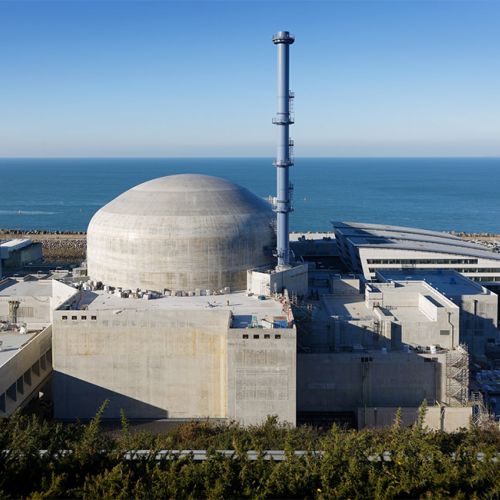
During a meeting of the local information commission on April 12, the Nuclear Safety Authority (ASN) assured that it could give the green light to the start-up of the reactor by the beginning of May. However, not all technical problems are resolved. And now a new one – of vibrations – appeared at the end of last year on the primary circuit. Revelations.
Blast, Thierry Gadault , 22 Apr 24
A few kilometers from the Flamanville nuclear power plant, Les Pieux (Manche) is typical of the many nuclear communities that we cross along the Rhône and Loire valleys: stone facades scrubbed with a toothbrush, paved sidewalks shiny as a new penny, innumerable municipal facilities that a town of some 3,500 inhabitants could never hope to afford, even in its wildest dreams, if it were not for the millions poured every year by EDF into the Department………………………..
Dialogue of the deaf in the basement
Behind the town hall, an old mansion which dominates the village, is the Pieux proximity center. In the basement of the building, which houses part of the municipal services, an auditorium with around fifty seats hosts the meetings of the Local Information Commission (CLI), a consultative body bringing together EDF, the Nuclear Safety Authority (ASN), local elected officials, the State and association representatives.
April 12, 2024, there was a crowd for the extraordinary meeting of the CLI. The menu was potentially copious: it was a question of taking stock of the EPR, before the ASN gave the green light to EDF to install the nuclear fuel in the vessel. While the independent authority was in full public consultation (it ended on April 17), an essential prerequisite for its decision-making, the associations had obtained this appointment in the form of a last-chance meeting, to try to derail the process.
But neither the ASN representative, Gaëtan Lafforge, the head of the Caen division, nor that of EDF, Alain Morvan, the director of the Flamanville EPR project, had the intention of revealing the reality of the numerous problems which still affect the reactor. And it was a dialogue of the deaf that the participants engaged in.
On the ASN and EDF side, the speech can easily be summarized: officially, everything is in order and the objective is now to gradually bring the reactor to operate at full power, at the end of the year. The authority also specified that the green light will be given by the beginning of May. Alain Morvan, with slides reduced to the strict minimum, simply outlined the process of starting up the new reactor.
On April 12, questioned on this subject by Yannick Rousselet, nuclear safety consultant at Greenpeace, the ASN representative had the greatest difficulty in answering the question clearly. “I can’t tell you that there won’t be anything left, there could be possible deviations during the tests,” stammered Gaëtan Lafforge. This then led to a short lunar exchange with the anti-nuclear activist, which triggered laughter from the audience.
On the anti-nuclear activist side, the troops left after two hours with their questions. In particular, lo and behold, a new vibration problem on the primary circuit detected last year.
The information was given to Blast by Julien Collet, the deputy director general of ASN, during the authority’s annual press conference organized at the end of last January. The DGA then told us that EDF was in the process of investigating this umpteenth glitch on the EPR.
On April 12, questioned on this subject by Yannick Rousselet, nuclear safety consultant at Greenpeace, the ASN representative had the greatest difficulty in answering the question clearly. “I can’t tell you that there won’t be anything left, there could be possible deviations during the tests,” stammered Gaëtan Lafforge. This then led to a short lunar exchange with the anti-nuclear activist, which triggered laughter from the audience.
Strangely, Alain Morvan, who could have provided technical details, remained silent. And no one thought to give him the floor. Especially since the president of the CLI, perhaps impatient to go to lunch, hastened to close the session. Questioned by Blast after the meeting, the director of the EPR project, cornered by a member of EDF communications, refused to answer us.
Hardly any more luck with the Parisian communications department, a few moments later. “The vibrational issues have been dealt with and technical solutions put in place,” she simply responded in the usual wooden language. In short, move around, there is nothing to see.
Yes, but here it is: questioned by a journalist from Presse de la Manche, the local daily which covered the event, EDF gave another answer : “There is no new vibration subject,” said the electrician. to our colleague. Um… we should know: has the subject been covered or does it not exist?
It’s not me, it’s him !
To try to see things clearly, Blast turned to the Institute of Radiation Protection and Nuclear Safety (IRSN), the public research establishment which provides technical advice to the ASN.
Perhaps concerned about its future – following the merger with the ASN imposed by the government and ratified by the National Assembly and the Senate – the establishment informed us through its press manager that the subject was not his responsibility. And to send us back to the ASN…
Unfortunately, ASN did not answer our questions. As Martine Aubry, the mayor of Lille and former candidate defeated in the 2011 socialist primary, said about François Hollande, “when it’s vague, there’s a wolf…”
The lid saga
This new problem… sorry “subject” vibration is therefore added to the numerous unresolved technical files that EDF has decided to leave as is, with the agreement of the ASN, to provide a response only after the commissioning of the reactor – it is unusual, we will agree. Starting obviously with the lid of the tank, weakened by a manufacturing defect (positive carbon segregation also present in the bottom of the tank). When the authority finally authorized the use of the tank and its lid in 2018, when it was no longer possible to exclude the risk of rupture but only to prevent it (which does not have the same meaning), she had asked EDF to change the cover no later than December 2024.
……………………………………..Questioned by activists to know why the company was not waiting for this new cover, Alain Morvan got confused in his explanations. He first suggested that it was not finished, and that it would therefore not be installed before the summer of 2025, before contradicting himself to finally assure that it would be delivered to the nuclear power plant at the end of the year…
In fact, the public group has nothing to do with it: in 2023, Framatome obtained from the ASN to postpone the replacement of the cover by one year, without giving any justification for such a postponement. According to the order issued by the authority last year, it must now be replaced during the first full inspection of the installation, after its start-up.
While it was possible to change this part in complete safety for the health of workers, if the new one had been installed before start-up, this postponement changes everything. The current cover will be irradiated and it will in fact become nuclear waste. In other words, an object that cannot be handled like that.
Apart from the fact that this unnecessarily exposes workers to taking doses during operations to replace it, this poses another problem. This question has not been resolved to date by EDF: that of the storage of this contaminated part, when it is removed. ASN asked the EDF group to construct a building for this purpose which would allow it to be stored safely on the power plant site. Which still doesn’t seem to be done…
Radioactivity, haphazardly
Emblematic, the tank cover file is not the only one which demonstrates EDF’s lack of consideration for nuclear employees, whether they are in-house agents or subcontracting employees. A second major project, also planned after the start-up of the reactor, will expose those involved to radioactive risks. Here again, this intervention could have been carried out in complete safety before the installation was started: the modification of the cooling system of the reactor auxiliary networks (RRI) and rescued raw water (SEC). Essential elements, particularly during reactor shutdown…………………………………………………………………………………………………………………….
Later, again
Still in the same logic, EDF has postponed the modification of the tank internals until later, more precisely the lower plenum which directs the distribution of the hydraulic flow in the tank. Since the incident that occurred on one of the two EPRs at Taishan in China, in 2021, we have had some feedback: it has been established that this equipment generates poor distribution of hydraulic flow which causes greater fluctuations. greater than expected in the neutron flux, which could lead to difficulties in controlling the nuclear reaction. Although ASN asked EDF to modify the lower plenum, the studies are still in progress………………………………………………………….
In China, to avoid major problems while waiting for the modification of the lower plenum, the power of the reactors (officially 1,750 MW) would have been limited to 1,500 MW. Will this also be the case for the Flamanville EPR? Questioned during the CLI meeting on April 12 by Yannick Rousselet, neither ASN nor EDF deigned to respond.
Let’s cross our fingers, hoping that there will be no runaway nuclear reaction in the Flamanville EPR tank. Especially since Libération revealed in July 2022, two systems of probes and sensors essential for operating the reactor, installed either in the tank or outside, are malfunctioning.
The EPR, political totem
“It would have been smarter to do all this work before the reactor was started,” exasperates Gilles Reynaud, the president of Ma Zone Contrôlée , which brings together nuclear subcontracting employees. But EDF wants to put the EPR into production to say: “that’s it, it works.” Doing all this work afterwards, I don’t find it very respectful for the workers and the population. »
No matter the cost
“We are starting at all costs for purely political reasons,” judge Yannick Rousselet, interviewed by Blast at the end of the CLI on April 12. As President Macron announced the relaunch of nuclear power with the construction of new EPRs, they want to send the message that we are out of the rut. » For Rousselet, this is a very short-term vision: “Even if this reactor shuts down in a few months for a long period, no one cares. We must be able to say: “That’s it, the Flamanville EPR is loaded. He started.” This is what is most dangerous. We don’t try to solve the problems first. »
The secrets of an engineer
And then, potentially, there is another problem in the medium term. Recently, an engineer, Thierry C, contacted Blast to tell us about his short experience in nuclear power.
………………………………. “When I took the file, I quickly realized that most of the valves that had to be installed could not meet the temperature and pressure conditions planned during these requalification tests,” he explains to Blast. Of the approximately 650 pipes equipped with valves, there were approximately 450 that had to be cut to remove the equipment and replace it with a temporary device to block the pipes. » A not really reassuring observation. “I spoke about it to my superiors who asked me to keep quiet and not talk to EDF about it. »
The documents and plans consulted by Blast seem to confirm these remarks. Which poses a problem: the requalification tests must be carried out with the valves to be validated. However, this analysis work was carried out in 2008-2009, when the EPR construction site, which had just started, was still in the civil engineering stage. Thierry C. left the group shortly after carrying out this study. What has happened since then? Has the error made by Alstom on the technical characteristics of the valves been corrected? Impossible to know: neither EDF, nor ASN, nor IRSN wanted to answer us.
Overall, given these unresolved problems and the lack of transparency from EDF and ASN regarding the technical setbacks of the installation, within the Flamanville CLI but also vis-à-vis the press, the long nightmare of the EPR construction site may not be over. This bad dream led to its bill exploding – which reached some 19.1 billion euros . A farce that could end up boring and no longer make anyone laugh. https://www.blast-info.fr/articles/2024/nucleaire-a-flamanville-la-farce-de-lepr-se-poursuit-G9PeKawaRwmShmxp6sJL3g
TODAY. Saint Rafael Grossi on the road to Damascus.

On the road to Damascus is where you get an epiphany. Well, Saint Paul did, anyway. He was on his way to Damascus to do punishing stuff to Christians, when he had a divine revelation and was transformed into an apostle, all aglow with Christian love.
Well, I don’t know that Rafael Grossi had any such revelation, in going to Damascus. But it seems clear that he decided that the proliferation of nuclear weapons is really nothing to worry about, certainly not when compared with the mission of the International Atomic Energy Agency, which is to promote the nuclear industry.
We always knew that countries that get nuclear weapons first get a “civil” nuclear industry. Except for the USA, which started the whole thing off the other way around, with the atrocity of the bombs for Hiroshima and Nagasaki. They then launched enthusiastically into the hypocrisy of the “peaceful nuke.
Britain’s leader Rishi Sunak, and France’s Emmanuel Macron have both publicly made it clear that “commercial” nuclear power is essential for their nuclear weapons industry. (So it doesn’t matter if commercial nuclear is a financial catastrophe.) The USA and Russia don’t seem to care, as long as they can sell all kinds of nuclear technology to anybody, really.
The new “advanced” small nuclear reactors make the problem worse, as they use enriched uranium, and reprocessing technologies that provide a great cover for making weapons grade fuel .
Rafael Grossi is well known for his earnest and pious statements about nuclear safety. Indeed, didn’t we all think that this is his job, to ensure the safety and non-weapons-proliferation of the world’s reactors?
But when did Rafael’s epiphany happen? When did he realise that safety and non-weapons proliferation did not matter now?
Rafael doesn’t seem to understand that all nuclear facilities become a target for terrorism, and a target in war-time. He has said a few cautionary words about the Zaporizhzhia Nuclear Power Station in Ukraine, but he’s quite OK with Ukraine setting up new nuclear power stations.
Rafael has expressed worthy worries about Saudi Arabia and nuclear weapons, but nevertheless “expressed his delight and admiration for Saudi Arabia’s nuclear capabilities” – and promoted them .
Syria is a place, and with a leader, prone to military disruptions, and , like Saudi Arabia, to human rights abuses, but that doesn’t seem to worry Grossi, over there to arrange for a Syrian nuclear industry.
An epiphany? Or did Rafael know all the time that his job is to be a nuclear salesman ?
Blatant hypocrisy
New civil nuclear programmes crossing over into military nuclear programmes

New Nuclear Dual-Use Risk: Beating Swords into Ploughshares? By Dr. Paul Dorfman, https://nct-cbnw.com/new-nuclear-dual-use-risk-beating-swords-into-ploughshares/ 24 Apr 24.
Dr. Paul Dorfman discusses whether new civil nuclear programs could cross over into military nuclear programs, and what this means for global non-proliferation efforts.
According to key global finance advisory and asset management firm Lazard, new nuclear power systems perform poorly compared to renewables’ storage, energy efficiency, cost, roll-out speed, and management. So why invest in new nuclear?
Prof. Andy Stirling and Dr. Phil Johnstone, from the University of Sussex Science Policy Research Unit (SPRU), argue that the answer lies in the clear and present link between civil and military nuclear infrastructure. This is because civil nuclear energy maintains the skills and supply chains also needed for military nuclear programs, without which the costs of nuclear military capabilities could become politically unsupportable.
As they point out, the U.K. Government’s ‘Civil Nuclear: Roadmap to 2050’ report includes sets of statements on civil and military nuclear ambitions in order to “identify opportunities to align the two across government”, strengthening existing interconnections between civil and military industries’ research and development, and thereby minimizing costs for both the weapons and power sectors.
More recently, in March 2024, U.K. Prime Minister Rishi Sunak explicitly linked military nuclear weapons production capability with civil nuclear power generation development. French President Emmanuel Macron has gone further, saying that “without civil nuclear power, no military nuclear power, without military nuclear, no civil nuclear”. And the fact is that 90% of all new nuclear construction projects worldwide involve corporations controlled by states with nuclear weapons
New Nuclear, New Proliferation Risk
The increasingly tense geopolitical environment makes nuclear a controversial issue, with nation states concerned that neighbors might use notionally civilian nuclear programs for military ends. In this sense, there are unique challenges and perceived opportunities when it comes to new civil nuclear ambitions.
Choice of offensive or defensive doctrine affects the way other states evaluate their respective security and, in turn, influences the probability of cross-over between civil and military nuclear capacity. Indeed, current movements in military doctrines share the common denominator of adopting more offensive postures.
Meanwhile, according to the U.K. Royal Society, all forms of nuclear production pose weapons development risks, as “there is no proliferation proof nuclear fuel cycle – the dual use risk of nuclear materials and technology and in civil and military applications cannot be eliminated.”
Unhelpfully, Small Modular Nuclear Reactors (SMRs), which are the best new hope for fissile fuel, could make the weapons proliferation problem even worse as any potential SMR roll-out to either developed or developing countries is likely to increase nuclear proliferation and security risks. This is especially so if any of those states prove politically unstable or have relatively limited resources to support a robust nuclear security and regulatory infrastructure.
Nuclear Cross-over in an Increasingly Unstable World
Unless uranium enrichment and reprocessing technologies are effectively regulated against the diversion of civil materials for military purposes, the reality is that new nuclear plants can provide the cover to develop and make nuclear weapons. Whether that capability is turned into actual weapons depends largely on political inclination.
Saudi officials have made it clear on more than one occasion that there’s another reason for their interest in civil nuclear energy technology which was not captured by the royal decree on the Saudi nuclear program – the relationship of the civil program to nuclear weapons. More recently, Saudi Arabia is pushing for the right to produce nuclear fuel, a move that poses further significant proliferation risk. The International Atomic Energy Agency (IAEA) has voiced concerns about Saudi intentions and safeguards.

Unfortunately, the IAEA’s support for Saudi’s civil nuclear clashes with their position on the Kingdom’s military ambition. This is not the first time that the UN nuclear regulator has been caught in this uncomfortably dualist situation.
More worryingly, the Director General of the IAEA, Rafael Grossi, has just met with Syrian President Bashar al-Assad in Damascus to “agree on a new engagement between Syria and IAEA with a view to providing confidence in the peaceful uses of nuclear energy for the benefit of its people”. Given the deeply problematic military and human rights history of al-Assad’s regime, the IAEA’s actions seem profoundly concerning, and bring the IAEA’s role in the global nuclear arena into sharp focus.
Thinking this through, an important question springs to mind. Due to the apparent potential for civil-military nuclear cross-over, could the IAEA’s mission – to work for “the safe, secure and peaceful application of nuclear science and technology” – inevitably result in weapons proliferation by default?
Irrational Paradoxes
Back in Eastern Europe, although Ukraine runs a substantive civil nuclear power program, it’s no longer a nuclear weapons state. Ukraine, once briefly the third-largest nuclear power in the world, made the decision to give up nuclear weapons on the basis that the U.S., U.K., and Russia would guarantee Ukraine’s security via the Budapest Memorandum.
In this sense, both Putin’s invasion of an independent state and subsequent nuclear weapons threats highlight the very real practical distinction between unilateral and multilateral nuclear weapons disarmament in an increasingly unstable world.
And then there’s Zaporizhzhia, where a civil nuclear power plant has become a target of war at the very same time that Russia’s role as a major player in the global civil nuclear power sector continues to expand via Moscow-backed international nuclear new-build projects and technology, uranium supply and enrichment, and spent nuclear fuel management.
Direction of Travel
While it appears reasonably clear that civil and military nuclear can enmesh, one must ask whether one inevitably leads to the other. While the usual concern is that civil nuclear infrastructure leads to military development, according to former Australian Prime Minister Scott Morrison, Australia is bucking the trend: “Let me be clear: Australia is not seeking to establish […] a civil nuclear capability […] a civil nuclear energy industry is not a requirement for us to go through the submarine program.”
In other words, despite the new nuclear submarine AUKUS deal, the current Australian government has no plans to develop new civil nuclear infrastructure.
So, does that start to negate the civil-military nexus hypothesis? Well, it’s not that nuclear military interests are the sole drivers of support for civil nuclear power, but for some states dual-use technology may comprise a significant complementary factor.
In the end, it’s the direction of travel that counts. While all key energy institutes and research organizations agree that renewables will do the heavy-lifting for the net-zero energy transition, it’s worth considering the implications of U.S. Energy Secretary Jennifer Granholm’s speech to Australia’s Energy Forum: “No country has ever been held hostage for access to the sun. No country has ever been held hostage for access to the wind. They have not ever been weaponized, nor will they be.”
Dr. Paul Dorfman is the Chair of the Nuclear Consulting Group, a Visiting Fellow at the Science Policy Research Unit (SPRU) of the University of Sussex, U.K., a Member of the Irish Government’s Radiation Protection Advisory Committee, and a Former Advisor to the U.K. Ministry of Defence Nuclear Submarine Dismantling Project.
1 This month

of the week – Australians for War Powers Reform (AWPR)
To see nuclear-related stories in greater depth and intensity
 Antinuclear