Australia, US, UK sign nuclear transfer deal for AUKUS subs – AUSTRALIA RESPONSIBLE FOR THE SPENT FUEL WASTES
Australia would be responsible for the storage and disposal of spent nuclear fuel and radioactive waste from the nuclear power units that are transferred under the deal.
SYDNEY: Australia said on Monday (Aug 12) it had signed a deal to allow the exchange of nuclear secrets and material with the United States and Britain, a key step toward equipping its navy with nuclear-powered submarines.
It binds the three countries to security arrangements for the transfer of sensitive US and UK nuclear material and know-how as part of the tripartite 2021 AUKUS security accord.
AUKUS, which envisages building an Australian nuclear-powered submarine fleet and jointly developing advanced warfighting capabilities, is seen as a strategic answer to Chinese military ambitions in the Pacific region.
“This agreement is an important step towards Australia’s acquisition of conventionally armed nuclear-powered submarines for the Royal Australian Navy,” said Richard Marles, Australia’s defence minister and deputy prime minister.
Australia’s acquisition of a nuclear-powered submarine fleet would set the “highest non-proliferation standards”, he said, stressing that the country did not seek nuclear weapons.
The latest deal – signed in Washington last week and tabled in the Australian parliament on Monday – includes a provision for Australia to indemnify its partners against any liability for nuclear risks from material sent to the country.
Nuclear material for the future submarines’ propulsion would be transferred from the US or Britain in “complete, welded power units”, it says.
But Australia would be responsible for the storage and disposal of spent nuclear fuel and radioactive waste from the nuclear power units that are transferred under the deal.
“Submarines are an essential part of Australia’s naval capability, providing a strategic advantage in terms of surveillance and protection of our maritime approaches,” the transfer deal says.
China’s foreign minister Wang Yi warned in a visit to Australia in April that AUKUS raised “serious nuclear proliferation risks”, claiming it ran counter to a South Pacific treaty banning nuclear weapons in the region.
Canada rejects AUKUS nuclear submarine deal
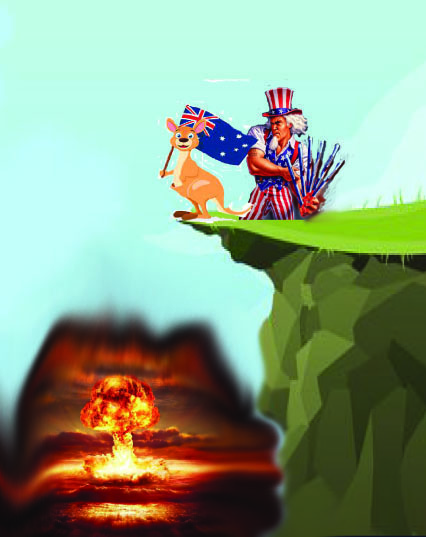
the main concern should be that this deal further locks Australia into US exceptionalism and attempted hegemony in our region. The Albanese government has repeatedly sought to reassure that our sovereignty has been preserved, but this is very difficult to accept given the extent to which our funding underwrites the US submarine-production program. Moreover, it’s likely Australia’s learning and launch activities will further integrate this country into the operational aspects of the American war machine, such that US leaders may effectively give all the instructions in terms of deployment and other activities.
John Hewson , professor at the ANU Crawford School of Public Policy and former Liberal opposition leader.
Some news this month might have given the government pause. Canada – with the longest coastline in the world and a security situation in its Arctic and north changing significantly as the region becomes more accessible, particularly with more Russian and Chinese activity – decided not to join the AUKUS arrangement and buy nuclear submarines. Instead it is considering cooperating with Germany and Norway as partners in a submarine program and will purchase 12 conventionally powered under-ice capable submarines for about $60 billion.
Compare this with the eye-watering cost of Australia’s acquisition: $368 billion for eight Virginia-class and next-generation SSN-AUKUS nuclear submarines with a vague delivery schedule.
Of course, defenders of the AUKUS deal will argue it is more than just an arrangement to buy submarines. They will claim it instead to be a broad, trilateral security arrangement for the Indo-Pacific region that also fosters technology exchanges between the three countries, and helps to build a conventionally armed nuclear-powered submarine force for Australia.
Nevertheless, the deal has been widely criticised and, given its huge cost, it’s worth asking why these criticisms haven’t resonated. One of its most vocal and effective opponents has been former prime minister Paul Keating, who has labelled it “the worst deal in history” and “the worst international decision by a Labor government since the former Labor leader Billy Hughes sought to introduce conscription”. He has slammed the deal particularly for allowing defence interests to trump diplomacy.
It has also been strongly criticised within the Labor Party and union structures: by some 50 units of the party from branches and electoral conferences, and leading unions including the Electrical Trades Union, the CFMEU and the Australian Manufacturing Workers’ Union. The Nobel Prize-winning, Australian-led International Campaign to Abolish Nuclear Weapons has also rejected it for the risks of nuclear proliferation. China’s reaction to the deal was to warn that we are “on a path of error and danger”.“The main concern should be that this deal further locks Australia into US exceptionalism and attempted hegemony in our region … Moreover, it’s likely Australia’s learning and launch activities will further integrate this country into … the American war machine…”
There has also been a host of technical concerns, including in relation to the supply of fuel to run the subs. Keating has drawn a comparison with an alternative deal proposed by the French that emerged after the Morrison government rescinded the original agreement to replace Australia’s ageing Collins-class fleet with the so-called Attack-class sub. This proposal, he says, came with a firm delivery date in 2034 at fixed prices, but was ignored by the government. Technically these French subs would have required only 5 per cent enriched uranium, instead of 95 per cent, weapons grade, for fuel. That this feature was ignored by the government should come as no surprise, as the Coalition has provided no detail about the enriched uranium fuel – neither supply nor cost – for its announced seven nuclear power plants.
However, the main concern should be that this deal further locks Australia into US exceptionalism and attempted hegemony in our region. The Albanese government has repeatedly sought to reassure that our sovereignty has been preserved, but this is very difficult to accept given the extent to which our funding underwrites the US submarine-production program. Moreover, it’s likely Australia’s learning and launch activities will further integrate this country into the operational aspects of the American war machine, such that US leaders may effectively give all the instructions in terms of deployment and other activities.
This should be an even greater concern having heard the Republican candidates for this year’s election speak at their national convention in Wisconsin. Both Donald Trump and J.D. Vance are committed to an even tougher line against China and Australia risks being used somewhat as a pawn in their response to what they like to refer to as the “China threat”. On the contrary, as I have suggested many times, the threat is not so much from the rise of China as it is related to the decline in the global standing of the US. It’s easy to imagine how Trump and Vance could only make this worse, especially by threatening tariffs on Chinese goods.
The Trump–Vance commitment to return to tariff protections flies in the face of voluminous accumulated evidence concerning the costs and disadvantages of doing so. This will certainly not restore the rust-belt states to their former glory as these candidates are promising. China’s only “sin” has been to grow its economy to rival that of the US. The US has lost any cost advantage it may once have enjoyed in manufacturing as well as its edge in technology – most recently in the production of electric vehicles. Just ask Tesla, which now bases much of its production in China.
And the halcyon days of inflation control in the ’90s were much more the result of China flooding the world with cheap manufactured goods, than any effective application of monetary policy. The US was a major beneficiary of this, which is so easily overlooked in its current cost-of-living crisis.
Surely Australia wouldn’t want to end up being pressured to park nuclear submarines along the Chinese coast as part of a US demonstration of strength? Nor should we allow ourselves to be dragged by the US into some conflict with China over Taiwan.
The Albanese government has had considerable difficulty justifying the cost of the AUKUS deal, and so it should. Governing is about priorities and, true enough, national security is a priority. It’s also true that the government has been able to deal effectively with many domestic priorities, such as providing non-inflationary cost-of-living assistance. Defence procurement has long been somewhat ring-fenced from the normal discipline applied to other departments in the Expenditure Review Committee processes, however. It’s no defence to spend so much on submarines, when so much more could have been done in other national priority areas, including education and the care sectors. This is especially so in light of the attendant risks of a deal such as AUKUS.
With the mounting tension between the US and China, world leaders should be increasingly concerned about the threat of another drift to a Cold War situation.
The need for a circuit breaker is clear. I was pleased recently to join the signatories to an open letter drafted by two former foreign affairs ministers, Gareth Evans and Bob Carr, for détente: “a genuine balance of power between the US and China, designed to avert the horror of great power conflict and to secure a lasting peace for our people, our region, and the world.”
Given the state of the world, and its pronounced geopolitical uncertainty, it is disappointing that neither the US nor China has yet responded to the proposal, and surprising that the Albanese government hasn’t embraced it as a mechanism to advance the point that Australia, as a middle-ranking power, has and can continue to punch above its weight in the global interest.
This is especially so given the benefits that Australia as a nation has reaped from the economic rise of China.
Surely a situation can’t be allowed to develop whereby the United States and China embark on trade protection and military conflict.
At the very least, there should be the imperative of a global discourse on this. Unfortunately, attitudes are hardening in Europe and the US – perhaps to the point where the outcome will be gratuitous harm?
This article was first published in the print edition of The Saturday Paper on July 27, 2024 as “Canada’s smart lead on nuclear subs”.
UK Nuclear Free Local Authorities back joint statement condemning AUKUS nuclear proliferation

The UK/Ireland Nuclear Free Local Authorities have joined environmental and peace groups around the world in endorsing a statement that will be delivered to a conference at the United Nations.
The 2024 Nuclear Non-Proliferation Treaty Preparatory Committee will meet today to begin work to make preparations for the next conference of signing to the Nuclear Non-Proliferation Treaty (or NPT).
The statement will be delivered to committee delegates by Jemila Rushton, Acting Director of the International Campaign to Abolish Nuclear Weapons Australia. The NFLAs are a member of ICAN.
Particular reference is made to the adverse impact of AUKUS, the military alliance forged between Australia, the United Kingdom, and the United States in opposition to China, on geopolitics in the Pacific.
Amongst its more controversial elements is the provision of nuclear-powered submarines by the other partners to Australia. We share the concern of other signatories that AUKUS violates in spirit both the Nuclear Non-Proliferation Treaty and the Rarotonga – South Pacific Nuclear Free Zone Treaty. The submarines will be powered by weapons-grade nuclear fuel, supplied by the other partners and will operate from Australian bases within a nuclear free zone.
Although present plans provide for these submarines to be conventionally armed, it is not inconceivable that over time they could be rearmed with nuclear weapons. The Leader of the Opposition in the Australian Parliament, Peter Dutton, is currently actively lobbying for Australia to establish a civil nuclear programme and such a programme is critical to support the development of nuclear weapons capacity.
The statement has also been endorsed by our colleagues Labrats, CND Cymru and Together against Sizewell C.
For more information please contact the NFLA Secretary Richard Outram by email to richard.outram@manchester.gov.uk
AUKUS and the pride of politicians

By Nick Deane, Jul 24, 2024 https://johnmenadue.com/aukus-and-the-pride-of-politicians/
With AUKUS, the pride of politicians has become an obstacle to reaching the best solution to the ‘national security’ conundrum. In the end, it could be that ego-driven reluctance to shift from entrenched positions results in the Australian people being delivered a disaster.
For my own purposes, I have been keeping a record of articles I have read under the topic ‘AUKUS’. There are now some 300 such items on my spreadsheet – nearly all of them finding fault of one kind or another with this extraordinary project.
The criticisms deal with a wide variety of aspects (mainly focussed on the acquisition of nuclear-powered submarines). To summarise a few, the AUKUS project:-
- Leads Australia in the direction of war;
- Has done damage to Australia’s international reputation;
- Destabilises Australia’s immediate region;
- Brings a nuclear industry with it;
- Introduces the intractable problem of nuclear waste disposal;
- Damages our relationship with our most important trading partner;
- Causes a significant loss of sovereignty;
- Is not good value for money;
- Diverts resources away from social programs;
- Will not be as effective as conventional submarines;
- Is aggressive and not defensive, and
- Will probably not come to fruition in any case.
Highly respected commentators, such as Hugh White, Paul Keating, Sam Roggeveen, Andrew Fowler, Rex Patrick and Clinton Fernandes, have all raised significant concerns. Meanwhile ‘civil society’ is also getting mobilised, with ‘anti-AUKUS’ groups springing up in all the major centres.
However, the proponents of AUKUS (and the mainstream media) appear content to ignore the valid, rational arguments being put forward against it. Indeed, industry-based conferences are going ahead as if there is nothing about to the project that needs to be questioned, and, no doubt, secret, military training programs are already well under way. Within the military-industrial establishment, the project is gathering momentum. Those in the military are excited by the prospect of controlling a new, highly lethal weapon, whilst those in the industry are attracted by the smell of the limitless funds being devoted to it.
It is disturbing to have to concede that rational argument appears to have little impact on AUKUS’s proponents. However there is an even more worrying aspect to add. That is the pride of politicians. For the longer the process continues, with all its secrecy and in the absence of meaningful debate at high levels, the harder it is for politicians to change course. Abandoning the project would already cause senior members of both major parties considerable ‘loss of face’. If it falls over (as some predict), or if opposition becomes a vote-winner at the next election, that ‘loss of face’ will be highly embarrassing. With AUKUS, the pride of politicians has thus become an obstacle to to reaching the best solution to the ‘national security’ conundrum. In the end, it could be that ego-driven reluctance to shift from entrenched positions results in the Australian people being delivered a disaster.
In an ideal, democratic society, voters and the politicians they elect appraise themselves of the ‘pros and cons’ of controversial matters and make decisions on a rational basis. If they do that in the case of AUKUS, it is surely doomed. Politicians beware!
The Atlas Network’s transnational revolution
By Lucy HamiltonJul 8, 2024 https://johnmenadue.com/the-atlas-networks-transnational-revolution/
Twice in a fortnight, the president of the Heritage Foundation has declared that America is experiencing its second revolution. The revolution would remain bloodless (because their side is “winning”) “if the left allows it to be.” The two bodies whose acts provoked the announcements are leading Atlas Network partners. They are also spending millions of dollars in Europe to roll back rights for women and LGBTQIA people.
Both president Kevin Roberts’ announcements were made on Steve Bannon’s War Room broadcast, central to the Trumpist movement and its efforts to remake America from every school board and electoral precinct upwards.
The first announcement of revolution was made on the 22nd June. It functioned as an advertisement for the MAGA(Make America Great Again) audience to take part. Becoming a revolutionary involves undertaking Project 2025’s recruitment and training of loyalists to staff the incoming Trump administration, but also at state and local government levels. Roberts declared they were building not just for 2025, but for the next century in the United States.
Project 2025 is the most recent iteration of Heritage’s Mandate for Leadership. The first was written for Ronald Reagan, spelling out his massive reforms. He implemented two thirds in his first term. The last iteration for Donald Trump’s first term was similarly “business Republican” in tone, and Trump too implemented two thirds in his first year. The newest iteration is, as Roberts describes, revolutionary. It dictates the process for the dismantling most of the federal government as well as setting America on track to eliminate reproductive and Queer rights.
It also sets out the intention to dismantle the vital energy transition work underway as a result of the Inflation Reduction Act, with plans to boost fossil fuel production instead. This is fitting as much of Heritage’s funding comes from fossil fuel sources.
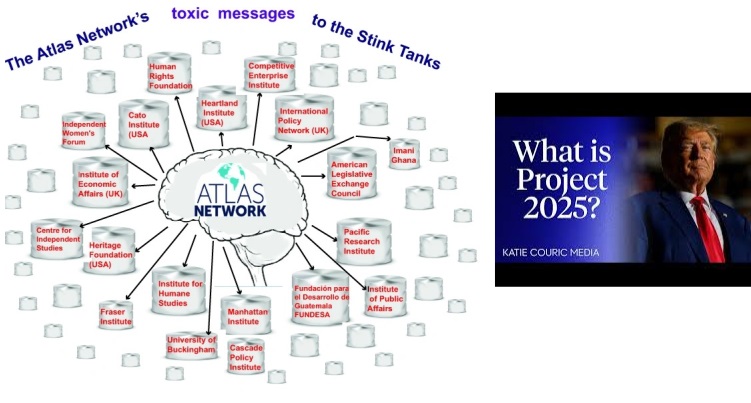
Project 2025 is a joint Atlas Network and Council for National Policy project.
The second announcement of revolution was made after the Supreme Court’s dramatic week of judgements. In particular, the one that granted the President of the United States immunity for the vaguely worded field of “official acts.” Naturally the partisan court will make the determination which acts are “official.”
The week also compounded the Trumpist Supreme Court’s norm-violating series of decisions that have rolled back reproductive healthcare access for women across Republican states, further damaged voters’ representation, and frozen programs that aim to address entrenched disadvantage.
In one week, the Court placed itself above the experts in government agencies who define, for example, how much mercury is unsafe to consume. While the relevant judge confused nitrous oxide and nitrogen oxide, he dared to claim that judges were better placed than government experts to determine the minutiae of America’s functioning. This attack on the administrative state’s ability to protect the public from corporate recklessness and malfeasance was a triumph for capital. The court also damaged the SEC’s ability to deal with White Collar crime.
Such gifts to the wealthy were balanced with another judgement that decided a gratuity given after a favour was received would not be determined an illegal bribe. For a court riddled with scandal over oligarch largesse, this was a particularly cynical decision.
As a footnote, the same week revealed a decision that said regions could make it illegal to be homeless. This can provide numbers for private prison operator profits. There prisoners are hired out to businesses for near slave-labour wages.
All these decisions have resulted from the years of work by the Federalist Society which handed Trump his literal list from which to choose judges. Republicans had stalled appointments to federal benches over the Obama era, granting Trump the gift of hundreds of appointments; some appointees were considered scandalous.
The years of surreptitious work by the Federalist Society and its leader Leonard Leo have been documented by Pro Publica. The body made headlines when it was gifted $1.6 billion by a single donor.
Both Heritage and the Federalist Society are Atlas Network partners. They are also Council for National Policy (CNP) members: that’s the interlinked body that has been driving the Christian Nationalist takeover of America.
Dr Jeremy Walker explained the process by which the Atlas Network architecture of influence operates in the lead-up to the Voice referendum in 2023.
Investigative journalist Jane Mayer revealed its American operations in Dark Money, using the label “Kochtopus” after Charles and David Koch, preeminent funders of the network. Historian Nancy MacLean documented its longer history in Democracy in Chains.
With around 500 partner organisations in roughly 100 countries its global operations remain less obvious because the system is intentionally covert.
The central “think” tanks foster the replication of more such bodies, providing seed funding if necessary and training in fundraising and public relations strategies to help the local offshoots become independent. They network. The primary function is to sell the donors’ messages by advertising them constantly: in 1985, Heritage founder Ed Feulner told Australian operatives to treat campaigns as if they were for a toothpaste brand that needed constant reinforcing. The messages: low tax, minimal regulation, small government, dismantling of social safety nets. Together the junktanks, as journalist George Monbiot has labelled them, create a chorus of voices from university centres and civil society bodies reinforcing the wishlist.
While the focus has primarily been on these “business Republican goals,” junktanks have their own remit. Conservative social messaging about the family has been partly used to conceal the lack of ethics in the libertarian mission. It has partly functioned to encourage family and church networks to mitigate the damage done to communities and individuals by the slashing of safety nets. There has also remained a more socially conservative and religious array of junktanks within the network.
The more toxic “family values” groups tend to be interconnected with Atlas rather than Atlas partners themselves. Trump appointee Betsy DeVos, for example, links the two. She has been chair and on the board of two Atlas partners: the American Federation for Children that aims to replace the public school system with privatised charter schools and the Acton Institute for the study of Religion and Liberty which educates business leaders and academics in “the connection that can exist between virtue and economic thinking.” Both Prince and DeVos families are substantial donors to the anti-LGBTQIA group Focus on Family. Focus is part of the CNP, a Christian Nationalist network that includes the Charles Koch and the Prince and DeVos families as donors, not to mention Mike Pence and Steve Bannon as key figures.
Both the extremist Christians and the libertarians are close to achieving their goals in America. Apart from the impact the implosion of the United States government and civil rights framework will have on the rest of the world, this is relevant because the very global nature of Atlas means that its outposts are trying to replicate its work outside the American homeland.
The European Parliament conducted a study affirming reporting that $280 million dollars have been funnelled into the EU over the last decade by Atlas and CNP partners as well as by Evangelical mission programs. Heritage and Federalist stand alongside the Cato Institute, the Leadership Institute and Acton as having donated roughly $20 million towards European groups fighting to repeal reproductive healthcare rights and LGBTQIA rights. Another American body, the American Society for the Defense of Tradition, Family and Property (TFP) has also been training European groups in strategy in cooperation with Bruce Eberle a “visiting professor” at the Leadership Institute. The Koch, DeVos and Prince families are named as major sources of the money.
(These donations are overshadowed in scale by those from European and Russian sources.)
Australia’s Centre for Independent Studies (CIS) mostly leaves the culture war battles on gender and religious virtues to the Institute of Public Affairs (IPA) and their media ally, News Corp. This year’s CIS Consilium event where the Atlas pipeliners intermingle with local and international talking heads is running adjacent to the inaugural conference of the Australian Chapter of the Alliance for Responsible Citizenship. The London original was a religio-ethnonationalist event. The consecutive timing is convenient for international guests to attend both.
The rest of us must remain focused on the fact that these networks operate transnationally. They share talking points, strategies, individuals and sometimes money. The revolution that Kevin Roberts has declared they are winning in the US is to be reenacted, piecemeal, for all of us.
Queensland LNP excludes nuclear from agenda at conference ahead of state election

ReNeweconomy, Fraser Barton, Jul 5, 2024
There are 173 items on the discussion list for the annual Queensland LNP conference, but nuclear energy is not one of them.
The three-day event starting in Brisbane on Friday is not due to canvass the major policy which has sparked a divide between some federal and state Liberal and Nationals party members.
Queensland-based federal Opposition Leader Peter Dutton has unveiled plans to build seven nuclear power plants if the federal coalition wins government in 2025.
The policy was backed by Queensland based Nationals leader David Littleproud, who is due to join Mr Dutton at the LNP conference on Saturday, and by another Queensland-based LNP member, the federal energy spokesman Ted O’Brien.
Their approach to nuclear is not supported by Queensland’s Liberal National Party leader David Crisafulli.
Ahead of Queensland’s October election, Mr Crisafulli has confirmed nuclear is “not part of our plan” when asked about Mr Dutton’s policy.
The state convention’s list of resolutions is lengthy but makes no mention of nuclear energy, although Mr Dutton and Mr Littleproud might raise the issue during their addresses to the conference on Saturday.
Mr Crisafulli will address the event on Sunday.
“When you see hundreds of people coming to a venue to be able to debate the future of the state, the future of party, that’s really, really healthy,” Mr Crisafulli said ahead of the convention. ………………… https://reneweconomy.com.au/queensland-lnp-excludes-nuclear-from-agenda-at-conference-ahead-of-state-election/
Trusting the ‘Five Eyes’ Only
For Their Eyes Only
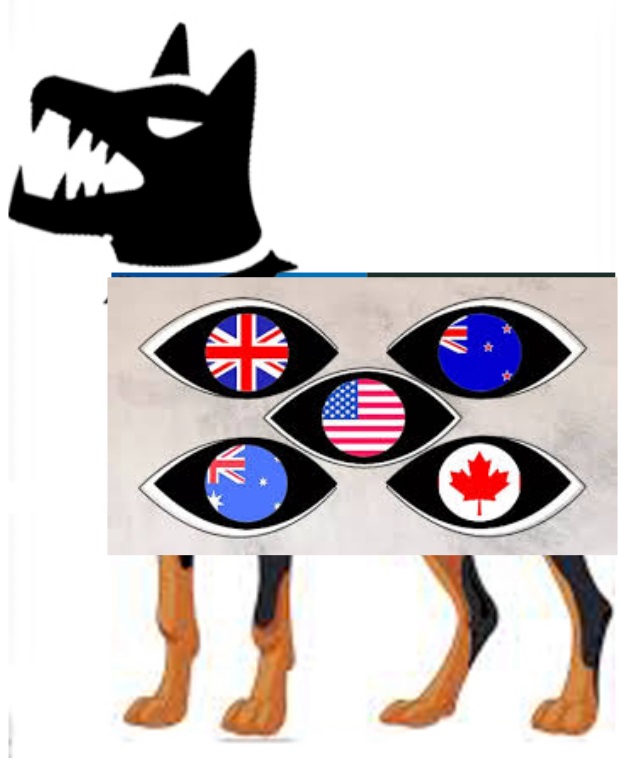
The “Five Eyes” (FVEY) is an elite club of five English-speaking countries — Australia, Canada, New Zealand, the United Kingdom, and the United States — that have agreed to cooperate in intelligence matters and share top-secret information. They all became parties to what was at first the bilateral UKUSA Agreement, a 1946 treaty for secret cooperation between the two countries in what’s called “signals intelligence” — data collected by electronic means, including by tapping phone lines or listening in on satellite communications. (The agreement was later amended to include the other three nations.) Almost all of the Five Eyes’ activities are conducted in secret, and its existence was not even disclosed until 2010. You might say that it constitutes the most secretive, powerful club of nations on the planet.
Anglo-Saxon solidarity supersedes all other relationships.
JULY 5, 2024 By Michael Klare / TomDispatch, https://scheerpost.com/2024/07/05/trusting-the-five-eyes-only/
Wherever he travels globally, President Biden has sought to project the United States as the rejuvenated leader of a broad coalition of democratic nations seeking to defend the “rules-based international order” against encroachments by hostile autocratic powers, especially China, Russia, and North Korea. “We established NATO, the greatest military alliance in the history of the world,” he told veterans of D-Day while at Normandy, France on June 6th. “Today… NATO is more united than ever and even more prepared to keep the peace, deter aggression, defend freedom all around the world.”
In other venues, Biden has repeatedly highlighted Washington’s efforts to incorporate the “Global South” — the developing nations of Africa, Asia, Latin America, and the Middle East — into just such a broad-based U.S.-led coalition. At the recent G7 summit of leading Western powers in southern Italy, for example, he backed measures supposedly designed to engage those countries “in a spirit of equitable and strategic partnership.”
But all of his soaring rhetoric on the subject scarcely conceals an inescapable reality: the United States is more isolated internationally than at any time since the Cold War ended in 1991. It has also increasingly come to rely on a tight-knit group of allies, all of whom are primarily English-speaking and are part of the Anglo-Saxon colonial diaspora. Rarely mentioned in the Western media, the Anglo-Saxonization of American foreign and military policy has become a distinctive — and provocative — feature of the Biden presidency.
America’s Growing Isolation
To get some appreciation for Washington’s isolation in international affairs, just consider the wider world’s reaction to the administration’s stance on the wars in Ukraine and Gaza.
Following Russia’s invasion of Ukraine, Joe Biden sought to portray the conflict there as a heroic struggle between the forces of democracy and the brutal fist of autocracy. But while he was generally successful in rallying the NATO powers behind Kyiv — persuading them to provide arms and training to the beleaguered Ukrainian forces, while reducing their economic links with Russia — he largely failed to win over the Global South or enlist its support in boycotting Russian oil and natural gas.
Despite what should have been a foreboding lesson, Biden returned to the same universalist rhetoric in 2023 (and this year as well) to rally global support for Israel in its drive to extinguish Hamas after that group’s devastating October 7th rampage. But for most non-European leaders, his attempt to portray support for Israel as a noble response proved wholly untenable once that country launched its full-scale invasion of Gaza and the slaughter of Palestinian civilians commenced. For many of them, Biden’s words seemed like sheer hypocrisy given Israel’s history of violating U.N. resolutions concerning the legal rights of Palestinians in the West Bank and its indiscriminate destruction of homes, hospitals, mosques, schools, and aid centers in Gaza. In response to Washington’s continued support for Israel, many leaders of the Global South have voted against the United States on Gaza-related measures at the U.N. or, in the case of South Africa, have brought suit against Israel at the World Court for perceived violations of the 1948 Genocide Convention.
In the face of such adversity, the White House has worked tirelessly to bolster its existing alliances, while trying to establish new ones wherever possible. Pity poor Secretary of State Antony Blinken, who has made seemingly endless trips to Asia, Africa, Europe, Latin America, and the Middle East trying to drum up support for Washington’s positions — with consistently meager results.
Here, then, is the reality of this anything but all-American moment: as a global power, the United States possesses a diminishing number of close, reliable allies – most of which are members of NATO, or countries that rely on the United States for nuclear protection (Japan and South Korea), or are primarily English-speaking (Australia and New Zealand). And when you come right down to it, the only countries the U.S. really trusts are the “Five Eyes.”
For Their Eyes Only
The “Five Eyes” (FVEY) is an elite club of five English-speaking countries — Australia, Canada, New Zealand, the United Kingdom, and the United States — that have agreed to cooperate in intelligence matters and share top-secret information. They all became parties to what was at first the bilateral UKUSA Agreement, a 1946 treaty for secret cooperation between the two countries in what’s called “signals intelligence” — data collected by electronic means, including by tapping phone lines or listening in on satellite communications. (The agreement was later amended to include the other three nations.) Almost all of the Five Eyes’ activities are conducted in secret, and its existence was not even disclosed until 2010. You might say that it constitutes the most secretive, powerful club of nations on the planet.
The origins of the Five Eyes can be traced back to World War II, when American and British codebreakers, including famed computer theorist Alan Turing, secretly convened at Bletchley Park, the British codebreaking establishment, to share intelligence gleaned from solving the German “Enigma” code and the Japanese “Purple” code. At first an informal arrangement, the secretive relationship was formalized in the British-US Communication Intelligence Agreement of 1943 and, after the war ended, in the UKUSA Agreement of 1946. That arrangement allowed for the exchange of signals intelligence between the National Security Agency (NSA) and its British equivalent, the Government Communications Headquarters (GCHQ) — an arrangement that persists to this day and undergirds what has come to be known as the “special relationship” between the two countries.
Then, in 1955, at the height of the Cold War, that intelligence-sharing agreement was expanded to include those other three English-speaking countries, Australia, Canada, and New Zealand. For secret information exchange, the classification “AUS/CAN/NZ/UK/US EYES ONLY” was then affixed to all the documents they shared, and from that came the “Five Eyes” label. France, Germany, Japan, and a few other countries have since sought entrance to that exclusive club, but without success.
Although largely a Cold War artifact, the Five Eyes intelligence network continued operating right into the era after the Soviet Union collapsed, spying on militant Islamic groups and government leaders in the Middle East, while eavesdropping on Chinese business, diplomatic, and military activities in Asia and elsewhere. According to former NSA contractor Edward Snowden, such efforts were conducted under specialized top-secret programs like Echelon, a system for collecting business and government data from satellite communications, and PRISM, an NSA program to collect data transmitted via the Internet.
As part of that Five Eyes endeavor, the U.S., the United Kingdom, and Australia jointly maintain a controversial, highly secret intelligence-gathering facility at Pine Gap, Australia, near the small city of Alice Springs. Known as the Joint Defence Facility Pine Gap (JDFPG), it’s largely run by the NSA, CIA, GCHQ, and the Australian Security Intelligence Organization. Its main purpose, according to Edward Snowden and other whistle-blowers, is to eavesdrop on radio, telephone, and internet communications in Asia and the Middle East and share that information with the intelligence and military arms of the Five Eyes. Since the Israeli invasion of Gaza was launched, it is also said to be gathering intelligence on Palestinian forces in Gaza and sharing that information with the Israeli Defense Forces. This, in turn, prompted a rare set of protests at the remote base when, in late 2023, dozens of pro-Palestinian activists sought to block the facility’s entry road.
Anglo-Saxon Solidarity in Asia
The Biden administration’s preference for relying on Anglophone countries in promoting its strategic objectives has been especially striking in the Asia-Pacific region. The White House has been clear that its primary goal in Asia is to construct a network of U.S.-friendly states committed to the containment of China’s rise. This was spelled out, for example, in the administration’s Indo-Pacific Strategy of the United States of 2022. Citing China’s muscle-flexing in Asia, it called for a common effort to resist that country’s “bullying of neighbors in the East and South China” and so protect the freedom of commerce. “A free and open Indo-Pacific can only be achieved if we build collective capacity for a new age,” the document stated. “We will pursue this through a latticework of strong and mutually reinforcing coalitions.”
That “latticework,” it indicated, would extend to all American allies and partners in the region, including Australia, Japan, New Zealand, the Philippines, and South Korea, as well as friendly European parties (especially Great Britain and France). Anyone willing to help contain China, the mantra seems to go, is welcome to join that U.S.-led coalition. But if you look closely, the renewed prominence of Anglo-Saxon solidarity becomes ever more evident.
Of all the military agreements signed by the Biden administration with America’s Pacific allies, none is considered more important in Washington than AUKUS, a strategic partnership agreement between Australia, the United Kingdom, and the United States. Announced by the three member states on Sept. 15, 2021, it contains two “pillars,” or areas of cooperation — the first focused on submarine technology and the second on AI, autonomous weapons, as well as other advanced technologies. As in the FVEY arrangement, both pillars involve high-level exchanges of classified data, but also include a striking degree of military and technological cooperation. And note the obvious: there is no equivalent U.S. agreement with any non-English-speaking country in Asia.
Consider, for instance, the Pillar I submarine arrangement. As the deal now stands, Australia will gradually retire its fleet of six diesel-powered submarines and purchase three to five top-of-the-line U.S.-made Los Angeles-class nuclear-powered submarines (SSNs), while it works with the United Kingdom to develop a whole new class of subs, the SSN-AUKUS, to be powered by an American-designed nuclear propulsion system. But — get this — to join, the Australians first had to scrap a $90 billion submarine deal with a French defense firm, causing a severe breach in the Franco-Australian relationship and demonstrating, once again, that Anglo-Saxon solidarity supersedes all other relationships.
Now, with the French out of the picture, the U.S. and Australia are proceeding with plans to build those Los Angeles-class SSNs — a multibillion-dollar venture that will require Australian naval officers to study nuclear propulsion in the United States. When the subs are finally launched (possibly in the early 2030s), American submariners will sail with the Australians to help them gain experience with such systems. Meanwhile, American military contractors will be working with Australia and the UK designing and constructing a next-generation sub, the SSN-AUKUS, that’s supposed to be ready in the 2040s. The three AUKUS partners will also establish a joint submarine base near Perth in Western Australia.
Pillar II of AUKUS has received far less media attention but is no less important. It calls for American, British, Australian scientific and technical cooperation in advanced technologies, including AI, robotics, and hypersonics, aimed at enhancing the future military capabilities of all three, including through the development of robot submarines that could be used to spy on or attack Chinese ships and subs.
Aside from the extraordinary degree of cooperation on sensitive military technologies — far greater than the U.S. has with any other countries — the three-way partnership also represents a significant threat to China. The substitution of nuclear-powered subs for diesel-powered ones in Australia’s fleet and the establishment of a joint submarine base at Perth will enable the three AUKUS partners to conduct significantly longer undersea patrols in the Pacific and, were a war to break out, attack Chinese ships, ports, and submarines across the region. I’m sure you won’t be surprised to learn that the Chinese have repeatedly denounced the arrangement, which represents a potentially mortal threat to them.
Unintended Consequences
It’s hardly a surprise that the Biden administration, facing growing hostility and isolation in the global arena, has chosen to bolster its ties further with other Anglophone countries rather than make the policy changes needed to improve relations with the rest of the world. The administration knows exactly what it would have to do to begin to achieve that objective: discontinue arms deliveries to Israel until the fighting stops in Gaza; help reduce the burdensome debt load of so many developing nations; and promote food, water security, and other life-enhancing measures in the Global South. Yet, despite promises to take just such steps, President Biden and his top foreign policy officials have focused on other priorities — the encirclement of China above all else — while the inclination to lean on Anglo-Saxon solidarity has only grown.
However, by reserving Washington’s warmest embraces for its anglophone allies, the administration has actually been creating fresh threats to U.S. security. Many countries in contested zones on the emerging geopolitical chessboard, especially in Africa, the Middle East, and Southeast Asia, were once under British colonial rule and so anything resembling a potential Washington-London neocolonial restoration is bound to prove infuriating to them. Add to that the inevitable propaganda from China, Iran, and Russia about a developing Anglo-Saxon imperial nexus and you have an obvious recipe for widespread global discontent.
It’s undoubtedly convenient to use the same language when sharing secrets with your closest allies, but that should hardly be the deciding factor in shaping this nation’s foreign policy. If the United States is to prosper in an increasingly diverse, multicultural world, it will have learn to think and act in a far more multicultural fashion — and that should include eliminating any vestiges of an exclusive Anglo-Saxon global power alliance.
Coalition nuclear policy leaves traditional owners of Kakadu uranium mine worried

ABC News, By Jane Bardon, 3 July 24
In short:
Kakadu traditional owners are worried the Coalition’s nuclear policy will drive demand for uranium mining on their land at Jabiluka.
Energy Resources of Australia (ERA) and traditional owners have asked the NT and federal governments to decide whether to extend the Jabiluka uranium mining lease.
What’s next?
ERA’s majority shareholder Rio Tinto is worried the Jabiluka lease stoush could drive up the costs of rehabilitating its closed Ranger Uranium Mine.
Mirarr traditional owner Corben Mudjandi is desperate for his spectacular land at Jabiluka to be incorporated into Kakadu National Park, which surrounds it, rather than mined for its uranium.
“Its sacred to us, and it’s a piece of human history, 65,000 years, we want Jabiluka not mined; we want to show people the beauty of nature, and what we call home,” he said.
Mr Mudjandi is worried the federal Coalition’s plan to open nuclear plants if it wins government could drive demand for Jabiluka’s uranium.
The Mirarr are also concerned that almost a year after Energy Resources of Australia (ERA) applied to extend its uranium mining lease over Jabiluka for another decade, the Northern Territory and federal governments have not yet decided whether to reject or approve it.
ERA’s current lease expires on August 11.
“The government are following process, but of course we hope they don’t support the application extension,” Mr Mudjandi said.
Senior Mirarr traditional owner Yvonne Margarula said she was worried that although ERA’s Jabiluka lease agreement enabled traditional owners to veto mining, they felt under constant pressure to change their minds.
“The mining companies might come back asking again and again, it’s annoying them asking more, enough is enough, so I hope the government is going to help us,” she said………………………………..
……………………….Professor of Archaeology at Griffith University Lynley Wallis said the Mirarr had a strong case for Jabiluka to be incorporated into Kakadu instead of mined, because of its 65,000 year-old-evidence of occupation.
“Archaeologically the escarpment that’s encapsulated within the Jabiluka mineral lease is unparalleled,” she said.
“There are hundreds of rock shelter sites, almost all of which have paintings in them, of which are incredibly well preserved, and then there are amazing objects that have been cached in those rock shelters, ceremonial wooden objects, grinding stones, spear points and scrapers.
………. the lease agreement includes a traditional owner right to veto mining……………
Lynley Wallis said the Jabiluka mining lease did not provide adequate protection.
“While a company holds a mineral lease over Jabiluka it is possible for them to apply to develop the resources in that land, and any development would pose imminent threat to the cultural sites that are within the lease,” she said.
While some of ERA’s minority shareholders want to keep the Jabiluka lease, which they estimate is worth $50 billion, its majority shareholder Rio Tinto does not.
Jabiluka is ERA’s only potentially valuable asset, but Rio Tinto estimates the rehabilitation costs would be much more than potential profits.
The cost of ERA’s rehabilitation of its neighbouring closed Ranger Uranium Mine on the Mirarr’s land has now blown out to more than $2.5 billion.
ERA is expected to run out of funds by September, and Rio Tinto has promised to fund Ranger’s rehabilitation.
But the ABC understands Rio Tinto is concerned ERA’s application to extend the Jabiluka lease is worrying Mirarr traditional owners so much, that they could delay further agreements needed on how the Ranger mine rehabilitation continues, adding to the project’s soaring costs.
Dave Sweeney, the Australian Conversation Foundation’s nuclear policy spokesman, has called on both governments to end the prospect of mining at Jabiluka.
“ERA are not making any money,” he said.
“They should be focused on getting the assured financial capacity on delivering on their legal obligations rather than appeasing minority shareholders in a fanciful push for a project that will never happen, but increases pressure on traditional owners who’ve had too much for too long.”
A spokesman for the federal Resources Minister Madeleine King said it was up to the NT government whether to renew ERA’s lease.
The spokesman said when Ms King provides her advice to NT government, she would “consider information about Jabiluka in good faith and with appropriate consultation”.
The NT Mining Minister Mark Monaghan would not explain why his government had not made a decision on the lease.
“We’re not delaying the decision, the decision is going through what is a process,” he said.
NT Opposition leader Lia Finocchiaro has backed ERA’s argument on why the lease should continue.
“Importantly that maintains the veto rights for the Mirarr people which we believe continues to be a very important right for them to have,” she said. worried
The Release of Julian Assange: Plea Deals and Dark Legacies
It ultimately goes to the brutal exercise of US extraterritorial power against any publisher, irrespective of outlet and irrespective of nationality…………….. the measure extracts a pound of flesh from the fourth estate. It signals that the United States can and will seek out those who obtain and publish national security information that they would rather keep under wraps under spurious notions of “harm”.
June 27, 2024, by: Dr Binoy Kampmark https://theaimn.com/the-release-of-julian-assange-plea-deals-and-dark-legacies-2/
One of the longest sagas of political persecution is coming to its terminus. That is, if you believe in final chapters. Nothing about the fate of Julian Assange seems determinative. His accusers and inquisitors will draw some delight at the plea deal reached between the WikiLeaks founder’s legal team and the US Department of Justice. Others, such as former US Vice President, Mike Pence, thought it unjustifiably lenient.
Alleged to have committed 18 offences, 17 novelly linked to the odious Espionage Act, the June 2020 superseding indictment against Assange was a frontal assault on the freedoms of publishing and discussing classified government information. At this writing, Assange has arrived in Saipan, located in the US commonwealth territory of Northern Mariana Islands in the Western Pacific, to face a fresh indictment. It was one of Assange’s conditions that he would not present himself in any court in the United States proper, where, with understandable suspicion, he might legally vanish.
As correspondence between the US Department of Justice and US District Court Chief Judge Ramona V. Manglona reveals, the “proximity of this federal US District Court to the defendant’s country of citizenship, Australia, to which we expect he will return at the conclusion of proceedings” was also a factor.
Before the US District Court for the Northern Mariana Islands, he will plead guilty to one count of conspiracy to obtain and disclose national defence information under the Espionage Act of 1917, or section 793(g) (Title 18, USC). The felony carries a fine up to $10,000 and/or up to 10 years in prison, though Assange’s time in Belmarsh Prison, spent on remand for some 62 months, will meet the bar.
The felony charge sheet alleges that Assange knowingly and unlawfully conspired with US Army intelligence analyst Chelsea Manning, then based at Operating Base Hammer in Iraq, to receive and obtain documents, writings and notes, including those of a secret nature, relating to national defence, wilfully communicated those documents from persons with lawful possession of or access to them to those not entitled to receive them, and do the same from persons unauthorised to possess such documents.
Before turning to the grave implications of this single count and the plea deal, supporters of Assange, including his immediate family, associates and those who had worked with him and drunk from the same well of publishing, had every reason to feel a surreal sense of intoxication. WikiLeaks announced Assange’s departure from London’s Belmarsh Prison on the morning of June 24 after a 1,901 day stint, his grant of bail by the High Court in London, and his release at Stansted Airport. Wife Stella regularly updated followers about the course of flight VJ199. In coverage posted of his arrival at the federal court house in Saipan, she pondered “how overloaded his senses must be, walking through the press scrum after years of sensory depravation and the four walls” of his Belmarsh cell.
As for the plea deal itself, it is hard to fault it from the emotional and personal perspective of Assange and his family. He was ailing and being subjected to a slow execution by judicial process. It was also the one hook upon which the DOJ, and the Biden administration, might move on. This being an election year in the US, the last thing President Biden wanted was a haunting reminder of this nasty saga of political persecution hovering over freedom land’s virtues.
There was another, rather more sordid angle, and one that the DOJ had to have kept in mind in thinning the charge sheet: a proper Assange trial would have seen the murderous fantasies of the CIA regarding the publisher subject to scrutiny. These included various possible measures: abduction, rendition, even assassination, points thoroughly explored in a Yahoo News contribution in September 2021.
One of the authors of the piece, Zach Dorfman, posted a salient reminder as news of the plea deal filtered through that many officials during the Trump administration, even harsh critics of Assange, “thought [CIA Director Mike] Pompeo’s extraordinary rendition plots foolhardy in the extreme, and probably illegal. They also – critically – thought it might harm Assange’s prosecution.” Were Pompeo’s stratagems to come to light, “it would make the discovery process nightmarish for the prosecution, should Assange ever see trial.”
From the perspective of publishers, journalists and scribblers keen to keep the powerful accountable, the plea must be seen as enormously troubling. It ultimately goes to the brutal exercise of US extraterritorial power against any publisher, irrespective of outlet and irrespective of nationality. While the legal freight and prosecutorial heaviness of the charges was reduced dramatically (62 months seems sweetly less imposing than 175 years), the measure extracts a pound of flesh from the fourth estate. It signals that the United States can and will seek out those who obtain and publish national security information that they would rather keep under wraps under spurious notions of “harm”.
Assange’s conviction also shores up the crude narrative adopted from the moment WikiLeaks began publishing US national security and diplomatic files: such activities could not be seen as journalistic, despite their role in informing press commentary or exposing the venal side of power through leaks.
From the lead prosecuting attorney Gordon Kromberg to such British judges as Vanessa Baraitser; from the national security commentariat lodged in the media stable to any number of politicians, including the late California Democrat Dianne Feinstein to the current President Joe Biden, Assange was not of the fourth estate and deserved his mobbing. He gave the game away. He pilfered and stole the secrets of empire.
To that end, the plea deal makes a mockery of arguments and effusive declarations that the arrangement is somehow a victory for press freedom. It suggests the opposite: that anyone publishing US national security information by a leaker or whistleblower is imperilled. While the point was never tested in court, non-US publishers may be unable to avail themselves of the free speech protections of the First Amendment. The Espionage Act, for the first time in history, has been given a global, tentacular reach, made a weapon against publishers outside the United States, paving the way for future prosecutions.
Julian Assange is free, but curly legal questions about his case remain

National Tribune, 26 Jun 2024, Holly Cullen, Adjunct Professor in Law, The University of Western Australia
Today Julian Assange walked out of the Federal Court Building in Saipan, North Marianas Islands, a free man. He pleaded guilty to one count of breaching the US Espionage Act.
With the court accepting his 62 months already spent in Belmarsh Prison as a sufficient sentence, he has no more case to answer, and no more sentence to serve.
However, this case leaves behind it a trail of unanswered legal questions and unresolved controversies. In particular, there are questions of fundamental human rights that can only now be addressed in future cases, if ever.
Can freedom of speech concerns stop extradition?
Once Assange had formally pleaded guilty, the US government’s lawyers announced they would immediately withdraw the request to extradite Assange from the UK.
That means the appeal that would have been heard later this year will not go ahead.
To recap, in May the UK High Court gave Assange the right to appeal the UK Home Secretary’s order for his extradition. This was granted on two grounds, both related to free speech.
The first ground of appeal accepted by the court was that extradition would be incompatible with Assange’s right to freedom of expression, as guaranteed in the European Convention on Human Rights.
The second ground, related to the first, is that he would be discriminated against on the basis of his nationality because he could, as a non-citizen of the US, be unable to rely on First Amendment freedom of speech rights.
But as this appeal is no longer proceeding, the issue of whether a threat to the accused’s freedom of expression can stop extradition will therefore not be argued or decided. The European Court of Human Rights and other human rights bodies have never addressed this point. It’s unlikely to arise again soon.
An espionage precedent?
Also on freedom of expression, the relationship between the US Espionage Act and the First Amendment of the US Constitution remains an open question.
In today’s pleadings, Assange and the US government took different views on whether the exercise of freedom of expression should constitute an exception to the offences under the Espionage Act. Nonetheless, Assange accepted that no existing US case law established such an exception.
This leads to the question of whether today’s guilty plea establishes a precedent for prosecuting journalists for espionage.
In the strict legal meaning of precedent in common law, which refers to a binding judicial interpretation, it does not.
The judge made no determination on whether Assange or the US government was legally correct. However, the US government can now point to this case as an example of securing a conviction against a journalist under the Espionage Act.
The question of how much a non-national of the US can rely on the First Amendment likewise continues to be on the table. This issue would also have been addressed in the extradition appeal, as a question of whether Assange would be discriminated against on the basis of his nationality.
Detention or confinement?
Finally, today’s hearing revived the question of whether the time Assange spent in the Ecuadorian embassy between 2012 and 2019 counts as detention.
As the judge moved to determine whether the sentence of “time served” was a sufficient penalty for his offence, the US government insisted the judge could only consider the 62 months in Belmarsh……………………………………………………
Today, the main story is that Assange no longer faces prosecution for espionage and is now free to return to his family. However, some of the legal issues emerging from this case remain tantalisingly unresolved. https://www.nationaltribune.com.au/julian-assange-is-free-but-curly-legal-questions-about-his-case-remain/
The Suspect Body Count: The Death Toll in Gaza is Much Higher Than We’re Being Told

Seymour Hersh Substack Thu, 27 Jun 2024 https://www.sott.net/article/492600-The-Suspect-Body-Count-The-Death-Toll-in-Gaza-is-Much-Higher-Than-We-re-Being-Told
The number of slain Palestinians in Gaza, including those believed to be Hamas cadres, has gone through a series of public recalibrations in recent weeks, as Israel’s reshuffled war cabinet has struggled to minimize international rage at the slaughter there. The reduced body count was little more than a sideshow because the Israeli offensive is continuing in Gaza with no signs of the ceasefire that the Biden administration has been desperately seeking.
Hamas triggered the war last October 7 with a surprise attack — there is so far no official explanation for Israel’s security failure that day — that killed 1,139 Israelis and injured 3,400 more. Some 250 soldiers and civilians were taken hostage.
Comment: There is plenty of evidence to strongly suggest that Israel allowed the incursion on Oct. 7th to happen and that parties unknown carried out most of the killing. This strategy fits with Israel’s decades-long goal of creating the right ‘conditions’ to justify implementing a final solution to their ‘Palestinian problem’.
The expected Israeli response began within days, with the bombing of the Gaza Strip. Some Israeli ground operations inside Gaza began on October 13, and two weeks later the expected full-scale offensive began. The war still rages, with one estimate concluding that by the beginning of April 70,000 tons of explosives had been dropped on targets throughout the 25-mile long Gaza, more tonnage than was dropped by Germany on London and by America and the United Kingdom on Dresden and Hamburg in World War II, combined.
The Gaza Health Ministry, which is under Hamas control, estimated as of Tuesday that the death toll from the Israeli attacks stood at 37,718, with more than 86,000 Gazans wounded. Last month the Israeli government issued a much lower estimate of the casualties, stating that its planes and troops had killed 14,000 “terrorists” — Hamas fighters — and no more than 16,000 civilians.
The Biden administration, on the eve of the first presidential debate, has said nothing about the new numbers, but there are many senior analysts in the international human rights and social science community who consider these numbers to be hokum: a vast underestimate of the damage that has been done to a terrorized civilian population living in makeshift tents and shelters amid disease and malnutrition, with a lack of sanitation, medical care, and medicines as well as increasing desperation and fatigue.
In days of telephone and email exchanges with public health and statistical experts in America I found a general belief that the civilian death toll in Gaza, both from the bombings and their aftermath, had to be significantly higher than reported, but none of the scientists and statisticians — appropriately — was willing to say so in print because of a lack of access to accurate data. I also asked one well-informed American official what he thought the actual civilian death count in Gaza might be and he answered, without pause: “We just don’t know.”
One public health expert acknowledged: “No clear and definite body count is possible, given the continuing Israeli bombing.” He added, caustically, “How many bombs does it take to kill a human being?”
Gaza was an ideal target for an air attack, he said. “No functioning fire department. No fire trucks. No water. No place to escape. No hospitals. No electricity. People living in tents and bodies stacked up all over . . . being eaten by stray dogs.
“What the fuck is wrong with the international medical community?” he asked. “Who are we kidding? Without a ceasefire, a million people are going to starve. This is not a debating point. How can you count something when the system is biting its own tail.” He was referring to the fact that the health system in Gaza — its hospitals and service agencies — “is being targeted and shattered” by Israeli aircraft and those responsible for the counting of the dead and injured “are themselves dead.”
The expert added that the lack of better casualty statistics is not only the fault of Israel. “Hamas has a vested interest in consistently minimizing the number of civilians killed “because of a lack of planning over the years when it was in charge of Gaza.” He was referring to ordinary Gazan citizens’ lack of access to Hamas’s vast underground tunnel complex that could have served as a bomb shelter for all. In Gaza during the Israeli bombing raids, “Is Hamas going to say that Israel” was able to kill all in Gaza “because we started a war without being able to fully protect our people?” His point was that Hamas has every reason, as does Israel, to minimize the extent of innocent civilians who have become collateral damage in the ongoing war.
Comment: Hamas did not start this most recent round of mass slaughter by Israel on Oct 7th. Hamas has never provided Israel with the justification it always sought to massacre Gazans wholesale. On Oct. 7th, Israel provided itself with that justification.
A prominent American public health official who spoke to me acknowledged that he was also concerned about the numbers of unreported dead in Gaza. In a crisis, he said, “we can start with a name-by-name count, but pretty soon the numbers of killed and missing exceed the capacity of any such approach, especially when the counters are being killed and the records [are] at risk.” He said that various postwar academic studies of mortality during the siege of Mosul — when a US-led coalition fought a door-to-door fight in 2017 against the Islamic State in Iraq, killing as many 11,000 civilians — “showed the large loss of life from the use of high-velocity weapons in urban areas. So we should expect similar in Gaza.”
Other data suggest that the published death figures are seriously misleading. Save the Children, an international child protection agency, issued a report this month estimating that as many as 21,000 children in Gaza are “trapped beneath rubble, detained, buried in unmarked graves, or lost from their families.” Other children, the agency said, “have been forcibly disappeared, including an unknown number detained and forcibly transferred out of Gaza” with their whereabouts unknown to the families “amidst reports of ill-treatment and torture.”
Comment: As if the mass slaughter and starvation of Palestinians in Gaza is not enough, it is highly likely that a large number of Palestinian children have been abducted by Zionist state forces, likely to be tortured and killed or otherwise used for the depraved pleasures of some of the people that inhabit that “shitty little country”.
Jeremy Stoner, the charity’s regional director for the Middle East, said: “Gaza has become a graveyard for children, with thousands of others missing, their fates unknown. . . . We desperately need a ceasefire to find and support the missing children who have survived, and to prevent more families from being destroyed.”
Warnings about the inevitability of far more deaths among the ordinary citizens of Gaza have been around since last winter. In December, Devi Sridhar, the chair of global public health at the University of Edinburgh, wrote in the Guardian that the Gaza war was “the deadliest conflict for children in recent years” with as many as 160 children being killed daily. The surviving children do not have “the basic needs that any human, especially babies and children, need to stay healthy and alive. . . . Unless something changes, the world faces the prospect of almost a quarter of Gaza’s 2 million population — close to half a million human beings — dying within a year.
“It’s a crude estimate,” Sridhar wrote, “but one that is data-driven, using the terrifying real numbers of death in previous and comparable conflicts.”
The New York Times and the Washington Post reported Wednesday that a new study endorsed by the United Nations found that as many as half a million Gaza residents are facing imminent starvation because of “a lack of food.” The study also said that more than one half of the surviving residents of Gaza “had to exchange their clothes for money and one-third resorted to picking up trash to sell.”)
One of the most avid early critics of the official statistics published by the Gaza Health Ministry and accepted by most in the American media, has been Ralph Nader. On March 5, he wrote a column in the Capitol Hill Citizen, a monthly newspaper he founded, about what he called “the undercount” of Palestinian casualties in Gaza. He quoted Martin Griffiths, the United Nations under-secretary-general for humanitarian affairs: “Life is draining out of Gaza at terrifying speed.”
In my years as a journalist, I have often found an oddball story that says more with each retelling. Something like that happened in February when Al Jazeera ran an interview with a 64-year-old Gazan undertaker named Saadi Hassan Sulieman Baraka, whose nickname is Abu Jawad. He complained of working almost constantly since the Israeli invasion of Gaza began.
“I’ve buried about ten times more people during this war than I did across my entire 27 years as an undertaker,” he said. “The least was 30 people and the most was 800. Since October 7, I’ve buried more than 17,000 people.” He especially remembered the day he buried the 800 dead. “We collected them in pieces; their bodies so riddled with holes it was like Israeli snipers used them for target practice; Others were crushed like . . . like a boiled potato, and many had huge facial burns.
“We couldn’t really tell one person’s body from the other, but we did our best. We made one big deep grave, probably 10 meters (30 feet) deep and buried them together.”
It could be propaganda — of course, it could. But Abu Jawad made no mention of anyone from the Gaza Health Ministry coming to collect the names of the dead. He made no mention of any government official being involved in the process at all.
TODAY. Time to abandon the hypocrisy about Israel’s nuclear weapons – they are now a perilous target
For many decades, the world, led by the USA, has swallowed the lie that nuclear weapons keep us safe.
“Deterrence” – what a hollow, hypocritical notion that is!
Along with that huge deception, there has been the deception that Israel does not have nuclear weapons -(it has 90 nuclear warheads, with fissile material stockpiles for about 200 weapons.)
Greedy, unethical, leaders of weapons manufacturers have continued to ply their wares – especially in the USA, but also among other Western powers, and Russia, and China, India, Pakistan, and Middle Eastern powers. And public and politicians have bought the lie, as clever lobbying preys on emotions of fear and patriotism.
Suddenly, the lie is all too apparent.
Why did Israel evacuate 91,000 citizens recently?
They feared an attack by Hezbollah.
Now that fear is starkly real – as Israel perpetrates atrocities on the Muslim people of Gaza, other Muslims are enraged and seek revenge.
What better target than Israel’s supposedly non-existent stash of nuclear weapons?
Apart from this current very real anxiety about Israel, this situation demonstrates the reality that nuclear weapons sites – (and indeed all nuclear sites) are the very opposite of public safety facilities.
It is almost comic, that politicians, and communities, seem comfortable with the idea of being incinerated, as long as the other side is incinerated too!
If by some magic, a nuclear conflagration in the Middle East is now avoided, perhaps the world will wake up to the peril of our safety deterrents being really our suicidal threats.
‘Julian Assange Is Free’: WikiLeaks Founder Strikes Plea Deal With US
“We thank all who stood by us, fought for us, and remained utterly committed in the fight for his freedom,” said WikiLeaks. “Julian’s freedom is our freedom.”
COMMON DREAMS STAFF, Jun 24, 2024, https://www.commondreams.org/news/julian-assange-plea-deal
WikiLeaks founder Julian Assange on Monday reached a deal with the U.S. government, agreeing to plead guilty to one felony related to the disclosure of national security information in exchange for his release from Belmarsh Prison in the United Kingdom.
A related document was filed in federal court in the Northern Mariana Islands, a U.S. commonwealth. Under the plea agreement, which must still be approved by a judge, the Department of Justice will seek a 62-month sentence, equal to the time that the 52-year-old Australian has served in the U.K. prison while battling his extradition to the United States.
Assange faced the risk of spending the rest of his life in U.S. prison if convicted of Espionage Act and Computer Fraud and Abuse Act charges for publishing classified material including the “Collateral Murder” video and the Afghan and Iraq war logs. Before Belmarsh, he spent seven years in the Ecuadorian Embassy in London with asylum protections.
“Julian Assange is free,” WikiLeaks declared on the social media platform X, confirming that he left Belmarsh Friday “after having spent 1,901 days there,” locked in a small cell for 23 hours a day.
He was granted bail by the High Court in London and was released at Stanstead Airport during the afternoon, where he boarded a plane and departed the U.K.,” WikiLeaks said. “This is the result of a global campaign that spanned grassroots organizers, press freedom campaigners, legislators, and leaders from across the political spectrum, all the way to the United Nations.”
“He will soon reunite with his wife Stella Assange, and their children, who have only known their father from behind bars,” the group continued. “WikiLeaks published groundbreaking stories of government corruption and human rights abuses, holding the powerful accountable for their actions. As editor-in-chief, Julian paid severely for these principles, and for the people’s right to know. As he returns to Australia.”
The news of Assange’s release was celebrated by people around the world, who also blasted the U.S. for continuing to pursue charges against him and the U.K. for going along with it.
“Takeaway from the 12 years of Assange persecution: We need a world where independent journalists work in freedom and top war criminals go to prison—not the other way around,” the progressive advocacy group and longtime Assange supporter RootsAction said on social media.
Leftist Colombian President Gustavo Petro said in a statement: “I congratulate Julian Assange on his freedom. Assange’s eternal imprisonment and torture was an attack on press freedom on a global scale. Denouncing the massacre of civilians in Iraq by the U.S. war machine was his “crime”; now the massacre is repeated in Gaza I invite Julian and his wife Stella to visit Colombia and let’s take action for true freedom.”
Australian Greens leader Adam Bandt, who represents Melbourne in Parliament, said on social media that “Julian Assange will finally be free. While great news, this has been over a decade of his life wasted by U.S. overreach.”
“Journalism is not a crime,” Bandt added. “Pursuing Assange was anti-democratic, anti-press freedom, and the charges should have been dropped.”
The women-led peace group CodePink said in a statement:
Without Julian Assange’s critical journalism, the world would know a lot less about war crimes committed by the United States and its allies. He is the reason so many anti-war organizations like ours have the proof we need to fight the war machine in the belly of the beast. CodePink celebrates Julian’s release and commends his brave journalism.
One of the most horrific videos published by WikiLeaks was called “Collateral Murder,” footage of the U.S. military opening fire on a group of unarmed civilians–including Reuters journalists–in Baghdad. While Julian has been in captivity for the past 14 years, the war criminals that destroyed Iraq walked free. Many are still in government positions today or living off the profits of weapons contracts.
While Julian pleads guilty to espionage—we uphold him as a giant of journalistic integrity.
Vahid Razavi, founder of Ethics in Tech and host of multiple NSA Comedy Nights focusing on government mass surveillance, told Common Dreams that “they took a hero and turned him into a criminal.”
“Meanwhile, all of the war criminals in the files exposed by WikiLeaks via Chelsea Manning are free and never faced any punishment or even their day in court,” he added. “You can kill journalists with impunity, just like Israel is doing right now in Gaza.”
British journalist Afshin Rattansi said, “Let no one think that any of us will ever forget what the British state did to the most famous journalist of his generation.”
“They tortured him—according to the United Nations special rapporteur on torture—at the behest of the United States,” Rattansi noted.
Andrew Kennis, a professor of journalism and social media at Rutgers University, told Common Dreams that “Julian Assange is nothing less than the Daniel Ellsberg of our time.”
Peter Dutton vows to override state nuclear bans as he steps up attack on PM
Opposition leader tells Liberal party officials that state premiers ‘won’t stop us’ and labels Anthony Albanese a ‘child in a man’s body’
Guardian, Jordyn Beazley, Sat 22 Jun 2024
Peter Dutton has vowed a Coalition government would override the states’ legislated ban on nuclear power, telling party officials on Saturday that state premiers “won’t stop us”.
The opposition leader made the comments in an address to the federal Liberal party council in Sydney, where he escalated his attacks on Anthony Albanese. He called the prime minister a “fraud” and a “child in a man’s body” that is “still captured in his university years”.
On Wednesday, the Coalition unveiled its controversial nuclear energy plan in the event it wins government, including seven proposed sites for nuclear reactors across five states. The nuclear pledge drew unanimous blowback from state premiers.
In question time this week, the New South Wales premier, Chris Minns, said he wanted to “make it clear” that his government would not be repealing the ban on nuclear energy in the state. The premiers of Victoria and Queensland said the same.
In responding to the criticism, Dutton said he would work “respectfully and collaboratively” with state premiers, “but I don’t answer to them”.
“The decisions I make will be in our national interest to the benefit of the Australian people,” he said on Saturday.
“Commonwealth laws override state laws even to the level of the inconsistency. So support or opposition at a state level won’t stop us rolling out our new energy system,” he said to a round of applause erupting from the room.
Some state opposition leaders have also opposed the Coalition’s nuclear pledge, with Victoria’s opposition leader, John Pesutto, saying his party had “no plans for nuclear” and Queensland’s opposition leader, David Crisafulli, also saying it was not part of the party’s plan and would remain that way.
In his address, Dutton said Crisafulli had taken “a perfectly understandable position on nuclear power” and was “getting a hard time from the worst premier in Australia, Steven Miles”.
Dutton said Australians would decide their energy future, saying the “the next election will not only define the next political term, it will define the future and fate of this nation”.
During his speech, Dutton slammed Albanese as being out of “his depth”, later adding “visionary Labor leaders – like the late, great Bob Hawke – knew that zero emissions nuclear energy was a good thing”.
“But Labor’s current crop of leaders have been reduced to posting juvenile social media memes of three-eyed fish and koalas.
“Frankly, their behaviour is an affront to the intelligence of the voters whom they seek to represent,” he said.
He then diverged from his scripted remarks to say “our prime minister is a man with his mind still captured in his university years, he’s as a child in a man’s body.
“[Albanese’s] more interested in appeasing the international climate lobby than sticking up for the interests of everyday Australians,” he said………………………………….
Prof Anne Twomey, a constitutional law expert at the University of Sydney, said the commonwealth can override state laws, but there were a number of hurdles the government would face.
The first would be enacting legislation that overrides any inconsistent state laws and passing that through the Senate, while ensuring government decision-making processes around the laws were done fairly.
“If you get through both of those, then … so long as the commonwealth enacts laws that are valid, that are supported by the Constitution, then those laws will override state laws that are inconsistent.”
Victoria’s premier, Jacinta Allan, said in a statement after Dutton’s remarks: “There is no plan that sits behind Peter Dutton and his Liberal National colleagues’ announcement to bring a nuclear power plant to Victoria – and no detail about how much it would cost, how long it would take, where the waste would go, the impact on water supply and the water security for the Gippsland community.
“When you look at all that uncertainty, it makes no sense when you have an alternative. We’ll continue to stand with the Gippsland community and stand against this toxic, risky, uncertain pathway that Peter Dutton wants to go down. https://www.theguardian.com/australia-news/article/2024/jun/22/peter-dutton-nuclear-power-energy-state-bans-attacks-pm
Peter Dutton reveals seven sites for proposed nuclear power plants
By political reporter Tom Crowley and national regional affairs reporter Jane Norman, 19 June 24 https://www.abc.net.au/news/2024-06-19/dutton-reveals-seven-sites-for-proposed-nuclear-power-plants/103995310—
Peter Dutton has told his Coalition colleagues he will go to the next election promising to build seven nuclear power stations.
Mr Dutton will promise the first two sites can be operational between 2035 and 2037, several years earlier than the timeframe the CSIRO and other experts believe is feasible.
As had been previously flagged, the stations are all on retiring or retired coal sites.
The seven sites are:
- Tarong in Queensland, north-west of Brisbane
- Callide in Queensland, near Gladstone
- Liddel in NSW, in the Hunter Valley
- Mount Piper in NSW, near Lithgow
- Port Augusta in SA
- Loy Yang in Victoria, in the Latrobe Valley
- Muja in WA, near Collie
Five of the seven are in Coalition seats: Muja in Rick Wilson’s seat of O’Connor, Loy Yang in Darren Chester’s seat of Gippsland, Port Augusta in Rowan Ramsey’s seat of Grey, Callide in Colin Boyce’s seat of Flynn and Tarong in Nationals leader David Littleproud’s seat of Maranoa.
Mount Piper is in the seat of Calare, held by independent Andrew Gee who was elected as a Nationals MP in 2022 but quit the party.
Liddel is in only site in a Labor seat, the seat of Hunter, held by Labor’s Dan Repacholi.
Further details are expected later this morning, including about how much government funding would be required and whether the proposal is for large-scale nuclear reactors, small modular nuclear reactors, or a combination.
The Coalition had been promising a nuclear policy, including specific sites, for several months amid expert concerns over the cost and timeframe.
Last week, Mr Dutton also revealed the Coalition would campaign against the Labor government’s legislated target to reduce emissions by 43 per cent by 2030, and would not outline a 2030 emissions reduction target of its own before the election.
Coalition energy spokesperson Ted O’Brien and Nationals leader Mr Littleproud will address an energy conference held by The Australian today.
This morning, Treasurer Jim Chalmers will tell that conference the Coalition’s nuclear plan is “the dumbest policy ever put forward by a major party” and will seek to contrast the Coalition’s plan, likely to require significant public funding, with Labor’s plan to encourage private investment in renewables and gas.
1 This month

of the week – Australians for War Powers Reform (AWPR)
To see nuclear-related stories in greater depth and intensity
 Antinuclear