The success of rooftop solar energy, in Germany, but in Australia, too
Last year, roof-mounted solar panels in Australia were able to compete favourably against peak-priced electricity from coal-fired power stations for the first time – without factoring in market-distorting subsidies. Solar PV panel wholesale prices are now about $1 per watt, compared to $3.50 per watt only a couple of years ago.
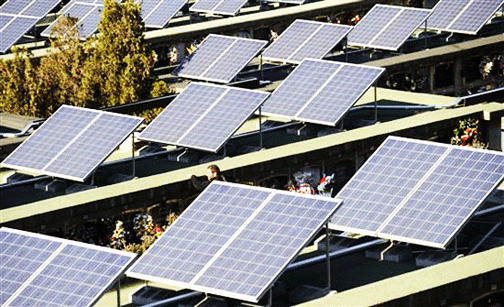
The proof is in the heating – solar’s shining success story, SMH, Martin Green January 21, 2012 Something extraordinary happened to the German national power grid during the pleasantly mild early weeks of last summer. Not only did the country’s almost 1 million, mainly rooftop (photovoltaic) solar panels pump 13.2 gigawatts into the grid – the equivalent output of up to a dozen nuclear power plants, or about 40 per cent of the highest-ever demand in Australia’s national electricity market – but they did so at exactly the right time.
That is, when demand was peaking. Whatever variability there might have been in the output of individual solar panels, due to shadowing, passing clouds or local rain, was smoothed out by the geographic range and sheer number of panels nationwide.
What the German experience demonstrates is that the stars are aligning for conventional roof-mounted solar, or photovoltaic (PV) panels, as a reliable and increasingly competitively-priced power source to make a significant contribution to electricity generation.
For many reasons – including the phenomenal uptake of PV panels in Germany, the economies of scale driven by mass production of panels in China, and increasingly efficient solar arrays – prices really are down. Continue reading
Solar energy can power your electronic book, iPad, iPhone, other mobile phones and USB devices
 Solar Panel Cover For The Kindle E-reader, by Energy Matters, 9 Jan 12 Using solar energy to provide power for hand-held devices has huge potential and while solar panels embedded in mobile phones mightn’t be much chop (yet) in terms of performance; it seems a new solar cover for the Kindle e-reader delivers.
The SolarKindle, weighing just 215 grams, incorporates a flexible, lightweight triple junction amorphous solar panel and is able to provide some level of charging even in the shade. A one hour charge in direct sunlight can provide almost three days worth of reading time according to the company that created the device, SolarFocus Technology.
After fully charging the Kindle, the solar panel automatically switches to charge the SolarKindle’s 1500mA reserve battery. A fully charged reserve battery requires around eight hours of direct sunlight and provides up to 80% of backup power to the Kindle.
However, bearing in mind that Australia’s sunshine and temperatures can be extreme during summer, perhaps sticking your SolarKindle enshrouded e-reader out in the sun on a 40 degree day for extended periods may be unwise.
The SolarKindle also incorporates an 800 lux LED reading lamp. If the reserve battery is used for lighting alone, it can power the light for up to 50 hours. An LED indicator incorporated in the SolarKindle shows battery power level and status of charging and discharging.
The SolarKindle can be purchased online for around AUD $80, plus delivery.
SolarFocus was named an International CES Innovations 2012 Design and Engineering Awards Honoree for its SolarKindle Lighted Cover. The company says it holds several solar technology patents with their products used in extreme environments such as the Himalayas and the North Pole.
SolarFocus also manufactures a folding solar charger for the iPad, iPhone, other mobile phones and USB devices called the SolarMio Pro. While certainly not as compact as the embedded solar panel Nokia recently trialed, the 5 watt SolarMio Pro watt system can provide 6 hours of talk time on the iPhone 3Gs with just an hour of solar charging.. http://www.energymatters.com.au/index.php?main_page=news_article&article_id=1972
Community solar energy for Australia – Mallacoota shows the way
 While these types of schemes are still relatively uncommon in Australia, a popular method of using the power of collaboration to install solar here is the solar buyers group. Consisting of people within a local area, these groups use their collective clout to secure better pricing for installing solar panels on their own rooftops…
In an initiative led by local resident Jim Sakkas, the community banded together to form a solar buyers group and since that time, close to one hundred solar power systems have been installed in Mallacoota by national solar solutions provider Energy Matters under the model.
A Co-operative Approach To Going Solar, by Energy Matters, 6 Jan 12, A growing number of people are starting renewable energy schemes in their communities through co-operatives and other forms of collaboration. A recent report from Co-operatives UK and The Co-operative Group states 43 communities are in the process of or already producing renewable energy by investing money to install solar panels, large wind turbines or hydro-electric power in their area.
£16 million has been invested by over 7,000 people in these schemes, which include a £2 million wind farm and a 98kW solar photovoltaic installation on the roof of a brewery.
The report says green economy co-operatives are the most rapidly growing part of the UK co-op sector, jumping 24% since 2008. In addition to these co-operatives’ efforts seeing clean, renewable energy being supplied to their communities, there is also a financial return to participants through the sale of electricity produced.
The co-operative approach covered in the report basically works like this: Continue reading
Solar energy costs, especially small scale, overestimated by 2 Australian agencies
renewable energy is coming down in price and fossil fuels are going up. In a carbon-constrained world, renewable energy is an investment in a lower electricity cost future for all Australians compared to the one they would face without it. Solar power will cost far less and provide far greater benefits over the medium term.”
 Productivity Commission And EUAA Blinkered On Solar by Energy Matters, 3 Jan 2012, Two Australian bodies criticising the cost of solar power have again failed to factor in all the benefits of the technology.
A Productivity Commission report from June this year was widely criticised by the solar power industry and supporters for stating rooftop solar has “generated little abatement for substantially higher cost”.
According to a recent article in The Australian, the backlash saw the Productivity Commission check over its figures recently and the Commissions has revised the cost of the small-scale component of the federal government’s Renewable Energy Target and state-based feed-in tariffs downwards – by tens of millions of dollars.
However, the Productivity Commission continues to dig its heels in relating to small scale solar’s cost generally. Continue reading
Australia’s Energy Minister subtly sabotages photovolcaic solar energy
 Ferguson labeled all clean technologies as expensive and requiring subsidies, however the figures in the white paper, concerning photovoltaics, are more than 12 months old and do not reflect the rapidly falling cost of photovoltaics.
Australian energy “white paper” neglects PV potential, PV Magazine, 14. DECEMBER  2011, BY: JONATHAN GIFFORD A strategy document released this week, on Australia’s energy future, seems to have
  overlooked the potential of photovoltaics in the country. Instead the report focused on unproven technology, like carbon capture and storage, and leaving the door open for thedevelopment of nuclear power stations.
The Australian Federal Government has released a draft energy “white paper” in an attempt to develop a clearer energy policy direction for the nation. While “accelerating cleaner energy outcomes” is identified as one of the policy priorities, it appears that a major role for photovoltaics has been eschewed in favor of alternative “cleaner” energy technologies, such as carbon capture and storage – forcoal-fired power plants, nuclear and geothermal power. Continue reading
Australian Capital Territory legislates for solar feed in tariff
ACT passes large solar scheme, ABC News, By Kathleen Dyett December 09, 2011 The ACT Government has passed legislation to set-up Australia first large-scale solar feed-in tariff scheme. It will support renewable energy projects with a total capacity of up to 210 megawatts, with the first 40 megawatts to be allocated via an auction.
Large solar facilities that generate 2 megawatts or more will be the first to take part in the auction. The Liberals have slammed the scheme as costly and ineffective. But the Greens negotiated some changes before backing the bill.
Greens MLA Shane Rattenbury says he is happy with the outcome. “The two amendments we’ve agreed with the Government are to first of all ensure that the developments take place within the Australian capital region,” he said.
“The second is to open it up to systems above 200 kilowatts which will predominantly go on rooftops. “We want to make the most of the many rooftops around Canberra that could be used to generate clean, green energy.” http://www.abc.net.au/news/2011-12-09/act-large-solar-tariff-scheme/3721884?section=act
Solar photovoltaics booming on Australian homes
 with high levels of irradiation nationwide, some argue that residential grid parity has arrived, on average, throughout Australia.
Australia’s 500,000 solar homes PV Magazine, 07. DECEMBER 2011 BY: JONATHAN GIFFORD In a report released yesterday at the UN climate negotiations in Durban, the Clean Energy Council of Australia has revealed that more than 500,000 homes in Australia feature photovoltaic systems. The report looked at renewable electricity generation across the board and revealed that power for around four million homes was produced in 2011. This means that the country is well on the way to meet its goal of producing 20 percent of its power through renewable sources by 2020.
The progress of photovoltaics was outstanding, Continue reading
As renewable energy costs go down, Australia should be partnering China in solar development
wind is already cheaper than new-built coal in the US, and solar thermal with storage, and used as a peaking plant, will be competitive with peaking gas.
Australia should be pursuing a more strategic partnerships with China – like that between UNSW and Suntech, the world’s biggest solar PV maker
Why we don’t need coal, Climate Spectator, Giles Parkinson, 1 Dec 11 Last month, the International Energy Agency released a stunning report that suggested that the future of thermal coal exports could be threatened if the world ever decides to implement the policies to limit global warming to an average 2°C, rather than just merely talking about it, as they are doing in Durban this fortnight.
The coal industry laughed, suggesting such a scenario was highly unlikely. But what if technology took the decision out of the hands of politicians, as seems increasingly likely with the plunging costs of renewables, particularly solar PV, across the globe? And what does that mean also for Australia’s energy infrastructure, and the tens of billions of dollars that will be invested in the coming decade on the basis that business will continue as usual?
New forecasts from China suggest the cost of solar PV in that country will fall below that of coal-fired generation within 10 years. From that point, or even before, says Wu Dacheng, the vice chairman and secretary general of the China Photovoltaic Society, the country’s energy build out will be dominated by cheaper renewables. Continue reading
Small solar power thriving in Australia – the top 10 solar postcodes
Australia’s Top 10 Small Scale Solar Power System Postcodes, by Energy Matters, 21 Nov 11 Over half a million small scale solar power systems are now installed around Australia, adding up to more than a million kilowatts of solar electricity generation capacity. Is your postcode among the top ten for solar in the country?
In May this year we reported on Australia’s top solar towns and suburbs in terms of system installations as a percentage of households. We’ve compiled the following new top 10 list based on figures extracted from data recently released by the Office Of The Renewable Energy Regulator (ORER), showing the Australian postcodes with the largest numbers of small scale solar energy systems* installed.
The top 10 small scale solar power Australian postcodes as of September 2011 are (in descending order of number of systems installed):
1. Postcode 6210 – Western Australia – 3,643 systems – 6,270.317 kW capacity
Postcode 6210 incorporates Coodanup, Dudley Park, Erskine, Falcon, Greenfields, Halls Head, Madorah Bay, Mandurah (+ DC, East and North), Meadows Springs, San Remo, Silver Sands and Wannanup.
2. Postcode 4551 – Queensland – 3,184 systems – 5,545.973 kW capacity
Postcode 4551 incorporates Aroona, Battery Hill, Bells Creek, Caloundra (+ BC, DC and West), Currimundi, Dicky Beach, Golden Beach, Kings Beach, Little Mountain, Meridan Plains, Moffat Beach, Pelican Waters and Shelly Beach)
3. Postcode 2830 – New South Wales – 3,141 systems – 5,672.010 kW capacity
Postcode 2830 incorporates Ballimore, Barbigal, Beni, Boothenba, Brocklehurst, Bruah, Bunglegumbie, Burrabadine, Butler Falls, CoolBaggie, Cumboogle, Dubbo (+DC, Grove, East and West), Eschol, EuloMogo, Glengerra and Goonoo Forest.
4. Postcode 4655 – Queensland – 3,036 systems – 6,243.677 kW capacity…….
http://www.energymatters.com.au/index.php?main_page=news_article&article_id=1886
An unexpected green upside to new USA military base in Australia?
 When the case for renewables is made on the grounds of national security, the arguments of climate denialists and delay merchants are bombed back to the Stone Age. ….
as the U.S. Marine Corps demonstrates, energy conservation and renewable energy are now critical national security concerns.
 Will President Obama Send Green Marines to Darwin?, Renewable Energy World, By Dan Cass ,November 18, 2011 President Barack Obama was in Australia this week and upset China and Indonesia with the annoucement of an increased military presence in this country, including 2500 US Marines to train and provision equipment in Darwin.
When the U.S. Marine Corp establish themselves a new home in Darwin, they will bring some seriously green equipment and ideas to our shores. This is because in the three years of his Presidency, Barack Obama has actively led the U.S. Department of Defense to embrace renewable energy and a strategic awareness of climate change…. Continue reading
Rapidly falling costs for rooftop solar PV mean that Australia is poised for a solar boom
a significant threat to the energy incumbents, particularly in the coal and gas industries, because it would reduce opportunities for new deployment and eat into their earnings because of the impact of solar and other short run marginal cost technologies in the so-called merit order effect (more on that tomorrow). It would also come as a shock to the government,
Suntech calls an Australian solar boom, Climate Spectator, Giles Parkinson, 17 Nov 11 Suntech, the world’s largest solar manufacturing company, has produced stunning forecasts for the solar PV industry in Australia – saying it could supply 5 per cent of the nation’s power demand by the end of this decade, reaching the target three decades ahead of the federal government’s most recent forecast.
Stefan Jarnason, the technical director of Suntech Australia, says solar PV capacity in Australia could reach 10 gigawatts by 2020, when it would be growing at a phenomenal 2GW a year. He bases these forecasts on rapidly declining costs, which mean electricity from rooftop PV that is already cheaper than coal-fired energy delivered by energy retailers in some parts of the country, will reach parity for commercial users around 2015, and parity for utility-scale developments towards the end of the decade.
It’s just a forecast, but it represents a growing realisation within and without the industry that in a very few years the rollout of solar PV will be dictated less by the scale of financial incentives – because it might not need much – but by the scale of regulatory protection for the current energy suppliers, because they might need all the help they can get. Continue reading
Australian Capital Territory will have solar feed in tariff for both small and commercial systems
Small scale solar power in Canberra is also still being supported through a 1:1feed in tariff. Solar households in Canberra and the A.C.T are rewarded for any surplus electricity generated by their systems; which is purchased by ActewAGL Retail at the customer’s electricity tariff rate.
Big Solar To Benefit From Feed In Tariffs In Canberra, by Energy Matters, 17 Nov 11 The ACT Labor Government will today table legislation in the Territory’s Legislative Assembly to support development of large scale solar power facilities in Canberra. Minister for Environment and Sustainable Development Simon Corbell says the Electricity Feed In (Large Scale Renewable Energy Generation) Bill 2011 is the first time a feed in tariff for commercial scale solar power has been proposed by an Australian government.
“The Bill establishes the framework for a feed in tariff ‘reverse auction’ to award support for at least two large scale solar generation plants capable of powering 7000 Canberra homes. This reverse auction process will require companies to provide a detailed proposal to the ACT Government about how they can provide the greatest amount of renewable energy at the lowest cost to Canberrans.” Continue reading
Well planned feed in tariffs are the way to promote renewable energy
 a number of studies, including those carried out for the European Commission, have found well-designed and well-implemented feed in tariffs are the most efficient and effective support policies for promoting renewable energy generated electricity.
IPCC Report Supports Feed-In Tariffs, Renewable Energy news, by Energy Matters 08 NOVEMBER, 2011 Australian states without solid feed in tariff programs or reviewing their current arrangements should take note of the Special Report on Renewable Energy Sources and Climate Change Mitigation published by the Intergovernmental Panel on Climate Change (IPCC).
Small scale solar energy farms the obvious choice for rural Western Australia
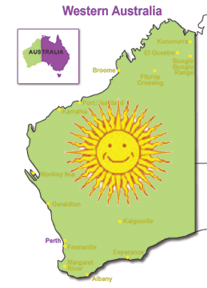 Sun to rise on solar farms, ABC Rural News, By Jo Prendergast , 08/11/2011 The increasing cost-effectiveness of solar energy could see more solar power plants established in regional Australia. The nation’s first utility-scale solar farm is under construction near Geraldton in Western Australia.
Rob Bartrop, from developer First Solar, says decreasing set-up costs mean solar has become competitive with other renewable forms of energy. “A lot of smaller communities throughout Western Australia and indeed Australia rely on diesel generation, which aside from being a very high emitter of greenhouse gases is roughly twice as expensive as solar electricity today,” he said.
“So we see that small scale solar farm market as really the low hanging fruit and the obvious choice.” http://www.abc.net.au/rural/news/content/201111/s3359039.htm
Silex solar project loss, and laser uranium enrichment problems
 I don’t know about you, but I’ve never been happy about Silex Systems getting government backing for its solar project. I know that these nuclear-related companies like to have a bet each way – in case the nuclear industry goes pear-shaped.
But it seems to me that there’s not much incentive for them to develop renewable energy, when their real stuff is in the nuclear industry. As with Silex’s dangerous laser enrichment technology – now being used by GE Hitachi in America. And there are questions there – with the American facility having 45 security violations! -Christina Macpherson
Silex downplays $30 million loss, A,BC News, 25 Oct 11 A company developing a major solar project in north-west Victoria says it is in a strong financial position, despite posting a $30 million loss in the past year.
Silex is developing power stations near Mildura using photovoltaic technology. The company has posted its annual report, including a net loss of $31.5 million….. http://www.abc.net.au/news/2011-10-24/silex-posts-30m-loss/3597688
1 This month
15 April – Zoom –Nuclear Power is Not the Solution
Apr 15, 2026 01:00 AM in Canberra, Melbourne, Sydney

Join the International Physicians for the Prevention of Nuclear War (IPPNW) on Tuesday, April 14th for a timely webinar exploring the risks associated with nuclear power and challenging the myth that it offers a simple, safe, carbon-free solution to the climate crisis

of the week – Australians for War Powers Reform (AWPR)
To see nuclear-related stories in greater depth and intensity
 Antinuclear