Why bet on a loser? Australia’s dangerous gamble on the USA
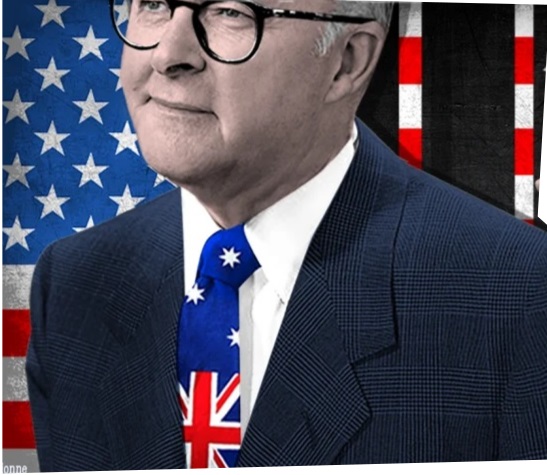
June 15, 2024, by: The AIM Network, By Michael Williss, https://theaimn.com/why-bet-on-a-loser-australias-dangerous-gamble-on-the-us/
A fresh warning that the US will lose a war with China has just been made by a US data analytics and military software company with US Department of Defense contracts.
It seems no-one is prepared to back the US to win a war with China, so why is Australia going all-out to align itself with provocative moves and hostility from the US directed at China?
Govini released its latest study of US capacity to fight China in June. Its annual reports measure the performance of the US federal government, looking at 12 top critical national security technologies through the lens of acquisition, procurement, supply chain, foreign influence and adversarial capital and science and technology.
It concluded that it is nearly impossible for the US to win a war against the PLA if a conflict were to break out between the two global superpowers.
The report also found that China has more patents than the US in 13 of 15 critical technology areas, further demonstrating how the US is falling behind in AI development.
“This year’s report also highlighted another reason a US conflict with China could be unwinnable: the very real possibility of parts scarcity.”
It identified serious risks within seven major DoD programs, including the cornerstone of AUKUS, namely the Virginia-class submarines. Not that this will worry the cargo-culters in Canberra who keep throwing billions at the fraught arrangement.
Another factor was China’s lead in the global supply chains.
-ADVERTISEMENT-
Govini CEO Tara Murphy Dougherty said:
”China still has a dangerously high presence in US government supply chains. The Departments of the Navy and Army showed a decreasing reliance on Chinese suppliers over the past year, however, the Department of the Air Force showed a 68.8 percent increase in the usage of Chinese suppliers.”
Govini’s report adds to a number of similar scenarios in recent years, starting with the headlined warning by The Times on May 16, 2020 “US ‘would lose any war’ fought in the Pacific with China.”
In the New Atlanticist, Lieutenant Colonel Brian Kerg, an active-duty US Marine Corps operational planner, critiqued biases in modern US war games, in which military planners command opposing armed forces in simulated warfare. He writes that instead of a short, sharp war over Taiwan with a win for the US, as predicted by war games, the greater likelihood is one of a years-long war with China with uncertain outcomes. One of those, too terrible to contemplate, must be the likelihood of Chinese retaliation against Australia for joining the US, for being fully interoperable with its military, and the consequent rubbleisation of Australian cities and attacks on US military bases here.
Retired US Army Colonel Dr John Mauk agrees that any conflict over Taiwan will almost certainly be a prolonged war, and he says that it would be one that favours China. He writes:
“U.S. military forces are too small, their supply lines are too vulnerable, and America’s defense industrial capacity is far too eroded to keep up with the materiel demands of a high-intensity conflict. Another critical factor undermining U.S. capacity to sustain a war is that Americans lack the resilience to fight a sustained, brutal conflict.”
By contrast, China is well-postured to sustain a protracted high intensity war of attrition.
He says that the current political divide in the US impedes its ability to respond to national security crises, and that:
“Americans in general are unprepared for, unwilling, or incapable to perform military service. Short of reinstituting a draft, U.S. military services cannot attract or retain enough manpower quickly enough to sustain a fight with China.”
Former US assistant secretary of state for Europe and Eurasia, A. Wess Mitchell, believes that “United States is a heartbeat away from a world war that it could lose.” He writes that:
“… today’s U.S. military is not designed to fight wars against two major rivals simultaneously. In the event of a Chinese attack on Taiwan, the United States would be hard-pressed to rebuff the attack while keeping up the flow of support to Ukraine and Israel.”
Comparing US and Chinese naval growths, Mitchell says that the US is no longer able to “outproduce its opponents”. With US debt already in excess of 100% of GDP, he says that the debt loads incurred through war with China would risk catastrophic consequences for the U.S. economy and financial system.
He raises the possibility of a Chinese fire-sale of US debt:
“China is a major holder of U.S. debt, and a sustained sell-off by Beijing could drive up yields in U.S. bonds and place further strains on the economy.”
Hillary Clinton raised this quandary facing the US with then PM Kevin Rudd in 2010 when she asked him “How do you deal toughly with your banker?” It is a question that the US has yet to find an answer to.
And questions there are. Harlan Ullman, a senior adviser at the Atlantic Council, opens a January 2024 article with the observation that:
“Since World War II ended, America has lost every war it started. Yes, America has lost every war it started – Vietnam, Afghanistan and the second Iraq War.”
He sounds a warning:
“… given likely weapons expenditure rates should a war with China erupt, the U.S. has the capacity for about a month before, as in Ukraine, it runs out of inventory,” before asking his questions: “War with China would be a strategic catastrophe. The U.S. has not explained how such a war could be fought and won. The economic consequences would be disastrous. And how would such a war end? Can anyone answer these questions?”
China is quite adept at utilising sentiments such as these. Major Franz J. Gayl, a retired Marine Corps infantry officer has regularly written for Chinese online news outlet Global Times. Last year, a number of his contributed articles to GT were published as a book, “The United States Will Lose the Coming War with China” which is available on Amazon.
Australia’s Liberal-Labor pro-US coalition has placed a $368 billion bet on the ability of the US to prevent the expansion of Chinese influence in the South Pacific or its recovery of the island province of Taiwan.
It is an expensive way to be taught the African proverb that when the elephants dance, it is the grass that suffers.
Biden signs $95bn aid bill to be sent ‘right away’ – for wars in Ukraine, Israel, and provocations in Taiwan

SOTT – Signs of the Times, BBC, Wed, 24 Apr 2024
US President Joe Biden has signed a $95bn (£76bn) package of aid for Ukraine, Israel and Taiwan.
“It’s going to make America safer, it’s going to make the world safer,” he said after signing the bill into law.
The president said the US would “right away” send fresh weapons and equipment to Ukraine to help Kyiv fend off Russian advances.
Comment: The West has depleted much of its weapon stocks, so much of the money is to go to US weapons manufacturers to actually make the weapons, first.
He spoke a day after the US Senate approved the aid package following months of congressional gridlock.
Ukraine has recently stepped up its calls for Western assistance as Russia makes steady gains in its invasion.
Included in the package is $61bn in military aid for Ukraine. It passed the Senate in a bipartisan vote of 79-18.
Tuesday evening’s approval came after the measurepassed the US House of Representativeson Saturday.
Democratic Senate Majority Leader Chuck Schumer said: “After more than six months of hard work and many twists and turns in the road, America sends a message to the entire world: we will not turn our back on you.”
Comment: They will, however, turn their backs on their own citizens.
Reacting to the vote, Ukrainian President Volodymyr Zelensky said it “reinforces America’s role as a beacon of democracy and leader of the free world”.
The Senate passed a similar aid package in February, but a group of conservatives who oppose new Ukraine support had prevented it from coming to a vote in the House of Representatives.
Last week, Democrats and Republicans in the lower chamber joined together to bypass this opposition.
They ultimately agreed to a package bill that included the foreign aid as well as legislation to confiscate Russian assets held by Western banks; new sanctions on Russia, Iran and China; and a provision that will force the Chinese company ByteDance to sell the popular social media service TikTok.
Comment: The theft of Russian assets will backfire, both with Russia’s retaliation, and global investors who will be reluctant to operate in the US; as will the sanctions; and the control of TikTok only further serves as proof of America as a surveillance state
In the House on Saturday, a majority of Republicans in the chamber voted against the foreign aid package.
The bill also faced resistance among a handful of Senate Republicans who opposed any new aid to Ukraine.
Fifteen voted with two Democrats – as well as independent Senator Bernie Sanders who objected to providing new offensive weapons to Israel – against the bill.
“Pouring more money into Ukraine’s coffers will only prolong the conflict and lead to more loss of life,” Republican Senator Tommy Tuberville said in remarks on Tuesday.
“No-one at the White House, the Pentagon, or the state department can articulate what victory looks like in this fight.”
The aid package is expected to provide a significant boost to Ukraine’s forces, which have suffered from a shortage of ammunition and air defence systems in recent months.
On Tuesday, Ukraine’s second city, Kharkiv, faced the latest in a series of recent drone and missile strikes, with authorities saying two people in a residential neighbourhood were injured.
The commander of Ukraine’s National Guard, Oleksandr Pivnenko, said he was expecting an attempt by Russian forces to advance on the city, which is near the Russian border.
Between February 2022 and January 2024, the US gave Ukraine more than $40bn in military aid, according to German research organisation, the Kiel Institute.
Comment: The EU has allocated 50 Billion euros of taxpayers money.
Aid for Israel and Taiwan
The foreign aid package passed on Tuesday also allocates $17bn to Israel, as well as $9bn for civilians suffering in conflict zones around the world, including Palestinians in Gaza.
Comment: So $17 billion to wage genocide, less than a few billion for those suffering from it?
Israeli Foreign Minister Israel Katz reacted to the vote by thanking congressional leaders for their “unwavering commitment to Israel’s security”.
“Israel and the United States stand together in the fight against terrorism, defending democracy and our shared values,” he said.
The US already provides Israel with $3.8bn in military aid each year.
Over in Asia, a Chinese government spokeswoman called the military aid for Taiwan a “serious violation of the one-China principle” that would “send the wrong signal to the pro-independence separatist forces” in Taiwan.
“We urge the US to take practical actions to fulfil its commitment not to support Taiwan independence by not arming Taiwan in any way,” she said.
Taiwan’s incoming President William Lai said the aid package would “strengthen deterrence against authoritarianism”.
Taiwan is a self-governing island and considers itself distinct from China, but Beijing views it as a breakaway province and hopes to bring it back under its own control.
TikTok ban
The national security package also includes a provision that could lead to a nationwide ban on TikTok………………….. more https://www.sott.net/article/490878-Biden-signs-95bn-aid-bill-to-be-sent-right-away-for-wars-in-Ukraine-Israel-and-provocations-in-Taiwan
Japanese food imports found with radioactive residues in Taiwan destroyed
Importers advised to return or destroy radioactive contaminated foods, though risk low

September 15, 2022
TAIPEI (Taiwan News) — Taiwan’s food authorities said Wednesday (Sept. 14) radioactive isotopes have been detected in six food samples from Japan this year.
Traces of cesium-137 were found in foods including konjac powder, blueberry juice concentrate, shiitake mushrooms, shiitake mushroom powder, and maitake mushrooms. The contaminated food products were imported from Gunma, Tokushima, Nagano, Yamagata, and Tottori prefectures, between March and August, wrote CNA.
Taiwan lifted the ban on food produced in five prefectures affected by the 2011 Fukushima nuclear disaster in February, which are Fukushima, Chiba, Gunma, Ibaraki and Tochigi. The konjac powder from Gunma was the first radioactive contaminated product inspected from these areas since the removal of the ban.
Wu Shou-mei (吳秀梅), director general of the Food and Drug Administration, said while the radiation levels of the questionable goods did not exceed those imposed by Taiwan, all were returned or destroyed by the importers at the advice of the authorities. The practice is in line with a resolution passed by the legislature, she added.
The scrapping of the ban has caused a stir in the public over food safety. The Tsai administration has promised vigorous inspection and the implementation of radiation standards on food imports stricter than those of the U.S. or EU.
1 This month

of the week – Australians for War Powers Reform (AWPR)
To see nuclear-related stories in greater depth and intensity
 Antinuclear