5 November Protest weapons manufacturer conference in Canberra.
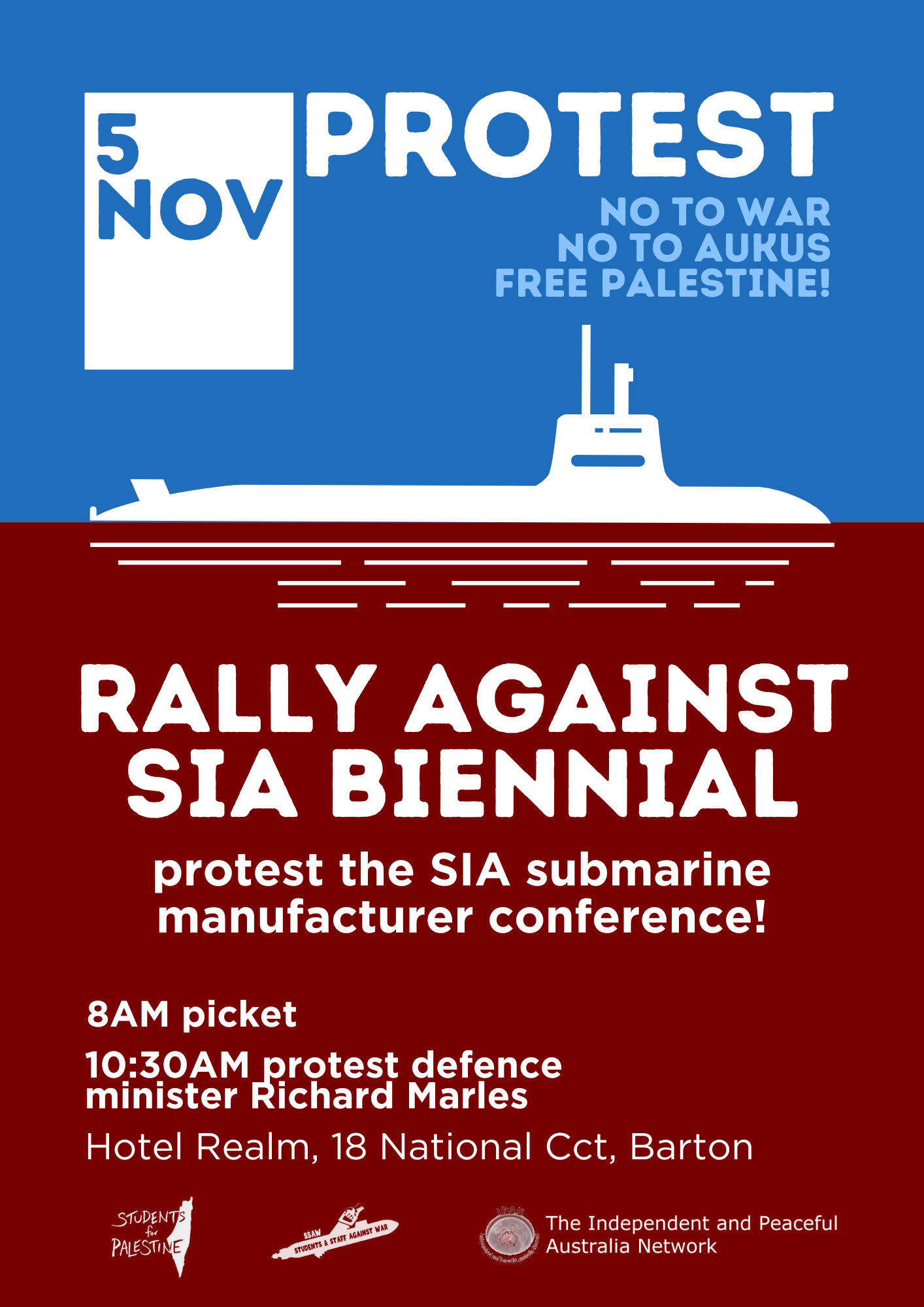
Defence minister Richard Marles will be in attendance – picket the conference starting 8am, Marles speaking at 10:30am, Hotel Realm, Barton.
Canadians are waking up to the nuclear scam. Why are the media and other nations pretending that nuclear is just dandy?

I do read quite a few criticisms of the nuclear industry, from various non-profit groups. But lately, there’s a whole heap of them from Canada. And the unnerving thing is that these pesky Canadians are giving “chapter and verse” – facts and figures on how bad things really are, for the nuclear industry.
Of course, the Canadian, and indeed, the global nuclear lobby too, are pretending not to notice this. (But they must be a tad worried, lest too many intelligent people in other countries catch on to this annoying attention to detail)
Susan O’Donnell writes about New Brunswick’s nuclear fantasies – the history of successive governments pouring tax-payers’ money into “advanced” reactor designs that are known by reputable scientists to be commercially unviable. -The Higgs government passing legislation forcing NB Power to buy electricity, at any price, from SMRs if they are ever built and actually work.
The companies involved have been unable to entice private investors, and are unlikely to get federal funding. NB Power’s $5.4-billion debt is mainly due to the poor performance of its Point Lepreau nuclear reactor. New Brunswickers are facing a 19.4 per cent increase in electricity rates. “Keeping the Point Lepreau and SMR fantasies alive will require considerable effort from the new government. “
Another recent example – from the Seniors for Climate Action Now! (SCAN):
They point out :
- the scandal-ridden nuclear history.
- the revolving door between government officials and nuclear industry well-paid jobs.
- the government/industry nuclear pitch to NATO- “Ontario is selling itself as the nuclear North Star to guide the direction of American power”.
- the failure of theNuScale SMR project.
- OPG’s lengthy submission on small nuclear reactors is full of the things that could go wrong.
- the over $40billion cost of refurbishing old end-of-life reactors.
- New nuclear reactors at over $60billion
They raise such awkward questions about “Ontario’s journey to becoming an energy superpower”

But then, I forgot that this comes from Seniors. And I’ve just remembered that the nuclear industry is all about the young cool and trendy.
There are so many views from Canadians exploding the nuclear propaganda. And they’re not all old fogeys.
Low-level nuclear waste from submarines to be stored at Osborne, South Australia
Adelaide Now, 30 Oct 24
Legislation passed will see a “radioactive waste facility’’ built in an Adelaide suburb, but federal and state ministers maintain it will only house “low level’’ material. Have your say.
Low-level radioactive waste generated by the building of the AUKUS nuclear submarines will be stored at Port Adelaide after legislation passed the federal parliament allowing for the construction of a “waste management facility’’.
However federal Defence Minister Richard Marles and his state counterpart Stephen Mullighan both denied any “intermediate’’ or “high-level” waste will be stored at the Osborne submarine facility, in Adelaide’s western suburbs
A spokesperson for Mr Marles said “submarine construction, test and commissioning activities planned for Osborne will generate small amounts of low-level radioactive waste’’, including personal protective equipment.
“This low-level radioactive waste will need to be managed and temporarily stored in a licensed facility,’’ the spokesperson said. “No intermediate-level waste or high-level radioactive waste (spent nuclear fuel) will be managed or stored in the facility.’’
Both the Albanese Labor government and the Peter Dutton-led Liberal opposition voted in favour of the Australian Naval Nuclear Power Safety Bill. The Bill ‘’regulate activities relating to conventionally armed, nuclear powered submarines’’.
Do you support a “radioactive waste facility’’ being built at the Osborne submarine base
Yes: It’s the right spot for it
69 %
No, I don’t want it anywhere in SA
31 %
563 votes
It names Osborne as a “designated zone’’ where “a facility for managing, storing or disposing of radioactive waste’’ could be built. The legislation does not specify what level of radioactive waste could be stored.
The legislation has sparked a community backlash, with a change.org petition started by former Liberal candidate Jake Hall-Evans already reaching almost 4000 signatures.
Mr Hall-Evans said there had been a lack of transparency about the possibility of a nuclear waste dump at Osborne.
“The people of Port Adelaide were promised submarine jobs, not a nuclear waste dump,’’ Mr Hall-Evans said.
He said Australia had struggled to find a suitable location for low-level radioactive waste, with a proposed facility at Kimba on the state’s Eyre Peninsula knocked back last year.
Premier Peter Malinauskas also opposed the dump at Kimba.
South Australian Greens Senator Sarah Hanson-Young said the new law was a “dangerous disaster for our state’’.
“This is toxic for South Australia,’’ Ms Hanson-Young, who is holding a nuclear forum at the Burnside Town Hall in the marginal seat of Sturt on Thursday.
“Peter Dutton not only wants nuclear reactors across Australia – he wants Adelaide to be an international dumping ground for nuclear waste,’’ she said.
A spokesperson for Port Adelaide Enfield Council said it had “not been consulted or advised of any licences being approved for a radioactive or nuclear waste storage site at Osborne’’.
Defence Minister Stephen Mullighan said there was “no proposal or capacity for nuclear waste, including low-level waste to be stored in the long term’’. term’’.
Yeah, Yeah, United Nations Relief and Works Agency (UNRWA) Is Hamas. Everyone Israel Hates Is Hamas.
Caitlin Johnstone Oct 30, 2024, https://www.caitlinjohnst.one/p/yeah-yeah-unrwa-is-hamas-everyone?utm_source=post-email-title&publication_id=82124&post_id=150919007&utm_campaign=email-post-title&isFreemail=true&r=1ise1&triedRedirect=true&utm_medium=email
The Israeli Knesset has banned UNRWA, an absolutely critical agency for getting humanitarian aid into Gaza, with the architect of the bill saying this was happening because “UNRWA equals Hamas”.
In addition to everything else this genocide has been, it’s been a colossal insult to our intelligence. UNRWA is Hamas. Hospitals are Hamas. Journalists are Hamas. Civilian infrastructure is Hamas. Ambulances, schools and mosques are Hamas. The women and babies — okay maybe they’re not technically Hamas, but Hamas is definitely hiding behind them and using them as human shields.
We are asked to believe self-evidently idiotic things, and if we don’t, we get called Nazi Jew-haters. We are being asked to turn ourselves into empty-headed morons to advance the information interests of a foreign state that’s allied with our government. Stupidity is being framed as a sign of patriotism. Gullibility is being framed as a sign of rejecting antisemitism. In this morally bankrupt and perverse civilization, the noblest thing you can be is a blithering imbecile.
Axios and its Israeli intelligence insider Barak Ravid have penned yet another White House press release disguised as a news story about how “concerned” the Biden administration is about Israel’s actions in Gaza.
“The Biden administration is ‘deeply concerned’ that two bills passed by the Israeli Knesset on Monday will exacerbate the already dire humanitarian crisis in Gaza and harm Palestinians in East Jerusalem and the West Bank,” Ravid writes.
Oh shit you guys the Biden administration is deeply concerned that Israel is doing something bad in Gaza! You’re in trouble now, Bibi!
Like I said. Just one nonstop insult to our intelligence
CNN has issued an apology after its panelist Ryan Girdusky told fellow panelist Mehdi Hasan “I hope your pager doesn’t go off” after Hasan said he supports Palestinians. Israel supporters have been directing this “hurr hurr you should be murdered with an explosive pager” wisecrack at Israel’s critics for weeks, and apparently Girdusky just forgot where he was in the heat of the moment.
CNN was like, This network is shocked and appalled that our panelist joked about murdering a British Muslim journalist with an explosive beeper. That kind of language is only appropriate when directed at Muslims who live in the middle east.
Per the rules of the western empire you are a religious extremist if you want to fight against an occupying force who has been abusing you your entire life, but you are not a religious extremist if you want to carpet bomb the middle east to help fulfill a Biblical prophecy.
❖
MSNBC’s Rachel Maddow is back to pushing her “Russians are interfering in the US election” narrative, so we know what we’ll be hearing again if Kamala loses. No matter who wins we can expect a bunch of outraged shrieking from the other side that the election was unfairly stolen from them.
The US presidential race is very openly a contest between two oligarch-owned Zionist war whores, and yet after the results are announced next week you’re still going to hear half the country going “OMG election interference! The election was stolen from us!”
It already was, you dopes. It was stolen before the race even started. The rest is just narrative.
I sure hope all the US progressives who obediently stopped talking about Gaza these last couple of months remember to start that thing up again after the election is over.
❖
I’m just gonna say this ahead of time so it’s out there: you don’t get to campaign on continuing a genocide and then blame other people when you lose. That is not a thing.
❖
“Trump will be worse on Gaza” is such an obnoxiously dishonest argument. It’s completely unfalsifiable and can’t even be tested after the election since abuses keep getting worse in Gaza anyway, and it’s based on nothing but the claim that very vague statements made by Trump prove he’ll facilitate Israeli atrocities more than the current administration already has been. It’s completely empty narrative fluff with no basis on the facts in evidence.
There are all kinds of legitimate cases to be made that Harris would be a little bit better than Trump on some aspects of domestic policy and the environment, but there is no case whatsoever to be made that he’ll be worse on Gaza than the administration that’s already committing genocide there. He could be worse, he could be a bit better, or he could be exactly the same. There’s no way to know, and there won’t be any way to know in a universe where we can’t observe alternate realities to compare what each presidential candidate would have done if they’d won. It’s an entirely unanswerable question that people are just pretending to know the answer to.
Harris and the Democrats have repeatedly attacked Trump for not starting a war with Iran when he was president. She criticized him for making John Bolton sad when he refused to bomb Iran. How is that less insanely pro-Israel than anything Trump has said?
If you want to argue that Harris will be better on reproductive rights or something then go ahead, but when it comes to Gaza don’t piss on my leg and tell me it’s raining.
Nuclear submarine shipyard fire at Barrow-in-Furness leaves two in hospital
Josh Halliday Hannah Al-Othman and Jasper Jolly Guardian, 31 Oct 24
Two people have been taken to hospital after a “significant” fire broke out at BAE Systems’ nuclear submarine shipyard in Cumbria.
Residents said they saw huge flames and smoke billowing from the complex in Barrow-in-Furness, where the UK’s new multi-billion-pound Dreadnought submarines are being built.
Cumbria police said there was no nuclear risk but two people were taken to hospital for suspected smoke inhalation. Police said: “At this time there are no other casualties and everyone else has been evacuated from the Devonshire Dock Hall and are accounted for.”
BAE said the two people taken to hospital were workers at the site and they have since been discharged. About 200 people were working on a night shift at the time the fire broke out.
…………………………………………………………….. Four nuclear submarines from the Dreadnought class are being built there as part of a £31bn programme, which is due to replace the Vanguard submarines in the early 2030s. The last of the Royal Navy’s seven new nuclear-powered submarines, part of the Astute class, is also being built at the site.
It is understood that the boat in the hall is HMS Agincourt, whose completion had already been delayed to 2026. The previous Astute class, HMS Agamemnon, was launched last month. It remains unclear whether any submarines were damaged by the fire.
The MoD has been contacted for comment. Cumbria fire and rescue service said an investigation into the cause of the fire was under way.
Police on Wednesday advised residents to keep doors and windows closed, having earlier instructed people to stay indoors. Motorists in the area have also been told to close their windows, air vents and sunroofs and turn off fans and air-conditioning units.
It is understood that the warning was because of the risk of particles, such as those from metals, being released in the air from the heavy industry site, where sophisticated extraction techniques are normally in place.
BAE Systems reportedly told non-essential staff working at Devonshire Dock Hall to work from home on Wednesday, while the BBC reported that staff turning up for their shifts were confused as to which parts of the 25,000 sq metre site was accessible.
Shares in BAE Systems fell as much as 2% in morning trading after news of the fire, making it one of the biggest fallers on the FTSE 100 index of blue-chip companies.
A BAE Systems spokesperson said: “The area around the Devonshire Dock Hall has been evacuated and everyone has been accounted for. Two colleagues were taken to hospital having suffered suspected smoke inhalation and have both since been released.”
It is understood that the company will launch an investigation into the cause of the fire. The rest of the site remains open and operating normally.
Additional reporting by Dan Sabbagh
https://www.theguardian.com/business/2024/oct/30/nuclear-submarine-shipyard-fire-at-barrow-in-furness-leaves-two-in-hospital
BAE Systems fire: blaze at shipyard ‘could delay Aukus’
Building schedule of new fleet could be set back, experts warn, as two taken to
hospital after blaze breaks out at facility in Cumbria. Investigators are
still trying to determine the cause of a massive fire at a nuclear
submarine shipyard in Cumbria that analysts warned could delay the delivery
schedule of new boats for Australia as part of the Aukus pact.
Times 30th Oct 2024
Australian Civil Society Statement for COP29 Baku, Azerbaijan

(from Scott Ludlam, on behalf of numerous, and increasing number of Australian civil groups)) 30 Oct 24
We, the undersigned Australian Civil Society organisations are united in support for the global clean energy transition and opposition to the nuclear industry playing a spoiling role in this transition.
Nuclear power is too slow, costly and inflexible to play any meaningful role in the global decarbonisation efforts. Nuclear also brings unique risks and long-lived wastes.
Given the environmental, economic and human urgency of addressing climate change and advancing the energy transition the nuclear industry must not be allowed to cause the global diplomatic community any further delay.
Australia is moving purposefully away from centralised fossil fuel combustion and toward distributed renewable energy generation and storage. In 2024, 40% of Australia’s electricity is generated from renewable energy. This capacity is proven, delivering and expanding rapidly.
We have been fortunate to learn from the world’s experience with nuclear power. We understand why its role in global energy systems and its contribution to global electricity production has been in decline for decades. Its legacy is one of underperformance, burgeoning cost, intractable health impacts and long-lived radioactive wastes.
Despite this, a coordinated campaign is currently being waged to undermine public support for this decarbonisation effort. The last thing Australia needs now is nuclear distraction and delay.
As the former Australian Chief Scientist Dr. Alan Finkel said, “Any call to go directly from coal to nuclear is effectively a call to delay decarbonisation of our electricity system by 20 years”.
Australia, and the world, cannot afford this delay. We stand resolute in our support for real climate action through the clean energy transition and in our opposition to false nuclear promises.
Ontario’s huge nuclear debt and other things Dutton doesn’t understand about cost of electricity

Unfortunately for us, Dutton and O’Brien are also in a hurry. They think they can deliver nuclear power plants far faster than what many experts believe is sensible and what many countries with far more nuclear experience than ourselves have been able to achieve.
Dutton and O’Brien also want to do this via a government-owned utility, instead of via a competitive market.
ReNewEconomy, Tristan Edis, Oct 30, 2024
All of this has left taxpayers with a massive budget and timeframe blow-out. This is what happens when we leave it to politicians in a hurry to hand pick power projects.
It seems our alternative Prime Minister Peter Dutton’s favourite topic is your electricity bill. Given how much he talks about electricity prices, you’d think he might know a fair bit about what makes up your electricity bill, wouldn’t you?
According to Dutton and his Shadow Energy Minister Ted O’Brien, the problem is all about too much renewable energy in the mix. And their answer to the problem is nuclear power, as well as more gas.
According to Peter Dutton, “We can’t continue a situation that Labor has us on of a renewables only policy because, as we know, your power prices are just going to keep going up under this Prime Minister.”
Instead, according to Dutton, “we could be like Ontario, where they’ve got 60 or 70 per cent nuclear in the mix, and they’re paying about a quarter of the price for electricity that we are here in Australia.”
O’Brien, elaborated on this point by saying:
“We will have plenty of time in due course to talk about the costings [for their nuclear plan] once we release them here in the Australian context. But I point to Ontario in Canada, there you have up to 60 per cent of their energy mix in the grid, coming from zero emissions, nuclear energy. Their households pay around about 14 cents kilowatt hour. There are parts in Australia that will be paying up to 56 cents a kilowatt hour from July 1 this year.”
Once you actually delve into these numbers it becomes apparent that O’Brien and Dutton don’t seem know much about electricity costs and pricing.
But even worse, they don’t know how badly Ontario’s taxpayers and electricity consumers were burnt by their utility racking up huge debt building nuclear power plants equal to $70 billion in current day Australian dollars.
Do Dutton and O’Brien understand your electricity bill?
You can actually look up what Ontario households pay for electricity via the Ontario Energy Board’s bill calculator website.
This provides you with a break down on the charges a typical household faces depending on the utility you choose…………………………………………………
But notice there’s also other very significant items in this bill separate to the kilowatt-hour charge? There’s a “delivery” charge which is the cost of paying for the distribution and transmission poles and wires. There’s also regulatory charges and also their sales tax is known as “HST” rather than GST for us.
So the Ontario 14 cents per kilowatt-hour charge that O’Brien and Dutton are referring to covers only the wholesale energy portion of their bill.
In Australia, we pay a majority of the costs of distribution and transmission in our cents per kilowatt-hour charge, in addition to wholesale energy costs, and then we get GST added on top. O’Brien and Dutton don’t seem to have appreciated this important aspect of electricity pricing in this country, which is different to Ontario.
But it actually gets worse.
I went digging on the official government energy retailer comparison sites- www.energymadeeasy.gov.au and www.energycompare.vic.gov.au and I initially couldn’t find a single Australian retailer selling electricity at 56 cents per kilowatt-hour.
This was based on looking at offers based on a single rate tariff. Then I had a brainwave and looked at time-of-use rates. In Queensland and Victoria I still couldn’t find anyone wanting to charge me 56 cents for the peak period.
But eventually I succeeded. Right at the bottom of the EnergyMadeEasy list of retailer offers – which were ordered from best to worst – sat EnergyAustralia as the worst offer, charging 57 cents for the peak period in South Australia (although with a compensating high solar feed-in tariff of 8.5 cents)…………………………………
To help out O’Brien and Dutton, I’ve prepared the table below which provides a proper apples versus apples comparison (as opposed to apples vs peak rate bananas) –[on original ]
…………………………………………….. Ontario’s nuclear debt debacle
Yet this comparison between Ontario and Australia misses a far more important part of the story that O’Brien and Dutton seem to be blissfully ignorant of.
That is the history of the Ontario’s state owned utility – Ontario Hydro – and the unsustainable level of debt that it racked up over the 1980’s and 1990’s as a result of an ambitious nuclear plant construction program that went wrong.
While this cost is no longer apparent in current electricity prices, Ontario businesses and households were stuck with paying back CAD$38.1 billion in debt (over $70 billion in Australian current day dollars) for more than 35 years after their public utility committed its last nuclear reactor to construction in 1981.
So what went wrong?
In anticipation of large growth in electricity demand, over the 1970’s and 1980’s Ontario Hydro committed to construction 12 nuclear reactors with 9,000 MW of generating capacity. To fund the projects the public utility accessed commercial debt markets anticipating that it could comfortably repay this debt from the increased electricity demand it forecast. However, several things went wrong.
The nuclear power stations took far longer to build and were around twice as expensive to build than had been planned
– Interest rates on debt rose to very high levels by historical standards over the 1980’s in order to contain the high levels of inflation that unfolded over the 1970’s and early 1980’s. With the nuclear power stations taking longer than expected to build, interest was accumulating on this debt with far less output from the plants to offset it.
– Lastly, Ontario Hydro’s estimate of large growth in electricity demand didn’t eventuate. A 1977 forecast projected a system peak of 57,000 MW by 1997. Actual peak demand in 1997 was 22,000 MW. This meant that the very large cost and associated debt of the large nuclear expansion had to be recovered from a much smaller volume of electricity sales than it had anticipated, making it much harder to pay off the debt without substantial increases in electricity prices.
……………………………………………………………………………………………………………… “On April 1, 1999, the Ministry of Finance determined that Ontario Hydro’s total debt and other liabilities stood at $38.1 billion, which greatly exceeded the estimated $17.2-billion market value of the assets being transferred to the new entities. The resulting shortfall of $20.9 billion was determined to be “stranded debt,” representing the total debt and other liabilities of Ontario Hydro that could not be serviced in a competitive environment.”
So the CAD$38.1 billion in debt was transferred out of the electricity companies and into a special purpose government entity called the Ontario Electricity Financial Corporation (OEFC). This debt management corporation was given the following revenues to service the debt:
– Both residential and business consumers were required to pay a special “Debt Retirement Charge”. This charge was introduced in 2002 and lasted until 2016 for residential consumers and 2018 for business customers.
– The Ontario government would forgo any corporate income and other taxes owed by the offshoot electricity companies from Ontario Hydro so they could be diverted to the OEFC to pay down debt.
– If the cumulative profits of two of the new state power companies exceeded the $520m annual interest cost on their debts, then this would go towards paying stranded debt rather than dividends to the Ontario government.
None of this is apparent on current bills, but the burden of repaying the nuclear debt left the Ontario government and its taxpayers far poorer than Dutton and O’Brien seem to appreciate.
More things O’Brien doesn’t want to understand about Ontario’s nuclear power program
Dutton and O’Brien like to claim that nuclear power plants last a very long time and so therefore the large upfront cost of these plants isn’t something we should be too worried about………………………..
It’s not as simple as this. Nuclear power plants involve a range of components which are exposed to severe heat and mechanical stress. These all need to be replaced well before you get to 60 years, and such refurbishment comes at a cost.
Ontario’s experience is that refurbishment comes at a very significant cost. Less than 25 years after the Darlington Nuclear Power Plant construction was completed, it needed to commence refurbishment. The total cost? $12.8 billion in Canadian dollars or $14 billion Australian dollars.
This is partly why, even though the original nuclear construction cost debt had been largely paid down and nuclear operating costs are lower than coal or gas plant, Ontario still pays more for its electricity than we do.
This is because the current owner of the nuclear power plants – Ontario Power Generation – operates under regulated return model where the regulator grants them the right to recover these refurbishment costs from electricity consumers.
Are O’Brien and Dutton about to commit to another Snowy 2.0 budget blow-out, but on steroids?
………………………………The problem here is that when you don’t know very much and you’re spending other people’s money, ego can easily cloud your judgement. Don’t get me wrong, ego will often cloud business leaders’ judgement too. But their ability to spend money to feed their ego can only so far before either competitors or shareholders intervene.
Ontario taxpayers on the other hand realised far too late that their public utility, in cahoots with their politicians, were pursuing a nuclear vanity project built upon a poor understanding of the future, and without any competitor to discipline their ego.
Australian taxpayers have seen a similar mistake unfold with the Snowy 2.0 pumped hydro plant whose cost now stands at five times greater than the original expectation, and double what was meant to be a fixed price construction contract.
Snowy 2.0 is a parable of what goes wrong when:
– Politicians rush things leading to inadequate planning and preparation;
– Politicians fail to objectively and thoroughly evaluate alternatives; and
– Politicians fail to employ open and competitive markets to deliver end consumer outcomes.
All of this has left taxpayers with a massive budget and timeframe blow-out. This is what happens when we leave it to politicians in a hurry to hand pick power projects.
Unfortunately for us, Dutton and O’Brien are also in a hurry. They think they can deliver nuclear power plants far faster than what many experts believe is sensible and what many countries with far more nuclear experience than ourselves have been able to achieve. Dutton and O’Brien also want to do this via a government-owned utility, instead of via a competitive market.
While the budget blowout of Snowy 2.0 is bad enough, it pales into comparison with the kind of cost blow-outs that can unfold with nuclear power projects. As an example, the budget for completion of UK’s Hinkley Point C nuclear project now stands at $89.7 billion which is three times higher than what was originally budgeted.
We’ve all seen this movie before, including in Ontario, and it doesn’t end well……………………………………………………………………………………………………………….. more https://reneweconomy.com.au/ontarios-huge-nuclear-debt-and-other-things-dutton-doesnt-understand-about-cost-of-electricity/
Cost of maintaining decommissioned nuclear submarines

UK Defence Journal 29th Oct 2024
Graeme Downie, Labour MP for Dunfermline and Dollar, recently raised a question regarding the financial burden of maintaining decommissioned nuclear submarines at two key UK facilities: Rosyth and Devonport. Specifically, he inquired about the annual costs associated with these sites.
In response, Defence Minister Maria Eagle provided the figures for the financial year 2023-24, explaining that “the annual cost for maintaining decommissioned submarines varies each year depending on the respective maintenance requirements.”
For the last financial year, £1.7 million was spent at Rosyth, while the maintenance costs at Devonport were significantly higher, totalling £7.1 million.
These figures highlight the ongoing financial commitment required to manage the UK’s decommissioned nuclear submarines, a task dependent on the maintenance needs of each vessel and the infrastructure of the respective facilities.
Additionally, during a recent exchange in the House of Lords, Lord Coaker expressed the urgency for the UK to expedite its nuclear submarine dismantling programme, addressing the slow progress in decommissioning and dismantling outdated submarines.
Responding to a question from Baroness Bryan of Partick, he outlined the current challenges and ongoing efforts to dismantle the aging fleet, currently spread across Scotland and Devonport, and acknowledged that, without significant changes, the timeline could stretch into decades.
Baroness Bryan highlighted widespread concerns, pointing out that many submarines have been out of service for years or even decades without being dismantled. She cited, for example, the case of a Dreadnought-class submarine stationed at Rosyth since 1980, a delay emblematic of the broader issue. “There remains real concern that not one of these submarines has yet been dismantled,” she noted, adding that with the rate of dismantling, “it will take decades to dismantle the boats remaining in both Scotland and Devonport.”……………………………………………………..
https://ukdefencejournal.org.uk/cost-of-maintaining-decommissioned-nuclear-submarines
Let’s be clear, Peter Dutton’s energy plan is more focused on coal and gas than it is on nuclear power
It seems reasonable to call the Coalition’s policy what it primarily is: a proposal to expand fossil fuels
Adam Morton, 29 Oct 24, https://www.theguardian.com/environment/commentisfree/2024/oct/29/peter-dutton-nuclear-power-plan-coal
Some news you may not have clocked last week while the focus was on important things like a royal tour: 44 of the world’s top climate scientists, including four decorated Australian professors, released an open letter warning that ocean circulation in the Atlantic is at serious risk of collapse sooner than was previously understood.
They said a string of studies suggested the Intergovernmental Panel on Climate Change, a body backed by nearly 200 countries, had greatly underestimated the possibility that the Atlantic meridional overturning circulation – or Amoc, a system of ocean currents that brings heat into the northern Atlantic west of Britain and Ireland – could in the next few decades reach a point at which its breakdown was inevitable. The cause? Rising greenhouse gas emissions.
This is consistent with what climate computer models have forecast but there are signs the circulation is weakening more rapidly than expected. Stefan Rahmstorf, from Germany’s Potsdam Institute, told my colleague Jonathan Watts that by his estimation the risk of crossing a tipping point this century so that collapse was unavoidable had increased from less than 10% to about a 50-50 chance.
If it happens, it will reshape the global climate, including cooling parts of north-western Europe so much that places such as Norway and Scotland could become unliveable while most of the planet gets hotter.
It is estimated that the northern Atlantic could rise an extra half a metre in addition to sea rise caused by global heating. Tropical rainfall would shift south, likely leading to rainforests suffering destructive droughts and regions that are now relatively dry being hit with flooding rains. Humanity would survive but the impact on ecosystems, lives and livelihoods would be, in the words of the 44 scientists, “devastating and irreversible”.
The trajectory of the Amoc echoes a similar story off Antarctica, where scientists have estimated the Southern Ocean overturning circulation, which also affects global weather patterns and ocean temperatures, has slowed by about 30% since the 1990s due to the melting of Antarctic glacial ice. This is also caused by – you guessed it – increasing temperatures linked to CO2 emissions.
I don’t raise this to suggest addressing the climate crisis is hopeless, though climate grief is real and understandable. The global effort to limit the climate emergency is not going well but amid the gloom there are some positive trends. And there is plenty of evidence that much more can be done quickly. As the mantra goes, every action – every fraction of a degree of heating avoided – counts.
I raise the warnings about the Amoc because the reality of what climate scientists are telling us is worth holding up against the energy debate in Australia, and particularly the Coalition’s nuclear power push. Too often it is completely missing from the discussion.
The central point is a familiar one: there are reams of evidence that emissions need to be cut as much and as rapidly as possible. There are other considerations that need to be met – primarily, making the project politically sustainable by ensuring energy reliability, affordability and dealing with social licence concerns. But, at the risk of stating the obvious, the overriding goal, the reason for doing any of this, is to cut pollution.
On this, the Coalition’s position fails spectacularly.
Despite all the oxygen dedicated to talking about it, the nuclear element of the opposition’s plan won’t – can’t – be more than a speculative side issue to the main game of how the country will get electricity over the next couple of decades.
The chair of the Australian Energy Regulator, Clare Savage, said in a parliamentary hearing last week it would take up to a decade to just get a nuclear regulatory framework in place. That takes us to 2035 before building even begins. The evidence from overseas is that construction of a large generator could then take twice as long again (the four nuclear plants completed in western Europe or north America this century took a minimum 18 years from announcement).
Small modular reactors? They still don’t exist, commercially.
But there are parts of the Coalition’s plan where Dutton and his climate change and energy shadow, Ted O’Brien, could move quickly – namely, limiting construction of large-scale renewable energy and instead burning more coal and gas.
Given that this is likely to be the early focus on the ground it seems reasonable to call the Coalition’s plan what it primarily is: a proposal to expand fossil fuels.
It is, of course, not the only pro-fossil fuel plan going around. The Albanese government has approved large expansions of export-focused thermal coal mines. Western Australia’s Labor government is taking the remarkable step of helping out the gas industry by no longer allowing its state Environment Protection Authority to consider climate pollution when it assesses fossil fuel developments.
But federal Labor and the Coalition are not the same on these issues. Labor has introduced some domestic climate policies, most significantly to push the country towards 82% renewable energy by 2030. In nearly every case, the Coalition supports Labor’s pro-fossil fuel plans but opposes its efforts to curtail emissions.
On coal, O’Brien accuses Labor of planning to force plants to shut early. As evidence, he points to an Australian Energy Market Operator “step change” scenario under which about 90% of coal plants will close by 2035. O’Brien says this differs markedly from the closure dates previously announced by coal plant owners.
In reality, the coal closure dates announced by companies generally don’t mean a great deal. Australia’s coal generators are becoming less reliable as they age – 26% of capacity was offline late last week – and experts including Savage have made clear their view is that the coal fleet just cannot last until a nuclear industry would be possible.
On the other, if it is possible to shut 90% of the coal fleet in a decade by accelerating renewable energy and firming support technology – as Aemo and others have suggested it is – then this is clearly good news. And a strange thing to oppose.
And, for all their rhetoric, the Coalition and its backers are yet to produce compelling evidence that explains why they think Aemo is wrong.
- Adam Morton is Guardian Australia’s climate and environment editor
This week: countering the nuclear-military-industrial news

A bit of good news. UNICEF highlights four proven policy solutions for children
TOP STORIES
Israel’s War on Journalism. Israel’s Iran reprisal, Middle East destabilized. ‘This is an extermination’: Israel’s assault on north Gaza’s last functioning hospital. https://www.youtube.com/watch?v=9wKluf25Or0
Sellafield cleanup cost rises to £136bn amid tensions with Treasury.
Japan struggles to find nuclear waste disposal site.
***************************
Climate. Climate Goal “Will Be Dead Within a Few Years” Unless World Acts, UN Warns. UNEP: New climate pledges need ‘quantum leap’ in ambition to deliver Paris goals.‘Climate crunch time’: UN warns world risks over 3C warming without urgent action this decade.
‘We have emotions too’: Climate scientists respond to attacks on objectivity.
Cop29 host Azerbaijan set for major fossil gas expansion, report says.
Biodiversity. Humanity is on the verge of ‘shattering Earth’s natural limits’, say experts in biodiversity warning
Noel’s notes. Weep for Gaza, the Palestinians, weep for the Jews- https://www.youtube.com/watch?v=9wKluf25Or0 Behind the really nasty “NICE” nuclear energy push to control the November COP Climate Change Conference. The world’s top lying nuclear salesman is after your climate action money.
***********************************
AUSTRALIA. Top Australian honour (whaa-at !!!!) for American politician who helped push Australia into the AUKUS agreement. Union slams “false hope” in nuclear push, warns energy jobs at risk. Matt Kean lambasts ‘wild fantasy’ of former Coalition colleagues to extend coal power and build nuclear plants. Drink up: Peter Dutton needs one billion empty Coke cans to store his nuclear waste. More nuclear news headlines at https://antinuclear.net/2024/10/24/australian-nuclear-news-21-28-october/
NUCLEAR ITEMS.
| ATROCITIES. The Gazafication of Lebanon: Israel Blows up Nabatieh City Hall, kills Mayor and Aid Workers. When The Holocaust Returned It Came Denouncing Anti-Semitism And Wearing A Star Of David. |
| CLIMATE. Nuclear lobby on track to sabotage COP29 . Book: Meltdown nightmares: silent spring for climate change. |
| CIVIL LIBERTIES. Literary Institutions Are Pressuring Authors to Remain Silent About Gaza. |
| ECONOMICS. Cost overruns at Sellafield nuclear waste site to hit £136bn ALSO AT ….. |
| EDUCATION. Nuclear lobby continues to infiltrate education. Nuclear lobby propagandises to kids AGAIN! |
| EMPLOYMENT. Green jobs and green skills – the state of play. |
| ENERGY. How data centres will cut carbon emissions, not increase them. Will AI’s huge energy demands spur a nuclear renaissance? |
| ENVIRONMENT. ‘Millions of fish could die’ under current Hinkley Point C plan. Fears salt marsh plan could lead to ‘destruction’ of Severn Vale. Somerset village would be devastated by salt marsh plans. Navy ‘Innovation’ Center for “warfighting capabilities” will harm the Monterey Peninsula and ocean. Wildlife Refuge’s Toxic Past Still A Colorado Concern. Inside the radioactive island with mutant sharks that was used to test nuclear bombs. |
| EVENTS. Petition (UK). Scrutinise Sizewell C |
| HEALTH. Crew members on Royal Navy nuclear submarine left with ‘low supplies’ and suffering fatigue. |
| LEGAL. UK Snubs Council of Europe Over Assange Inquiry. Fighting for More Evidence of Assange’s Political Prosecution. |
| MEDIA. Media Hawks Make Case for War Against Iran. Israel Continues Its War On Journalism. Let’s talk about…Mainstream Media (MSM) Coverage of Israeli War Crimes. Western Press Scramble To Frame Israel’s Attack On Iran As Self Defense. Ha ha – Facebook removed my post AGAIN! |
| OPPOSITION to NUCLEAR . ‘Nuclear waste would be disaster for our seaside’. |
| PLUTONIUM. Isotopic signature of plutonium accumulated in cryoconite on glaciers worldwide. |
POLITICS.
- Ontario town starts voting today on willingness to host ‘forever’ nuclear waste storage site.
- The New Nuclear Push: New Package, Same Lies.
- Harris admits to US/Israeli genocide in Gaza….then says ‘Oops, never mind’.
- Crippling The United Nations Relief and Works Agency for Palestine Refugees (UNRWA): The Knesset’s Collective Punishment of Palestinians.
- Slovenia cancels referendum on new nuclear plant. Slovenia’s referendum on new nuclear cancelled.
- MP Steffan Aquarone says scrap Norfolk nuclear power plans.
POLITICS INTERNATIONAL and DIPLOMACY. Path to peace in Ukraine is thru negotiated settlement, not escalatory war that could go nuclear.
Iran complains to IAEA about possible Israeli attack on nuclear sites. Biden to Bibi: ‘OK to continue Gaza genocide till after election’. President Biden’s depraved last 15 months enables Israel’s genocidal destruction of Gaza.
| SAFETY.Iran complains to UN nuclear watchdog about Israeli threats against its nuclear sites.US nuclear regulator kicks off review on Three Mile Island restart.Letter laments the unscientific assurances of safety by spokesmen from the nuclear industry.Are Royal Navy nuclear deterrent submarines being re-supplied mid-patrol? |
| SECRETS and LIES. Mini-Nukes, Big Bucks: The Interests Behind the SMR Push.US authorizes CIA mercenaries to run biometric concentration camps in Gaza Strip.Secrecy over radioactive pollution from nuclear bases. |
| SPACE. EXPLORATION, WEAPONS. Space Tech Is How Israel Targets Doctors’ & Journalists’ Homes For Bombing. |
| SPINBUSTER. Alistair Osborne – nuclear is waste of time and money– ALSO AT https://nuclear-news.net/2024/10/25/2-a-alistair-osborne-nuclear-is-waste-of-time-and-money/‘You couldn’t make this up’: Expert pans Ontario nuclear option. |
| TECHNOLOGY. Three Mile Island nuclear plant gears up for Big Tech reboot. |
| URANIUM. Nuclear Energy Firm Orano Halts Niger Uranium Production |
WASTES.
- Google and Amazon Are Betting Big on Nuclear: No One Has a Plan for the Radioactive Waste ALSO AT https://nuclear-news.net/2024/10/28/1-b1-google-and-amazon-are-betting-big-on-nuclear-no-one-has-a-plan-for-the-radioactive-waste/
- Nuclear waste plant ‘leaking 2,100 litres of contaminated water a day’– ALSO AT https://nuclear-news.net/2024/10/25/2-b1-nuclear-waste-plant-leaking-2100-litres-of-contaminated-water-a-day/
- Has Canada’s Nuclear Waste Management Organization earned the public’s trust? – ALSO AT https://nuclear-news.net/2024/10/26/1-b1-has-canadas-nuclear-waste-management-organization-earned-the-publics-trust/
- Decommissioning. Last German nuclear power plant to receives decommissioning and dismantling permit.
- Britain ‘must speed up’ disposal of old nuclear submarines.
- Japan to resume trial removal of Fukushima nuclear debris, reports say.
| WAR and CONFLICT. Israel strikes Iran military targets amid fears of a wider war. |
| WEAPONS and WEAPONS SALES. CND condemns ‘outrageous railroading’ of US-UK nuclear agreement renewal through Parliament. |
Matt Kean lambasts ‘wild fantasy’ of former Coalition colleagues to extend coal power and build nuclear plants
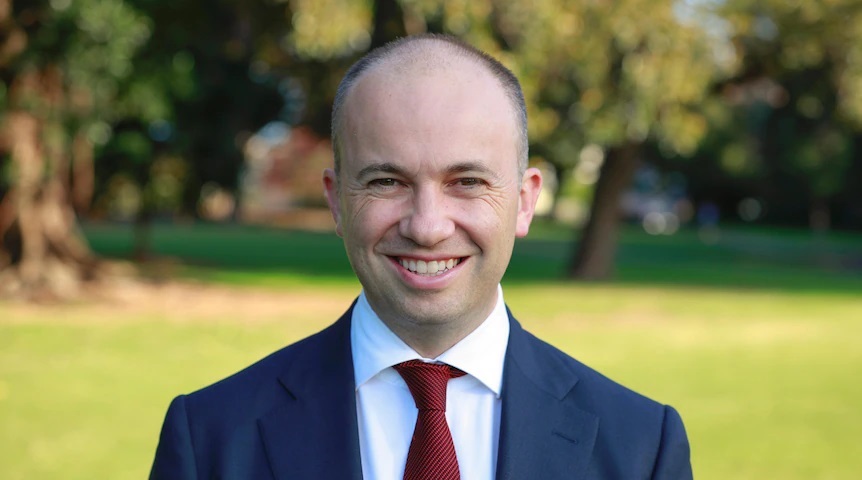
Climate Change Authority chair says Peter Dutton’s energy policy would drive up electricity bills and deter investment in renewables
Peter Hannam Economics correspondent, Guardian, 22 Oct 24
Extending the life of ageing coal-fired power stations before nuclear plants can be built is a “wild fantasy” that would deter near-term investment in renewables and push up power bills, according to Matt Kean, the Climate Change Authority chair.
The federal Coalition’s nuclear strategy was “an illiberal drive to intervene in the market-led energy transition [that had] been elevated from internet chatrooms and lobby groups to the national stage”, said Kean, a former energy minister in a Coalition government in New South Wales.
“The ‘delay-mongers’ have latched on to nuclear power despite the overwhelming evidence that it can only drive up energy bills, can only be more expensive, and can only take too long to build,” he told an AFR energy conference in Sydney on Tuesday.
“I suspect that even those arguing for nuclear don’t believe we’ll ever build one of these reactors in Australia … and certainly not in time to help manage the exit of coal from the system.”
The Albanese government appointed Kean, who has long advocated for more urgent climate action including by his then federal Liberal colleagues, to head the independent authority in June……………………………………………………… https://www.theguardian.com/australia-news/2024/oct/22/matt-kean-fantasy-coalition-energy-policy-coal-nuclear-power?fbclid=IwY2xjawGFBTtleHRuA2FlbQIxMQABHZOLw35JiI_0LOuO7ud0lCdaODH8ws-XTXtm6BjH-aQRT5FT8Ac8UKeUTQ_aem_yTUmsY_z33BOm66Ol9MkEA
Crisafulli victory sets up awkward clash over nuclear

AFR James Hall, Queensland correspondent, 28 Oct 24
Incoming Queensland premier David Crisafulli, who is now the highest-ranking conservative leader in Australia, is expected to hold firm to his repeated rejection of his federal counterpart’s nuclear energy push.
Mr Crisafulli will be sworn in as premier after securing a comfortable mandate at the weekend’s election, with his ascension compounding an awkward schism in the energy policies of the state and federal party branches.
Establishing a nuclear energy grid across the country, which includes two nuclear plants in Queensland, will form federal Opposition Leader Peter Dutton’s headline policy at the next national poll, due by May.
The Queensland-based federal leader will be eager to shore up the Coalition’s dominance in the Sunshine State, where it holds 70 per cent of the seats, but it was unlikely to secure the support for nuclear from the incoming premier.
Nationals leader David Littleproud, another Queensland figure, has in the past been infuriated by the state branch’s refusal to fall in behind the energy policy and on Sunday again said he expected all states to back nuclear if the coalition forms government…………………………………………………. more https://www.afr.com/politics/crisafulli-victory-sets-up-awkward-clash-over-nuclear-20241027-p5kloh
Coalition’s nuclear plan is ‘today’s version of a lump of coal in parliament’, inquiry told.

Renewables advocate tells parliamentary hearing that opposition’s nuclear proposal is a ‘smokescreen’ for burning coal and gas.
Graham Readfearn, 28 Oct 24, Guardian,
The Coalition did not approach Geoscience Australia to ask about the suitability of any of the seven sites where it wants to put nuclear reactors, including asking about risks from earthquakes, a parliamentary hearing was told.
The government called the parliamentary inquiry to scrutinise the Coalition’s proposals to lift the country’s ban on nuclear energy and build taxpayer-funded reactors at seven sites.
One renewables industry figure attacked the Coalition’s plans during the hearing, saying it was a “smokescreen” to continue to burn coal and gas.
During the hearing on Monday, officials from Geoscience Australia said it would probably take two years to carry out comprehensive “geohazard” assessments for each site that would look at risks including earthquakes and tsunamis, and geological formations beneath each site such as groundwater sources and caves…………………………………………..
John Grimes, the chief executive of the Smart Energy Council, an advocacy group representing clean energy businesses, told the inquiry the Coalition’s plan was “all about attacking renewables and boosting fossil fuels”.
Grimes, recalling former prime minister Scott Morrison’s 2017 parliamentary taunt, labelled the proposal “today’s version of a lump of coal in parliament”.
“The motivation [of the Coalition’s plan] is to attack renewables and hold them back,” he said. “Nothing has changed. This is a smokescreen.”
The committee is due to deliver a final report no later than 30 April 2025, which is likely to be before the next general election. https://www.theguardian.com/australia-news/2024/oct/28/peter-dutton-liberal-coalition-nuclear-plan-parliament-inquiry
1 This month


Help Aunty Sue Protect Her Land and Sacred Sites From Destructive Rocket Testing.
.

Australians deserve the truth
about
AUKUS – https://aukuspublicinquiry.com/

PETITION – To: Prime Minister Anthony Albanese and the Australian Labor Government

of the week – Australians for War Powers Reform (AWPR)
To see nuclear-related stories in greater depth and intensity

