Cheaper and more efficient solar energy with solar thin films
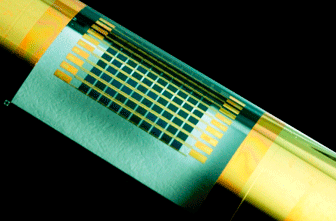
to produce considerably more material a lot more rapidly and much more cost efficiently.
University of Illinois Scientists Show Us Little Known Techniques to Produce More Productive Solar panels, Original article for Antinuclear, by Shannon Combs, 2 June 2010, Although silicon is actually the market standard semiconductor in the majority of electronic devices, which includes the photovoltaic cells that photovoltaic panels use to transform sunshine into power, it is hardly the most efficient material readily available.
For example, the semiconductor gallium arsenide and associated ingredient semiconductors provide close to 2 times the performance as silicon in photo voltaic devices, but they are rarely employed in utility-scale applications mainly because of their high construction price.U. of I. (http://illinois.edu/) teachers J. Rogers and X. Li explored lower-cost ways to manufacture thin films of gallium arsenide that also allowed adaptability in the kinds of products they can be integrated into.
If you may decrease substantially the price of gallium arsenide and some other compound semiconductors, then you might increase their variety of applications.Typically, gallium arsenide is deposited in a single thin layer on a smaller wafer. Either the desired unit is created directly on the wafer, or the semiconductor-coated wafer is break up into chips of the desired dimension.
The Illinois team considered to deposit multiple levels of the material on a individual wafer, producing a layered, “pancake” stack of gallium arsenide thin films.If you increase ten layers in 1 growth, you simply have to load the wafer 1 time. If you do this in 10 growths, loading and unloading with temperature ramp-up and ramp-down take a lot of time.
If you take into account exactly what is needed for every growth – the machine, the research, the period, the workers – the overhead saving this technique presents is a substantial price decrease.Next the researchers individually peel off the layers and move them. To achieve this, the stacks alternate levels of aluminum arsenide with the gallium arsenide. Bathing the stacks in a formula of acid and an oxidizing agent dissolves the layers of aluminum arsenide, freeing the single thin sheets of gallium arsenide. A soft stamp-like system selects up the levels, just one at a time from the top down, for exchange to one other substrate – glass, plastic-type or silicon, depending on the application. After that the wafer could be used again for an additional growth.
By doing this it’s possible to produce considerably more material a lot more rapidly and much more cost efficiently. This process could produce mass amounts of material, as compared to merely the thin single-layer method in which it is usually grown.Freeing the material from the wafer also starts the possibility of flexible, thin-film electronics made with gallium arsenide or other high-speed semiconductors.
To make units that can conform but still retain higher efficiency, which is significant.In a document written and published online May 20 in the journal Nature (http://www.nature.com/), the team details its methods and displays 3 types of products utilizing gallium arsenide chips manufactured in multilayer stacks: light products, high-speed transistors and solar cells.
The authors additionally supply a comprehensive price comparison.Another benefit of the multilayer method is the release from area constraints, especially important for photo voltaic cells. As the layers are taken away from the stack, they may be laid out side-by-side on another substrate in order to make a significantly larger surface area, whereas the standard single-layer procedure limits area to the size of the wafer.For solar panels, you want large area coverage to get as much sunshine as achievable.
In an extreme case we may grow enough layers to have ten times the area of the standard.Up coming, the team plans to investigate more potential device applications and additional semiconductor resources that could adapt to multilayer growth.About the Source – Shannon Combs gives advice for the residential solar power installation blog site, her personal hobby blog centered on ideas to aid home owners to save energy with sun power.Photos:
http://www.residentialsolarpanels.org/thin_film_solar.jpghttp://www.residentialsolarpanels.org/solar_arsenium.jpgComplete Bio Photo of the Author
Cheaper and more efficient solar energy with solar thin films « Antinuclear
No comments yet.
1 This month

of the week – Australians for War Powers Reform (AWPR)
To see nuclear-related stories in greater depth and intensity
 Antinuclear

Leave a comment