Australian Conservation Foundation call to govt about Olympic Dam uranium mine
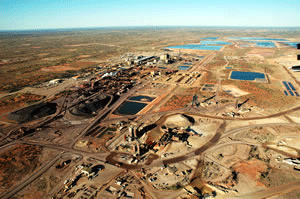 The debate over BHP Billiton’s proposed new Olympic Dam open pit mine is entering a new phase as the Minister for Environment assesses and makes a decision on the company’s Final Environmental Impact Statement (EIS) in response to over 4000 public submissions.
The ALP Federal government should require BHP to address key public interests to avoid nuclear risks, to prevent environmental impacts and to commit to on-site copper processing.
BHP Billiton uranium impacts to drive down standards Australian Conservation Foundation, June 2011 BHP Biliton’s proposed new Olympic Dam open pit mine fails to comply with ALP policy commitments for the most stringent conditions
and to ensure world’s best practice standards in uranium mining. ACF calls on the Federal government to:
1. assess the option of copper mining and processing on-site, without uranium sales;
2. prevent leakage of tailings and isolate radioactive waste for at least 10 000 years;
3. extend the use of renewable energy from the desalination plant to all new operations;
4. re-locate the proposed desalination plant to prevent ecological impact from brine waste
The debate over BHP Billiton’s proposed new Olympic Dam open pit mine is entering a new phase as the Minister for Environment assesses and makes a decision on the company’s Final Environmental Impact Statement (EIS) in response to over 4000 public submissions.
The ALP Federal government should require BHP to address key public interests to avoid nuclear risks, to prevent environmental impacts and to commit to on-site copper processing.
Australia should call a halt to new uranium sales deals and not proceed with BHP’s proposed new nuclear treaty with China for precedent sale of uranium-infused copper concentrates.
1. Avoid nuclear risks by retaining uranium on site and trading in copper
Australia should learn from the Fukashima nuclear disaster and stop fuelling nuclear risks, instability and unresolved nuclear waste problems across the world. The public interest in phasing out uranium sales should be paramount above BHP’s narrow self interest in uranium which represents less than one per cent of BHP profits. Olympic Dam could trade profitably as one of the world’s largest copper ventures, avoid nuclear risks, and leave the uranium on site.
ACF call on the Federal government to require BHP to leave all the uranium at the Olympic Dam mine site and to only proceed with this new open pit mine if strict environmental preconditions are met, including processing copper on site to boost local jobs.
BHP proposes an untenable new nuclear treaty with China for precedent sale of uranium-infused bulk copper concentrates. Australia’s existing nuclear treaties have sold uranium as yellowcake. This new BHP plan would further compromise our nuclear responsibilities and dump some 1.2 million tonnes of Australian mine wastes in China every year.
China’s nuclear weapons program, their failure to observe human rights and jailing of whistle blowers are sufficient reasons to disqualify China from receiving Australian uranium.
2. Prevent leakage of liquid waste and isolate rather than dump radioactive tailings
The BHP Chairman Jac Nasser AO has stated in a letter to ACF (22nd Feb 2011) that:
“The Olympic Dam Project uses ‘world’s best practice’ and many areas of the project will establish world’s leading practice and set a new benchmark for others to follow.”
BHP made record Australian half year profits of over $10 billion but their proposed new open pit mine project may only be economic by failing to manage their impacts and wastes.
BHP has designed Olympic Dam to leak up to 8 million litres of liquid radioactive wastes a day and plan to minimise waste management costs by lining only a few per cent of the world’s largest radioactive tailings piles – to cover some 44 km sq up to a height of 65 metres.
BHP propose to dump radioactive mine tailings out on the surface and to leave them there for ever. BHP does not intend to rehabilitate their impacts on our environment and intends to leave the proposed new open pit as a toxic lake and permanent scar on the landscape.
The ALP Federal government has given election policy commitments that:
“Labor will only allow the mining and export of uranium under the most stringent conditions”; and “Labor will ensure that Australian uranium mining, milling and rehabilitation is based on world best practice standards” (ALP National Platform “Building a 21st Century Economy” Aug 2009).
At Olympic Dam BHP should be required to prevent leakage of liquid radioactive wastes and to comply with the same regulatory standard required by the Federal government at the Ranger open pit uranium mine: to isolate tailings from the environment for at least 10 000 years and to dispose of tailings into the void of the proposed new open pit.
3. Use renewable energy for electricity and end public subsidies for diesel
BHP seek rights to lock in long term fossil fuel use for this project and propose an untenable 12 per cent increase in South Australia’s total greenhouse pollution. Use of renewable energy to provide the full electricity supply to this project would half this increase in pollution.
The public expectation that energy intensive desalination plants be powered by renewable energy should be extended to the full electricity supply for this major new mining project.
BHP should not receive public subsidies for increased diesel fuel use. BHP proposes to receive some $70 million a year (at projected diesel usage of some 400 million litres a year) throughout 5 years of construction of the proposed new open pit and up to $85 million a year throughout decades of proposed ongoing mining operations up to 2050.
4. Protect fragile ecological systems from impact by BHP mine water supply
Brine discharge from BHP’s proposed desalination plant in the Upper Spencer Gulf threatens the unique breeding ground of the Giant Australian Cuttlefish, which recently featured on David Attenborough’s “Life on Earth.” The ecology and the fishing industry of this shallow gulf are particularly susceptible to damage as it has a low level of flush from ocean waters.
BHP should respect the broad-based fishing industry, scientists and community alliance to “keep the gulf clean” and pay to re-locate this proposed large scale desalination plant to a site with ocean flushing characteristics that could effectively disperse the brine waste discharge.
5. Require pre-conditions on BHP mining plans to deliver on ALP commitments
ACF has called on the Federal government to formally assess a number of key feasible alternatives to BHP Billiton mining plans and to require these alternatives as pre-conditions on any potential decision of approval to the proposed new Olympic Dam open pit mine.
The public has a right to expect the ALP Federal government to deliver on their policy commitments to conditions and standards to protect the environment. BHP must avoid nuclear risks and pay to prevent environmental impacts in any new mining project.
No comments yet.
1 This month
17 October, Free Public Talk on Nuclear Issues in South Australia
David Noonan will speak on public interest concerns over the new Roxby Downs Indenture Act 2026 on BHP copper-uranium mining and ore processing in SA, and on how AUKUS may face SA with a High-Level nuclear waste agenda.
Dr Jim Green will discuss international developments in the field of nuclear power including ‘small modular reactors’ and Generation 4 ‘advanced’ nuclear reactor concepts.


Help Aunty Sue Protect Her Land and Sacred Sites From Destructive Rocket Testing.
.

Australians deserve the truth
about
AUKUS – https://aukuspublicinquiry.com/

PETITION – To: Prime Minister Anthony Albanese and the Australian Labor Government

of the week – Australians for War Powers Reform (AWPR)
To see nuclear-related stories in greater depth and intensity


Leave a comment