New South Wales – protest against uranium exploration and mining
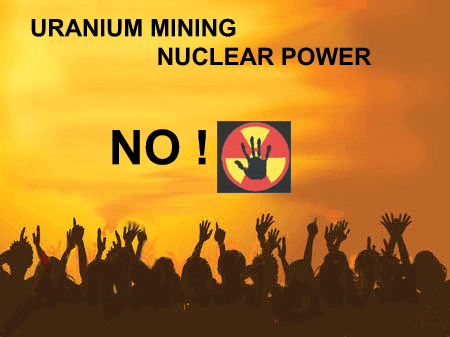 Protest MC Nat Wasley, from the Beyond Nuclear Initiative, said uranium exports made up just one-third of one per cent of Australia’s export revenue, and were a danger to the environment.
“Long after Barry O’Farrell is dead and gone from this earth, radioactive waste from uranium mining operations will live on for future generations to look after and that’s why we’re standing here today,” she said.
Anti-uranium protesters rally outside NSW parliament http://www.theaustralian.com.au/news/breaking-news/anti-uranium-protesters-rally-on-parliament/story-fn3dxity-1226278337387 THE AUSTRALIAN, AAP February 22, 2012
DEMONSTRATORS in white coats and masks have gathered outside NSW Parliament House to protest against state government plans to allow uranium exploration. Continue reading
Anti-Nuclear Alliance of Western Australia appealing to EPA about Lynas rare earths and radiation
 ANAWA is currently working with the Environmental Defenders Office (EDO) to lodge a referral to the EPA regarding the Lynas operations at Mt Weld and their mining of rare earths. Lynas has made a number of changes to their procedures, which have not gone through the appropriate approvals and they are currently operating under approvals given to them 14 years ago.
There are major concerns about the amounts of this radioactive substance being transported from Mt Weld to the ports of Fremantle and health & safety issues for those involved in handling the material that will be exported to their controversial processing plant in Malaysia. ANAWA will be going to the EPA with the EDO lawyer Josie Walker on Tuesday the 28th of February at 10.30 am.
Malaysians asking questions about Lynas’ rare earths and radioactive wastes
 The Lynas Advanced Material project will produce 20,000 tones of radioactive waste, which is 10 times more than the Asian Rare Earth factory in Bukit Merah.
1. Why didn’t Lynas set-up the rare earth plant near its source of extraction in Western Australia as it would have saved a huge amount of money in shipping costs?
2. Why didn’t Lynas obtain an approval from the authorities in Western Australia to set-up the plant?
3. Could the authorities in Western Australia be concerned about the possible radiation leaks, health hazards, birth defects, lead poisoning and other complications?
4. Shouldn’t this in itself raise a red flag with the Malaysian authorities?
Gov’t fails to learn from Bkt Merah tragedy http://www.freemalaysiatoday.com/2012/02/22/govt-fails-to-learn-from-bkt-merah-tragedy/ Free Malaysia Today February 22, 2012 Is the RM700 million in Lynas investment more important to the government than the lives of its citizens? By Charles Santiago Severe birth defects, eight leukemia cases over five years in a community of 11,000, tears and anguish of the poor people from a largely shoe-making community – these are not news headlines. Neither is it the plot of a movie.
These are the consequences of carelessly allowing the Asian Rare Earth factory to be built in Bukit Merah, Perak in 1982. When Mitsubishi Chemical started operating its rare earth factory, the villagers complained of choking sensation, pungent smell, coughs and colds. The community also saw a sharp rise in the cases of infant deaths, congenital disease, leukemia and lead poisoning. While US$100 million is estimated to be the clean-up cost of the factory and dump site, the
largest in the rare earth industry, it has not wiped out the memories and heartache of the villagers who lost their children and loved ones.
But 30 years later, the government has again allowed a rare earth factory to be set-up by Lynas Corporation Ltd in Gebeng, Kuantan. This means the government has waved the green flag with full knowledge of
the possible consequences and deadly effects. Continue reading
Melting permafrost leads Australian uranium company to exploit Greenland
 Asian, European Firms Circle Greenland Mining Project, WSJ, By Robb M. Stewart, FEBRUARY 22, 2012, In one of the world’s coldest climates, competition to develop a future source of uranium and rare earths is heating up…. The impact of climate change has made mining in Greenland easier by melting permafrost, while the island’s growing autonomy from Denmark has enabled officials to award more exploration licenses….
The government of Greenland late last year amended the Perth-based Greenland Minerals & Energy company’s exploration license to include uranium, the first such permit for the nuclear fuel on the island. According to John Mair, the company’s executive director of business development, an attractive option as a strategic partner would be a consortium interested in rare earths as well as uranium…. http://blogs.wsj.com/dealjournalaustralia/2012/02/21/asian-european-firms-circle-greenland-mining-project/
Australian renewable energy technologies need government stimulus
 Many Australian ideas are now being commercialised overseas, such as David Mills’ solar thermal technology
Without government intervention to ‘tilt the marketplace’, Australia could lose its potential competitive edge in developing renewable energy technologies and will become a passive importer of technologies developed overseas,
The route to a renewable energy future for Australia, Eco Business, February 22nd, 2012 ,By : Vicky Kenrick , Renewable energy production is excelling in Europe and making its name as a simple and cost effective alternative to fossil fuel power generation; meanwhile it is barely developed within Australia and in need of increased focus and investment.
That may come in 2013-2014. Despite the recession affecting the global economy, the world invested a record US$251 billion in clean energy during 2011, with the US streaking ahead in green spending ($54 billion) and boosting confidence among climate action advocates. This was further endorsed last month at COP17 where the major green-house emitting countries recognised the need for further investment in renewable technologies.
According to Kobad Bhavnagri, Bloomberg New Energy Finance’s lead clean energy analyst in Australia, Australia’s investment is on track to rise to US$6.8 billion next year and will aim to be a total of $45 billion by 2020, However, is this enough investment to meet the target of renewable sources such as solar, wind and geothermal making up 20 per cent of the energy supply for Australia?
Despite some of the best renewable energy resources on the planet, Australia has been slow at tapping into the potential of these. Nevertheless, Australia did see an increase of 11 per cent on the previous year; with the biggest contribution to the $4.7 billion spend on renewable energy, coming from solar power installations. Continue reading
“advanced cost recovery” – how the nuclear industry plans for consumers to take all the financial risks
 “It exposes ratepayers to all the risk.” The nuclear industry’s answer to its post-Fukushima challenges, he said, “is to simply rip out the heart of consumer protection and turn the logic of capital markets on their head.”
His message to policymakers is simple, Cooper said. “This is an investment you would not make with your own money. Therefore, you should not make it with the ratepayers’ money.”
The Nuclear Industry’s Answer to Its Marketplace Woes, Greentech media Construction Work in Progress (CWIP) financing shifts the risks of nuclear energy to utility ratepayers. HERMAN K. TRABISH: FEBRUARY 22, 2012 A sign of the nuclear industry’s difficult situation in the aftermath of Fukushima is a proposal before the Iowa legislature that would allow utility MidAmerican Energy Holdings, a subsidiary of Warren Buffett’s Berkshire Hathaway, to build a new nuclear facility in the state using Construction Work in Progress (CWIP) financing (also called advanced cost recovery).
“Investment in nuclear power is the antithesis of the kind of investments you would want to make under the current uncertain conditions,” explained nuclear industry authority Mark Cooper, a senior fellow for economic analysis at Vermont Law School’s Institute for Energy and the Environment. “They cannot raise the capital to build these plants in normal markets under the normal regulatory structures.”
CWIP would allow the utility to raise the money necessary to build a nuclear power plant by billing ratepayers in advance of and during construction.
“Construction Work in Progress was intended to circumvent the core consumer protection of the regulatory decision-making process,” Cooper explained. Continue reading
1 This month
15 April – Zoom –Nuclear Power is Not the Solution
Apr 15, 2026 01:00 AM in Canberra, Melbourne, Sydney

Join the International Physicians for the Prevention of Nuclear War (IPPNW) on Tuesday, April 14th for a timely webinar exploring the risks associated with nuclear power and challenging the myth that it offers a simple, safe, carbon-free solution to the climate crisis

of the week – Australians for War Powers Reform (AWPR)
To see nuclear-related stories in greater depth and intensity
 Antinuclear