Small Modular Reactors – latest pipe dream to keep the nuclear industry alive
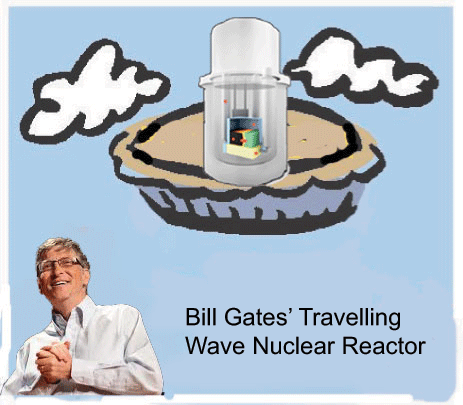 Small Modular Reactors, [SMRs] the latest “rabbit out the nuclear hat,” are generally based on scaled down BWR or PWR technology and illustrate the nuclear industry’s schizophrenic attitude to reactor size…. it was clear that the AP600 [small nuclear reactor] was hopelessly uneconomic… SMRs may turn out to be the latest in a long line of nuclear designs that looked good on paper, but could not make the transition to commercial technology
Prospects for Nuclear Power in 2012, The Energy Report 2 April 12, “…….Technological Cul-de-Sac If plant life extensions can be achieved in France and the U.S. and Gen III+ does prove a blind alley, it raises the question of what options are open to the nuclear sector. Ten years ago, the industry answer would have been Generation IV designs. Unlike Gen III+, which evolved from existing Pressurized Water Reactors (PWRs) and Boiling Water Reactors (BWRs), these would be based on radical new technologies. Six technologies were selected by the major nuclear countries as the most promising.
However, 10 years on, they seem no closer to commercial deployment. These designs were a mix of designs already pursued, such as sodium-cooled fast reactors and helium/graphite high-temperature reactors, and totally untested options such a lead-cooled fast reactors. The more familiar reactors have a very poor record so far, despite all major nuclear nations trying to develop them over the past 50 years. Demonstration fast reactors like Superphenix, Monju and Dounreay, and high-temperature reactors like THTR-300 and Fort St. Vrain had highly problematic, often short lives.
How the nuclear industry is going to solve problems it has failed to solve over the past 50 years is not clear. The radical new designs require major technological development and progress and it is hard to see who will fund that.
Small Modular Reactors, the latest “rabbit out the nuclear hat,” are generally based on scaled down BWR or PWR technology and illustrate the nuclear industry’s schizophrenic attitude to reactor size. This is well illustrated by the history of the AP1000 and the Pebble Bed Modular Reactor (PBMR). Around 1990, Westinghouse claimed that they had looked for the scale economies of building ever bigger reactors and found they were not there. They therefore developed the AP600 design, half the size of the reactors they had previously been offering. This received regulatory approval from the U.S. authorities in 1997.
However, by then, it was clear that the AP600 was hopelessly uneconomic, so Westinghouse nearly doubled its output in the AP1000, which received final regulatory approval in December 2011. The AP1000 is still proving far too expensive and China is now examining the possibility of scaling it up to 1,800 MWh to reduce cost.
The PBMR was meant to be a small modular reactor that would fit more easily into small electricity systems. The capacity of sites could be expanded in small steps. The idea was that it could also be upgraded by increasing the coolant temperature from about 850° C to more than 1,000° C, making it one of the Gen IV designs, the Very High Temperature Reactor. If such temperatures could have been achieved, efficient production of hydrogen from water using a catalytic process would have been feasible.
South Africa licensed pebble bed technology from Germany in 1998, the 80-MWh Modul 80 design, and immediately uprated it to 110 MWh. What happened over the next decade is not well reported by the South Africans, but after a decade, the project was running about 25 years behind its original schedule, the estimated cost of a demonstration plant had increased 30-fold and a design fit to submit to the regulator had still not been completed. It appears economics were a serious problem because the design was successively uprated from 110 MWh to 125 MWh, then 137 MWh and finally 165 MWh. In 2010, the South Africans belatedly admitted defeat. SMRs may turn out to be the latest in a long line of nuclear designs that looked good on paper, but could not make the transition to commercial technology…. http://www.theenergyreport.com/pub/na/12441
No comments yet.
1 This month
7 April – WEBINAR – Australia and the Doomsday Clock – Preventing nuclear war through NoFirstUse and other policies
Online | Tuesday April 7, 4:00-5:30pm, Australian Eastern Time / 8:00-9:30am Central Europe Time
– Access the registration link
15 April – Zoom –Nuclear Power is Not the Solution
Apr 15, 2026 01:00 AM in Canberra, Melbourne, Sydney

Join the International Physicians for the Prevention of Nuclear War (IPPNW) on Tuesday, April 14th for a timely webinar exploring the risks associated with nuclear power and challenging the myth that it offers a simple, safe, carbon-free solution to the climate crisis

21 April Webinar: No Nuclear Weapons in Australia
Start: 2026-04-21 18:00:00 UTC Canberra, Melbourne, Sydney (GMT+10:00)
End: 2026-04-21 19:30:00 UTC Canberra, Melbourne, Sydney (GMT+10:00)
Event Type: Virtual
A virtual link will be communicated before the event.
Host Contact Info: australia@icanw.org

of the week – Australians for War Powers Reform (AWPR)
To see nuclear-related stories in greater depth and intensity
 Antinuclear
Leave a comment