USA nuclear-related bases in Australia still targets for attack
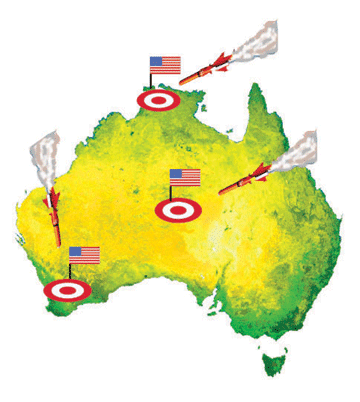
”I am sure that all important targets are included in Russian combat plans,” Colonel Valery Yarynich, a visitor to Australia, said at a rally in Hyde Park on the eve of today’s anniversary of the Hiroshima atom-bombing.
Questioned about the top-secret facilities at Pine Gap near Alice Springs, and WA’s North West Cape communications station, he said: ”Nobody knows, only the high command. It’s secret. Like American plans, too. And targeting can be changed in a matter of minutes.”…….
”I think the world was saved largely due to the fact that missiles of those days were imperfect. They required many hours to prepare to launch. This circumstance helped Kennedy and Krushchev to reach agreement. Today the Russian rocket and the American minuteman demand only a couple of minutes.”
In the 1980s, Soviet strategists became worried the high accuracy of new US missiles might allow a disabling first strike. Colonel Yarynich was involved in setting up the terrifying ”Perimitr” (perimeter) dead-hand system which set off a retaliatory strike automatically from sensor data. It is now disabled. Like many Cold War warriors, the colonel is now involved in efforts to reduce the risk of nuclear war.
He hopes negotiations on nuclear force reductions and de-alerting of remaining forces will pick up between Washington and Moscow after the US election in November and set an example for other nuclear powers. ”We must act,” he said. ”It is necessary and it is possible to remove the finger from the trigger.” http://www.smh.com.au/opinion/political-news/australian-bases-still-in-russian-sights–soldier-20120805-23nxr.html#ixzz22nWt1Gdc
In Cold War, Russia targeted Australia’s USA military bases, not our cities
the US-Australian naval communications station at North West Cape in Western Australia would be a high-priority nuclear target
risks of nuclear attacks on the Pine Gap signals intelligence satellite ground station in central Australia and the missile launch detection facility at Nurrungar
Secret’s out: Soviets did not target cities http://www.smh.com.au/opinion/political-news/secrets-out-soviets-did-not-target-cities-20120805-23ny1.html#ixzz22nPnXqyD August 6, 2012 Philip Dorling THE US-Australian joint defence installations were almost certainly Russian nuclear targets during the Cold War. However, Australia’s cities might well have survived unscathed if superpower tensions had erupted into a global conflagration, according to a top secret intelligence assessment released by the National Archives of Australia.
More than three decades after it was written, the Australian government has finally declassified its most secret study of the
potential impact on Australia of a nuclear war between the US and the former Soviet Union. Continue reading
The push for monster Olympic Dam uranium mine – a monster mistake for Marius Kloppers?
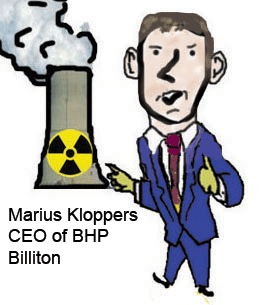 a go-ahead decision on the $US30bn expansion will be delayed for at least two years.
Kloppers made what can now be said to have been an error in talking up the ability of its monster cashflow to fund $US80bn over five years in organic projects to the end of the 2015 fiscal year. Olympic Dam was included in those organic growth projects…
The big money in horse racing waits to the last moment in case an unknown becomes known and changes the odds. A decision on Olympic Dam is much the same. ….
Olympic Dam decision will show Kloppers’ standing BY: BARRY FITZGERALD : The Australian July 31, 2012 THE number five is popping up everywhere for Marius Kloppers. He turns 50 next month, has been chief executive for five years come October, and on August 22 will get to announce an annual profit fall of $US5 billion ($4.7bn) and the need for a $US5bn or so writeoff on last year’s US shale gas push
Then there is the talk that the clock on his chief executive tenure is at five minutes to midnight, ….
Rounding out the string of fives is whether the time is right to commit $US5bn to kick-start the Olympic Dam expansion. A decision on that is due in December. Continue reading
Time for SA Govt to find some true Olympic spirit – don’t extend Olympic Dam contract
 The Weatherill Government must clearly state there will be no extension on the contract to expand the Roxby
  mine, says Greens Parliamentary Leader Mark Parnell.
The call comes as speculation increases that BHP Billiton will not make a decision on the Olympic Dam Mine Expansion until after the December 15 deadline set out in the Indenture agreement negotiated last year. In yesterday’s Sunday Mail, ex Treasurer Kevin Foley said the Government should force BHPB to stick to the deadline.
“The SA Government is chasing its Olympic dream – the only problem is the other side is simply not playing fair,” said Mr Parnell. “There is an iron clad contract between the South Australian Government and BHP Billiton. Both sides knew the rules when they signed this agreement – including the 12 month deadline.
“If giving BHP Billiton everything they wanted was an Olympic sport, the SA Government would win a gold medal. They have already rolled over enough on environmental standards, local jobs and royalties.
“It’s time for Premier Weatherill to take a stand. Kevin Foley is dead right on the ODX deadline: ‘a deal is a deal, you break it at your peril’.
“If BHP Billiton refuses to commit by December, the SA Parliament must be given another opportunity to renegotiate a better deal for South Australia.
“Premier Weatherill must stand firm against BHP Billiton and say his Government will not accept an extension on this already ridiculously over-generous contract,” he said.
Australian company SILEX: its laser uranium technology could promote nuclear weapons spread
 SILEX is an acronym for Separation of Isotopes by Laser Excitation. The company, a spin-off from the Australian government’s nuclear science and research establishment at Lucas Heights, ANSTO
the worry with SILEX laser technology ”is that it is particularly suited for nuclear proliferation
Uranium on the laser’s edge, Canberra Times, August 6, 2012, Michael Richardson Enrichment systems produce nuclear bomb-grade matter as well as fuel for civilian reactors. The United States is on the verge of approving a licence later this month for the world’s first plant to enrich uranium on a commercial scale for civilian nuclear power reactors
using laser technology developed by an Australian company.
The Australian firm, Silex Systems, says that its secret laser system is cheaper than existing methods of turning natural uranium into fuel for reactors that generate electricity. The plant could be in operation in the US by 2016. Continue reading
South Australian govt not keen to extend Olympic Dam agreement. BHP tightlipped
 No extension offer to BHP – Weatherill. Christopher Russell The Advertiser August 01, 2012 PREMIER Jay Weatherill has rejected suggestions the State Government has offered to grant BHP Billiton an extension to the
indenture agreement on the Olympic Dam project.
Reacting to interstate reports that the Government was offering BHP an olive branch and was willing to “entertain” an extension, Mr Weatherill said he had been misinterpreted.
The Government’s position had consistently been that it wanted BHP Billiton to make a decision by the December 15 expiry date of the indenture agreement….. “There has been no proposition advanced to us that would justify an extension of the 12-month period at this time.”
This is consistent with Resources and Energy Minister Tom Koutsantonis who has previously stated the Government would be reluctant to grant an extension… Despite outside speculation, BHP Billiton has said again this week that no decision has been made on the Olympic Dam project.
Its Adelaide office continues to work on a proposal to present to the BHP Billiton board.
http://www.adelaidenow.com.au/no-extension-offer-to-bhp-weatherill/story-e6frea6u-1226440162081
Doubts continue about BHP’s expansion of Olympic Damn uranium mine
No change yet to mine plans: premier 9 News Aug 6 2012 South Australian Premier Jay Weatherill says he still can’t see any justification for granting BHP Billiton an extension to the agreement to expand the Olympic Dam copper and uranium mine.
The company has until the end of the year to give the $30 billion expansion the final go-ahead or face the need to renegotiate approvals with the state government….. “Right at the moment there is a lot of speculation about the future of BHP,” Mr Weatherill told ABC Radio on Monday….. http://news.ninemsn.com.au/national/8511545/no-change-yet-to-mine-plans-premier
Nuclear reactors remain dangerous, even when shut down in hot weather
 For Nuclear Power This Summer, It’s Too Darn Hot, Truth Out, 05 August 2012 By
  Gregg Levine, “……when it comes to nuclear power, as global temperatures continue to rise and water levels in rivers and lakes continue to drop, an even more disconcerting threat emerges.
When a coal plant is forced to shut down because of a lack of cool intake water, it can, in short order, basically get turned off. With no coal burning, the cooling needs of the facility quickly downgrade to zero.
A nuclear reactor, however, is never really “off.”
When a boiling water reactor or pressurized water reactor (BWR and PWR respectively, the two types that make up the total of the US commercial reactor fleet) is “shutdown” (be it in an orderly fashion or an abrupt “scram”), control rods are inserted amongst the fuel rods inside the reactor. The control rods absorb free neutrons, decreasing the number of heavy atoms getting hit and split in the fuel rods. It is that split, that fission, that provides the energy that heats the water in the reactor and produces the steam that drives the electricity-generating turbines. Generally, the more collisions, the more heat generated. An increase in heat means more steam to spin a turbine; fewer reactions means less heat, less steam and less electrical output. But it doesn’t mean no heat.
The water that drives the turbines also cools the fuel rods. It needs to circulate and somehow get cooled down when it is away from the reactor core. Even with control rods inserted, there are still reactions generating heat, and that heat needs to be extracted from the reactor or all kinds of trouble ensues–from too-high pressure breaching containment to melting the cladding on fuel rods, fires, and hydrogen explosions. This is why the term LOCA–a loss of coolant accident–is a scary one to nuclear watchdogs (and, theoretically, to nuclear regulators, too).
So, even when they are not producing electricity, nuclear reactors still need cooling. They still need a power source to make that cooling happen, and they still need a coolant, which, all across the United States and most of the rest of the world, means water. http://truth-out.org/news/item/10707-for-nuclear-power-this-summer-its-too-darn-hot
Dr Helen Caldicott to speak at Sydney forum on August 25
 Beyond Nuclear , 6 Aug 12 Fantastic news as we commemorate Hiroshima Day- Dr Helen Mary Caldicott is confirmed to speak at the ‘Nuclear South Wales?’ discussion and workshop day in Sydney on August 25. Other guest speakers include Dr Gavin Mudd, independent consultant and mining expert; Jim Green, Friends of the Earth nuclear free campaigner and Paul McAleer from Maritime Union of Australia (MUA). The day runs from 10-3, please send Beyond Nuclear Initiative a message if you want to come along. We will discuss the Movement Against Uranium Mining in the 70s/80s (and lessons for today), the state if the nuclear industry and brainstorm ideas for building a nuclear free NSW.
Australians taking up decentralised solar power – with a vengeance!
 The federal government’s principal forecasting body last week said its landmark assessment of 40 different technologies indicated that by 2030, solar PV would be the cheapest of all available
  technologies
Off grid and on household and commercial rooftops, solar PV is already offering a cheaper alternative.
nearly four million Australians are living in a home with solar hot water or a PV system – and that means they don’t listen to the bulls*** that it is not working, not ready or unreliable.”
Bolt from the blue: How Australia got gold in rooftop solar REneweconomy By Giles Parkinson 6 August 2012 Australia has long been regarded as one of the pioneers of the global solar photovoltaic industry, courtesy of its excellent research at institutions such as UNSW and elsewhere. Now, thanks to its excellent solar resource, rising electricity costs and the falling cost of solar PV, it is now emerging as the leading market for rooftop solar as well.
It wasn’t that long ago that visitors from Europe expressed their astonishment about the lack of solar panels on Australia’s rooftops. But, as one industry leader noted the other day, the growth of PV in Australia has jumped 6,900 per cent between the Beijing Olympics and the London Olympics – enough to earn it a gold medal in deployment.
As consulting group SunWiz noted last month, Australia installed more small-scale rooftop PV (systems less than 10kW) on households in 2011 than Germany, with 795MW vs 759MW. It now has an estimated 1.7 gigawatts of solar PV installed on rooftops, and is expected to get to 2,000MW by the end of the year. The Australian Energy Markets Operator recently said there could be 12,000MW to 18,000MW of rooftop solar PV in the country by 2030. Sunwiz and Solar Business Services say 18,000MW is conceivable by 2022. Continue reading
Peaceful dream to nightmare: India’s secret nuclear weapons drive
India’s Secret Nuclear Weapons Program, The Market Oracle, by Marya Mufty, Aug 05, 2012 If there was any arms race in the region, India has won it, at whatever the cost may be. But the claims to have good neighbourly relations, with MFN-status, no-war pact or no-first-use nuclear arsenal are just a dream seemingly never to come true.
In April this year India yanked open the door of the exclusive ICBM (International Ballistic Missile) club with the first test of Agni-V. Now, if DRDO is to be believed, India has quietly gate-crashed into an even more exclusive club of nuclear-tipped submarine-launched ballistic missiles (SLBMs).

The most ironic part of this achievement on part of India is that New Delhi had been able to successfully keep it as a secret ‘black project’. Continue reading
A multibillion-dollar nuclear aircraft carrier strike group for Australia?
 “full Australian participation in US theatre missile defence”.
US bid for multibillion-dollar nuclear aircraft carrier strike group in Perth, SMH, Nick O’Malley August 1, 2012
- US base in Perth would cost billions
- Strike group includes aircraft carrier, 9 squadrons, 2 submarines
- Read the full report
A report for the US military contains a recommendation to expand America’s defence presence in Australia by massively expanding a base in Perth for a US aircraft carrier and supporting fleet. Continue reading
USA’s nuclear reactors affected by global warming
simply getting permission to suck in hotter water does not make the problem go away..
despite a myriad of potential problems and two decades of climate warnings, it is sobering to note that none of the US reactors were built to account for any of this
[The new reactors] they are still PWRs and they still require a large reserve of cool, circulating water to keep them operating and nominally safe.
 For Nuclear Power This Summer, It’s Too Darn Hot, Truth Out, 05 August 2012 By Gregg Levine, You know that expression, “Hotter than July?” Well, this July, July was hotter than July. Depending on what part of the country you live in, it was upwards of three degrees hotter this July than the 20th Century average. Chicago, Denver, Detroit, Indianapolis and St. Louis are each “on a pace to shatter their all-time monthly heat records.” And “when the thermometer goes way up and the weather is sizzling hot,” as the Cole Porter song goes, demand for electricity goes way up, too….. Take, for example, Braidwood, the nuclear facility that supplies much of Chicago with electricity:
It was so hot last week, a twin-unit nuclear plant in northeastern Illinois had to get special permission to continue operating after the temperature of the water in its cooling pond rose to 102 degrees. Continue reading
1 This month

of the week – Australians for War Powers Reform (AWPR)
To see nuclear-related stories in greater depth and intensity
 Antinuclear