I hope we can now trust Tim Flannery on energy issues for Australia
 Well – I don’t know if we can, but I hope so. Flannery was chosen as Climate Change Commissioner because he’s been very outspoken on that issue. Good, but also perhaps, chosen because he was toeing the political Establishment line. (Labor being pretty watery about nuclear power, Liberal being all for it.)
Tim Flannery’s credentials as an environmentalist would be improved if he completely repudiated his 2006 statements on nuclear power:
“Over the next two decades, Australians could use nuclear power to replace all our coal-fired power plants. We would then have a power infrastructure like that of France, and in doing so we would have done something great for the world, for whatever risks go with a domestic nuclear power industry are local, while greenhouse gas pollution is global in its impact…..” (The Age 30/5/06)
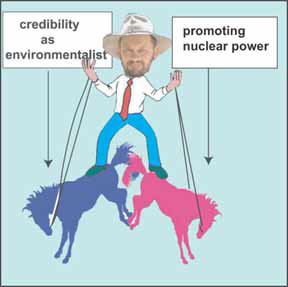
However, there is hope that Flannery has learned something, in addition to these, his later comments:
“Why should we take the most expensive option in this country, which has always been recognized as having the most expensive and difficult option.
We are going to see a whole lot of other technologies and innovations which are now well under way which we could use instead of nuclear power……. Such as concentrated PV technology, geothermal technology, wave power, wind power.” 20 June 2010
In 2012 a tipping point in the change to renewable energy for Australia
 We’ve hit energy tipping point: Flannery THE AUSTRALIAN, AAP August 14, CLIMATE change campaigner Tim Flannery says 2012 will be seen as a tipping point in the fight against rising carbon dioxide levels.
Advances in clean energy technologies, increasing global investment, the drop in price of those technologies and growing public support point to the dawn of the clean energy era, Australia’s chief climate commissioner says.
“Global investments in renewable power and fuels has increased six fold since just 2004, standing today at about $257 billion,” Professor Flannery told a Committee for Economic Development of Australia function in Melbourne on Tuesday.
“We’re seeing investment in renewables now outpacing those of fossil fuels. “Some of these trends have only become evident in the last 12 months. I don’t think they’re going to go away and I think we’ll see this as the moment when things really started to move.”
Prof Flannery said the 75 per cent drop in the cost of producing solar panels over the past four years, and the subsequent take-up rate in Australian homes was evidence of the change locally….. “(Look at) Germany, with it’s 25 gigawatts of solar power, where the very best sunlight you get in Germany is about as good as our worst here in Australia – we have huge potential in that area.” http://www.theaustralian.com.au/news/breaking-news/weve-hit-energy-tipping-point-flannery/story-fn3dxiwe-1226450269594
Rooftop solar energy is meeting peak demand, especially in South Australia
 Rooftop solar panels: our new peaking power generators REneweconomy By Giles Parkinson on 14 August 2012 Demand management has finally entered the political lexicon, as politicians to the left and the right realise that a 20-lane wide power grid has been built to service our energy demands, when one half that size might just as easily fit the bill.
Politicians are reacting because the increasing cost to consumers is finally being passed on to the ruling class in the form of a cost to their political capital. But amid the name-calling, the blame-gaming, the party one liners, and the ducking and weaving, comes the realisation that there are some seriously good alternatives. But what is not widely accepted is that many of these solutions involve renewables.
The common thinking among many energy experts and energy ingénues is that renewables such as wind and solar are intermittent and unreliable, and therefore cannot be relied upon for “baseload” generation, let alone switched on at will to meet the rising peaks.
The CSIRO would like to differ. In fact, says Glenn Platt, the head of the local energy systems team, distributed generation such as tri-generation and co-generation, but also in the form of rooftop solar, can play a crucial part in meeting peaking demand. Far from contributing to the problem, renewables such as solar can be harnessed to provide a solution.
“The traditional view would be to say that solar generation doesn’t have a huge part to play in peak demand,” Platt told RenewEconomy in an interview. “But if you look at peak demand on the wider electricity market, it coincides very well.”
The Australian Energy Market Operator noted in a report last week that in the state with the highest amount of solar PV, South Australia, where two out of five houses have a rooftop system, 38 per cent of the solar output could be considered to be meeting peak demand…… http://reneweconomy.com.au/2012/how-rooftop-solar-can-help-meet-energy-demand-peaks-32691
AUDIO – Australia using less electricity, renewables increasingly supplying baseload power
 Electricity demand falling in Australia ABC Radio David Mark reported this story on Monday, August 13, 2012 Listen to MP3 of this story ( minutes) MARK COLVIN: A new report shows demand for new electricity generation in Australia is slowing down.
Across the country the demand for new baseload power generators has been pushed back by around four years. What’s more, that baseload power is being increasingly supplied by renewables like wind and gas, which produce less CO2 than coal.
One expert in the electricity market says reasons for the reduced demand include greater efficiency in electronic goods, consumer education and an increasing number of rooftop solar panels.
David Mark reports. DAVID MARK: There’s a strange disconnect going on in the debate about electricity prices in Australia. We’re all paying more for our electricity. And we’re being told we have to because of the need for more infrastructure. And yet…
HUGH SADLER: For the last four or five years we’ve seen no growth inthe consumption of electricity in Australia. ….
http://www.abc.net.au/pm/content/2012/s3566840.htm
Climate change causing nuclear plant shutdowns in USA – now heat shuts a coastal one
 Heat Shuts Down a Coastal Reactor NYT, By MATTHEW L. WALD A reactor at the Millstone nuclear plant in Waterford, Conn., has shut down because of something that its 1960s designers never anticipated: the water in Long Island Sound was too warm to cool it.
Under the reactor’s safety rules, the cooling water can be no higher than 75 degrees. On Sunday afternoon, the water’s temperature soared to 76.7 degrees, prompting the operator, Dominion Power, to order the shutdown of the 880-megawatt reactor.
“Temperatures this summer are the warmest we’ve had since operations began here at Millstone,’’ said a spokesman for Dominion, Ken Holt. The plant’s first reactor, now retired, began operation in 1970.
The plant’s third reactor was still running on Monday, but engineers were watching temperature trends carefully out of concern that it, too, might have to shut down….. And higher water temperatures could lie ahead. The sound’s temperature usually does not peak until late August….. Power plants in the Midwest have also experienced problems as temperatures soared in recent weeks. In some cases, reactors shut down because the cooling water was too warm; in others, the ongoing drought had shrunken the body of water from which the cooling water is drawn, and the plant’s intake pipes were above the surface.
Last month the twin-unit Braidwood nuclear plant in Illinois needed special permission to keep operating because its cooling water pond reached 102 degrees as a result of low rainfall and high air temperatures. When Braidwood opened 26 years ago, it was designed to run at temperatures up to 98 degrees. http://green.blogs.nytimes.com/2012/08/13/heat-shuts-down-a-coastal-reactor/
1 This month

of the week – Australians for War Powers Reform (AWPR)
To see nuclear-related stories in greater depth and intensity
 Antinuclear