Facing the facts on climate change
it is worth exploring the question, what would a world with >2°C global surface warming look like?
Global Warming Impacts
The 2007 IPCC Fourth Assessment Report (AR4) summarizes the magnitudes of impact of various degrees of warming here, and graphically….
This is Why Reducing Emissions is Critical
Realistically What Might the Future Climate Look Like? Sceptical Science 31 August 2012 by dana1981Robert Watson, former Chair of the Intergovernmental Panel on Climate Change (IPCC),recently made headlines by declaring that it is unlikely we will be able to limit global warming to the 2°C ‘danger limit’. This past April, the International Energy Agency similarly warnedthat we are rapidly running out of time to avoid blowing past 2°C global warming compared to late 19th Century temperatures. The reason for their pessimism is illustrated in the ‘ski slopes’ graphic, which depicts how steep emissions cuts will have to be in order to give ourselves a good chance to stay below the 2°C target, given different peak emissions dates
Clearly our CO2 emissions have not yet peaked – in fact they increased by 1 billion tonnes between 2010 and 2011 despite a continued global economic recession; therefore, the green curve is no longer an option. There has also been little progress toward an international climate accord to replace the Kyoto Protocol, which suggests that the blue curve does not represent a likely scenario either – in order to achieve peak emissions in 2015 we would have to take serious steps to reduce emissions today, which we are not. The red curve seems the most likely, but the required cuts are so steep that it is unlikely we will be able to achieve them, which means we are indeed likely to surpass the 2°C target.
Thus it is worth exploring the question, what would a world with >2°C global surface warming look like?
Global Warming Impacts
The 2007 IPCC Fourth Assessment Report (AR4) summarizes the magnitudes of impact of various degrees of warming here, and graphically….
This is Why Reducing Emissions is Critical
We’re not yet committed to surpassing 2°C global warming, but as Watson noted, we are quickly running out of time to realistically give ourselves a chance to stay below that ‘danger limit’. However, 2°C is not a do-or-die threshold. Every bit of CO2 emissions we can reduce means that much avoided future warming, which means that much avoided climate change impacts. As Lonnie Thompson noted, the more global warming we manage to mitigate, the less adaption and suffering we will be forced to cope with in the future……
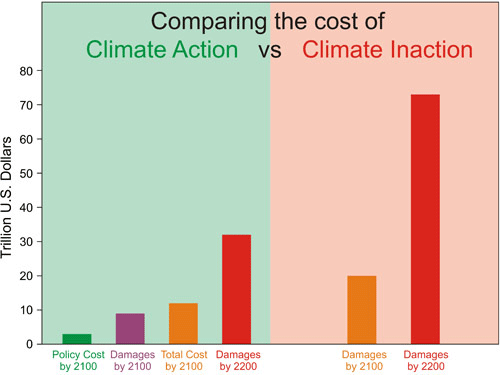
we continue forward on our current path, catastrophe is not just a possible outcome, it is the most probable outcome. And an intelligent risk management approach would involve taking steps to prevent a catastrophic scenario if it were a mere possibility, let alone the most probable outcome. This is especially true since the most important component of the solution – carbon pricing – can be implemented at a relatively low cost, and a far lower cost than trying to adapt to the climate change consequences we have discussed here (Figure 4).
Figure 4: Approximate costs of climate action (green) and inaction (red) in 2100 and 2200. Sources: German Institute for Economic Research andWatkiss et al. 2005

Climate contrarians will often mock ‘CAGW’ (catastrophic anthropogenic global warming), but the sad reality is that CAGW is looking more and more likely every day. But it’s critical that we don’t give up, that we keep doing everything we can do to reduce our emissions as much as possible in order to avoid as many catastrophic consequences as possible, for the sake of future generations and all species on Earth. The future climate will probably be much more challenging for life on Earth than today’s, but we still can and must limit the damage. http://www.skepticalscience.com/realistically-what-might-future-climate-look-like.html
1 Comment »
Leave a Reply
1 This month
17 October, Free Public Talk on Nuclear Issues in South Australia
David Noonan will speak on public interest concerns over the new Roxby Downs Indenture Act 2026 on BHP copper-uranium mining and ore processing in SA, and on how AUKUS may face SA with a High-Level nuclear waste agenda.
Dr Jim Green will discuss international developments in the field of nuclear power including ‘small modular reactors’ and Generation 4 ‘advanced’ nuclear reactor concepts.


Help Aunty Sue Protect Her Land and Sacred Sites From Destructive Rocket Testing.
.

Australians deserve the truth
about
AUKUS – https://aukuspublicinquiry.com/

PETITION – To: Prime Minister Anthony Albanese and the Australian Labor Government

of the week – Australians for War Powers Reform (AWPR)
To see nuclear-related stories in greater depth and intensity


most problem has been not CO2 emission itself, but deforestation & water pollution. So Biosphere gets reducing capabilities to regenerate O2 + all that have made ideal base to form severe patterns of Weather (droughts, floods, hurricanes & so on). + needless to mention, Comrades, awful trouble is arising… i say about O2 depletion around the Globe.
LikeLike