Don’t miss this excellent radio interview on the future of nuclear power

 Nuclear Energy Raises More Questions http://blogs.abc.net.au/nsw/2012/10/nuclear-energy-raises-more-questions.html ABC Radio 702 Sydney. Tim Holt interviews Derek Abbott, Professor of Electrical Engineering at the University of Adelaide, raises some very interesting practical considerations that will affect the future of this alternative source. 17/10/2012

PROF ABBOTT – Very hard to say how much nuclear industry is going ahead. Nuclear power – Some countries going ahead some countries pulling back. Not all so rosy in India.They are planning 60 nuclear stations. But In Tamil district 10,000 villagers demonstrating against local nuclear reactor, going on hunger strikes. Indian forces had to put out 4,000 security forces to control this problem. Needed large security force there.
My view is no. Nuclear power at the most could achieve only a very small slice of global energy pie. Can’t even supply half of the world’s needs.
Uranium gradually runs out – ore becomes more crude, harder to find uranium, and mining costs more. That’s one problem
Other problem actual metal you make the nuclear power stations out of / Nuclear power station isn’t just concrete and steel. Metals in nuclear power station – lots of exotic rare metals.Excessive energy given out, Prone to cracking, these exotic metals needed to prevent cracking are quite rare. Growth rate in consumption of these rare metals is huge , because used also in many modern technologies. Faster growth rate in consumption of these metals than the growth rate in oil. Likely to run out, even without nuclear. When would these metals run out? Add nuclear to the equation put on line hundreds of new nuclear stations.- eat into these rare metals and depleting them at a faster rate.
Problem with nuclear power – everything becomes non recyclable. What do you do with the nuclear station – you bury it for 10,000 years. Those metals become radioactive and you can’t re-use them. So – reducing world’s elemental diversity, supply of these rare metals.How many nuclear reactors would we need to supply all our energy needs from nuclear power? Something like 15,000 nuclear power stations to power the world presently. Completely unfeasible to scale up to some sort of nuclear utopia. We have problems with 430 reactors now.
Get any map of any country of the world – draw 100 dots on map as to where you could possibly put a new nuclear power station. Hard to put 10 nuclear power stations, let alone 100. Need to be away from populations, near water, where you won’t get lawsuits. USA would need 4000 nuclear stations – hard put to find 100 spots.
Yes, we should still research nuclear fusion. But to make that leap to a commercial fusion reactor- a big thing.But nowhere near commercial. Still the problems – high energy neutrons will crack the metal – same problems of rare metals – metals recycling problems again.
Renewables so relatively cheap and easy to lay on. Can build a modular solar farm using curved mirrors that focus sunlight . Mirror 10 metres in diameter – get 300-400 degrees Centigrade Can super heat water and run a steam turbine.- can set up in desert place relatively easily.
Sadly Australia has not taken bull by the horns. There are solar thermal projects in Australia. ANU in Canberra have had solar project for along time. Australia needs to take up solar. So much desert – the ideal country for solar.
Theoretically, If you powered an area size of Canberra with solar mirrors. – enough to power the whole of Australia.
Sun is a nuclear fusion reactor – it’s the obvious one to turn to.
Going back to your question about why Australia has not embraced solar power – Economics the reason and what we can afford to do. – we have a relatively small population. We are getting wakeup calls now with the changing climate. The rime is ripe now for Australia to change this

Grim future for Australia’s uranium industry, falling demand, falling prices
 Adding to the miners’ woes, uranium prices continue to fall, from US$73 a pound in March 2011, to around US$43 currently. That’s lower than the cash cost of production at Paladin’s Kayelekera mine in Malawi, giving the miner a decent sized headache.
Nuclear Fallout Hurts Uranium Miners , 9 News, by Mike King, The Motley Fool, October 19, 2012 The world continues to feel the impact of the Fukushima nuclear disaster. The disaster in Japan in 2011 has left 48 of Japan’s nuclear reactors sitting idle, awaiting government approval to resume operations, with just 2 restarted. In mid-September, the Japanese government approved a new energy plan which included reducing the nation’s reliance on nuclear energy substantially.
Following the Fukushima accident, Germany immediately shut 8 of its reactors, and plans to close its remaining 9 reactors by 2022.
The impact is being felt by uranium miners globally.
Paladin Energy Ltd (ASX: PDN) recently stated that annual demand for uranium has fallen, as the future of nuclear energy was cast into doubt. The world’s largest uranium producer, Canada’s Cameco, has also forecast lower sales and highlighted doubts about the take-up of nuclear power in future. Continue reading
Political (and economic) suicide if UK government gives a blank cheque to the nuclear industry
 The energy consumer would be funding such a blank cheque, this would effectively mean that nuclear power costs were being nationalized and billions of pounds handed over to a multinational company in an unlimited commitment.
this time the cost comparison with other options seems painfully clear. Nuclear is more expensive than renewables – now – never mind in the future as renewable costs decline.
Will the Government Write a Blank Cheque for Nuclear  Construction? http://www.huffingtonpost.co.uk/david-toke/will-government-write-a-blank-cheque-for-nuclear-construction_b_1979027.html?just_reloaded=1 18/10/2012 David Toke Senior Lecturer of Energy Policy at the University of Birmingham The government’s plans for new nuclear power stations are on the rocks, and it would require desperate measures to save them.
Some evidence of the desperation emerged when John Hayes, the recently appointed minister for energy said, in an interview with the Daily Telegraph, that he is ‘mulling over’ the possibility of underwriting plans for building new nuclear power stations. He appeared to be referring to the last remaining ‘live’ proposal by EDF’s for a 3.2 GW nuclear power plant at Hinkley C in Somerset.
Mr Hayes would be well advised not to sip from the poisoned chalice (underwriting) he has been presented by nuclear supporters via the Daily Telegraph. Underwriting means telling EDF, in effect, that the government would foot whatever bill it took to build the power plant. Nobody knows for sure how much that would be given than similar plants still being
built in Finland and France are now terribly over budget and a long time behind schedule. Underwriting would blast a hole through specific Conservative pre-election commitments not to underwrite nuclear power construction, not to mention Ed Davey’s pronouncements about there being ‘no blank cheque’ for nuclear.
Underwriting would make a complete nonsense of any notion of nuclear power being competitive with renewable energy sources such as wind power and solar power which certainly are not in receipt of ‘underwriting’ commitments. Continue reading
Ducking and weaving about India’s nuclear safety – Australian Safeguards and Non-Proliferation Office (ASNO)
Senator LUDLAM: …. Are you aware of the recent report by their Auditor-General that absolutely slams the industry?
Mr Shannon: Yes.
Senator LUDLAM: ……. if you are not convinced-as the Indian Auditor-General certainly isn’t-that those plants are being run to anything like world’s best practice, a sales agreement would not occur?
Ms Bird: These are all issues which will be worked through during the negotiating practice process.
 http://scott-ludlam.greensmps.org.au/content/estimates/australian-safeguards-and-non-proliferation-office-asno Australian Safeguards and Non-Proliferation Office (ASNO) 18 Oct 2012 | Scott Ludlam Supplementary Senate Estimates – Foreign Affairs Defence and Trade Committee – 18 October 2012 “Dr Kalish is the acting DG of ASNO……
Senator LUDLAM: … Can you tell us officially, from the point of view of ASNO, what the status is of the bilateral safeguards agreement with India?….
Dr Kalish: Negotiation has not commenced on that treaty.
Senator LUDLAM: Well, it has been announced to the entire planet that there will be an agreement. So ASNO has not yet begun work on any such agreement?
Dr Kalish: I believe what was announced was that negotiations would commence on an agreement.
Senator LUDLAM: Can you just sketch for us the process by which those negotiations will be conducted?
Mr Shannon:….. The agreement has been reached to start the negotiations, which was last night, our time. Advice is being
assembled for ministers to consider the mandate. …. We think it will take some time, maybe a year or two. We do not have a feel for it yet
Senator LUDLAM: It sounds like a big announcement has been made but actually there is nothing at all in terms of how these negotiations will progress or, from an Australian side, who the lead organisation will be, who our negotiators will be.
Mr Shannon: No. Those things have not yet been finally decided…… Continue reading
How safe would we all be with Mitt Romney on the nuclear trigger?
 Half a century later, it still is and, even in the academic colloquy over the Missile Crisis, doubts arise about the fitness of Mitt Romney to follow in JFK’s footsteps.
As Mitt Romney blusters about confrontations with China, Iran and other adversaries, his sound-bite posturing may be effective in debates, campaign ads and comic relief, but how safe would we be if he moved into the Oval Office?
Romney on the Nuclear Trigger: How Safe? http://themoderatevoice.com/164729/romney-on-the-nuclear-trigger-how-safe/ Oct 19, 2012 by ROBERT STEIN At Harvard today scholars commemorate the 50th anniversary of the Cuban Missile Crisis, 13 days when the world held its breath in the shadow of a nuclear war that John F. Kennedy said could have led to “ultimate destruction of the human race.”
In interviews afterward, the President told me, “Too many people want to blow up the world…In Cuba, a lot of people thought we should take more drastic action. I think we did the right thing. More drastic action would have increased the possibility of nuclear exchange. The real question now is to meet conflicts year after year without having to escalate.” Continue reading
Fukushima nuclear reactors critically dangerous, and so are other reactors of the same type
 The Worst Yet to Come? Why Nuclear Experts Are Calling Fukushima a Ticking Time-Bomb, 07 May 2012 14:20 By Brad Jacobson, AlterNet Experts say acknowledging the threat would call into question the safety of dozens of identically designed nuclear power plants in the U.S.
More than a year after the triple meltdown at the Fukushima Daiichi power plant, the Japanese government, Tokyo Electric Power Company (Tepco) and the U.S. Nuclear Regulatory Commission (NRC) present similar assurances of the site’s current state: challenges remain but everything is under control. The worst is over.
But nuclear waste experts say the Japanese are literally playing with fire in the way nuclear spent fuel continues to be stored onsite, especially in reactor 4, which contains the most irradiated fuel — 10 times the deadly cesium-137 released during the 1986 Chernobyl nuclear accident. These experts also charge that the NRC is letting this threat fester because acknowledging it would call into question safety at dozens of identically designed nuclear power plants around the U.S., which contain exceedingly higher volumes of spent fuel in similar elevated pools outside of reinforced containment.
Reactor 4: The Most Imminent Threat…
The Threat Not Just to Japan But to the U.S. and the World…..http://truth-out.org/news/item/8972-the-worst-yet-to-come?-why-nuclear-experts-are-calling-fukushima-a-ticking-time-bomb
Australian Youth Climate Coalition working for action, and we all should
Carbon age must end or we will, Canberra Times , October 19, 2012, Bob Douglas“…….For now, the climate-change denial industry remains in the ascendancy. National consensus that climate change is the greatest moral challenge of our time rose and fell with Kevin Rudd. Neither side of federal politics now sees it as the cataclysmically important issue that it is. We are much more concerned with Peter Slipper’s texts and Alan Jones’s outbursts.
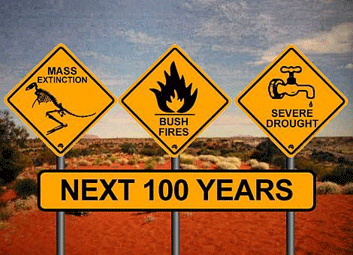
It would seem that until there is visible electoral expression of concern about these issues, government policy commitments will remain timid and largely ignored by media that are preoccupied with trivia.
 The good news is that many Australians are now acting and that the 50,000 strong Australian Youth Climate Coalition is working strategically with politicians on a number of fronts to awaken the dreamers to the reality that the threat is here and now.
The Manning Clark conference heard from former Liberal leader John Hewson, who is leading an international ratings agency that is monitoring the extent to which trillions of dollars of investment and superannuation funds are being used to prop up fossil fuels rather than promote renewable technologies. This is a brilliant strategy to force investors to a reality check on how their funds are being used.
A decisive rejection of fossil fuels and an enthusiastic embrace of renewable energy is our best hope for a future for our grandchildren. This is a moral and not an economic issue http://www.canberratimes.com.au/opinion/carbon-age-must-end-or-we-will-20121018-27tqz.html
Nuclear and coal power enthusiasts confounded – we’re using LESS energy, and fast
Energy producers caught off guard by demand slump, SMH October 19, 2012 Peter Hannam Electricity prices and the power sector have probably never been more in the news. And no wonder.
Households have been slugged by a 50 per cent surge in power prices over the past five years. The arrival of the carbon price in the last few months has intensified the debate and added to the bill shock.
A swarm of government reports – an Energy White Paper, the review of the 20 per cent renewable energy target, and the Senate inquiry into electricity prices – will land in coming weeks, flaring arguments over who is to blame. Analysts will bicker over whether recommended reforms curb or exacerbate industry excesses.
Complicating the debate is a development that has caught the industry completely off guard – the amount of electricity the country uses stopped growing in 2009 and is now shrinking. And the industry and regulators seem very much in the dark about what’s going on… “It’s quite extraordinary what’s happened” to demand, said Professor Mike Sandiford, director of the Melbourne Energy Institute. “The process isaccelerating.”….
: http://www.smh.com.au/environment/climate-change/energy-producers-caught-off-guard-by-demand-slump-20121019-27utv.html#ixzz29t5NWc3e.
Australia’s uniquely beautiful cuttlefish in need of protection
 Christina’s note: The cancelling of BHP’s plan for a mega uranium mine at Olympic Dam has had one bit of very good “fallouT – in that they now probabaly won’t want the desalination plant at Spencer Gulf. That would have alomost certainly resulted in the extinction of this unique and beautiful animal, which depends on the delicate balance of salt and fresh water for its breeding area
More protection urged for cuttlefish http://www.abc.net.au/news/2012-10-19/more-protection-urged-for-cuttlefish/4323270 Oct 19, 2012 Greens MP Mark Parnell is urging an immediate listing of the giant
Australian cuttlefish as a protected species. Some Whyalla locals say cuttlefish numbers in upper Spencer Gulf fell
from an annual aggregation of about 200,000 to about 6,000 for the most recent breeding season. Research is yet to pinpoint a cause.
Mr Parnell said even if over-fishing was not the cause, there would be no harm in giving the cuttlefish more protection.
“There are some simple actions they can take – protect these fish under state law, seek their protection under federal law and put in place an emergency recovery plan that involves all the best science, and not just throw your hands up in despair and say ‘Well they’re disappearing and there’s nothing we can do about it’,” he said.
1 This month

of the week – Australians for War Powers Reform (AWPR)
To see nuclear-related stories in greater depth and intensity
 Antinuclear