Aboriginal community leaders refute Marcia Langton’s claim that minng is the solution to Aboriginal progress
As Aboriginal community based leaders we take issue with Professor Langton’s suggestion that
embracing mining is a positive option for Aboriginal people if they are to engage with the modern
economy. In her lectures Professor Langton paints a rosy picture of the services and employment
which some mining companies offer Aboriginal people as part of Native Title ‘agreements’. There
is only passing reference to the fact that Native Title does not allow Aboriginal people to say no
to mining.
Mining is inherently short term but the problems it brings to country last well beyond the life of
any mine.
 Peter Watts (Arabana)
Mitch (Aranda/Luritja)
Kado Muir (Wongutha) 4 Feb 13, We write as co-chairs of the Australian Nuclear Free Alliance (ANFA) in response to recent
comments by Professor Marcia Langton in her Boyer Lecture series “Indigenous People and the
Resources Boom”. ANFA brings together Aboriginal people, environment, health groups and trade
union representatives to discuss the impacts of the nuclear industry on land and communities.
ANFA opposes uranium mining, exploration and the dumping of radioactive waste on Aboriginal
land.
Uranium mining, exploration and the dumping of radioactive waste on Aboriginal land is
detrimental to the health of Aboriginal people, Aboriginal lands and our collective environments.
Mining generally is an extractive industry that by its very nature destroys land often at the
expense of spiritual and cultural connections of Aboriginal people. Income generated from mining
comes at a cost and often ignores the possibility of creating alternative sustainable economic
opportunities that need not rely on extraction as its primary economic base. Continue reading
Australia’s Labor Party lurches to the Right- example Paul Howes attack on The Greens
 I always thought that Paul Howes had his own political career firmly in mind. Now, as the Greens sever their support from
 Labor, Howes sees an opportunity to move up in the Party, as it wobbles its way further to the Right.
Howes has previously compared The Greens to the Democratic Labor Party (DLP) which brought about a traumatic split within Labor.
Howes does not seem to grasp the fact that The Greens have a very clear agenda for a sustainable economy, providing both jobs and the very basis of the economy, a clean environment. Today, Howes criticises the fact that the Greens support polices towards those aims, whether those polices are Labor’s or Liberals. They have no obligation to mindlessly support Labor, as Howes seems to think.
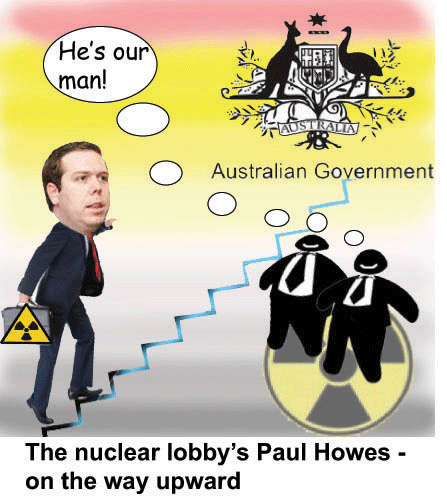 In an interview with Tony Jones, on ABC Lateline ( http://www.abc.net.au/news/2013-02-20/howes-calls-for-greens-destruction/4530952?section=qld) Howes calls for Greens’ destruction,
In a fairly vitriolic attack on Greens leader, Christine Milne, Howes praises the Mineral Resources Rent Tax, but fails completely to refute Christine Milnes very clear exposition of the reasons why this tax is a failure.
“…..TONY JONES: Now in July of last year when the Labor/Green alliance was still very much alive you described the Greens as “extremists who threaten Australia’s democracy” and that the Labor Party, you said, “should concentrate its efforts on destroying them”. Will that now happen?
PAUL HOWES: Absolutely…….
TONY JONES:……this is what Bob Brown says, “the increasingly powerful Howesian Labor cause has a simple political recipe to prefer the Liberals over the Greens”. What do you say to that?
PAUL HOWES: Howesian! I’d rather be a Howesian than an Earthian…..
..the Greens are no different than the Liberals insomuch as they are a political party that stands for values that are fundamentally different to the values of the Labor Party…”
Nuclear lobby very coy about figures showing the decline of nuclear energy to 2013
For the longer term picture on the decline of nuclear I still recommend theirWorld Nuclear Industry Status Report 2012.
Nuclear Lobby Doesn’t Tell How Much Nuclear Generated Last Year http://k.lenz.name/LB/?p=8858 Feb 19 2013 by Karl-Friedrich Lenz under Nuclear energy
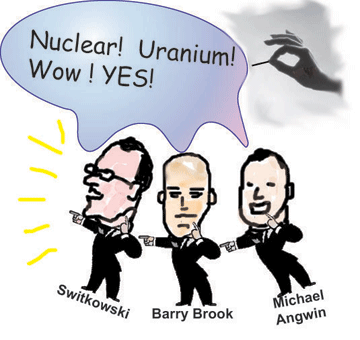 The good news for Australian Fossil Nukes like the one I discussed yesterday is that nuclear didn’t decline at all in Australia last year.
That is of course caused by the fact that it is completely illegal there in the first place, and there is no way to further decline from zero.
I recall that Barry Brook, the most prominent Australian Fossil Nuke, expects that small amounts of low carbon nuclear energy may be expected there as early as 2030. As mentioned earlier, until such time he and his friends will try to stand in the way of renewable energy, making climate change worse in the process, if anybody listens to them.
While it is easy to find out how much nuclear declined in Australia, it is surprisingly difficult to find out what happened world wide. Continue reading
Now is the time to firmly reject nuclear power: 10 reasons why
 Ten Urgent Reasons to Reject Nuclear Power Now http://www.truth-out.org/opinion/item/14461-ten-urgent-reasons-to-reject-nuclear-power-now 17 February 2013 By Jim McCluskey, Truthout
“……..1. Nuclear Power Stations are Prohibitively Dangerous. There have now been four grave nuclear reactor accidents: Windscale in Britain in 1957 (the one that is never mentioned), Three Mile Island in the United States in 1979, Chernobyl in the Soviet Union in 1986 and now Fukushima. Each accident was unique, and each was supposed to have been impossible.
A recent book, Chernobyl: Consequences of the Catastrophe for People and the Environment, concludes that, based on records now available, some 985,000 people died between 1986 and 2004, mainly of cancer, as a result of the Chernobyl accident. Alice Slater, New York representative of the Nuclear Age Peace Foundation, comments: “The tragic news uncovered by comprehensive new research that almost one million people died in the toxic aftermath of Chernobyl should be a wake-up call to people all over the world to petition their governments to put a halt to the current industry-driven ‘nuclear renaissance.’ Aided by a corrupt IAEA (International Atomic Energy Agency), the world has been subjected to a massive coverup and deception about the true damages caused by Chernobyl.”
At Fukushima we have the worst industrial disaster ever. Three simultaneous ongoing complete meltdowns have proven impossible to stop or contain since they started almost two years ago. These meltdowns are still pouring radiation pollution across the Japanese landscape.
International experts (e.g. Charles Perrow in Normal Accidents) agree that there will continue to be disastrous failures at nuclear power stations, and that this cannot be avoided.
As Edward Teller, the great nuclear physicist, said, “If you [try to] construct something foolproof, there will always be a fool greater than the proof.”
2. Nuclear Power Stations are Prohibitively Expensive. Continue reading
Engineers Australia (IEAust) wants greater greenhouse cuts, and a big shift to renewable energy
Engineers Australia Advocates 80 Per Cent Reduction in Greenhouse Gas Emissions http://designbuildsource.com.au/engineers-australia-advocates-80-per-cent-reduction-in-greenhouse-gas-emissions By Marc Howe, 19 Feb 13, A submission by Engineers Australia (IEAust) to the Australian Renewable Energy Agency (ARENA) endorses ambitious new targets for reductions in the country’s greenhouse gas emissions by mid-century.
The new benchmarks target a reduction of 25 per cent of greenhouse gas emissions by 2020 and 80 per cent by 2050 based on 2000 levels. These declines are believed to be necessary for Australia to make a meaningful contribution to international efforts to keep emissions within 450 ppm of equivalent carbon dioxide (CO2-e), and ensure that global average temperature gains are kept within two degrees Celsius.
In addition to supporting the new set of targets, the Sustainable Engineering Society strongly advocates a stricter target of 350ppm CO2-e, due to uncertainty over whether the 450ppm target will be sufficient to limit worrying gains in global temperature levels.
The professional engineering body also supports the concomitant shift to renewable energies that such ambitious reductions in CO2 emissions will necessitate. Continue reading
Australia not actually DOING much about solar thermal, but doing Research anyway
It would be better if Australia were to get going on building solar thermal power plants, rather than stick to just research for 8 years. Sort of a delaying tactic?
Australia’s CSIRO to lead solar thermal research initiative http://www.renewableenergymagazine.com/article/australia-s-csiro-to-lead-solar-thermal-20130218 Dan McCueMonday, 18 February 2013 Australia’s CSIRO is partnering with six Australian universities and the United States’ Department of Energy’s National Renewable Energy Laboratory (NREL), Sandia National Laboratories and Arizona State University on an eight-year solar thermal research initiative, which aims to lower the cost of solar thermal power from 25 to around 10 cents a kilowatt hour. Continue reading
Wind energy now getting way ahead in China, while nuclear power prospects slow down
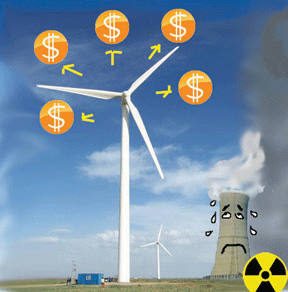 Although officials still claim that China will reach 40,000 megawatts of nuclear capacity in 2015, the current pace of construction makes this appear increasingly unlikely. China’s inexperience with Generation-III reactors also casts doubt on its prospects for achieving what the government now sees as a more reasonable 2020 goal, some 70,000 megawatts.
The outlook for wind in China is much more promising. Wind developers connected 19,000 megawatts of wind powercapacity to the grid during 2011 and 2012, and they are expected to add nearly this much in 2013 alone.
China’s overall wind energy resource is staggering. Harvard researchers estimate that China’s wind generation potential is 12 times larger than its 2010 electricity consumption.
Wind Surpasses Nuclear in China 19 Febuary 2013 Earth Policy Institute  http://www.treehugger.com/renewable-energy/wind-surpasses-nuclear-china.html
Wind has overtaken nuclear as an electricity source in China. In 2012, wind farms generated 2 percent more electricity than nuclear power plants did, a gap that will likely widen dramatically over the next few years as wind surges ahead. Since 2007, nuclear power generation has risen by 10 percent annually, compared with wind’s explosive growth of 80 percent per year.
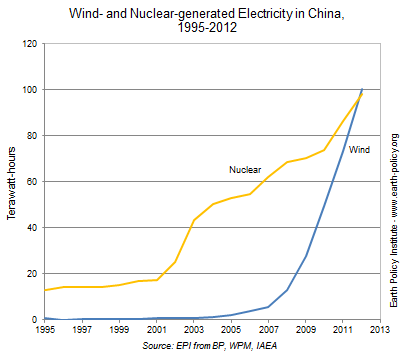
Before the March 2011 nuclear disaster in Japan, China had 10,200 megawatts of installed nuclear capacity. With 28,000 megawatts then under construction at 29 nuclear reactors—19 of which had begun construction since 2009—officials were confident China would reach 40,000 megawatts of nuclear power by 2015 and perhaps 100,000 megawatts by 2020. The government’s response to the Fukushima disaster, however, was to suspend new reactor approvals and conduct a safety review of plants in operation and under construction.
When authorities finally lifted the moratorium on approvals in October 2012, it was with the stipulation that going forward only “Generation-III” models that meet stricter safety standards would be approved. China has no experience in operating these more advanced models; several of the Generation-III reactors it has currently under construction are already facing delays due to post-Fukushima design changes or supply chain issues. Continue reading
1 This month

of the week – Australians for War Powers Reform (AWPR)
To see nuclear-related stories in greater depth and intensity
 Antinuclear